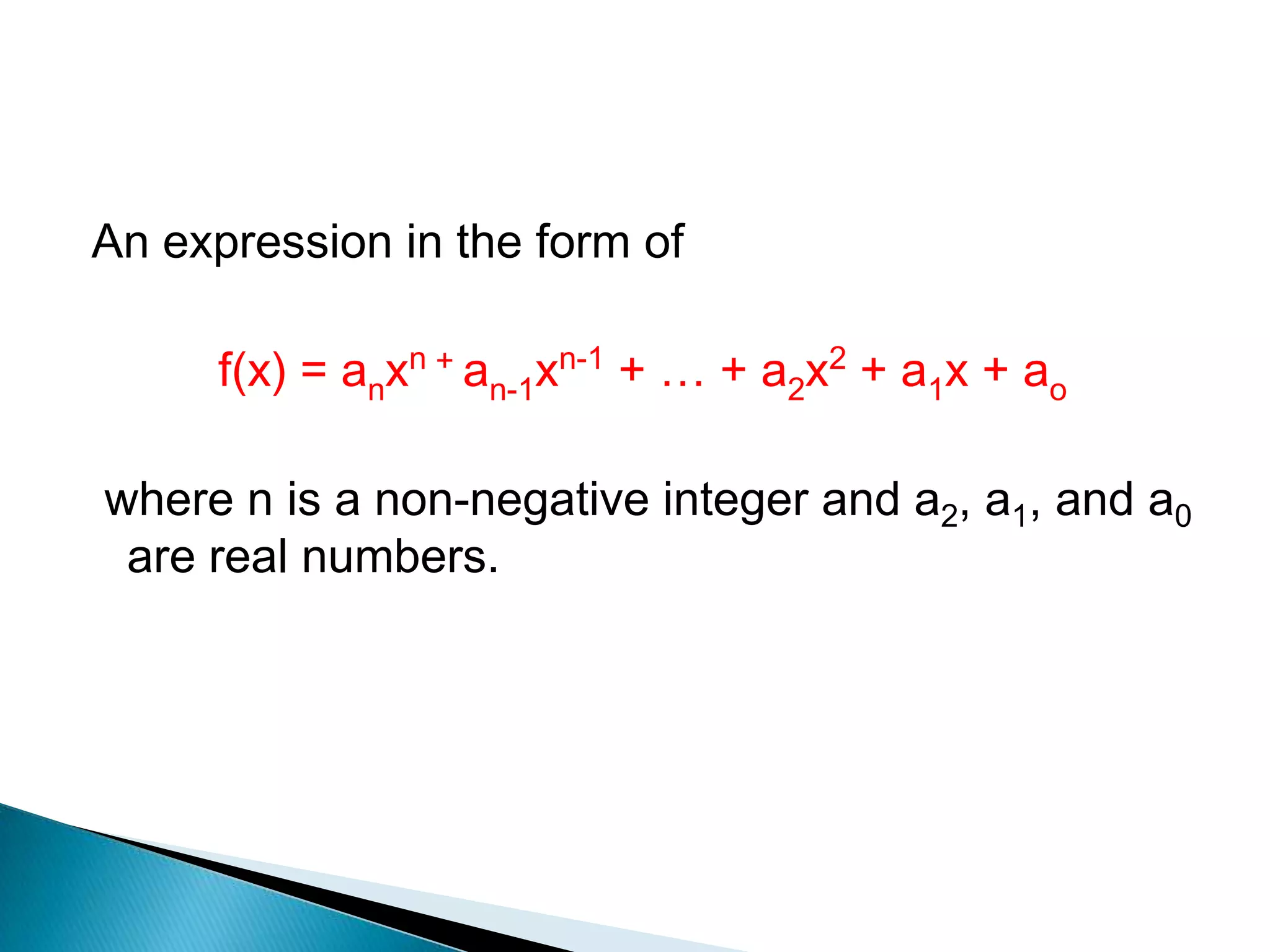
An expression in the form of

     f(x) = anxn + an-1xn-1 + … + a2x2 + a1x + ao

where n is a non-negative integer and a2, a1, and a0
 are real numbers.
 The  function is called a
  polynomial function of x with
  degree n.
 A polynomial is a monomial or a
  sum of terms that are
  monomials.
 Polynomials can NEVER have a
  negative exponent or a variable
  in the denominator!
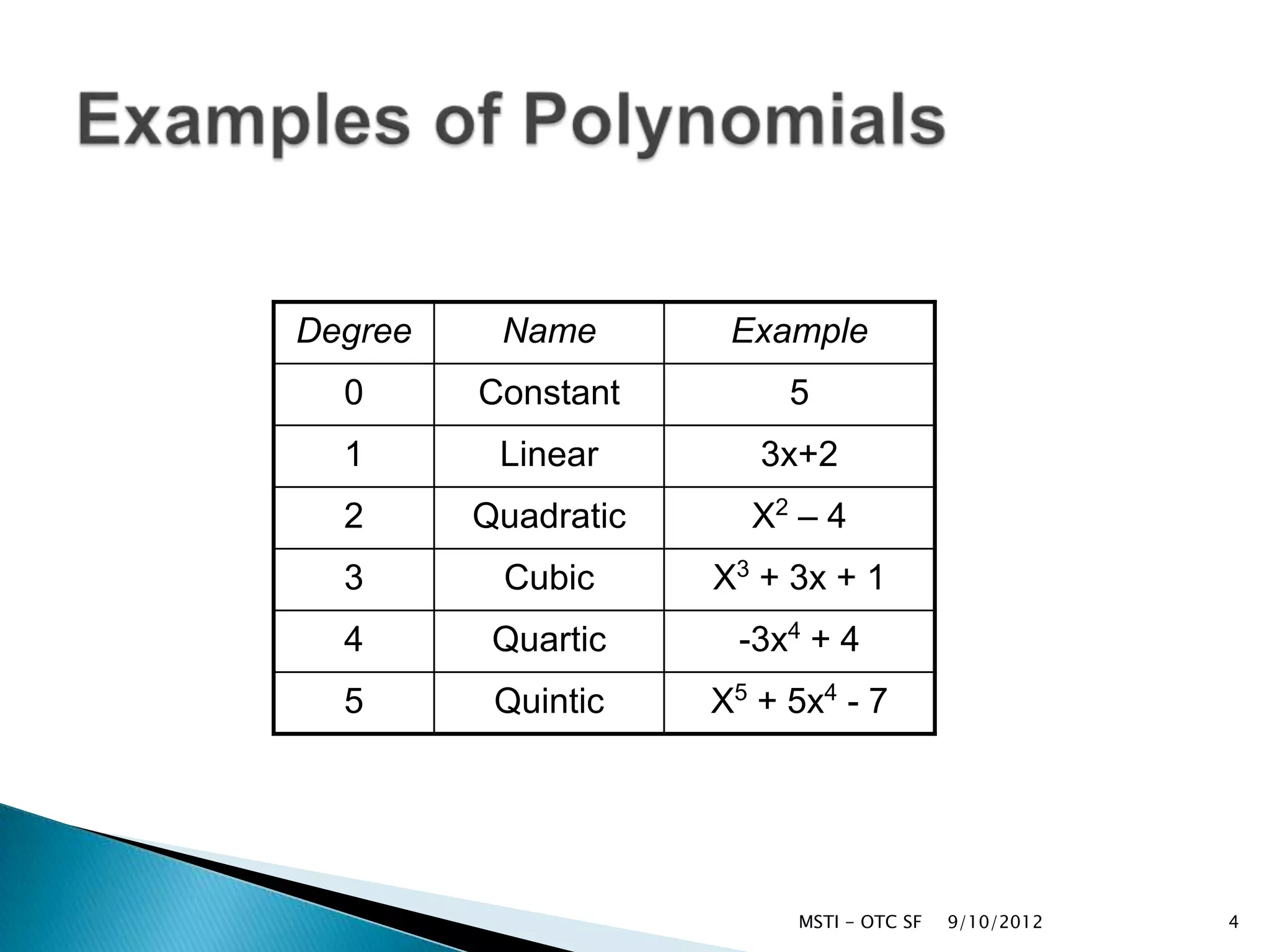
Degree    Name        Example
  0      Constant         5
  1       Linear        3x+2
  2      Quadratic     X2 – 4
  3       Cubic      X3 + 3x + 1
  4       Quartic     -3x4 + 4
  5       Quintic    X5 + 5x4 - 7


                          MSTI - OTC SF   9/10/2012   4
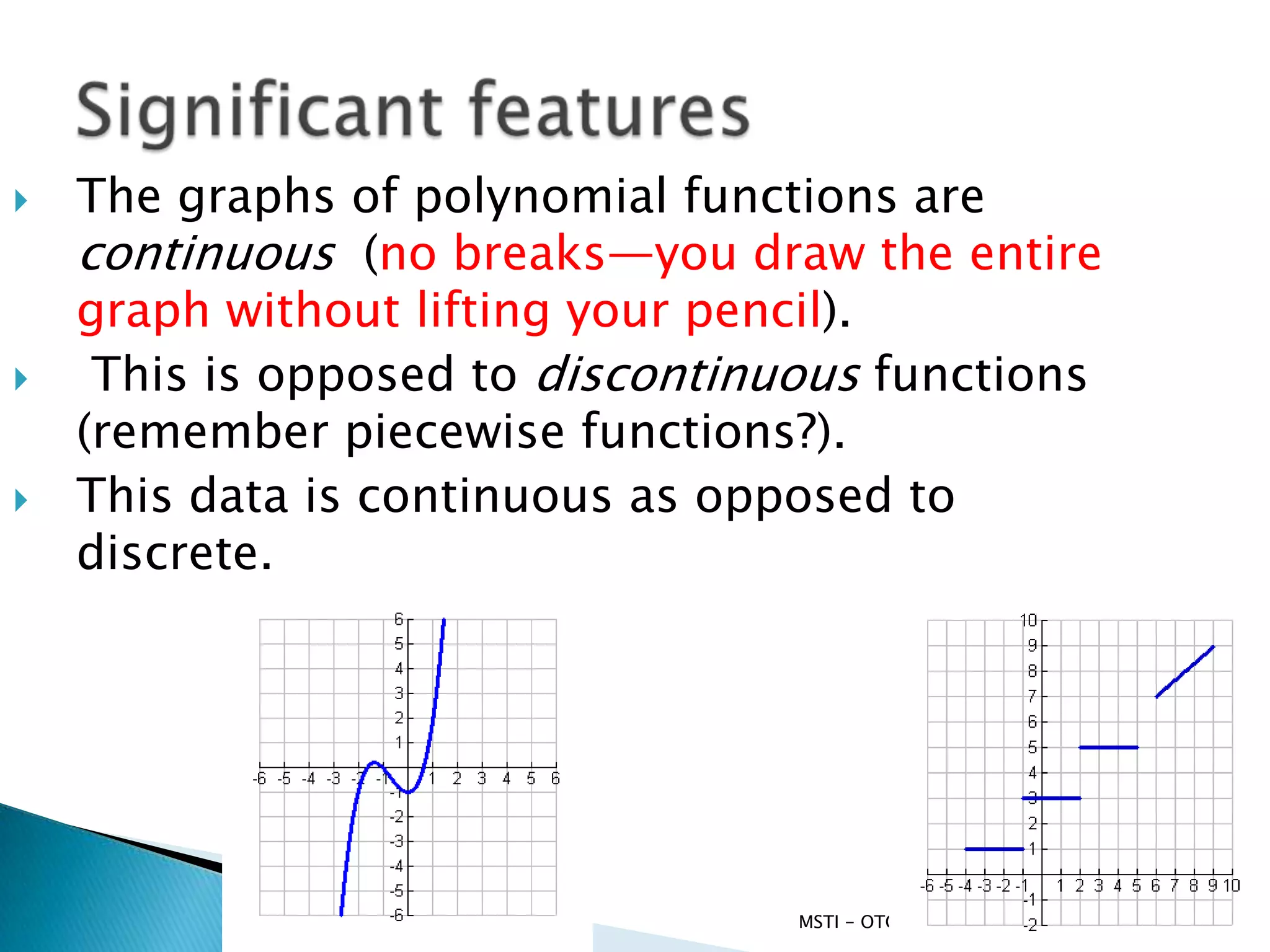
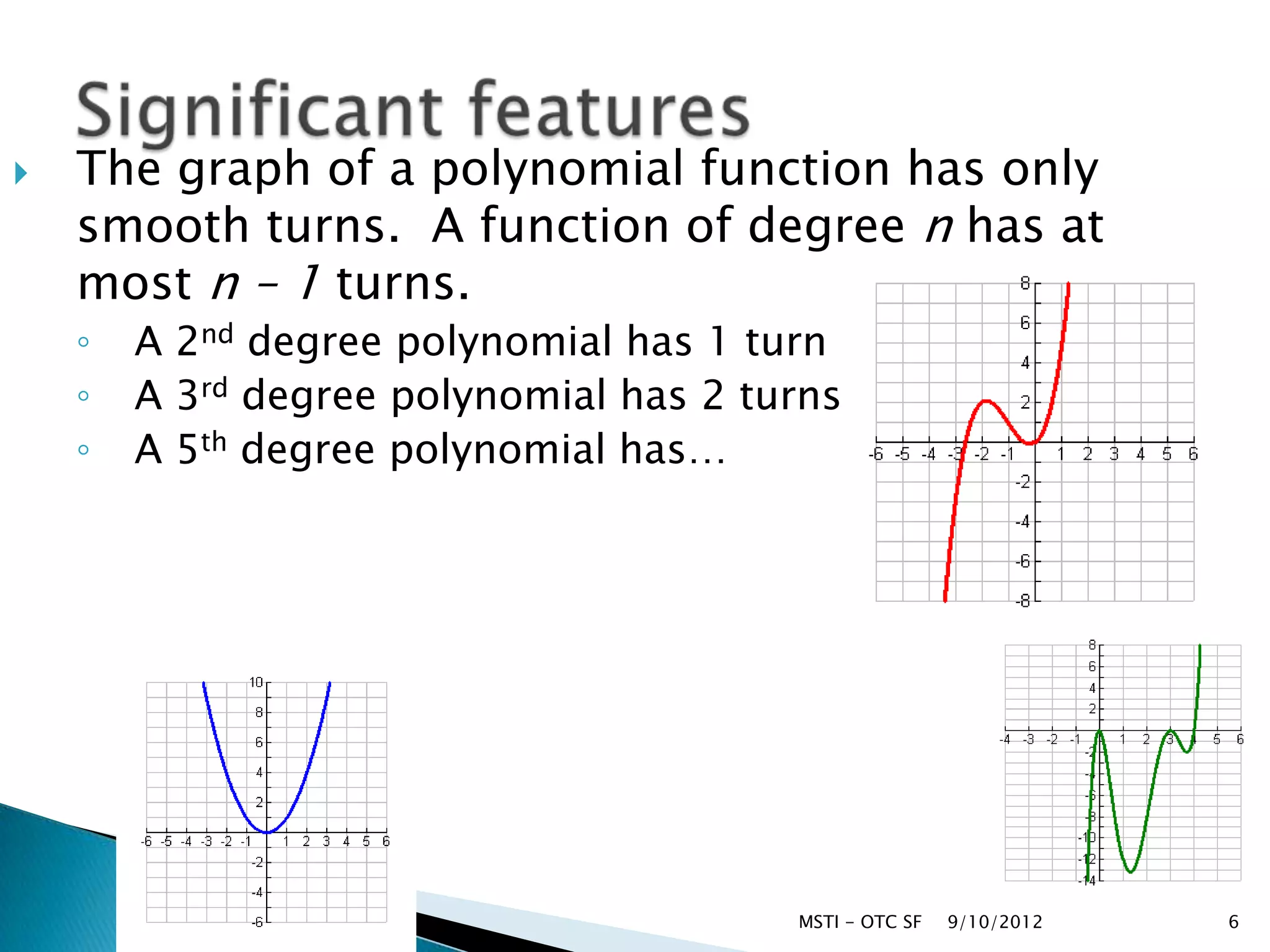
   The graphs of polynomial functions are
    continuous (no breaks—you draw the entire
    graph without lifting your pencil).
    This is opposed to discontinuous functions
    (remember piecewise functions?).
   This data is continuous as opposed to
    discrete.


                                  MSTI - OTC SF   9/10/2012   5
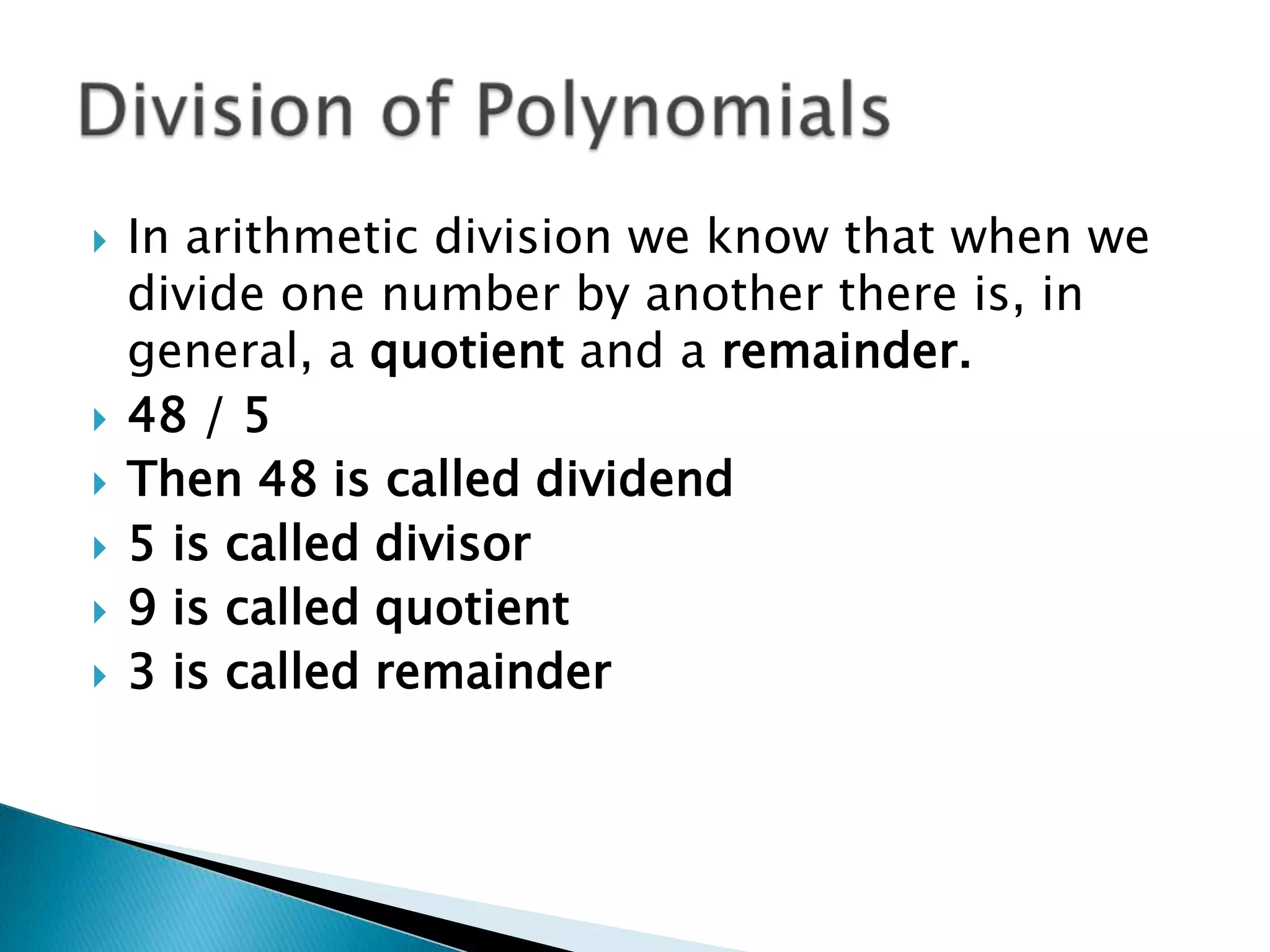
   The graph of a polynomial function has only
    smooth turns. A function of degree n has at
    most n – 1 turns.
    ◦   A 2nd degree polynomial has 1 turn
    ◦   A 3rd degree polynomial has 2 turns
    ◦   A 5th degree polynomial has…


                                        MSTI - OTC SF   9/10/2012   6
   In arithmetic division we know that when we
    divide one number by another there is, in
    general, a quotient and a remainder.
   48 / 5
   Then 48 is called dividend
   5 is called divisor
   9 is called quotient
   3 is called remainder
   In the algebra of polynomials too a
    polynomial f(x) can be divided by a
    polynomial g(x) provided that the degree of
    f(x) is greater than or equal to the degree of
    g(x). Here f(x) is the dividend and g(x) is the
    divisor. The quotient and remainder obtained
    in this division are, in general, polynomials.
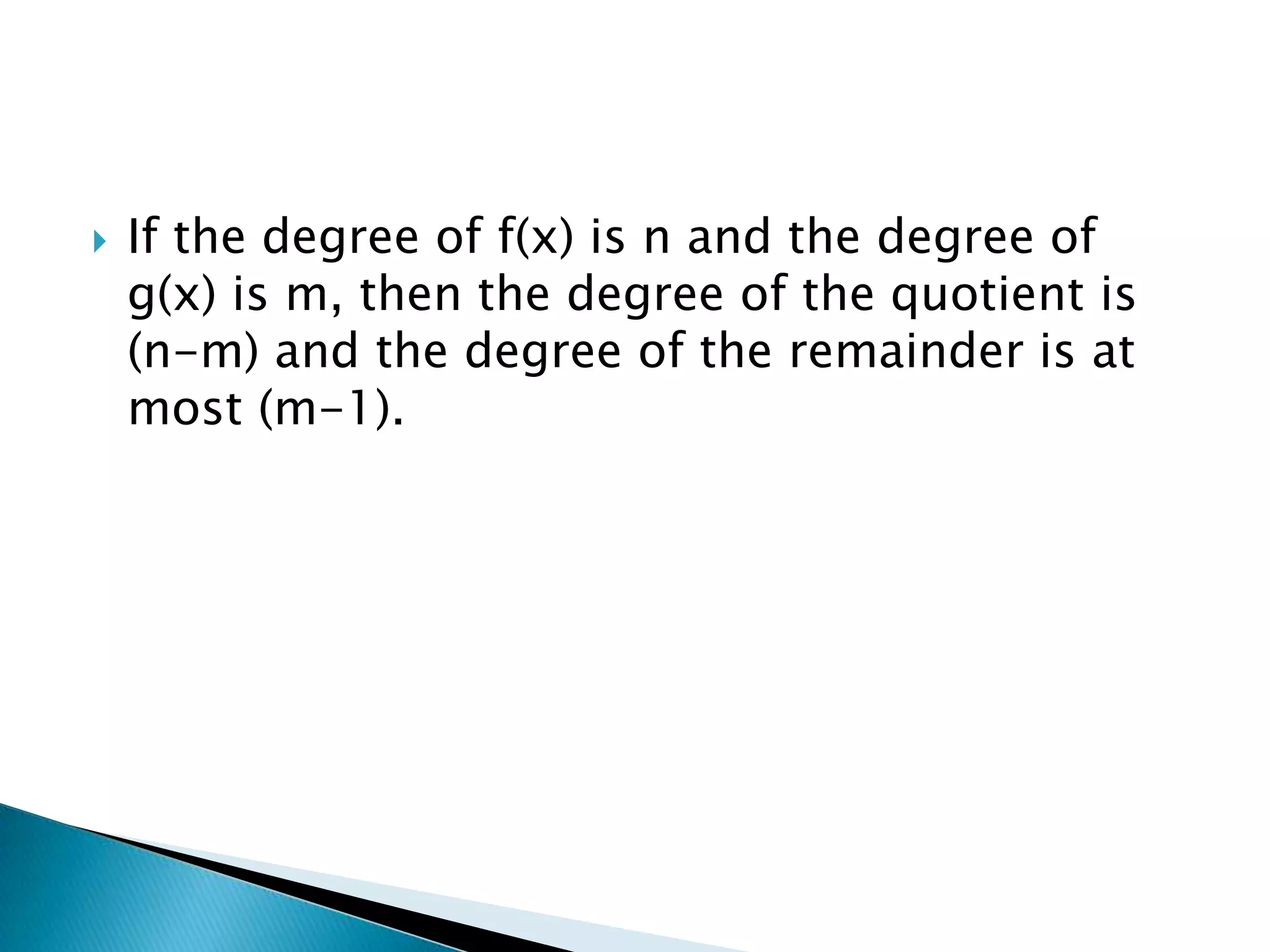
   If the degree of f(x) is n and the degree of
    g(x) is m, then the degree of the quotient is
    (n-m) and the degree of the remainder is at
    most (m-1).
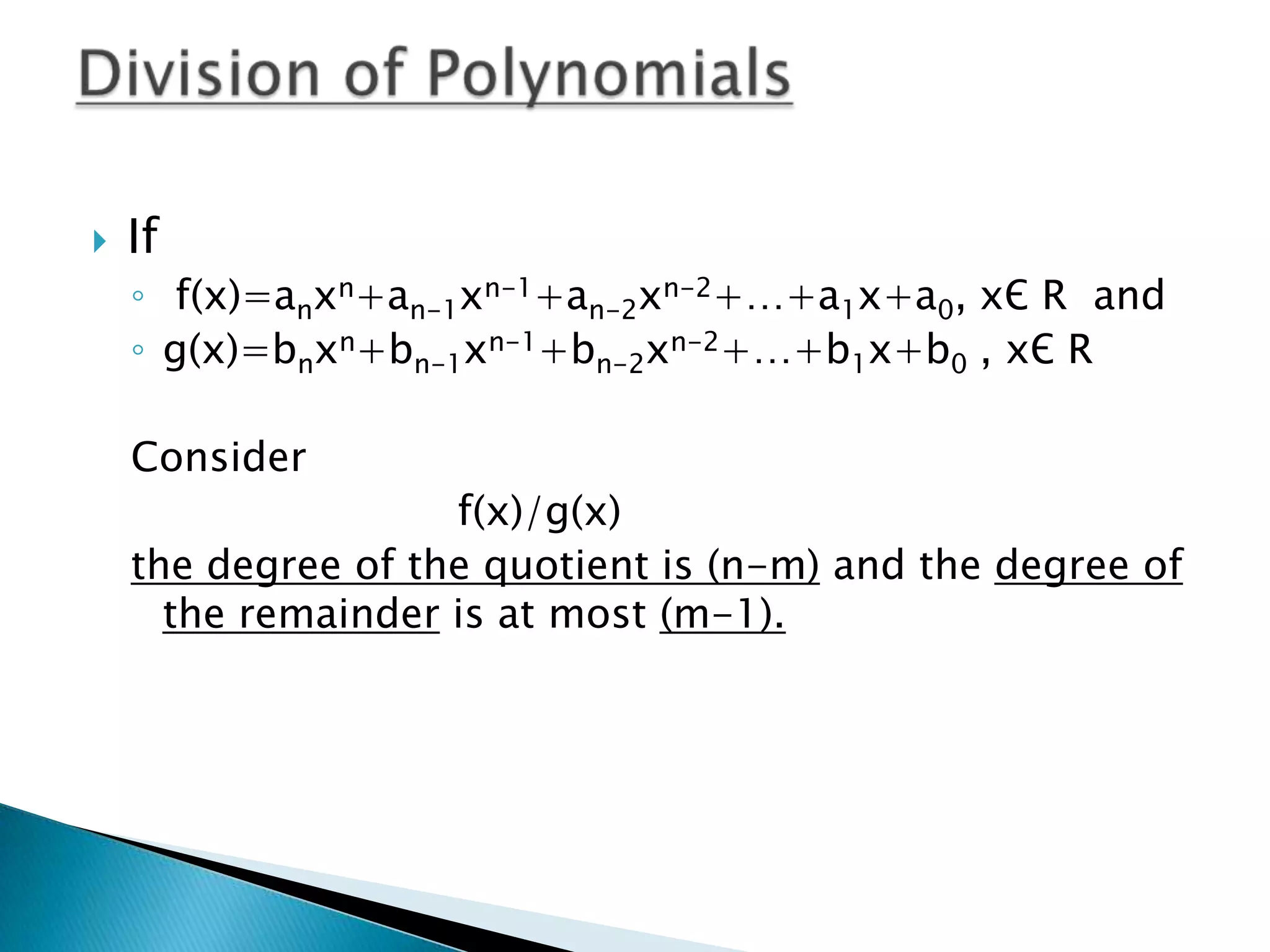
   If
    ◦ f(x)=anxn+an-1xn-1+an-2xn-2+…+a1x+a0, xЄ R and
    ◦ g(x)=bnxn+bn-1xn-1+bn-2xn-2+…+b1x+b0 , xЄ R

    Consider
                    f(x)/g(x)
    the degree of the quotient is (n-m) and the degree of
      the remainder is at most (m-1).
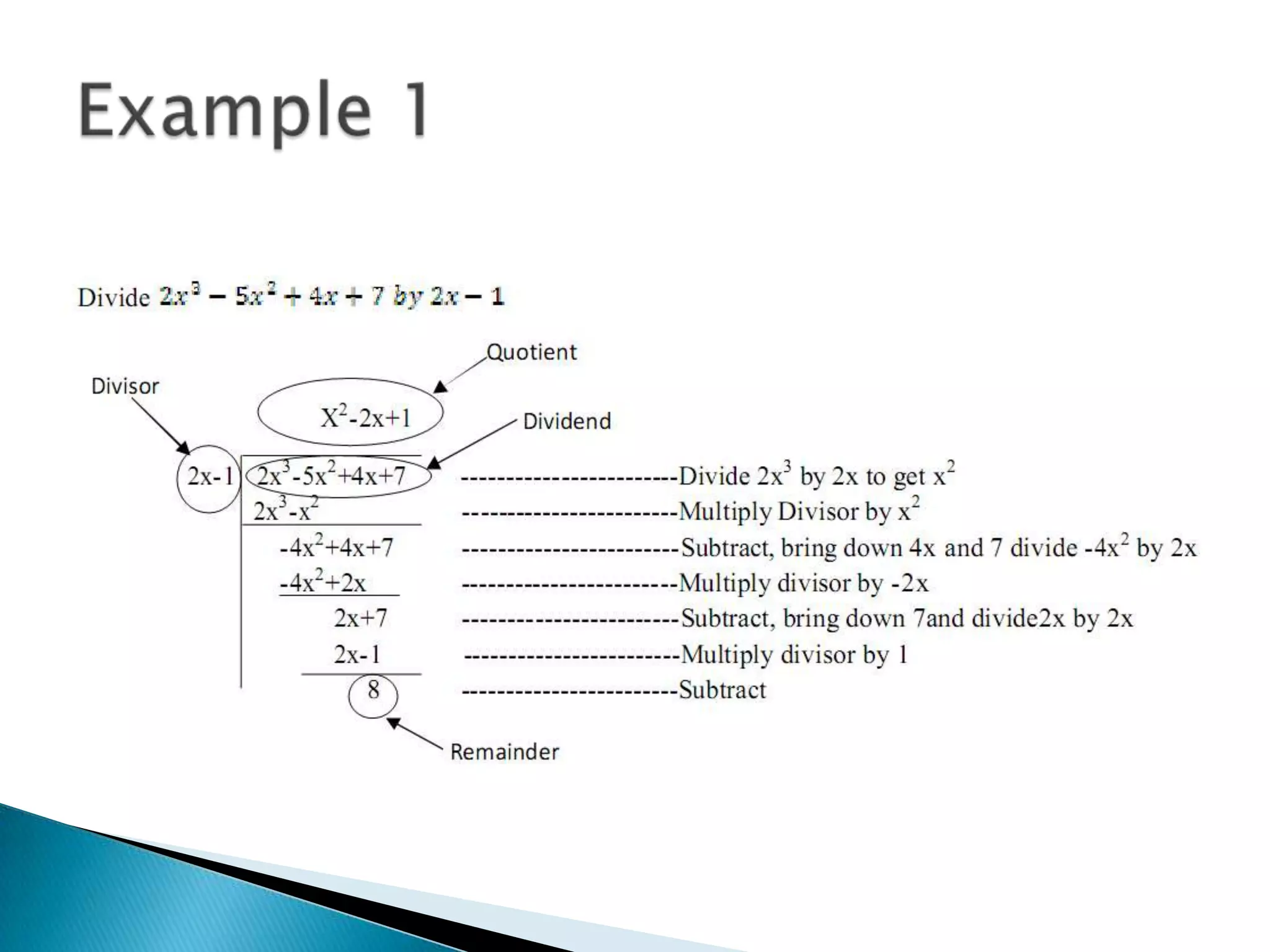
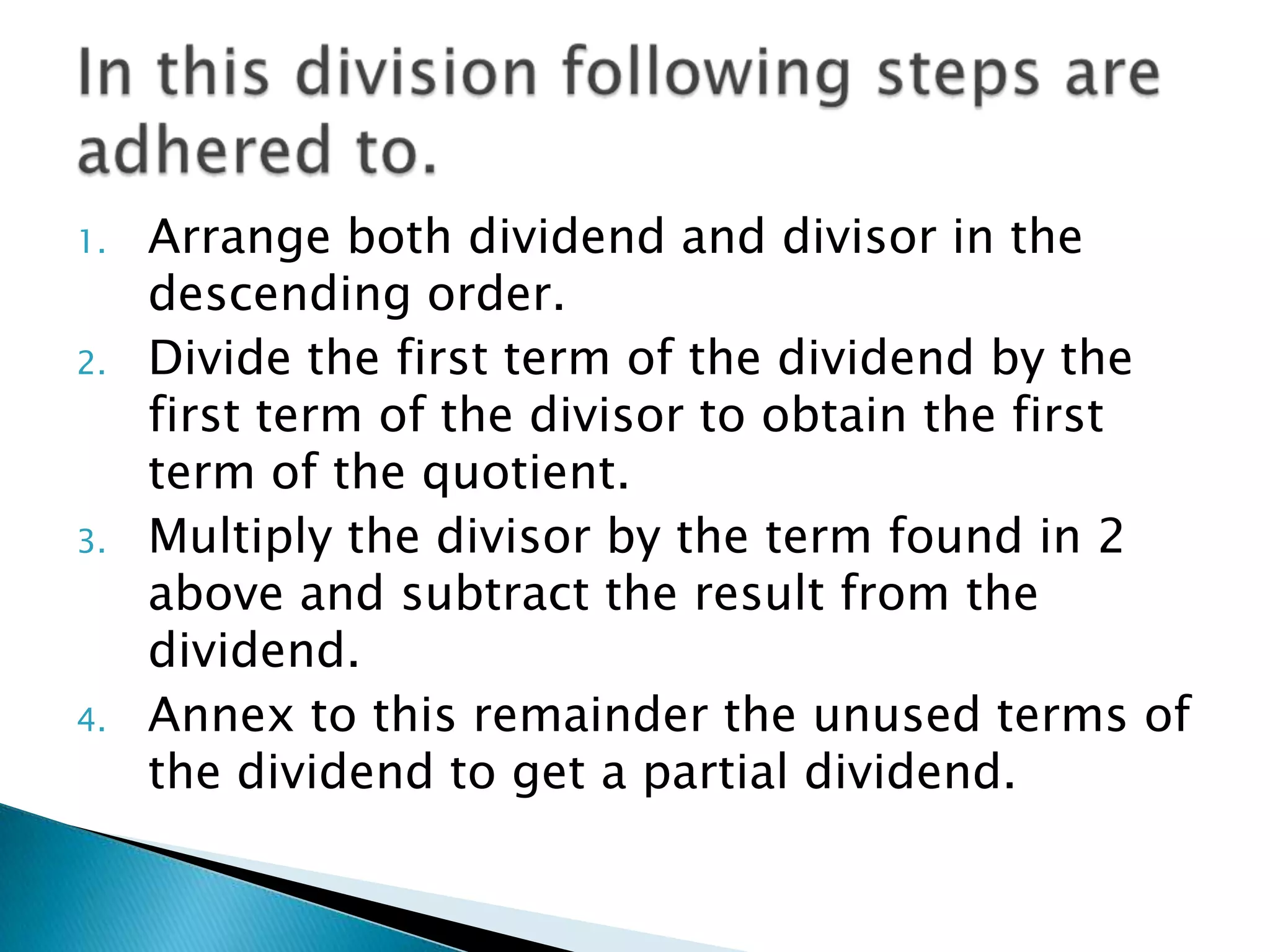
1.   Arrange both dividend and divisor in the
     descending order.
2.   Divide the first term of the dividend by the
     first term of the divisor to obtain the first
     term of the quotient.
3.   Multiply the divisor by the term found in 2
     above and subtract the result from the
     dividend.
4.   Annex to this remainder the unused terms of
     the dividend to get a partial dividend.
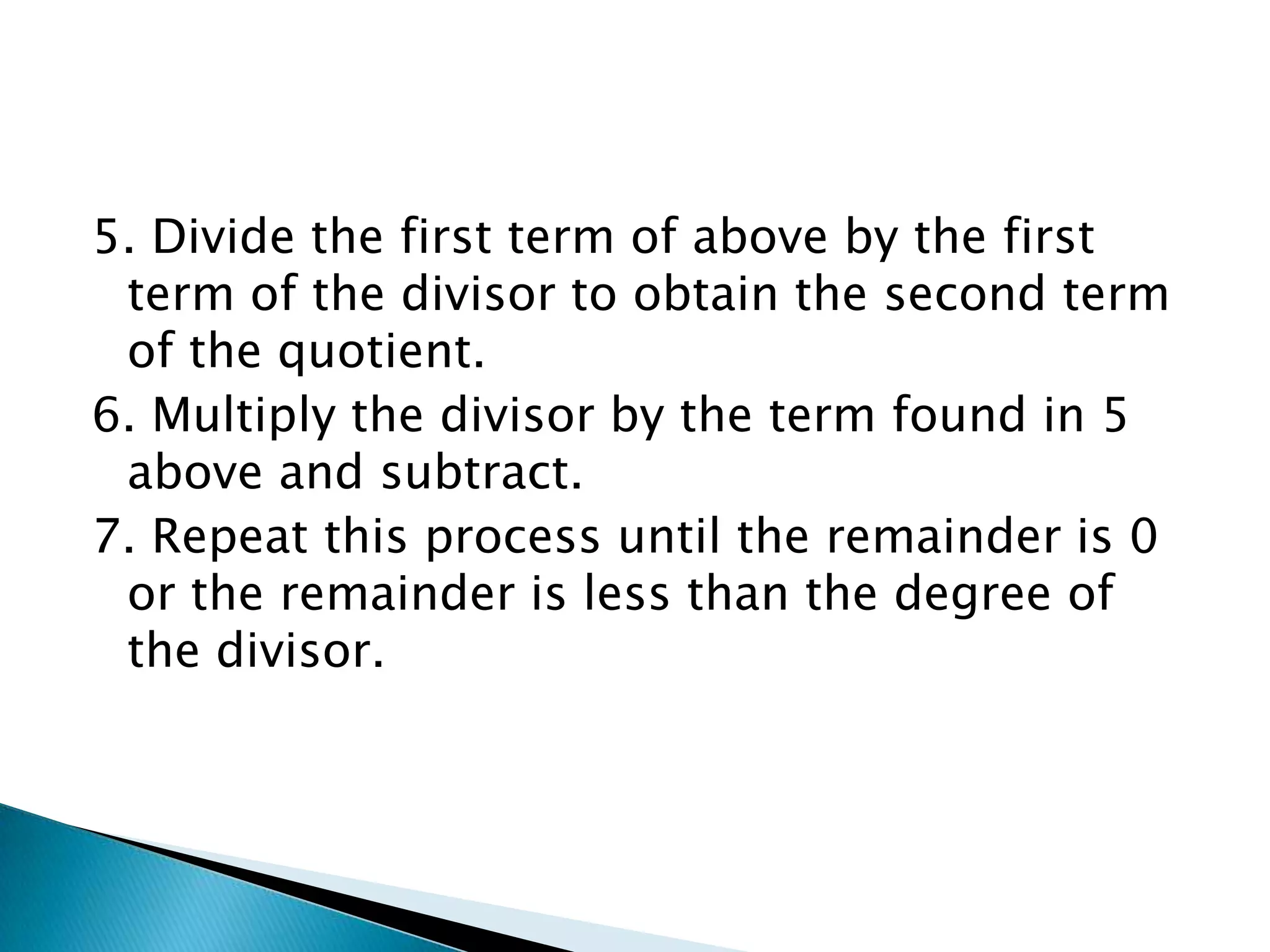
5. Divide the first term of above by the first
 term of the divisor to obtain the second term
 of the quotient.
6. Multiply the divisor by the term found in 5
 above and subtract.
7. Repeat this process until the remainder is 0
 or the remainder is less than the degree of
 the divisor.
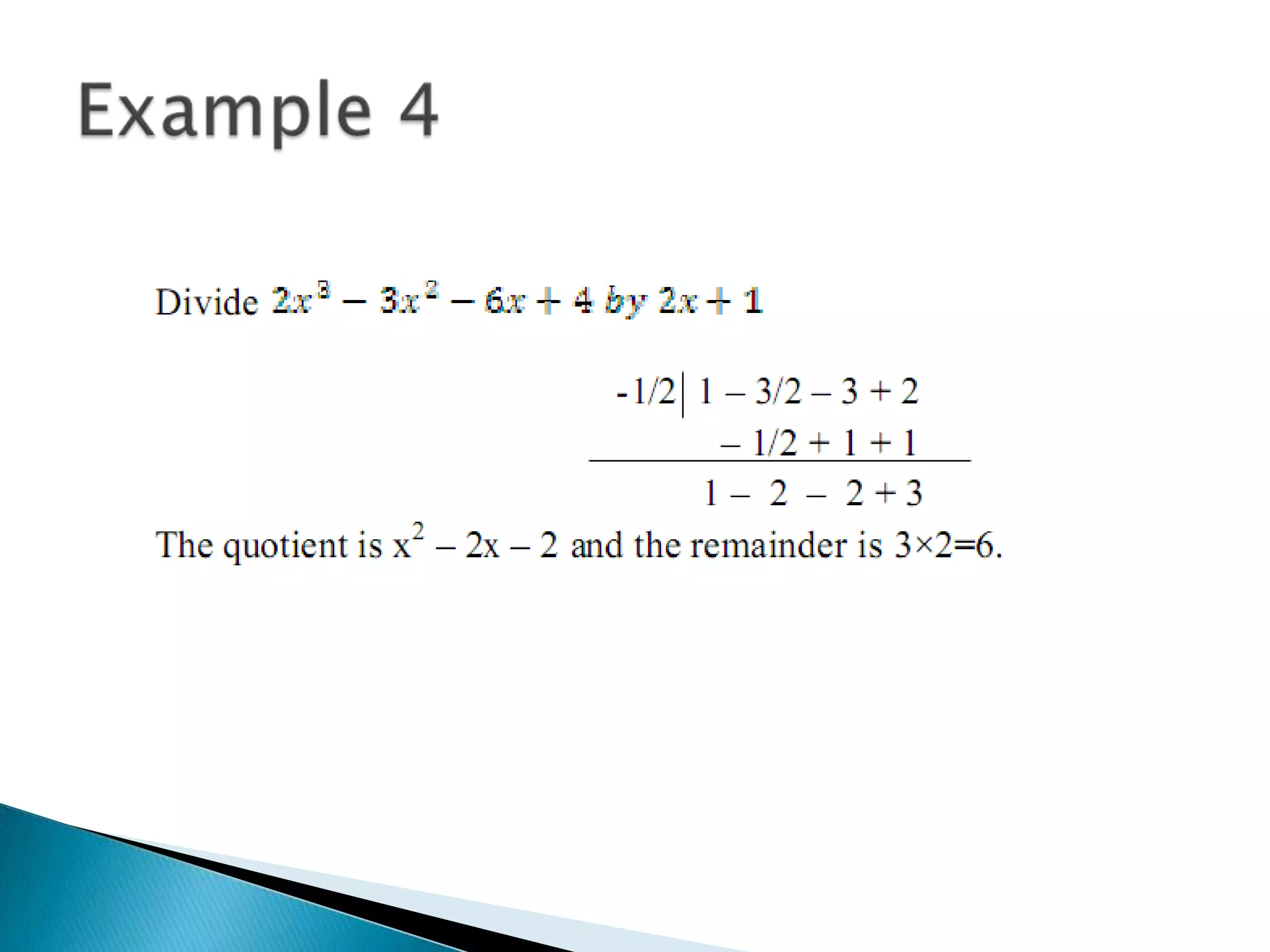
4.
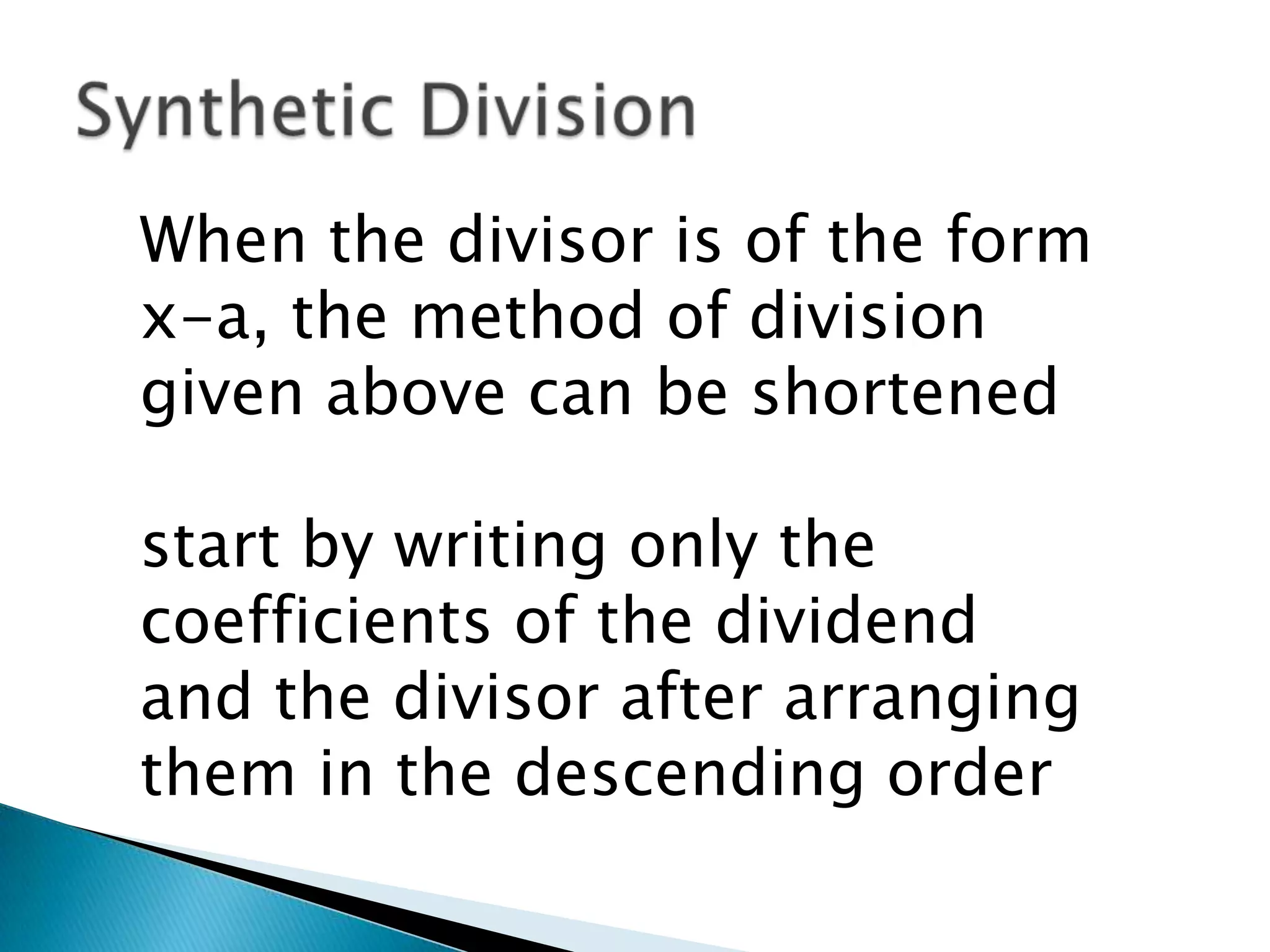
When the divisor is of the form
x-a, the method of division
given above can be shortened

start by writing only the
coefficients of the dividend
and the divisor after arranging
them in the descending order
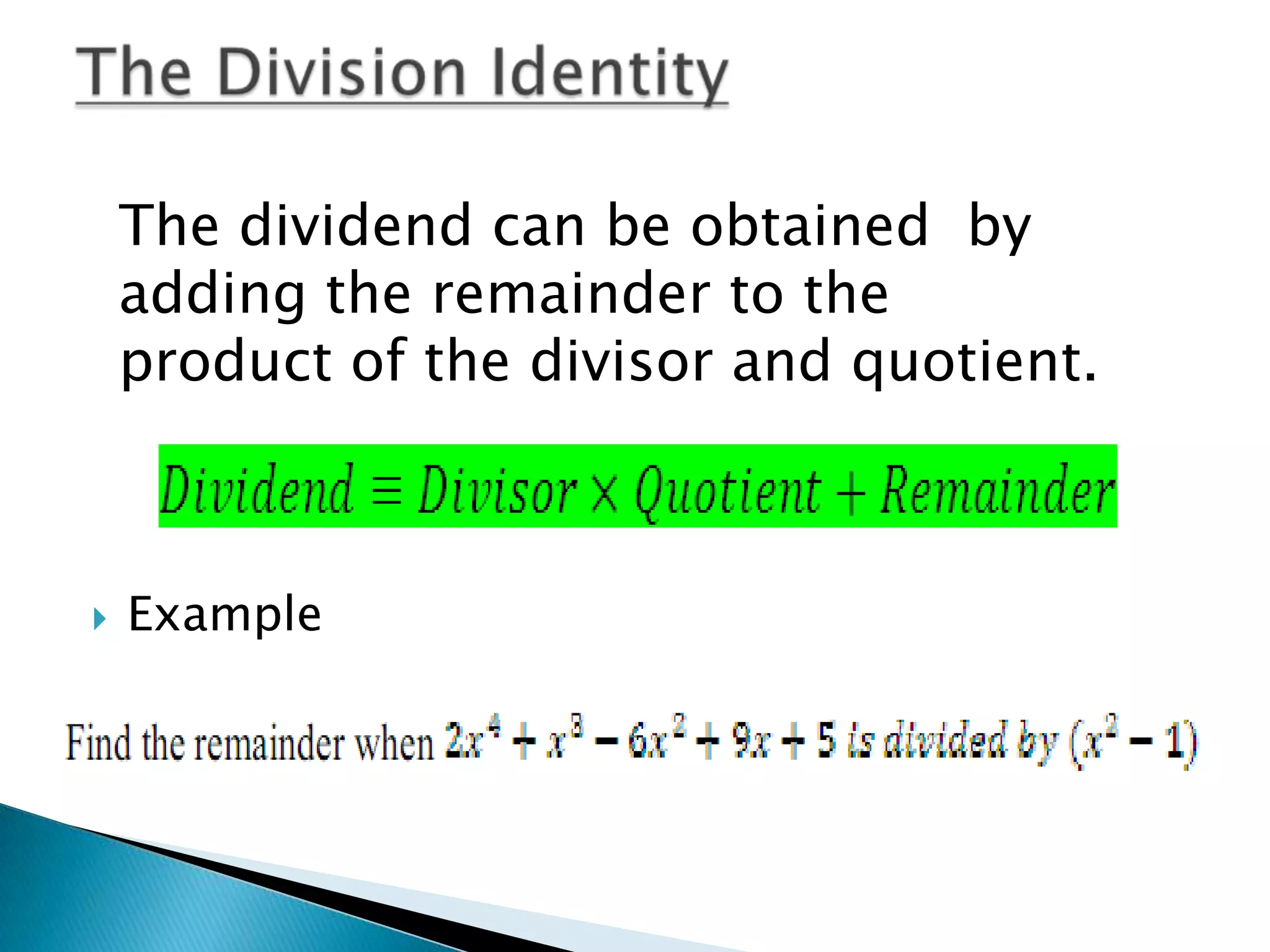
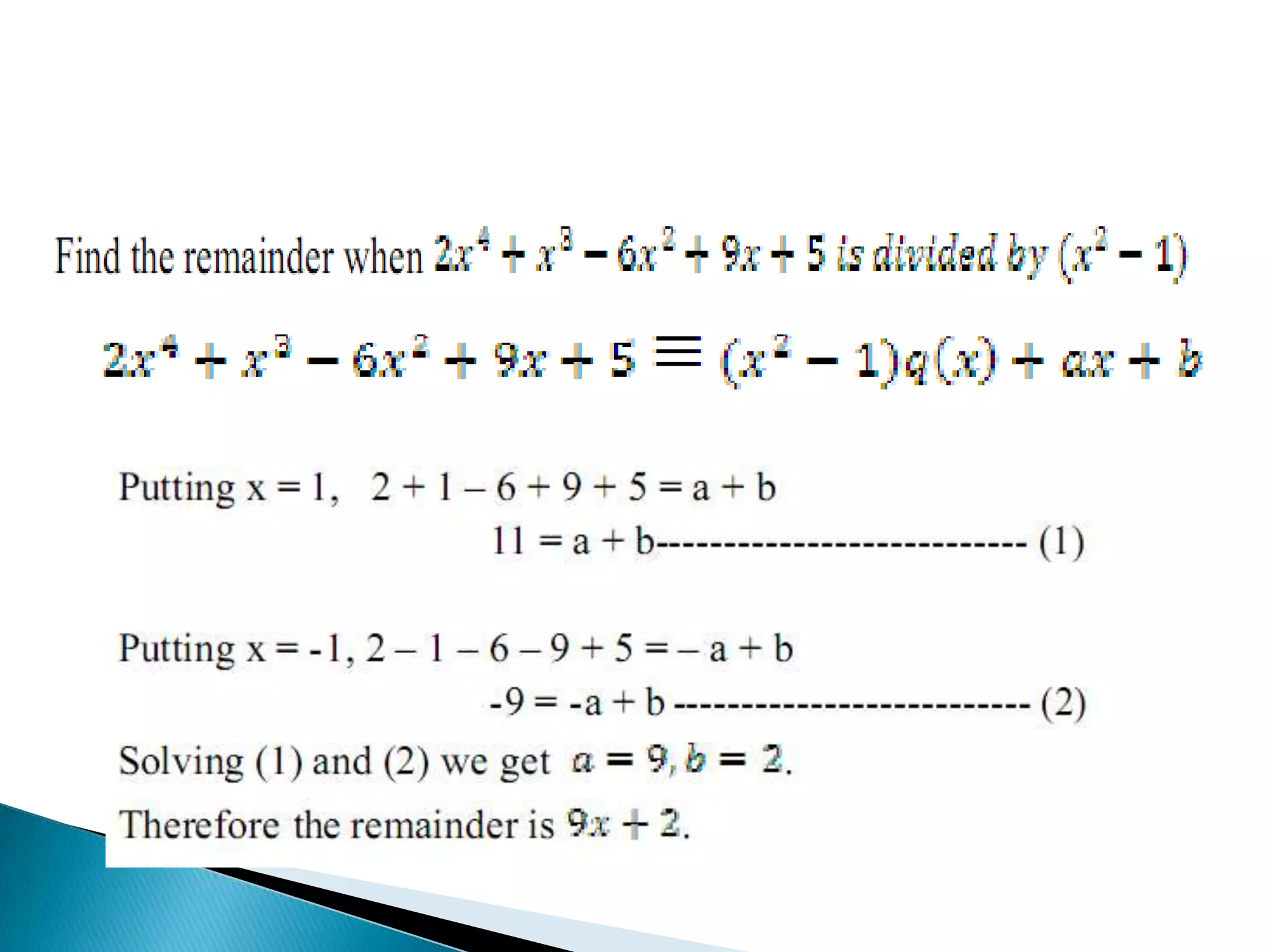
The dividend can be obtained by
    adding the remainder to the
    product of the divisor and quotient.


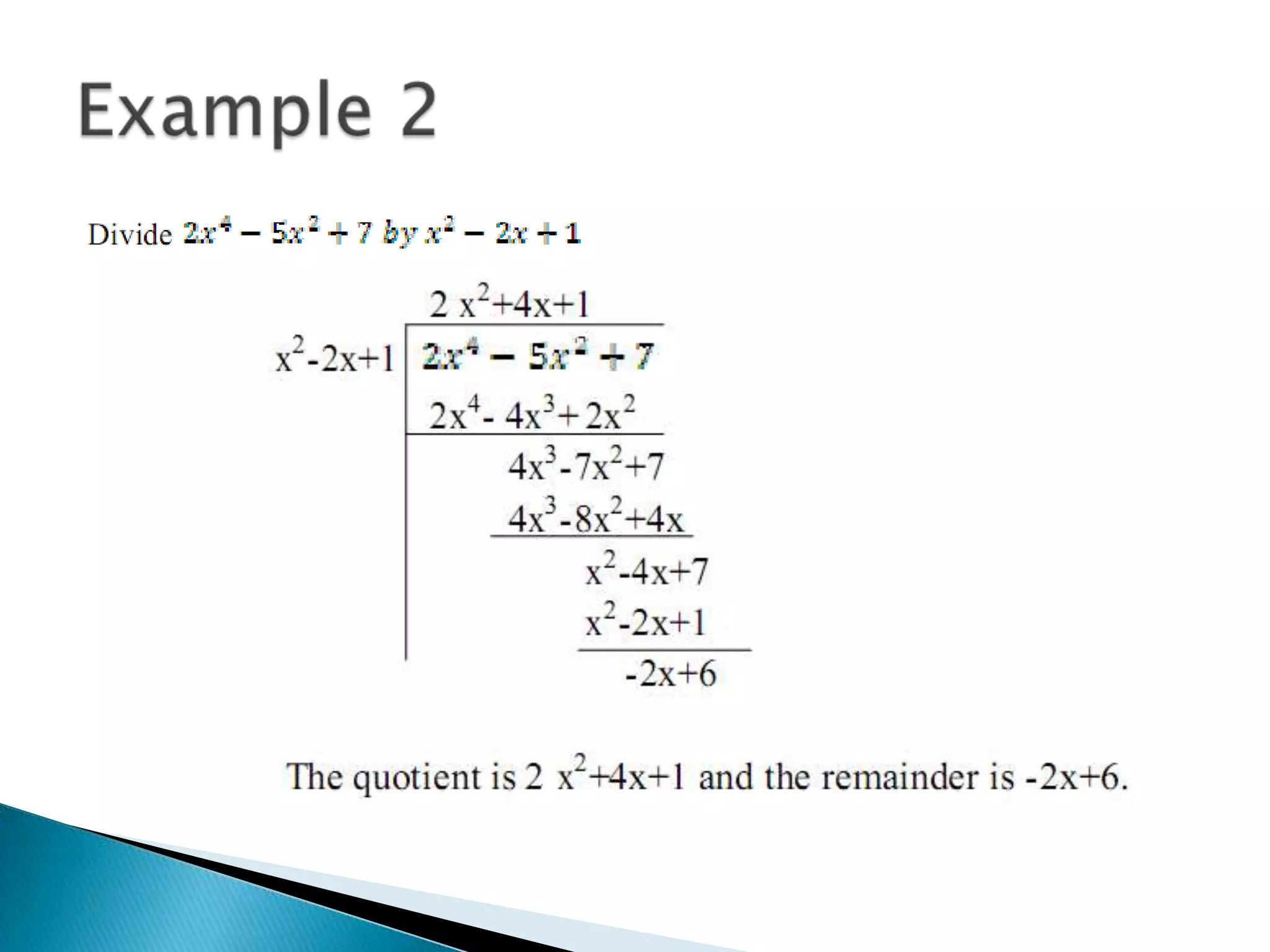
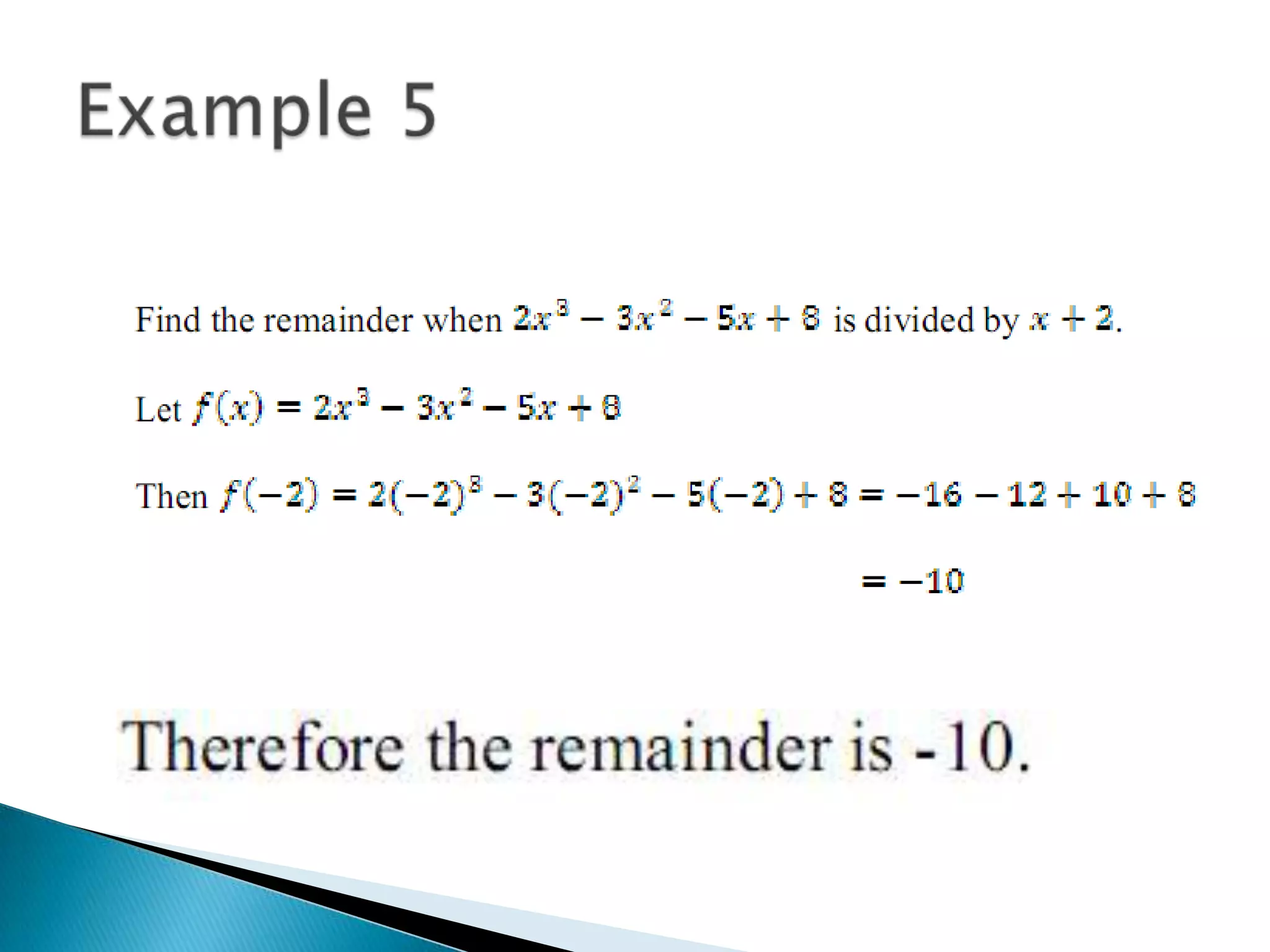
   Example
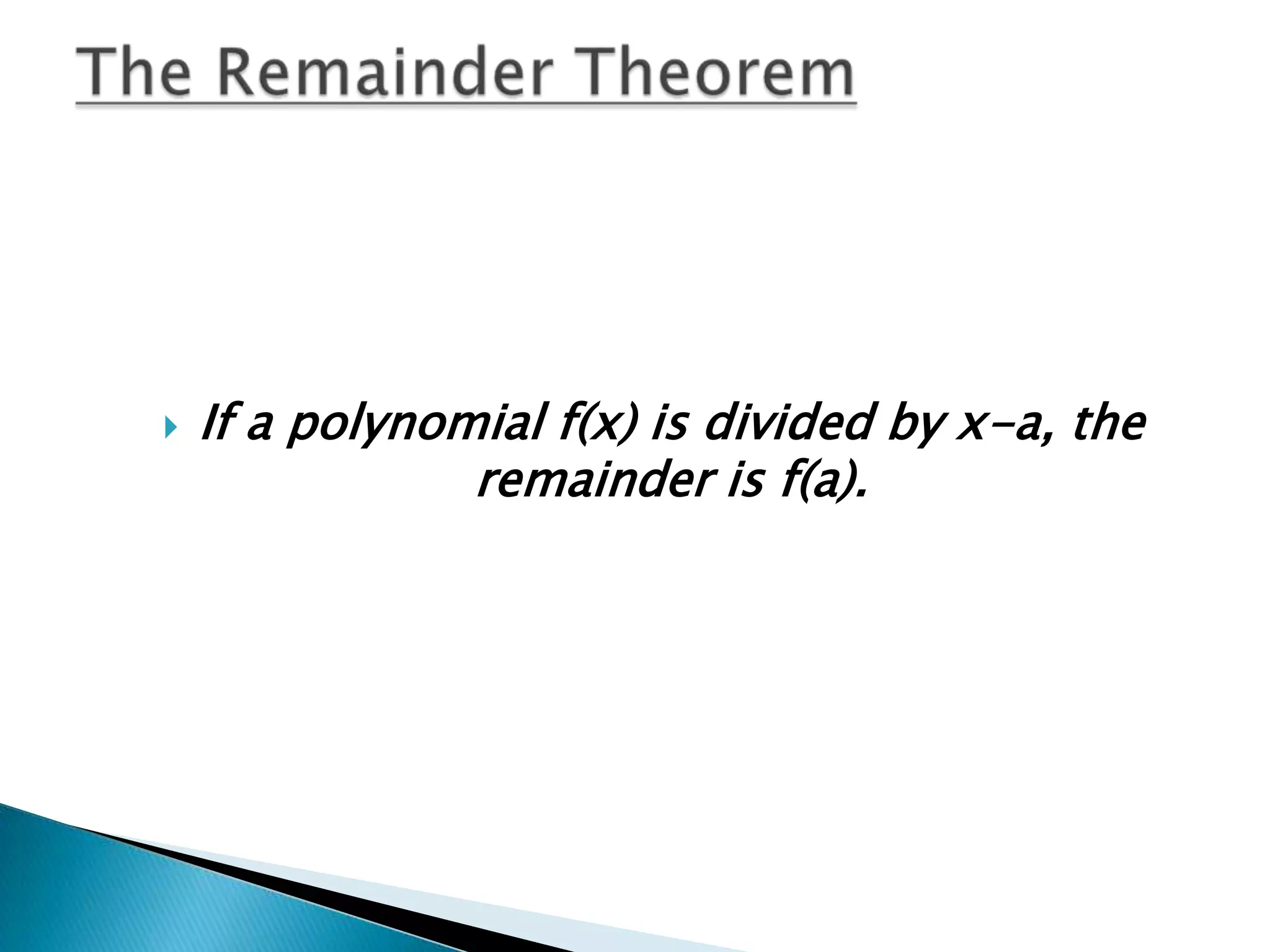
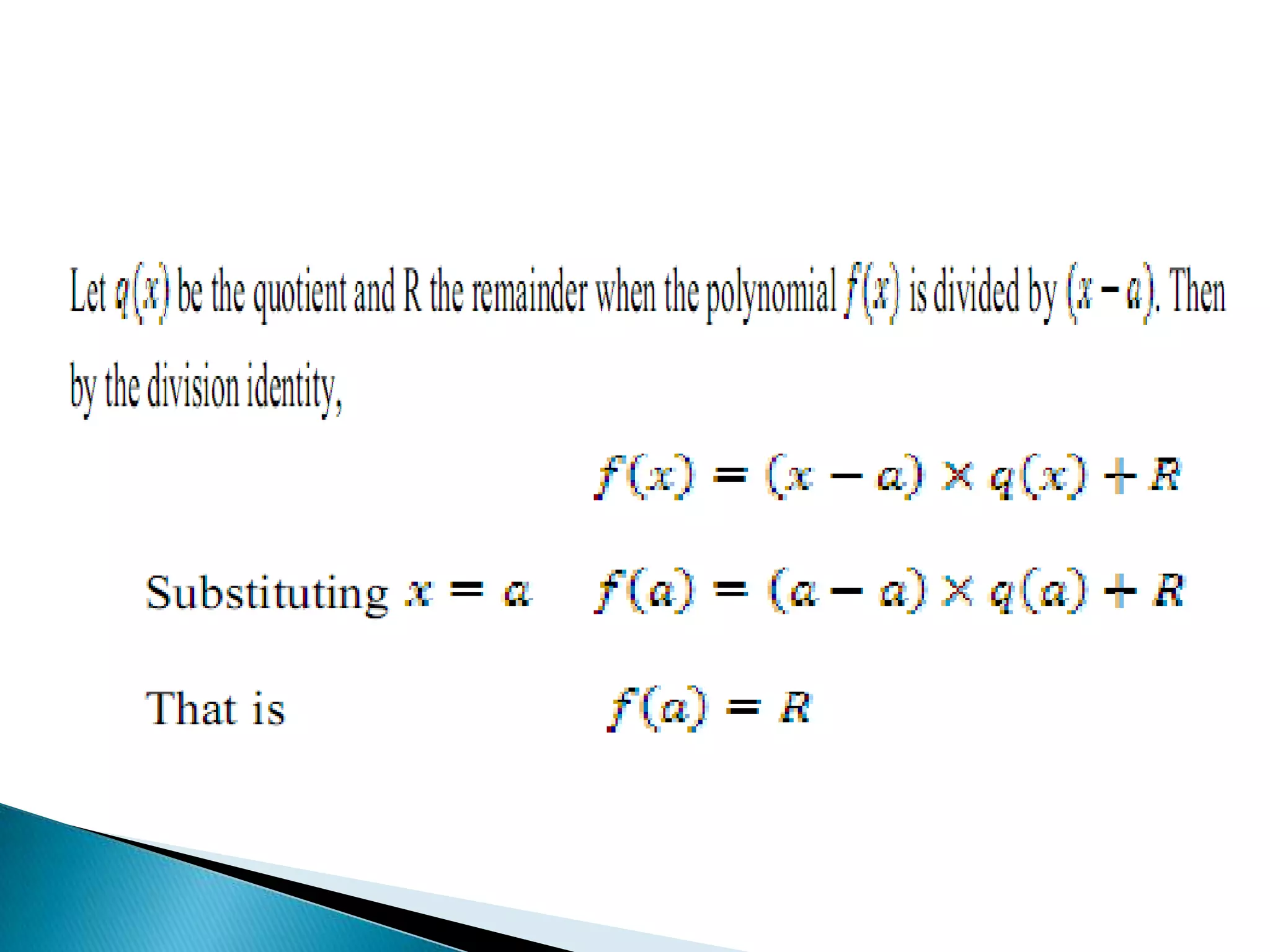
   If a polynomial f(x) is divided by x-a, the
                remainder is f(a).
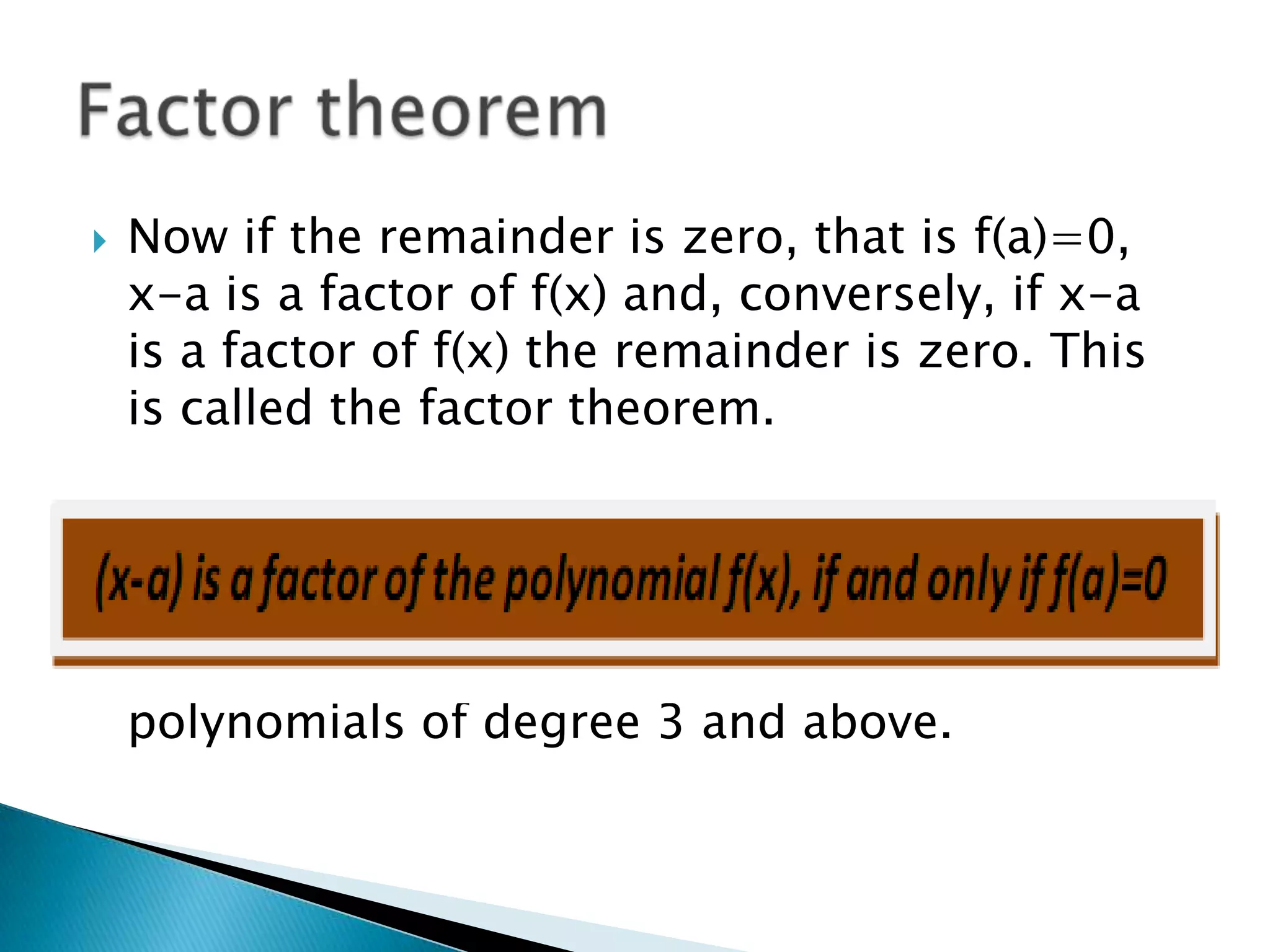
   Now if the remainder is zero, that is f(a)=0,
    x-a is a factor of f(x) and, conversely, if x-a
    is a factor of f(x) the remainder is zero. This
    is called the factor theorem.


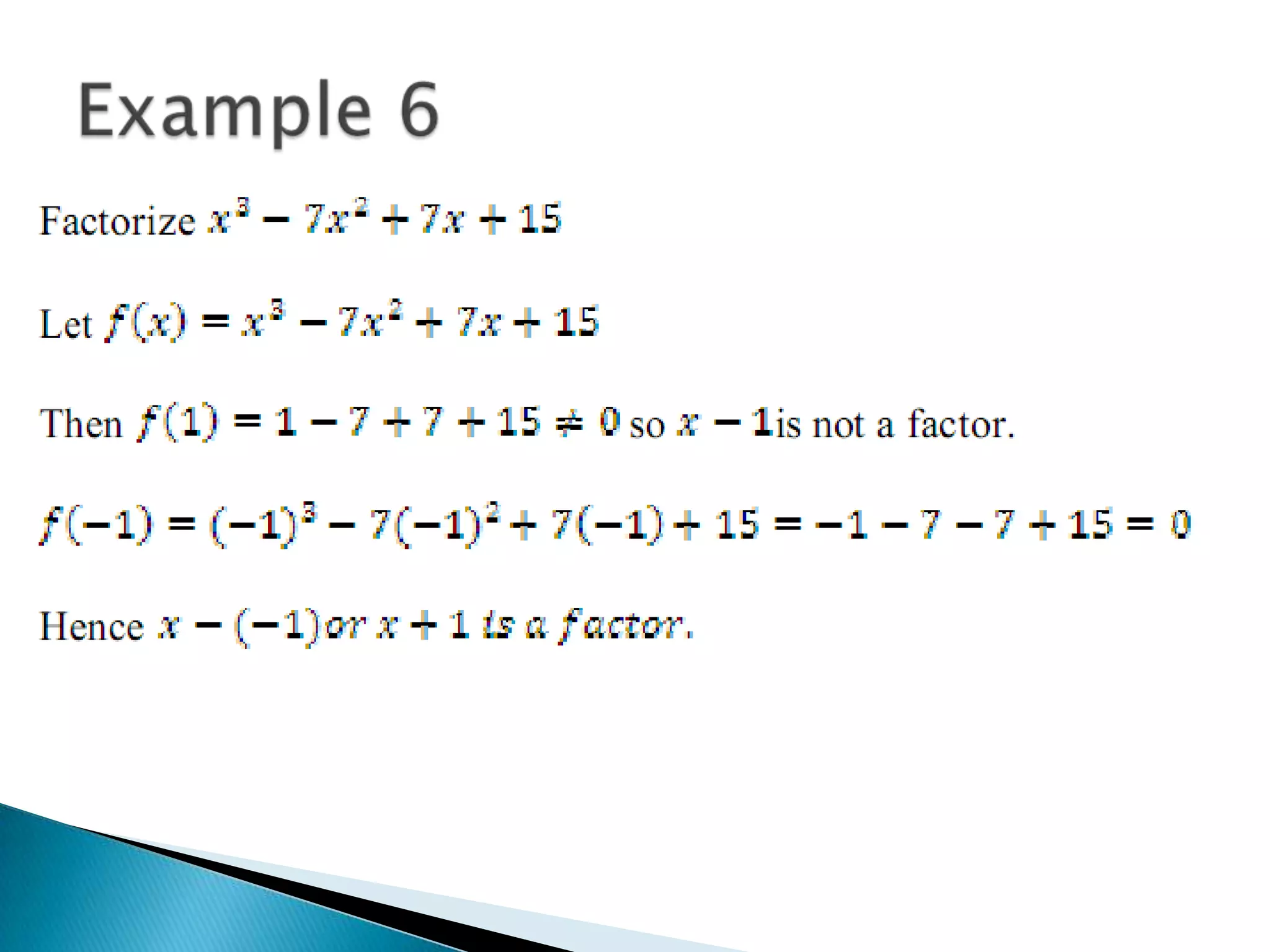
   This theorem can be used to factorize
    polynomials of degree 3 and above.
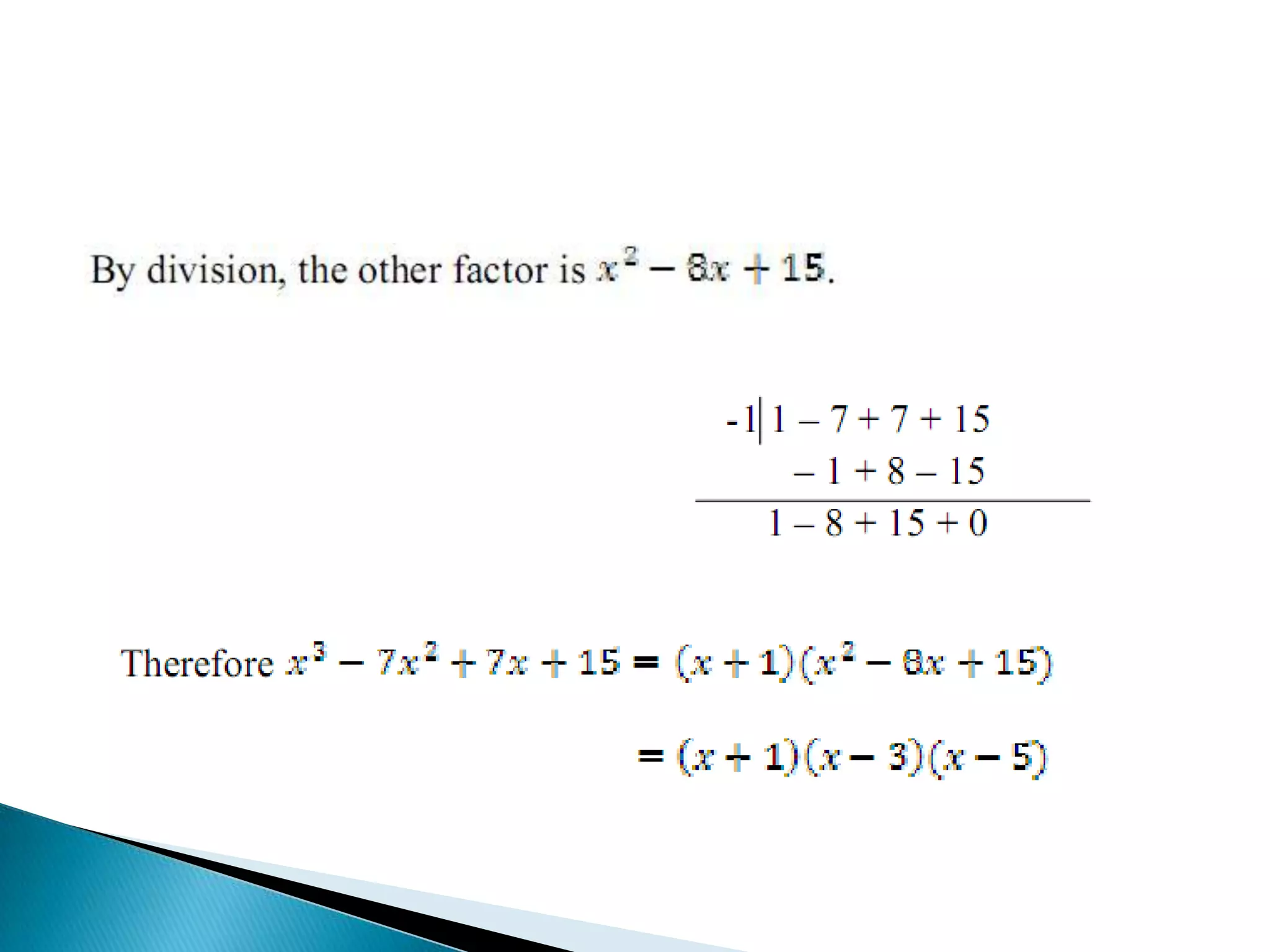
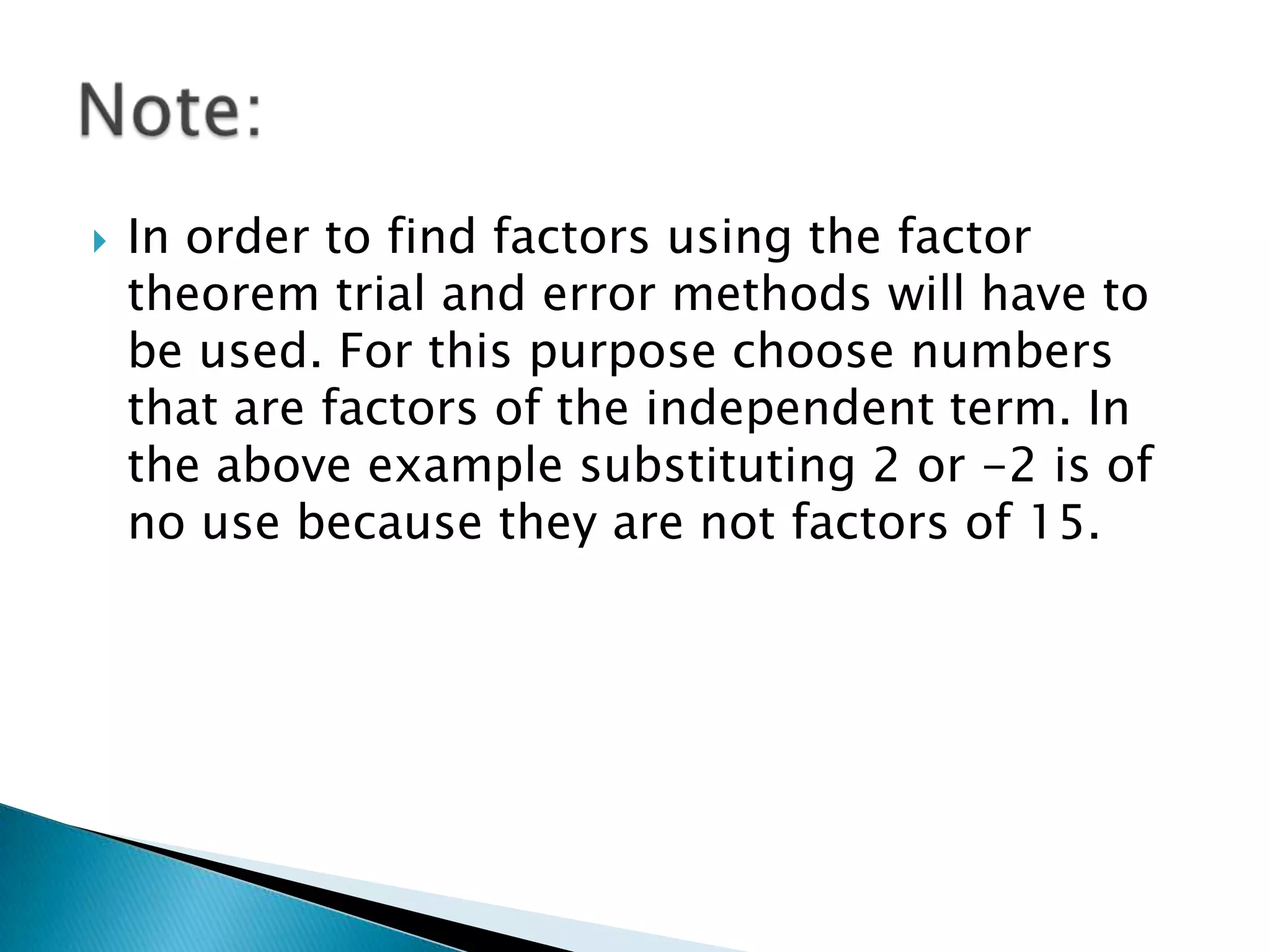
   In order to find factors using the factor
    theorem trial and error methods will have to
    be used. For this purpose choose numbers
    that are factors of the independent term. In
    the above example substituting 2 or -2 is of
    no use because they are not factors of 15.
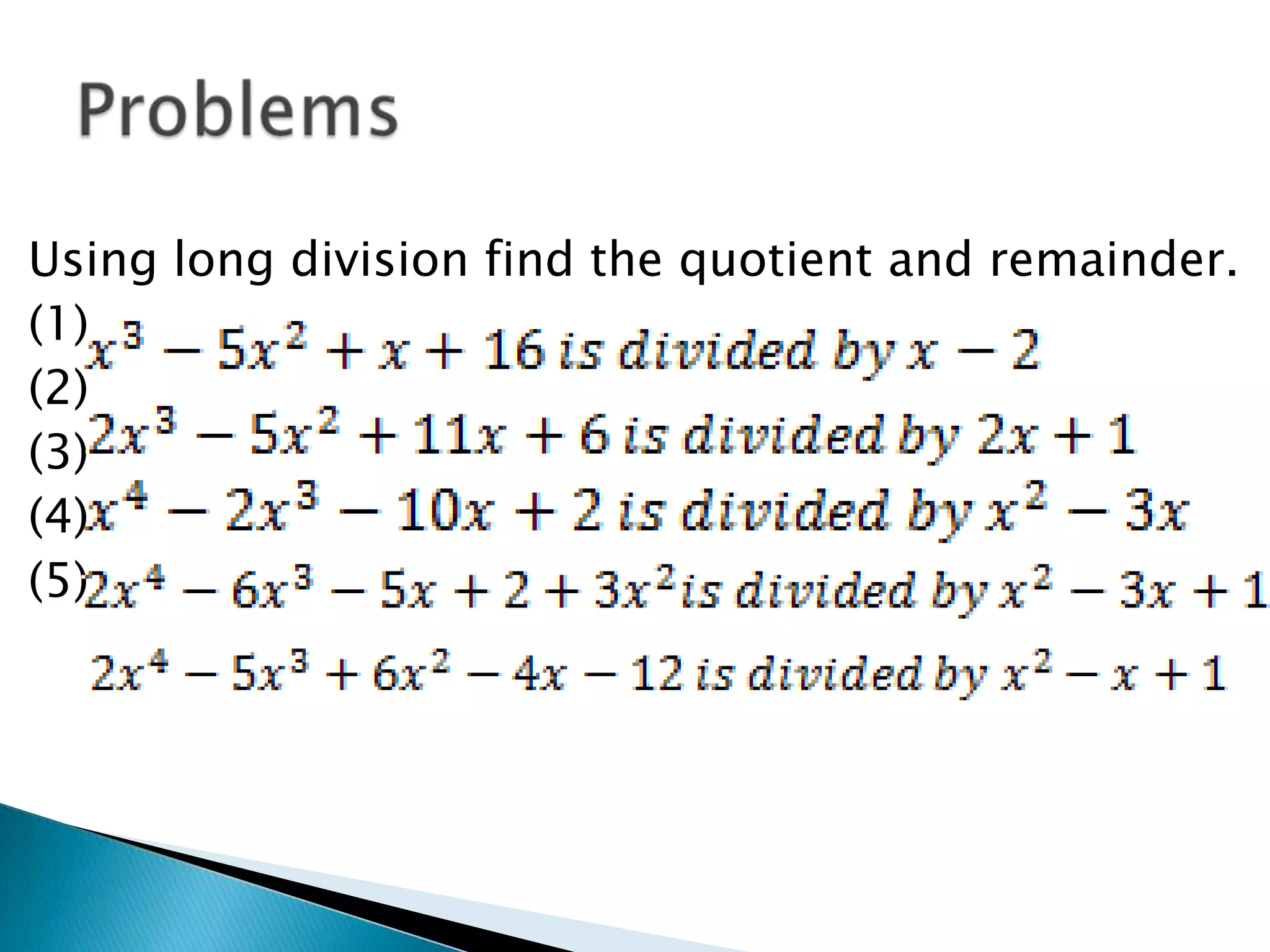
Using long division find the quotient and remainder.
(1)
(2)
(3)
(4)
(5)
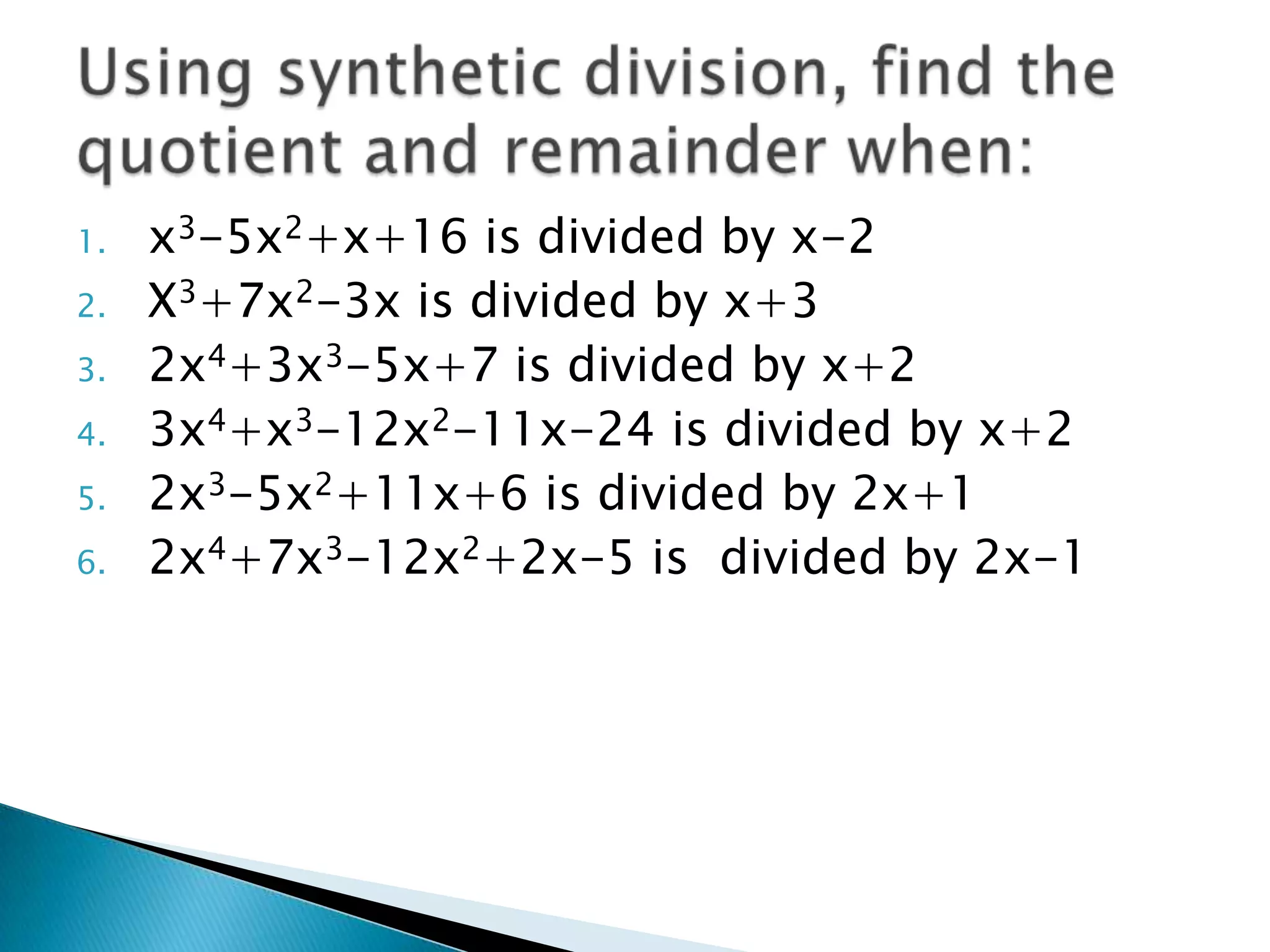
1.   x3-5x2+x+16 is divided by x-2
2.   X3+7x2-3x is divided by x+3
3.   2x4+3x3-5x+7 is divided by x+2
4.   3x4+x3-12x2-11x-24 is divided by x+2
5.   2x3-5x2+11x+6 is divided by 2x+1
6.   2x4+7x3-12x2+2x-5 is divided by 2x-1
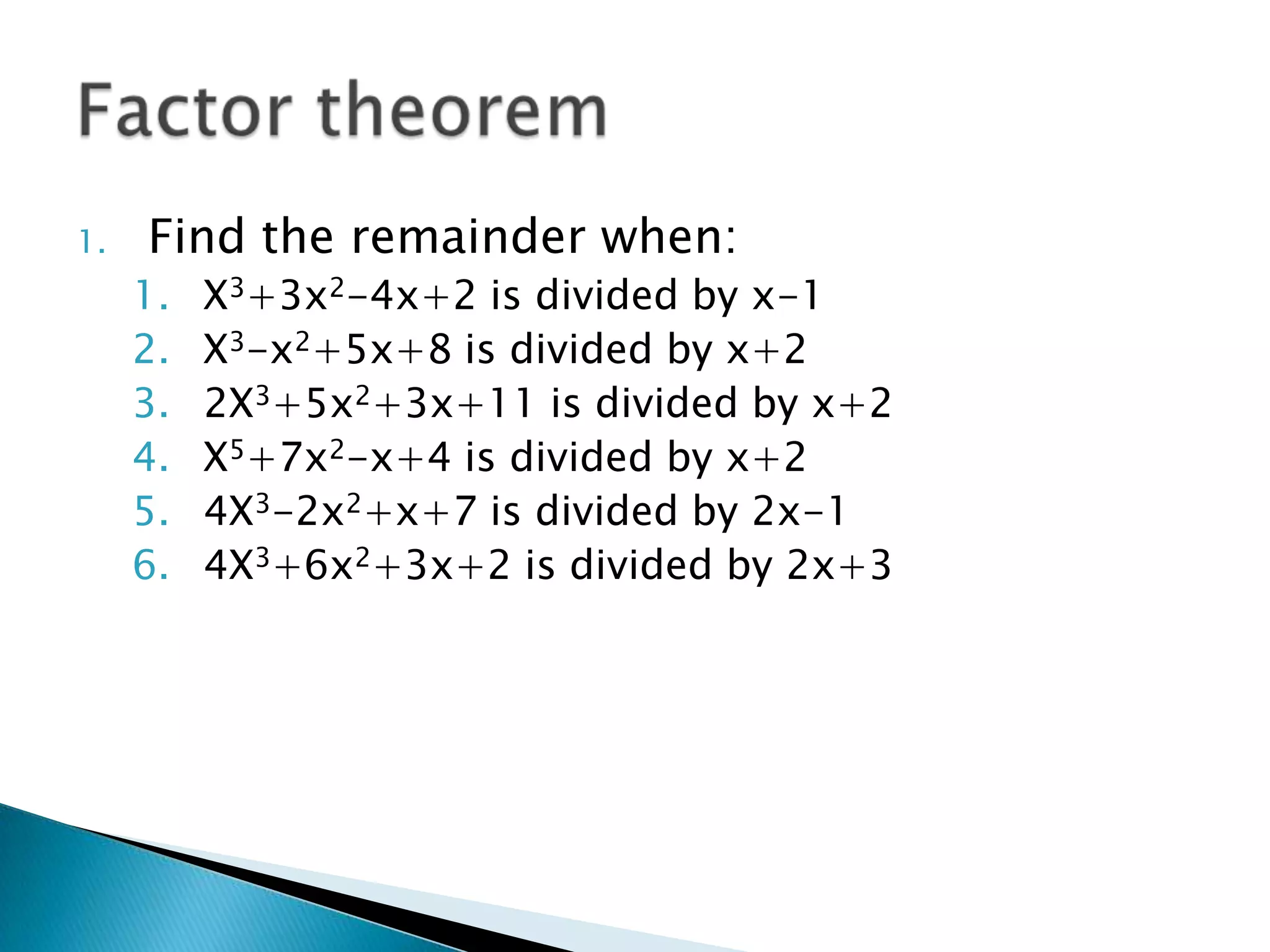
1.   Find the remainder when:
     1.   X3+3x2-4x+2 is divided by x-1
     2.   X3-x2+5x+8 is divided by x+2
     3.   2X3+5x2+3x+11 is divided by x+2
     4.   X5+7x2-x+4 is divided by x+2
     5.   4X3-2x2+x+7 is divided by 2x-1
     6.   4X3+6x2+3x+2 is divided by 2x+3

Polynomial equations

  • 2.
    An expression inthe form of f(x) = anxn + an-1xn-1 + … + a2x2 + a1x + ao where n is a non-negative integer and a2, a1, and a0 are real numbers.
  • 3.
     The function is called a polynomial function of x with degree n.  A polynomial is a monomial or a sum of terms that are monomials.  Polynomials can NEVER have a negative exponent or a variable in the denominator!
  • 4.
    Degree Name Example 0 Constant 5 1 Linear 3x+2 2 Quadratic X2 – 4 3 Cubic X3 + 3x + 1 4 Quartic -3x4 + 4 5 Quintic X5 + 5x4 - 7 MSTI - OTC SF 9/10/2012 4
  • 5.
    The graphs of polynomial functions are continuous (no breaks—you draw the entire graph without lifting your pencil).  This is opposed to discontinuous functions (remember piecewise functions?).  This data is continuous as opposed to discrete. MSTI - OTC SF 9/10/2012 5
  • 6.
    The graph of a polynomial function has only smooth turns. A function of degree n has at most n – 1 turns. ◦ A 2nd degree polynomial has 1 turn ◦ A 3rd degree polynomial has 2 turns ◦ A 5th degree polynomial has… MSTI - OTC SF 9/10/2012 6
  • 7.
    In arithmetic division we know that when we divide one number by another there is, in general, a quotient and a remainder.  48 / 5  Then 48 is called dividend  5 is called divisor  9 is called quotient  3 is called remainder
  • 8.
    In the algebra of polynomials too a polynomial f(x) can be divided by a polynomial g(x) provided that the degree of f(x) is greater than or equal to the degree of g(x). Here f(x) is the dividend and g(x) is the divisor. The quotient and remainder obtained in this division are, in general, polynomials.
  • 9.
    If the degree of f(x) is n and the degree of g(x) is m, then the degree of the quotient is (n-m) and the degree of the remainder is at most (m-1).
  • 10.
    If ◦ f(x)=anxn+an-1xn-1+an-2xn-2+…+a1x+a0, xЄ R and ◦ g(x)=bnxn+bn-1xn-1+bn-2xn-2+…+b1x+b0 , xЄ R Consider f(x)/g(x) the degree of the quotient is (n-m) and the degree of the remainder is at most (m-1).
  • 12.
    1. Arrange both dividend and divisor in the descending order. 2. Divide the first term of the dividend by the first term of the divisor to obtain the first term of the quotient. 3. Multiply the divisor by the term found in 2 above and subtract the result from the dividend. 4. Annex to this remainder the unused terms of the dividend to get a partial dividend.
  • 13.
    5. Divide thefirst term of above by the first term of the divisor to obtain the second term of the quotient. 6. Multiply the divisor by the term found in 5 above and subtract. 7. Repeat this process until the remainder is 0 or the remainder is less than the degree of the divisor.
  • 14.
  • 16.
    When the divisoris of the form x-a, the method of division given above can be shortened start by writing only the coefficients of the dividend and the divisor after arranging them in the descending order
  • 19.
    The dividend canbe obtained by adding the remainder to the product of the divisor and quotient.  Example
  • 21.
    If a polynomial f(x) is divided by x-a, the remainder is f(a).
  • 24.
    Now if the remainder is zero, that is f(a)=0, x-a is a factor of f(x) and, conversely, if x-a is a factor of f(x) the remainder is zero. This is called the factor theorem.  This theorem can be used to factorize polynomials of degree 3 and above.
  • 27.
    In order to find factors using the factor theorem trial and error methods will have to be used. For this purpose choose numbers that are factors of the independent term. In the above example substituting 2 or -2 is of no use because they are not factors of 15.
  • 28.
    Using long divisionfind the quotient and remainder. (1) (2) (3) (4) (5)
  • 29.
    1. x3-5x2+x+16 is divided by x-2 2. X3+7x2-3x is divided by x+3 3. 2x4+3x3-5x+7 is divided by x+2 4. 3x4+x3-12x2-11x-24 is divided by x+2 5. 2x3-5x2+11x+6 is divided by 2x+1 6. 2x4+7x3-12x2+2x-5 is divided by 2x-1
  • 30.
    1. Find the remainder when: 1. X3+3x2-4x+2 is divided by x-1 2. X3-x2+5x+8 is divided by x+2 3. 2X3+5x2+3x+11 is divided by x+2 4. X5+7x2-x+4 is divided by x+2 5. 4X3-2x2+x+7 is divided by 2x-1 6. 4X3+6x2+3x+2 is divided by 2x+3