Synthetic Division Example
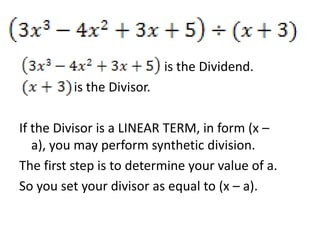
is the Dividend.
         is the Divisor.

If the Divisor is a LINEAR TERM, in form (x –
   a), you may perform synthetic division.
The first step is to determine your value of a.
So you set your divisor as equal to (x – a).
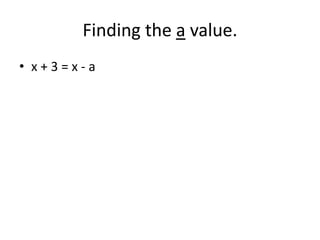
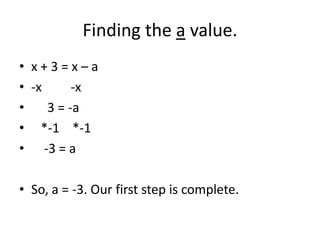
Finding the a value.
• x+3=x-a
Finding the a value.
• x+3=x–a
• -x      -x
•    3 = -a
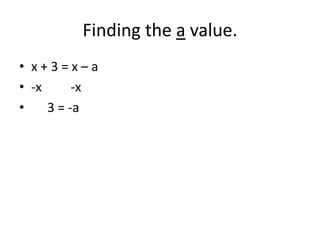
Finding the a value.
• x+3=x–a
• -x      -x
•    3 = -a
• *-1 *-1
• -3 = a

• So, a = -3. Our first step is complete.
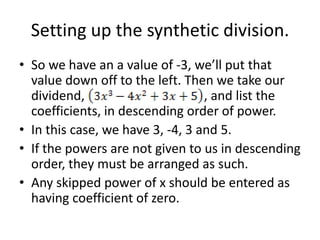
Setting up the synthetic division.
• So we have an a value of -3, we’ll put that
  value down off to the left. Then we take our
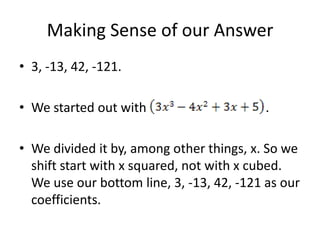
  dividend,                       , and list the
  coefficients, in descending order of power.
• In this case, we have 3, -4, 3 and 5.
• If the powers are not given to us in descending
  order, they must be arranged as such.
• Any skipped power of x should be entered as
  having coefficient of zero.
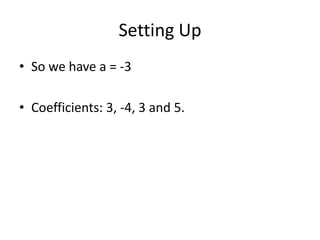
Setting Up
• So we have a = -3

• Coefficients: 3, -4, 3 and 5.
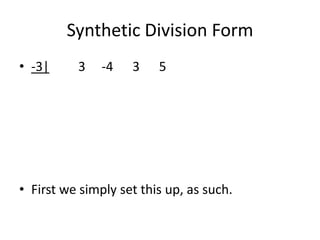
Synthetic Division Form
• -3|     3    -4   3    5


• First we simply set this up, as such.
Synthetic Division Form
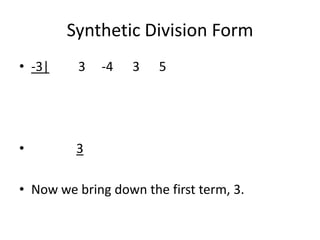
• -3|    3   -4    3   5


•        3

• Now we bring down the first term, 3.
Synthetic Division Form
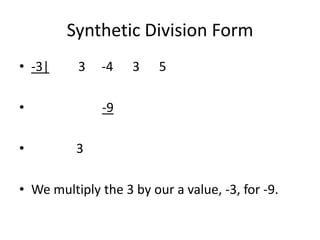
• -3|     3   -4    3    5

•              -9

•         3

• We multiply the 3 by our a value, -3, for -9.
Synthetic Division Form
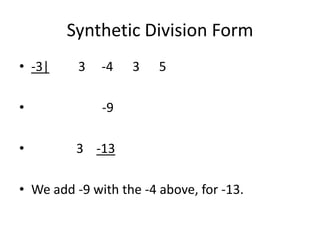
• -3|     3   -4   3    5

•             -9

•        3 -13

• We add -9 with the -4 above, for -13.
Synthetic Division Form
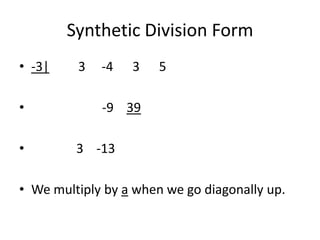
• -3|    3   -4   3    5

•            -9 39

•        3 -13

• We multiply by a when we go diagonally up.
Synthetic Division Form
• -3|    3   -4   3   5

•            -9 39

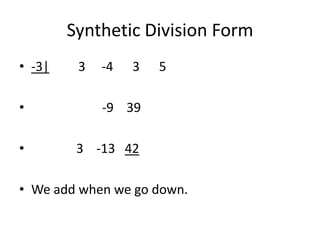
•        3 -13 42

• We add when we go down.
Synthetic Division Form
• -3|    3   -4   3    5

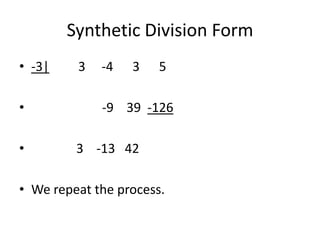
•            -9 39 -126

•        3 -13 42

• We repeat the process.
Synthetic Division Form
• -3|     3   -4    3   5

•             -9 39 -126

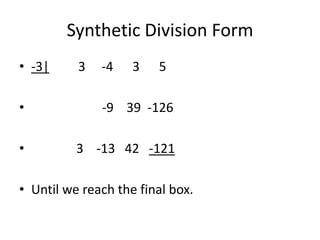
•         3 -13 42 -121

• Until we reach the final box.
Synthetic Division Form
• -3|     3   -4   3    5

•             -9 39 -126

•        3 -13 42 -121

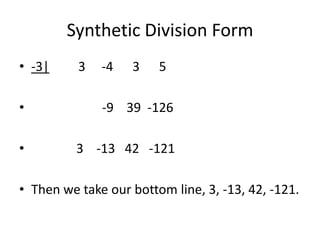
• Then we take our bottom line, 3, -13, 42, -121.
Making Sense of our Answer
• 3, -13, 42, -121.

• We started out with                      .

• We divided it by, among other things, x. So we
  shift start with x squared, not with x cubed.
  We use our bottom line, 3, -13, 42, -121 as our
  coefficients.
Our Answer.
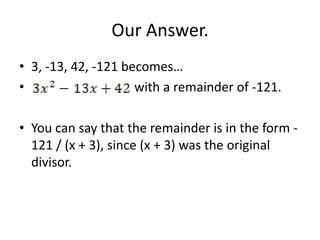
• 3, -13, 42, -121 becomes…
•                    with a remainder of -121.

• You can say that the remainder is in the form -
  121 / (x + 3), since (x + 3) was the original
  divisor.

Synthetic division example

  • 1.
  • 2.
    is the Dividend. is the Divisor. If the Divisor is a LINEAR TERM, in form (x – a), you may perform synthetic division. The first step is to determine your value of a. So you set your divisor as equal to (x – a).
  • 3.
    Finding the avalue. • x+3=x-a
  • 4.
    Finding the avalue. • x+3=x–a • -x -x • 3 = -a
  • 5.
    Finding the avalue. • x+3=x–a • -x -x • 3 = -a • *-1 *-1 • -3 = a • So, a = -3. Our first step is complete.
  • 6.
    Setting up thesynthetic division. • So we have an a value of -3, we’ll put that value down off to the left. Then we take our dividend, , and list the coefficients, in descending order of power. • In this case, we have 3, -4, 3 and 5. • If the powers are not given to us in descending order, they must be arranged as such. • Any skipped power of x should be entered as having coefficient of zero.
  • 7.
    Setting Up • Sowe have a = -3 • Coefficients: 3, -4, 3 and 5.
  • 8.
    Synthetic Division Form •-3| 3 -4 3 5 • First we simply set this up, as such.
  • 9.
    Synthetic Division Form •-3| 3 -4 3 5 • 3 • Now we bring down the first term, 3.
  • 10.
    Synthetic Division Form •-3| 3 -4 3 5 • -9 • 3 • We multiply the 3 by our a value, -3, for -9.
  • 11.
    Synthetic Division Form •-3| 3 -4 3 5 • -9 • 3 -13 • We add -9 with the -4 above, for -13.
  • 12.
    Synthetic Division Form •-3| 3 -4 3 5 • -9 39 • 3 -13 • We multiply by a when we go diagonally up.
  • 13.
    Synthetic Division Form •-3| 3 -4 3 5 • -9 39 • 3 -13 42 • We add when we go down.
  • 14.
    Synthetic Division Form •-3| 3 -4 3 5 • -9 39 -126 • 3 -13 42 • We repeat the process.
  • 15.
    Synthetic Division Form •-3| 3 -4 3 5 • -9 39 -126 • 3 -13 42 -121 • Until we reach the final box.
  • 16.
    Synthetic Division Form •-3| 3 -4 3 5 • -9 39 -126 • 3 -13 42 -121 • Then we take our bottom line, 3, -13, 42, -121.
  • 17.
    Making Sense ofour Answer • 3, -13, 42, -121. • We started out with . • We divided it by, among other things, x. So we shift start with x squared, not with x cubed. We use our bottom line, 3, -13, 42, -121 as our coefficients.
  • 18.
    Our Answer. • 3,-13, 42, -121 becomes… • with a remainder of -121. • You can say that the remainder is in the form - 121 / (x + 3), since (x + 3) was the original divisor.