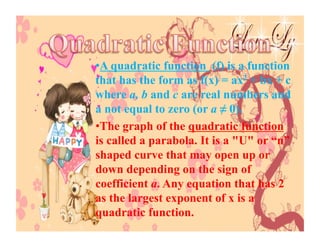
• A quadratic function (f) is a function
that has the form as f(x) = ax2 + bx + c
where a, b and c are real numbers and
a not equal to zero (or a ≠ 0).
• The graph of the quadratic function
is called a parabola. It is a "U" or “n”
shaped curve that may open up or
down depending on the sign of
coefficient a. Any equation that has 2
as the largest exponent of x is a
quadratic function.
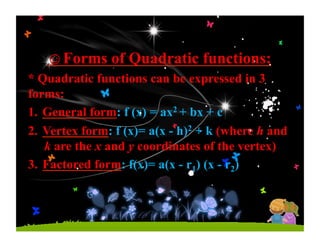
☺Forms of Quadratic functions:
* Quadratic functions can be expressed in 3
forms:
1.  General form: f (x) = ax2 + bx + c
2.  Vertex form: f (x)= a(x - h)2 + k (where h and
    k are the x and y coordinates of the vertex)
3.  Factored form: f(x)= a(x - r1) (x - r2)
1. General form
•  Form : f(x) = ax2+ bx+ c
•  General form is always written with the x2 term
   first, followed by the x term, and the constant term
   last. a, b, and c are called the coefficients of the
   equation. It is possible for the b and/or c coefficient
   to equal zero. Examples of some quadratic functions
   in standard form are:
        a. f(x) = 2x2 + 3x – 4 (where a = 2, b = 3, c = -4)
        b. f(x) =x2 – 4 (where a = 1, b = 0, c = -4)
        c. f(x)= x2 ( where a = 1, b and c = 0)
        d. f(x)= x2 – 8x (where a = ½, b = -8, c = 0).
2. Vertex Form


•  Form: f(x) = a(x - h)2 + k where the point
   (h, k) is the vertex of the parabola.
•  Vertex form or graphing form of a
   parabola.
•  Examples:
   a. 2(x - 2)2 + 5 (where a = 2, h = 2, and k = 5)
   b. (x + 5)2 (where a = 1, h = -5, k = 0)
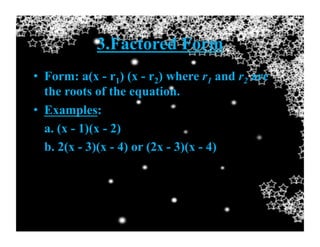
3.Factored Form
•  Form: a(x - r1) (x - r2) where r1 and r2 are
   the roots of the equation.
•  Examples:
   a. (x - 1)(x - 2)
   b. 2(x - 3)(x - 4) or (2x - 3)(x - 4)
Discriminant
•  Quadratic formula: If ax2 + bx + c, a ≠ 0, x =

•  The value contained in the square root of the quadratic
   formula is called the discriminant, and is often represented
   by ∆ = b2 – 4ac.
   * b2 – 4ac > 0             →     There are 2 roots

                                    x1,2=                  .

  * b2 – 4ac = 0            →      There is 1 real root,
                                   x = -b/2a.
  * b2 – 4ac < 0            →      There are no real
                                   roots.
Using Quadratic Formula
•  A general formula for solving quadratic equations, known as
   the quadratic formula, is written as:
•  To solve quadratic equations of the form ax2+ bx+ c,
   substitute the coefficients a, b, and c in to the quadratic
   formula.
    1.  Exercise: Solve 4x2 – 5x + 1 = 0 using the quadratic
        formula
    ∆ = b2 – 4ac= 52 – 4(4)(1) = 25 – 16 = 9 =>       =   =±3
    x


   x1 = 1           or            x2 = 1/4
Using Factoring
•  Convert from general form, f(x) = ax2 + bx + c to factored form,
   a(x - x1) (x - x2) :
    + Example 1: Solve x2+ 2x = 15 by factoring
                   => x2 + 2x – 15 = 0     (General form)
                       (x + 5)(x - 3) = 0   (Factoring form)
                        x+5=0          or  x–3=0
                           x = -5      or      x=3
    → Thus, the solution to the quadratic equation is x = -5 or x = 3.
    + Example 2: Solve x2 + 5x – 9 = -3 by factoring
                        => x2 + 5x – 6 = 0  (General form)
                        (x – 1)(x + 6) = 0 (Factoring form)
                        x–1=0          or  x+6=0
                           x=1         or      x = -6
    → Thus, the solution to the quadratic equation is x = 1 or x = -6.
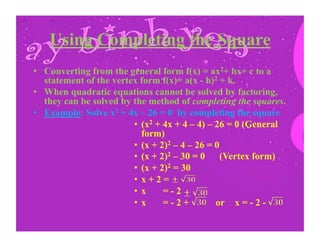
Using Completing the Square
•  Converting from the general form f(x) = ax2+ bx+ c to a
   statement of the vertex form f(x)= a(x - h)2 + k.
•  When quadratic equations cannot be solved by factoring,
   they can be solved by the method of completing the squares.
•  Example: Solve x2 + 4x – 26 = 0 by completing the square
                         •  (x2 + 4x + 4 – 4) – 26 = 0 (General
                            form)
                         •  (x + 2)2 – 4 – 26 = 0
                         •  (x + 2)2 – 30 = 0 (Vertex form)
                         •  (x + 2)2 = 30
                         •  x + 2 =
                         •  x     =-2
                         •  x     =-2+          or x = - 2 -


Application to higher-degree
                equations
•  Example: x4 + 4x2 - 5 = 0
          –  The equation above can be written as:
          –  (x2)2 + 4(x2) - 5 = 0
          –  (Quadratic function with exponent x = 2)
          –  Solve: ./ Substitute x2 = P
                       P2 + 4P - 5 =0
                       (P + 5)(P - 1) = 0
                       P = -5 or          P=1
                      ./ Re-substitute P = x2
                      => P = -5 = x2 = no roots
                      => P = 1 = x2 => x = ± 1
The Graph of Quadratic Equation

•  The graph of quadratic equation in the form f(x) = ax2+ bx+ c is a
   parabola. The parts of the graph of the parabola are determined by the
   values of a, b, and c.
•  The most meaningful points of the graph of a parabola are:
     1. x-intercepts: The x-intercepts, if any, are also called the roots of the
     function. They are meaningful specifically as the zeroes of the
     function, but also represent the two roots for any value of .
     2. y-intercept: The importance of the y-intercept is usually as an
   initial value or initial condition for some state of an experiment,
   especially one where the independent variable represents time.
      3. Vertex: The vertex represents the maximum (or minimum) value
   of the function, and is very important in calculus and many natural
   phenomena.
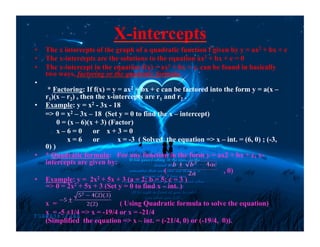
X-intercepts
•    The x intercepts of the graph of a quadratic function f given by y = ax2 + bx + c
•    The x-intercepts are the solutions to the equation ax2 + bx + c = 0
•    The x-intercept in the equation f(x) = ax2 + bx + c, can be found in basically
     two ways, factoring or the quadratic formula.
• 
      * Factoring: If f(x) = y = ax2 + bx + c can be factored into the form y = a(x –
     r1)(x – r2) , then the x-intercepts are r1 and r2 .
•    Example: y = x2 - 3x - 18
     => 0 = x2 – 3x – 18 (Set y = 0 to find the x – intercept)
          0 = (x – 6)(x + 3) (Factor)
          x – 6 = 0 or x + 3 = 0
              x = 6 or          x = -3 ( Solved the equation => x – int. = (6, 0) ; (-3,
     0) )
•    * Quadratic formula: For any function in the form y = ax2 + bx + c, x-
     intercepts are given by:
                                                (                  , 0)
•    Example: y = 2x2 + 5x + 3 (a = 2; b = 5; c = 3 )
     => 0 = 2x2 + 5x + 3 (Set y = 0 to find x – int. )

     x =                      ( Using Quadratic formula to solve the equation)
     x = -5 ±1/4 => x = -19/4 or x = -21/4
     (Simplified the equation => x – int. = (-21/4, 0) or (-19/4, 0)).
Y-intercept
•  The y intercept of the graph of a quadratic function is
   given by f(0) = c or y-intercept = (0,c).
•  Example:
    Find the y intercept of the following equations:
   –  A) x2 + 2x + 26
   –  B) 16x2 – 3x – 59
   –  C) 10x2 + 5x – 10/7
   * Solution:
      A) Substitute 0 for x as f(x) = f(0) = x2 + 2x + 26
      => f(0) = c = 26.
      The y intercept is at (0, 26).
      B) Same method as A). f(0) = -59.
      The y-int. is (0, -59)
      C) f(0) = -10/7.
      The y-int. is (0, -10/7)
The Vertex
•  The vertex can be found by completing the
   square, or by using the expression derived from
   completing the square on the general form.
•  Formula given by: y = ax2 + bx + c So the
   vertex is

•  Example: h = -12x2 + 168x – 38
•  => -b/2a = -168/2(-12) = 7 (applied the formula
   to find x-coordinate of vertex of the quadratic
   equation).
•  Substitute for x (x = 7) into the original
   equation. We have that: h = -12(7)2 + 168(7) –
   38 = 550
•  Thus, the vertex of the equation is (7, 550).
Graphing Parabola
•  There are several steps to do before we sketch a graph of
    parabola of the quadratic equation.
•  The most easiest way to sketch the graph is from vertex
    form.
•  Steps:
  1. We need to check whether the graph is concave up if a > 0
    (U- shaped) or concave down if a < 0(n-shaped).
   2. We need to find the vertex of the equation by the formula
        x =-b/2a or by the vertex form.
  3. We need to find the values of x and y intercepts.
        + Substitute x = 0 into the equation then find the
    coordinate of        y value.
        + Let y = 0 then find the values of x.
Graphing Parabola
•  Graph the function f(x) = 2x2 + 8x +7
Solution:
1.  Write the function f(x) = 2x2 + 8x + 7 in the form f(x) = a (x - h)
     2 + k by completing the square. (h, k)

    f (x) = 2x2 + 8x + 7 => f (x) = 2 (x2 + 4x) + 7
                               => f (x) = 2 (x2 + 4x + 4) + 7 – 8
                               => f (x) = 2 (x + 2)2 – 1
3.  The function f (x) = 2x2 + 8x + 7 has vertex at (-2, -1) with a
     horizontal shift of 2 units to the left and a vertical shift of one
     unit downward. Also since a = 2 > 0 then the graph is concave
     up.
4.  The x-intercept of the function are determined by letting
      f (x) = 2 (x + 2)2 – 1 = 0 and solving for x as illustrated below:
Continued
   f (x) = 2 (x + 2)2 – 1 = 0
       => (x + 2)2 = ½
       => x + 2 = ± √½ = ± 1/√2
        =>      x = -2 ± (1/√2)

4. The y-intercept is f (0) = 2 (0 + 2)2 – 1 = 7
* The graph of f (x) = 2x2 + 8x +7 is
   illustrated below:
Helpful Links
•  h#p://www.douglas.bc.ca/services/learning-­‐
   centre/pdf/math/
   MA7_30_QuadraBc_EquaBons_and_FuncBons
   .pdf	
  
•  h#p://www.cimt.plymouth.ac.uk/projects/
   mepres/book9/y9s17ex.pdf	
  
•  h#p://www.tech.plym.ac.uk/maths/
   resources/PDFLaTeX/quad_graphs.pdf	
  
•  h#p://www.neufeldmath.com/ss/Plus/
   Graphing%209.pdf	
  

Quadratic Function Presentation

  • 1.
    • A quadratic function(f) is a function that has the form as f(x) = ax2 + bx + c where a, b and c are real numbers and a not equal to zero (or a ≠ 0). • The graph of the quadratic function is called a parabola. It is a "U" or “n” shaped curve that may open up or down depending on the sign of coefficient a. Any equation that has 2 as the largest exponent of x is a quadratic function.
  • 2.
    ☺Forms of Quadraticfunctions: * Quadratic functions can be expressed in 3 forms: 1.  General form: f (x) = ax2 + bx + c 2.  Vertex form: f (x)= a(x - h)2 + k (where h and k are the x and y coordinates of the vertex) 3.  Factored form: f(x)= a(x - r1) (x - r2)
  • 3.
    1. General form • Form : f(x) = ax2+ bx+ c •  General form is always written with the x2 term first, followed by the x term, and the constant term last. a, b, and c are called the coefficients of the equation. It is possible for the b and/or c coefficient to equal zero. Examples of some quadratic functions in standard form are: a. f(x) = 2x2 + 3x – 4 (where a = 2, b = 3, c = -4) b. f(x) =x2 – 4 (where a = 1, b = 0, c = -4) c. f(x)= x2 ( where a = 1, b and c = 0) d. f(x)= x2 – 8x (where a = ½, b = -8, c = 0).
  • 4.
    2. Vertex Form • Form: f(x) = a(x - h)2 + k where the point (h, k) is the vertex of the parabola. •  Vertex form or graphing form of a parabola. •  Examples: a. 2(x - 2)2 + 5 (where a = 2, h = 2, and k = 5) b. (x + 5)2 (where a = 1, h = -5, k = 0)
  • 5.
    3.Factored Form •  Form:a(x - r1) (x - r2) where r1 and r2 are the roots of the equation. •  Examples: a. (x - 1)(x - 2) b. 2(x - 3)(x - 4) or (2x - 3)(x - 4)
  • 6.
    Discriminant •  Quadratic formula:If ax2 + bx + c, a ≠ 0, x = •  The value contained in the square root of the quadratic formula is called the discriminant, and is often represented by ∆ = b2 – 4ac. * b2 – 4ac > 0 → There are 2 roots x1,2= . * b2 – 4ac = 0 → There is 1 real root, x = -b/2a. * b2 – 4ac < 0 → There are no real roots.
  • 7.
    Using Quadratic Formula • A general formula for solving quadratic equations, known as the quadratic formula, is written as: •  To solve quadratic equations of the form ax2+ bx+ c, substitute the coefficients a, b, and c in to the quadratic formula. 1.  Exercise: Solve 4x2 – 5x + 1 = 0 using the quadratic formula ∆ = b2 – 4ac= 52 – 4(4)(1) = 25 – 16 = 9 => = =±3 x x1 = 1 or x2 = 1/4
  • 8.
    Using Factoring •  Convertfrom general form, f(x) = ax2 + bx + c to factored form, a(x - x1) (x - x2) : + Example 1: Solve x2+ 2x = 15 by factoring => x2 + 2x – 15 = 0 (General form) (x + 5)(x - 3) = 0 (Factoring form) x+5=0 or x–3=0 x = -5 or x=3 → Thus, the solution to the quadratic equation is x = -5 or x = 3. + Example 2: Solve x2 + 5x – 9 = -3 by factoring => x2 + 5x – 6 = 0 (General form) (x – 1)(x + 6) = 0 (Factoring form) x–1=0 or x+6=0 x=1 or x = -6 → Thus, the solution to the quadratic equation is x = 1 or x = -6.
  • 9.
    Using Completing theSquare •  Converting from the general form f(x) = ax2+ bx+ c to a statement of the vertex form f(x)= a(x - h)2 + k. •  When quadratic equations cannot be solved by factoring, they can be solved by the method of completing the squares. •  Example: Solve x2 + 4x – 26 = 0 by completing the square •  (x2 + 4x + 4 – 4) – 26 = 0 (General form) •  (x + 2)2 – 4 – 26 = 0 •  (x + 2)2 – 30 = 0 (Vertex form) •  (x + 2)2 = 30 •  x + 2 = •  x =-2 •  x =-2+ or x = - 2 -        
  • 10.
    Application to higher-degree equations •  Example: x4 + 4x2 - 5 = 0 –  The equation above can be written as: –  (x2)2 + 4(x2) - 5 = 0 –  (Quadratic function with exponent x = 2) –  Solve: ./ Substitute x2 = P P2 + 4P - 5 =0 (P + 5)(P - 1) = 0 P = -5 or P=1 ./ Re-substitute P = x2 => P = -5 = x2 = no roots => P = 1 = x2 => x = ± 1
  • 11.
    The Graph ofQuadratic Equation •  The graph of quadratic equation in the form f(x) = ax2+ bx+ c is a parabola. The parts of the graph of the parabola are determined by the values of a, b, and c. •  The most meaningful points of the graph of a parabola are: 1. x-intercepts: The x-intercepts, if any, are also called the roots of the function. They are meaningful specifically as the zeroes of the function, but also represent the two roots for any value of . 2. y-intercept: The importance of the y-intercept is usually as an initial value or initial condition for some state of an experiment, especially one where the independent variable represents time. 3. Vertex: The vertex represents the maximum (or minimum) value of the function, and is very important in calculus and many natural phenomena.
  • 12.
    X-intercepts •  The x intercepts of the graph of a quadratic function f given by y = ax2 + bx + c •  The x-intercepts are the solutions to the equation ax2 + bx + c = 0 •  The x-intercept in the equation f(x) = ax2 + bx + c, can be found in basically two ways, factoring or the quadratic formula. •  * Factoring: If f(x) = y = ax2 + bx + c can be factored into the form y = a(x – r1)(x – r2) , then the x-intercepts are r1 and r2 . •  Example: y = x2 - 3x - 18 => 0 = x2 – 3x – 18 (Set y = 0 to find the x – intercept) 0 = (x – 6)(x + 3) (Factor) x – 6 = 0 or x + 3 = 0 x = 6 or x = -3 ( Solved the equation => x – int. = (6, 0) ; (-3, 0) ) •  * Quadratic formula: For any function in the form y = ax2 + bx + c, x- intercepts are given by: ( , 0) •  Example: y = 2x2 + 5x + 3 (a = 2; b = 5; c = 3 ) => 0 = 2x2 + 5x + 3 (Set y = 0 to find x – int. ) x = ( Using Quadratic formula to solve the equation) x = -5 ±1/4 => x = -19/4 or x = -21/4 (Simplified the equation => x – int. = (-21/4, 0) or (-19/4, 0)).
  • 13.
    Y-intercept •  The yintercept of the graph of a quadratic function is given by f(0) = c or y-intercept = (0,c). •  Example: Find the y intercept of the following equations: –  A) x2 + 2x + 26 –  B) 16x2 – 3x – 59 –  C) 10x2 + 5x – 10/7 * Solution: A) Substitute 0 for x as f(x) = f(0) = x2 + 2x + 26 => f(0) = c = 26. The y intercept is at (0, 26). B) Same method as A). f(0) = -59. The y-int. is (0, -59) C) f(0) = -10/7. The y-int. is (0, -10/7)
  • 14.
    The Vertex •  Thevertex can be found by completing the square, or by using the expression derived from completing the square on the general form. •  Formula given by: y = ax2 + bx + c So the vertex is •  Example: h = -12x2 + 168x – 38 •  => -b/2a = -168/2(-12) = 7 (applied the formula to find x-coordinate of vertex of the quadratic equation). •  Substitute for x (x = 7) into the original equation. We have that: h = -12(7)2 + 168(7) – 38 = 550 •  Thus, the vertex of the equation is (7, 550).
  • 15.
    Graphing Parabola •  Thereare several steps to do before we sketch a graph of parabola of the quadratic equation. •  The most easiest way to sketch the graph is from vertex form. •  Steps: 1. We need to check whether the graph is concave up if a > 0 (U- shaped) or concave down if a < 0(n-shaped). 2. We need to find the vertex of the equation by the formula x =-b/2a or by the vertex form. 3. We need to find the values of x and y intercepts. + Substitute x = 0 into the equation then find the coordinate of y value. + Let y = 0 then find the values of x.
  • 16.
    Graphing Parabola •  Graphthe function f(x) = 2x2 + 8x +7 Solution: 1.  Write the function f(x) = 2x2 + 8x + 7 in the form f(x) = a (x - h) 2 + k by completing the square. (h, k) f (x) = 2x2 + 8x + 7 => f (x) = 2 (x2 + 4x) + 7 => f (x) = 2 (x2 + 4x + 4) + 7 – 8 => f (x) = 2 (x + 2)2 – 1 3.  The function f (x) = 2x2 + 8x + 7 has vertex at (-2, -1) with a horizontal shift of 2 units to the left and a vertical shift of one unit downward. Also since a = 2 > 0 then the graph is concave up. 4.  The x-intercept of the function are determined by letting f (x) = 2 (x + 2)2 – 1 = 0 and solving for x as illustrated below:
  • 17.
    Continued f (x) = 2 (x + 2)2 – 1 = 0 => (x + 2)2 = ½ => x + 2 = ± √½ = ± 1/√2 => x = -2 ± (1/√2) 4. The y-intercept is f (0) = 2 (0 + 2)2 – 1 = 7 * The graph of f (x) = 2x2 + 8x +7 is illustrated below:
  • 19.
    Helpful Links •  h#p://www.douglas.bc.ca/services/learning-­‐ centre/pdf/math/ MA7_30_QuadraBc_EquaBons_and_FuncBons .pdf   •  h#p://www.cimt.plymouth.ac.uk/projects/ mepres/book9/y9s17ex.pdf   •  h#p://www.tech.plym.ac.uk/maths/ resources/PDFLaTeX/quad_graphs.pdf   •  h#p://www.neufeldmath.com/ss/Plus/ Graphing%209.pdf