CHAPTER 2
POLYNOMIALS
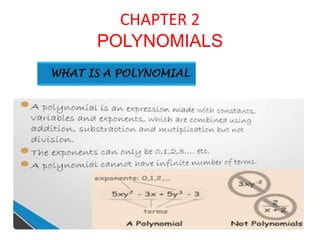
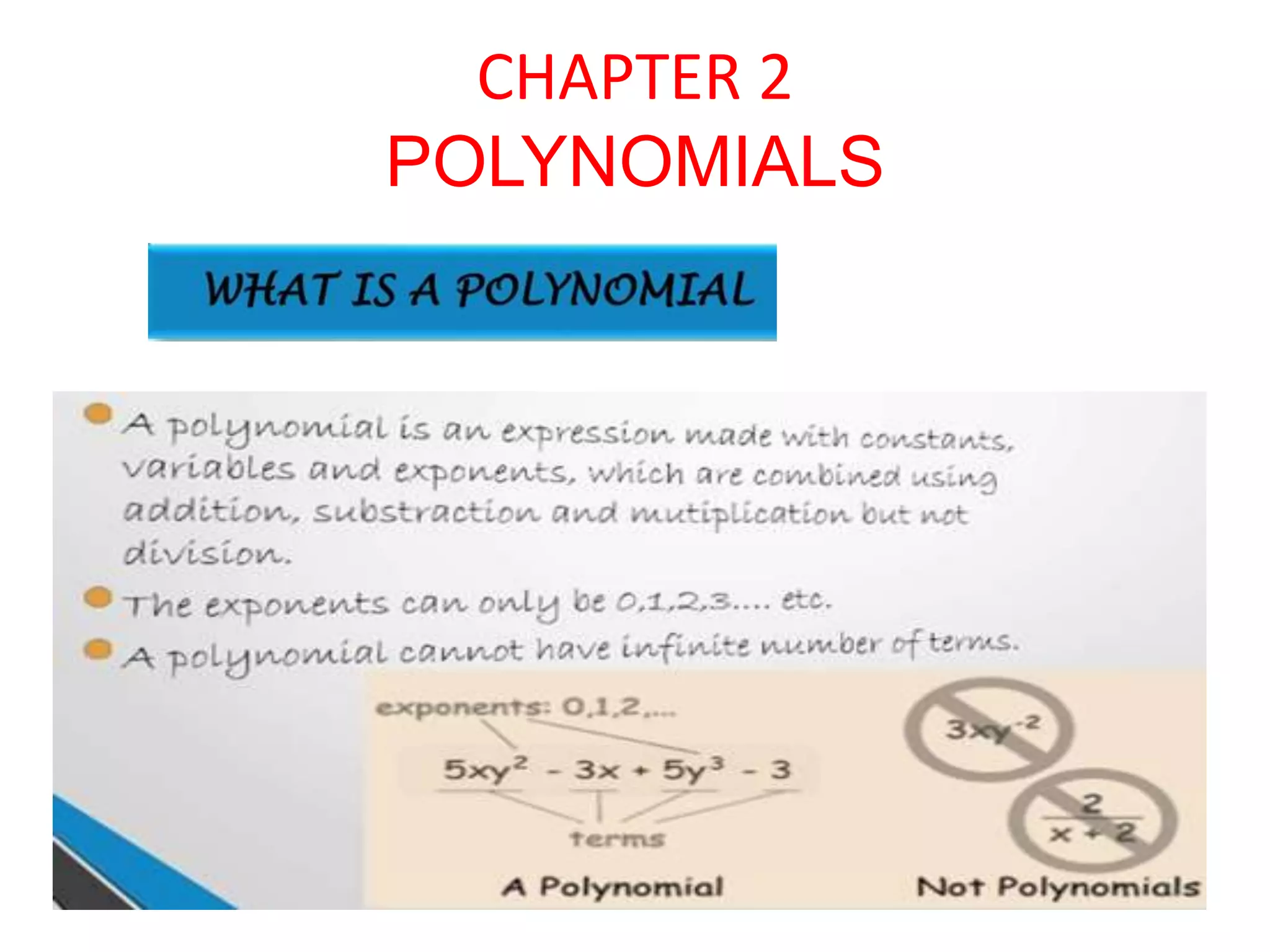
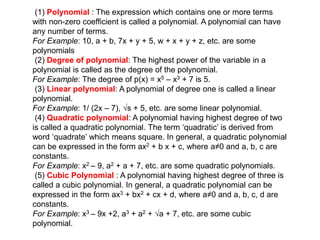
(1) Polynomial : The expression which contains one or more terms
with non-zero coefficient is called a polynomial. A polynomial can have
any number of terms.
For Example: 10, a + b, 7x + y + 5, w + x + y + z, etc. are some
polynomials
(2) Degree of polynomial: The highest power of the variable in a
polynomial is called as the degree of the polynomial.
For Example: The degree of p(x) = x5 – x3 + 7 is 5.
(3) Linear polynomial: A polynomial of degree one is called a linear
polynomial.
For Example: 1/ (2x – 7), √s + 5, etc. are some linear polynomial.
(4) Quadratic polynomial: A polynomial having highest degree of two
is called a quadratic polynomial. The term ‘quadratic’ is derived from
word ‘quadrate’ which means square. In general, a quadratic polynomial
can be expressed in the form ax2 + b x + c, where a≠0 and a, b, c are
constants.
For Example: x2 – 9, a2 + a + 7, etc. are some quadratic polynomials.
(5) Cubic Polynomial : A polynomial having highest degree of three is
called a cubic polynomial. In general, a quadratic polynomial can be
expressed in the form ax3 + bx2 + cx + d, where a≠0 and a, b, c, d are
constants.
For Example: x3 – 9x +2, a3 + a2 + √a + 7, etc. are some cubic
polynomial.
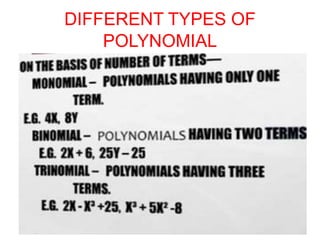
DIFFERENT TYPES OF
POLYNOMIAL
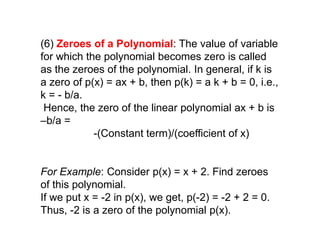
(6) Zeroes of a Polynomial: The value of variable
for which the polynomial becomes zero is called
as the zeroes of the polynomial. In general, if k is
a zero of p(x) = ax + b, then p(k) = a k + b = 0, i.e.,
k = - b/a.
Hence, the zero of the linear polynomial ax + b is
–b/a =
-(Constant term)/(coefficient of x)
For Example: Consider p(x) = x + 2. Find zeroes
of this polynomial.
If we put x = -2 in p(x), we get, p(-2) = -2 + 2 = 0.
Thus, -2 is a zero of the polynomial p(x).
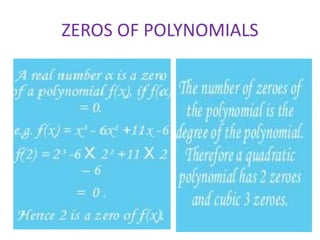
ZEROS OF POLYNOMIALS
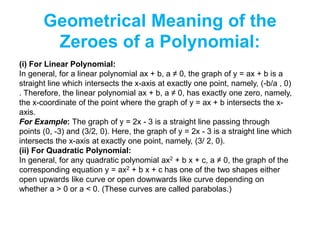
Geometrical Meaning of the
Zeroes of a Polynomial:
(i) For Linear Polynomial:
In general, for a linear polynomial ax + b, a ≠ 0, the graph of y = ax + b is a
straight line which intersects the x-axis at exactly one point, namely, (-b/a , 0)
. Therefore, the linear polynomial ax + b, a ≠ 0, has exactly one zero, namely,
the x-coordinate of the point where the graph of y = ax + b intersects the x-
axis.
For Example: The graph of y = 2x - 3 is a straight line passing through
points (0, -3) and (3/2, 0). Here, the graph of y = 2x - 3 is a straight line which
intersects the x-axis at exactly one point, namely, (3/ 2, 0).
(ii) For Quadratic Polynomial:
In general, for any quadratic polynomial ax2 + b x + c, a ≠ 0, the graph of the
corresponding equation y = ax2 + b x + c has one of the two shapes either
open upwards like curve or open downwards like curve depending on
whether a > 0 or a < 0. (These curves are called parabolas.)
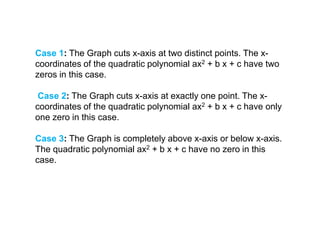
Case 1: The Graph cuts x-axis at two distinct points. The x-
coordinates of the quadratic polynomial ax2 + b x + c have two
zeros in this case.
Case 2: The Graph cuts x-axis at exactly one point. The x-
coordinates of the quadratic polynomial ax2 + b x + c have only
one zero in this case.
Case 3: The Graph is completely above x-axis or below x-axis.
The quadratic polynomial ax2 + b x + c have no zero in this
case.
Relationship between Zeroes and
Coefficients of a Polynomial:
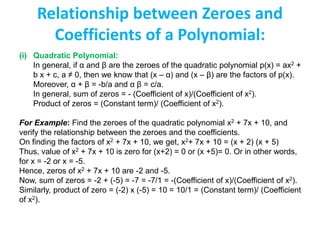
(i) Quadratic Polynomial:
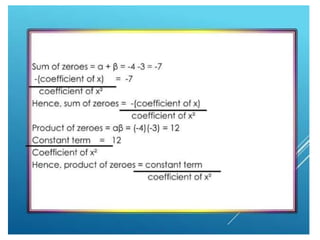
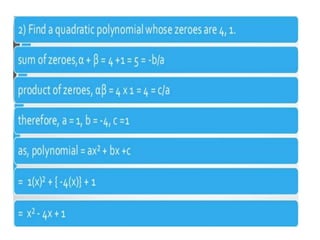
In general, if α and β are the zeroes of the quadratic polynomial p(x) = ax2 +
b x + c, a ≠ 0, then we know that (x – α) and (x – β) are the factors of p(x).
Moreover, α + β = -b/a and α β = c/a.
In general, sum of zeros = - (Coefficient of x)/(Coefficient of x2).
Product of zeros = (Constant term)/ (Coefficient of x2).
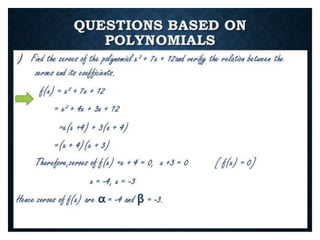
For Example: Find the zeroes of the quadratic polynomial x2 + 7x + 10, and
verify the relationship between the zeroes and the coefficients.
On finding the factors of x2 + 7x + 10, we get, x2+ 7x + 10 = (x + 2) (x + 5)
Thus, value of x2 + 7x + 10 is zero for (x+2) = 0 or (x +5)= 0. Or in other words,
for x = -2 or x = -5.
Hence, zeros of x2 + 7x + 10 are -2 and -5.
Now, sum of zeros = -2 + (-5) = -7 = -7/1 = -(Coefficient of x)/(Coefficient of x2).
Similarly, product of zero = (-2) x (-5) = 10 = 10/1 = (Constant term)/ (Coefficient
of x2).
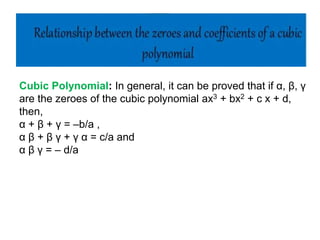
Cubic Polynomial: In general, it can be proved that if α, β, γ
are the zeroes of the cubic polynomial ax3 + bx2 + c x + d,
then,
α + β + γ = –b/a ,
α β + β γ + γ α = c/a and
α β γ = – d/a
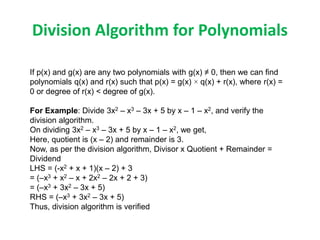
Division Algorithm for Polynomials
If p(x) and g(x) are any two polynomials with g(x) ≠ 0, then we can find
polynomials q(x) and r(x) such that p(x) = g(x) × q(x) + r(x), where r(x) =
0 or degree of r(x) < degree of g(x).
For Example: Divide 3x2 – x3 – 3x + 5 by x – 1 – x2, and verify the
division algorithm.
On dividing 3x2 – x3 – 3x + 5 by x – 1 – x2, we get,
Here, quotient is (x – 2) and remainder is 3.
Now, as per the division algorithm, Divisor x Quotient + Remainder =
Dividend
LHS = (-x2 + x + 1)(x – 2) + 3
= (–x3 + x2 – x + 2x2 – 2x + 2 + 3)
= (–x3 + 3x2 – 3x + 5)
RHS = (–x3 + 3x2 – 3x + 5)
Thus, division algorithm is verified
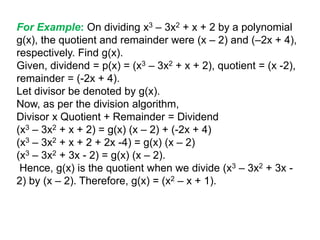
For Example: On dividing x3 – 3x2 + x + 2 by a polynomial
g(x), the quotient and remainder were (x – 2) and (–2x + 4),
respectively. Find g(x).
Given, dividend = p(x) = (x3 – 3x2 + x + 2), quotient = (x -2),
remainder = (-2x + 4).
Let divisor be denoted by g(x).
Now, as per the division algorithm,
Divisor x Quotient + Remainder = Dividend
(x3 – 3x2 + x + 2) = g(x) (x – 2) + (-2x + 4)
(x3 – 3x2 + x + 2 + 2x -4) = g(x) (x – 2)
(x3 – 3x2 + 3x - 2) = g(x) (x – 2).
Hence, g(x) is the quotient when we divide (x3 – 3x2 + 3x -
2) by (x – 2). Therefore, g(x) = (x2 – x + 1).
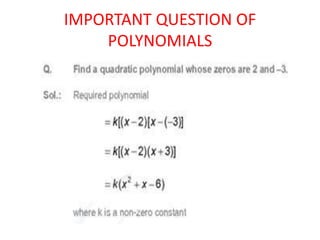
IMPORTANT QUESTION OF
POLYNOMIALS
THANK YOU

Class 10 Maths Ch Polynomial PPT

  • 1.
  • 2.
    (1) Polynomial :The expression which contains one or more terms with non-zero coefficient is called a polynomial. A polynomial can have any number of terms. For Example: 10, a + b, 7x + y + 5, w + x + y + z, etc. are some polynomials (2) Degree of polynomial: The highest power of the variable in a polynomial is called as the degree of the polynomial. For Example: The degree of p(x) = x5 – x3 + 7 is 5. (3) Linear polynomial: A polynomial of degree one is called a linear polynomial. For Example: 1/ (2x – 7), √s + 5, etc. are some linear polynomial. (4) Quadratic polynomial: A polynomial having highest degree of two is called a quadratic polynomial. The term ‘quadratic’ is derived from word ‘quadrate’ which means square. In general, a quadratic polynomial can be expressed in the form ax2 + b x + c, where a≠0 and a, b, c are constants. For Example: x2 – 9, a2 + a + 7, etc. are some quadratic polynomials. (5) Cubic Polynomial : A polynomial having highest degree of three is called a cubic polynomial. In general, a quadratic polynomial can be expressed in the form ax3 + bx2 + cx + d, where a≠0 and a, b, c, d are constants. For Example: x3 – 9x +2, a3 + a2 + √a + 7, etc. are some cubic polynomial.
  • 3.
  • 4.
    (6) Zeroes ofa Polynomial: The value of variable for which the polynomial becomes zero is called as the zeroes of the polynomial. In general, if k is a zero of p(x) = ax + b, then p(k) = a k + b = 0, i.e., k = - b/a. Hence, the zero of the linear polynomial ax + b is –b/a = -(Constant term)/(coefficient of x) For Example: Consider p(x) = x + 2. Find zeroes of this polynomial. If we put x = -2 in p(x), we get, p(-2) = -2 + 2 = 0. Thus, -2 is a zero of the polynomial p(x).
  • 5.
  • 6.
    Geometrical Meaning ofthe Zeroes of a Polynomial: (i) For Linear Polynomial: In general, for a linear polynomial ax + b, a ≠ 0, the graph of y = ax + b is a straight line which intersects the x-axis at exactly one point, namely, (-b/a , 0) . Therefore, the linear polynomial ax + b, a ≠ 0, has exactly one zero, namely, the x-coordinate of the point where the graph of y = ax + b intersects the x- axis. For Example: The graph of y = 2x - 3 is a straight line passing through points (0, -3) and (3/2, 0). Here, the graph of y = 2x - 3 is a straight line which intersects the x-axis at exactly one point, namely, (3/ 2, 0). (ii) For Quadratic Polynomial: In general, for any quadratic polynomial ax2 + b x + c, a ≠ 0, the graph of the corresponding equation y = ax2 + b x + c has one of the two shapes either open upwards like curve or open downwards like curve depending on whether a > 0 or a < 0. (These curves are called parabolas.)
  • 7.
    Case 1: TheGraph cuts x-axis at two distinct points. The x- coordinates of the quadratic polynomial ax2 + b x + c have two zeros in this case. Case 2: The Graph cuts x-axis at exactly one point. The x- coordinates of the quadratic polynomial ax2 + b x + c have only one zero in this case. Case 3: The Graph is completely above x-axis or below x-axis. The quadratic polynomial ax2 + b x + c have no zero in this case.
  • 8.
    Relationship between Zeroesand Coefficients of a Polynomial: (i) Quadratic Polynomial: In general, if α and β are the zeroes of the quadratic polynomial p(x) = ax2 + b x + c, a ≠ 0, then we know that (x – α) and (x – β) are the factors of p(x). Moreover, α + β = -b/a and α β = c/a. In general, sum of zeros = - (Coefficient of x)/(Coefficient of x2). Product of zeros = (Constant term)/ (Coefficient of x2). For Example: Find the zeroes of the quadratic polynomial x2 + 7x + 10, and verify the relationship between the zeroes and the coefficients. On finding the factors of x2 + 7x + 10, we get, x2+ 7x + 10 = (x + 2) (x + 5) Thus, value of x2 + 7x + 10 is zero for (x+2) = 0 or (x +5)= 0. Or in other words, for x = -2 or x = -5. Hence, zeros of x2 + 7x + 10 are -2 and -5. Now, sum of zeros = -2 + (-5) = -7 = -7/1 = -(Coefficient of x)/(Coefficient of x2). Similarly, product of zero = (-2) x (-5) = 10 = 10/1 = (Constant term)/ (Coefficient of x2).
  • 9.
    Cubic Polynomial: Ingeneral, it can be proved that if α, β, γ are the zeroes of the cubic polynomial ax3 + bx2 + c x + d, then, α + β + γ = –b/a , α β + β γ + γ α = c/a and α β γ = – d/a
  • 10.
    Division Algorithm forPolynomials If p(x) and g(x) are any two polynomials with g(x) ≠ 0, then we can find polynomials q(x) and r(x) such that p(x) = g(x) × q(x) + r(x), where r(x) = 0 or degree of r(x) < degree of g(x). For Example: Divide 3x2 – x3 – 3x + 5 by x – 1 – x2, and verify the division algorithm. On dividing 3x2 – x3 – 3x + 5 by x – 1 – x2, we get, Here, quotient is (x – 2) and remainder is 3. Now, as per the division algorithm, Divisor x Quotient + Remainder = Dividend LHS = (-x2 + x + 1)(x – 2) + 3 = (–x3 + x2 – x + 2x2 – 2x + 2 + 3) = (–x3 + 3x2 – 3x + 5) RHS = (–x3 + 3x2 – 3x + 5) Thus, division algorithm is verified
  • 11.
    For Example: Ondividing x3 – 3x2 + x + 2 by a polynomial g(x), the quotient and remainder were (x – 2) and (–2x + 4), respectively. Find g(x). Given, dividend = p(x) = (x3 – 3x2 + x + 2), quotient = (x -2), remainder = (-2x + 4). Let divisor be denoted by g(x). Now, as per the division algorithm, Divisor x Quotient + Remainder = Dividend (x3 – 3x2 + x + 2) = g(x) (x – 2) + (-2x + 4) (x3 – 3x2 + x + 2 + 2x -4) = g(x) (x – 2) (x3 – 3x2 + 3x - 2) = g(x) (x – 2). Hence, g(x) is the quotient when we divide (x3 – 3x2 + 3x - 2) by (x – 2). Therefore, g(x) = (x2 – x + 1).
  • 14.
  • 16.