4-8 The Quadratic Formula
and the Discriminant
p.278-281
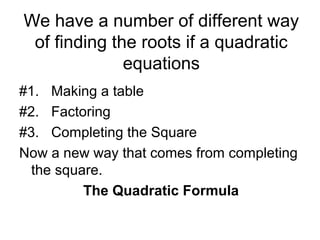
We have a number of different way
of finding the roots if a quadratic
equations
#1. Making a table
#2. Factoring
#3. Completing the Square
Now a new way that comes from completing
the square.
The Quadratic Formula
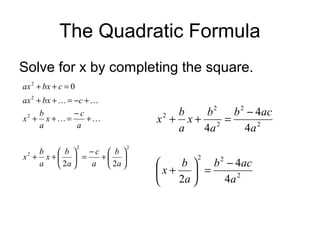
Solve for x by completing the square.
ax 2 + bx + c = 0
ax 2 + bx +  = −c + 
b
−c
2
x + x +=
+
a
a
2

b
−c  b 
 b 
x + x+  =
+ 
a
a  2a 
 2a 
2

2
The Quadratic Formula
Solve for x by completing the square.
ax 2 + bx + c = 0
ax 2 + bx +  = −c + 
b
−c
x2 + x +  =
+
a
a
2

b
−c  b 
 b 
x2 + x +   =
+ 
a
a  2a 
 2a 

b
b2
b 2 − 4ac
x2 + x + 2 =
a
4a
4a 2
2

2

b  b 2 − 4ac

x+  =
2a 
4a 2

The Quadratic Formula
Solve for x by completing the square.
b
b2
b 2 − 4ac
x + x+ 2 =
a
4a
4a 2
2

2

b  b 2 − 4ac

x+  =
2a 
4a 2


b
b 2 − 4ac
x+
=±
2a
4a 2
−b
b 2 − 4ac
x=
±
2a
2a
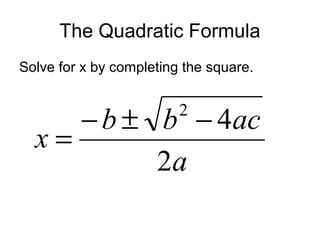
− b ± b 2 − 4ac
x=
2a
The Quadratic Formula
Solve for x by completing the square.

− b ± b − 4ac
x=
2a
2
How does it work
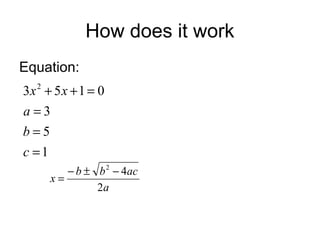
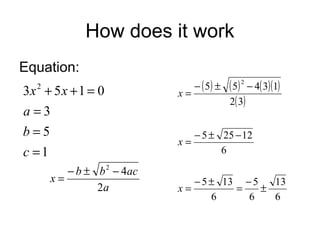
Equation:
3x 2 + 5 x + 1 = 0
a=3
b=5
c =1
− b ± b 2 − 4ac
x=
2a
How does it work
Equation:
3x + 5 x + 1 = 0
a=3
b=5
c =1
2

− b ± b 2 − 4ac
x=
2a

x=

− ( 5) ±

( 5) 2 − 4( 3)(1)
2( 3)

− 5 ± 25 − 12
x=
6
x=

− 5 ± 13 − 5
13
=
±
6
6
6
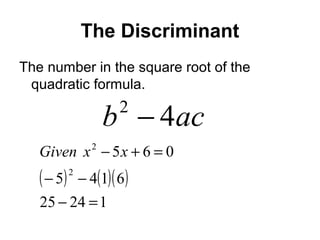
The Discriminant
The number in the square root of the
quadratic formula.

b − 4ac
2

Given x − 5 x + 6 = 0
2

( − 5)

− 4(1)( 6 )
25 − 24 = 1
2
The Discriminant

b − 4ac
2

The Discriminant can be negative, positive or zero
If the Discriminant is positive then there are:
2 real answers.
If the square root is not a prefect square
( for example 25 ),
then there will be 2 irrational roots
( for example 2 ± 5 ).
The Discriminant

b 2 − 4ac

The Discriminant can be negative, positive or zero
If the Discriminant is positive,
there are 2 real answers.
If the Discriminant is zero,
there is 1 real answer.
If the Discriminant is negative,
there are 2 complex answers.
complex answer have i.
Let’s put all of that
b
information in a chart.
Value of Discriminant

Type and
Number of Roots

D > 0,
D is a perfect square

2 real,
rational roots
(ex: x= 2 and x= -4)

D > 0,
D NOT a perfect square

2 real,
Irrational roots
(x = √13 x= -√13)

D=0

1 real, rational root
(double root)
(ex: x = 5)

D<0

2 complex roots
(complex conjugates)
(x = 2 ± 3i )

2

− 4ac

Sample Graph
of Related Function
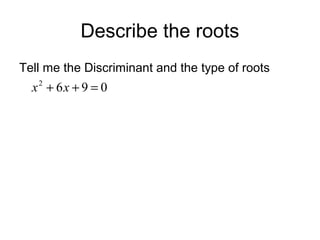
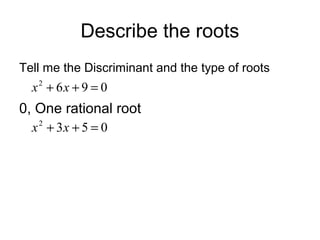
Describe the roots
Tell me the Discriminant and the type of roots

x2 + 6x + 9 = 0
Describe the roots
Tell me the Discriminant and the type of roots

x2 + 6x + 9 = 0

0, One rational root
Describe the roots
Tell me the Discriminant and the type of roots

x2 + 6x + 9 = 0

0, One rational root
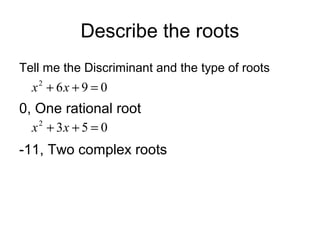
x + 3x + 5 = 0
2

-11, Two complex roots
x + 8x − 4 = 0
2

80, Two irrational roots
Describe the roots
Tell me the Discriminant and the type of roots

x2 + 6x + 9 = 0

0, One rational root
x + 3x + 5 = 0
2
Describe the roots
Tell me the Discriminant and the type of roots

x2 + 6x + 9 = 0

0, One rational root
x + 3x + 5 = 0
2

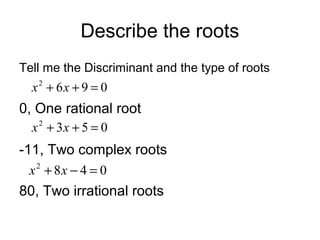
-11, Two complex roots
Describe the roots
Tell me the Discriminant and the type of roots

x2 + 6x + 9 = 0

0, One rational root
x + 3x + 5 = 0
2

-11, Two complex roots
x + 8x − 4 = 0
2
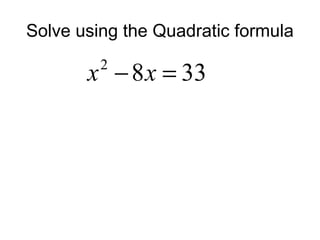
Solve using the Quadratic formula

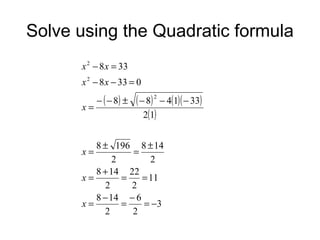
x − 8 x = 33
2
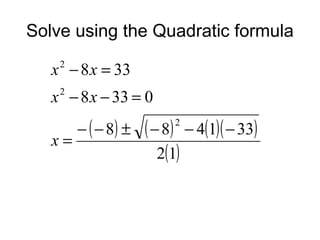
Solve using the Quadratic formula
x − 8 x = 33
2

x − 8 x − 33 = 0
2

x=

− ( − 8) ±

( − 8) − 4(1)( − 33)
2(1)
2
Solve using the Quadratic formula
x 2 − 8 x = 33
x 2 − 8 x − 33 = 0
x=

− ( − 8) ±

( − 8) 2 − 4(1)( − 33)
2(1)

8 ± 196 8 ± 14
x=
=
2
2
8 + 14 22
x=
=
= 11
2
2
8 − 14 − 6
x=
=
= −3
2
2
Solve using the Quadratic formula

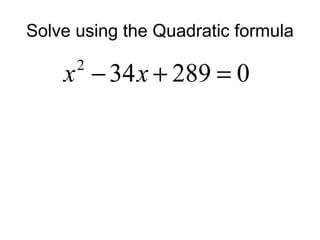
x − 34 x + 289 = 0
2
Solve using the Quadratic formula
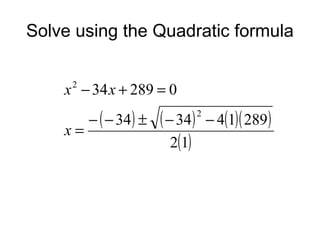
x − 34 x + 289 = 0
2

x=

− ( − 34 ) ±

( − 34)
2(1)

2

− 4(1)( 289 )
Solve using the Quadratic formula
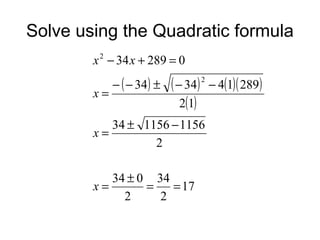
x − 34 x + 289 = 0
2

x=

− ( − 34) ±

( − 34) 2 − 4(1)( 289)
2(1)

34 ± 1156 − 1156
x=
2
34 ± 0 34
x=
=
= 17
2
2
Solve using the Quadratic formula

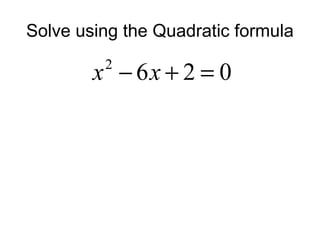
x − 6x + 2 = 0
2
Solve using the Quadratic formula
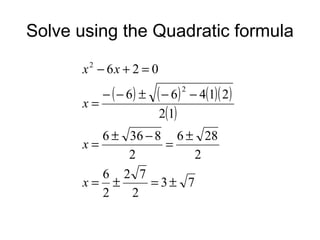
x − 6x + 2 = 0
2

x=

− ( − 6) ±

( − 6)
2(1)

2

− 4(1)( 2 )

6 ± 36 − 8 6 ± 28
x=
=
2
2
6 2 7
x= ±
= 3± 7
2
2
Solve using the Quadratic formula

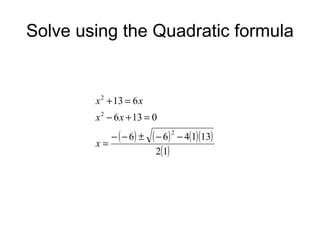
x 2 + 13 = 6 x
x 2 − 6 x + 13 = 0
x=

− ( − 6) ±

( − 6) 2 − 4(1)(13)
2(1)
Solve using the Quadratic formula

x 2 + 13 = 6 x
x 2 − 6 x + 13 = 0
x=

− ( − 6) ±

( − 6) 2 − 4(1)(13)
2(1)

6 ± 36 − 52 6 ± − 16
x=
=
2
2
Solve using the Quadratic formula
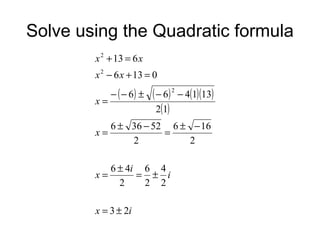
x 2 + 13 = 6 x
x 2 − 6 x + 13 = 0
x=

− ( − 6) ±

( − 6) 2 − 4(1)(13)
2(1)

6 ± 36 − 52 6 ± − 16
x=
=
2
2
6 ± 4i 6 4
x=
= ± i
2
2 2
x = 3 ± 2i