Types of Numbers


                   1
Content
Natural numbers
Whole numbers
Integers
Rational numbers
Irrational numbers
Real numbers
Rationalize the denominator
Properties of real numbers
Complex numbers

                               2
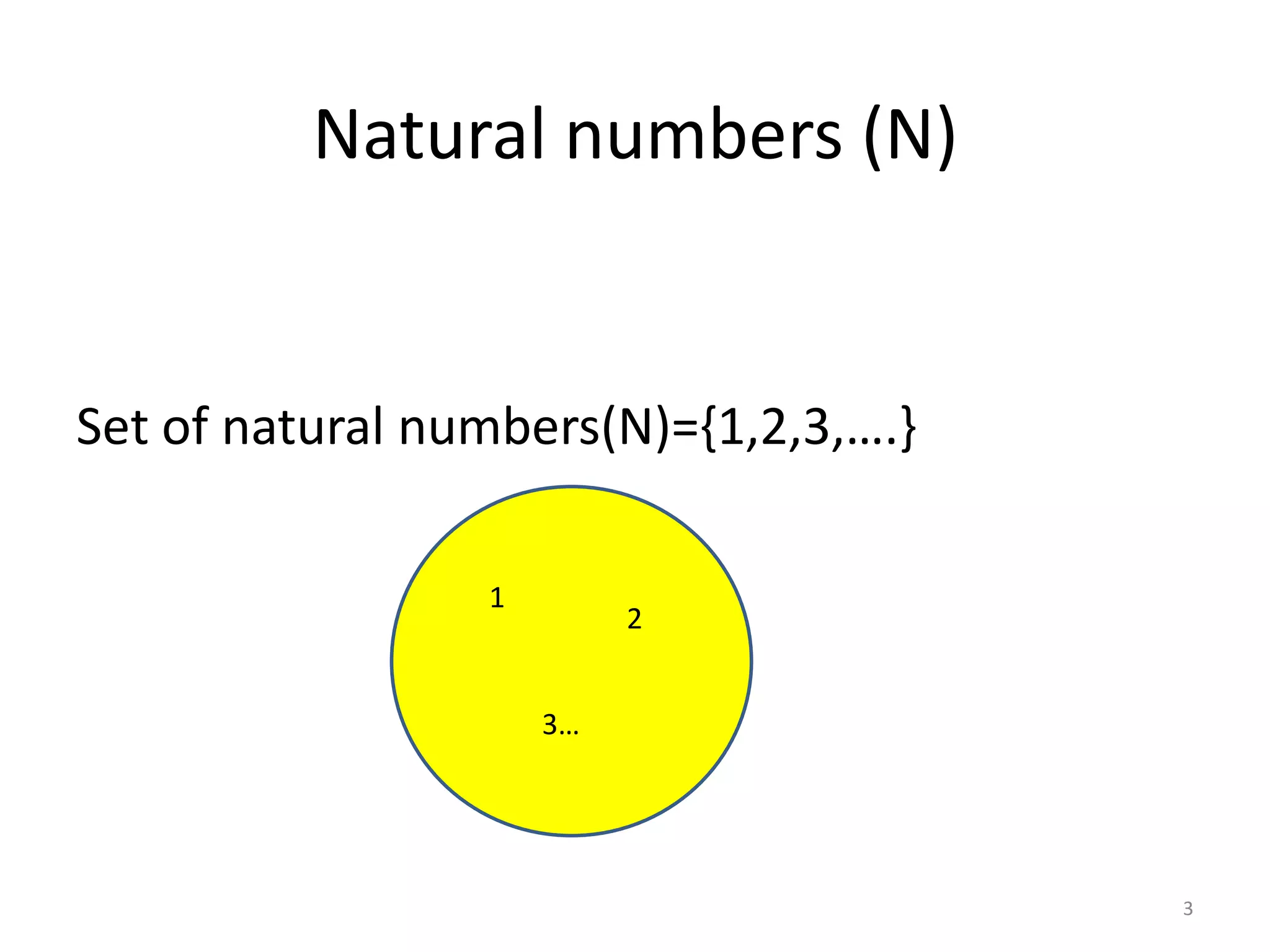
Natural numbers (N)


Set of natural numbers(N)={1,2,3,….}

                 1
                          2


                     3…


                                       3
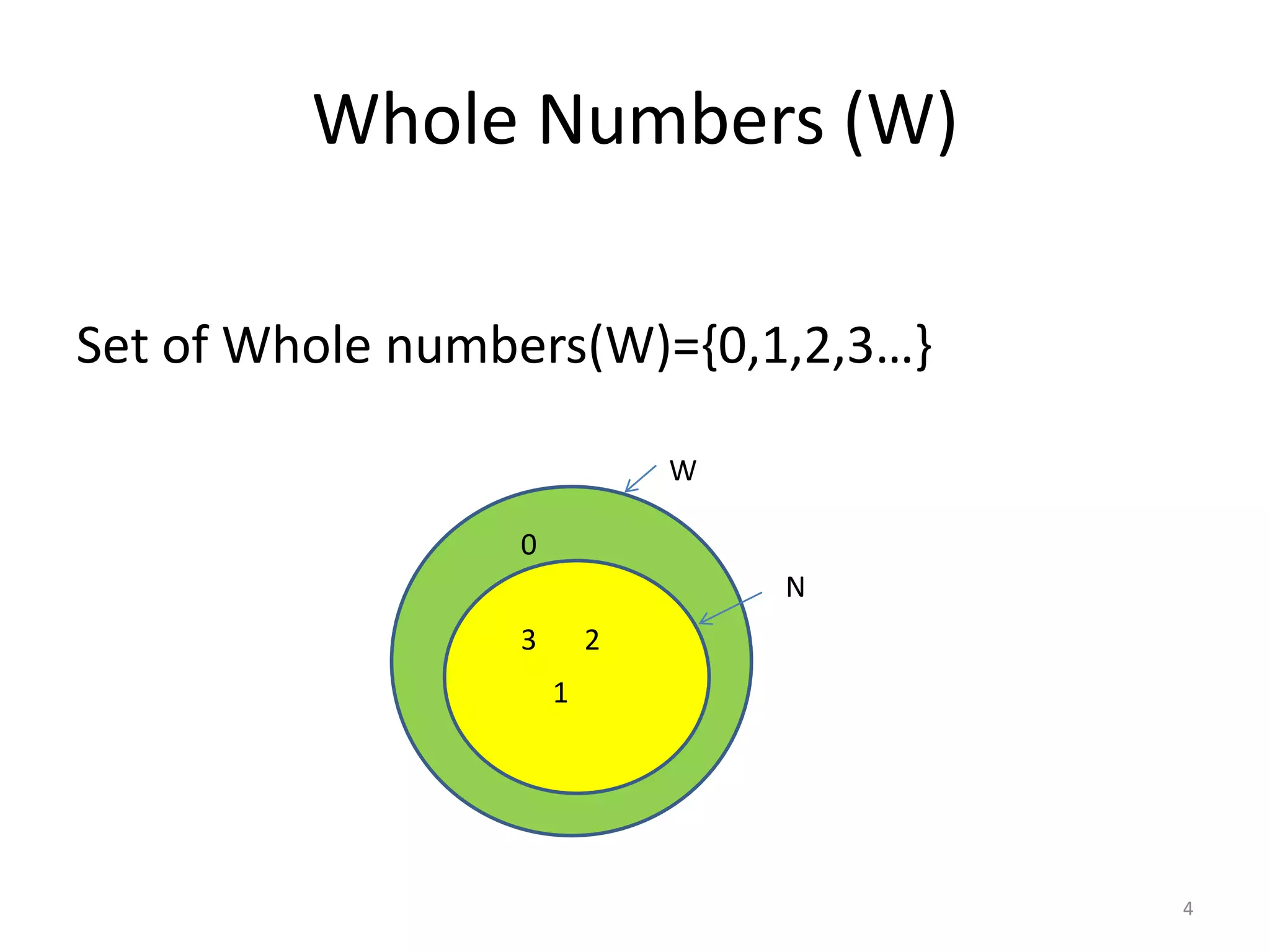
Whole Numbers (W)

Set of Whole numbers(W)={0,1,2,3…}

                             W

                 0
                                 N
                 3       2
                     1


                                     4
Integers
Set of Integers (Z) ={…-3,-2,-1,0,1,2,3,…}

          Z
                                     W
                                -1
                   -2
                                              N
                    0

                    3       2
                                         -3
                        1


                                                  5
Rational Numbers (Q)
Set of rational numbers(Q)
                      ={x:x=p/q;p,q ЄZ and q≠0}
            Z                              W
                                 -1
                    -2
                                                      N
                     0

                                               -1/2
                     3       2
           5/25                       -3
                         1


                                                          6
Irrational numbers
 REAL NUMBERS: a number that can be written as a
                   decimal.

RATIONAL NUMBERS: a number that can be written as
                  a fraction.

IRRATIONAL NUMBERS: a number that is not rational.
         It can not be written as a fraction


                                                     7
What this means…….
•   The number line goes on forever.
•   Every point on the line is a REAL number.
•   There are no gaps on the number line.
•   Between the whole numbers and the fractions
    there are numbers that are decimals but they
    don’t terminate and are not recurring
    decimals. They go on forever.


                                               8
Examples of IRRATIONAL numbers


   , 2 , 3, 5 , 6 , 7 , 8


   4 is not irrational because
   4   2 a rational number

                                 9
Converting Fractions and Decimals
  Fraction                      Decimal
                 0 37 5
    3          8 3.000          0.375
    8             24
means 3 8          60
                   56
                    40
                    40
                     0
To change a fraction to a decimal, take
the top divided by the bottom, or
numerator divided by the denominator.     10
Complete the table.
     Fraction         Decimal
         4
         5              0.8
         3
                       0.03
       100
         7
        20             0.35

       6  7
                        6.7
         10
       9  1            9.125
          8                     11
Repeating Decimals
  Fraction                        Decimal
    1              0 3 33...
    3            3 1.000           0.3
                     9
means 1 3            10            0.33
                       9
                      10
                        9
                        1
Every rational number (fraction) either terminates
or repeats when written as a decimal.
                                               12
Repeating Decimals
  Fraction                        Decimal
     5              0 45454 ...
                 11 5.00000       0.454
    11
                    44
means 5 11            60          0.454
                      55
                       50         0.45
                       44
                        60
                         55
                          50
                          44
                           6                13
Repeating Decimals
  Fraction                        Decimal
    5              0 8 33...
                 6 5.000           0.83
    6              48
means 5 6            20           0.833
                     18
                      20
                      18           0.83
                        2


                                            14
PLACE YOUR ANSWERS IN THESE

    +        Rational Irrational       -        Rational Irrational

Rational                           Rational

irrational                         Irrational


                                                                 15
+       Rational Irrational       -      Rational Irrational

Rational   Rational Irrational   Rational   Rational Irrational

irrational Irrational   Either   Irrational Irrational   Either


                                                             16
PLACE YOUR ANSWERS IN THESE

    x        Rational Irrational                Rational Irrational

Rational                           Rational

irrational                         Irrational


                                                                 17
x       Rational Irrational              Rational Irrational

Rational   Rational Irrational   Rational   Rational Irrational

irrational Irrational Rational   Irrational Irrational Rational


                                                            18
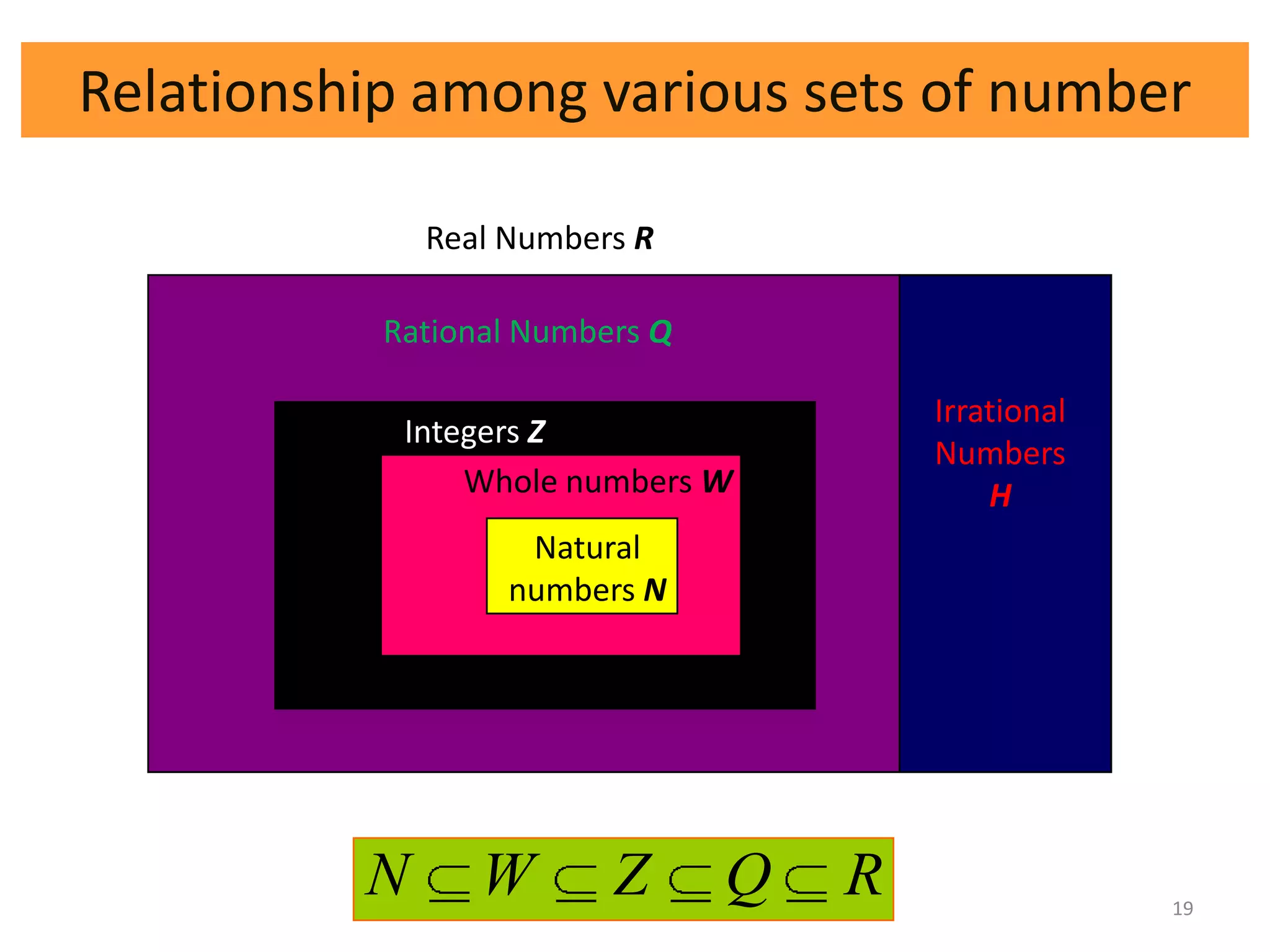
Relationship among various sets of number

              Real Numbers R

           Rational Numbers Q
                                        Irrational
                                        Irrational
            Integers Z                  numbers
                                        Numbers
                Whole numbers W              H
                    Natural
                   numbers N


          N      W       Z      Q   R                19
• Two ways of representing real numbers. As is
  evident, all rational numbers can be written as
  fractions. Decimals which are presented on
  the place value system, are two types.
  – 1. Finite decimals
  – 2. infinite decimals
  Out of these finite decimals are rational. For
    example 3.467 is a finite decimal which is equal to
    3467/1000 and is of the form p/q.
                                                      20
• Infinite decimals are also of two types.
      1. recurring decimals
      2. Non-recurring decimals
Out of these recurring decimals are rational and
  non recurring decimals are irrational.


                                               21
Rationalizing the Denominator
  This process transfers the surd from the
  denominator to the numerator. Follow the
Examples:
1. Rationalize the Denominator
(a) 2/√3
(b) 10/√5


                                             22
Examples:
2. Rationalize the Denominator 2/(√7+2).


3. Rationalize the Denominator of
  (3√2+ 2√3)/(3√2- √2) and simplify.


                                           23
Properties of the Real Number System
                                         Rules of Operations
Under Addition
1. a b b a                                         Commutative law of addition
2.   a     b       c        a    b   c              Associative law of addition
3.   a   0         0    a                          Identity law of addition
4.   a         a =0                                 Inverse Law of addition
Under Multiplication
1. ab ba                                           Commutative law of multiplication
2.   a bc              ab c                         Associative law of multiplication
3.   a  1a
       1                                           Identity law of multiplication
      1
4.   a   =1                                        Inverse Law of multiplication
      a
Under Addition and Multiplication
1.   a b       c       ab       bc                 Distributive law for multiplication
                                                   w.r.t addition                        24
Properties of Negatives

     1.              a       a
     2.          a b             ab      a     b
     3.          a       b       ab
     4.          1 a         a


          Properties Involving Zero


1.   a0     0
2.   If ab       0 then a         0, b       0 or both


                                                         25
Properties of Quotients

     a   c
1.           if ad bc                 b, d        0
     b   d
     ca    a
2.                                    b, c        0
     cb    b
      a      a       a
3.                                    b       0
       b    b        b
     a c      ac
4.                                       b, d       0
     b d     bd
     a c       a d     ad
5.                                       b, c , d       0
     b d       b c     bc
     a c       ad bc
6.                                        b, d       0
     b d          bd
     a c       ad bc
7.                                        b, d       0
     b d          bd
                                                             26
Open & Closed Interval

                          Open Half Interval
      Open Interval

                          xa    x b or a, b
xa    x b or a, b         xa    x b or a, b

        Closed Interval   xx   a or            ,a
                          xx   a or            ,a
 xa    x b or a, b        xx   a or a,
                          xx    a or a,


                                                    27
Imaginary and Complex
      Numbers


                        28
What is a Complex Number
• A number that can be expressed in the form a + bi where a
  and b are real numbers and i is the imaginary unit.
• Imaginary unit is the number represented by i, where

                      i     1 and i 2   1

• Imaginary number is a number that can be expressed in
  the form bi, where b is a real number and i is the imaginary
  unit.
• When written in the form a + bi , a complex number is said
  to be in Standard Form.


                                                                 29
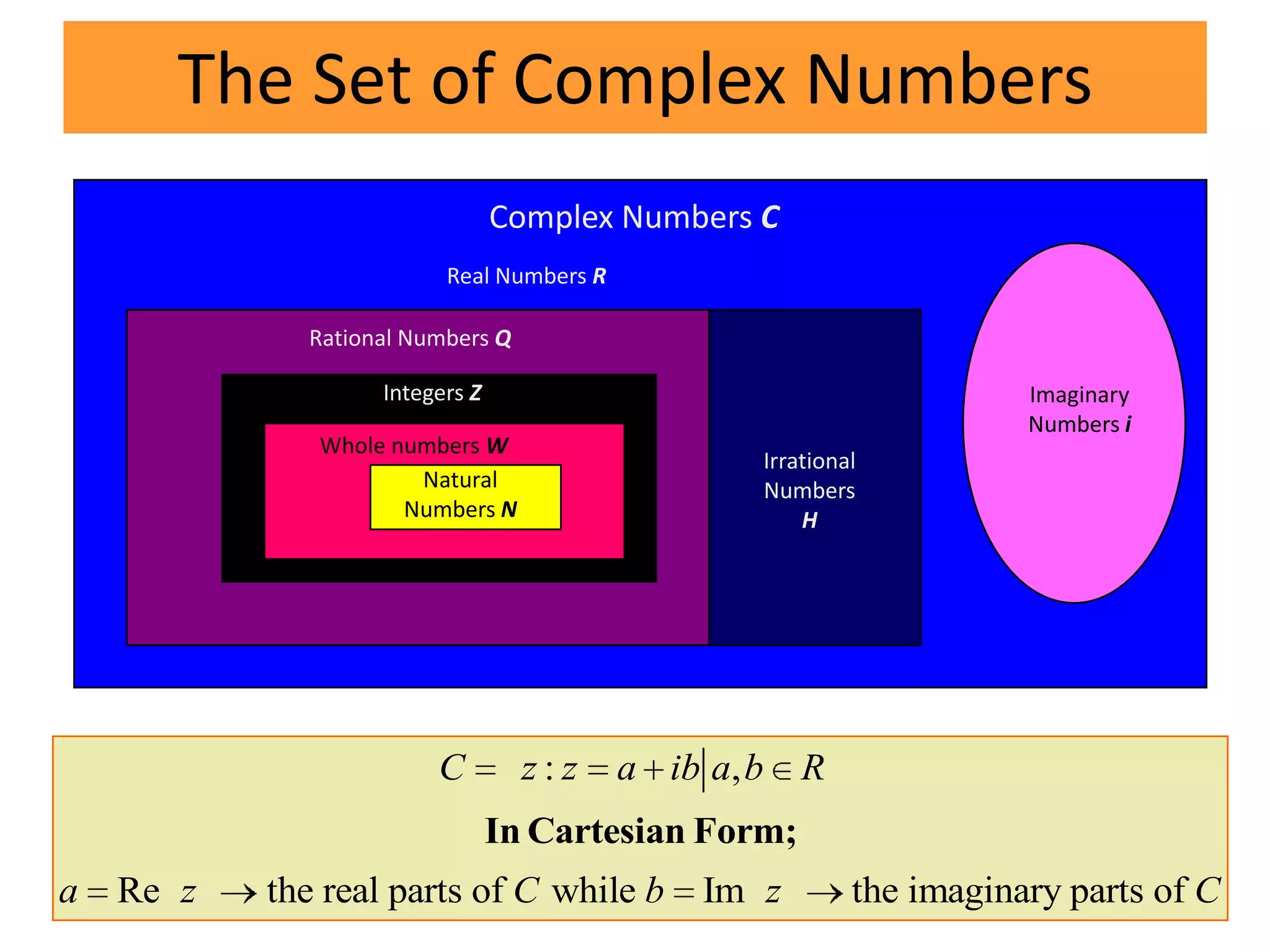
The Set of Complex Numbers
                                Complex Numbers C
                         Real Numbers R

             Rational Numbers Q

                   Integers Z                                        Imaginary
                                          R                          Numbers i
              Whole numbers W
                                                 Irrational
                      Natural                    Numbers
                     Numbers N                       H


                        C         z:z     a ib a, b R
                                In Cartesian Form;
a   Re z   the real parts of C while b        Im z        the imaginary parts of C
                                                                               30
Imaginary Numbers
• Consider if we use the product rule to rewrite as
         16      1    16
   – This step is called “poking out the i”
   – We know how to evaluate
• Imaginary unit:                             16
   – Thus,     16 4i i       1
   – Any number with an i is called an imaginary number
   – Also by definition:
                               2
                           i       1


                                                          31
Complex Numbers
• Complex Number: a number written in the
  format a + bi where:
  – a and b are real numbers
  – a is the real part
  – bi is the imaginary part


                                            32
Complex Numbers (Example)
Ex 1: Simplify and write in a + bi format:

  a)        81

  b)      12      48


                                             33
Adding & Subtracting
 Complex Numbers


                       34
Adding & Subtracting Complex Numbers

• To add complex numbers
  – Add the real parts
  – Add the imaginary parts
  – The real and imaginary parts cannot be combined
    any further
• To subtract two complex numbers
  – Distribute the negative to the second complex
    number
  – Treat as adding complex numbers

                                                      35
Adding & Subtracting Complex
          Numbers (Example)
Ex 2: Simplify and write in a + bi format:

  a) (8 – 3i) + (2 + i)
  b) (5 + 9i) – (4 – 8i)
  c) 5i – (-5 + 2i)


                                             36
Multiplying Complex
     Numbers


                      37
Multiplying Complex Numbers
• To multiply 3i · 2i
   – Multiply the real numbers first: 6
   – Multiply the i s: i · i = i2
     3i · 2i = 6i2 = -6
      • Remember that it is only acceptable to leave i in the
        final answer
• To multiply complex numbers in general
   – Use the distributive property or FOIL


                                                                38
Multiplying Complex Numbers
               (Example)
Ex 3: Multiply and write in a + bi format:

  a) -3i · 5i
  b) 7i(9 – 4i)
  c) (3 – 2i)(7 + 6i)


                                             39
Dividing Complex
    Numbers


                   40
Complex Conjugates
• Consider (3 + i), (3 – i)
   – What do you notice?
• Complex conjugate: the same complex
  number with real parts a and imaginary part
  bi except with the opposite sign
   – Very similar to conjugates when we discussed
     rationalizing
   – Ex: The complex conjugate of (2 – i) is (2 + i)

                                                       41
Dividing Complex Numbers
• Goal is to write the quotient of complex
  numbers in the format a + bi
  – Multiply the numerator and denominator by the
    complex conjugate of the denominator (dealing
    with an expression)
  – The numerator simplifies to a complex number
  – The denominator simplifies to a single real
    number
  – Divide the denominator into each part of the
    numerator and write the result in a + bi format

                                                      42
Dividing Complex Numbers (Example)
Ex 4: Divide – write in a + bi format:

         6 i
  a)
          3i
         2 i
  b)
         2 5i


                                         43
SUMMERY
    Operations on Complex Numbers
For z a bi and z c di then ;
     1             ,2


• Adding complex numbers
    z1 z2    a bi        c di      a c    b d i

• Subtracting complex numbers
   z1 z2     a bi        c di     a c     b d i
• Multiplying complex numbers
    z1 z2   a bi c di           ac bd    ad bc i
• Dividing complex numbers
                                 a bi    c di      ac bd   bc ad i
   z1 z2    a bi        c di
                                 c di    c di          c2 d 2        44
Same Complex Numbers
   2 complex numbers z = a + bi and z = c + di
                              1                   2


    are same if a = c and b = d.

   Example:

       Given z = 2 + (3y+1)i and z = 2x + 7i
                  1                 2


        with z = z . Find the value of x and y.
              1       2


                                                      45
Conjugate Complex
   A complex conjugate of a complex number
    z = a + bi is z* = a – bi

   If z and z are complex numbers, then
      1     2


                                    *
                1.   z1    z2                z1*   z 2*
                                *
                2.    z1 z2              z1* z2*
                        * *
                3.   z 1            z1
                                         *
                      1         1
                4.
                     z1*        z1
                                                          46

types of numbers

  • 1.
  • 2.
    Content Natural numbers Whole numbers Integers Rationalnumbers Irrational numbers Real numbers Rationalize the denominator Properties of real numbers Complex numbers 2
  • 3.
    Natural numbers (N) Setof natural numbers(N)={1,2,3,….} 1 2 3… 3
  • 4.
    Whole Numbers (W) Setof Whole numbers(W)={0,1,2,3…} W 0 N 3 2 1 4
  • 5.
    Integers Set of Integers(Z) ={…-3,-2,-1,0,1,2,3,…} Z W -1 -2 N 0 3 2 -3 1 5
  • 6.
    Rational Numbers (Q) Setof rational numbers(Q) ={x:x=p/q;p,q ЄZ and q≠0} Z W -1 -2 N 0 -1/2 3 2 5/25 -3 1 6
  • 7.
    Irrational numbers REALNUMBERS: a number that can be written as a decimal. RATIONAL NUMBERS: a number that can be written as a fraction. IRRATIONAL NUMBERS: a number that is not rational. It can not be written as a fraction 7
  • 8.
    What this means……. • The number line goes on forever. • Every point on the line is a REAL number. • There are no gaps on the number line. • Between the whole numbers and the fractions there are numbers that are decimals but they don’t terminate and are not recurring decimals. They go on forever. 8
  • 9.
    Examples of IRRATIONALnumbers , 2 , 3, 5 , 6 , 7 , 8 4 is not irrational because 4 2 a rational number 9
  • 10.
    Converting Fractions andDecimals Fraction Decimal 0 37 5 3 8 3.000 0.375 8 24 means 3 8 60 56 40 40 0 To change a fraction to a decimal, take the top divided by the bottom, or numerator divided by the denominator. 10
  • 11.
    Complete the table. Fraction Decimal 4 5 0.8 3 0.03 100 7 20 0.35 6 7 6.7 10 9 1 9.125 8 11
  • 12.
    Repeating Decimals Fraction Decimal 1 0 3 33... 3 3 1.000 0.3 9 means 1 3 10 0.33 9 10 9 1 Every rational number (fraction) either terminates or repeats when written as a decimal. 12
  • 13.
    Repeating Decimals Fraction Decimal 5 0 45454 ... 11 5.00000 0.454 11 44 means 5 11 60 0.454 55 50 0.45 44 60 55 50 44 6 13
  • 14.
    Repeating Decimals Fraction Decimal 5 0 8 33... 6 5.000 0.83 6 48 means 5 6 20 0.833 18 20 18 0.83 2 14
  • 15.
    PLACE YOUR ANSWERSIN THESE + Rational Irrational - Rational Irrational Rational Rational irrational Irrational 15
  • 16.
    + Rational Irrational - Rational Irrational Rational Rational Irrational Rational Rational Irrational irrational Irrational Either Irrational Irrational Either 16
  • 17.
    PLACE YOUR ANSWERSIN THESE x Rational Irrational Rational Irrational Rational Rational irrational Irrational 17
  • 18.
    x Rational Irrational Rational Irrational Rational Rational Irrational Rational Rational Irrational irrational Irrational Rational Irrational Irrational Rational 18
  • 19.
    Relationship among varioussets of number Real Numbers R Rational Numbers Q Irrational Irrational Integers Z numbers Numbers Whole numbers W H Natural numbers N N W Z Q R 19
  • 20.
    • Two waysof representing real numbers. As is evident, all rational numbers can be written as fractions. Decimals which are presented on the place value system, are two types. – 1. Finite decimals – 2. infinite decimals Out of these finite decimals are rational. For example 3.467 is a finite decimal which is equal to 3467/1000 and is of the form p/q. 20
  • 21.
    • Infinite decimalsare also of two types. 1. recurring decimals 2. Non-recurring decimals Out of these recurring decimals are rational and non recurring decimals are irrational. 21
  • 22.
    Rationalizing the Denominator This process transfers the surd from the denominator to the numerator. Follow the Examples: 1. Rationalize the Denominator (a) 2/√3 (b) 10/√5 22
  • 23.
    Examples: 2. Rationalize theDenominator 2/(√7+2). 3. Rationalize the Denominator of (3√2+ 2√3)/(3√2- √2) and simplify. 23
  • 24.
    Properties of theReal Number System Rules of Operations Under Addition 1. a b b a Commutative law of addition 2. a b c a b c Associative law of addition 3. a 0 0 a Identity law of addition 4. a a =0 Inverse Law of addition Under Multiplication 1. ab ba Commutative law of multiplication 2. a bc ab c Associative law of multiplication 3. a  1a 1 Identity law of multiplication 1 4. a =1 Inverse Law of multiplication a Under Addition and Multiplication 1. a b c ab bc Distributive law for multiplication w.r.t addition 24
  • 25.
    Properties of Negatives 1. a a 2. a b ab a b 3. a b ab 4. 1 a a Properties Involving Zero 1. a0 0 2. If ab 0 then a 0, b 0 or both 25
  • 26.
    Properties of Quotients a c 1. if ad bc b, d 0 b d ca a 2. b, c 0 cb b a a a 3. b 0 b b b a c ac 4.  b, d 0 b d bd a c a d ad 5.  b, c , d 0 b d b c bc a c ad bc 6. b, d 0 b d bd a c ad bc 7. b, d 0 b d bd 26
  • 27.
    Open & ClosedInterval Open Half Interval Open Interval xa x b or a, b xa x b or a, b xa x b or a, b Closed Interval xx a or ,a xx a or ,a xa x b or a, b xx a or a, xx a or a, 27
  • 28.
  • 29.
    What is aComplex Number • A number that can be expressed in the form a + bi where a and b are real numbers and i is the imaginary unit. • Imaginary unit is the number represented by i, where i 1 and i 2 1 • Imaginary number is a number that can be expressed in the form bi, where b is a real number and i is the imaginary unit. • When written in the form a + bi , a complex number is said to be in Standard Form. 29
  • 30.
    The Set ofComplex Numbers Complex Numbers C Real Numbers R Rational Numbers Q Integers Z Imaginary R Numbers i Whole numbers W Irrational Natural Numbers Numbers N H C z:z a ib a, b R In Cartesian Form; a Re z the real parts of C while b Im z the imaginary parts of C 30
  • 31.
    Imaginary Numbers • Considerif we use the product rule to rewrite as 16 1 16 – This step is called “poking out the i” – We know how to evaluate • Imaginary unit: 16 – Thus, 16 4i i 1 – Any number with an i is called an imaginary number – Also by definition: 2 i 1 31
  • 32.
    Complex Numbers • ComplexNumber: a number written in the format a + bi where: – a and b are real numbers – a is the real part – bi is the imaginary part 32
  • 33.
    Complex Numbers (Example) Ex1: Simplify and write in a + bi format: a) 81 b) 12 48 33
  • 34.
    Adding & Subtracting Complex Numbers 34
  • 35.
    Adding & SubtractingComplex Numbers • To add complex numbers – Add the real parts – Add the imaginary parts – The real and imaginary parts cannot be combined any further • To subtract two complex numbers – Distribute the negative to the second complex number – Treat as adding complex numbers 35
  • 36.
    Adding & SubtractingComplex Numbers (Example) Ex 2: Simplify and write in a + bi format: a) (8 – 3i) + (2 + i) b) (5 + 9i) – (4 – 8i) c) 5i – (-5 + 2i) 36
  • 37.
  • 38.
    Multiplying Complex Numbers •To multiply 3i · 2i – Multiply the real numbers first: 6 – Multiply the i s: i · i = i2 3i · 2i = 6i2 = -6 • Remember that it is only acceptable to leave i in the final answer • To multiply complex numbers in general – Use the distributive property or FOIL 38
  • 39.
    Multiplying Complex Numbers (Example) Ex 3: Multiply and write in a + bi format: a) -3i · 5i b) 7i(9 – 4i) c) (3 – 2i)(7 + 6i) 39
  • 40.
  • 41.
    Complex Conjugates • Consider(3 + i), (3 – i) – What do you notice? • Complex conjugate: the same complex number with real parts a and imaginary part bi except with the opposite sign – Very similar to conjugates when we discussed rationalizing – Ex: The complex conjugate of (2 – i) is (2 + i) 41
  • 42.
    Dividing Complex Numbers •Goal is to write the quotient of complex numbers in the format a + bi – Multiply the numerator and denominator by the complex conjugate of the denominator (dealing with an expression) – The numerator simplifies to a complex number – The denominator simplifies to a single real number – Divide the denominator into each part of the numerator and write the result in a + bi format 42
  • 43.
    Dividing Complex Numbers(Example) Ex 4: Divide – write in a + bi format: 6 i a) 3i 2 i b) 2 5i 43
  • 44.
    SUMMERY Operations on Complex Numbers For z a bi and z c di then ; 1 ,2 • Adding complex numbers z1 z2 a bi c di a c b d i • Subtracting complex numbers z1 z2 a bi c di a c b d i • Multiplying complex numbers z1 z2 a bi c di ac bd ad bc i • Dividing complex numbers a bi c di ac bd bc ad i z1 z2 a bi c di c di c di c2 d 2 44
  • 45.
    Same Complex Numbers  2 complex numbers z = a + bi and z = c + di 1 2 are same if a = c and b = d.  Example:  Given z = 2 + (3y+1)i and z = 2x + 7i 1 2 with z = z . Find the value of x and y. 1 2 45
  • 46.
    Conjugate Complex  A complex conjugate of a complex number z = a + bi is z* = a – bi  If z and z are complex numbers, then 1 2 * 1. z1 z2 z1* z 2* * 2. z1 z2 z1* z2* * * 3. z 1 z1 * 1 1 4. z1* z1 46