Polynomial Functions and
Graphs
Higher Degree Polynomial Functions
and Graphs
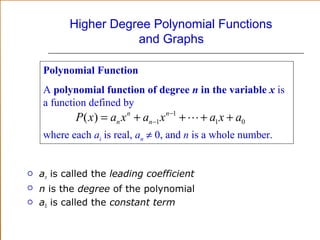
Polynomial Function
A polynomial function of degree n in the variable x is
a function defined by

P( x) = an x + an−1 x
n

n −1

+  + a1 x + a0

where each ai is real, an ≠ 0, and n is a whole number.



an is called the leading coefficient



n is the degree of the polynomial
a0 is called the constant term


Polynomial Functions
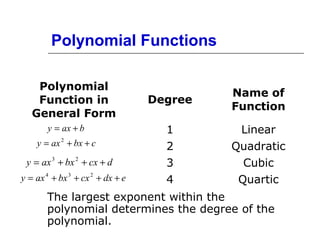
Polynomial
Function in
General Form
y = ax + b

y = ax 2 + bx + c

y = ax 3 + bx 2 + cx + d
y = ax 4 + bx 3 + cx 2 + dx + e

Degree

Name of
Function

1
2
3
4

Linear
Quadratic
Cubic
Quartic

The largest exponent within the
polynomial determines the degree of the
polynomial.
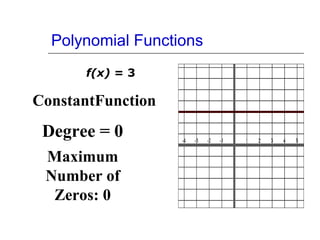
Polynomial Functions
f(x) = 3

ConstantFunction

Degree = 0
Maximum
Number of
Zeros: 0
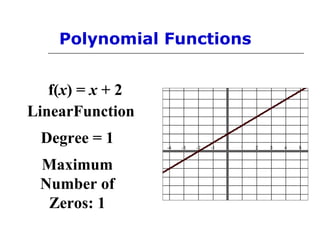
Polynomial Functions
f(x) = x + 2
LinearFunction
Degree = 1
Maximum
Number of
Zeros: 1
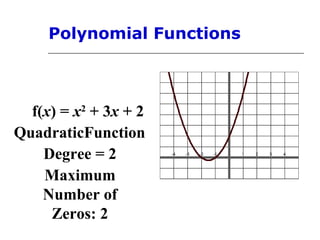
Polynomial Functions

f(x) = x2 + 3x + 2
QuadraticFunction
Degree = 2
Maximum
Number of
Zeros: 2
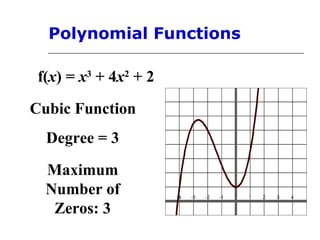
Polynomial Functions
f(x) = x3 + 4x2 + 2
Cubic Function
Degree = 3
Maximum
Number of
Zeros: 3
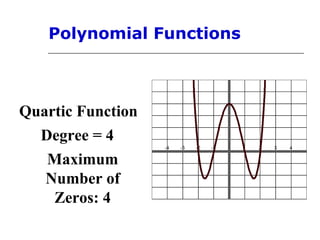
Polynomial Functions

Quartic Function
Degree = 4
Maximum
Number of
Zeros: 4
Leading Coefficient
The leading coefficient is the coefficient of
the first term in a polynomial when the
terms are written in descending order by
degrees.
For example, the quartic function
f(x) = -2x4 + x3 – 5x2 – 10 has a leading
coefficient of -2.
The Leading Coefficient Test
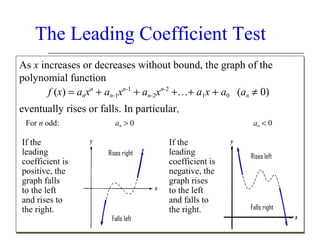
As x increases or decreases without bound, the graph of the
polynomial function
n
n-1
n-2
f (x) = anxn + an-1xn-1 + an-2xn-2 +…+ a1x + a0 (an ≠ 0)
n
n-1
n-2
1
0
n
eventually rises or falls. In particular,
For n odd:

If the
leading
coefficient is
positive, the
graph falls
to the left
and rises to
the right.

an > 0
n
Rises right

Falls left

an < 0
n

If the
leading
coefficient is
negative, the
graph rises
to the left
and falls to
the right.

Rises left

Falls right
The Leading Coefficient Test
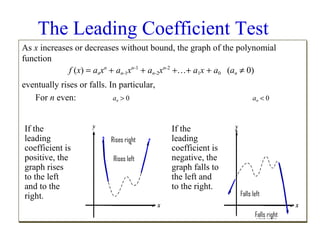
As x increases or decreases without bound, the graph of the polynomial
function
n
n-1
n-2
f (x) = anxn + an-1xn-1 + an-2xn-2 +…+ a1x + a0 (an ≠ 0)
n
n-1
n-2
1
0
n
eventually rises or falls. In particular,
For n even:
an > 0
an < 0
n
n
If the
leading
coefficient is
positive, the
graph rises
to the left
and to the
right.

Rises right
Rises left

If the
leading
coefficient is
negative, the
graph falls to
the left and
to the right.

Falls left
Falls right
Example
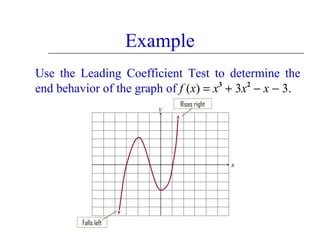
Use the Leading Coefficient Test to determine the
end behavior of the graph of f (x) = x3 + 3x2 − x − 3.
y

Rises right

x

Falls left
Determining End Behavior

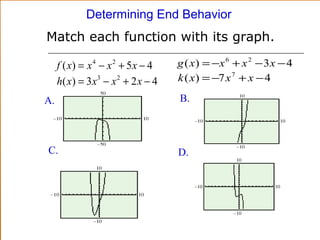
Match each function with its graph.
f ( x) = x − x + 5 x − 4
h( x ) = 3 x 3 − x 2 + 2 x − 4
4

A.

C.

2

g ( x ) = −x 6 + x 2 − 3 x − 4
k ( x ) = −7 x 7 + x − 4
B.

D.
Quartic Polynomials
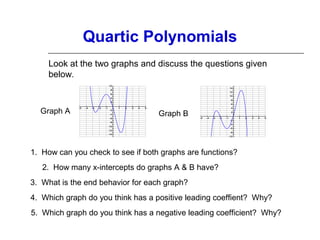
Look at the two graphs and discuss the questions given
below.
10

14

8

12

6

10

4

8

2

Graph A

-5

-4

-3

-2

-1

-2
-4
-6

6
1

2

3

4

5

Graph B

4
2
-5

-4

-3

-8
-10
-12
-14

-2

-1

-2

1

2

3

4

5

-4
-6
-8
-10

1. How can you check to see if both graphs are functions?
2. How many x-intercepts do graphs A & B have?
3. What is the end behavior for each graph?
4. Which graph do you think has a positive leading coeffient? Why?
5. Which graph do you think has a negative leading coefficient? Why?
x-Intercepts (Real Zeros)
Number Of x-Intercepts of a Polynomial Function
A polynomial function of degree n will have a maximum
of n x- intercepts (real zeros).

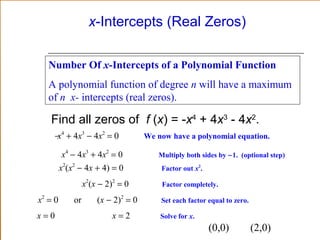
Find all zeros of f (x) = -x4 + 4x3 - 4x2.
−x4 + 4x3 − 4x2 = 0
x4 − 4x3 + 4x2 = 0
x2(x2 − 4x + 4) = 0
x2(x − 2)2 = 0
x2 = 0
x=0

or

(x − 2)2 = 0
x=2

We now have a polynomial equation.
Multiply both sides by −1. (optional step)
Factor out x2.
Factor completely.
Set each factor equal to zero.
Solve for x.

(0,0)

(2,0)
Multiplicity and x-Intercepts
If r is a zero of even multiplicity, then
the graph touches the x-axis and
turns around at r. If r is a zero of
odd multiplicity, then the graph
crosses the x-axis at r. Regardless
of whether a zero is even or odd,
graphs tend to flatten out at zeros
with multiplicity greater than one.
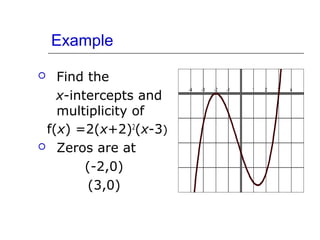
Example
Find the
x-intercepts and
multiplicity of
f(x) =2(x+2)2(x-3)
 Zeros are at
(-2,0)
(3,0)

Extrema


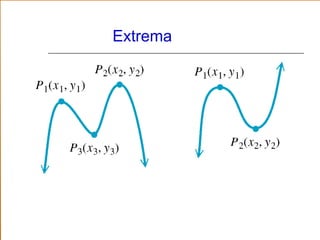
Turning points – where the graph of a function changes from
increasing to decreasing or vice versa. The number of turning points
of the graph of a polynomial function of degree n ≥ 1 is at most n – 1.



Local maximum point – highest point or “peak” in an interval
 function values at these points are called local maxima



Local minimum point – lowest point or “valley” in an interval
 function values at these points are called local minima



Extrema – plural of extremum, includes all local maxima and local
minima
Extrema
Number of Local Extrema










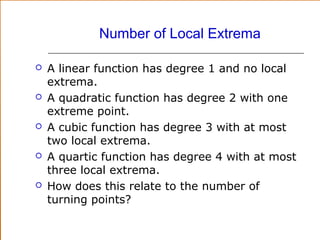
A linear function has degree 1 and no local
extrema.
A quadratic function has degree 2 with one
extreme point.
A cubic function has degree 3 with at most
two local extrema.
A quartic function has degree 4 with at most
three local extrema.
How does this relate to the number of
turning points?
Comprehensive Graphs


The most important features of the graph of a
polynomial function are:

intercepts,
2.
extrema,
3.
end behavior.
A comprehensive graph of a polynomial function
will exhibit the following features:
1.
all x-intercepts (if any),
2.
the y-intercept,
3.
all extreme points (if any),
4.
enough of the graph to exhibit end
behavior.
1.



Polynomial functionsandgraphs

  • 1.
  • 2.
    Higher Degree PolynomialFunctions and Graphs Polynomial Function A polynomial function of degree n in the variable x is a function defined by P( x) = an x + an−1 x n n −1 +  + a1 x + a0 where each ai is real, an ≠ 0, and n is a whole number.  an is called the leading coefficient  n is the degree of the polynomial a0 is called the constant term 
  • 3.
    Polynomial Functions Polynomial Function in GeneralForm y = ax + b y = ax 2 + bx + c y = ax 3 + bx 2 + cx + d y = ax 4 + bx 3 + cx 2 + dx + e Degree Name of Function 1 2 3 4 Linear Quadratic Cubic Quartic The largest exponent within the polynomial determines the degree of the polynomial.
  • 4.
    Polynomial Functions f(x) =3 ConstantFunction Degree = 0 Maximum Number of Zeros: 0
  • 5.
    Polynomial Functions f(x) =x + 2 LinearFunction Degree = 1 Maximum Number of Zeros: 1
  • 6.
    Polynomial Functions f(x) =x2 + 3x + 2 QuadraticFunction Degree = 2 Maximum Number of Zeros: 2
  • 7.
    Polynomial Functions f(x) =x3 + 4x2 + 2 Cubic Function Degree = 3 Maximum Number of Zeros: 3
  • 8.
    Polynomial Functions Quartic Function Degree= 4 Maximum Number of Zeros: 4
  • 9.
    Leading Coefficient The leadingcoefficient is the coefficient of the first term in a polynomial when the terms are written in descending order by degrees. For example, the quartic function f(x) = -2x4 + x3 – 5x2 – 10 has a leading coefficient of -2.
  • 10.
    The Leading CoefficientTest As x increases or decreases without bound, the graph of the polynomial function n n-1 n-2 f (x) = anxn + an-1xn-1 + an-2xn-2 +…+ a1x + a0 (an ≠ 0) n n-1 n-2 1 0 n eventually rises or falls. In particular, For n odd: If the leading coefficient is positive, the graph falls to the left and rises to the right. an > 0 n Rises right Falls left an < 0 n If the leading coefficient is negative, the graph rises to the left and falls to the right. Rises left Falls right
  • 11.
    The Leading CoefficientTest As x increases or decreases without bound, the graph of the polynomial function n n-1 n-2 f (x) = anxn + an-1xn-1 + an-2xn-2 +…+ a1x + a0 (an ≠ 0) n n-1 n-2 1 0 n eventually rises or falls. In particular, For n even: an > 0 an < 0 n n If the leading coefficient is positive, the graph rises to the left and to the right. Rises right Rises left If the leading coefficient is negative, the graph falls to the left and to the right. Falls left Falls right
  • 12.
    Example Use the LeadingCoefficient Test to determine the end behavior of the graph of f (x) = x3 + 3x2 − x − 3. y Rises right x Falls left
  • 13.
    Determining End Behavior Matcheach function with its graph. f ( x) = x − x + 5 x − 4 h( x ) = 3 x 3 − x 2 + 2 x − 4 4 A. C. 2 g ( x ) = −x 6 + x 2 − 3 x − 4 k ( x ) = −7 x 7 + x − 4 B. D.
  • 14.
    Quartic Polynomials Look atthe two graphs and discuss the questions given below. 10 14 8 12 6 10 4 8 2 Graph A -5 -4 -3 -2 -1 -2 -4 -6 6 1 2 3 4 5 Graph B 4 2 -5 -4 -3 -8 -10 -12 -14 -2 -1 -2 1 2 3 4 5 -4 -6 -8 -10 1. How can you check to see if both graphs are functions? 2. How many x-intercepts do graphs A & B have? 3. What is the end behavior for each graph? 4. Which graph do you think has a positive leading coeffient? Why? 5. Which graph do you think has a negative leading coefficient? Why?
  • 15.
    x-Intercepts (Real Zeros) NumberOf x-Intercepts of a Polynomial Function A polynomial function of degree n will have a maximum of n x- intercepts (real zeros). Find all zeros of f (x) = -x4 + 4x3 - 4x2. −x4 + 4x3 − 4x2 = 0 x4 − 4x3 + 4x2 = 0 x2(x2 − 4x + 4) = 0 x2(x − 2)2 = 0 x2 = 0 x=0 or (x − 2)2 = 0 x=2 We now have a polynomial equation. Multiply both sides by −1. (optional step) Factor out x2. Factor completely. Set each factor equal to zero. Solve for x. (0,0) (2,0)
  • 16.
    Multiplicity and x-Intercepts Ifr is a zero of even multiplicity, then the graph touches the x-axis and turns around at r. If r is a zero of odd multiplicity, then the graph crosses the x-axis at r. Regardless of whether a zero is even or odd, graphs tend to flatten out at zeros with multiplicity greater than one.
  • 17.
    Example Find the x-intercepts and multiplicityof f(x) =2(x+2)2(x-3)  Zeros are at (-2,0) (3,0) 
  • 18.
    Extrema  Turning points –where the graph of a function changes from increasing to decreasing or vice versa. The number of turning points of the graph of a polynomial function of degree n ≥ 1 is at most n – 1.  Local maximum point – highest point or “peak” in an interval  function values at these points are called local maxima  Local minimum point – lowest point or “valley” in an interval  function values at these points are called local minima  Extrema – plural of extremum, includes all local maxima and local minima
  • 19.
  • 20.
    Number of LocalExtrema      A linear function has degree 1 and no local extrema. A quadratic function has degree 2 with one extreme point. A cubic function has degree 3 with at most two local extrema. A quartic function has degree 4 with at most three local extrema. How does this relate to the number of turning points?
  • 21.
    Comprehensive Graphs  The mostimportant features of the graph of a polynomial function are: intercepts, 2. extrema, 3. end behavior. A comprehensive graph of a polynomial function will exhibit the following features: 1. all x-intercepts (if any), 2. the y-intercept, 3. all extreme points (if any), 4. enough of the graph to exhibit end behavior. 1. 

Editor's Notes

  • #4 Teachers: This definition for ‘degree’ has been simplified intentionally to help students understand the concept quickly and easily.