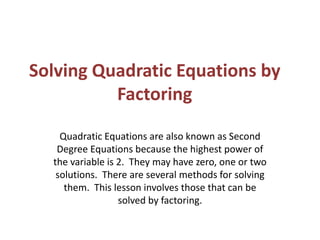
Solving Quadratic Equations by FactoringQuadratic Equations are also known as Second Degree Equations because the highest power of the variable is 2.  They may have zero, one or two solutions.  There are several methods for solving them.  This lesson involves those that can be solved by factoring.
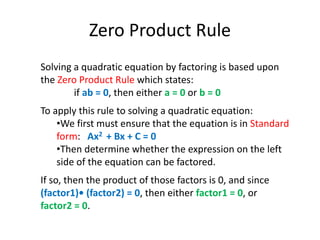
Zero Product RuleSolving a quadratic equation by factoring is based upon the Zero Product Rule which states:             if ab = 0, then either a = 0 or b = 0To apply this rule to solving a quadratic equation:We first must ensure that the equation is in Standard form:   Ax2 + Bx + C = 0
Then determine whether the expression on the left side of the equation can be factored. If so, then the product of those factors is 0, and since(factor1)• (factor2) = 0, then either factor1 = 0, or factor2 = 0.
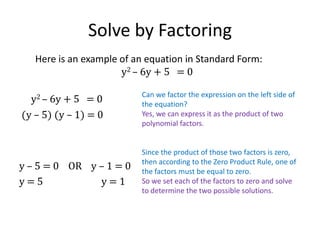
Solve by FactoringHere is an example of an equation in Standard Form:y2 – 6y + 5   = 0Can we factor the expression on the left side of the equation?  Yes, we can express it as the product of two polynomial factors.Since the product of those two factors is zero, then according to the Zero Product Rule, one of the factors must be equal to zero.So we set each of the factors to zero and solve to determine the two possible solutions.y2 – 6y + 5   = 0 (y – 5) (y – 1) = 0  y – 5 = 0    OR    y – 1 = 0y = 5                         y = 1
CheckSubstitute each of the solutions into the original equationfor y = 5  y2 –  6y + 5 = 0(5)2 – 6(5) + 5 =  0 25  –   30  + 5 = 0-5  +  5 = 00 = 0 for y = 1  y2 – 6y + 5  = 0(1)2– 6(1) + 5 = 0 1   –   6   +  5 = 0-5  +  5 = 00 = 0 Both solutions are valid.
Solve by Factoring – common factor      9 x2 – 5 = 12x – 5              9x2 = 12x  9x2– 12x = 0  9x2– 12x = 03x(3x – 4) = 0 3x = 0       OR      3x - 4 =  0   x = 0                      3x   =  4 x =   In  this example, the equation is not in standard form, so the first step is to express the equation in standard form.  To do so, we move the terms from the right to the left side of the equation.  The constant term cancels out in our resulting equation.Next, we factor the expression on the right side of the equation.  We find that we have a common factor of 3x in each of the terms of the expression.Using the zero product rule, we set each of the resulting factors equal to zero and solve to find the two solutions.
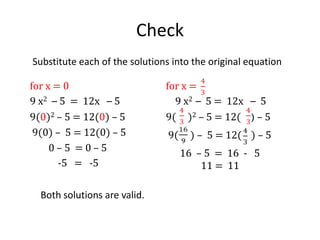
CheckSubstitute each of the solutions into the original equationfor x = 09 x2   – 5  =  12x   – 59(0)2 – 5 = 12(0) – 5 9(0) –  5 = 12(0) – 5        0 – 5  = 0 – 5           -5   =   -5for x =     9 x2  –  5 =  12x   –  59(     )2 – 5 = 12(    ) – 5 9(     ) –  5 = 12(    ) – 5      16  – 5  =  16  -   5              11 =  11Both solutions are valid.
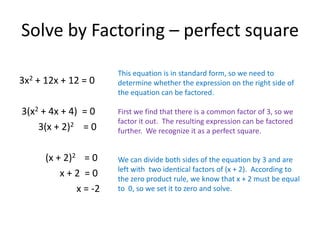
Solve by Factoring – perfect squareThis equation is in standard form, so we need to determine whether the expression on the right side of the equation can be factored.  First we find that there is a common factor of 3, so we factor it out.  The resulting expression can be factored further.  We recognize it as a perfect square.We can divide both sides of the equation by 3 and are left with  two identical factors of (x + 2).  According to  the zero product rule, we know that x + 2 must be equal to  0, so we set it to zero and solve.3x2 + 12x + 12 = 03(x2+ 4x + 4)  = 0        3(x + 2)2    = 0(x + 2)2     = 0x + 2  = 0                        x = -2
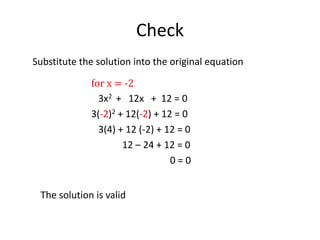
CheckSubstitute the solution into the original equationfor x = -2   3x2  +   12x   +  12 = 03(-2)2 + 12(-2) + 12 = 0   3(4) + 12 (-2) + 12 = 0             12 – 24 + 12 = 0                                0 = 0The solution is valid
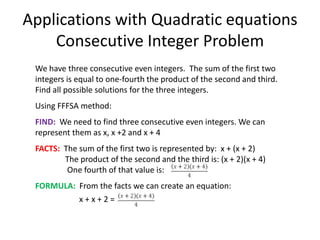
Applications with Quadratic equations Consecutive Integer ProblemWe have three consecutive even integers.  The sum of the first two integers is equal to one-fourth the product of the second and third.  Find all possible solutions for the three integers.Using FFFSA method:FIND:  We need to find three consecutive even integers. We can represent them as x, x +2 and x + 4FACTS:  The sum of the first two is represented by:  x + (x + 2)              The product of the second and the third is: (x + 2)(x + 4)               One fourth of that value is: FORMULA:  From the facts we can create an equation:                      x + x + 2 =
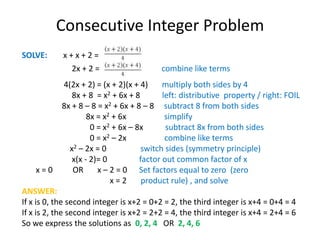
Consecutive Integer ProblemSOLVE:        x + x + 2 =                        2x + 2 =                               combine like terms                    4(2x + 2) = (x + 2)(x + 4)       multiply both sides by 4                        8x + 8  = x2 + 6x + 8           left: distributive  property / right: FOIL                   8x + 8 – 8 = x2 + 6x + 8 – 8     subtract 8 from both sides	8x = x2 + 6x                   simplify                                 0 = x2 + 6x – 8x           subtract 8x from both sides                                 0 = x2 – 2x                   combine like termsx2 – 2x = 0                 switch sides (symmetry principle)                         x(x - 2)= 0                factor out common factor of x      x = 0          OR       x – 2 = 0      Set factors equal to zero  (zero                                            x = 2       product rule) , and solveANSWER:If x is 0, the second integer is x+2 = 0+2 = 2, the third integer is x+4 = 0+4 = 4If x is 2, the second integer is x+2 = 2+2 = 4, the third integer is x+4 = 2+4 = 6So we express the solutions as  0, 2, 4   OR  2, 4, 6
Check the SolutionConsecutive Integer ProblemLet’s see if our answers fit into the original problem:We have three consecutive even integers.  The sum of the first two integers is equal to one-fourth the product of the second and third.  Find all possible solutions for the three integers.The solution 0, 2, 4:     0 + 2 = (2)(4) ÷ 4	               2 = 8 ÷ 4                                              2 = 2      TrueThe solution 2, 4, 6:       2 + 4 = (4)(6) ÷ 4		                  6 = 24 ÷ 4                                                   6 = 6      True Both solutions are possible.
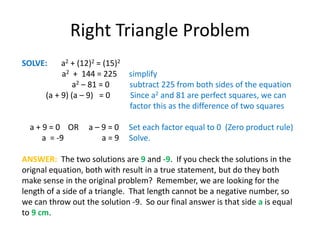
Applications with Quadratic equationsRight Triangle ProblemThe Pythagorean Theorem states that the sum of the squares of the legs of a right triangle is equal to the square of the hypotenuse.  It is represented by the formula:    a2 + b2 = c2Here is an example problem:  The hypotenuse of a right triangle is 15 cm. and the larger leg is 12 cm.  What is the length of the shorter leg?FIND:  the length of the shorter leg.  We will represent it as:  aFACTS:    b = 12,   c = 15FORMULA :       a2 + b2 = c2SUBSTITUTE:       a2 + (12)2 = (15)2

Solving Quadratic Equations by Factoring

  • 1.
    Solving Quadratic Equationsby FactoringQuadratic Equations are also known as Second Degree Equations because the highest power of the variable is 2. They may have zero, one or two solutions. There are several methods for solving them. This lesson involves those that can be solved by factoring.
  • 2.
    Zero Product RuleSolvinga quadratic equation by factoring is based upon the Zero Product Rule which states: if ab = 0, then either a = 0 or b = 0To apply this rule to solving a quadratic equation:We first must ensure that the equation is in Standard form: Ax2 + Bx + C = 0
  • 3.
    Then determine whetherthe expression on the left side of the equation can be factored. If so, then the product of those factors is 0, and since(factor1)• (factor2) = 0, then either factor1 = 0, or factor2 = 0.
  • 4.
    Solve by FactoringHereis an example of an equation in Standard Form:y2 – 6y + 5 = 0Can we factor the expression on the left side of the equation? Yes, we can express it as the product of two polynomial factors.Since the product of those two factors is zero, then according to the Zero Product Rule, one of the factors must be equal to zero.So we set each of the factors to zero and solve to determine the two possible solutions.y2 – 6y + 5 = 0 (y – 5) (y – 1) = 0  y – 5 = 0 OR y – 1 = 0y = 5 y = 1
  • 5.
    CheckSubstitute each ofthe solutions into the original equationfor y = 5 y2 – 6y + 5 = 0(5)2 – 6(5) + 5 = 0 25 – 30 + 5 = 0-5 + 5 = 00 = 0 for y = 1 y2 – 6y + 5 = 0(1)2– 6(1) + 5 = 0 1 – 6 + 5 = 0-5 + 5 = 00 = 0 Both solutions are valid.
  • 6.
    Solve by Factoring– common factor 9 x2 – 5 = 12x – 5 9x2 = 12x 9x2– 12x = 0 9x2– 12x = 03x(3x – 4) = 0 3x = 0 OR 3x - 4 = 0 x = 0 3x = 4 x = In this example, the equation is not in standard form, so the first step is to express the equation in standard form. To do so, we move the terms from the right to the left side of the equation. The constant term cancels out in our resulting equation.Next, we factor the expression on the right side of the equation. We find that we have a common factor of 3x in each of the terms of the expression.Using the zero product rule, we set each of the resulting factors equal to zero and solve to find the two solutions.
  • 7.
    CheckSubstitute each ofthe solutions into the original equationfor x = 09 x2 – 5 = 12x – 59(0)2 – 5 = 12(0) – 5 9(0) – 5 = 12(0) – 5 0 – 5 = 0 – 5 -5 = -5for x = 9 x2 – 5 = 12x – 59( )2 – 5 = 12( ) – 5 9( ) – 5 = 12( ) – 5 16 – 5 = 16 - 5 11 = 11Both solutions are valid.
  • 8.
    Solve by Factoring– perfect squareThis equation is in standard form, so we need to determine whether the expression on the right side of the equation can be factored. First we find that there is a common factor of 3, so we factor it out. The resulting expression can be factored further. We recognize it as a perfect square.We can divide both sides of the equation by 3 and are left with two identical factors of (x + 2). According to the zero product rule, we know that x + 2 must be equal to 0, so we set it to zero and solve.3x2 + 12x + 12 = 03(x2+ 4x + 4) = 0 3(x + 2)2 = 0(x + 2)2 = 0x + 2 = 0 x = -2
  • 9.
    CheckSubstitute the solutioninto the original equationfor x = -2 3x2 + 12x + 12 = 03(-2)2 + 12(-2) + 12 = 0 3(4) + 12 (-2) + 12 = 0 12 – 24 + 12 = 0 0 = 0The solution is valid
  • 10.
    Applications with Quadraticequations Consecutive Integer ProblemWe have three consecutive even integers. The sum of the first two integers is equal to one-fourth the product of the second and third. Find all possible solutions for the three integers.Using FFFSA method:FIND: We need to find three consecutive even integers. We can represent them as x, x +2 and x + 4FACTS: The sum of the first two is represented by: x + (x + 2) The product of the second and the third is: (x + 2)(x + 4) One fourth of that value is: FORMULA: From the facts we can create an equation: x + x + 2 =
  • 11.
    Consecutive Integer ProblemSOLVE: x + x + 2 = 2x + 2 = combine like terms 4(2x + 2) = (x + 2)(x + 4) multiply both sides by 4 8x + 8 = x2 + 6x + 8 left: distributive property / right: FOIL 8x + 8 – 8 = x2 + 6x + 8 – 8 subtract 8 from both sides 8x = x2 + 6x simplify 0 = x2 + 6x – 8x subtract 8x from both sides 0 = x2 – 2x combine like termsx2 – 2x = 0 switch sides (symmetry principle) x(x - 2)= 0 factor out common factor of x x = 0 OR x – 2 = 0 Set factors equal to zero (zero x = 2 product rule) , and solveANSWER:If x is 0, the second integer is x+2 = 0+2 = 2, the third integer is x+4 = 0+4 = 4If x is 2, the second integer is x+2 = 2+2 = 4, the third integer is x+4 = 2+4 = 6So we express the solutions as 0, 2, 4 OR 2, 4, 6
  • 12.
    Check the SolutionConsecutiveInteger ProblemLet’s see if our answers fit into the original problem:We have three consecutive even integers. The sum of the first two integers is equal to one-fourth the product of the second and third. Find all possible solutions for the three integers.The solution 0, 2, 4: 0 + 2 = (2)(4) ÷ 4 2 = 8 ÷ 4 2 = 2 TrueThe solution 2, 4, 6: 2 + 4 = (4)(6) ÷ 4 6 = 24 ÷ 4 6 = 6 True Both solutions are possible.
  • 13.
    Applications with QuadraticequationsRight Triangle ProblemThe Pythagorean Theorem states that the sum of the squares of the legs of a right triangle is equal to the square of the hypotenuse. It is represented by the formula: a2 + b2 = c2Here is an example problem: The hypotenuse of a right triangle is 15 cm. and the larger leg is 12 cm. What is the length of the shorter leg?FIND: the length of the shorter leg. We will represent it as: aFACTS: b = 12, c = 15FORMULA : a2 + b2 = c2SUBSTITUTE: a2 + (12)2 = (15)2