Part 1: Long Division
Long Division
We can divide polynomials using steps that are
 similar to the steps of numerical long division
                    a
 Notation: a ÷ b =    = b a
                    b
 Vocabulary: dividend ÷ divisor = quotient
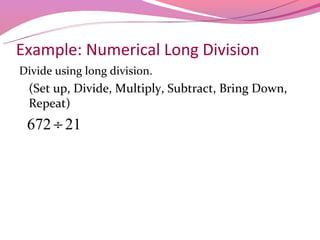
Example: Numerical Long Division
Divide using long division.
 (Set up, Divide, Multiply, Subtract, Bring Down,
 Repeat)
 672 ÷ 21
Polynomial Long Division
Dividing polynomials is useful when we are trying to
 factor polynomials, especially when we are unsure of
 factors.
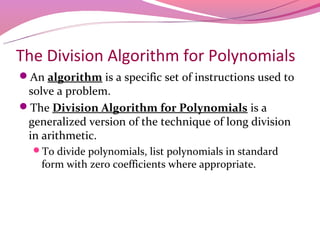
The Division Algorithm for Polynomials
An algorithm is a specific set of instructions used to
 solve a problem.
The Division Algorithm for Polynomials is a
 generalized version of the technique of long division
 in arithmetic.
  To divide polynomials, list polynomials in standard
    form with zero coefficients where appropriate.
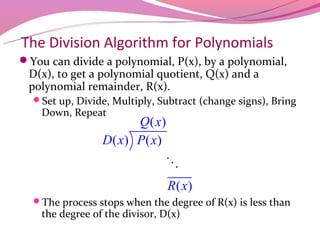
The Division Algorithm for Polynomials
You can divide a polynomial, P(x), by a polynomial,
 D(x), to get a polynomial quotient, Q(x) and a
 polynomial remainder, R(x).
  Set up, Divide, Multiply, Subtract (change signs), Bring
    Down, Repeat
                       Q( x)
                 D( x) P( x)
                               O
                                R( x)
  The process stops when the degree of R(x) is less than
    the degree of the divisor, D(x)
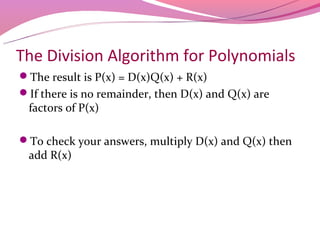
The Division Algorithm for Polynomials
The result is P(x) = D(x)Q(x) + R(x)
If there is no remainder, then D(x) and Q(x) are
 factors of P(x)

To check your answers, multiply D(x) and Q(x) then
 add R(x)
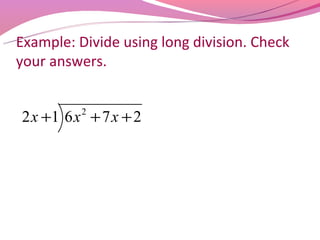
Example: Divide using long division. Check
your answers.


2 x +1 6 x + 7 x + 2
          2
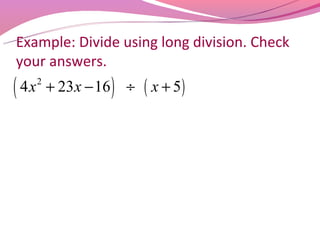
Example: Divide using long division. Check
your answers.
( 4x   2
           + 23 x − 16 ) ÷   ( x + 5)
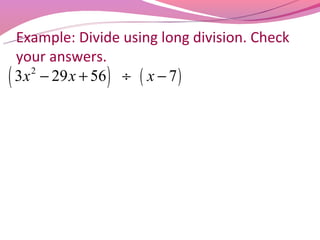
Example: Divide using long division. Check
  your answers.
( 3x − 29 x + 56 ) ÷ ( x − 7 )
    2
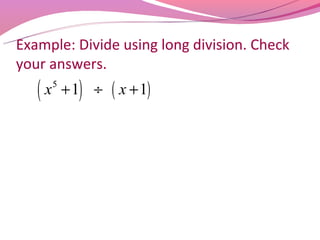
Example: Divide using long division. Check
your answers.
   (x   5
            + 1) ÷   ( x + 1)
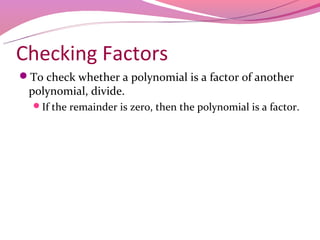
Checking Factors
To check whether a polynomial is a factor of another
 polynomial, divide.
  If the remainder is zero, then the polynomial is a factor.
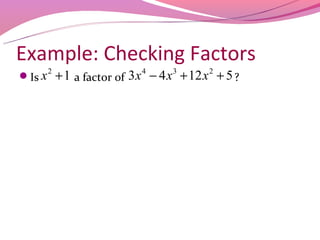
Example: Checking Factors
Is x
        2
            + 1 a factor of 3 x 4 − 4 x 3 + 12 x 2 + 5 ?
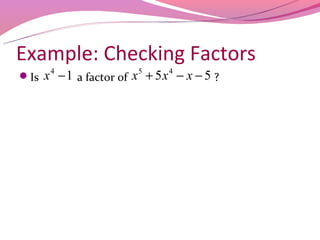
Example: Checking Factors
Is   x 4 − 1 a factor of x 5 + 5 x 4 − x − 5 ?
Checking Factors
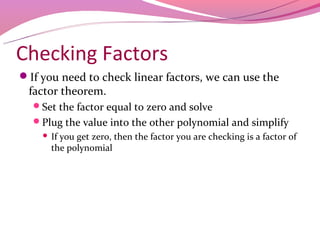
If you need to check linear factors, we can use the
 factor theorem.
  Set the factor equal to zero and solve
  Plug the value into the other polynomial and simplify
       If you get zero, then the factor you are checking is a factor of
        the polynomial
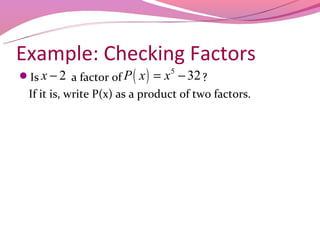
Example: Checking Factors
Is x − 2 a factor of P (   x ) = x 5 − 32 ?
  If it is, write P(x) as a product of two factors.
Homework
P308 #9 – 19 odd, 44 – 51 odd

5.4 long division

  • 1.
    Part 1: LongDivision
  • 2.
    Long Division We candivide polynomials using steps that are similar to the steps of numerical long division a Notation: a ÷ b = = b a b Vocabulary: dividend ÷ divisor = quotient
  • 3.
    Example: Numerical LongDivision Divide using long division. (Set up, Divide, Multiply, Subtract, Bring Down, Repeat) 672 ÷ 21
  • 4.
    Polynomial Long Division Dividingpolynomials is useful when we are trying to factor polynomials, especially when we are unsure of factors.
  • 5.
    The Division Algorithmfor Polynomials An algorithm is a specific set of instructions used to solve a problem. The Division Algorithm for Polynomials is a generalized version of the technique of long division in arithmetic. To divide polynomials, list polynomials in standard form with zero coefficients where appropriate.
  • 6.
    The Division Algorithmfor Polynomials You can divide a polynomial, P(x), by a polynomial, D(x), to get a polynomial quotient, Q(x) and a polynomial remainder, R(x). Set up, Divide, Multiply, Subtract (change signs), Bring Down, Repeat Q( x) D( x) P( x) O R( x) The process stops when the degree of R(x) is less than the degree of the divisor, D(x)
  • 7.
    The Division Algorithmfor Polynomials The result is P(x) = D(x)Q(x) + R(x) If there is no remainder, then D(x) and Q(x) are factors of P(x) To check your answers, multiply D(x) and Q(x) then add R(x)
  • 8.
    Example: Divide usinglong division. Check your answers. 2 x +1 6 x + 7 x + 2 2
  • 9.
    Example: Divide usinglong division. Check your answers. ( 4x 2 + 23 x − 16 ) ÷ ( x + 5)
  • 10.
    Example: Divide usinglong division. Check your answers. ( 3x − 29 x + 56 ) ÷ ( x − 7 ) 2
  • 11.
    Example: Divide usinglong division. Check your answers. (x 5 + 1) ÷ ( x + 1)
  • 12.
    Checking Factors To checkwhether a polynomial is a factor of another polynomial, divide. If the remainder is zero, then the polynomial is a factor.
  • 13.
    Example: Checking Factors Isx 2 + 1 a factor of 3 x 4 − 4 x 3 + 12 x 2 + 5 ?
  • 14.
    Example: Checking Factors Is x 4 − 1 a factor of x 5 + 5 x 4 − x − 5 ?
  • 15.
    Checking Factors If youneed to check linear factors, we can use the factor theorem. Set the factor equal to zero and solve Plug the value into the other polynomial and simplify  If you get zero, then the factor you are checking is a factor of the polynomial
  • 16.
    Example: Checking Factors Isx − 2 a factor of P ( x ) = x 5 − 32 ? If it is, write P(x) as a product of two factors.
  • 17.
    Homework P308 #9 –19 odd, 44 – 51 odd