SAINIK SCHOOL GOPALGANJ
CHAPTER : TWO
CHAPTER NAME : POLYNOMIALS
CLASS : 9
In mathematics, a polynomial is an expression of finite length
constructed from variables and constants, using only the operations
of addition, subtraction, multiplication, and non-negative, whole-
number exponents. Polynomials appear in a wide variety of areas of
mathematics and science. For example, they are used to form
polynomial equations, which encode a wide range of problems, from
elementary word problems to complicated problems in the sciences;
they are used to define polynomial functions, which appear in
settings ranging from basic chemistry and physics to economics and
social science; they are used in calculus and numerical analysis to
approximate other functions.
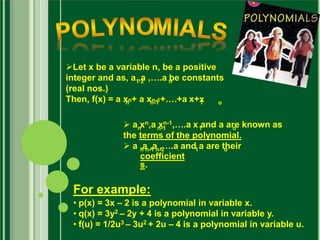
Let x be a variable n, be a positive
integer and as, a ,a ,….a be constants
1 2 n
(real nos.)
Then, f(x) = a xn+ a xn-1+….+a x+x
n n-1 1 o
 a xn,a xn-1,….a x and a are known as
n n-1 1 o
the terms of the polynomial.
 a ,a ,a ,….a and a are their
n n-1 n-2
coefficient
s.
1 o
For example:
• p(x) = 3x – 2 is a polynomial in variable x.
• q(x) = 3y2 – 2y + 4 is a polynomial in variable y.
• f(u) = 1/2u3 – 3u2 + 2u – 4 is a polynomial in variable u.
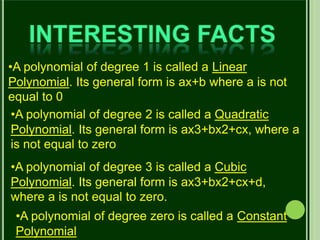
•A polynomial of degree 1 is called a Linear
Polynomial. Its general form is ax+b where a is not
equal to 0
•A polynomial of degree 2 is called a Quadratic
Polynomial. Its general form is ax3+bx2+cx, where a
is not equal to zero
•A polynomial of degree 3 is called a Cubic
Polynomial. Its general form is ax3+bx2+cx+d,
where a is not equal to zero.
•A polynomial of degree zero is called a Constant
Polynomial
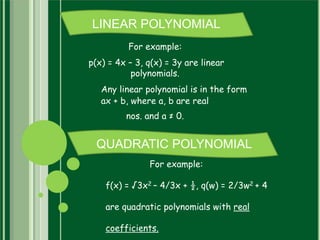
LINEAR POLYNOMIAL
For example:
p(x) = 4x – 3, q(x) = 3y are linear
polynomials.
Any linear polynomial is in the form
ax + b, where a, b are real
nos. and a ≠ 0.
QUADRATIC POLYNOMIAL
For example:
f(x) = √3x2 – 4/3x + ½, q(w) = 2/3w2 + 4
are quadratic polynomials with real
coefficients.
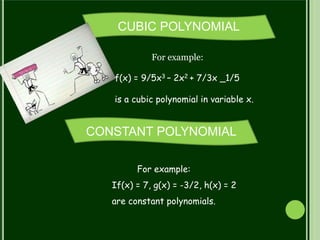
CUBIC POLYNOMIAL
For example:
f(x) = 9/5x3 – 2x2 + 7/3x _1/5
is a cubic polynomial in variable x.
CONSTANT POLYNOMIAL
For example:
If(x) = 7, g(x) = -3/2, h(x) = 2
are constant polynomials.
VALUE OF POLYNOMIAL
If f(x) is a polynomial and y is
any real no. then real no.
obtained by replacing x by y in
f(x) is called the value of f(x)
at x = y and is denoted by f(x).
ZEROES OF POLYNOMIAL
A real no. x is a zero of the
polynomial f(x),is f(x) = 0
Finding a zero of the
polynomial means solving
polynomial equation f(x) = 0.
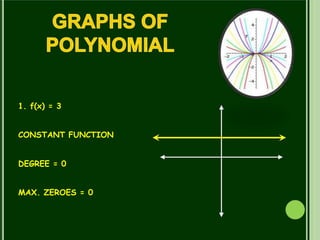
1. f(x) = 3
CONSTANT FUNCTION
DEGREE = 0
MAX. ZEROES = 0
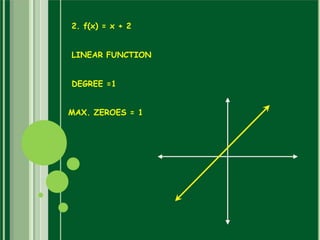
2. f(x) = x + 2
LINEAR FUNCTION
DEGREE =1
MAX. ZEROES = 1
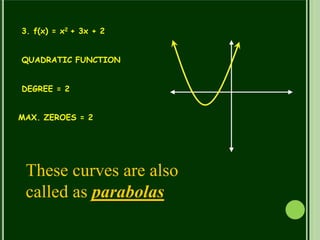
3. f(x) = x2 + 3x + 2
QUADRATIC FUNCTION
DEGREE = 2
MAX. ZEROES = 2
These curves are also
called as parabolas
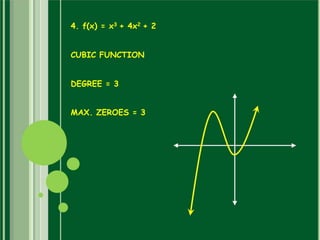
4. f(x) = x3 + 4x2 + 2
CUBIC FUNCTION
DEGREE = 3
MAX. ZEROES = 3
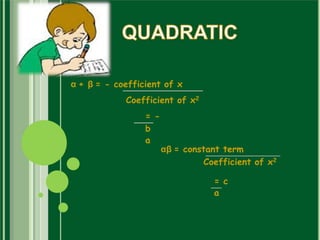
α + β = - coefficient of x
Coefficient of x2
= -
b
a
αβ = constant term
Coefficient of x2
= c
a
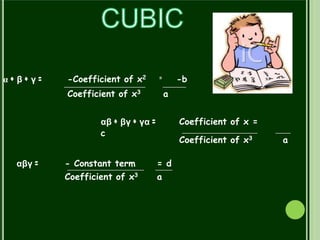
α + β + γ = -Coefficient of x2
Coefficient of x3
= -b
a
αβ + βγ + γα =
c
Coefficient of x =
Coefficient of x3 a
αβγ = - Constant term
Coefficient of x3
= d
a
DIVISION
ALGORITHM
•ON FINDING THE
QUOTIENT AND
REMAINDER USING
DIVISION ALGORITHM.
•If f(x) and g(x) are
any two polynomials
with g(x) ≠ 0,then we
can always find
polynomials q(x), and
r(x) such that :
•ON CHECKING WHETHER
A GIVEN POLYNOMIAL IS
A FACTOR OF THE OTHER
POLYNIMIAL BY APPLYING
THEDIVISION
ALGORITHM
F(x) = q(x) g(x) +
r(x),
•
ON FINDING THE
Where r(x) = 0 or
degree r(x) < degree
gD(IxV)ISION ALGORITHM
FOR POLYNOMIALS.
REMAINING ZEROES OF A
POLYNOMIAL WHEN SOME
OF ITS ZEROES ARE GIVEN.
•ON VERYFYING THE
Cl 9 Chapter 2.ppt
Cl 9 Chapter 2.ppt

Cl 9 Chapter 2.ppt

  • 1.
    SAINIK SCHOOL GOPALGANJ CHAPTER: TWO CHAPTER NAME : POLYNOMIALS CLASS : 9
  • 3.
    In mathematics, apolynomial is an expression of finite length constructed from variables and constants, using only the operations of addition, subtraction, multiplication, and non-negative, whole- number exponents. Polynomials appear in a wide variety of areas of mathematics and science. For example, they are used to form polynomial equations, which encode a wide range of problems, from elementary word problems to complicated problems in the sciences; they are used to define polynomial functions, which appear in settings ranging from basic chemistry and physics to economics and social science; they are used in calculus and numerical analysis to approximate other functions.
  • 4.
    Let x bea variable n, be a positive integer and as, a ,a ,….a be constants 1 2 n (real nos.) Then, f(x) = a xn+ a xn-1+….+a x+x n n-1 1 o  a xn,a xn-1,….a x and a are known as n n-1 1 o the terms of the polynomial.  a ,a ,a ,….a and a are their n n-1 n-2 coefficient s. 1 o For example: • p(x) = 3x – 2 is a polynomial in variable x. • q(x) = 3y2 – 2y + 4 is a polynomial in variable y. • f(u) = 1/2u3 – 3u2 + 2u – 4 is a polynomial in variable u.
  • 5.
    •A polynomial ofdegree 1 is called a Linear Polynomial. Its general form is ax+b where a is not equal to 0 •A polynomial of degree 2 is called a Quadratic Polynomial. Its general form is ax3+bx2+cx, where a is not equal to zero •A polynomial of degree 3 is called a Cubic Polynomial. Its general form is ax3+bx2+cx+d, where a is not equal to zero. •A polynomial of degree zero is called a Constant Polynomial
  • 6.
    LINEAR POLYNOMIAL For example: p(x)= 4x – 3, q(x) = 3y are linear polynomials. Any linear polynomial is in the form ax + b, where a, b are real nos. and a ≠ 0. QUADRATIC POLYNOMIAL For example: f(x) = √3x2 – 4/3x + ½, q(w) = 2/3w2 + 4 are quadratic polynomials with real coefficients.
  • 7.
    CUBIC POLYNOMIAL For example: f(x)= 9/5x3 – 2x2 + 7/3x _1/5 is a cubic polynomial in variable x. CONSTANT POLYNOMIAL For example: If(x) = 7, g(x) = -3/2, h(x) = 2 are constant polynomials.
  • 8.
    VALUE OF POLYNOMIAL Iff(x) is a polynomial and y is any real no. then real no. obtained by replacing x by y in f(x) is called the value of f(x) at x = y and is denoted by f(x). ZEROES OF POLYNOMIAL A real no. x is a zero of the polynomial f(x),is f(x) = 0 Finding a zero of the polynomial means solving polynomial equation f(x) = 0.
  • 9.
    1. f(x) =3 CONSTANT FUNCTION DEGREE = 0 MAX. ZEROES = 0
  • 10.
    2. f(x) =x + 2 LINEAR FUNCTION DEGREE =1 MAX. ZEROES = 1
  • 11.
    3. f(x) =x2 + 3x + 2 QUADRATIC FUNCTION DEGREE = 2 MAX. ZEROES = 2 These curves are also called as parabolas
  • 12.
    4. f(x) =x3 + 4x2 + 2 CUBIC FUNCTION DEGREE = 3 MAX. ZEROES = 3
  • 14.
    α + β= - coefficient of x Coefficient of x2 = - b a αβ = constant term Coefficient of x2 = c a
  • 15.
    α + β+ γ = -Coefficient of x2 Coefficient of x3 = -b a αβ + βγ + γα = c Coefficient of x = Coefficient of x3 a αβγ = - Constant term Coefficient of x3 = d a
  • 16.
  • 17.
    •ON FINDING THE QUOTIENTAND REMAINDER USING DIVISION ALGORITHM. •If f(x) and g(x) are any two polynomials with g(x) ≠ 0,then we can always find polynomials q(x), and r(x) such that : •ON CHECKING WHETHER A GIVEN POLYNOMIAL IS A FACTOR OF THE OTHER POLYNIMIAL BY APPLYING THEDIVISION ALGORITHM F(x) = q(x) g(x) + r(x), • ON FINDING THE Where r(x) = 0 or degree r(x) < degree gD(IxV)ISION ALGORITHM FOR POLYNOMIALS. REMAINING ZEROES OF A POLYNOMIAL WHEN SOME OF ITS ZEROES ARE GIVEN. •ON VERYFYING THE