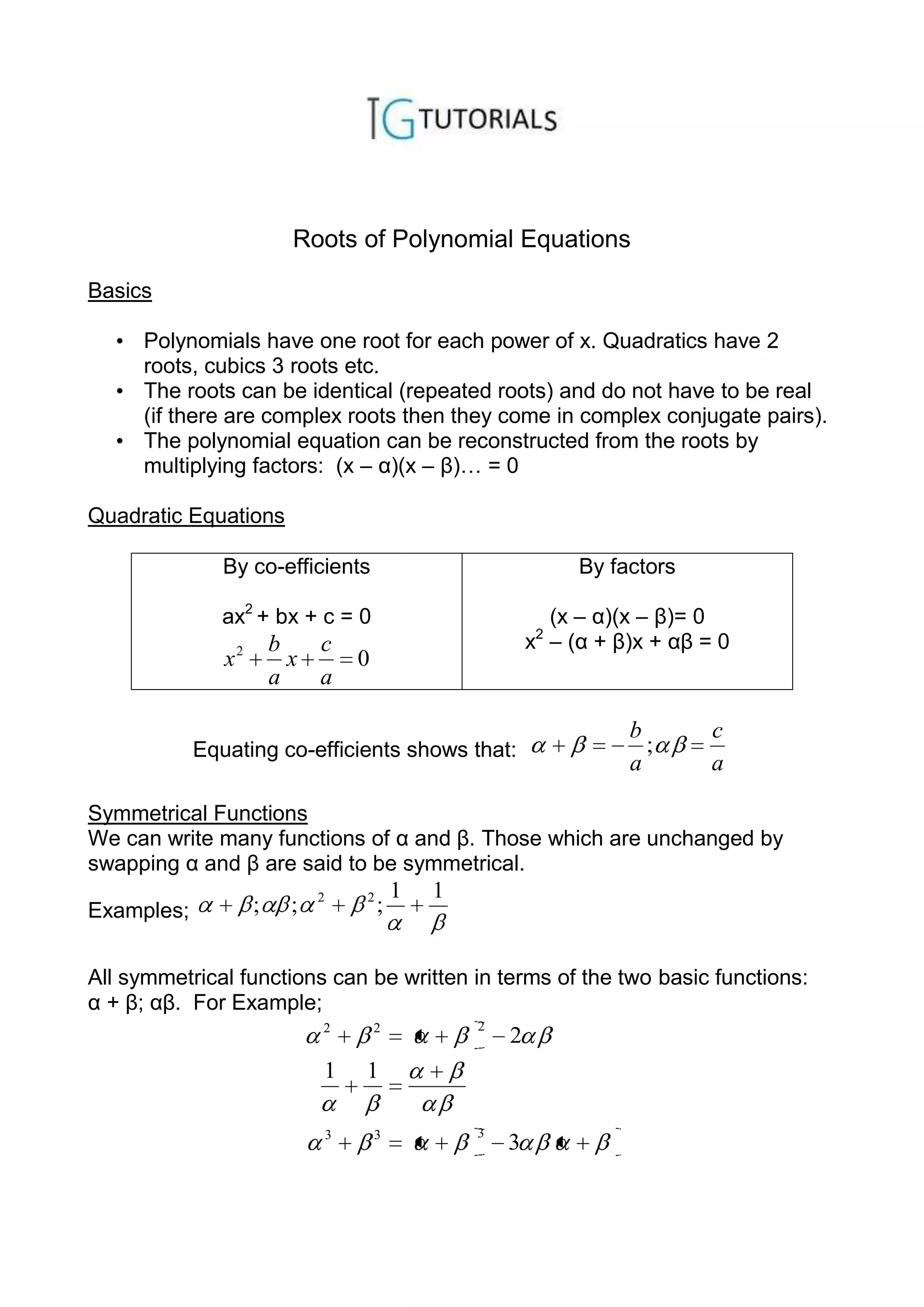
Roots of Polynomial Equations

Basics

  • Polynomials have one root for each power of x. Quadratics have 2
    roots, cubics 3 roots etc.
  • The roots can be identical (repeated roots) and do not have to be real
    (if there are complex roots then they come in complex conjugate pairs).
  • The polynomial equation can be reconstructed from the roots by
    multiplying factors: (x – α)(x – β)… = 0

Quadratic Equations

               By co-efficients                                   By factors

               ax2 + bx + c = 0                                (x – α)(x – β)= 0
                                                              2
                        b   c                                x – (α + β)x + αβ = 0
               x2         x          0
                        a   a

                                                                       b        c
            Equating co-efficients shows that:                           ;
                                                                       a        a

Symmetrical Functions
We can write many functions of α and β. Those which are unchanged by
swapping α and β are said to be symmetrical.
                             2       2       1   1
Examples;           ;    ;               ;


All symmetrical functions can be written in terms of the two basic functions:
α + β; αβ. For Example;
                             2           2           2
                                                         2
                             1       1

                                 3       3           3
                                                         3
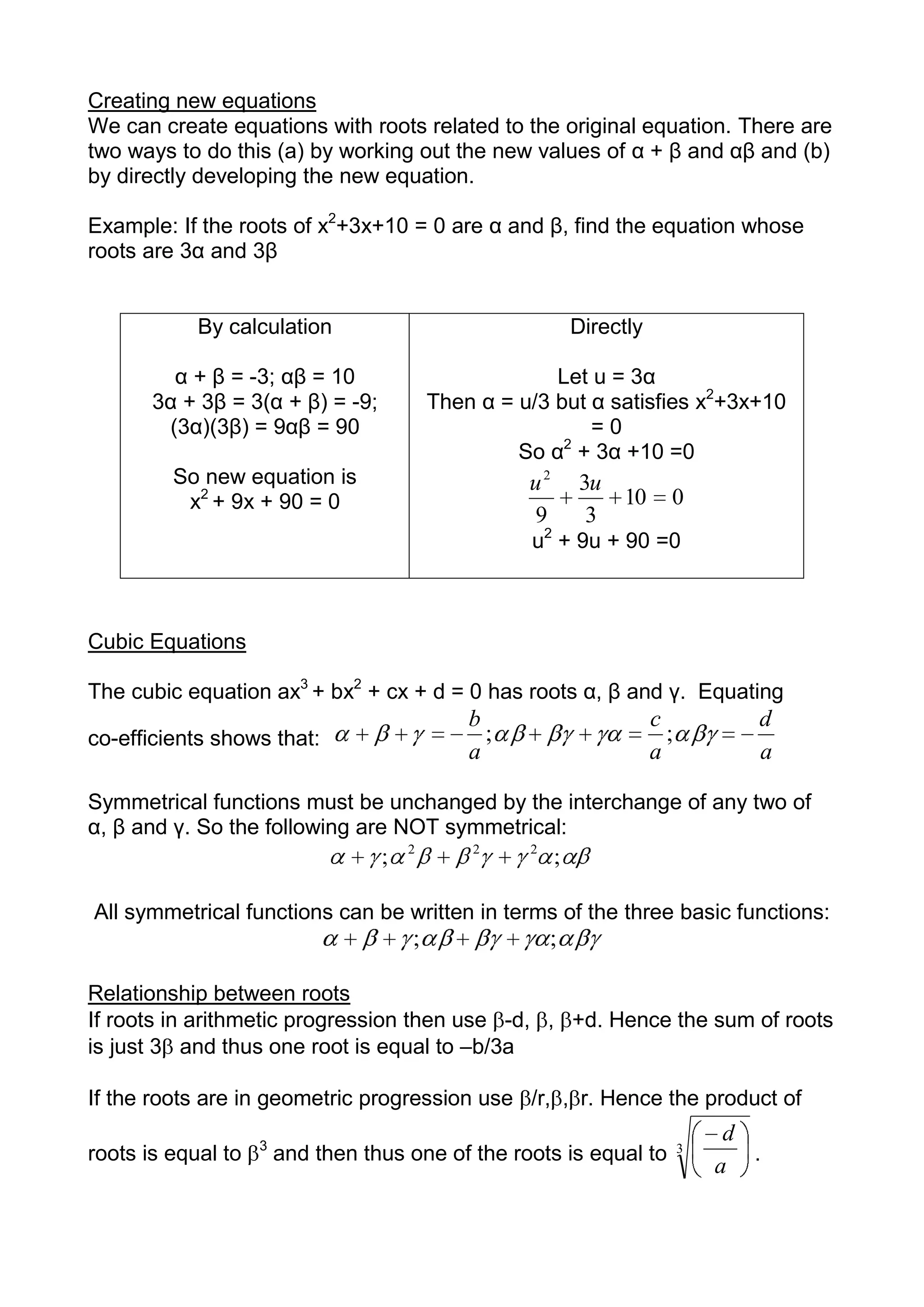
Creating new equations
We can create equations with roots related to the original equation. There are
two ways to do this (a) by working out the new values of α + β and αβ and (b)
by directly developing the new equation.

Example: If the roots of x2+3x+10 = 0 are α and β, find the equation whose
roots are 3α and 3β


            By calculation                                    Directly

         α + β = -3; αβ = 10                            Let u = 3α
       3α + 3β = 3(α + β) = -9;            Then α = u/3 but α satisfies x2+3x+10
        (3α)(3β) = 9αβ = 90                                 =0
                                                         2
                                                    So α + 3α +10 =0
         So new equation is                          u2       3u
          x2 + 9x + 90 = 0                                         10      0
                                                     9         3
                                                     u2 + 9u + 90 =0


Cubic Equations

The cubic equation ax3 + bx2 + cx + d = 0 has roots α, β and γ. Equating
                                               b                         c            d
co-efficients shows that:                        ;                         ;
                                               a                         a            a

Symmetrical functions must be unchanged by the interchange of any two of
α, β and γ. So the following are NOT symmetrical:
                                       2       2     2
                                   ;                      ;

All symmetrical functions can be written in terms of the three basic functions:
                                       ;                 ;

Relationship between roots
If roots in arithmetic progression then use -d, , +d. Hence the sum of roots
is just 3 and thus one root is equal to –b/3a

If the roots are in geometric progression use /r, , r. Hence the product of

                    3
                                                                                    d
                                                                               3
roots is equal to       and then thus one of the roots is equal to                    .
                                                                                   a

Roots of polynomial equations

  • 1.
    Roots of PolynomialEquations Basics • Polynomials have one root for each power of x. Quadratics have 2 roots, cubics 3 roots etc. • The roots can be identical (repeated roots) and do not have to be real (if there are complex roots then they come in complex conjugate pairs). • The polynomial equation can be reconstructed from the roots by multiplying factors: (x – α)(x – β)… = 0 Quadratic Equations By co-efficients By factors ax2 + bx + c = 0 (x – α)(x – β)= 0 2 b c x – (α + β)x + αβ = 0 x2 x 0 a a b c Equating co-efficients shows that: ; a a Symmetrical Functions We can write many functions of α and β. Those which are unchanged by swapping α and β are said to be symmetrical. 2 2 1 1 Examples; ; ; ; All symmetrical functions can be written in terms of the two basic functions: α + β; αβ. For Example; 2 2 2 2 1 1 3 3 3 3
  • 2.
    Creating new equations Wecan create equations with roots related to the original equation. There are two ways to do this (a) by working out the new values of α + β and αβ and (b) by directly developing the new equation. Example: If the roots of x2+3x+10 = 0 are α and β, find the equation whose roots are 3α and 3β By calculation Directly α + β = -3; αβ = 10 Let u = 3α 3α + 3β = 3(α + β) = -9; Then α = u/3 but α satisfies x2+3x+10 (3α)(3β) = 9αβ = 90 =0 2 So α + 3α +10 =0 So new equation is u2 3u x2 + 9x + 90 = 0 10 0 9 3 u2 + 9u + 90 =0 Cubic Equations The cubic equation ax3 + bx2 + cx + d = 0 has roots α, β and γ. Equating b c d co-efficients shows that: ; ; a a a Symmetrical functions must be unchanged by the interchange of any two of α, β and γ. So the following are NOT symmetrical: 2 2 2 ; ; All symmetrical functions can be written in terms of the three basic functions: ; ; Relationship between roots If roots in arithmetic progression then use -d, , +d. Hence the sum of roots is just 3 and thus one root is equal to –b/3a If the roots are in geometric progression use /r, , r. Hence the product of 3 d 3 roots is equal to and then thus one of the roots is equal to . a