New Era Progressive School
Session 2015-16
PowerPoint Presentation
Group Members :
• Priyanka Sahu
• Ravleen Kaur
• Ridhima Agarwal
• Samsriti Vohra
Submitted To :
Mrs. Mona Thakur
Mathematics
Contents…
• Polynomials
• Degree of Polynomials
• Types of Polynomials
On the basis of number of terms
On the basis of degree
• Zeroes of Polynomial
• Relation between the zeroes & coefficients of
Polynomial
• Division Algorithm for Polynomials
Polynomials…
• POLYNOMIAL – A polynomial is an expression made
with constants, variables, and exponents which are
combined by using mathematical operations.
• The exponents can only be 1, 2, 3, 4, ….etc.
• A Polynomial cannot have infinite no. of terms.
•Example : p(x)=3x-2
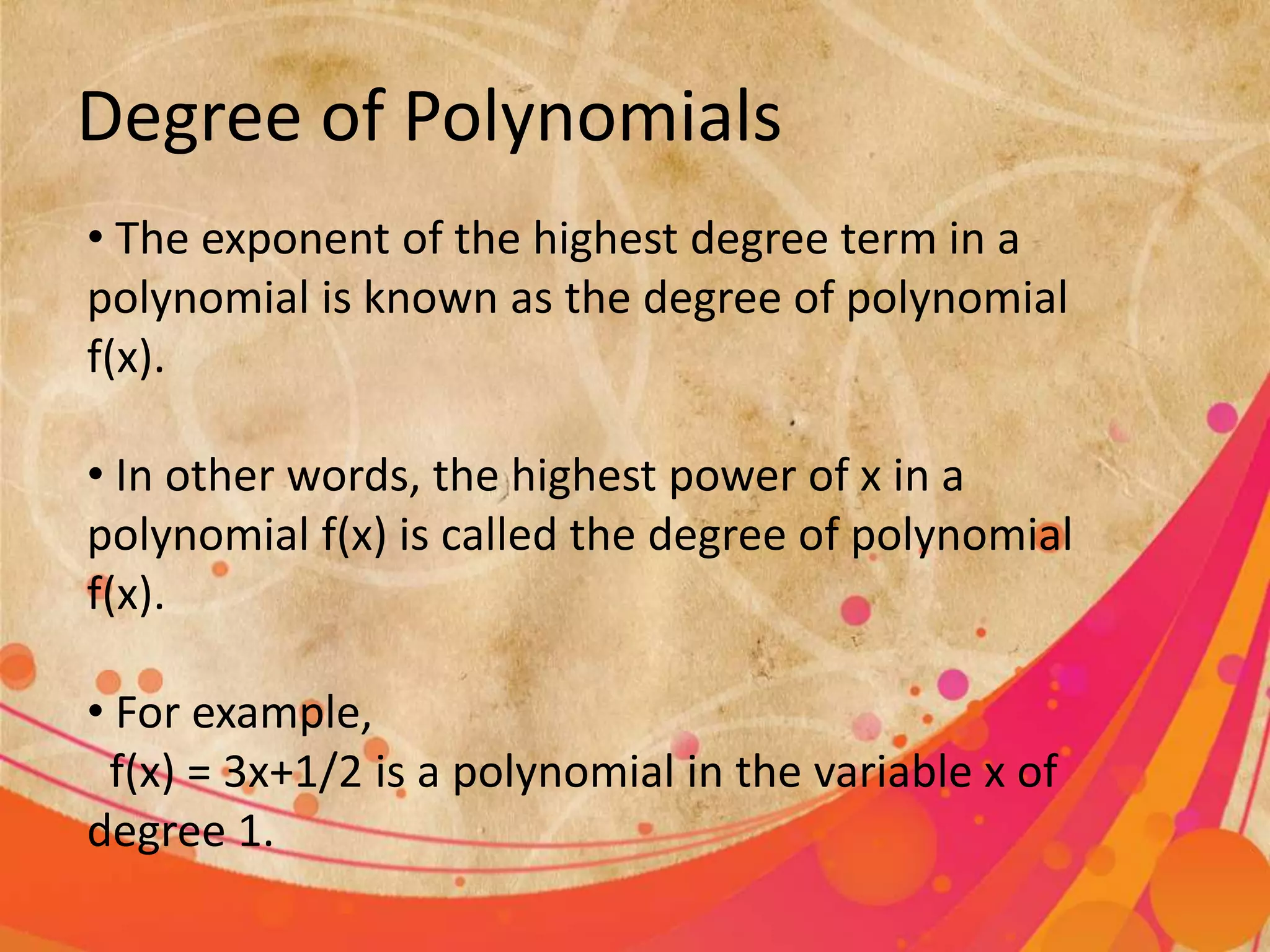
Degree of Polynomials
• The exponent of the highest degree term in a
polynomial is known as the degree of polynomial
f(x).
• In other words, the highest power of x in a
polynomial f(x) is called the degree of polynomial
f(x).
• For example,
f(x) = 3x+1/2 is a polynomial in the variable x of
degree 1.
Types of Polynomial…
 On the Basis of Number of terms
1. Monomial : Polynomials having only one term.
Example : 4x, 8x
2. Binomial : Polynomials having two terms .
Example : 2x+6, 25y-25.
3. Trinomial : Polynomials having three terms.
Examples : 2x²-x-3, x³+x²-8
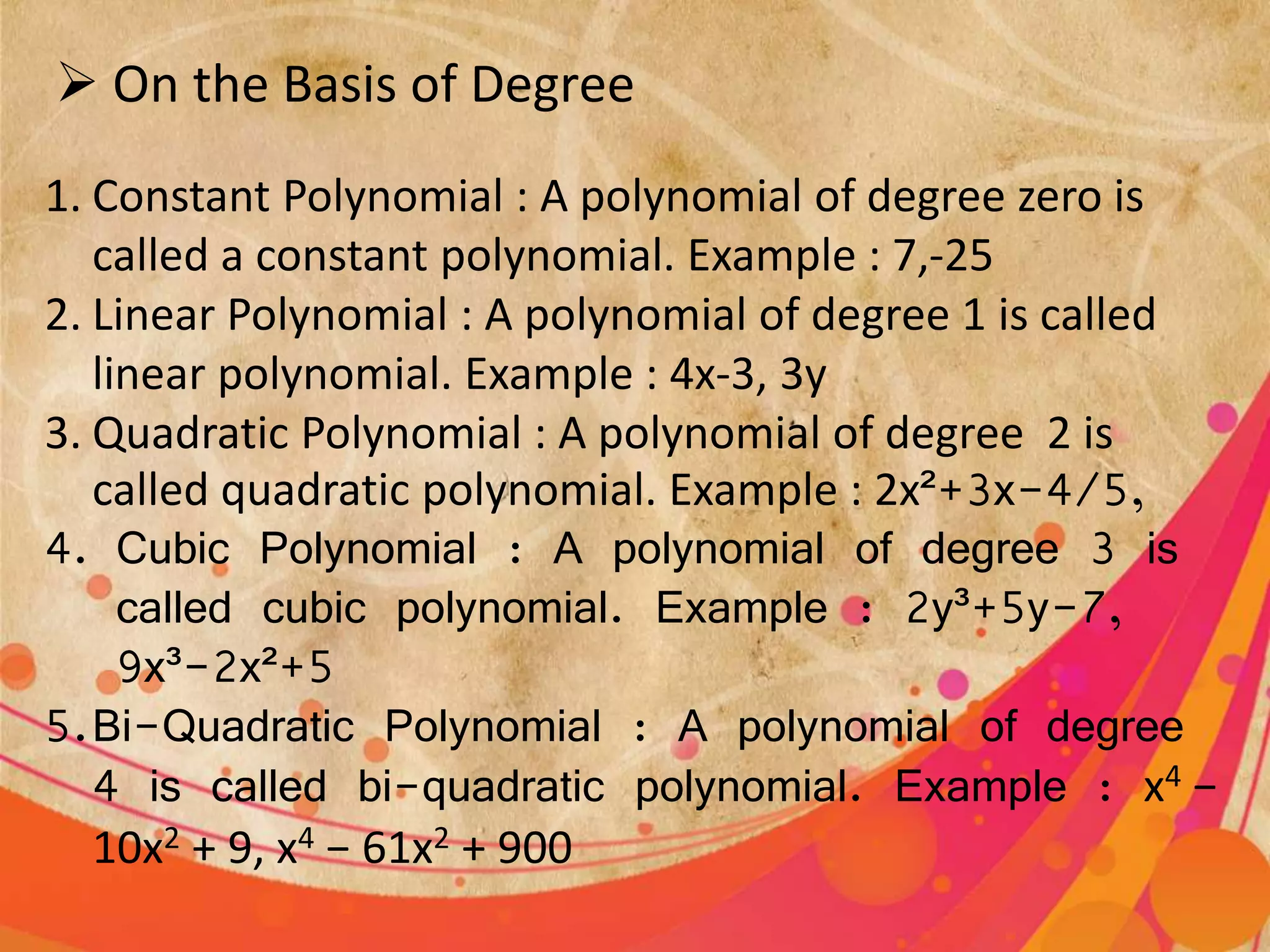
 On the Basis of Degree
1. Constant Polynomial : A polynomial of degree zero is
called a constant polynomial. Example : 7,-25
2. Linear Polynomial : A polynomial of degree 1 is called
linear polynomial. Example : 4x-3, 3y
3. Quadratic Polynomial : A polynomial of degree 2 is
called quadratic polynomial. Example : 2x²+3x-4/5,
4. Cubic Polynomial : A polynomial of degree 3 is
called cubic polynomial. Example : 2y³+5y-7,
9x³-2x²+5
5.Bi-Quadratic Polynomial : A polynomial of degree
4 is called bi-quadratic polynomial. Example : x4 −
10x2 + 9, x4 − 61x2 + 900
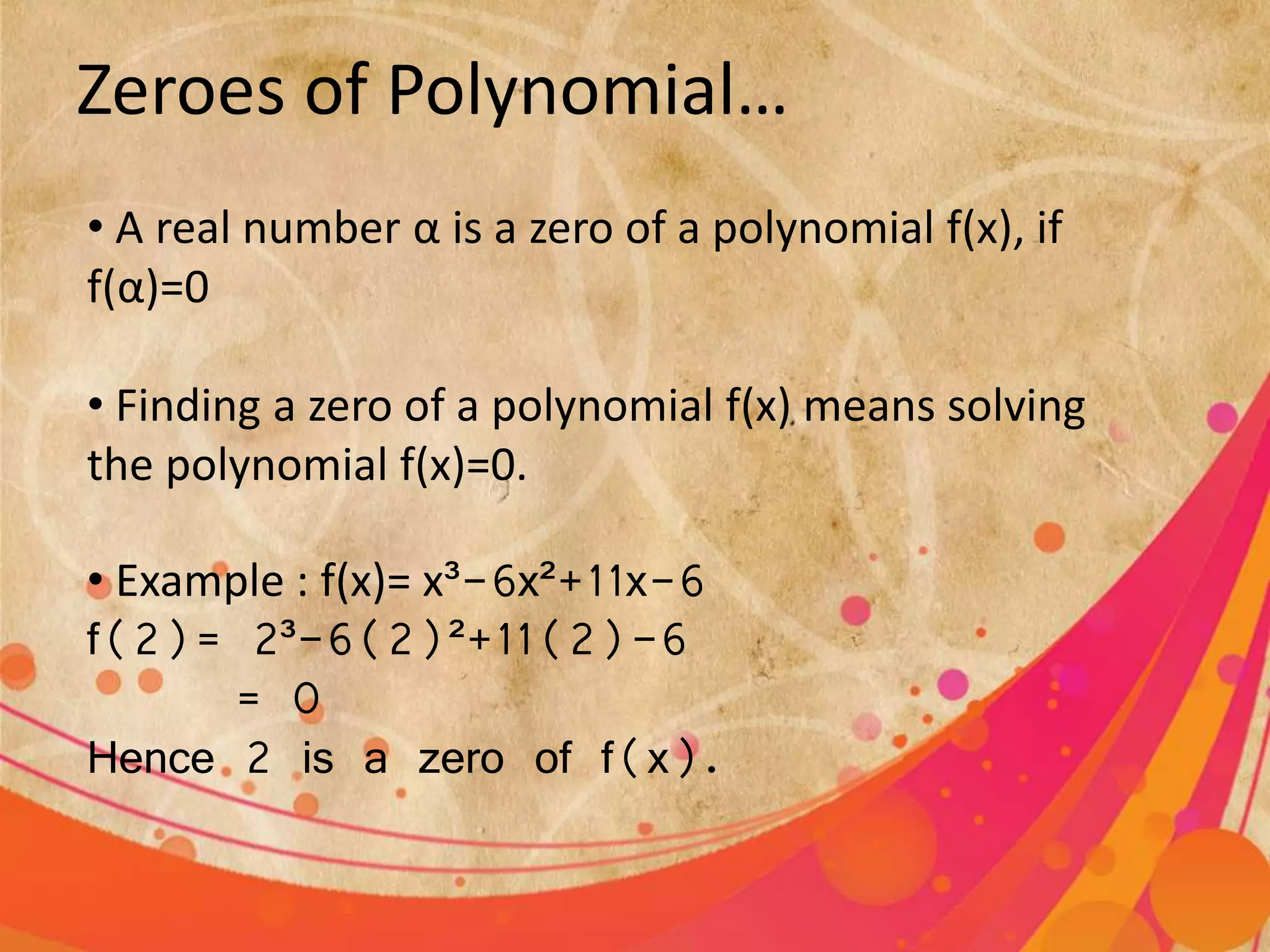
Zeroes of Polynomial…
• A real number α is a zero of a polynomial f(x), if
f(α)=0
• Finding a zero of a polynomial f(x) means solving
the polynomial f(x)=0.
• Example : f(x)= x³-6x²+11x-6
f(2)= 2³-6(2)²+11(2)-6
= 0
Hence 2 is a zero of f(x).
Relation between the Zeroes and
Coefficients of a Quadratic Polynomial
Let α , β and γ be the zeroes of the polynomial f(x)= ax²+bx+c.By
factor theorem (x- α)and (x- β) are the factors of f(x).
∴ f(x)=k(x- α)(x- β), where k is a constant
⇒ ax²+bx+c= k {x²-(α+ β )x+ αβ}
⇒ax²+bx+c= kx²-k(α+ β )x+ kαβ
Comparing the coefficients of x²,x and constant terms on both
sides, we get
a=k, b=-k(α+ β )and c= kαβ
⇒ α+ β= -b/a and αβ=c/a
⇒ α+ β(Sum of the zeroes)= -(Coefficient of x)
Coefficient of x²
and αβ(Product of the zeroes)= Constant term
Coefficient of x²
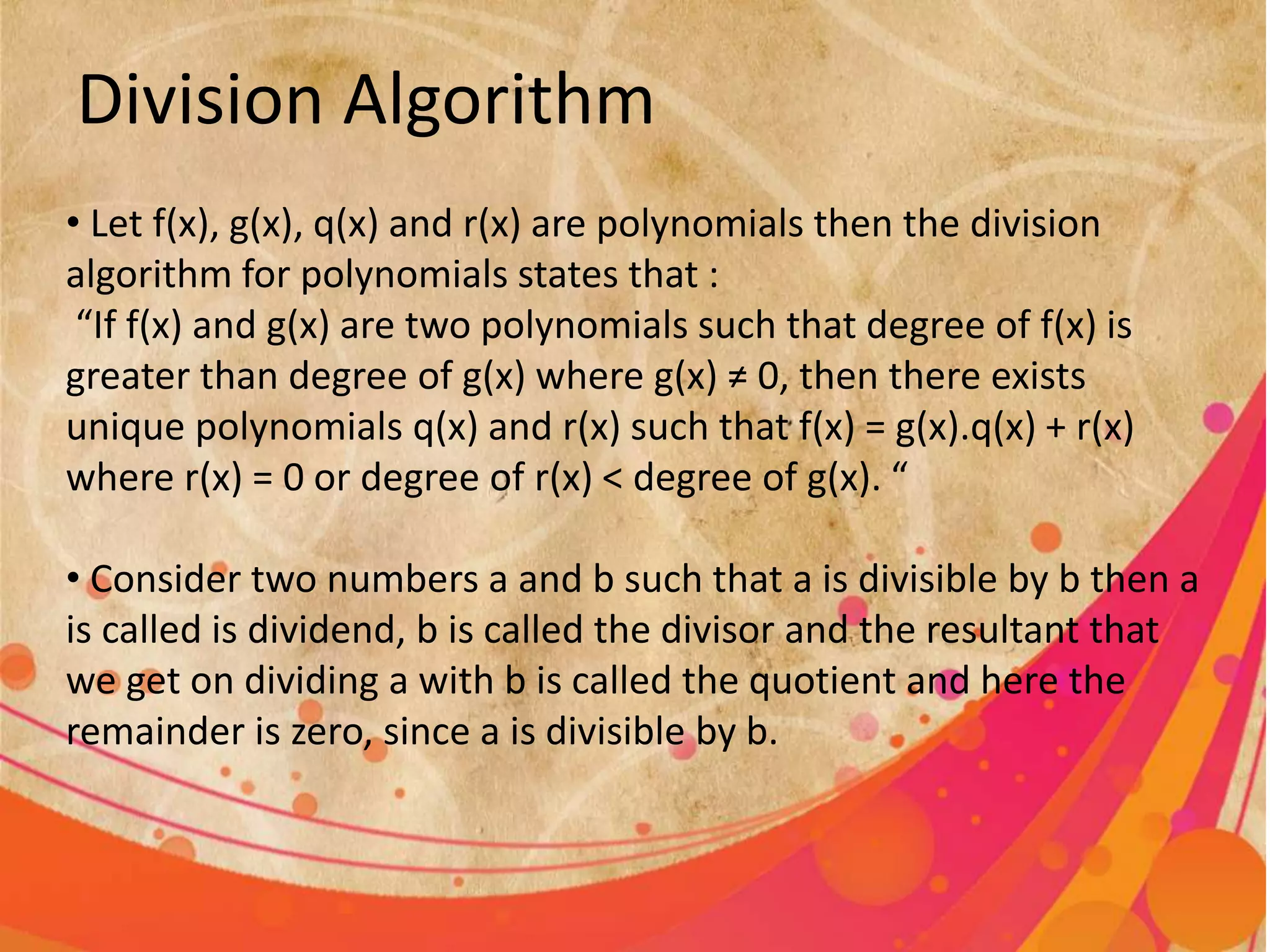
Division Algorithm
• Let f(x), g(x), q(x) and r(x) are polynomials then the division
algorithm for polynomials states that :
“If f(x) and g(x) are two polynomials such that degree of f(x) is
greater than degree of g(x) where g(x) ≠ 0, then there exists
unique polynomials q(x) and r(x) such that f(x) = g(x).q(x) + r(x)
where r(x) = 0 or degree of r(x) < degree of g(x). “
• Consider two numbers a and b such that a is divisible by b then a
is called is dividend, b is called the divisor and the resultant that
we get on dividing a with b is called the quotient and here the
remainder is zero, since a is divisible by b.
Hence by division rule it can written as,
Dividend = divisor x quotient + remainder. This holds good
even for polynomials too.
Divide the highest degree term of the dividend by the highest
degree term of the divisor and obtain the remainder.
If the remainder is O or degree of remainder is less than
divisor, then we cannot continue the division any furthur,if
degree of remainder is equal to or more than divisor repeat
the first step.
Thanks…

Polynomials

  • 1.
    New Era ProgressiveSchool Session 2015-16 PowerPoint Presentation Group Members : • Priyanka Sahu • Ravleen Kaur • Ridhima Agarwal • Samsriti Vohra Submitted To : Mrs. Mona Thakur Mathematics
  • 2.
    Contents… • Polynomials • Degreeof Polynomials • Types of Polynomials On the basis of number of terms On the basis of degree • Zeroes of Polynomial • Relation between the zeroes & coefficients of Polynomial • Division Algorithm for Polynomials
  • 3.
    Polynomials… • POLYNOMIAL –A polynomial is an expression made with constants, variables, and exponents which are combined by using mathematical operations. • The exponents can only be 1, 2, 3, 4, ….etc. • A Polynomial cannot have infinite no. of terms. •Example : p(x)=3x-2
  • 4.
    Degree of Polynomials •The exponent of the highest degree term in a polynomial is known as the degree of polynomial f(x). • In other words, the highest power of x in a polynomial f(x) is called the degree of polynomial f(x). • For example, f(x) = 3x+1/2 is a polynomial in the variable x of degree 1.
  • 5.
    Types of Polynomial… On the Basis of Number of terms 1. Monomial : Polynomials having only one term. Example : 4x, 8x 2. Binomial : Polynomials having two terms . Example : 2x+6, 25y-25. 3. Trinomial : Polynomials having three terms. Examples : 2x²-x-3, x³+x²-8
  • 6.
     On theBasis of Degree 1. Constant Polynomial : A polynomial of degree zero is called a constant polynomial. Example : 7,-25 2. Linear Polynomial : A polynomial of degree 1 is called linear polynomial. Example : 4x-3, 3y 3. Quadratic Polynomial : A polynomial of degree 2 is called quadratic polynomial. Example : 2x²+3x-4/5, 4. Cubic Polynomial : A polynomial of degree 3 is called cubic polynomial. Example : 2y³+5y-7, 9x³-2x²+5 5.Bi-Quadratic Polynomial : A polynomial of degree 4 is called bi-quadratic polynomial. Example : x4 − 10x2 + 9, x4 − 61x2 + 900
  • 7.
    Zeroes of Polynomial… •A real number α is a zero of a polynomial f(x), if f(α)=0 • Finding a zero of a polynomial f(x) means solving the polynomial f(x)=0. • Example : f(x)= x³-6x²+11x-6 f(2)= 2³-6(2)²+11(2)-6 = 0 Hence 2 is a zero of f(x).
  • 8.
    Relation between theZeroes and Coefficients of a Quadratic Polynomial Let α , β and γ be the zeroes of the polynomial f(x)= ax²+bx+c.By factor theorem (x- α)and (x- β) are the factors of f(x). ∴ f(x)=k(x- α)(x- β), where k is a constant ⇒ ax²+bx+c= k {x²-(α+ β )x+ αβ} ⇒ax²+bx+c= kx²-k(α+ β )x+ kαβ Comparing the coefficients of x²,x and constant terms on both sides, we get a=k, b=-k(α+ β )and c= kαβ ⇒ α+ β= -b/a and αβ=c/a ⇒ α+ β(Sum of the zeroes)= -(Coefficient of x) Coefficient of x² and αβ(Product of the zeroes)= Constant term Coefficient of x²
  • 9.
    Division Algorithm • Letf(x), g(x), q(x) and r(x) are polynomials then the division algorithm for polynomials states that : “If f(x) and g(x) are two polynomials such that degree of f(x) is greater than degree of g(x) where g(x) ≠ 0, then there exists unique polynomials q(x) and r(x) such that f(x) = g(x).q(x) + r(x) where r(x) = 0 or degree of r(x) < degree of g(x). “ • Consider two numbers a and b such that a is divisible by b then a is called is dividend, b is called the divisor and the resultant that we get on dividing a with b is called the quotient and here the remainder is zero, since a is divisible by b.
  • 10.
    Hence by divisionrule it can written as, Dividend = divisor x quotient + remainder. This holds good even for polynomials too. Divide the highest degree term of the dividend by the highest degree term of the divisor and obtain the remainder. If the remainder is O or degree of remainder is less than divisor, then we cannot continue the division any furthur,if degree of remainder is equal to or more than divisor repeat the first step.
  • 11.