BY
D.VENKATESH KUMAR
1ST YR PG
• Introduction
• Atrophy
• Hypertrophy
• Hyperplasia
• Metaplasia
• Dysplasia
• Conclusion
• References
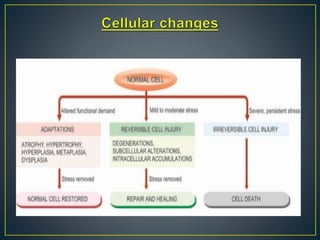
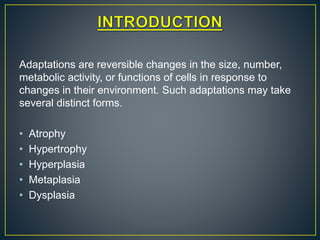
Adaptations are reversible changes in the size, number,
metabolic activity, or functions of cells in response to
changes in their environment. Such adaptations may take
several distinct forms.
• Atrophy
• Hypertrophy
• Hyperplasia
• Metaplasia
• Dysplasia
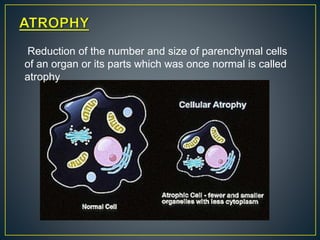
Reduction of the number and size of parenchymal cells
of an organ or its parts which was once normal is called
atrophy
Atrophy may occur from physiologic and pathologic causes:
Atrophy of brain with
aging.
Atrophy of gonads after
menopause.
PHYSIOLOGIC
ATRPOHY
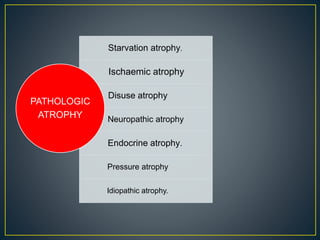
Starvation atrophy.
Ischaemic atrophy
Disuse atrophy
Neuropathic atrophy
Endocrine atrophy.
Pressure atrophy
Idiopathic atrophy.
PATHOLOGIC
ATROPHY
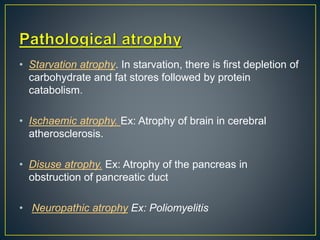
• Starvation atrophy. In starvation, there is first depletion of
carbohydrate and fat stores followed by protein
catabolism.
• Ischaemic atrophy. Ex: Atrophy of brain in cerebral
atherosclerosis.
• Disuse atrophy. Ex: Atrophy of the pancreas in
obstruction of pancreatic duct
• Neuropathic atrophy Ex: Poliomyelitis
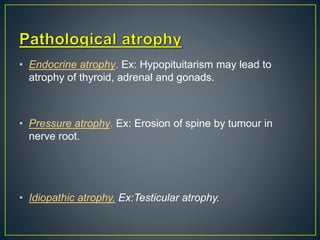
• Endocrine atrophy. Ex: Hypopituitarism may lead to
atrophy of thyroid, adrenal and gonads.
• Pressure atrophy. Ex: Erosion of spine by tumour in
nerve root.
• Idiopathic atrophy. Ex:Testicular atrophy.
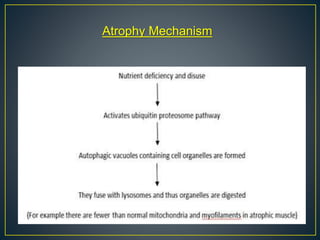
Atrophy Mechanism
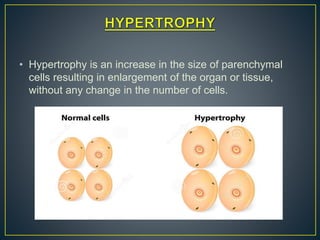
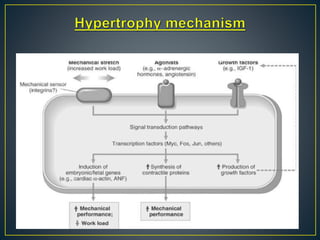
• Hypertrophy is an increase in the size of parenchymal
cells resulting in enlargement of the organ or tissue,
without any change in the number of cells.
• Hypertrophy may be physiologic or pathologic
Physiologic hypertrophy. Enlarged size of the uterus in
pregnancy is an excellent example of physiologic
hypertrophy as well as hyperplasia.
Pathologic hypertrophy:
• Hypertrophy of cardiac muscle may occur in a number of
cardiovascular diseases Ex: Systemic hypertension
• Hypertrophy of smooth muscle Ex: Pyloric stenosis (in
stomach)
• Hypertrophy of skeletal muscle Ex: hypertrophied
muscles in athletes and manual labourers
• Compensatory hypertrophy may occur in an organ when
the contralateral organ is removed
Ex. Following nephrectomy on one side in a young
patient, there is compensatory hypertrophy as well as
hyperplasia of the nephrons of the other kidney.
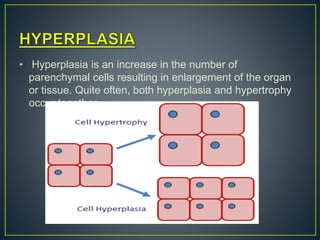
• Hyperplasia is an increase in the number of
parenchymal cells resulting in enlargement of the organ
or tissue. Quite often, both hyperplasia and hypertrophy
occur together.
Hyperplasia has also been divided into physiologic and
pathologic.
Physiologic hyperplasia- The two most common types
follows: 1.Hormonal hyperplasia
2.Compensatory hyperplasia
1. Hormonal hyperplasia i.e. hyperplasia occurring under
the influence of hormonal stimulation
Ex. Hyperplasia of female breast at puberty, during
pregnancy and lactation.
2. Compensatory hyperplasia i.e. hyperplasia occurring
following removal of part of an organ or a contralateral
organ in paired organ
e.g. i) Regeneration of the liver following partial
hepatectomy
• Pathologic hyperplasia: pathologic hyperplasia are due to
excessive stimulation of hormones or growth factors.
Ex: In wound healing, there is formation of granulation
tissue due to proliferation of fibroblasts and endothelial
cells
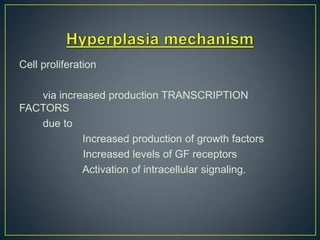
Cell proliferation
via increased production TRANSCRIPTION
FACTORS
due to
Increased production of growth factors
Increased levels of GF receptors
Activation of intracellular signaling.
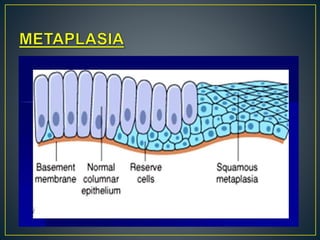
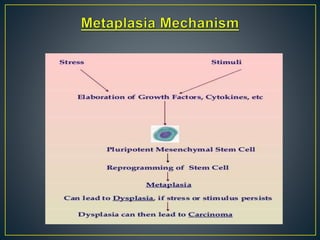
• Metaplasia is defined as a reversible change of one type
of epithelial or mesenchymal adult cells to another type of
adult epithelial or mesenchymal cells, usually in response
to abnormal stimuli, and often reverts back to normal on
removal of stimulus.
• Metaplasia is broadly divided into 2 types: epithelial and
mesenchymal.
A. EPITHELIAL METAPLASIA. Two types of
epithelial metaplasia are seen squamous and columnar
1. Squamous metaplasia: squamous metaplastic change
due to chronic irritation that may be mechanical, chemical
or infective in origin.
Ex: In bronchus (normally lined by
pseudostratified columnar ciliated epithelium) in chronic
smokers
2. Columnar metaplasia: There are some conditions in
which there is transformation to columnar epithelium.
Ex: Intestinal metaplasia in healed chronic gastric
ulcer
• B. MESENCHYMAL METAPLASIA. Less often, there is
transformation of one adult type of mesenchymal tissue
to another.
• 1. Osseous metaplasia: Ex-In cartilage of larynx and
bronchi in elderly people
• 2. Cartilaginous metaplasia. In healing of fractures,
cartilaginous metaplasia may occur where there is undue
mobility
• It is defined as the alteration of size, shape and
architectural orientation of the cellular components of the
epithelium
Epithelial dysplasia is characterised by
histomorphologic and histopathologic changes. These
changes include:
Histopathologic alterations:
• Bulbous or teardrop shaped rete ridges.
• Loss of polarity
• keratinization or epithelial pearls.
• Loss of typical epithelial cohesiveness.
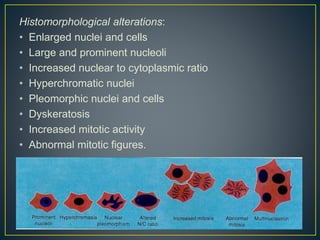
Histomorphological alterations:
• Enlarged nuclei and cells
• Large and prominent nucleoli
• Increased nuclear to cytoplasmic ratio
• Hyperchromatic nuclei
• Pleomorphic nuclei and cells
• Dyskeratosis
• Increased mitotic activity
• Abnormal mitotic figures.
• Mild dysplasia: Disturbance in architecture limited to the
lower third of the epithelium, accompanied by minimal
cytological atypia.
• Moderate dysplasia: Disturbance in architecture
extending up to the middle third of the epithelium.
• Alternatively lesion with mild atypical features extending
in to the middle third of the epithelium.
Grades of dysplasia
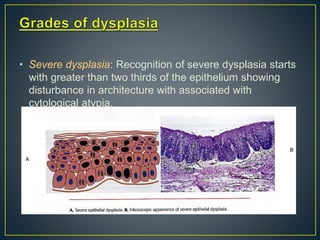
• Severe dysplasia: Recognition of severe dysplasia starts
with greater than two thirds of the epithelium showing
disturbance in architecture with associated with
cytological atypia.
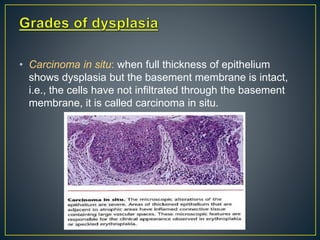
• Carcinoma in situ: when full thickness of epithelium
shows dysplasia but the basement membrane is intact,
i.e., the cells have not infiltrated through the basement
membrane, it is called carcinoma in situ.
• Overall cellular adaptations is the changes
in structure and function of cells in the
human body. Thus, cellular adaptations
provide clue to pathologists in diagnosing
the disease.
• Harsh Mohan: Text Book of Pathology; 6th edition
• Robbins :Pathologic basis of diseases; 8th edition
• Colour atlas of histopathology-R.C curran 3rd edition
• Ak mandal :Text book of pathology
• Anil ghom: Text book of oral pathology
• Oral and maxillofacial pathology:J.Philip sapp
• Text book of oral pathology: Neville
• http://en.m.wikipedia.org>wiki>cellular_adaptaions
Cellular adaptations

Cellular adaptations

  • 2.
  • 3.
    • Introduction • Atrophy •Hypertrophy • Hyperplasia • Metaplasia • Dysplasia • Conclusion • References
  • 5.
    Adaptations are reversiblechanges in the size, number, metabolic activity, or functions of cells in response to changes in their environment. Such adaptations may take several distinct forms. • Atrophy • Hypertrophy • Hyperplasia • Metaplasia • Dysplasia
  • 6.
    Reduction of thenumber and size of parenchymal cells of an organ or its parts which was once normal is called atrophy
  • 7.
    Atrophy may occurfrom physiologic and pathologic causes: Atrophy of brain with aging. Atrophy of gonads after menopause. PHYSIOLOGIC ATRPOHY
  • 8.
    Starvation atrophy. Ischaemic atrophy Disuseatrophy Neuropathic atrophy Endocrine atrophy. Pressure atrophy Idiopathic atrophy. PATHOLOGIC ATROPHY
  • 9.
    • Starvation atrophy.In starvation, there is first depletion of carbohydrate and fat stores followed by protein catabolism. • Ischaemic atrophy. Ex: Atrophy of brain in cerebral atherosclerosis. • Disuse atrophy. Ex: Atrophy of the pancreas in obstruction of pancreatic duct • Neuropathic atrophy Ex: Poliomyelitis
  • 10.
    • Endocrine atrophy.Ex: Hypopituitarism may lead to atrophy of thyroid, adrenal and gonads. • Pressure atrophy. Ex: Erosion of spine by tumour in nerve root. • Idiopathic atrophy. Ex:Testicular atrophy.
  • 11.
  • 12.
    • Hypertrophy isan increase in the size of parenchymal cells resulting in enlargement of the organ or tissue, without any change in the number of cells.
  • 13.
    • Hypertrophy maybe physiologic or pathologic Physiologic hypertrophy. Enlarged size of the uterus in pregnancy is an excellent example of physiologic hypertrophy as well as hyperplasia.
  • 14.
    Pathologic hypertrophy: • Hypertrophyof cardiac muscle may occur in a number of cardiovascular diseases Ex: Systemic hypertension • Hypertrophy of smooth muscle Ex: Pyloric stenosis (in stomach) • Hypertrophy of skeletal muscle Ex: hypertrophied muscles in athletes and manual labourers
  • 15.
    • Compensatory hypertrophymay occur in an organ when the contralateral organ is removed Ex. Following nephrectomy on one side in a young patient, there is compensatory hypertrophy as well as hyperplasia of the nephrons of the other kidney.
  • 17.
    • Hyperplasia isan increase in the number of parenchymal cells resulting in enlargement of the organ or tissue. Quite often, both hyperplasia and hypertrophy occur together.
  • 18.
    Hyperplasia has alsobeen divided into physiologic and pathologic. Physiologic hyperplasia- The two most common types follows: 1.Hormonal hyperplasia 2.Compensatory hyperplasia
  • 19.
    1. Hormonal hyperplasiai.e. hyperplasia occurring under the influence of hormonal stimulation Ex. Hyperplasia of female breast at puberty, during pregnancy and lactation. 2. Compensatory hyperplasia i.e. hyperplasia occurring following removal of part of an organ or a contralateral organ in paired organ e.g. i) Regeneration of the liver following partial hepatectomy
  • 20.
    • Pathologic hyperplasia:pathologic hyperplasia are due to excessive stimulation of hormones or growth factors. Ex: In wound healing, there is formation of granulation tissue due to proliferation of fibroblasts and endothelial cells
  • 21.
    Cell proliferation via increasedproduction TRANSCRIPTION FACTORS due to Increased production of growth factors Increased levels of GF receptors Activation of intracellular signaling.
  • 23.
    • Metaplasia isdefined as a reversible change of one type of epithelial or mesenchymal adult cells to another type of adult epithelial or mesenchymal cells, usually in response to abnormal stimuli, and often reverts back to normal on removal of stimulus. • Metaplasia is broadly divided into 2 types: epithelial and mesenchymal. A. EPITHELIAL METAPLASIA. Two types of epithelial metaplasia are seen squamous and columnar
  • 24.
    1. Squamous metaplasia:squamous metaplastic change due to chronic irritation that may be mechanical, chemical or infective in origin. Ex: In bronchus (normally lined by pseudostratified columnar ciliated epithelium) in chronic smokers 2. Columnar metaplasia: There are some conditions in which there is transformation to columnar epithelium. Ex: Intestinal metaplasia in healed chronic gastric ulcer
  • 25.
    • B. MESENCHYMALMETAPLASIA. Less often, there is transformation of one adult type of mesenchymal tissue to another. • 1. Osseous metaplasia: Ex-In cartilage of larynx and bronchi in elderly people • 2. Cartilaginous metaplasia. In healing of fractures, cartilaginous metaplasia may occur where there is undue mobility
  • 27.
    • It isdefined as the alteration of size, shape and architectural orientation of the cellular components of the epithelium Epithelial dysplasia is characterised by histomorphologic and histopathologic changes. These changes include: Histopathologic alterations: • Bulbous or teardrop shaped rete ridges. • Loss of polarity • keratinization or epithelial pearls. • Loss of typical epithelial cohesiveness.
  • 28.
    Histomorphological alterations: • Enlargednuclei and cells • Large and prominent nucleoli • Increased nuclear to cytoplasmic ratio • Hyperchromatic nuclei • Pleomorphic nuclei and cells • Dyskeratosis • Increased mitotic activity • Abnormal mitotic figures.
  • 29.
    • Mild dysplasia:Disturbance in architecture limited to the lower third of the epithelium, accompanied by minimal cytological atypia.
  • 30.
    • Moderate dysplasia:Disturbance in architecture extending up to the middle third of the epithelium. • Alternatively lesion with mild atypical features extending in to the middle third of the epithelium. Grades of dysplasia
  • 31.
    • Severe dysplasia:Recognition of severe dysplasia starts with greater than two thirds of the epithelium showing disturbance in architecture with associated with cytological atypia.
  • 32.
    • Carcinoma insitu: when full thickness of epithelium shows dysplasia but the basement membrane is intact, i.e., the cells have not infiltrated through the basement membrane, it is called carcinoma in situ.
  • 33.
    • Overall cellularadaptations is the changes in structure and function of cells in the human body. Thus, cellular adaptations provide clue to pathologists in diagnosing the disease.
  • 34.
    • Harsh Mohan:Text Book of Pathology; 6th edition • Robbins :Pathologic basis of diseases; 8th edition • Colour atlas of histopathology-R.C curran 3rd edition • Ak mandal :Text book of pathology • Anil ghom: Text book of oral pathology • Oral and maxillofacial pathology:J.Philip sapp • Text book of oral pathology: Neville • http://en.m.wikipedia.org>wiki>cellular_adaptaions

Editor's Notes

  • #19 . Labile cells (e.g. epithelial cells of the skin and mucous membranes, cells of the bone marrow and lymph nodes) and stable cells (e.g. parenchymal cells of the liver, pancreas, kidney, adrenal, and thyroid) can undergo hyperplasia, while permanent cells (e.g. neurons, cardiac and skeletal muscle) have little or no capacity for regenerative hyperplastic growth.