DR HASAN
ASKARI
HYPERPLASIA
• HYPERPLASIA:
• Definition: an increase in the number of
cells in an organ or tissue.
• Hyperplasia can only occur with cells
capable of synthesizing DNA like epithial
and hematopoietic and connective tissue
cells.
• Nerve, cardiac and skeletal cell have little
or no capacity for hyper plastic growth.
• Eg lactating breast
HYPERPLASIA
• Physiologic hyperplasia:
• Examples of physiologic hyperplasia include
• 1 hormonal hyperplasia increase the
functional capacity of a tissue when
needed.(e.g. endometrial proliferation after
estrogen stimulation/granular proliferation of
the female breast at puberty and during
pregnancy).
• 2 compensatory hyperplasia increase tissue
mass after damage or partial resection.(e.g.
hyperplasia of the liver after partial
hepatectomy) myth of Prometheus
HYPERPLASIA
Normal lactating
breast
HYPERPLASIA
Mechanisms of physiologic hyperplasia:
lessons from hepatic regeneration
After partial hepatectomy all the remaining cellular
population of the liver proliferate to rebuild the lost
hepatic tissue.
The increase in cell proliferation is due to the combined
action of growth factors such as hepatocyte growth
factors, transforming growth factors –alpha (TGF-
ALPHA) and epidermal growth factor as well as
cytokines such as tumor necrosis factor- alpha and
interleukin-6.
Cell growth inhibited by growth inhibitors (e.g.
transforming growth factors – beta ) produced in the liver
itself.
HYPERPLASIA
• Pathologic hyperplasia:
• Example of pathologic hyperplasia are excessive hormonal stimulation or
growth factors (e.g. typical endometrial hyperplasia)
• locally produced growth factors on target cells (e.g. connective tissue cell in
wound healing or Squamous epithelium induced by viruses)
• In pathologic hyperplasia if the stimulus abates, the hyperplasia disappears.
Thus, cell respond to regular growth control, differentiating the process from
neoplasia.
• Other example : benign prostatic hyperplasia
• In cancer the growth control mechanism become ineffective because of
genetics aberration resulting unrestrained /uncontrolled proliferation.
• Hyperplasia is distinct from cancer but pathologic hyperplasia constitutes a
fertile soil in which cancerous proliferation may eventually arise.
• Pt with hyperplasia of endometrial are at increased risk for developing
endometrial cancer.
• In viral infections such as papillomavirus which cause skin wart and several
mucosal lesion of hyperplasia .
HYPERTROPHY
• HYPERTROPHY:
• Definition: an increase in the number of organelles
(e.g. myofilaments) and size of cells and with such
changes an increase in the size of the organs.
• Hypertrophy can be physiologic or pathologic and is
caused by:
• 1 increased functional demand (e.g. hypertrophy of
striated muscle in muscle builders [physiologic] or
cardiac muscle cell in cardiac disease that induce
volume overload [pathologic]
• 2 specific hormonal stimulation (e.g. uterine
hypertrophy or breast enlargement during pregnancy)
• E.g. skeletal muscles of athletes.
ATROPHY
• Atrophy
• Atrophy is shrinkage in the size of the cell and in the size of
the organ as a result of loss of cell substance .
• Atrophy cells have diminished function but are not dead.
Causes of atrophy are:
• 1 Decreased workload (atrophy of disuse)
• 2 Loss of innervations (denervation atrophy)
• 3 Diminished blood supply
• 4 Inadequate nutrition
• 5 Loss of endocrine stimulation
• 6 Aging
• 7 pressure
• E.g. post menopausal endometrium
ATROPHY
ATROPHY
• The reduction in the structural component in
atrophy occurs through several mechanisms:
• Decreased synthesis→ the balance between
synthesis and degradation has been altered.
• Endocytic mechanisms → atrophic cell
exhibit autophagy with a reduction in the
number of cell organelles and often a marked
increase in the number of autophagic
vacuoles. Components resisting digestion are
converted to lipofuscin granules, which in
sufficient number make the organ brown
(brown atrophy)
ATROPHY
• Proteasomal pathway → responsible for the
accerlated proteolysis seen in a variety of
catabolic condition as well as in the
degradation of abnormal or aggregated
protein.
• Meditation prevent atrophy
• “Meditation appears to be a powerful mental exercise with the potential to change the
physical structure of the brain at large,” said Eileen Luders of UCLA. “Collecting evidence
that active, frequent, and regular meditation practices cause alterations of white-matter
fiber tracts that are profound and sustainable may become relevant for patient populations
suffering from axonal demyelination and white-matter atrophy.
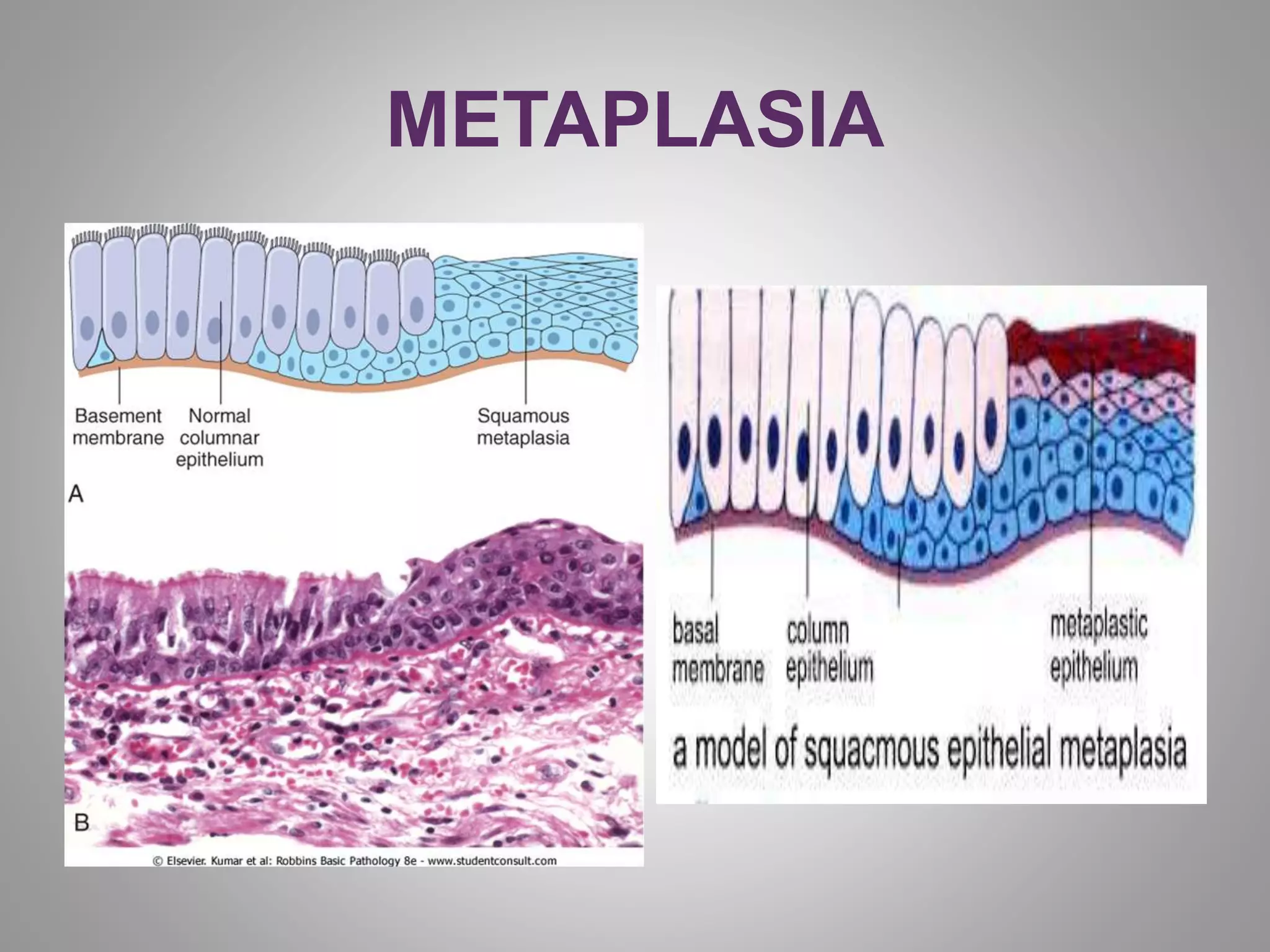
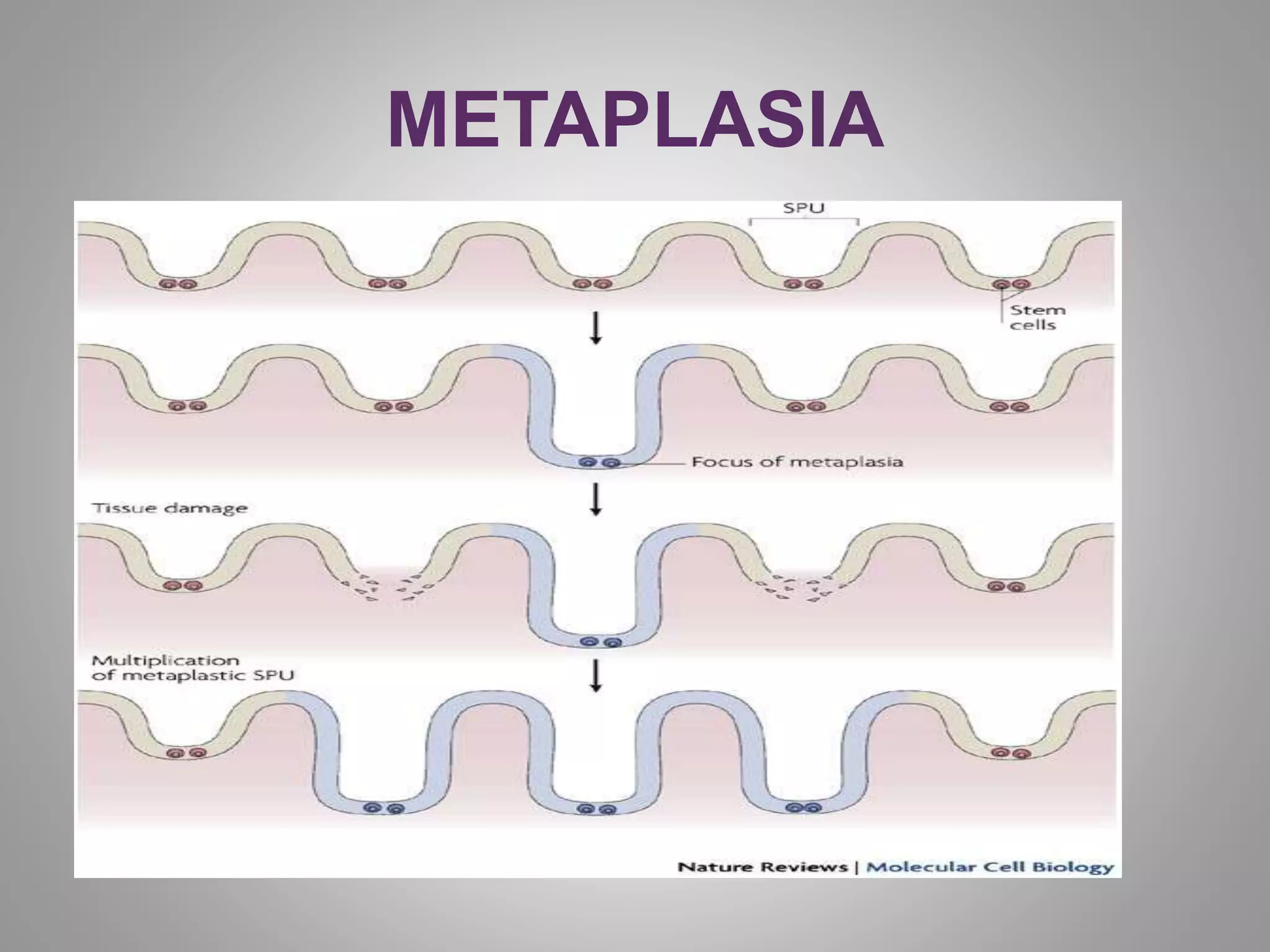
METAPLASIA
• METAPLASIA:
• DEFINITION: reversible change in which one adult cell type is replaced by
another (epithelial or mesenchymal).
• The most common example is a change from columnar to Squamous
epithelium as occurs in the Squamous metaphase of respiratory epithelium
in chronic irritation .
• Metaplastic epithelium is benign, the influence that predispose to such
metaplasia, if persistent may induce atypical metaplasia which may
progress to cancer .
• Metaplasia can also occur in mesenchymal cell by which fibroblast may
become transformed to osteoblasts or chrondroblasts to produce bone or
cartilage.
• Metaplasia is occurs from genetic reprogramming of stem cell.
• This genetic reprogramming is brought about by changes in signal
generated by mixture of cytokines , growth factors, and extracellular matrix
component in cell envirnment .
• The external signal induce specific transcription factors that lead the
cascade of phenotype specific genes toward a fully differentiated cell.
• when stimulus stops metaplastic changes reverse.
• Eg baretts oseophagus
METAPLASIA
• Barrett esophagus :
• In which the esophageal Squamous
epithelium is replaced by intestinal like
columnar cells under the influences of
refluxed gastric acid. Cancer may arises in
these areas .
• Eg glandular (adeno) carcinomas
• Connective tissue metaplasia is the
formation of cartilage, bone or adipose
tissue e.g. myositis ossificans.
METAPLASIA
Figure 11. Barrett’s esophagus; A, before and B, after endoscopic ablative
therapy. A’, B’, endoscopic views.
METAPLASIA
Figure 12. A, Esophageal cancer arising from Barrett’s esophagus; B,
endoscopic view.
METAPLASIA
METAPLASIA
Metaplasia

Metaplasia

  • 1.
  • 2.
    HYPERPLASIA • HYPERPLASIA: • Definition:an increase in the number of cells in an organ or tissue. • Hyperplasia can only occur with cells capable of synthesizing DNA like epithial and hematopoietic and connective tissue cells. • Nerve, cardiac and skeletal cell have little or no capacity for hyper plastic growth. • Eg lactating breast
  • 4.
    HYPERPLASIA • Physiologic hyperplasia: •Examples of physiologic hyperplasia include • 1 hormonal hyperplasia increase the functional capacity of a tissue when needed.(e.g. endometrial proliferation after estrogen stimulation/granular proliferation of the female breast at puberty and during pregnancy). • 2 compensatory hyperplasia increase tissue mass after damage or partial resection.(e.g. hyperplasia of the liver after partial hepatectomy) myth of Prometheus
  • 5.
  • 7.
    HYPERPLASIA Mechanisms of physiologichyperplasia: lessons from hepatic regeneration After partial hepatectomy all the remaining cellular population of the liver proliferate to rebuild the lost hepatic tissue. The increase in cell proliferation is due to the combined action of growth factors such as hepatocyte growth factors, transforming growth factors –alpha (TGF- ALPHA) and epidermal growth factor as well as cytokines such as tumor necrosis factor- alpha and interleukin-6. Cell growth inhibited by growth inhibitors (e.g. transforming growth factors – beta ) produced in the liver itself.
  • 8.
    HYPERPLASIA • Pathologic hyperplasia: •Example of pathologic hyperplasia are excessive hormonal stimulation or growth factors (e.g. typical endometrial hyperplasia) • locally produced growth factors on target cells (e.g. connective tissue cell in wound healing or Squamous epithelium induced by viruses) • In pathologic hyperplasia if the stimulus abates, the hyperplasia disappears. Thus, cell respond to regular growth control, differentiating the process from neoplasia. • Other example : benign prostatic hyperplasia • In cancer the growth control mechanism become ineffective because of genetics aberration resulting unrestrained /uncontrolled proliferation. • Hyperplasia is distinct from cancer but pathologic hyperplasia constitutes a fertile soil in which cancerous proliferation may eventually arise. • Pt with hyperplasia of endometrial are at increased risk for developing endometrial cancer. • In viral infections such as papillomavirus which cause skin wart and several mucosal lesion of hyperplasia .
  • 9.
    HYPERTROPHY • HYPERTROPHY: • Definition:an increase in the number of organelles (e.g. myofilaments) and size of cells and with such changes an increase in the size of the organs. • Hypertrophy can be physiologic or pathologic and is caused by: • 1 increased functional demand (e.g. hypertrophy of striated muscle in muscle builders [physiologic] or cardiac muscle cell in cardiac disease that induce volume overload [pathologic] • 2 specific hormonal stimulation (e.g. uterine hypertrophy or breast enlargement during pregnancy) • E.g. skeletal muscles of athletes.
  • 13.
    ATROPHY • Atrophy • Atrophyis shrinkage in the size of the cell and in the size of the organ as a result of loss of cell substance . • Atrophy cells have diminished function but are not dead. Causes of atrophy are: • 1 Decreased workload (atrophy of disuse) • 2 Loss of innervations (denervation atrophy) • 3 Diminished blood supply • 4 Inadequate nutrition • 5 Loss of endocrine stimulation • 6 Aging • 7 pressure • E.g. post menopausal endometrium
  • 14.
  • 15.
    ATROPHY • The reductionin the structural component in atrophy occurs through several mechanisms: • Decreased synthesis→ the balance between synthesis and degradation has been altered. • Endocytic mechanisms → atrophic cell exhibit autophagy with a reduction in the number of cell organelles and often a marked increase in the number of autophagic vacuoles. Components resisting digestion are converted to lipofuscin granules, which in sufficient number make the organ brown (brown atrophy)
  • 17.
    ATROPHY • Proteasomal pathway→ responsible for the accerlated proteolysis seen in a variety of catabolic condition as well as in the degradation of abnormal or aggregated protein.
  • 18.
    • Meditation preventatrophy • “Meditation appears to be a powerful mental exercise with the potential to change the physical structure of the brain at large,” said Eileen Luders of UCLA. “Collecting evidence that active, frequent, and regular meditation practices cause alterations of white-matter fiber tracts that are profound and sustainable may become relevant for patient populations suffering from axonal demyelination and white-matter atrophy.
  • 20.
    METAPLASIA • METAPLASIA: • DEFINITION:reversible change in which one adult cell type is replaced by another (epithelial or mesenchymal). • The most common example is a change from columnar to Squamous epithelium as occurs in the Squamous metaphase of respiratory epithelium in chronic irritation . • Metaplastic epithelium is benign, the influence that predispose to such metaplasia, if persistent may induce atypical metaplasia which may progress to cancer . • Metaplasia can also occur in mesenchymal cell by which fibroblast may become transformed to osteoblasts or chrondroblasts to produce bone or cartilage. • Metaplasia is occurs from genetic reprogramming of stem cell. • This genetic reprogramming is brought about by changes in signal generated by mixture of cytokines , growth factors, and extracellular matrix component in cell envirnment . • The external signal induce specific transcription factors that lead the cascade of phenotype specific genes toward a fully differentiated cell. • when stimulus stops metaplastic changes reverse. • Eg baretts oseophagus
  • 21.
    METAPLASIA • Barrett esophagus: • In which the esophageal Squamous epithelium is replaced by intestinal like columnar cells under the influences of refluxed gastric acid. Cancer may arises in these areas . • Eg glandular (adeno) carcinomas • Connective tissue metaplasia is the formation of cartilage, bone or adipose tissue e.g. myositis ossificans.
  • 22.
    METAPLASIA Figure 11. Barrett’sesophagus; A, before and B, after endoscopic ablative therapy. A’, B’, endoscopic views.
  • 23.
    METAPLASIA Figure 12. A,Esophageal cancer arising from Barrett’s esophagus; B, endoscopic view.
  • 24.
  • 25.

Editor's Notes

  • #6 Lactating adenoma is actually a focus of hyperplasia seen in breasts during pregnancy or puerperial period. It may be solitary or multiple and has a gray cut surface. This low-power image shows enlarged lobules containing markedly increased number of glands. The patient was a 32 year old pregnant woman who presented with bilateral breast masses.