PRESENTED BY
Dr. D.Venkatesh Kumar
2nd yr PG

CONTENTS
 Introduction
 Classification
 Etiology
 Clinical Features
 Monostotic Form
 Polyostotic Form
 Craniofacial form
 Radiographic Features
 Histologic Features
 Treatment &Prognosis
 Conclusion

Fibro-Osseous
Lesion
•“Replacement of normal bone by tissue composed of
collagen fibers and fibroblasts, containing varying
amount of mineralized substance” – Waldron 1985.
•“A collection of non – neoplastic intraosseous lesions
that replace bone and consists of a cellular fibrous
connective tissue within which non- functional osseous
structures form” Eversole
INTRODUCTION

WHO CLASSIFICATION 1992
1. Osteogenic Neoplasms
a. A.Cemento-Ossifying Fibroma (Cementifying Fibroma, Ossifying
Fibroma)
2. Non-Neoplastic Bone Lesions
a. Fibrous Dysplasia Of Jaws
b. Cemento-Osseous Dysplasia
I. Periapical Cemental Dysplasia (Periapical Fiberous Dysplasia),
II. Florid Cemento-Osseous Dysplasia (Gigantiform Cementoma, Familial
Multiple Cementomas)
III. Other Cemento-Osseous Dysplasia
c. Cherubism (Familial Multilocular Cystic Disease Of The Jaws)
d. Central Giant Cell Granuloma
e. Aneurismal Bone Cyst
f. Solitary Bone Cyst (Traumatic, Simple, Hemorrhagic Bone Cyst)

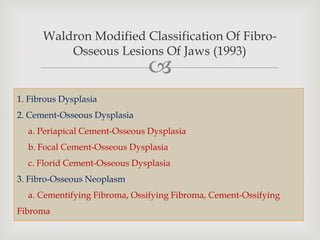
Waldron Modified Classification Of Fibro-
Osseous Lesions Of Jaws (1993)
1. Fibrous Dysplasia
2. Cement-Osseous Dysplasia
a. Periapical Cement-Osseous Dysplasia
b. Focal Cement-Osseous Dysplasia
c. Florid Cement-Osseous Dysplasia
3. Fibro-Osseous Neoplasm
a. Cementifying Fibroma, Ossifying Fibroma, Cement-Ossifying
Fibroma

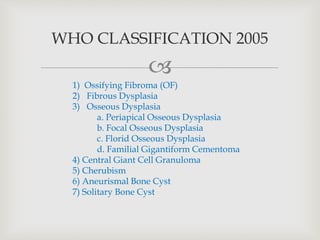
WHO CLASSIFICATION 2005
1) Ossifying Fibroma (OF)
2) Fibrous Dysplasia
3) Osseous Dysplasia
a. Periapical Osseous Dysplasia
b. Focal Osseous Dysplasia
c. Florid Osseous Dysplasia
d. Familial Gigantiform Cementoma
4) Central Giant Cell Granuloma
5) Cherubism
6) Aneurismal Bone Cyst
7) Solitary Bone Cyst

EVERSOLE 2008 CLASSIFICATION
1.Bone dysplasias
a. Fibrous dysplasia
i. Monostotic
ii. Polyostotic
iii. Polyostotic with endocrinopathy (McCune-Albright)
iv. Osteofibrous dysplasia
b. Osteitis deformans
c. Pagetoid heritable bone dysplasias of childhood
d. Segmental odontomaxillary dysplasia
2. Cemento-osseous dysplasias
a. Focal cemento-osseous dysplasia
b. Florid cemento-osseous dysplasia
3.Inflammatory/reactive processes
a. Focal sclerosing osteomyelitis
b. Diffuse sclerosing osteomyelitis
c. Proliferative periostitis
4. Metabolic Disease: hyperparathyroidism

5. Neoplastic lesions (Ossifying fibromas)
a. Ossifying fibroma
b. Hyperparathyroidism jaw lesion syndrome
c. Juvenile ossifying fibroma
i. Trabecular type
ii. Psammomatoid type
d. Gigantiform cementomas

Terminology
• Skeletal developmental anomaly of the bone - defect in osteoblastic
differentiation and maturation
• 2.5% of all bony tumours & 7% of all non-malignant tumours of bone
• Von recklinghausen 1891- osteitis fibrosa cystica.
• Fibrous dysplasia of bone.
Lichentenstein
1938

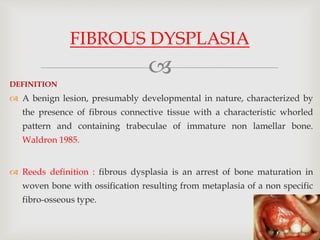
DEFINITION
 A benign lesion, presumably developmental in nature, characterized by
the presence of fibrous connective tissue with a characteristic whorled
pattern and containing trabeculae of immature non lamellar bone.
Waldron 1985.
 Reeds definition : fibrous dysplasia is an arrest of bone maturation in
woven bone with ossification resulting from metaplasia of a non specific
fibro-osseous type.
FIBROUS DYSPLASIA

Idiopathic
Non hereditary
Caused by mutation in GNAS1 gene
ETIOLOGY & PATHOGENESIS

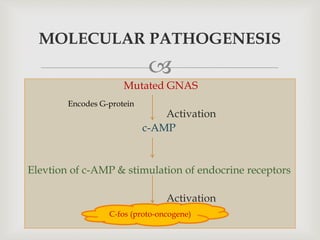
Mutated GNAS
Activation
c-AMP
Elevtion of c-AMP & stimulation of endocrine receptors
Activation
MOLECULAR PATHOGENESIS
C-fos (proto-oncogene)
Encodes G-protein
JAFFE-LICHENSTEIN SYNDROME
MCCUNE ALBRIGHT
SYNDROME

Mutated osteoblasts
Over expression IL-6
Stimulate osteoclastic activity
Bone Lesion Expansion

CLINICAL FEATURES
Monostotic form
Polyostotic form
Craniofacial form
Three disease patterns are recognized
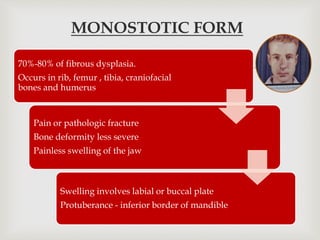
70%-80% of fibrous dysplasia.
Occurs in rib, femur , tibia, craniofacial
bones and humerus
Pain or pathologic fracture
Bone deformity less severe
Painless swelling of the jaw
Swelling involves labial or buccal plate
Protuberance - inferior border of mandible
MONOSTOTIC FORM

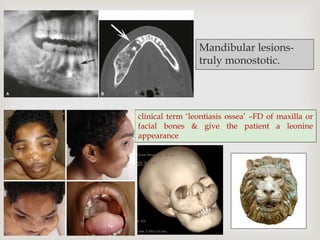
Mandibular lesions-
truly monostotic.
clinical term ‘leontiasis ossea’ –FD of maxilla or
facial bones & give the patient a leonine
appearance
20%-30% of fibrous dysplasia.
Sites: Femur, tibia, pelvis, ribs, skull and facial
bones, upper extrimites, lumbar spine &
clavicle.
Tends to occur in unilateral distribution.
Involvement asymmetric and generalized on
bilateral lesions.
POLYOSTOTIC FORM

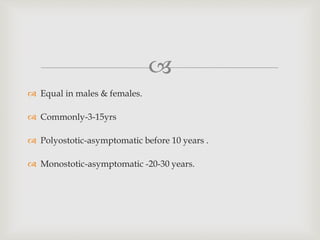
 Equal in males & females.
 Commonly-3-15yrs
 Polyostotic-asymptomatic before 10 years .
 Monostotic-asymptomatic -20-30 years.

Pain in
involved limb
Spontaneous
fracture
Structural
integrity
weak
Bowing of
weight
bearing bones
curvature of
femoral neck
Shepherd’s
crook
deformity
Malalignment
Tipping
Displacement
Intact over lesion
Maxillary sinus, zygomatic process
Floor of orbit, extend to base of
skull

• Polyostotic FD and lesions of skin
or café-au-lait spots
Jaffe Lichenstien
syndrome
• Polyostotic FD, café-au-lait spots
and endocrine disturbances
Mc-Cune
Albright
syndrome
• Fibrous dysplasia & intramuscular
myxoma
Mazabraud
syndrome
Café-au-lait pigmentation
Fibrous dysplasia Neurofibroma

CAFE-AU-LAIT
SPOTS
• Increased
melanin in basal
cells of epidermis
• Cutaneous
pigmentation
seen ipsilateral to
side of bone
lesion.
MAZABRAUDS
SYNDROME
• Fibrous dysplasia
and
intramuscular
myxoma, risk of
sarcomatous
malformation
MALIGNANCIES
• Osteosarco Mc-
Cune albright
syndrome
• Chondrosarco
Mc-Cune albright
syndrome
• Fibrosarco Mc-
Cune albright
syndrome
• LiposarcoMc-
Cune albright
syndrome
In 10-25% of pt. with monostotic form.
In 50% of pt. with polyostotic form.
Also in isolated craniofacial form.
No extracranial lesions present.
Sites: frontal, sphenoid, maxillary, ethmoid
bones.
Extreme prominence of zygomatic process,
facial deformity
Vestibular dysfunction, tinnitus, hearing loss,
Hypertelorism, cranial asymmetry, facial deformity,
visual impairment, exophthalmos, blindness .
Craniofacial Fibrous Dysplasia
Network of fine bone trabeculae
Increased trabeculation – lesion more opaque & mottled
appearance
Cortical bone becomes thinned
Roots of teeth moved out of normal position
RADIOGRAPHIC FEATURES
• Radiolucent
image
• Ground glass/
Orange peel
appearance
• Radiopaque
image
Rind
sign

HISTOLOGIC FEATURES
 Proliferating fibroblasts in a compact stroma of interlacing
collagen fibres.
 Irregular bony trabeculae scattered throughout lesion.
 Chinese character shaped.
 Trabeculae usually coarse woven bone
 Lesions rich in spindle shaped fibroblasts with a swirled
appearance within the marrow space
 Lesional bone fuses directly with normal bone at the periphery
10x
Bony trabeculae
Fibrous
connective tissue
osteocyte
peri-trabecular cleft
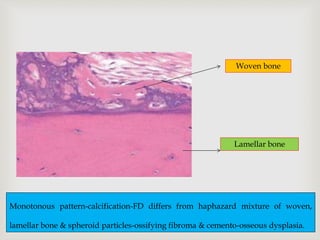
Woven bone
Lamellar bone
Monotonous pattern-calcification-FD differs from haphazard mixture of woven,
lamellar bone & spheroid particles-ossifying fibroma & cemento-osseous dysplasia.

Fibrous Dysplasia
 1st & 2nd decades
 Usually-Maxilla
 Self limited
 One or more bones
 Diffuse opacity
 Vascular matrix
 Woven bone trabeculae
 Chinese letter pattern
 Peri-trabecular clefting is
present
Ossifying fibroma
 3rd & 4th decades
 Usually-mandible
 Continuous
 One bone
 Circumscribed
 Cellular fibrous matrix
 Bony islands & trabeculae
 ”bizarre” character shape
 Absent
No significant change in serum
calcium/phosphorus
Elevated Alkaline phosphatase
Moderate increase in Basal Metabolic Rate
LAB FINDING

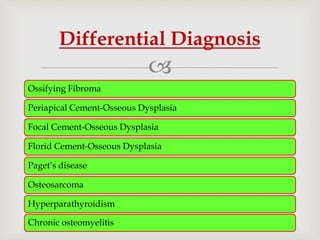
Ossifying Fibroma
Periapical Cement-Osseous Dysplasia
Focal Cement-Osseous Dysplasia
Florid Cement-Osseous Dysplasia
Paget’s disease
Osteosarcoma
Hyperparathyroidism
Differential Diagnosis
Chronic osteomyelitis
Conservative treatment-prevent deformity.
Management requires a multidisciplinary approach -polyostotic.
Bisphosphonate therapy may help to improve function, decrease pain,
& lower fracture risk -some patients.
Surgery-complete resection, restoring function &improving facial
aesthetics
TREATMENT

 0.4% - 4%
 Osteosarcoma
 Fibrosarcoma
 Chondrosarcoma
 28% - seen in radiated-Radiotherapy contraindicated ….
Malignant transformation

Prognosis-good
Although-bad outcomes-more frequently among young
patients or with polyostotic forms.
PROGNOSIS

CONCLUSION
 Fibrous dysplasia is a lesion of bone commonly affecting the younger
age group. It shows similarities with other fibro osseous lesions
clinically, radiological & histopathologically.
 Hence through knowledge about these lesions is necessary for proper
diagnosis & treatment plan.

 Shafer’s textbook of oral pathology 7th Edition
 Burkitt’s oral medicine,11th edition.
 Neville, Damm, Allen, Bouquot. Oral & maxillofacial
pathology ,1st south asia edition
 Lucas Pathology Of Tumours Of The Oral Tissues
 Fibrous Dysplasia. Pathophysiology, Evaluation, and
Treatment www.jbjs.org
REFERENCES

 Craniofacial polyostotic Fibrous Dysplasia-
contemporary clinical dentistry jul-sep-2010/vol
1/issue 3.
 Fibrous Dysplasia In the Maxillomandibular region–
Journal of IMAB - Annual Proceeding (Scientific
Papers) vol. 16, book 4, 2010
 Regezi- Textbook of oral pathology- 5th edition.
THANK YOU

Fibrousdysplasia

  • 1.
  • 2.
     CONTENTS  Introduction  Classification Etiology  Clinical Features  Monostotic Form  Polyostotic Form  Craniofacial form  Radiographic Features  Histologic Features  Treatment &Prognosis  Conclusion
  • 3.
     Fibro-Osseous Lesion •“Replacement of normalbone by tissue composed of collagen fibers and fibroblasts, containing varying amount of mineralized substance” – Waldron 1985. •“A collection of non – neoplastic intraosseous lesions that replace bone and consists of a cellular fibrous connective tissue within which non- functional osseous structures form” Eversole INTRODUCTION
  • 4.
     WHO CLASSIFICATION 1992 1.Osteogenic Neoplasms a. A.Cemento-Ossifying Fibroma (Cementifying Fibroma, Ossifying Fibroma) 2. Non-Neoplastic Bone Lesions a. Fibrous Dysplasia Of Jaws b. Cemento-Osseous Dysplasia I. Periapical Cemental Dysplasia (Periapical Fiberous Dysplasia), II. Florid Cemento-Osseous Dysplasia (Gigantiform Cementoma, Familial Multiple Cementomas) III. Other Cemento-Osseous Dysplasia c. Cherubism (Familial Multilocular Cystic Disease Of The Jaws) d. Central Giant Cell Granuloma e. Aneurismal Bone Cyst f. Solitary Bone Cyst (Traumatic, Simple, Hemorrhagic Bone Cyst)
  • 5.
     Waldron Modified ClassificationOf Fibro- Osseous Lesions Of Jaws (1993) 1. Fibrous Dysplasia 2. Cement-Osseous Dysplasia a. Periapical Cement-Osseous Dysplasia b. Focal Cement-Osseous Dysplasia c. Florid Cement-Osseous Dysplasia 3. Fibro-Osseous Neoplasm a. Cementifying Fibroma, Ossifying Fibroma, Cement-Ossifying Fibroma
  • 6.
     WHO CLASSIFICATION 2005 1)Ossifying Fibroma (OF) 2) Fibrous Dysplasia 3) Osseous Dysplasia a. Periapical Osseous Dysplasia b. Focal Osseous Dysplasia c. Florid Osseous Dysplasia d. Familial Gigantiform Cementoma 4) Central Giant Cell Granuloma 5) Cherubism 6) Aneurismal Bone Cyst 7) Solitary Bone Cyst
  • 7.
     EVERSOLE 2008 CLASSIFICATION 1.Bonedysplasias a. Fibrous dysplasia i. Monostotic ii. Polyostotic iii. Polyostotic with endocrinopathy (McCune-Albright) iv. Osteofibrous dysplasia b. Osteitis deformans c. Pagetoid heritable bone dysplasias of childhood d. Segmental odontomaxillary dysplasia 2. Cemento-osseous dysplasias a. Focal cemento-osseous dysplasia b. Florid cemento-osseous dysplasia 3.Inflammatory/reactive processes a. Focal sclerosing osteomyelitis b. Diffuse sclerosing osteomyelitis c. Proliferative periostitis 4. Metabolic Disease: hyperparathyroidism
  • 8.
     5. Neoplastic lesions(Ossifying fibromas) a. Ossifying fibroma b. Hyperparathyroidism jaw lesion syndrome c. Juvenile ossifying fibroma i. Trabecular type ii. Psammomatoid type d. Gigantiform cementomas
  • 9.
     Terminology • Skeletal developmentalanomaly of the bone - defect in osteoblastic differentiation and maturation • 2.5% of all bony tumours & 7% of all non-malignant tumours of bone • Von recklinghausen 1891- osteitis fibrosa cystica. • Fibrous dysplasia of bone. Lichentenstein 1938
  • 10.
     DEFINITION  A benignlesion, presumably developmental in nature, characterized by the presence of fibrous connective tissue with a characteristic whorled pattern and containing trabeculae of immature non lamellar bone. Waldron 1985.  Reeds definition : fibrous dysplasia is an arrest of bone maturation in woven bone with ossification resulting from metaplasia of a non specific fibro-osseous type. FIBROUS DYSPLASIA
  • 11.
     Idiopathic Non hereditary Caused bymutation in GNAS1 gene ETIOLOGY & PATHOGENESIS
  • 12.
     Mutated GNAS Activation c-AMP Elevtion ofc-AMP & stimulation of endocrine receptors Activation MOLECULAR PATHOGENESIS C-fos (proto-oncogene) Encodes G-protein
  • 13.
  • 14.
     Mutated osteoblasts Over expressionIL-6 Stimulate osteoclastic activity Bone Lesion Expansion
  • 15.
     CLINICAL FEATURES Monostotic form Polyostoticform Craniofacial form Three disease patterns are recognized
  • 16.
    70%-80% of fibrousdysplasia. Occurs in rib, femur , tibia, craniofacial bones and humerus Pain or pathologic fracture Bone deformity less severe Painless swelling of the jaw Swelling involves labial or buccal plate Protuberance - inferior border of mandible MONOSTOTIC FORM
  • 17.
     Mandibular lesions- truly monostotic. clinicalterm ‘leontiasis ossea’ –FD of maxilla or facial bones & give the patient a leonine appearance
  • 18.
    20%-30% of fibrousdysplasia. Sites: Femur, tibia, pelvis, ribs, skull and facial bones, upper extrimites, lumbar spine & clavicle. Tends to occur in unilateral distribution. Involvement asymmetric and generalized on bilateral lesions. POLYOSTOTIC FORM
  • 19.
      Equal inmales & females.  Commonly-3-15yrs  Polyostotic-asymptomatic before 10 years .  Monostotic-asymptomatic -20-30 years.
  • 20.
     Pain in involved limb Spontaneous fracture Structural integrity weak Bowingof weight bearing bones curvature of femoral neck Shepherd’s crook deformity
  • 21.
    Malalignment Tipping Displacement Intact over lesion Maxillarysinus, zygomatic process Floor of orbit, extend to base of skull
  • 22.
     • Polyostotic FDand lesions of skin or café-au-lait spots Jaffe Lichenstien syndrome • Polyostotic FD, café-au-lait spots and endocrine disturbances Mc-Cune Albright syndrome • Fibrous dysplasia & intramuscular myxoma Mazabraud syndrome
  • 23.
  • 24.
     CAFE-AU-LAIT SPOTS • Increased melanin inbasal cells of epidermis • Cutaneous pigmentation seen ipsilateral to side of bone lesion. MAZABRAUDS SYNDROME • Fibrous dysplasia and intramuscular myxoma, risk of sarcomatous malformation MALIGNANCIES • Osteosarco Mc- Cune albright syndrome • Chondrosarco Mc-Cune albright syndrome • Fibrosarco Mc- Cune albright syndrome • LiposarcoMc- Cune albright syndrome
  • 25.
    In 10-25% ofpt. with monostotic form. In 50% of pt. with polyostotic form. Also in isolated craniofacial form. No extracranial lesions present. Sites: frontal, sphenoid, maxillary, ethmoid bones. Extreme prominence of zygomatic process, facial deformity Vestibular dysfunction, tinnitus, hearing loss, Hypertelorism, cranial asymmetry, facial deformity, visual impairment, exophthalmos, blindness . Craniofacial Fibrous Dysplasia
  • 26.
    Network of finebone trabeculae Increased trabeculation – lesion more opaque & mottled appearance Cortical bone becomes thinned Roots of teeth moved out of normal position RADIOGRAPHIC FEATURES
  • 27.
    • Radiolucent image • Groundglass/ Orange peel appearance • Radiopaque image Rind sign
  • 28.
     HISTOLOGIC FEATURES  Proliferatingfibroblasts in a compact stroma of interlacing collagen fibres.  Irregular bony trabeculae scattered throughout lesion.  Chinese character shaped.  Trabeculae usually coarse woven bone  Lesions rich in spindle shaped fibroblasts with a swirled appearance within the marrow space  Lesional bone fuses directly with normal bone at the periphery
  • 29.
  • 30.
    Woven bone Lamellar bone Monotonouspattern-calcification-FD differs from haphazard mixture of woven, lamellar bone & spheroid particles-ossifying fibroma & cemento-osseous dysplasia.
  • 31.
     Fibrous Dysplasia  1st& 2nd decades  Usually-Maxilla  Self limited  One or more bones  Diffuse opacity  Vascular matrix  Woven bone trabeculae  Chinese letter pattern  Peri-trabecular clefting is present Ossifying fibroma  3rd & 4th decades  Usually-mandible  Continuous  One bone  Circumscribed  Cellular fibrous matrix  Bony islands & trabeculae  ”bizarre” character shape  Absent
  • 32.
    No significant changein serum calcium/phosphorus Elevated Alkaline phosphatase Moderate increase in Basal Metabolic Rate LAB FINDING
  • 33.
     Ossifying Fibroma Periapical Cement-OsseousDysplasia Focal Cement-Osseous Dysplasia Florid Cement-Osseous Dysplasia Paget’s disease Osteosarcoma Hyperparathyroidism Differential Diagnosis Chronic osteomyelitis
  • 34.
    Conservative treatment-prevent deformity. Managementrequires a multidisciplinary approach -polyostotic. Bisphosphonate therapy may help to improve function, decrease pain, & lower fracture risk -some patients. Surgery-complete resection, restoring function &improving facial aesthetics TREATMENT
  • 35.
      0.4% -4%  Osteosarcoma  Fibrosarcoma  Chondrosarcoma  28% - seen in radiated-Radiotherapy contraindicated …. Malignant transformation
  • 36.
     Prognosis-good Although-bad outcomes-more frequentlyamong young patients or with polyostotic forms. PROGNOSIS
  • 37.
     CONCLUSION  Fibrous dysplasiais a lesion of bone commonly affecting the younger age group. It shows similarities with other fibro osseous lesions clinically, radiological & histopathologically.  Hence through knowledge about these lesions is necessary for proper diagnosis & treatment plan.
  • 38.
      Shafer’s textbookof oral pathology 7th Edition  Burkitt’s oral medicine,11th edition.  Neville, Damm, Allen, Bouquot. Oral & maxillofacial pathology ,1st south asia edition  Lucas Pathology Of Tumours Of The Oral Tissues  Fibrous Dysplasia. Pathophysiology, Evaluation, and Treatment www.jbjs.org REFERENCES
  • 39.
      Craniofacial polyostoticFibrous Dysplasia- contemporary clinical dentistry jul-sep-2010/vol 1/issue 3.  Fibrous Dysplasia In the Maxillomandibular region– Journal of IMAB - Annual Proceeding (Scientific Papers) vol. 16, book 4, 2010  Regezi- Textbook of oral pathology- 5th edition.
  • 40.

Editor's Notes

  • #12 Guanine nucleotide binding protein, alpha activity peptidase
  • #13 Cyclic adenosine monophospate
  • #14 Add some more
  • #21 pics
  • #28 early (osteolytic) stage, the lesion appears as a radiolucency; in the intermediate stage, it appears as a "ground glass" or "orange peel" appearance; in the final (mature) stage, it appears as a radiopacity
  • #31 Pic change older fibrous dysplasia replaced by lammelar bone
  • #34 Sunburst-os,,, ossyfying dysplasias –cenentu like material gets fuse form a large mass,,, florid type is strictly ristricted to tooth bearing areas,,, pagets disease--- cotton wool appearance long bones zigsaw/ mossaic h/e feature,,, increase parahaomone in parathyroidism