
PERIODONTAL LIGAMENT IN
HEALTH & DISEASE
Presented by:
Dr. D.Venkatesh Kumar
CONTENTS
• Introduction
• Structure
• Cells in PDL
• PDL Fibers
• Functions
• Clinical Considerations
• Conclusion
• References
INTRODUCTION
• Periodontal ligament is an integral part of periodontium.
• The periodontium is an attachment apparatus-teeth. It is a
connective tissue organ-covered by epithelium.
• It comprises of Cementum,PDL,Bone
• Teeth are attached -bone of the jaws by periodontium.
 Periodontal ligament-soft, fibrous specialized connective tissue -cementum & bone
-socket wall.
 Periodontal ligament extends coronally up to the most apical part of connective
tissue of gingiva.
 Because the collagen fibers -attached -cementum & alveolar bone, the ligament
provides soft tissue continuity between mineralized connective tissues of
periodontium.
SyNONyMS
1. Desmondont
2. Gomphosis
3. Pericementum
4. Dental Periosteum
5. Alveolodental ligament
6. Periodontal membrane
STRUCTURE
• The periodontal ligament-shape-“HOUR GLASS” &
narrowest-midroot level.
• Width-PDL -approx 0.15-0.38mm.
CELLS IN PDL
SyNTHETIC CELLS
The characteristic of synthetic cells are:
• Should be actively synthesizing ribosomes.
• Increase in the complement rough endoplasmic reticulum and golgi
apparatus.
• Large open faced or vesicular nucleus with prominent nucleoli.
OSTEOBLASTS
Osteoblasts covers-periodontal surface of alveolar bone.
A periosteum comprises at least two distinct layers:
1. Inner – CELLULAR LAYER
2. Outer – FIBROUS LAYER-periodontal surface of alveolar bone.
FIBROBLASTS
• Fibroblasts- most common cells in PDL. 65% -total cellular population.
• Elongated cells with pseudopodia like process.
• Synthesize higher quantities-chondroitin sulphate & lesser quantities-
heparin sulphate and hyaluronic acid
• The fibroblast is stellate shaped cell which produces:
1. COLLAGEN FIBERS
2. RETICULIN FIBERS
3. OXYTALAN FIBERS
FUNCTION:
Production Of Various Types Of Fibers & Instrumental In The Synthesis Of
Connective Tissue Matrix
• Inflammatory situations-associated with periodontal diseases, an increased
expression-MMP occurs that aggressively destroys collagen.
• Attractive therapies-controlling tissue destruction-host-modulators
-capacity to inhibit MMP’s.
• Damaged periodontal fibers-replaced & remodeled -newly formed fibers.
• “RENEWAL CAPABILITY”-important characteristic feature-PDL.
CEMENTOBLASTS
• Cementoblasts synthesize collagen & protein polysaccharides, which make
organic matrix of cementum.
• After some cementum-laid down-mineralization begins-calcium and
phosphate ions.
RESORPTIVE CELLS
OSTEOCLASTS:
• Resorbs bone
• Surface of osteoclasts -contact with bone-ruffled border.
• Osteoclasts demineralise-inorganic part & disintegrates-organic matrix.
FIBROBLASTS
• Fibroblasts -both synthesis and resorption.
• They exhibit lysosomes- digest-collagen fragments
• Collagen resorbing fibroblasts-normal PDL indicates-remodeling of
periodontal ligament.
CEMENTOCLASTS
• Cementoclasts -found in periodontal ligament but not remodeled-
alveolar bone and PDL.
• These are found on the surface of cementum.
PROGENITOR CELLS
• Progenitor cells-undifferentiated mesenchymal cells-capacity -mitotic
division & replace the differentiated cells..
• Located -perivascular region & small close faced nucleus and little
cytoplasm.
• Cell division occurs one of the daughter cells differentiate- functional typeCell division occurs one of the daughter cells differentiate- functional type
of connective tissue cells.of connective tissue cells.
• Other remaining cells retain their capacity to divideOther remaining cells retain their capacity to divide..
EPITHELIAL CELL RESTS OF MALASSEZ
• These cells-These cells-remnants-remnants-epithelium ofepithelium of Hertwig’s Epithelial Root SheathHertwig’s Epithelial Root Sheath &&
are found close to cementum.are found close to cementum.
• These cells exhibitThese cells exhibit monofilamentsmonofilaments & attached to each other by& attached to each other by
desmosomes.desmosomes.
MAST CELLS
• Mast cells are small round or oval.
• Characterized by numerous cytoplasm- mask its small, indistinct nucleus.
• Diameter-12 to 15 microns.
• The granules contain heparin and histamine.
• The release of histamine into the extracellular compartment causes
proliferation –endothelial & mesenchymal cells.
• Degranulate in response to antigen- antibody formation on their
surface.
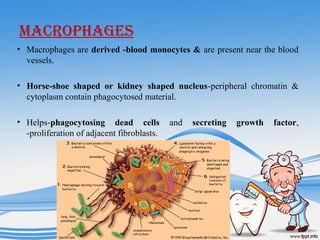
MACROPHAGES
• Macrophages are derived -blood monocytes & are present near the blood
vessels.
• Horse-shoe shaped or kidney shaped nucleus-peripheral chromatin &
cytoplasm contain phagocytosed material.
• Helps-phagocytosing dead cells and secreting growth factor,
-proliferation of adjacent fibroblasts.
PERIODONTAL FIBERS
• Most important element -PDL has principal fibers
• Fibers –collagenous & arranged in bundles & follow a wavy course.
• Collagen is a high molecular weight protein.
• Collagen macromolecules are rod like & arranged-fibrils. Fibrils are
packed side by side to form fibers.
• Vitamin C help in formation & repair of collagen.
• Half life -collagen fibers-3 to 23 days & collagen imparts a unique
combination of flexibility & strength to tissue.
TYPES OF PERIODONTAL LIGAMENT
FIBERS
1. TRANSEPTAL GROUP:
• Fibers extend interproximally over alveolar bone crest and areFibers extend interproximally over alveolar bone crest and are
embedded in the cementum of adjacent teeth.embedded in the cementum of adjacent teeth.
• They areThey are reconstructedreconstructed even after-destruction of alveolar boneeven after-destruction of alveolar bone
-periodontal disease.-periodontal disease.
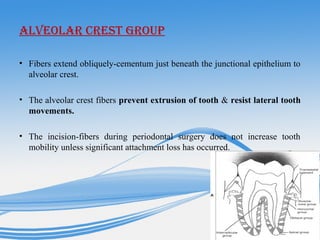
ALVEOLAR CREST GROUP
• Fibers extend obliquely-cementum just beneath the junctional epithelium to
alveolar crest.
• The alveolar crest fibers prevent extrusion of tooth & resist lateral tooth
movements.
• The incision-fibers during periodontal surgery does not increase tooth
mobility unless significant attachment loss has occurred.
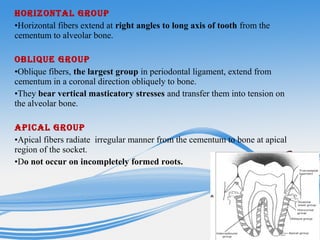
HORIZONTAL GROUP
•Horizontal fibers extend at right angles to long axis of tooth from the
cementum to alveolar bone.
OBLIQUE GROUP
•Oblique fibers, the largest group in periodontal ligament, extend from
cementum in a coronal direction obliquely to bone.
•They bear vertical masticatory stresses and transfer them into tension on
the alveolar bone.
APICAL GROUP
•Apical fibers radiate irregular manner from the cementum to bone at apical
region of the socket.
•Do not occur on incompletely formed roots.
INTER-RADICULAR FIBERS
• The interradicular fibers-cementum to bone-furcation areas of multirooted
teeth.
• The remodeling of fibers take place in intermediate plexus.
• This allows adjustments in the ligament, which accommodate small
movements of tooth.
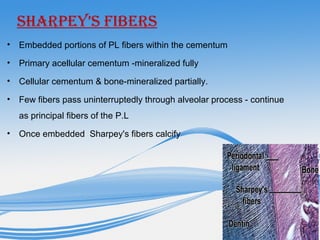
Sharpey’S fiberS
• Embedded portions of PL fibers within the cementum
• Primary acellular cementum -mineralized fully
• Cellular cementum & bone-mineralized partially.
• Few fibers pass uninterruptedly through alveolar process - continue
as principal fibers of the P.L
• Once embedded Sharpey's fibers calcify
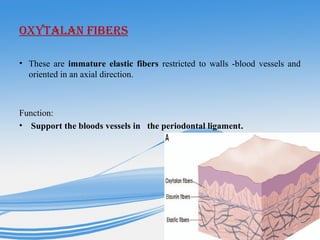
OXyTaLaN fiberS
• These are immature elastic fibers restricted to walls -blood vessels and
oriented in an axial direction.
Function:
• Support the bloods vessels in the periodontal ligament..
STrUCTUreS preSeNT iN The CONNeCTiVe TiSSUe
 BLOOD VESSELS
Superior and inferior alveolar arteries.
The blood vessels are derived from the following:
1. BRANCHES FROM APICAL VESSELS
Vessels supplying the pulp.
 BRANCHES FROM INTRA-ALVEOLAR VESSELS:- Vessels run
horizontally & penetrate-alveolar bone-enter-PDL.
 BRANCHES FROMBRANCHES FROM GINGIVAL VESSELSGINGIVAL VESSELS:- The arterioles and:- The arterioles and
capillaries form a rich network.capillaries form a rich network.
Rich vascular plexus is found at the apex and in cervical part ofRich vascular plexus is found at the apex and in cervical part of
ligament.ligament.
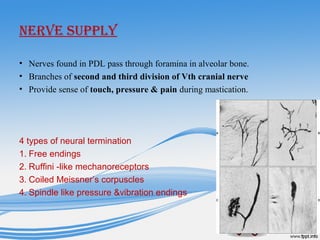
NerVe SUppLy
• Nerves found in PDL pass through foramina in alveolar bone.
• Branches of second and third division of Vth cranial nerve
• Provide sense of touch, pressure & pain during mastication.
4 types of neural termination
1. Free endings
2. Ruffini -like mechanoreceptors
3. Coiled Meissner’s corpuscles
4. Spindle like pressure &vibration endings
CeMeNTiCLeS
• Cementicles -small calcified bodies - PDL.
• May form large calcified bodies & fuse within cementum or remain free.
• Old age.
• Calcification due to degenerative changes epithelial cell rests of malassez.
fUNCTiONS
1. PHYSICAL FUNCTION
A) Protect-vessels & nerves from injury -mechanical forces.
B) Transmission of occlusal forces to bone.
 Axial force when applied causes stretching of oblique fibers of
periodontal ligament.
A) Transmission-tensional force-alveolar bone encourages bone formation
rather then bone resorption.
B) But when horizontal or tipping force is applied, the tooth rotates
around the axis.
C) Greater force is applied, displacement of facial & lingual plates may
occur.
C) Attaches the teeth to the bone.C) Attaches the teeth to the bone.
D) Maintains the gingival tissues in their proper relationship-teeth.D) Maintains the gingival tissues in their proper relationship-teeth.
E)E) “Shock absorption”“Shock absorption”
Two theories have been explained for
mechanism of tooth support:
A.A.TENSIONAL THEORYTENSIONAL THEORY
B.B.VISCOELASTIC THEORYVISCOELASTIC THEORY
• Principal fibers-major role in supporting tooth & transmitting forces to
bone.
TeNSiONaL TheOry:
compressed stretched
ViSCOeLaSTiC TheOry
• The fluid movement largely controls the displacement of the tooth, with
fibers playing a secondary role.
• When forces are transmitted to the tooth, the extracellular fluid is pushed
from periodontal ligament to marrow spaces through the cribriform plate.
• After depletion of tissue fluids, the bundle fibers absorb the shock and
tighten.
• This leads to blood vessel stenosis  arterial lack pressure  ballooning
of vessels tissue replenishes with fluids.
2. fOrMaTiVe & reMODeLLiNG fUNCTiON
• Cells-PDL have the capacity synthesis & resorption of cementum, ligament
and alveolar bone.
• Periodontal ligament undergoes constant remodeling.
3. NUTriTiONaL fUNCTiON
• Blood vessels of PDL provide nutrition to cells of
periodontium
• Compression of blood vessels (due to heavy forces applied on
tooth) leads to necrosis of cells.
• Blood vessels also remove catabolites.
4. SENSORY FUNCTION
•Pain sensation is transmitted by small diameter nerves
•Temperature by intermediate type
•Pressure by large myelinated fibers.
HOMEOSTATIC MECHANISM
• Resorption & synthesis are controlled procedures.
• If long term damage of PDL which is not repaired, the bone is deposited in
the periodontal space.
• Obliteration of space & ankylosis between bone and the tooth.
• Deprivation of Vit. C -resorption of collagen will continue.
• So there is progressive destruction and loss of extra cellular substance
of ligament.
• Hence, loss of attachment between bone and tooth and at last, loss of
tooth.
CLINICAL CONSIDERATIONS
DIURNAL CHANGES
Day
• PDL fibers gradually straighten out
Night
• Fibers regain their wavy course.
AGE
• The width of periodontal ligament varies from 0.15 to 0.38mm. The average width
is:
-0.21mm at 11 to 16 years of age.
-0.18mm at 32 to 50 years of age.
-0.15mm at 51 to 67 years of age.
• If gingivitis is not cured -periodontitis.
• Few coccal cells & more motile rods & spirochetes -diseased site than in the
healthy site.
• Healthy site –gram positive rods & cocci
• Diseased site-gram-negative rods and anaerobes are more in number.
• Resorption & formation-bone & PDL-orthodontic tooth movement.
• Tooth movement-compression of PDL -compensated by bone resorption-tension
side, formation on opposite side.
• Periapical area -main pathologic site.
• Inflammation of pulp -apical periodontal ligament & replaces-fiber bundles-
granulation tissue –granuloma-apical cyst.
ENDOCRINOLOGIC INFLUENCES ON PERIODONTIUM
HYPOTHYROIDISM:
• Oedema and disorganisation of collagen bundles
• Hydropic degeneration and fragmentation of fibers of PDL
HYPERTHYROIDISM:
• Increase in width of PDL
• Increase in vascularity of PDL
HYPOPITUITARISM:
• Reduced vascularity of PDL
• Degeneration of the ligament with cystic degeneration
• Calcification of epithelial cell rests
HYPERPARATHYROIDISM:
• Widening of PDL space
DIABETES MELLITUS:
• Multiple periodontal abscesses
• Deep periodontal pockets
• Widening of PDL
• Rapid bone loss
Nutritional influences on
periodontium
• Vit A – pocket formation
• Vit C – oedema, hemorrhage in PDL
• Vit D – Dystrophic calcification in PDL
• Protein deficiency – degeneration of CT in PDL
EHLER DANLOS SYNDROME
• Characterized by abnormal collagen production
Manifestation:
• Excessive periodontal destruction
• Periodontitis in type 4, 8, 9
DISEASES OF BONE-EFFECT ON PDL
OSTEOSARCOMA
• Bone tumour
• Arise from primitive mesenchymal bone forming cells
• Characterised by production of osteoid
• Sunburst appearance
• Widening of PDL
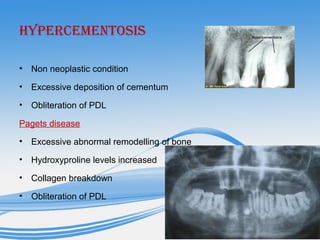
HYPERCEMENTOSIS
• Non neoplastic condition
• Excessive deposition of cementum
• Obliteration of PDL
Pagets disease
• Excessive abnormal remodelling of bone
• Hydroxyproline levels increased
• Collagen breakdown
• Obliteration of PDL
CONCLUSION
• PDL is fibrous connective tissue forming important part of the
periodontium.
• PDL is an absolute requirement for rapid remodeling of alveolar
bone when forces are applied to teeth.
• Cells of PDL are pluri-potent & helps in the regeneration of all
components of periodontium lost in the periodontal disease process.
REFERENCES
•TEN CATE. TEXTBOOK OF ORAL HISTOLOGY- 8th
EDITION
•ORBAN’S. TEXTBOOK OF ORAL HISTOLOGY AND EMBRYOLOGY 12TH
EDITION
•BHALAJHI.TEXTBOOK OF DENTAL ANATOMY, HISTOLOGY AND
DEVELOPMENT-1ST
EDITION
•NEVILLE. TEXT BOOK OF ORAL AND MAXILLOFACIAL PATHOLOGY.1ST
SOUTH
ASIAN EDITION
•SHAFER’S.TEXT BOOK OF ORAL PATHOLOGY-7TH
EDITION
•CARRANZA. TEXT BOOK OF PERIODONTOLOGY 11TH
EDITION.

Pdl

  • 2.
    PERIODONTAL LIGAMENT IN HEALTH& DISEASE Presented by: Dr. D.Venkatesh Kumar
  • 3.
    CONTENTS • Introduction • Structure •Cells in PDL • PDL Fibers • Functions • Clinical Considerations • Conclusion • References
  • 4.
    INTRODUCTION • Periodontal ligamentis an integral part of periodontium. • The periodontium is an attachment apparatus-teeth. It is a connective tissue organ-covered by epithelium. • It comprises of Cementum,PDL,Bone • Teeth are attached -bone of the jaws by periodontium.
  • 5.
     Periodontal ligament-soft,fibrous specialized connective tissue -cementum & bone -socket wall.  Periodontal ligament extends coronally up to the most apical part of connective tissue of gingiva.  Because the collagen fibers -attached -cementum & alveolar bone, the ligament provides soft tissue continuity between mineralized connective tissues of periodontium.
  • 6.
    SyNONyMS 1. Desmondont 2. Gomphosis 3.Pericementum 4. Dental Periosteum 5. Alveolodental ligament 6. Periodontal membrane
  • 7.
    STRUCTURE • The periodontalligament-shape-“HOUR GLASS” & narrowest-midroot level. • Width-PDL -approx 0.15-0.38mm.
  • 8.
  • 9.
    SyNTHETIC CELLS The characteristicof synthetic cells are: • Should be actively synthesizing ribosomes. • Increase in the complement rough endoplasmic reticulum and golgi apparatus. • Large open faced or vesicular nucleus with prominent nucleoli.
  • 10.
    OSTEOBLASTS Osteoblasts covers-periodontal surfaceof alveolar bone. A periosteum comprises at least two distinct layers: 1. Inner – CELLULAR LAYER 2. Outer – FIBROUS LAYER-periodontal surface of alveolar bone.
  • 11.
    FIBROBLASTS • Fibroblasts- mostcommon cells in PDL. 65% -total cellular population. • Elongated cells with pseudopodia like process. • Synthesize higher quantities-chondroitin sulphate & lesser quantities- heparin sulphate and hyaluronic acid • The fibroblast is stellate shaped cell which produces: 1. COLLAGEN FIBERS 2. RETICULIN FIBERS 3. OXYTALAN FIBERS
  • 12.
    FUNCTION: Production Of VariousTypes Of Fibers & Instrumental In The Synthesis Of Connective Tissue Matrix
  • 13.
    • Inflammatory situations-associatedwith periodontal diseases, an increased expression-MMP occurs that aggressively destroys collagen. • Attractive therapies-controlling tissue destruction-host-modulators -capacity to inhibit MMP’s. • Damaged periodontal fibers-replaced & remodeled -newly formed fibers. • “RENEWAL CAPABILITY”-important characteristic feature-PDL.
  • 14.
    CEMENTOBLASTS • Cementoblasts synthesizecollagen & protein polysaccharides, which make organic matrix of cementum. • After some cementum-laid down-mineralization begins-calcium and phosphate ions.
  • 15.
    RESORPTIVE CELLS OSTEOCLASTS: • Resorbsbone • Surface of osteoclasts -contact with bone-ruffled border. • Osteoclasts demineralise-inorganic part & disintegrates-organic matrix.
  • 16.
    FIBROBLASTS • Fibroblasts -bothsynthesis and resorption. • They exhibit lysosomes- digest-collagen fragments • Collagen resorbing fibroblasts-normal PDL indicates-remodeling of periodontal ligament.
  • 17.
    CEMENTOCLASTS • Cementoclasts -foundin periodontal ligament but not remodeled- alveolar bone and PDL. • These are found on the surface of cementum.
  • 18.
    PROGENITOR CELLS • Progenitorcells-undifferentiated mesenchymal cells-capacity -mitotic division & replace the differentiated cells.. • Located -perivascular region & small close faced nucleus and little cytoplasm. • Cell division occurs one of the daughter cells differentiate- functional typeCell division occurs one of the daughter cells differentiate- functional type of connective tissue cells.of connective tissue cells. • Other remaining cells retain their capacity to divideOther remaining cells retain their capacity to divide..
  • 19.
    EPITHELIAL CELL RESTSOF MALASSEZ • These cells-These cells-remnants-remnants-epithelium ofepithelium of Hertwig’s Epithelial Root SheathHertwig’s Epithelial Root Sheath && are found close to cementum.are found close to cementum. • These cells exhibitThese cells exhibit monofilamentsmonofilaments & attached to each other by& attached to each other by desmosomes.desmosomes.
  • 20.
    MAST CELLS • Mastcells are small round or oval. • Characterized by numerous cytoplasm- mask its small, indistinct nucleus. • Diameter-12 to 15 microns. • The granules contain heparin and histamine. • The release of histamine into the extracellular compartment causes proliferation –endothelial & mesenchymal cells. • Degranulate in response to antigen- antibody formation on their surface.
  • 21.
    MACROPHAGES • Macrophages arederived -blood monocytes & are present near the blood vessels. • Horse-shoe shaped or kidney shaped nucleus-peripheral chromatin & cytoplasm contain phagocytosed material. • Helps-phagocytosing dead cells and secreting growth factor, -proliferation of adjacent fibroblasts.
  • 22.
    PERIODONTAL FIBERS • Mostimportant element -PDL has principal fibers • Fibers –collagenous & arranged in bundles & follow a wavy course. • Collagen is a high molecular weight protein. • Collagen macromolecules are rod like & arranged-fibrils. Fibrils are packed side by side to form fibers. • Vitamin C help in formation & repair of collagen. • Half life -collagen fibers-3 to 23 days & collagen imparts a unique combination of flexibility & strength to tissue.
  • 23.
    TYPES OF PERIODONTALLIGAMENT FIBERS 1. TRANSEPTAL GROUP: • Fibers extend interproximally over alveolar bone crest and areFibers extend interproximally over alveolar bone crest and are embedded in the cementum of adjacent teeth.embedded in the cementum of adjacent teeth. • They areThey are reconstructedreconstructed even after-destruction of alveolar boneeven after-destruction of alveolar bone -periodontal disease.-periodontal disease.
  • 24.
    ALVEOLAR CREST GROUP •Fibers extend obliquely-cementum just beneath the junctional epithelium to alveolar crest. • The alveolar crest fibers prevent extrusion of tooth & resist lateral tooth movements. • The incision-fibers during periodontal surgery does not increase tooth mobility unless significant attachment loss has occurred.
  • 25.
    HORIZONTAL GROUP •Horizontal fibersextend at right angles to long axis of tooth from the cementum to alveolar bone. OBLIQUE GROUP •Oblique fibers, the largest group in periodontal ligament, extend from cementum in a coronal direction obliquely to bone. •They bear vertical masticatory stresses and transfer them into tension on the alveolar bone. APICAL GROUP •Apical fibers radiate irregular manner from the cementum to bone at apical region of the socket. •Do not occur on incompletely formed roots.
  • 26.
    INTER-RADICULAR FIBERS • Theinterradicular fibers-cementum to bone-furcation areas of multirooted teeth. • The remodeling of fibers take place in intermediate plexus. • This allows adjustments in the ligament, which accommodate small movements of tooth.
  • 27.
    Sharpey’S fiberS • Embeddedportions of PL fibers within the cementum • Primary acellular cementum -mineralized fully • Cellular cementum & bone-mineralized partially. • Few fibers pass uninterruptedly through alveolar process - continue as principal fibers of the P.L • Once embedded Sharpey's fibers calcify
  • 28.
    OXyTaLaN fiberS • Theseare immature elastic fibers restricted to walls -blood vessels and oriented in an axial direction. Function: • Support the bloods vessels in the periodontal ligament..
  • 29.
    STrUCTUreS preSeNT iNThe CONNeCTiVe TiSSUe  BLOOD VESSELS Superior and inferior alveolar arteries. The blood vessels are derived from the following: 1. BRANCHES FROM APICAL VESSELS Vessels supplying the pulp.  BRANCHES FROM INTRA-ALVEOLAR VESSELS:- Vessels run horizontally & penetrate-alveolar bone-enter-PDL.  BRANCHES FROMBRANCHES FROM GINGIVAL VESSELSGINGIVAL VESSELS:- The arterioles and:- The arterioles and capillaries form a rich network.capillaries form a rich network. Rich vascular plexus is found at the apex and in cervical part ofRich vascular plexus is found at the apex and in cervical part of ligament.ligament.
  • 30.
    NerVe SUppLy • Nervesfound in PDL pass through foramina in alveolar bone. • Branches of second and third division of Vth cranial nerve • Provide sense of touch, pressure & pain during mastication. 4 types of neural termination 1. Free endings 2. Ruffini -like mechanoreceptors 3. Coiled Meissner’s corpuscles 4. Spindle like pressure &vibration endings
  • 31.
    CeMeNTiCLeS • Cementicles -smallcalcified bodies - PDL. • May form large calcified bodies & fuse within cementum or remain free. • Old age. • Calcification due to degenerative changes epithelial cell rests of malassez.
  • 32.
    fUNCTiONS 1. PHYSICAL FUNCTION A)Protect-vessels & nerves from injury -mechanical forces. B) Transmission of occlusal forces to bone.  Axial force when applied causes stretching of oblique fibers of periodontal ligament. A) Transmission-tensional force-alveolar bone encourages bone formation rather then bone resorption. B) But when horizontal or tipping force is applied, the tooth rotates around the axis. C) Greater force is applied, displacement of facial & lingual plates may occur.
  • 33.
    C) Attaches theteeth to the bone.C) Attaches the teeth to the bone. D) Maintains the gingival tissues in their proper relationship-teeth.D) Maintains the gingival tissues in their proper relationship-teeth. E)E) “Shock absorption”“Shock absorption”
  • 34.
    Two theories havebeen explained for mechanism of tooth support: A.A.TENSIONAL THEORYTENSIONAL THEORY B.B.VISCOELASTIC THEORYVISCOELASTIC THEORY
  • 35.
    • Principal fibers-majorrole in supporting tooth & transmitting forces to bone. TeNSiONaL TheOry:
  • 36.
  • 37.
    ViSCOeLaSTiC TheOry • Thefluid movement largely controls the displacement of the tooth, with fibers playing a secondary role. • When forces are transmitted to the tooth, the extracellular fluid is pushed from periodontal ligament to marrow spaces through the cribriform plate. • After depletion of tissue fluids, the bundle fibers absorb the shock and tighten. • This leads to blood vessel stenosis  arterial lack pressure  ballooning of vessels tissue replenishes with fluids.
  • 38.
    2. fOrMaTiVe &reMODeLLiNG fUNCTiON • Cells-PDL have the capacity synthesis & resorption of cementum, ligament and alveolar bone. • Periodontal ligament undergoes constant remodeling.
  • 39.
    3. NUTriTiONaL fUNCTiON •Blood vessels of PDL provide nutrition to cells of periodontium • Compression of blood vessels (due to heavy forces applied on tooth) leads to necrosis of cells. • Blood vessels also remove catabolites.
  • 40.
    4. SENSORY FUNCTION •Painsensation is transmitted by small diameter nerves •Temperature by intermediate type •Pressure by large myelinated fibers.
  • 41.
    HOMEOSTATIC MECHANISM • Resorption& synthesis are controlled procedures. • If long term damage of PDL which is not repaired, the bone is deposited in the periodontal space. • Obliteration of space & ankylosis between bone and the tooth. • Deprivation of Vit. C -resorption of collagen will continue. • So there is progressive destruction and loss of extra cellular substance of ligament. • Hence, loss of attachment between bone and tooth and at last, loss of tooth.
  • 42.
    CLINICAL CONSIDERATIONS DIURNAL CHANGES Day •PDL fibers gradually straighten out Night • Fibers regain their wavy course. AGE • The width of periodontal ligament varies from 0.15 to 0.38mm. The average width is: -0.21mm at 11 to 16 years of age. -0.18mm at 32 to 50 years of age. -0.15mm at 51 to 67 years of age.
  • 43.
    • If gingivitisis not cured -periodontitis. • Few coccal cells & more motile rods & spirochetes -diseased site than in the healthy site. • Healthy site –gram positive rods & cocci • Diseased site-gram-negative rods and anaerobes are more in number.
  • 44.
    • Resorption &formation-bone & PDL-orthodontic tooth movement. • Tooth movement-compression of PDL -compensated by bone resorption-tension side, formation on opposite side. • Periapical area -main pathologic site. • Inflammation of pulp -apical periodontal ligament & replaces-fiber bundles- granulation tissue –granuloma-apical cyst.
  • 45.
    ENDOCRINOLOGIC INFLUENCES ONPERIODONTIUM HYPOTHYROIDISM: • Oedema and disorganisation of collagen bundles • Hydropic degeneration and fragmentation of fibers of PDL HYPERTHYROIDISM: • Increase in width of PDL • Increase in vascularity of PDL
  • 46.
    HYPOPITUITARISM: • Reduced vascularityof PDL • Degeneration of the ligament with cystic degeneration • Calcification of epithelial cell rests HYPERPARATHYROIDISM: • Widening of PDL space DIABETES MELLITUS: • Multiple periodontal abscesses • Deep periodontal pockets • Widening of PDL • Rapid bone loss
  • 47.
    Nutritional influences on periodontium •Vit A – pocket formation • Vit C – oedema, hemorrhage in PDL • Vit D – Dystrophic calcification in PDL • Protein deficiency – degeneration of CT in PDL
  • 48.
    EHLER DANLOS SYNDROME •Characterized by abnormal collagen production Manifestation: • Excessive periodontal destruction • Periodontitis in type 4, 8, 9
  • 49.
    DISEASES OF BONE-EFFECTON PDL OSTEOSARCOMA • Bone tumour • Arise from primitive mesenchymal bone forming cells • Characterised by production of osteoid • Sunburst appearance • Widening of PDL
  • 50.
    HYPERCEMENTOSIS • Non neoplasticcondition • Excessive deposition of cementum • Obliteration of PDL Pagets disease • Excessive abnormal remodelling of bone • Hydroxyproline levels increased • Collagen breakdown • Obliteration of PDL
  • 51.
    CONCLUSION • PDL isfibrous connective tissue forming important part of the periodontium. • PDL is an absolute requirement for rapid remodeling of alveolar bone when forces are applied to teeth. • Cells of PDL are pluri-potent & helps in the regeneration of all components of periodontium lost in the periodontal disease process.
  • 52.
    REFERENCES •TEN CATE. TEXTBOOKOF ORAL HISTOLOGY- 8th EDITION •ORBAN’S. TEXTBOOK OF ORAL HISTOLOGY AND EMBRYOLOGY 12TH EDITION •BHALAJHI.TEXTBOOK OF DENTAL ANATOMY, HISTOLOGY AND DEVELOPMENT-1ST EDITION •NEVILLE. TEXT BOOK OF ORAL AND MAXILLOFACIAL PATHOLOGY.1ST SOUTH ASIAN EDITION •SHAFER’S.TEXT BOOK OF ORAL PATHOLOGY-7TH EDITION •CARRANZA. TEXT BOOK OF PERIODONTOLOGY 11TH EDITION.