GOOD MORNING
Presented by
DR. D.Venkatesh kumar
1st yr PG
CONTENTS
Introduction
Glossopharyngeal nerve
Course & origin
Nuclear columns & Functional components
Branches & Distribution
Applied aspects
Conclusion
References
INTRODUCTION
The nervous system is an organ system containing a
network of specialized cells called neurons that transmit
signals between different parts of the body & co-ordinate
the actions.
Structure of Nerve:
• Dendrites: Receptor segments
that receive impulses from
other neurons.
• Axons: Projecting segments
that transmit impulses to other
neurons.
Parts of the nerve:
• Epineurium
• Perineurium
• Endoneurium
CRANIAL NERVES
The cranial nerves are a group of 12 paired nerves originating from the brain.
The twelve cranial nerves are:
I – Olfactory nerve
II –Optic nerve
III – Occulomotor nerve
IV –Trochlear nerve
V – Trigeminal nerve
VI – Abducent nerve
VII –Facial nerve
VIII–Vestibulocochlear or Auditory nerve
IX – Glossopharyngeal nerve
X – Vagus nerve
XI – Spinal accessory nerve
XII– Hypoglossal nerve
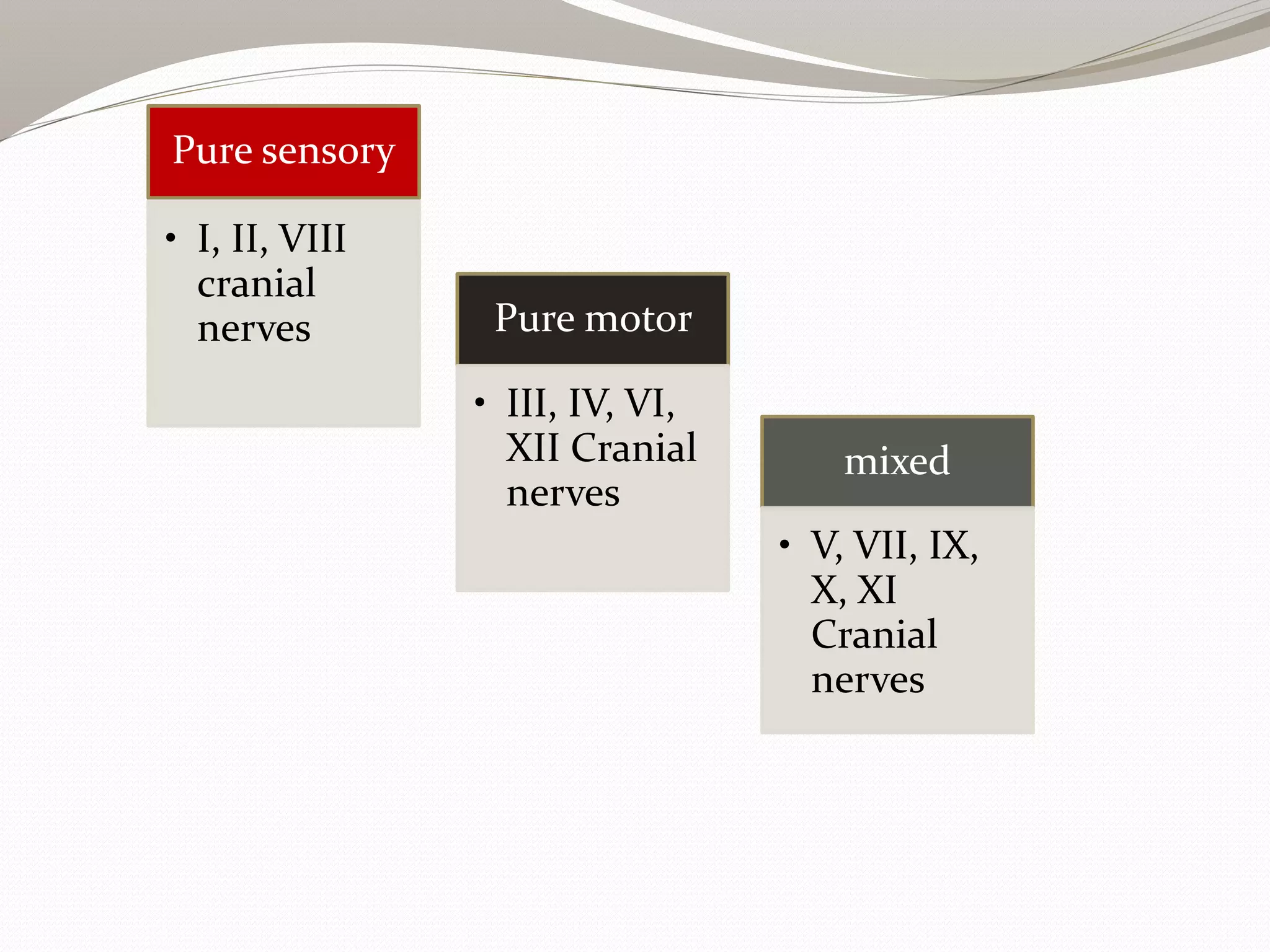
Pure sensory
• I, II, VIII
cranial
nerves Pure motor
• III, IV, VI,
XII Cranial
nerves
mixed
• V, VII, IX,
X, XI
Cranial
nerves
Nerve fibers
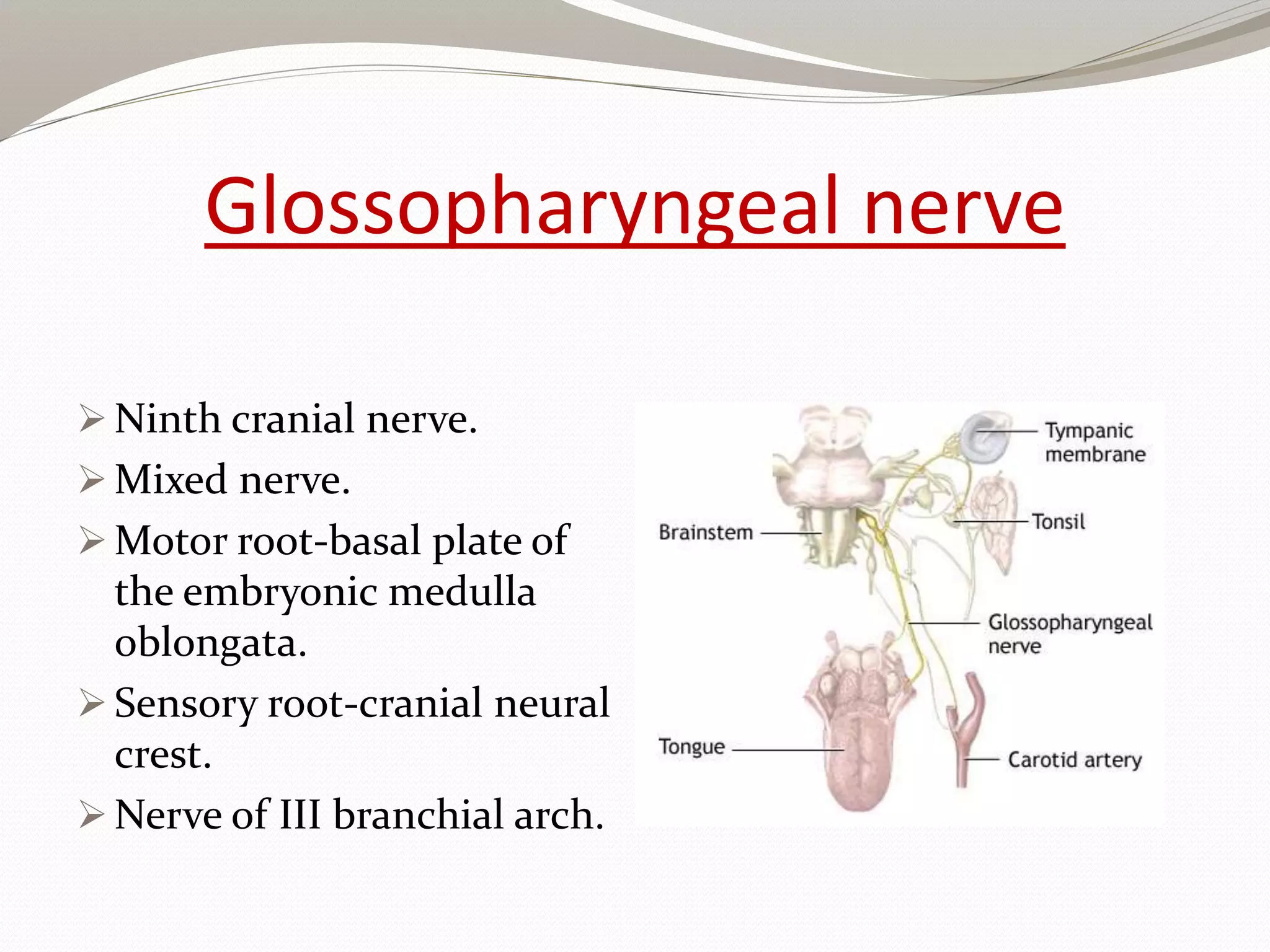
Glossopharyngeal nerve
 Ninth cranial nerve.
 Mixed nerve.
 Motor root-basal plate of
the embryonic medulla
oblongata.
 Sensory root-cranial neural
crest.
 Nerve of III branchial arch.
Ventral surface of medulla
oblongata.
posterior cranial fossa.
Central part of jugular
foramen
Between internal jugular vein
and external carotid artery
Course & Origin
Deep to styloid pr0cess
Between internal and external
carotid arteries at posterior
border of stylopharyngeus
Reaches pharynx-between
middle and inferior constrictor,
deep to hypoglossus.
Course & origin
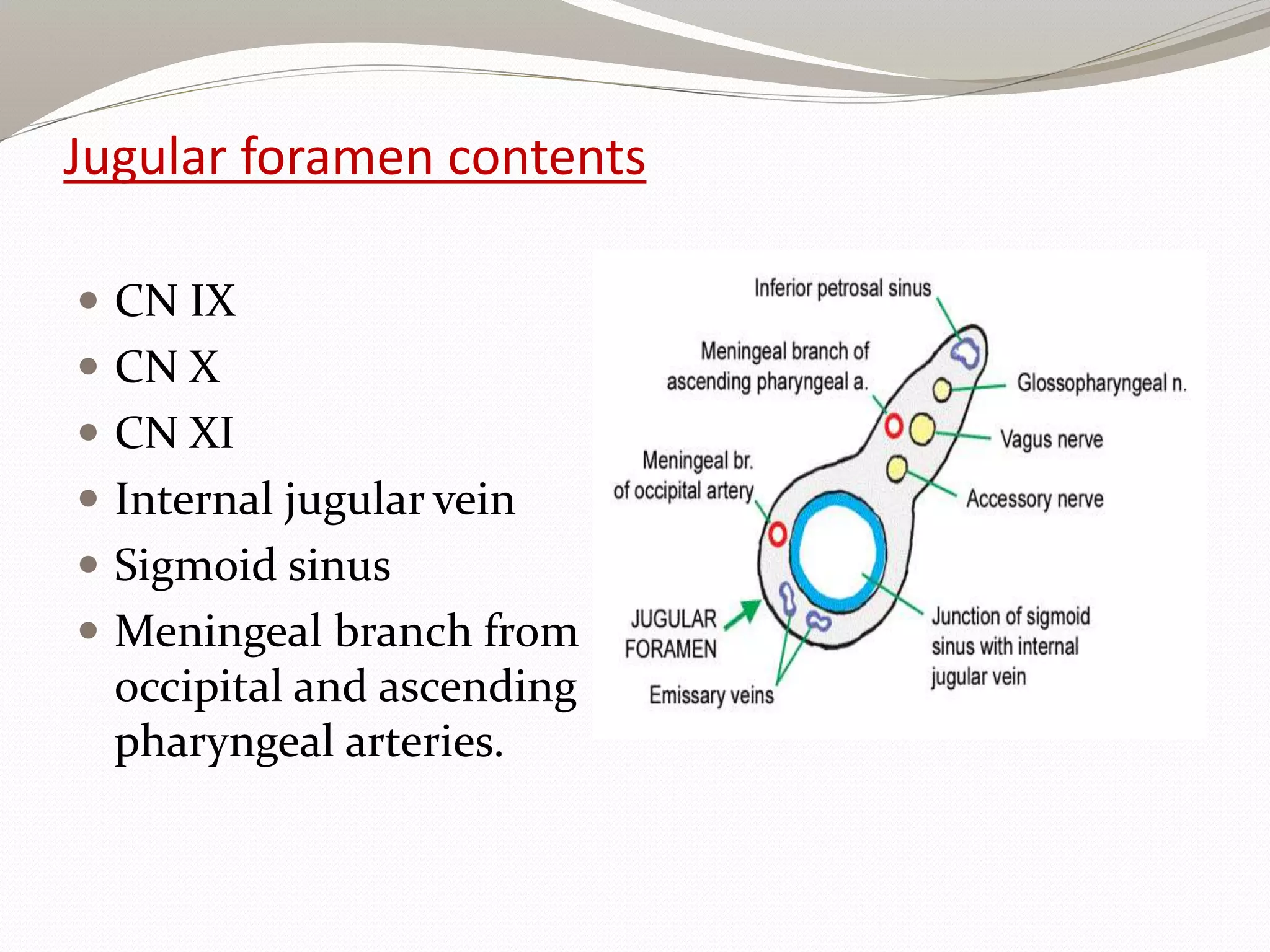
Jugular foramen contents
 CN IX
 CN X
 CN XI
 Internal jugular vein
 Sigmoid sinus
 Meningeal branch from
occipital and ascending
pharyngeal arteries.
Nucleus of glossopharyngeal nerve
Nuclear columns & functional components
Branchiomotor
Special visceral efferent
(Nucleus ambigus )
Supply only one muscle –
stylopharyngeus.
Nuclear columns & functional components
Parasympathatic
General visceral efferent
(inferior salivatory
nucleus)
To supply parotid gland
after relay in the otic
ganglion.
General somatic afferent
Spinal nucleus of CN V Carries proprioceptive
impulses from pharyngeal
muscle to spinal tract of V.
Viscerosensory
(Nucleus of solitary tract)
General visceral afferent
&special visceral afferent
Recives general sensations
from post 1/3rd of tongue,
tonsil, pharynx, carotid
body, taste sensation from
post 1/3rd of tongue.
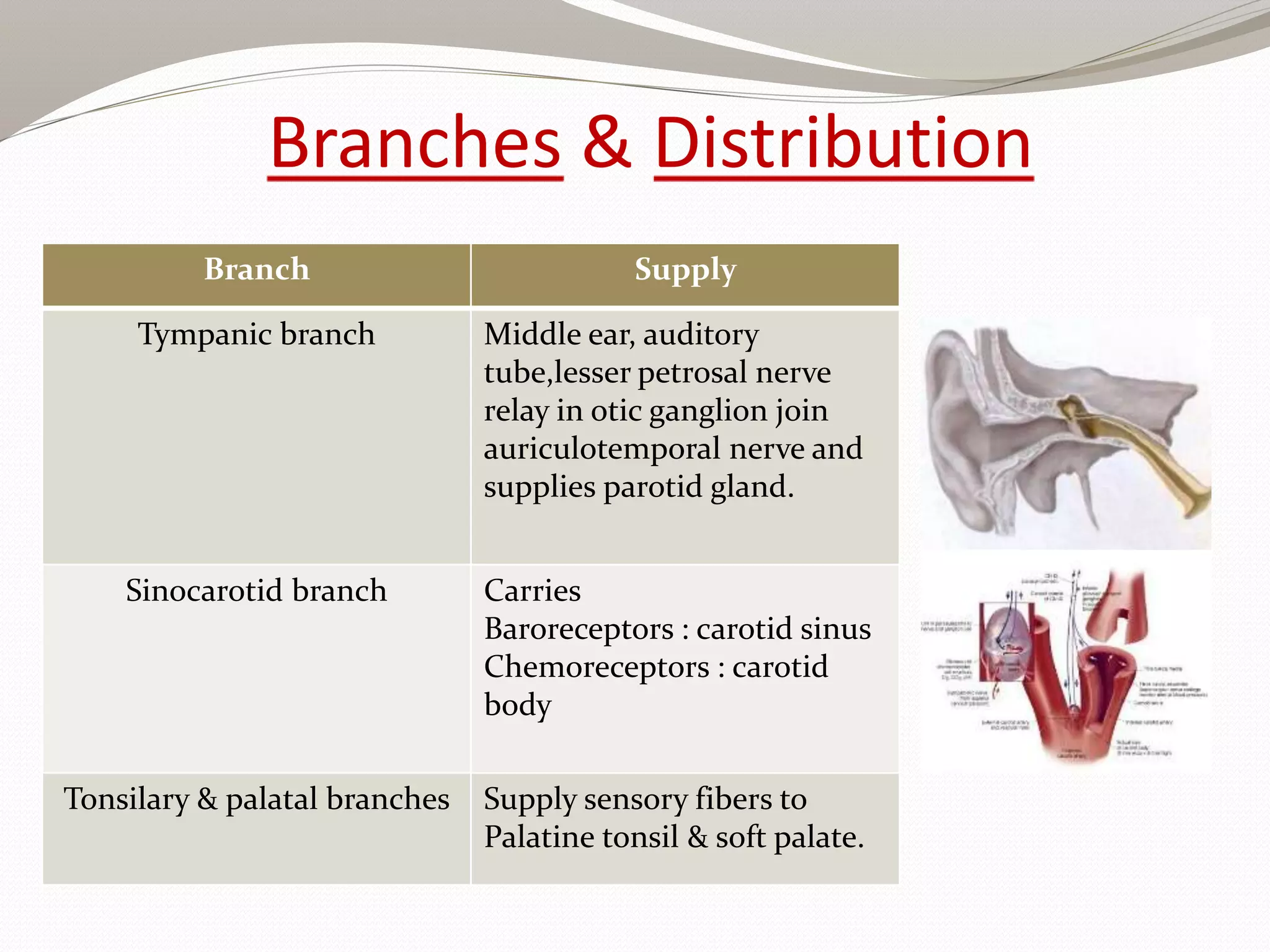
Branches & Distribution
Branch Supply
Tympanic branch Middle ear, auditory
tube,lesser petrosal nerve
relay in otic ganglion join
auriculotemporal nerve and
supplies parotid gland.
Sinocarotid branch Carries
Baroreceptors : carotid sinus
Chemoreceptors : carotid
body
Tonsilary & palatal branches Supply sensory fibers to
Palatine tonsil & soft palate.
Branches Supply
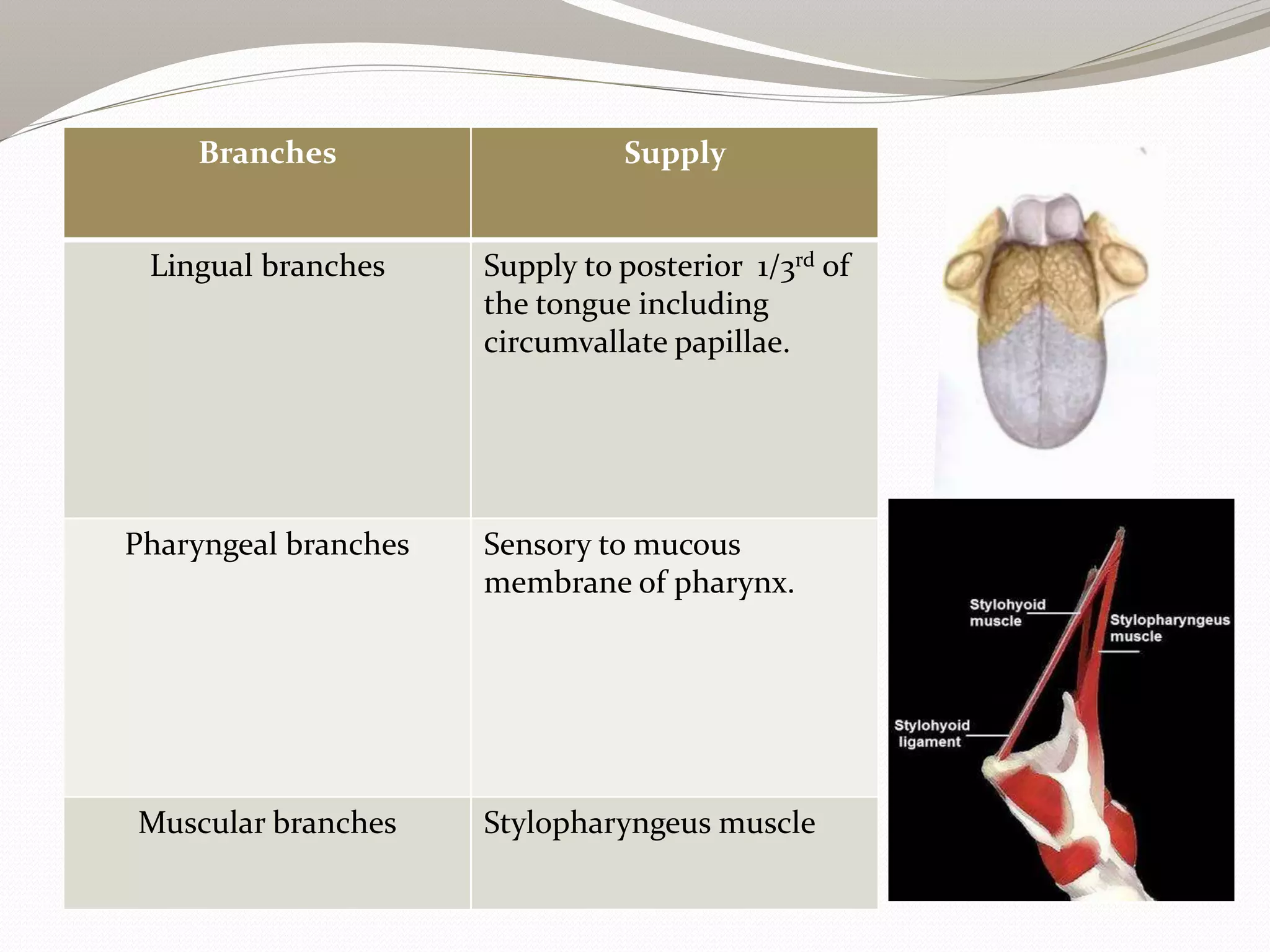
Lingual branches Supply to posterior 1/3rd of
the tongue including
circumvallate papillae.
Pharyngeal branches Sensory to mucous
membrane of pharynx.
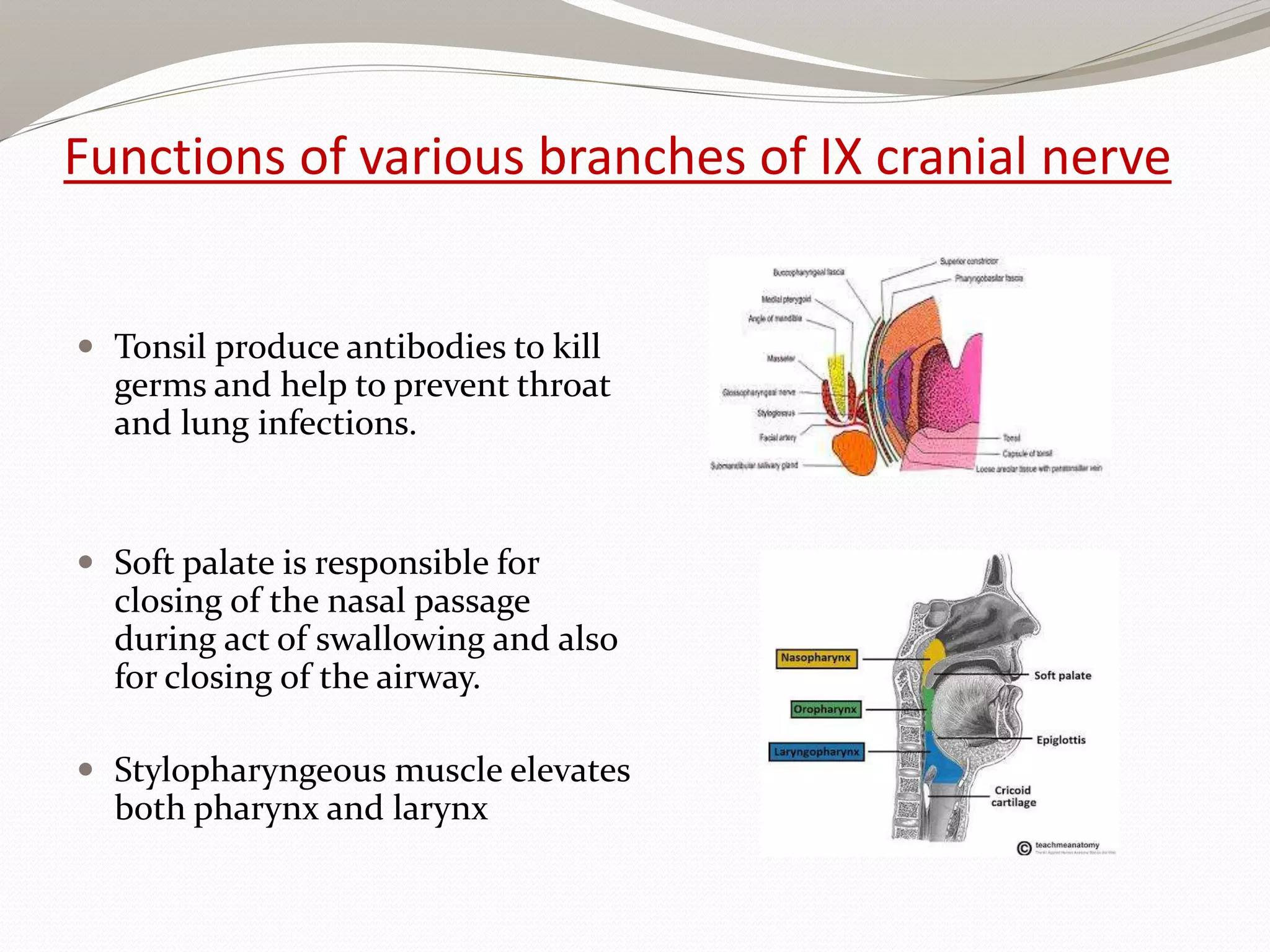
Muscular branches Stylopharyngeus muscle
Branches & Distribution
Functions of various branches of IX cranial nerve
 Auriculotemporal nerve
provides various sensory
innervations on the side of
head.
 Baroreceptors are maintains
blood pressure.
 Chemoreceptors are maintains
chemical concentrations in
blood.
Functions of various branches of IX cranial nerve
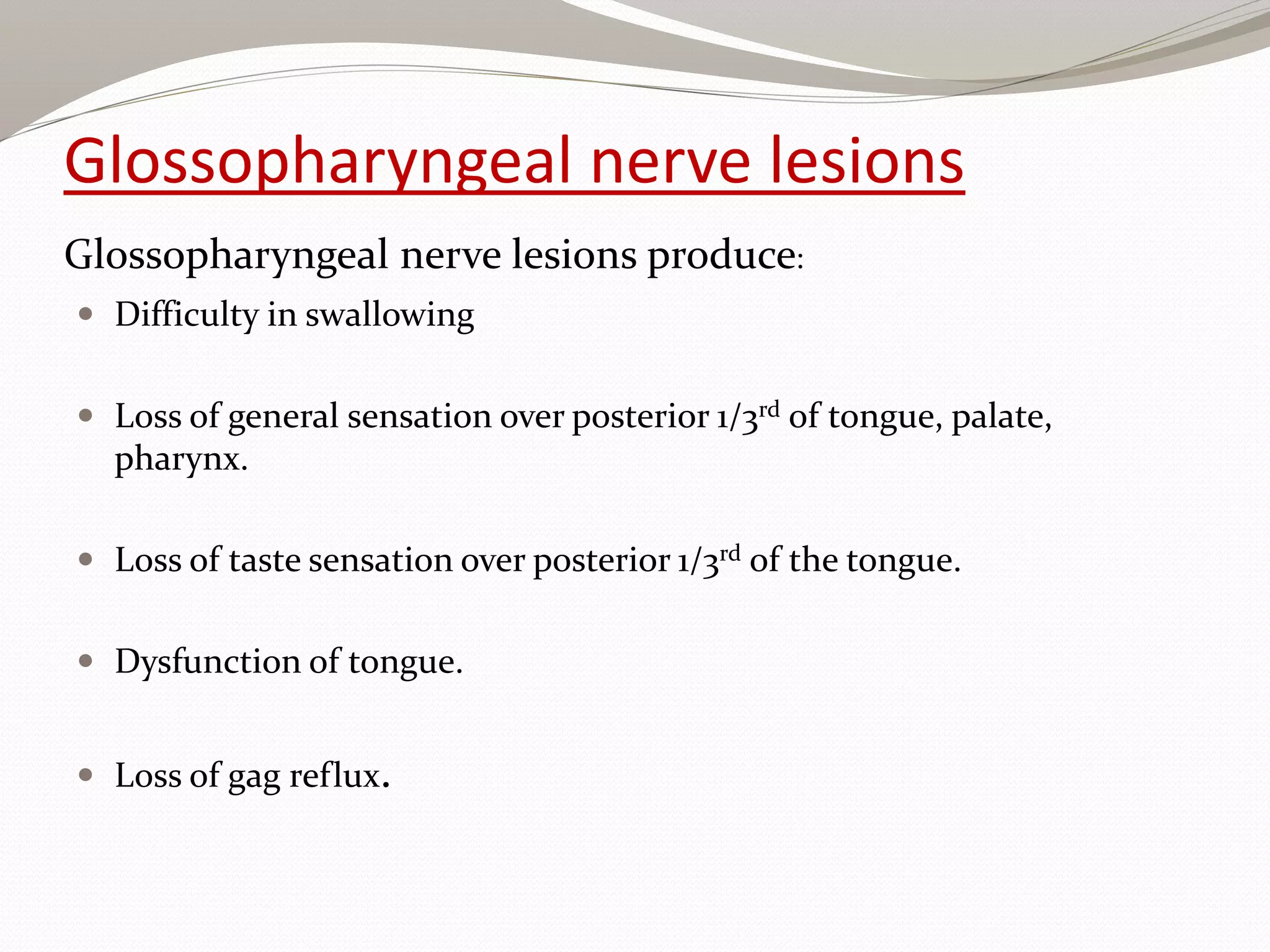
 Tonsil produce antibodies to kill
germs and help to prevent throat
and lung infections.
 Soft palate is responsible for
closing of the nasal passage
during act of swallowing and also
for closing of the airway.
 Stylopharyngeous muscle elevates
both pharynx and larynx
Applied aspects
Glossopharyngeal nerve lesions
Glossopharyngeal neuralgia
Glossopharyngeal nerve paralysis.
Glossopharyngeal nerve lesions
 Difficulty in swallowing
 Loss of general sensation over posterior 1/3rd of tongue, palate,
pharynx.
 Loss of taste sensation over posterior 1/3rd of the tongue.
 Dysfunction of tongue.
 Loss of gag reflux.
Glossopharyngeal nerve lesions produce:
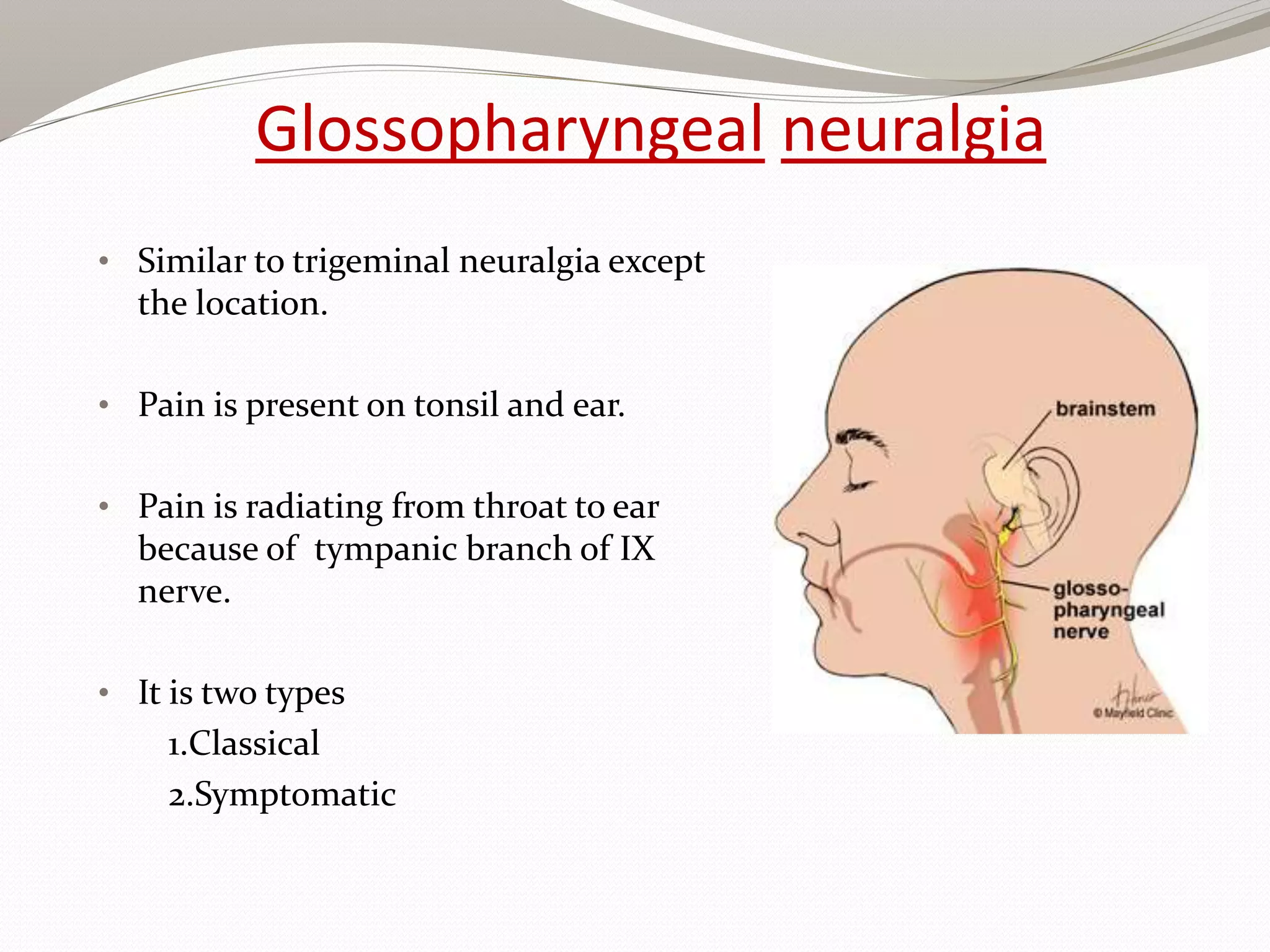
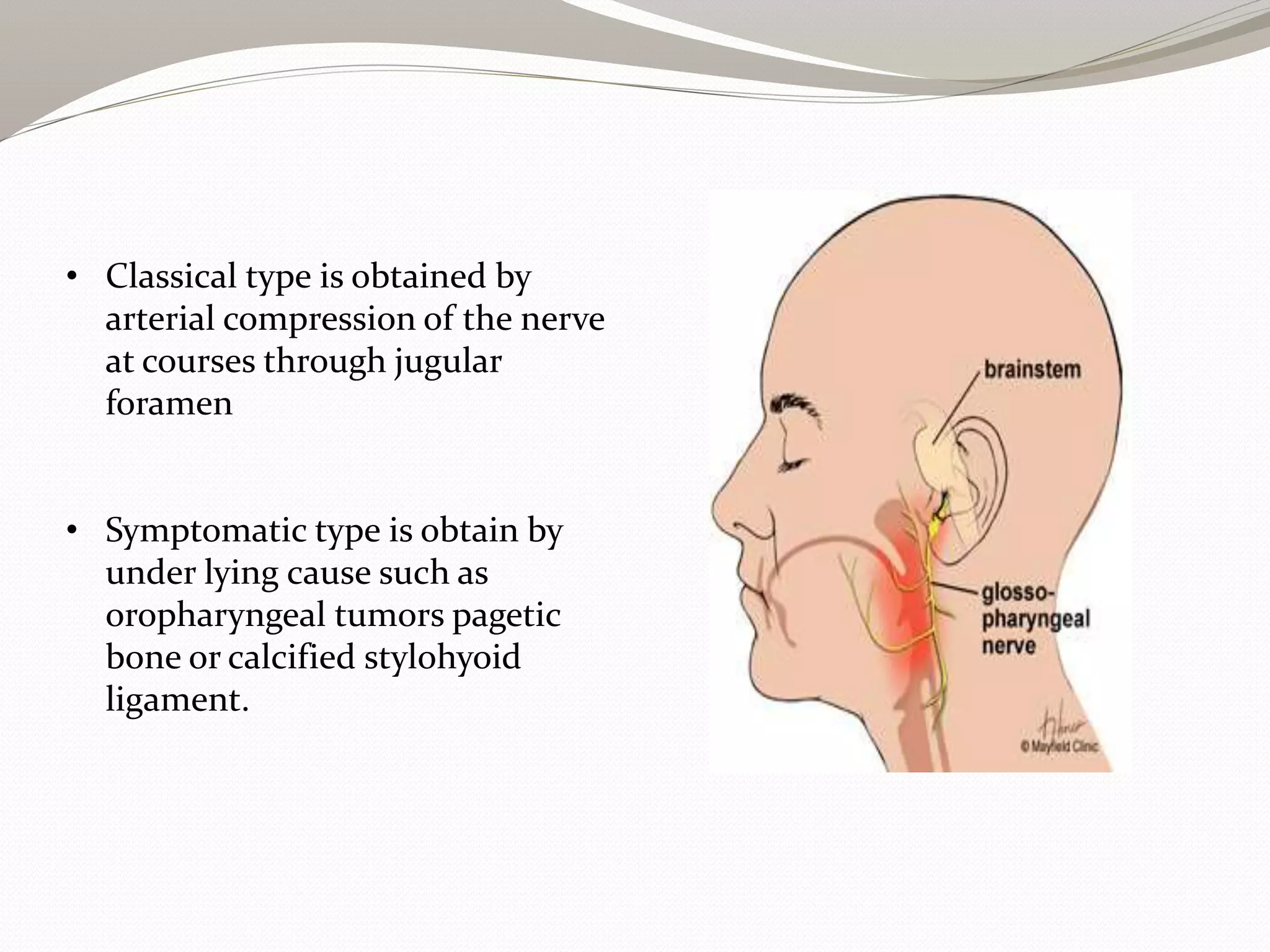
Glossopharyngeal neuralgia
• Similar to trigeminal neuralgia except
the location.
• Pain is present on tonsil and ear.
• Pain is radiating from throat to ear
because of tympanic branch of IX
nerve.
• It is two types
1.Classical
2.Symptomatic
• Classical type is obtained by
arterial compression of the nerve
at courses through jugular
foramen
• Symptomatic type is obtain by
under lying cause such as
oropharyngeal tumors pagetic
bone or calcified stylohyoid
ligament.
Clinical features
• Rarely bilateral involvement.
• Episodic pain ,sharp, lancinating, and extreme
intense.
• Pain during talking ,chewing, yawning,
swallowing, touching a blunt instrument to tonsil.
• No definite trigger zone.
• Pt difficulty to localize the pain in oropharynx.
Diagnosis
 MRI scan of head
 CT scan of head
 X rays of arteries with
dye( conventional
angiography)
Treatment
Medical :
Anticonvulsant medications-
Carbamazepine,
Oxcarbazepine,
Baclofen,
Phenytoin,
Lamotrigine
Surgical
1. Micro vascular
decompression
2. Surgical sectioning of
glossopharyngeal nerve.
Glossopharyngeal paralysis
Etiology –
Diphtheria may cause IX nerve paralysis( Reversible)
Diseases to lower brainstem
Surgical procedures to tonsil.
Symptoms –
Loss of sensation from pharynx
Decreased salivation
Loss of taste sensation at post 1/3rd of the tongue.
Conclusion
Glossopharyngeal nerve is a ninth cranial nerve, which
carries both sensory and motor functions. Any damage
to this nerve leads to abnormalities in its function. So,
proper care must be taken during surgical procedures to
prevent these complications.
References
 1. B.D.Chaurasia’s Human Anatomy, vol 3: 4th edition
 2. Burket’s Oral Medicine- Diagnosis & Treatment – 10th
ed. Martin S Greenberg & Michael Glick
 3. Internet source
 4. Gray’s anatomy– The anatomical basis of clinical
practice
 5. Shafer’s-A textbook of Oral Pathology.
 6. Neville –A textbook of Oral and Maxillofacial
Pathology, 1st south asia edition
 7. Thieme - Textbook of head and neck anatomy for
dental medicine
Glossopharyngeal nerve & its pathology ppt

Glossopharyngeal nerve & its pathology ppt

  • 1.
  • 2.
  • 3.
    CONTENTS Introduction Glossopharyngeal nerve Course &origin Nuclear columns & Functional components Branches & Distribution Applied aspects Conclusion References
  • 4.
    INTRODUCTION The nervous systemis an organ system containing a network of specialized cells called neurons that transmit signals between different parts of the body & co-ordinate the actions.
  • 5.
    Structure of Nerve: •Dendrites: Receptor segments that receive impulses from other neurons. • Axons: Projecting segments that transmit impulses to other neurons.
  • 6.
    Parts of thenerve: • Epineurium • Perineurium • Endoneurium
  • 7.
    CRANIAL NERVES The cranialnerves are a group of 12 paired nerves originating from the brain. The twelve cranial nerves are: I – Olfactory nerve II –Optic nerve III – Occulomotor nerve IV –Trochlear nerve V – Trigeminal nerve VI – Abducent nerve VII –Facial nerve VIII–Vestibulocochlear or Auditory nerve IX – Glossopharyngeal nerve X – Vagus nerve XI – Spinal accessory nerve XII– Hypoglossal nerve
  • 8.
    Pure sensory • I,II, VIII cranial nerves Pure motor • III, IV, VI, XII Cranial nerves mixed • V, VII, IX, X, XI Cranial nerves
  • 9.
  • 10.
    Glossopharyngeal nerve  Ninthcranial nerve.  Mixed nerve.  Motor root-basal plate of the embryonic medulla oblongata.  Sensory root-cranial neural crest.  Nerve of III branchial arch.
  • 11.
    Ventral surface ofmedulla oblongata. posterior cranial fossa. Central part of jugular foramen Between internal jugular vein and external carotid artery Course & Origin
  • 12.
    Deep to styloidpr0cess Between internal and external carotid arteries at posterior border of stylopharyngeus Reaches pharynx-between middle and inferior constrictor, deep to hypoglossus.
  • 13.
  • 14.
    Jugular foramen contents CN IX  CN X  CN XI  Internal jugular vein  Sigmoid sinus  Meningeal branch from occipital and ascending pharyngeal arteries.
  • 15.
  • 16.
    Nuclear columns &functional components
  • 17.
    Branchiomotor Special visceral efferent (Nucleusambigus ) Supply only one muscle – stylopharyngeus. Nuclear columns & functional components
  • 18.
    Parasympathatic General visceral efferent (inferiorsalivatory nucleus) To supply parotid gland after relay in the otic ganglion.
  • 19.
    General somatic afferent Spinalnucleus of CN V Carries proprioceptive impulses from pharyngeal muscle to spinal tract of V.
  • 20.
    Viscerosensory (Nucleus of solitarytract) General visceral afferent &special visceral afferent Recives general sensations from post 1/3rd of tongue, tonsil, pharynx, carotid body, taste sensation from post 1/3rd of tongue.
  • 21.
    Branches & Distribution BranchSupply Tympanic branch Middle ear, auditory tube,lesser petrosal nerve relay in otic ganglion join auriculotemporal nerve and supplies parotid gland. Sinocarotid branch Carries Baroreceptors : carotid sinus Chemoreceptors : carotid body Tonsilary & palatal branches Supply sensory fibers to Palatine tonsil & soft palate.
  • 22.
    Branches Supply Lingual branchesSupply to posterior 1/3rd of the tongue including circumvallate papillae. Pharyngeal branches Sensory to mucous membrane of pharynx. Muscular branches Stylopharyngeus muscle
  • 23.
  • 24.
    Functions of variousbranches of IX cranial nerve  Auriculotemporal nerve provides various sensory innervations on the side of head.  Baroreceptors are maintains blood pressure.  Chemoreceptors are maintains chemical concentrations in blood.
  • 25.
    Functions of variousbranches of IX cranial nerve  Tonsil produce antibodies to kill germs and help to prevent throat and lung infections.  Soft palate is responsible for closing of the nasal passage during act of swallowing and also for closing of the airway.  Stylopharyngeous muscle elevates both pharynx and larynx
  • 26.
    Applied aspects Glossopharyngeal nervelesions Glossopharyngeal neuralgia Glossopharyngeal nerve paralysis.
  • 27.
    Glossopharyngeal nerve lesions Difficulty in swallowing  Loss of general sensation over posterior 1/3rd of tongue, palate, pharynx.  Loss of taste sensation over posterior 1/3rd of the tongue.  Dysfunction of tongue.  Loss of gag reflux. Glossopharyngeal nerve lesions produce:
  • 28.
    Glossopharyngeal neuralgia • Similarto trigeminal neuralgia except the location. • Pain is present on tonsil and ear. • Pain is radiating from throat to ear because of tympanic branch of IX nerve. • It is two types 1.Classical 2.Symptomatic
  • 29.
    • Classical typeis obtained by arterial compression of the nerve at courses through jugular foramen • Symptomatic type is obtain by under lying cause such as oropharyngeal tumors pagetic bone or calcified stylohyoid ligament.
  • 30.
    Clinical features • Rarelybilateral involvement. • Episodic pain ,sharp, lancinating, and extreme intense. • Pain during talking ,chewing, yawning, swallowing, touching a blunt instrument to tonsil. • No definite trigger zone. • Pt difficulty to localize the pain in oropharynx.
  • 31.
    Diagnosis  MRI scanof head  CT scan of head  X rays of arteries with dye( conventional angiography)
  • 32.
  • 33.
    Surgical 1. Micro vascular decompression 2.Surgical sectioning of glossopharyngeal nerve.
  • 34.
    Glossopharyngeal paralysis Etiology – Diphtheriamay cause IX nerve paralysis( Reversible) Diseases to lower brainstem Surgical procedures to tonsil. Symptoms – Loss of sensation from pharynx Decreased salivation Loss of taste sensation at post 1/3rd of the tongue.
  • 35.
    Conclusion Glossopharyngeal nerve isa ninth cranial nerve, which carries both sensory and motor functions. Any damage to this nerve leads to abnormalities in its function. So, proper care must be taken during surgical procedures to prevent these complications.
  • 36.
    References  1. B.D.Chaurasia’sHuman Anatomy, vol 3: 4th edition  2. Burket’s Oral Medicine- Diagnosis & Treatment – 10th ed. Martin S Greenberg & Michael Glick  3. Internet source  4. Gray’s anatomy– The anatomical basis of clinical practice  5. Shafer’s-A textbook of Oral Pathology.  6. Neville –A textbook of Oral and Maxillofacial Pathology, 1st south asia edition  7. Thieme - Textbook of head and neck anatomy for dental medicine

Editor's Notes

  • #11 The glossopharyngeal nerve, known as the ninth cranial nerve (CN IX), is a mixed nerve that carries afferent sensory and efferent motor information . Motor division is derived from the basal plate of the embryonic medulla oblongata, while sensory division originates from the cranial neural crest.
  • #12 3rd arch -Lower part of body of hyoid bone 3rd pouch –inferior parathyroid gland, thymus
  • #13 BDeep to the styloid process. Between the internal and external carotid arteries at posterior border of stylopharyngeus then lateral to it. Reaches the pharynx by passing between middle and inferior constrictor, deep to hyoglossus, where it breaks into terminal branches.
  • #21 Motor-All muscles except palatoglossus are suppied by hypoglossal nerve. PG is supplied by cranial root of accessory nerve. Sensory – chorda tympani ant 2/3rd ,post 1/3rd IX nerve (both sensory and motor) Lingual nerve is nerve of general sensations.
  • #25 2. Baroreceptors are sensors which locates in the blood vessels of all vertebrate animals. They sense the blood pressure and relay the information to the brain, so that a proper blood pressure to be maintained. Chemoreceptors are sensory extensions of the peripheral nervous system in to blood vessels where they detect changes in chemical concentrations.
  • #26  3. Tonsil: Antibodies produce by the immune cells in the tonsils help to kill germs and help to prevent throat and lung infections. Soft palate is responsible for closing of the nasal passage during act of swallowing and also for closing of the airway.
  • #31 Middle and old age group. No sex predilection.