The verb phrasePresented by :HananSaleh Al-gomariID:0765385
The verb phrase:The verb phrase may consist of  the main verb, and auxiliary verb, plus optional complements, and other modifiers.The material of verb phrase ( VP ) depends on the type or CLASS of verb used.
Types or classes of verb:-Transitive Verb.Intransitive Verb.Ditransitive verb.Intensive Verb.Complex-trasitive Verb.Prepositional verb.
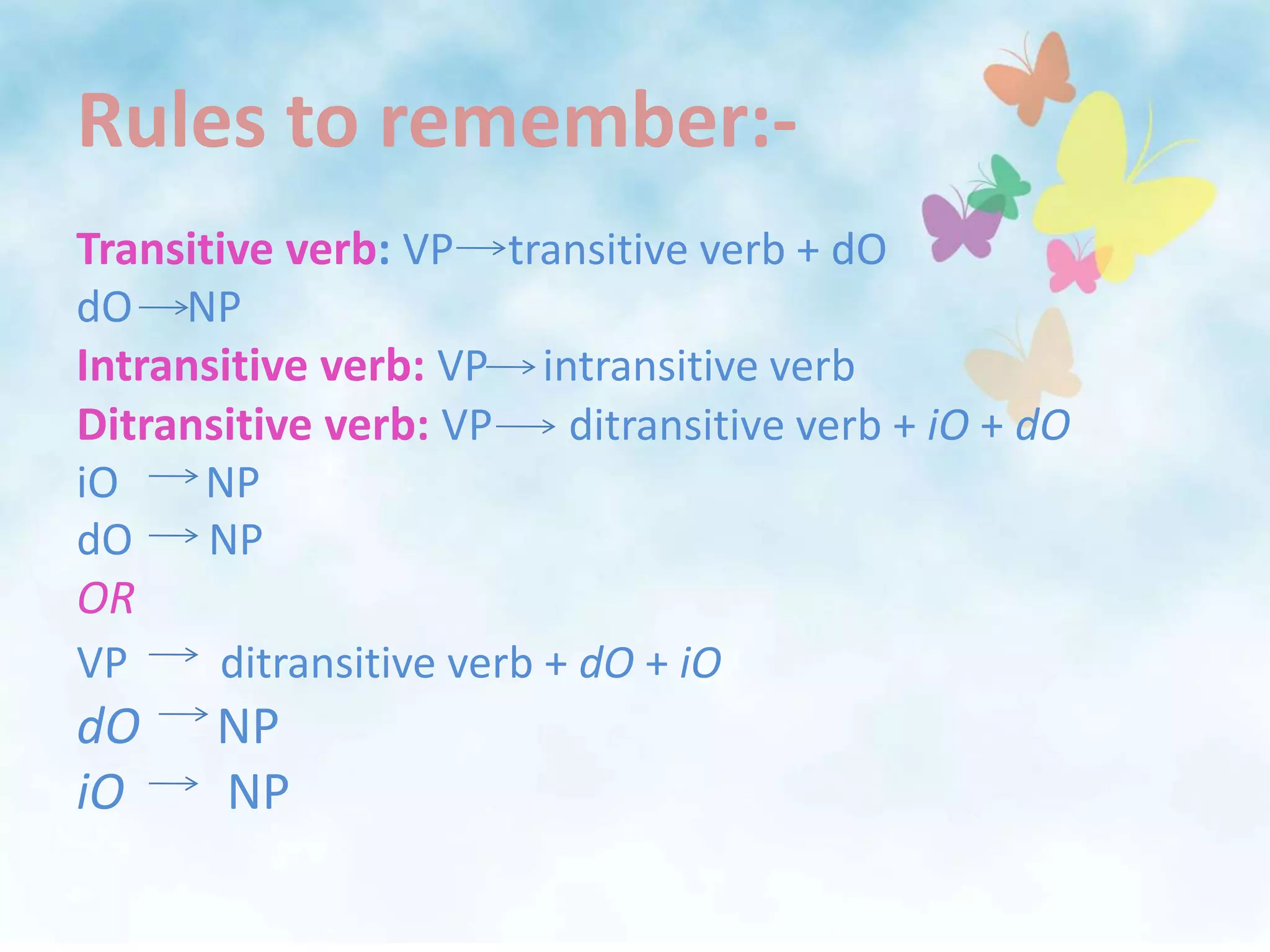
Rules to remember:-Transitive verb: VP     transitive verb + dOdO     NPIntransitive verb: VP     intransitive verbDitransitive verb: VP       ditransitive verb + iO + dOiO        NPdO       NPORditransitive verb + dO + iOVPNPdONPiO
Complex – transitive verb : VP    Complex – transitive verb + dO + oCdO     NP oC      NP or PP or AP Prepositional verb: VP    prepositional verb + pOpO     PP
Transitive Verb:A verb phrase using a transitive verb normally has to have a direct object to be complete.There are many transitive verbs for example:Kate hugged the babyThe dog found a boneThe rule :VP        transitive verb + dOdONP
The tree diagram for this class of verb is as follows:Kate hugged the babyS                             NP                          VP                              N          V                       NP                                        [trans]         DET              NKate      hugged            the                 baby.     P                     dO                           S
Intransitive verb:By contrast, the intransitive Verb, is a class of verb doesn’t take an object. In fact it requires nothing else to complete the verb phrase.for example: Ken snores.    The rule :Transitive verb: VP     transitive verb + dOdO     NP
The tree diagram for this class of verb is as follows:Ken snoresS                          NP                  VP                              N                   V                                             [intrans]                           Ken             snores.
Ditransitive Verb :Another class of verb is ditransitive. This type of Verb requeires two objects. One of these is the familiar direct object dO, the other an INDIRECT OBJECT or iO for short.for example: Ray told the children a story. The rule :VP       ditransitive verb + iO + dOiO        NPdO       NPORditransitive verb + dO + iOVPNPdONPiO
The tree diagram for this class of verb is as follows:Ray told the children a story.                  SNP                     VP             N        V                   NP                      NP                                 DET          N       DET         N                 Ray    told      the     children   a            story.     [ditrans]SPdOiO
Ray told a story to the children.                            SNP                             VP                N              V                      NP                  PP                                                DET          N       P              NP                                                                                   DET           N                                                    Ray       told          a          story   to    the      children.               [ditrans]SdOiOP
Intensive verb:Belong to a small group which include verbs like, be,seem appear, become, look and so on.for example: Sally became a doctor.George is in the gardenSue seems unhappy.The rule :VP      intensive verb + sCsC       NP  or  PP  or  AP
The tree diagram for this class of verb is as follows:Sally become a doctor.               SNP              VP N         V                NP                                  DET          N     Sally  become    a         doctor.[intens]
Complex-transitive Verb :A verb that takes a direct object (dO)  plus an object complement ( oC ).for example: Kate thought John a fool. The rule :VP       complex-transitive verb + dO + oC  NPdOoC         NP  or  PP  or  AP
The tree diagram for this class of verb is as follows:Kate thought John a fool.                 S          NP                   VP           N         V         NP        NP                                   N    DET        Nkate     thought  John   a           fool. [Complex]SoCPdO
Prepositional Verb: Prepositional verb is one which requires a prepositional phrase in order to be complete. Verbs like glance at, lean on, refer to, fall into this class.for example: sally leant on the table.  The rule :VP        prepositional verb + pOpO        PP
The tree diagram for this class of verb is as follows:Sally leant on the table.                S       NP                     VP        N          V                      PP                                          P                 NP                                                         DET          N      Sally    leant            on         the        table.  [Complex]pOSP
Imperative Verb.Used to give commands or instructions. e.g. Close the door!                S                 VP            V                         NP              [trans]               DET        N        close                     the    door       p                    do
Thank you

The verb phrase-3

  • 1.
    The verb phrasePresentedby :HananSaleh Al-gomariID:0765385
  • 2.
    The verb phrase:Theverb phrase may consist of the main verb, and auxiliary verb, plus optional complements, and other modifiers.The material of verb phrase ( VP ) depends on the type or CLASS of verb used.
  • 3.
    Types or classesof verb:-Transitive Verb.Intransitive Verb.Ditransitive verb.Intensive Verb.Complex-trasitive Verb.Prepositional verb.
  • 4.
    Rules to remember:-Transitiveverb: VP transitive verb + dOdO NPIntransitive verb: VP intransitive verbDitransitive verb: VP ditransitive verb + iO + dOiO NPdO NPORditransitive verb + dO + iOVPNPdONPiO
  • 5.
    Complex – transitiveverb : VP Complex – transitive verb + dO + oCdO NP oC NP or PP or AP Prepositional verb: VP prepositional verb + pOpO PP
  • 6.
    Transitive Verb:A verbphrase using a transitive verb normally has to have a direct object to be complete.There are many transitive verbs for example:Kate hugged the babyThe dog found a boneThe rule :VP transitive verb + dOdONP
  • 7.
    The tree diagramfor this class of verb is as follows:Kate hugged the babyS NP VP N V NP [trans] DET NKate hugged the baby. P dO S
  • 8.
    Intransitive verb:By contrast,the intransitive Verb, is a class of verb doesn’t take an object. In fact it requires nothing else to complete the verb phrase.for example: Ken snores. The rule :Transitive verb: VP transitive verb + dOdO NP
  • 9.
    The tree diagramfor this class of verb is as follows:Ken snoresS NP VP N V [intrans] Ken snores.
  • 10.
    Ditransitive Verb :Anotherclass of verb is ditransitive. This type of Verb requeires two objects. One of these is the familiar direct object dO, the other an INDIRECT OBJECT or iO for short.for example: Ray told the children a story. The rule :VP ditransitive verb + iO + dOiO NPdO NPORditransitive verb + dO + iOVPNPdONPiO
  • 11.
    The tree diagramfor this class of verb is as follows:Ray told the children a story. SNP VP N V NP NP DET N DET N Ray told the children a story. [ditrans]SPdOiO
  • 12.
    Ray told astory to the children. SNP VP N V NP PP DET N P NP DET N Ray told a story to the children. [ditrans]SdOiOP
  • 13.
    Intensive verb:Belong toa small group which include verbs like, be,seem appear, become, look and so on.for example: Sally became a doctor.George is in the gardenSue seems unhappy.The rule :VP intensive verb + sCsC NP or PP or AP
  • 14.
    The tree diagramfor this class of verb is as follows:Sally become a doctor. SNP VP N V NP DET N Sally become a doctor.[intens]
  • 15.
    Complex-transitive Verb :Averb that takes a direct object (dO) plus an object complement ( oC ).for example: Kate thought John a fool. The rule :VP complex-transitive verb + dO + oC NPdOoC NP or PP or AP
  • 16.
    The tree diagramfor this class of verb is as follows:Kate thought John a fool. S NP VP N V NP NP N DET Nkate thought John a fool. [Complex]SoCPdO
  • 17.
    Prepositional Verb: Prepositionalverb is one which requires a prepositional phrase in order to be complete. Verbs like glance at, lean on, refer to, fall into this class.for example: sally leant on the table. The rule :VP prepositional verb + pOpO PP
  • 18.
    The tree diagramfor this class of verb is as follows:Sally leant on the table. S NP VP N V PP P NP DET N Sally leant on the table. [Complex]pOSP
  • 19.
    Imperative Verb.Used togive commands or instructions. e.g. Close the door! S VP V NP [trans] DET N close the door p do
  • 20.

Editor's Notes