ADVERB CLAUSES
What is a clause?
■ A clause is a group of words containing at
least one subject and a verb showing past,
present or future time.
Clause are either independent or dependent:
■ Independent Clauses: can stand alone as complete sentences.We can call them Main
Clauses.
– Ex: She’s going to be a teacher.
■ Dependent Clause: can not stand alone.They do need another clause to be fully
understood.We can also call them Subordinate Clause.
– Ex: When she graduates, she’s going to be a teacher.
Subordinate clause Main clause
Subordinating
conjunction
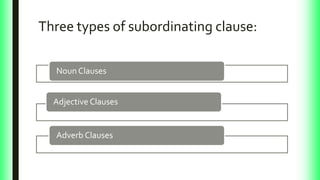
Three types of subordinating clause:
Noun Clauses
Adjective Clauses
Adverb Clauses
What is an Adverb clause?
An Adverb clause is a subordinate clause that does the work of
an adverb in a sentence.
An Adverb clause can modify a verb, an adjective or an adverb.
Note!!!
■ Adverb clause without main clause
(independent clause) is a FRAGMENT.
– Before we moved to the mountain. =>
meaningless sentence
– Before we moved to the mountain, we lived
in the city. => meaning sentence
5 types of Adverb Clauses
Time Place Reason
Condition Contrast
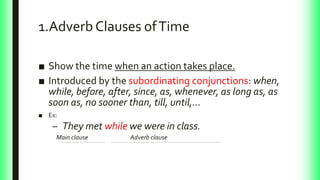
1.Adverb Clauses ofTime
■ Show the time when an action takes place.
■ Introduced by the subordinating conjunctions: when,
while, before, after, since, as, whenever, as long as, as
soon as, no sooner than, till, until,…
■ Ex:
– They met while we were in class.
Main clause Adverb clause
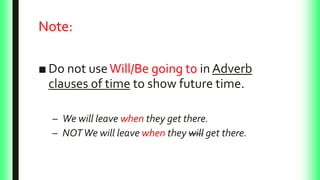
Note:
■ Do not use Will/Be going to in Adverb
clauses of time to show future time.
– We will leave when they get there.
– NOTWe will leave when they will get there.
2.Adverb Clauses of Place
■ Show the place where an action takes place.
■ Introduced by the subordinating conjunctions: where,
wherever, anywhere, everywhere,…
■ Ex:
– He lives where it rains a lot.
main clause adverb clause
3.Adverb Clauses of Reason
■ Show why an action takes place.
■ Introduced by: because, since, as, now that,…
■ Ex:
– He was sad because he missed the show.
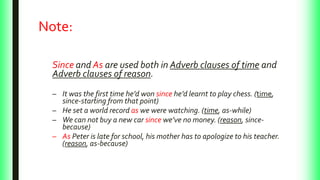
Note:
Since and As are used both in Adverb clauses of time and
Adverb clauses of reason.
– It was the first time he’d won since he’d learnt to play chess. (time,
since-starting from that point)
– He set a world record as we were watching. (time, as-while)
– We can not buy a new car since we’ve no money. (reason, since-
because)
– As Peter is late for school, his mother has to apologize to his teacher.
(reason, as-because)
4.Adverb Clauses of Condition
■ Indicate under what conditions something happen.
■ The main clause states what will happen if the conditions
are fulfilled.
■ Introduced by: if, even if, only if, unless, as long as,
whether, incase,…
– Even if: the condition does not matter, the result will be the same.
– Only if: only one condition will be the result.
– Unless: if….not….
Examples:
■ You can’t get good mark unless you study hard =You can’t get
good mark if you do not study hard.
■ Even if he comes here, I will not forgive him.
■ Only if:
– You are allowed to enter this room only if I have given permission.
– Only if I have given permission are you allowed to enter this room.
=> no comma, the S and theV in main clause are inverted.
The conjunction if can be used to covey a
variety of meanings
Rules Examples
To talk about the future If I get a holiday, we can go boating on
Saturday.
To talk about things that are not real or
unlikely to happen at the moment
If I were famous, I would live in Hollywood.
To talk about things that not happen If you had told me, I would have left
immediately.
When there are two possibilities of
expression
If you are late, meet me at the theatre.
5.Adverb Clauses of Contrast
■ Make a contrast with the idea expressed in the
main clause.
■ Introduced by: although, even though, though,
whereas, while,…
Although, even though and though
■ Show an unexpected result.
■ Ex:
– Although/even though/though it rained a lot, they enjoyed
themselves.
While orWhereas to make a direct
contrast
■ Ex:
– Some people like meat with much fat on it whereas/while others hate it.
Note:
■ Whereas is used in formal language and careful speech.
■ While is used both in a clause of contrast and a clauses of time.
– While I was reading book, he came. (time)
– I like black coffee while he prefers it with cream. (contrast)
■ When an adverb clause begins a sentence, it is
followed by a comma.
■ When an adverb clause follow the main clause, do
not separate.
– While some people are tall, others are shot.
– Some people are tall while others are shot.
Comma rule
Reduction
■ While I was walking to class, I ran into an old friend.
■ While walking to class, I ran into an old friend.
■ While the teacher was lecturing to the class, I fell asleep.
=> can not reduce
☻We can reduce adverb clauses into phrases
only when the subject of the adverb clause and
the subject of the main clause are the same!
1. Much of the food we eat would not actually last
that long ………… it were not for the chemicals
they contain.
A. If B.Though
C. Unless
A. If B.Though
C. Unless
2. ……. chatting online can be
beneficial, it is certainly not the same
as real interaction with human
beings.
A.Where B. Because
C. Although
A.Where B. Because
C. Although
3. I will keep studying hard I
pass the exam.
A. Because B. Until
C.Wherever
A. Because B. Until
C.Wherever
4. Global warming will not slow
down government take
serious action soon.
A. Unless B. Until
C. As long as
A. Unless B. Until
C. As long as
5. I used to live ……… you can now
see that office block.They knocked
my house down to build it.
A. Since B.Where
C. Until
A. Since B.Where
C. Until

Adverb clauses

  • 1.
  • 2.
    What is aclause? ■ A clause is a group of words containing at least one subject and a verb showing past, present or future time.
  • 3.
    Clause are eitherindependent or dependent: ■ Independent Clauses: can stand alone as complete sentences.We can call them Main Clauses. – Ex: She’s going to be a teacher. ■ Dependent Clause: can not stand alone.They do need another clause to be fully understood.We can also call them Subordinate Clause. – Ex: When she graduates, she’s going to be a teacher. Subordinate clause Main clause Subordinating conjunction
  • 4.
    Three types ofsubordinating clause: Noun Clauses Adjective Clauses Adverb Clauses
  • 5.
    What is anAdverb clause? An Adverb clause is a subordinate clause that does the work of an adverb in a sentence. An Adverb clause can modify a verb, an adjective or an adverb.
  • 6.
    Note!!! ■ Adverb clausewithout main clause (independent clause) is a FRAGMENT. – Before we moved to the mountain. => meaningless sentence – Before we moved to the mountain, we lived in the city. => meaning sentence
  • 7.
    5 types ofAdverb Clauses Time Place Reason Condition Contrast
  • 8.
    1.Adverb Clauses ofTime ■Show the time when an action takes place. ■ Introduced by the subordinating conjunctions: when, while, before, after, since, as, whenever, as long as, as soon as, no sooner than, till, until,… ■ Ex: – They met while we were in class. Main clause Adverb clause
  • 9.
    Note: ■ Do notuse Will/Be going to in Adverb clauses of time to show future time. – We will leave when they get there. – NOTWe will leave when they will get there.
  • 10.
    2.Adverb Clauses ofPlace ■ Show the place where an action takes place. ■ Introduced by the subordinating conjunctions: where, wherever, anywhere, everywhere,… ■ Ex: – He lives where it rains a lot. main clause adverb clause
  • 11.
    3.Adverb Clauses ofReason ■ Show why an action takes place. ■ Introduced by: because, since, as, now that,… ■ Ex: – He was sad because he missed the show.
  • 12.
    Note: Since and Asare used both in Adverb clauses of time and Adverb clauses of reason. – It was the first time he’d won since he’d learnt to play chess. (time, since-starting from that point) – He set a world record as we were watching. (time, as-while) – We can not buy a new car since we’ve no money. (reason, since- because) – As Peter is late for school, his mother has to apologize to his teacher. (reason, as-because)
  • 13.
    4.Adverb Clauses ofCondition ■ Indicate under what conditions something happen. ■ The main clause states what will happen if the conditions are fulfilled. ■ Introduced by: if, even if, only if, unless, as long as, whether, incase,… – Even if: the condition does not matter, the result will be the same. – Only if: only one condition will be the result. – Unless: if….not….
  • 14.
    Examples: ■ You can’tget good mark unless you study hard =You can’t get good mark if you do not study hard. ■ Even if he comes here, I will not forgive him. ■ Only if: – You are allowed to enter this room only if I have given permission. – Only if I have given permission are you allowed to enter this room. => no comma, the S and theV in main clause are inverted.
  • 15.
    The conjunction ifcan be used to covey a variety of meanings Rules Examples To talk about the future If I get a holiday, we can go boating on Saturday. To talk about things that are not real or unlikely to happen at the moment If I were famous, I would live in Hollywood. To talk about things that not happen If you had told me, I would have left immediately. When there are two possibilities of expression If you are late, meet me at the theatre.
  • 16.
    5.Adverb Clauses ofContrast ■ Make a contrast with the idea expressed in the main clause. ■ Introduced by: although, even though, though, whereas, while,…
  • 17.
    Although, even thoughand though ■ Show an unexpected result. ■ Ex: – Although/even though/though it rained a lot, they enjoyed themselves.
  • 18.
    While orWhereas tomake a direct contrast ■ Ex: – Some people like meat with much fat on it whereas/while others hate it. Note: ■ Whereas is used in formal language and careful speech. ■ While is used both in a clause of contrast and a clauses of time. – While I was reading book, he came. (time) – I like black coffee while he prefers it with cream. (contrast)
  • 19.
    ■ When anadverb clause begins a sentence, it is followed by a comma. ■ When an adverb clause follow the main clause, do not separate. – While some people are tall, others are shot. – Some people are tall while others are shot. Comma rule
  • 20.
    Reduction ■ While Iwas walking to class, I ran into an old friend. ■ While walking to class, I ran into an old friend. ■ While the teacher was lecturing to the class, I fell asleep. => can not reduce ☻We can reduce adverb clauses into phrases only when the subject of the adverb clause and the subject of the main clause are the same!
  • 21.
    1. Much ofthe food we eat would not actually last that long ………… it were not for the chemicals they contain. A. If B.Though C. Unless A. If B.Though C. Unless
  • 22.
    2. ……. chattingonline can be beneficial, it is certainly not the same as real interaction with human beings. A.Where B. Because C. Although A.Where B. Because C. Although
  • 23.
    3. I willkeep studying hard I pass the exam. A. Because B. Until C.Wherever A. Because B. Until C.Wherever
  • 24.
    4. Global warmingwill not slow down government take serious action soon. A. Unless B. Until C. As long as A. Unless B. Until C. As long as
  • 25.
    5. I usedto live ……… you can now see that office block.They knocked my house down to build it. A. Since B.Where C. Until A. Since B.Where C. Until