

course :  LANE 334 instructor: Dr.Shadia Banjar done by   Nawar abullrhman khan 0879681
syntax Presentation:
We are going to concentrate on making noun phrases by using the following formulas: Determiner | Noun Determiner | Adjective | Noun Determiner | Adjective | Adjective | Noun
Determiners  are used in front of nouns to indicate whether you are referring to something specific or something of a particular type. Determiners are words that are used with nouns: to define something or someone to state the amount of people, things or other nouns  to state possessives to state something or someone is specific to state how things or people are distributed to state the difference between nouns to state someone or something is not specific
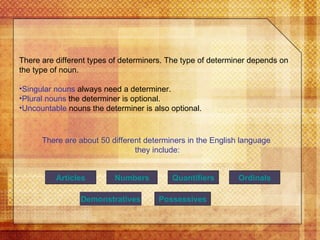
There are different types of determiners. The type of determiner depends on the type of noun.  Singular nouns  always need a determiner.  Plural nouns  the determiner is optional. Uncountable  nouns the determiner is also optional.  There are about 50 different determiners in the English language  they include: Articles Possessives Demonstratives Numbers Quantifiers Ordinals
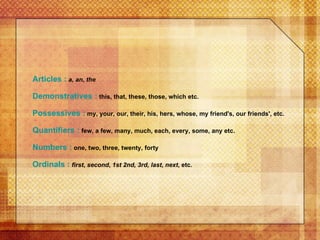
Articles :   a, an ,  the   Demonstratives :  this, that, these, those, which etc. Possessives :  my, your, our, their, his, hers, whose, my friend's, our friends', etc.  Quantifiers :  few, a few, many, much, each, every, some, any etc.  Numbers :  one, two, three, twenty, forty  Ordinals :   first ,  second ,  1st 2nd, 3rd, last ,  next , etc.
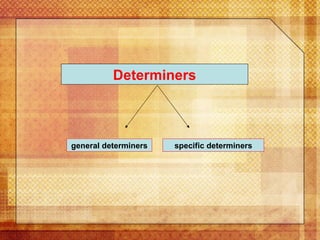
Determiners general determiners specific determiners
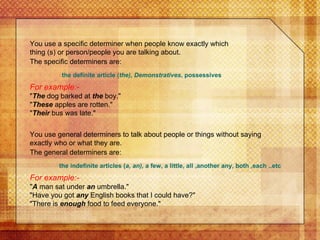
For example:- " The  dog barked at  the  boy." " These  apples are rotten." " Their  bus was late." You use a specific determiner when people know exactly which thing (s) or person/people you are talking about.  The specific determiners are:   the definite article ( the), Demonstratives , possessives You use general determiners to talk about people or things without saying exactly who or what they are. The general determiners are:   the indefinite articles ( a, an),  a few, a little, all ,another any, both ,each ..etc For example:- " A  man sat under  an  umbrella." "Have you got  any  English books that I could have?" "There is  enough  food to feed everyone."
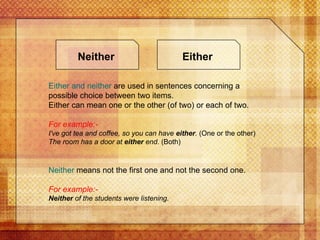
Either   and neither  are used in sentences concerning a possible choice between two items. Either can mean one or the other (of two) or each of two. For example:- I've got tea and coffee, so you can have  either .  (One or the other) The room has a door at  either  end.  (Both) Neither  means not the first one and not the second one. For example:- Neither  of the students were listening.   Either Neither

Syntax -1

  • 1.
    course : LANE 334 instructor: Dr.Shadia Banjar done by Nawar abullrhman khan 0879681
  • 2.
  • 3.
    We are goingto concentrate on making noun phrases by using the following formulas: Determiner | Noun Determiner | Adjective | Noun Determiner | Adjective | Adjective | Noun
  • 4.
    Determiners areused in front of nouns to indicate whether you are referring to something specific or something of a particular type. Determiners are words that are used with nouns: to define something or someone to state the amount of people, things or other nouns to state possessives to state something or someone is specific to state how things or people are distributed to state the difference between nouns to state someone or something is not specific
  • 5.
    There are differenttypes of determiners. The type of determiner depends on the type of noun. Singular nouns always need a determiner. Plural nouns the determiner is optional. Uncountable nouns the determiner is also optional. There are about 50 different determiners in the English language they include: Articles Possessives Demonstratives Numbers Quantifiers Ordinals
  • 6.
    Articles : a, an , the Demonstratives : this, that, these, those, which etc. Possessives : my, your, our, their, his, hers, whose, my friend's, our friends', etc. Quantifiers : few, a few, many, much, each, every, some, any etc. Numbers : one, two, three, twenty, forty Ordinals : first , second , 1st 2nd, 3rd, last , next , etc.
  • 7.
    Determiners general determinersspecific determiners
  • 8.
    For example:- "The dog barked at the boy." " These apples are rotten." " Their bus was late." You use a specific determiner when people know exactly which thing (s) or person/people you are talking about. The specific determiners are: the definite article ( the), Demonstratives , possessives You use general determiners to talk about people or things without saying exactly who or what they are. The general determiners are: the indefinite articles ( a, an), a few, a little, all ,another any, both ,each ..etc For example:- " A man sat under an umbrella." "Have you got any English books that I could have?" "There is enough food to feed everyone."
  • 9.
    Either and neither are used in sentences concerning a possible choice between two items. Either can mean one or the other (of two) or each of two. For example:- I've got tea and coffee, so you can have either . (One or the other) The room has a door at either end. (Both) Neither means not the first one and not the second one. For example:- Neither of the students were listening. Either Neither