Constituents  and  Phrases
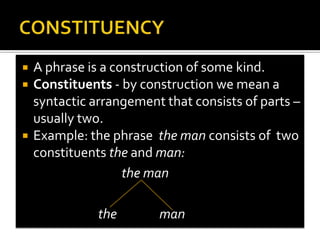
CONSTITUENCYA phrase is a construction of some kind.
Constituents - by construction we mean a syntactic arrangement that consists of parts – usually two.
Example: the phrase  the man consists of  two constituents the and man:         the man   the               man
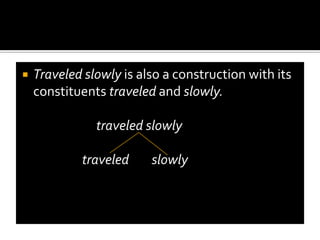
Traveled slowly is also a construction with its constituents traveled and slowly.			     traveled slowly			traveled	  slowly
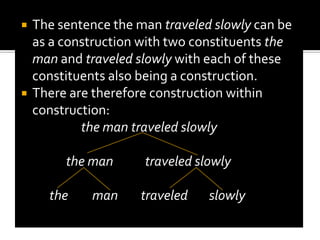
The sentence the man traveled slowly can be as a construction with two constituents the man and traveled slowly with each of these constituents also being a construction.There are therefore construction within construction: the man traveled slowly		      the man	traveled slowly	      the	    man        traveled 	slowly
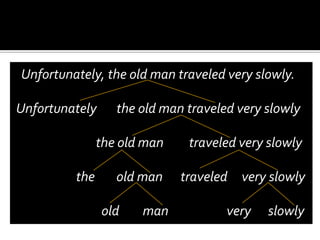
We can further increase the number of constructions in, and therefore the constructional “depth” of, the previous sentence. For example, if we add old between the and man, very before slowly, and unfortunately at the very beginning of the sentence, we produce the following arrangement of construction and constituents:
  Unfortunately, the old man traveled very slowly.Unfortunately	   the old man traveled very slowly			       the old man	      traveled very slowly			the	   old man	   traveled	  very slowly			         old	 man		        very	slowly
The previous example illustrates how it is possible to show constructional relationships among the various parts of phrases, clauses, and sentences. We will shortly try to provide a little more evidence for justifying what we have not done here, i.e., claim that certain words, etc. are constituents of certain constructions. Such a claim denies other possible claims about constituency.
Example, it denies the claim that in the final sentence given above there is many immediate constructional relationship between man and traveled or between traveled and very.
The constituents of a constructions are likely to number just two and to be adjacent to each other. Analysis into constructions is not without problems.
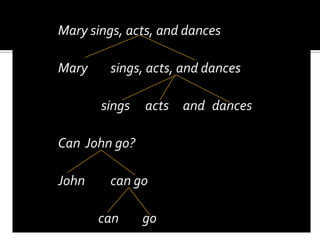
Example, in the first of the following sentences there appear to be three constituents sings, acts, and dances plus the problem and, and in the second sentence there is a definite discontinuity between can and go in the can go constituents.Mary sings, acts, and dancesMary	sings, acts, and dances		        sings	 acts	   and	  dancesCan  John go?John	can go		       can	go
In the first case what has happened here is that and is one of those words (conjunctions) which can unite any number of constituents.In the second case it is very characteristic of discontinuity which operates to signal and particular type of structure in English, in this case a question requiring either yes or no for an answer.
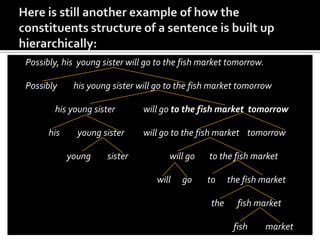
Here is still another example of how the constituents structure of a sentence is built up hierarchically:Possibly, his  young sister will go to the fish market tomorrow.Possibly	his young sister will go to the fish market tomorrow		       his young sister	   will go to the fish market  tomorrow	       his	  young sister	   will go to the fish market    tomorrow		             young	 sister		will go	    to the fish market					          will      go	   to      the fish market							     the	  fish market								fish	market
Phrases, clauses, and sentences are built up out of construction even though the actual constructions involved may not always be easy to diagram. The immediate problem we should address though is just what kinds of constructions we have and how we should describe them.
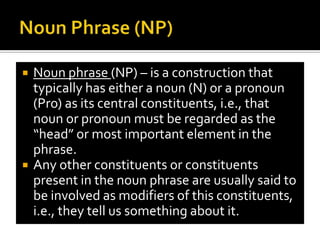
Noun Phrase (NP)Noun phrase (NP) – is a construction that typically has either a noun (N) or a pronoun (Pro) as its central constituents, i.e., that noun or pronoun must be regarded as the “head” or most important element in the phrase.
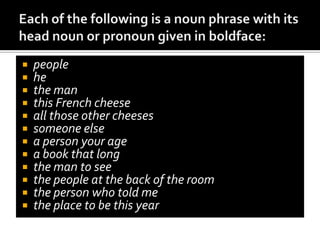
Any other constituents or constituents present in the noun phrase are usually said to be involved as modifiers of this constituents, i.e., they tell us something about it.Each of the following is a noun phrase with its head noun or pronoun given in boldface:people
he
the man
this French cheese
all those other cheeses
someone else
a person your age
a book that long
the man to see
the people at the back of the room
the person who told me
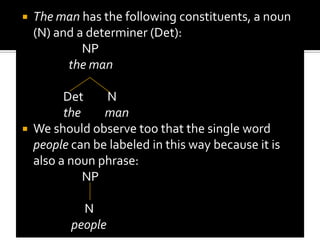
the place to be this yearThe man has the following constituents, a noun (N) and a determiner (Det):		NP       the man		     Det        N     the         manWe should observe too that the single word people can be labeled in this way because it is also a noun phrase:		NP			 N        people
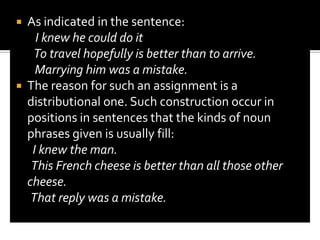
As indicated in the sentence:I knew he could do it  To travel hopefully is better than to arrive.       Marrying him was a mistake.The reason for such an assignment is a distributional one. Such construction occur in positions in sentences that the kinds of noun phrases given is usually fill:  I knew the man.  This French cheese is better than all those other         cheese.     That reply was a mistake.
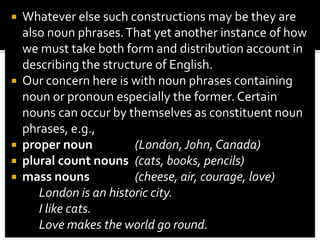
Whatever else such constructions may be they are also noun phrases. That yet another instance of how we must take both form and distribution account in describing the structure of English. Our concern here is with noun phrases containing noun or pronoun especially the former. Certain nouns can occur by themselves as constituent noun phrases, e.g.,proper noun (London, John, Canada)plural count nouns(cats, books, pencils)mass nouns(cheese, air, courage, love)	London is an historic city.	I like cats.	Love makes the world go round.
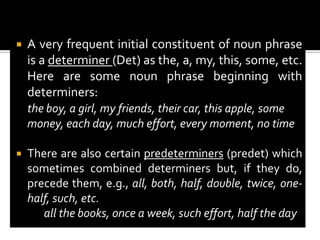
A very frequent initial constituent of noun phrase is a determiner (Det) as the, a, my, this, some, etc. Here are some noun phrase beginning with determiners:the boy, a girl, my friends, their car, this apple, some      money, each day, much effort, every moment, no timeThere are also certain predeterminers (predet) which sometimes combined determiners but, if they do, precede them, e.g., all, both, half, double, twice, one-half, such, etc.	all the books, once a week, such effort, half the day
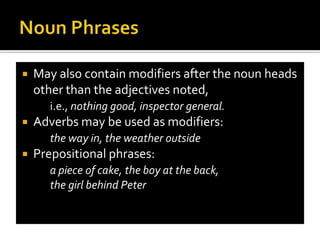
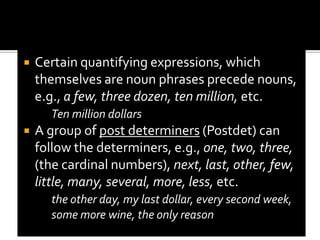
Certain quantifying expressions, which themselves are noun phrases precede nouns, e.g., a few, three dozen, ten million, etc.Ten million dollarsA group of post determiners (Postdet) can follow the determiners, e.g., one, two, three, (the cardinal numbers), next, last, other, few, little, many, several, more, less, etc.the other day, my last dollar, every second week, 	some more wine, the only reason
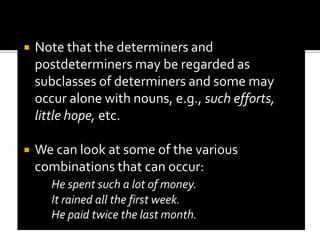
Note that the determiners and postdeterminers may be regarded as subclasses of determiners and some may occur alone with nouns, e.g., such efforts, little hope, etc.We can look at some of the various combinations that can occur:He spent such a lot of money.	It rained all the first week.	He paid twice the last month.
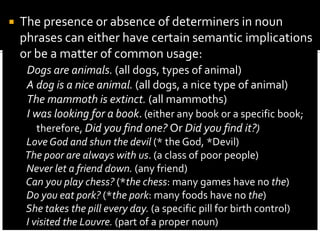
The presence or absence of determiners in noun phrases can either have certain semantic implications or be a matter of common usage:  Dogs are animals. (all dogs, types of animal)  A dog is a nice animal. (all dogs, a nice type of animal)The mammoth is extinct. (all mammoths)   I was looking for a book. (either any book or a specific book; 	therefore, Did you find one? Or Did you find it?)   Love God and shun the devil (* the God, *Devil)   The poor are always with us. (a class of poor people)Never let a friend down. (any friend)   Can you play chess? (*the chess: many games have no the)Do you eat pork? (*the pork: many foods have no the)   She takes the pill every day. (a specific pill for birth control)  I visited the Louvre. (part of a proper noun)
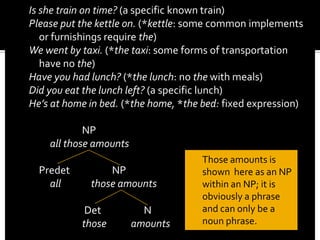
   Is she train on time? (a specific known train)Please put the kettle on. (*kettle: some common implements 	or furnishings require the)We went by taxi. (*the taxi: some forms of transportation 	have no the)   Have you had lunch? (*the lunch: no the with meals)   Did you eat the lunch left? (a specific lunch)He’s at home in bed. (*the home, *the bed: fixed expression)		     NPall those amounts		Predet                  NP     all	         those amountsDet		    N     those           amountsThose amounts is
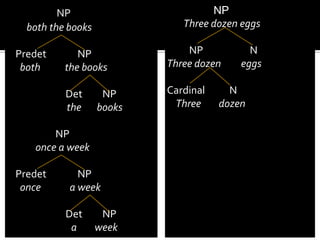
shown  hereas anNP within an NP; it is obviously a phrase and can only be a noun phrase.         NP       both the books  Predet             NP   both           the booksDet         NP                   the       books                    NP           once a weekPredet              NP    once             a weekDet         NP	                      a        week               NP        Three dozen eggs          NP                     NThree dozen         eggsCardinal           NThree        dozen
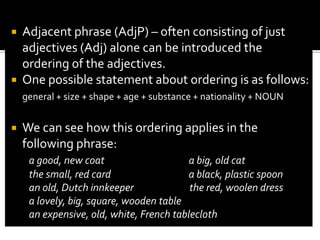
Adjacent phrase (AdjP) – often consisting of just adjectives (Adj) alone can be introduced the ordering of the adjectives.One possible statement about ordering is as follows:general + size + shape + age + substance + nationality + NOUNWe can see how this ordering applies in the following phrase:   a good, new coat                                      a big, old cat   the small, red card                                   a black, plastic spoon	   an old, Dutch innkeeper                         the red, woolen dress	   a lovely, big, square, wooden table   an expensive, old, white, French tablecloth
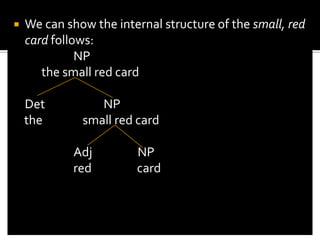
We can show the internal structure of the small, red card follows:		NP	the small red cardDet                      NP    the               small red cardAdj                 NP	            red                 card
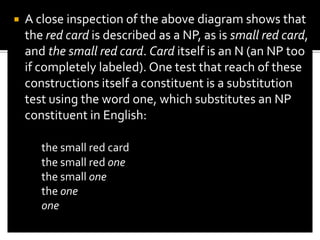
A close inspection of the above diagram shows that the red card is described as a NP, as is small red card, and the small red card. Card itself is an N (an NP too if completely labeled). One test that reach of these constructions itself a constituent is a substitution test using the word one, which substitutes an NP constituent in English:the small red card	the small red one	the small one	the oneone
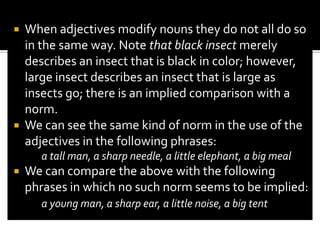
When adjectives modify nouns they do not all do so in the same way. Note that black insect merely describes an insect that is black in color; however, large insect describes an insect that is large as insects go; there is an implied comparison with a norm. We can see the same kind of norm in the use of the adjectives in the following phrases:	a tall man, a sharp needle, a little elephant, a big mealWe can compare the above with the following phrases in which no such norm seems to be implied:a young man, a sharp ear, a little noise, a big tent
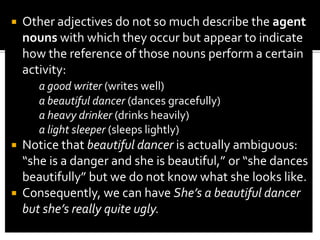
Other adjectives do not so much describe the agent nouns with which they occur but appear to indicate how the reference of those nouns perform a certain activity:a good writer (writes well)a beautiful dancer (dances gracefully)a heavy drinker (drinks heavily)a light sleeper (sleeps lightly)Notice that beautiful dancer is actually ambiguous: “she is a danger and she is beautiful,” or “she dances beautifully” but we do not know what she looks like. Consequently, we can have She’s a beautiful dancer but she’s really quite ugly.
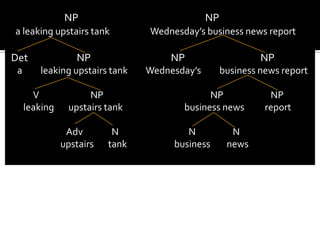
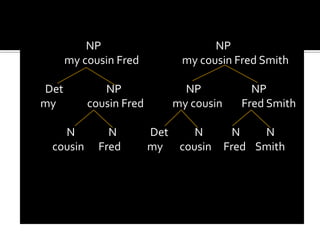
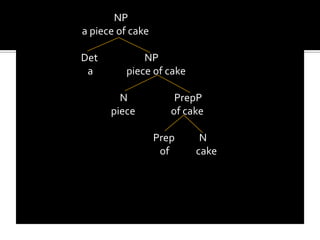
A few adjectives follow the noun in a noun phrase:inspector  general, heir apparent, China proper, the 	amount due, the information available, the people 	concernedIndefinite pronouns may also sometimes be modified in this way:nothing good, something interesting, anything worthwhileOther kinds of components may be inserted into noun phrases before the noun. Nouns and noun phrases may be used as modifiers:stone wall, business news report, language acquisition 	device, knife and fork meal, bacon, lettuce, and tomato 	sandwhich
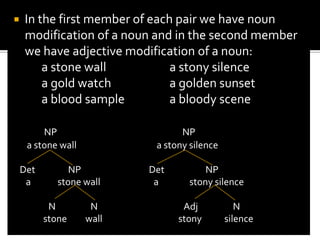
In the first member of each pair we have noun modification of a noun and in the second member we have adjective modification of a noun:	a stone wall		a stony silence		a gold watch		a golden sunset	a blood sample		a bloody sceneNP                                                             NP a stone wall                                       a stony silenceDet                NP                                 Det                    NP     a             stone wall                          a               stony silence                 N                 NAdj                 N        stone         wall                                     stony           silence

Constituents and phrases

  • 1.
  • 2.
    CONSTITUENCYA phrase isa construction of some kind.
  • 3.
    Constituents - byconstruction we mean a syntactic arrangement that consists of parts – usually two.
  • 4.
    Example: the phrase the man consists of two constituents the and man: the man the man
  • 5.
    Traveled slowly isalso a construction with its constituents traveled and slowly. traveled slowly traveled slowly
  • 6.
    The sentence theman traveled slowly can be as a construction with two constituents the man and traveled slowly with each of these constituents also being a construction.There are therefore construction within construction: the man traveled slowly the man traveled slowly the man traveled slowly
  • 7.
    We can furtherincrease the number of constructions in, and therefore the constructional “depth” of, the previous sentence. For example, if we add old between the and man, very before slowly, and unfortunately at the very beginning of the sentence, we produce the following arrangement of construction and constituents:
  • 8.
    Unfortunately,the old man traveled very slowly.Unfortunately the old man traveled very slowly the old man traveled very slowly the old man traveled very slowly old man very slowly
  • 9.
    The previous exampleillustrates how it is possible to show constructional relationships among the various parts of phrases, clauses, and sentences. We will shortly try to provide a little more evidence for justifying what we have not done here, i.e., claim that certain words, etc. are constituents of certain constructions. Such a claim denies other possible claims about constituency.
  • 10.
    Example, it deniesthe claim that in the final sentence given above there is many immediate constructional relationship between man and traveled or between traveled and very.
  • 11.
    The constituents ofa constructions are likely to number just two and to be adjacent to each other. Analysis into constructions is not without problems.
  • 12.
    Example, in thefirst of the following sentences there appear to be three constituents sings, acts, and dances plus the problem and, and in the second sentence there is a definite discontinuity between can and go in the can go constituents.Mary sings, acts, and dancesMary sings, acts, and dances sings acts and dancesCan John go?John can go can go
  • 13.
    In the firstcase what has happened here is that and is one of those words (conjunctions) which can unite any number of constituents.In the second case it is very characteristic of discontinuity which operates to signal and particular type of structure in English, in this case a question requiring either yes or no for an answer.
  • 14.
    Here is stillanother example of how the constituents structure of a sentence is built up hierarchically:Possibly, his young sister will go to the fish market tomorrow.Possibly his young sister will go to the fish market tomorrow his young sister will go to the fish market tomorrow his young sister will go to the fish market tomorrow young sister will go to the fish market will go to the fish market the fish market fish market
  • 15.
    Phrases, clauses, andsentences are built up out of construction even though the actual constructions involved may not always be easy to diagram. The immediate problem we should address though is just what kinds of constructions we have and how we should describe them.
  • 16.
    Noun Phrase (NP)Nounphrase (NP) – is a construction that typically has either a noun (N) or a pronoun (Pro) as its central constituents, i.e., that noun or pronoun must be regarded as the “head” or most important element in the phrase.
  • 17.
    Any other constituentsor constituents present in the noun phrase are usually said to be involved as modifiers of this constituents, i.e., they tell us something about it.Each of the following is a noun phrase with its head noun or pronoun given in boldface:people
  • 18.
  • 19.
  • 20.
  • 21.
  • 22.
  • 23.
  • 24.
  • 25.
  • 26.
    the people atthe back of the room
  • 27.
  • 28.
    the place tobe this yearThe man has the following constituents, a noun (N) and a determiner (Det): NP the man Det N the manWe should observe too that the single word people can be labeled in this way because it is also a noun phrase: NP N people
  • 29.
    As indicated inthe sentence:I knew he could do it To travel hopefully is better than to arrive. Marrying him was a mistake.The reason for such an assignment is a distributional one. Such construction occur in positions in sentences that the kinds of noun phrases given is usually fill: I knew the man. This French cheese is better than all those other cheese. That reply was a mistake.
  • 30.
    Whatever else suchconstructions may be they are also noun phrases. That yet another instance of how we must take both form and distribution account in describing the structure of English. Our concern here is with noun phrases containing noun or pronoun especially the former. Certain nouns can occur by themselves as constituent noun phrases, e.g.,proper noun (London, John, Canada)plural count nouns(cats, books, pencils)mass nouns(cheese, air, courage, love) London is an historic city. I like cats. Love makes the world go round.
  • 31.
    A very frequentinitial constituent of noun phrase is a determiner (Det) as the, a, my, this, some, etc. Here are some noun phrase beginning with determiners:the boy, a girl, my friends, their car, this apple, some money, each day, much effort, every moment, no timeThere are also certain predeterminers (predet) which sometimes combined determiners but, if they do, precede them, e.g., all, both, half, double, twice, one-half, such, etc. all the books, once a week, such effort, half the day
  • 32.
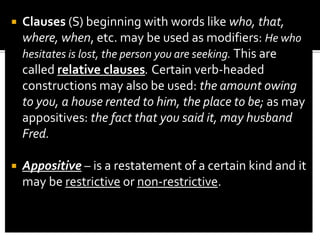
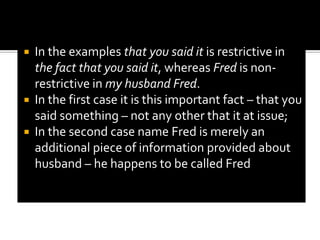
    Certain quantifying expressions,which themselves are noun phrases precede nouns, e.g., a few, three dozen, ten million, etc.Ten million dollarsA group of post determiners (Postdet) can follow the determiners, e.g., one, two, three, (the cardinal numbers), next, last, other, few, little, many, several, more, less, etc.the other day, my last dollar, every second week, some more wine, the only reason
  • 33.
    Note that thedeterminers and postdeterminers may be regarded as subclasses of determiners and some may occur alone with nouns, e.g., such efforts, little hope, etc.We can look at some of the various combinations that can occur:He spent such a lot of money. It rained all the first week. He paid twice the last month.
  • 34.
    The presence orabsence of determiners in noun phrases can either have certain semantic implications or be a matter of common usage: Dogs are animals. (all dogs, types of animal) A dog is a nice animal. (all dogs, a nice type of animal)The mammoth is extinct. (all mammoths) I was looking for a book. (either any book or a specific book; therefore, Did you find one? Or Did you find it?) Love God and shun the devil (* the God, *Devil) The poor are always with us. (a class of poor people)Never let a friend down. (any friend) Can you play chess? (*the chess: many games have no the)Do you eat pork? (*the pork: many foods have no the) She takes the pill every day. (a specific pill for birth control) I visited the Louvre. (part of a proper noun)
  • 35.
    Is she train on time? (a specific known train)Please put the kettle on. (*kettle: some common implements or furnishings require the)We went by taxi. (*the taxi: some forms of transportation have no the) Have you had lunch? (*the lunch: no the with meals) Did you eat the lunch left? (a specific lunch)He’s at home in bed. (*the home, *the bed: fixed expression) NPall those amounts Predet NP all those amountsDet N those amountsThose amounts is
  • 36.
    shown hereasanNP within an NP; it is obviously a phrase and can only be a noun phrase. NP both the books Predet NP both the booksDet NP the books NP once a weekPredet NP once a weekDet NP a week NP Three dozen eggs NP NThree dozen eggsCardinal NThree dozen
  • 37.
    Adjacent phrase (AdjP)– often consisting of just adjectives (Adj) alone can be introduced the ordering of the adjectives.One possible statement about ordering is as follows:general + size + shape + age + substance + nationality + NOUNWe can see how this ordering applies in the following phrase: a good, new coat a big, old cat the small, red card a black, plastic spoon an old, Dutch innkeeper the red, woolen dress a lovely, big, square, wooden table an expensive, old, white, French tablecloth
  • 38.
    We can showthe internal structure of the small, red card follows: NP the small red cardDet NP the small red cardAdj NP red card
  • 39.
    A close inspectionof the above diagram shows that the red card is described as a NP, as is small red card, and the small red card. Card itself is an N (an NP too if completely labeled). One test that reach of these constructions itself a constituent is a substitution test using the word one, which substitutes an NP constituent in English:the small red card the small red one the small one the oneone
  • 40.
    When adjectives modifynouns they do not all do so in the same way. Note that black insect merely describes an insect that is black in color; however, large insect describes an insect that is large as insects go; there is an implied comparison with a norm. We can see the same kind of norm in the use of the adjectives in the following phrases: a tall man, a sharp needle, a little elephant, a big mealWe can compare the above with the following phrases in which no such norm seems to be implied:a young man, a sharp ear, a little noise, a big tent
  • 41.
    Other adjectives donot so much describe the agent nouns with which they occur but appear to indicate how the reference of those nouns perform a certain activity:a good writer (writes well)a beautiful dancer (dances gracefully)a heavy drinker (drinks heavily)a light sleeper (sleeps lightly)Notice that beautiful dancer is actually ambiguous: “she is a danger and she is beautiful,” or “she dances beautifully” but we do not know what she looks like. Consequently, we can have She’s a beautiful dancer but she’s really quite ugly.
  • 42.
    A few adjectivesfollow the noun in a noun phrase:inspector general, heir apparent, China proper, the amount due, the information available, the people concernedIndefinite pronouns may also sometimes be modified in this way:nothing good, something interesting, anything worthwhileOther kinds of components may be inserted into noun phrases before the noun. Nouns and noun phrases may be used as modifiers:stone wall, business news report, language acquisition device, knife and fork meal, bacon, lettuce, and tomato sandwhich
  • 43.
    In the firstmember of each pair we have noun modification of a noun and in the second member we have adjective modification of a noun: a stone wall a stony silence a gold watch a golden sunset a blood sample a bloody sceneNP NP a stone wall a stony silenceDet NP Det NP a stone wall a stony silence N NAdj N stone wall stony silence