X’ SCHEMAX’ SCHEMA
A typical phrase can be brokenA typical phrase can be broken
down into three parts:down into three parts:
1. HEAD1. HEAD
2. SPECIFIER2. SPECIFIER
3. COMPLEMENT3. COMPLEMENT
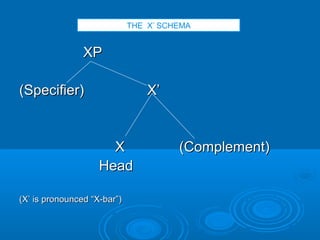
XPXP
(Specifier)(Specifier) XX’’
XX (Complement)(Complement)
HeadHead
(X(X’ is pronounced “X-bar”)’ is pronounced “X-bar”)
THE X’ SCHEMA
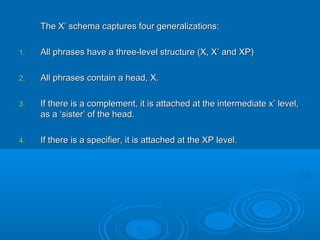
The XThe X’ schema captures four generalizations:’ schema captures four generalizations:
1.1. All phrases have a three-level structure (X, XAll phrases have a three-level structure (X, X’ and XP)’ and XP)
2.2. All phrases contain a head, X.All phrases contain a head, X.
3.3. If there is a complement, it is attached at the intermediate xIf there is a complement, it is attached at the intermediate x’ level,’ level,
as a ‘sister’ of the head.as a ‘sister’ of the head.
4.4. If there is a specifier, it is attached at the XP level.If there is a specifier, it is attached at the XP level.
HEADHEAD
1.1. The head is obligatory nucleus around which a phrase is built.The head is obligatory nucleus around which a phrase is built.
2.2. Four categories that can function as head- nouns, verbs,Four categories that can function as head- nouns, verbs,
adjectives and prepositions.adjectives and prepositions.
3.3. A head may form a phrase all by itself although phrases usuallyA head may form a phrase all by itself although phrases usually
consist of two or more words.consist of two or more words.
4.4. When a head phrase forms by itself, the structure has a singleWhen a head phrase forms by itself, the structure has a single
straightstraight “branch” form which only the head hangs.“branch” form which only the head hangs.
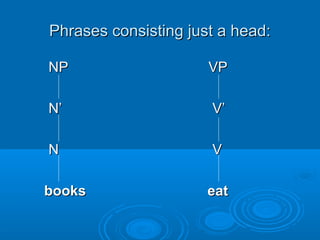
Phrases consisting just a head:Phrases consisting just a head:
NPNP VPVP
NN’’ V’V’
NN VV
booksbooks eateat
APAP PPPP
AA’’ P’P’
AA PP
(She is) certain(She is) certain (He went) in(He went) in
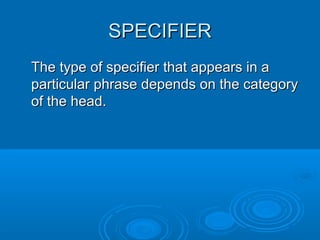
SPECIFIERSPECIFIER
The type of specifier that appears in aThe type of specifier that appears in a
particular phrase depends on the categoryparticular phrase depends on the category
of the head.of the head.
HeadHead SpecifierSpecifier ExamplesExamples
N Determiner (Det)N Determiner (Det) the, athe, a
V Qualifier(Qual)V Qualifier(Qual) never, seldomnever, seldom
A Degree word (Deg)A Degree word (Deg) very, quitevery, quite
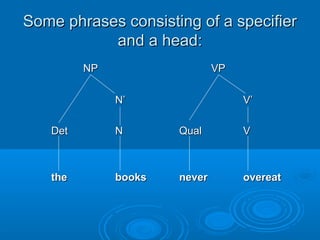
Some phrases consisting of a specifierSome phrases consisting of a specifier
and a head:and a head:
NPNP VPVP
NN’’ V’V’
DetDet NN QualQual VV
thethe booksbooks nevernever overeatovereat
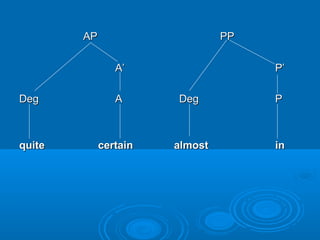
APAP PPPP
AA’’ P’P’
DegDeg AA DegDeg PP
quitequite certaincertain almostalmost inin
COMPLEMENTCOMPLEMENT
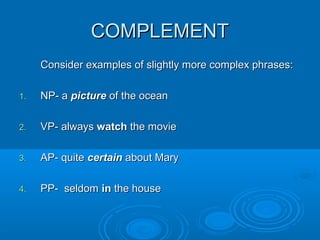
Consider examples of slightly more complex phrases:Consider examples of slightly more complex phrases:
1.1. NP- aNP- a picturepicture of the oceanof the ocean
2.2. VP- alwaysVP- always watchwatch the moviethe movie
3.3. AP- quiteAP- quite certaincertain about Maryabout Mary
4.4. PP- seldomPP- seldom inin the housethe house
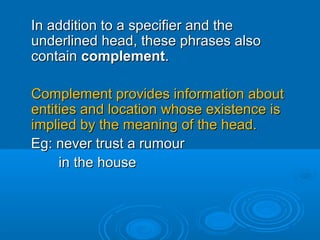
In addition to a specifier and theIn addition to a specifier and the
underlined head, these phrases alsounderlined head, these phrases also
containcontain complementcomplement..
Complement provides information aboutComplement provides information about
entities and location whose existence isentities and location whose existence is
implied by the meaning of the head.implied by the meaning of the head.
Eg: never trust a rumourEg: never trust a rumour
in the housein the house
A vegetarian would neverA vegetarian would never eat [a hamburger]eat [a hamburger]
headhead
In [the house]In [the house]
headhead
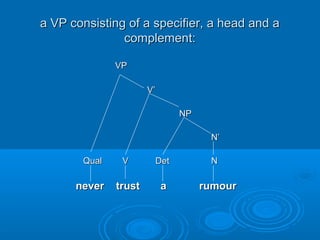
a VP consisting of a specifier, a head and aa VP consisting of a specifier, a head and a
complement:complement:
VPVP
VV’’
NPNP
NN’’
QualQual V DetV Det NN
never trust a rumournever trust a rumour
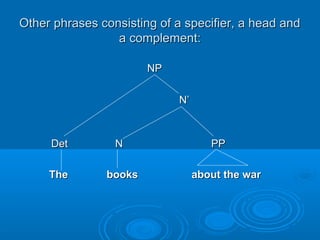
Other phrases consisting of a specifier, a head andOther phrases consisting of a specifier, a head and
a complement:a complement:
NPNP
NN’’
DetDet NN PPPP
The books about the warThe books about the war
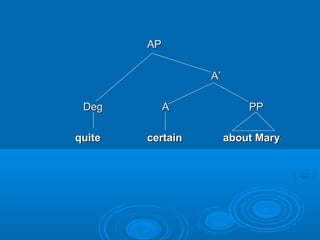
APAP
AA’’
DegDeg AA PPPP
quitequite certaincertain about Maryabout Mary
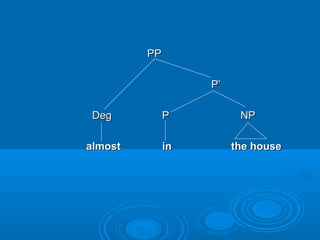
PPPP
PP’’
DegDeg P NPP NP
almost in the housealmost in the house
Always drive the carAlways drive the car
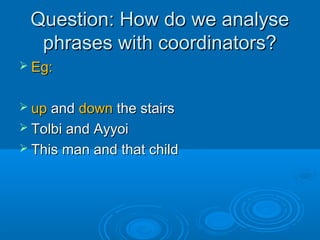
Question: How do we analyseQuestion: How do we analyse
phrases with coordinators?phrases with coordinators?
 Eg:Eg:
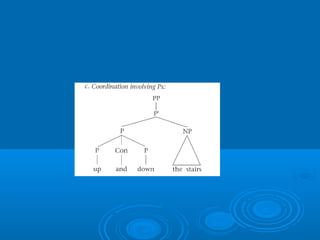
 upup andand downdown the stairsthe stairs
 Tolbi and AyyoiTolbi and Ayyoi
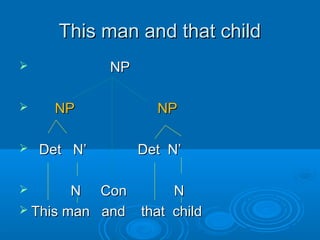
 This man and that childThis man and that child
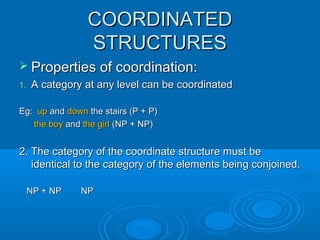
COORDINATEDCOORDINATED
STRUCTURESSTRUCTURES
 Properties of coordination:Properties of coordination:
1.1. A category at any level can be coordinatedA category at any level can be coordinated
Eg:Eg: upup andand downdown the stairs (P + P)the stairs (P + P)
the boythe boy andand the girlthe girl (NP + NP)(NP + NP)
2. The category of the coordinate structure must be2. The category of the coordinate structure must be
identical to the category of the elements being conjoined.identical to the category of the elements being conjoined.
NP + NP NPNP + NP NP
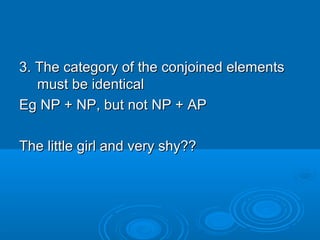
3. The category of the conjoined elements3. The category of the conjoined elements
must be identicalmust be identical
Eg NP + NP, but not NP + APEg NP + NP, but not NP + AP
The little girl and very shy??The little girl and very shy??
The coordination schemaThe coordination schema
 XXnn
XXnn Con XCon Xnn
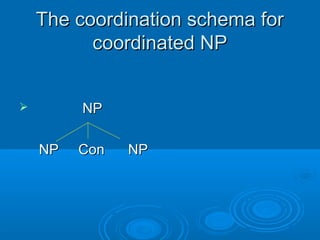
The coordination schema forThe coordination schema for
coordinated NPcoordinated NP
 NPNP
NP Con NPNP Con NP
This man and that childThis man and that child
 NPNP
 NPNP NPNP
 Det NDet N’ Det N’’ Det N’
 N Con NN Con N
 This man and that childThis man and that child
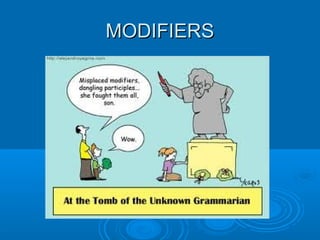
MODIFIERSMODIFIERS
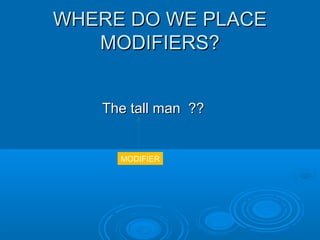
WHERE DO WE PLACEWHERE DO WE PLACE
MODIFIERS?MODIFIERS?
The tall man ??The tall man ??
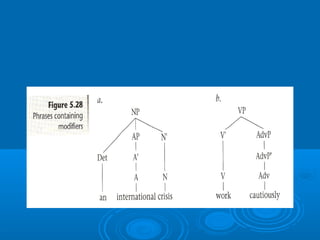
MODIFIER
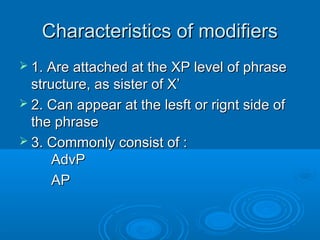
Characteristics of modifiersCharacteristics of modifiers
 1. Are attached at the XP level of phrase1. Are attached at the XP level of phrase
structure, as sister of X’structure, as sister of X’
 2. Can appear at the lesft or rignt side of2. Can appear at the lesft or rignt side of
the phrasethe phrase
 3. Commonly consist of :3. Commonly consist of :
AdvPAdvP
APAP
X bar schema
X bar schema

X bar schema

  • 1.
  • 2.
    A typical phrasecan be brokenA typical phrase can be broken down into three parts:down into three parts: 1. HEAD1. HEAD 2. SPECIFIER2. SPECIFIER 3. COMPLEMENT3. COMPLEMENT
  • 3.
    XPXP (Specifier)(Specifier) XX’’ XX (Complement)(Complement) HeadHead (X(X’is pronounced “X-bar”)’ is pronounced “X-bar”) THE X’ SCHEMA
  • 4.
    The XThe X’schema captures four generalizations:’ schema captures four generalizations: 1.1. All phrases have a three-level structure (X, XAll phrases have a three-level structure (X, X’ and XP)’ and XP) 2.2. All phrases contain a head, X.All phrases contain a head, X. 3.3. If there is a complement, it is attached at the intermediate xIf there is a complement, it is attached at the intermediate x’ level,’ level, as a ‘sister’ of the head.as a ‘sister’ of the head. 4.4. If there is a specifier, it is attached at the XP level.If there is a specifier, it is attached at the XP level.
  • 5.
    HEADHEAD 1.1. The headis obligatory nucleus around which a phrase is built.The head is obligatory nucleus around which a phrase is built. 2.2. Four categories that can function as head- nouns, verbs,Four categories that can function as head- nouns, verbs, adjectives and prepositions.adjectives and prepositions. 3.3. A head may form a phrase all by itself although phrases usuallyA head may form a phrase all by itself although phrases usually consist of two or more words.consist of two or more words. 4.4. When a head phrase forms by itself, the structure has a singleWhen a head phrase forms by itself, the structure has a single straightstraight “branch” form which only the head hangs.“branch” form which only the head hangs.
  • 6.
    Phrases consisting justa head:Phrases consisting just a head: NPNP VPVP NN’’ V’V’ NN VV booksbooks eateat
  • 7.
    APAP PPPP AA’’ P’P’ AAPP (She is) certain(She is) certain (He went) in(He went) in
  • 8.
    SPECIFIERSPECIFIER The type ofspecifier that appears in aThe type of specifier that appears in a particular phrase depends on the categoryparticular phrase depends on the category of the head.of the head.
  • 9.
    HeadHead SpecifierSpecifier ExamplesExamples NDeterminer (Det)N Determiner (Det) the, athe, a V Qualifier(Qual)V Qualifier(Qual) never, seldomnever, seldom A Degree word (Deg)A Degree word (Deg) very, quitevery, quite
  • 10.
    Some phrases consistingof a specifierSome phrases consisting of a specifier and a head:and a head: NPNP VPVP NN’’ V’V’ DetDet NN QualQual VV thethe booksbooks nevernever overeatovereat
  • 11.
    APAP PPPP AA’’ P’P’ DegDegAA DegDeg PP quitequite certaincertain almostalmost inin
  • 12.
    COMPLEMENTCOMPLEMENT Consider examples ofslightly more complex phrases:Consider examples of slightly more complex phrases: 1.1. NP- aNP- a picturepicture of the oceanof the ocean 2.2. VP- alwaysVP- always watchwatch the moviethe movie 3.3. AP- quiteAP- quite certaincertain about Maryabout Mary 4.4. PP- seldomPP- seldom inin the housethe house
  • 13.
    In addition toa specifier and theIn addition to a specifier and the underlined head, these phrases alsounderlined head, these phrases also containcontain complementcomplement.. Complement provides information aboutComplement provides information about entities and location whose existence isentities and location whose existence is implied by the meaning of the head.implied by the meaning of the head. Eg: never trust a rumourEg: never trust a rumour in the housein the house
  • 14.
    A vegetarian wouldneverA vegetarian would never eat [a hamburger]eat [a hamburger] headhead In [the house]In [the house] headhead
  • 15.
    a VP consistingof a specifier, a head and aa VP consisting of a specifier, a head and a complement:complement: VPVP VV’’ NPNP NN’’ QualQual V DetV Det NN never trust a rumournever trust a rumour
  • 16.
    Other phrases consistingof a specifier, a head andOther phrases consisting of a specifier, a head and a complement:a complement: NPNP NN’’ DetDet NN PPPP The books about the warThe books about the war
  • 17.
    APAP AA’’ DegDeg AA PPPP quitequitecertaincertain about Maryabout Mary
  • 18.
    PPPP PP’’ DegDeg P NPPNP almost in the housealmost in the house
  • 19.
    Always drive thecarAlways drive the car
  • 20.
    Question: How dowe analyseQuestion: How do we analyse phrases with coordinators?phrases with coordinators?  Eg:Eg:  upup andand downdown the stairsthe stairs  Tolbi and AyyoiTolbi and Ayyoi  This man and that childThis man and that child
  • 21.
    COORDINATEDCOORDINATED STRUCTURESSTRUCTURES  Properties ofcoordination:Properties of coordination: 1.1. A category at any level can be coordinatedA category at any level can be coordinated Eg:Eg: upup andand downdown the stairs (P + P)the stairs (P + P) the boythe boy andand the girlthe girl (NP + NP)(NP + NP) 2. The category of the coordinate structure must be2. The category of the coordinate structure must be identical to the category of the elements being conjoined.identical to the category of the elements being conjoined. NP + NP NPNP + NP NP
  • 22.
    3. The categoryof the conjoined elements3. The category of the conjoined elements must be identicalmust be identical Eg NP + NP, but not NP + APEg NP + NP, but not NP + AP The little girl and very shy??The little girl and very shy??
  • 23.
    The coordination schemaThecoordination schema  XXnn XXnn Con XCon Xnn
  • 24.
    The coordination schemaforThe coordination schema for coordinated NPcoordinated NP  NPNP NP Con NPNP Con NP
  • 25.
    This man andthat childThis man and that child  NPNP  NPNP NPNP  Det NDet N’ Det N’’ Det N’  N Con NN Con N  This man and that childThis man and that child
  • 28.
  • 29.
    WHERE DO WEPLACEWHERE DO WE PLACE MODIFIERS?MODIFIERS? The tall man ??The tall man ?? MODIFIER
  • 30.
    Characteristics of modifiersCharacteristicsof modifiers  1. Are attached at the XP level of phrase1. Are attached at the XP level of phrase structure, as sister of X’structure, as sister of X’  2. Can appear at the lesft or rignt side of2. Can appear at the lesft or rignt side of the phrasethe phrase  3. Commonly consist of :3. Commonly consist of : AdvPAdvP APAP