Higher national diploma
in English
Language Structure Usage and Linguistics
SRI LANKA INSTITUTE OF ADVANCED TECHNOLOGICAL EDUCATION
BATTICALOA
Verb Phrase
1st Year
2nd Semester
Group no-05
Group Members
1. S.Mohanaraj
2. S.Mathusoothanan
3. L.Kupenigah
4. E.Tishany
5. D.Darani
6. K.Sritharani
7. S.Parivampikai
8. Shifana Arafath
9. H.Fathima Safa Lecturer: Mr.Uthayakumar
Includes
 What is the verb phrase
 Classification of verb phrase
 What is mood
 What is aspect
 Summary
Verb Phrase
The verb phrase (VP) in English has a
noticeably different structure, since the
information it carries about mood, tense,
modality, aspect, and voice is quite
different from the information carried by
a noun phrase.
The verb phrase has two functional parts.
Cont..
 The auxiliary, a grammatical
morpheme carrying information about
mood, tense, modality, and voice.
 The main verb, a lexical morpheme
carrying its lexical information and,
usually, an inflection.
Mood
verb phrases have mood, which indicates
the speaker's attitude to the predication.
 Indicative mood is used to state a fact or
ask a question:
* Lisa can do that. * Can Lisa do that?
 Imperative mood is used to issue a
command or make a request:
* Be here at seven o'clock
 Subjunctive mood is used to express
doubt, wish, belief, or improbability:
* I wish I had something to eat
Cont..
Verb phrase
Auxiliary
Main verb Support
auxiliary
Passive
Progressive
Perfect
Modal
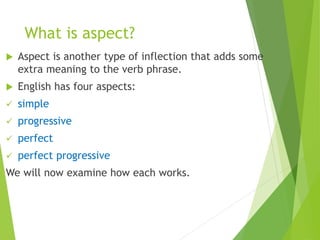
What is aspect?
 Aspect is another type of inflection that adds some
extra meaning to the verb phrase.
 English has four aspects:
 simple
 progressive
 perfect
 perfect progressive
We will now examine how each works.
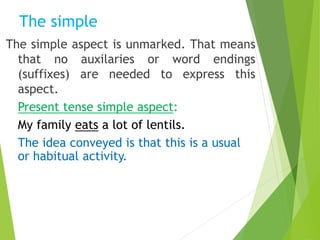
The simple
The simple aspect is unmarked. That means
that no auxilaries or word endings
(suffixes) are needed to express this
aspect.
Present tense simple aspect:
My family eats a lot of lentils.
The idea conveyed is that this is a usual
or habitual activity.
cont..
Past tense simple aspect:
My Labrador retriever chased a rabbit
yesterday.
The idea conveyed is the idea that this
chasing happened and is now over and
done with.
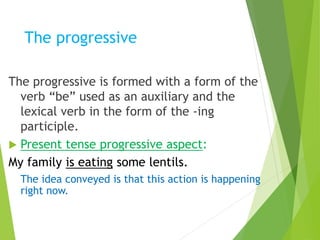
The progressive
The progressive is formed with a form of the
verb “be” used as an auxiliary and the
lexical verb in the form of the -ing
participle.
 Present tense progressive aspect:
My family is eating some lentils.
The idea conveyed is that this action is happening
right now.
Cont..
 Past tense progressive aspect:
My Labrador retriever was chasing a
rabbit yesterday when he ran into the
train.
The idea conveyed is that the chasing
was ongoing when some other activity
(the running into the train)
interrupted this chasing.
The perfect
The perfect is formed with a form of the
verb “have” used as an auxiliary and the
use of the past participle for the lexical
verb.
 Present tense perfect aspect:
My family has eaten a lot of lentils since
we became vegans.
The idea conveyed is that this is an
activity that started in the past (at the
point we became vegans) and continues
as a habitual activity.
Cont..
 Past tense perfect aspect:
My Labrador retriever had chased a
rabbit down a hole before I could stop
him.
The idea conveyed is that this chasing
happened before some other thing in
the past (the attempt at stopping him)
happened.
The perfect progressive
The perfect progressive is formed with a
form of the verb “have” used as an
auxiliary, followed by the past participle of
“be” -- been -- (that’s the perfect part),
followed by the lexical verb in the -ing
participle form (that’s the progressive
part).
Cont..
 Present tense perfect progressive
aspect.
Waiter! My family has been eating
lentils for the last twenty minutes and
we’re ready for the second course now
please!
The idea conveyed is that the activity
started in the past and continues
through the present -- right now.
Cont..
 Past tense perfect progressive
aspect.
My Labrador retriever had been
chasing a rabbit when suddenly he
ran into a porcupine.
The idea conveyed is that the activity of
chasing started before the second activity
running into the porcupine and was
interrupted by the second activity.
Future perfect
 Formed will have/shall +past participle
of main verb.
For examples
 By the age of six average child will
have completed the basic American
Education and be ready to enter
school.
Cont..
There future perfect is formed with will
followed by have and the past participle.
 I will have finished grading the papers
at 4.00pm.
Cont..
However the future perfect can also be used
to express state, that will have endured for a
period of time as measured action future
date.
 This coming January we will have been
married for 30 days .
Cont..
 As with past perfect sentence with future
perfect often have a main clause and
surbodinate clause.
 In these sentences , the future action is
completed prior to another action in a
surbodinate clause introduced by before
by the time
Cont..
 The verb in this surbodinate may be in
the present perfect.
He will have finished grading all of his
papers by the time you have eaten
your lunch
Passive voice
What is the definition of passive?
The voice used to indicate that the grammatical
subject of the verb is the recipient (not the source) of
the action denoted by the verb.
Linguistics the grammatical relation (active or passive)
of the grammatical subject of a verb to the action that
the verb denotes.
How to form passive voice
 Someone cleans the streets every day
The Streets are cleaned every day
 Coloumbus discovered America in 1492
America was discovered by coloumbus in 1492
Cont..
 Jack will buy a new computer
A new computer will be bought by Jack
Example of passive sentences
 We are going to watch a movie tonight.
A movie is going to be watched by us tonight
 Mom read the novel in one day
The novel was read by mom in one day
 I will clean the house every Saturday
The house will be cleaned by me every Saturday
Summary….
 The simple predicate ,or verb ,may
consist of two or more words. These
words are called the verb phrase.
 A verb phrase is made up of a main
verb and one or more helping verbs.
 A main verb can study by itself as the
simple predicate of a sentence.
Ex: I am learning about life in India.
They are in hostel.
Cont..
Underline the main verb
1) The young boys were called
apprentices.
2) He was playing cricket.
3) They have bought a car.
4) A farm boy would help his father with
the chores.
Cont..
Make the sentence to each main
verb
1) Play
2) Read
3) Took
4) Cooking
5) Written
Any
questions ?

verb phrase

  • 1.
    Higher national diploma inEnglish Language Structure Usage and Linguistics SRI LANKA INSTITUTE OF ADVANCED TECHNOLOGICAL EDUCATION BATTICALOA Verb Phrase 1st Year 2nd Semester Group no-05
  • 2.
    Group Members 1. S.Mohanaraj 2.S.Mathusoothanan 3. L.Kupenigah 4. E.Tishany 5. D.Darani 6. K.Sritharani 7. S.Parivampikai 8. Shifana Arafath 9. H.Fathima Safa Lecturer: Mr.Uthayakumar
  • 3.
    Includes  What isthe verb phrase  Classification of verb phrase  What is mood  What is aspect  Summary
  • 4.
    Verb Phrase The verbphrase (VP) in English has a noticeably different structure, since the information it carries about mood, tense, modality, aspect, and voice is quite different from the information carried by a noun phrase. The verb phrase has two functional parts.
  • 5.
    Cont..  The auxiliary,a grammatical morpheme carrying information about mood, tense, modality, and voice.  The main verb, a lexical morpheme carrying its lexical information and, usually, an inflection.
  • 6.
    Mood verb phrases havemood, which indicates the speaker's attitude to the predication.  Indicative mood is used to state a fact or ask a question: * Lisa can do that. * Can Lisa do that?  Imperative mood is used to issue a command or make a request: * Be here at seven o'clock  Subjunctive mood is used to express doubt, wish, belief, or improbability: * I wish I had something to eat
  • 7.
    Cont.. Verb phrase Auxiliary Main verbSupport auxiliary Passive Progressive Perfect Modal
  • 8.
    What is aspect? Aspect is another type of inflection that adds some extra meaning to the verb phrase.  English has four aspects:  simple  progressive  perfect  perfect progressive We will now examine how each works.
  • 9.
    The simple The simpleaspect is unmarked. That means that no auxilaries or word endings (suffixes) are needed to express this aspect. Present tense simple aspect: My family eats a lot of lentils. The idea conveyed is that this is a usual or habitual activity.
  • 10.
    cont.. Past tense simpleaspect: My Labrador retriever chased a rabbit yesterday. The idea conveyed is the idea that this chasing happened and is now over and done with.
  • 11.
    The progressive The progressiveis formed with a form of the verb “be” used as an auxiliary and the lexical verb in the form of the -ing participle.  Present tense progressive aspect: My family is eating some lentils. The idea conveyed is that this action is happening right now.
  • 12.
    Cont..  Past tenseprogressive aspect: My Labrador retriever was chasing a rabbit yesterday when he ran into the train. The idea conveyed is that the chasing was ongoing when some other activity (the running into the train) interrupted this chasing.
  • 13.
    The perfect The perfectis formed with a form of the verb “have” used as an auxiliary and the use of the past participle for the lexical verb.  Present tense perfect aspect: My family has eaten a lot of lentils since we became vegans. The idea conveyed is that this is an activity that started in the past (at the point we became vegans) and continues as a habitual activity.
  • 14.
    Cont..  Past tenseperfect aspect: My Labrador retriever had chased a rabbit down a hole before I could stop him. The idea conveyed is that this chasing happened before some other thing in the past (the attempt at stopping him) happened.
  • 15.
    The perfect progressive Theperfect progressive is formed with a form of the verb “have” used as an auxiliary, followed by the past participle of “be” -- been -- (that’s the perfect part), followed by the lexical verb in the -ing participle form (that’s the progressive part).
  • 16.
    Cont..  Present tenseperfect progressive aspect. Waiter! My family has been eating lentils for the last twenty minutes and we’re ready for the second course now please! The idea conveyed is that the activity started in the past and continues through the present -- right now.
  • 17.
    Cont..  Past tenseperfect progressive aspect. My Labrador retriever had been chasing a rabbit when suddenly he ran into a porcupine. The idea conveyed is that the activity of chasing started before the second activity running into the porcupine and was interrupted by the second activity.
  • 18.
    Future perfect  Formedwill have/shall +past participle of main verb. For examples  By the age of six average child will have completed the basic American Education and be ready to enter school.
  • 19.
    Cont.. There future perfectis formed with will followed by have and the past participle.  I will have finished grading the papers at 4.00pm.
  • 20.
    Cont.. However the futureperfect can also be used to express state, that will have endured for a period of time as measured action future date.  This coming January we will have been married for 30 days .
  • 21.
    Cont..  As withpast perfect sentence with future perfect often have a main clause and surbodinate clause.  In these sentences , the future action is completed prior to another action in a surbodinate clause introduced by before by the time
  • 22.
    Cont..  The verbin this surbodinate may be in the present perfect. He will have finished grading all of his papers by the time you have eaten your lunch
  • 23.
    Passive voice What isthe definition of passive? The voice used to indicate that the grammatical subject of the verb is the recipient (not the source) of the action denoted by the verb. Linguistics the grammatical relation (active or passive) of the grammatical subject of a verb to the action that the verb denotes.
  • 24.
    How to formpassive voice  Someone cleans the streets every day The Streets are cleaned every day  Coloumbus discovered America in 1492 America was discovered by coloumbus in 1492
  • 25.
    Cont..  Jack willbuy a new computer A new computer will be bought by Jack
  • 26.
    Example of passivesentences  We are going to watch a movie tonight. A movie is going to be watched by us tonight  Mom read the novel in one day The novel was read by mom in one day  I will clean the house every Saturday The house will be cleaned by me every Saturday
  • 27.
    Summary….  The simplepredicate ,or verb ,may consist of two or more words. These words are called the verb phrase.  A verb phrase is made up of a main verb and one or more helping verbs.  A main verb can study by itself as the simple predicate of a sentence. Ex: I am learning about life in India. They are in hostel.
  • 28.
    Cont.. Underline the mainverb 1) The young boys were called apprentices. 2) He was playing cricket. 3) They have bought a car. 4) A farm boy would help his father with the chores.
  • 29.
    Cont.. Make the sentenceto each main verb 1) Play 2) Read 3) Took 4) Cooking 5) Written
  • 30.