INSTRUCTOR: LE NGUYEN NHU ANH
LINGUISTICS 2
M1 LESSON 2.1
ALLPPT.com _ Free PowerPoint Templates, Diagrams and Charts
2.1 The basic Verb Phrase
• Contents:
– A first look at verbs
– The complements of lexical verbs
• Transitive verbs
• Intransitive verbs
• Ditransitive verbs
• Intensive verbs
• Complex transitive verbs
• Prepositional verbs
2.1 The basic Verb Phrase
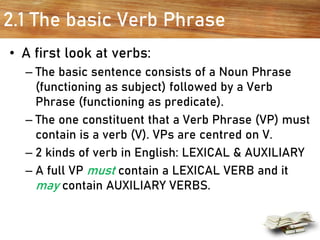
• A first look at verbs:
– The basic sentence consists of a Noun Phrase
(functioning as subject) followed by a Verb
Phrase (functioning as predicate).
– The one constituent that a Verb Phrase (VP) must
contain is a verb (V). VPs are centred on V.
– 2 kinds of verb in English: LEXICAL & AUXILIARY
– A full VP must contain a LEXICAL VERB and it
may contain AUXILIARY VERBS.
2.1 The basic Verb Phrase
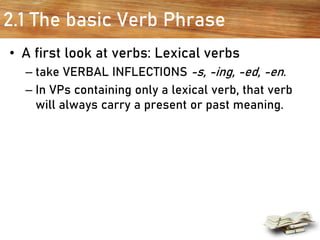
• A first look at verbs: Lexical verbs
– take VERBAL INFLECTIONS -s, -ing, -ed, -en.
– In VPs containing only a lexical verb, that verb
will always carry a present or past meaning.
2.1 The basic Verb Phrase
• The complements of lexical verbs
Phil dreads affectionate cats
– VP: dreads affectionate cats
– V: dreads
– Relation between the V (dreads) and the NP
(affectionate cats) is a head–complement
relation. It’s a two-way (mutual) dependency
between the verb (as head) and the NP (its
complement).
Phil sunbathed affectionate cats.
The presence of the NP depends on the type of
verb
2.1 The basic Verb Phrase
• The complements of lexical verbs
– Lexical verbs are sub-categorised according to
what other elements must appear with them in
the VP.
They are sub-categorised in terms of what
complements they demand.
– All VPs can include (optional) modification by a
PP.
Phil sunbathed beside a stream.
2.1 The basic Verb Phrase
• Six sub-categories of lexical verbs
(1) TRANSITIVE,
(2) INTRANSITIVE,
(3) DITRANSITIVE,
(4) INTENSIVE,
(5) COMPLEX TRANSITIVE,
(6) PREPOSITIONAL.
2.1 The basic Verb Phrase
• TRANSITIVE VERBS
– A transitive verb is one which requires a single
Noun Phrase to complement it.
– Example: dread, make, spot, throw, inspect, etc.
– The NP that complements a transitive verb is
said to function as its DIRECT OBJECT.
– When the form of an NP is determined by its
complement relation with another constituent, it
is said to be GOVERNED by that other constituent
(in this case, the verb).
NP a sister of the V
2.1 The basic Verb Phrase
• TRANSITIVE VERBS When an NP is the sister
of a V bearing the [trans]
feature, we know that the
NP is functioning as
DIRECT OBJECT.
2.1 The basic Verb Phrase
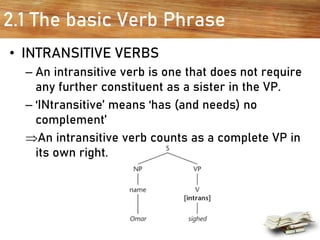
• INTRANSITIVE VERBS
– An intransitive verb is one that does not require
any further constituent as a sister in the VP.
– ‘INtransitive’ means ‘has (and needs) no
complement’
An intransitive verb counts as a complete VP in
its own right.
2.1 The basic Verb Phrase
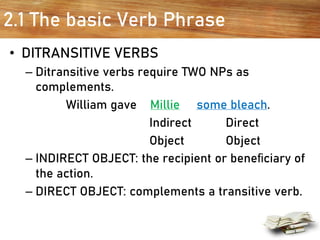
• DITRANSITIVE VERBS
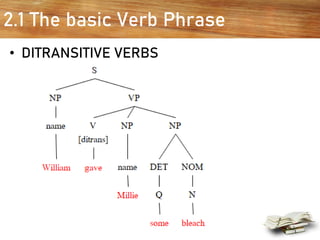
– Ditransitive verbs require TWO NPs as
complements.
William gave Millie some bleach.
Indirect Direct
Object Object
– INDIRECT OBJECT: the recipient or beneficiary of
the action.
– DIRECT OBJECT: complements a transitive verb.
2.1 The basic Verb Phrase
• DITRANSITIVE VERBS
2.1 The basic Verb Phrase
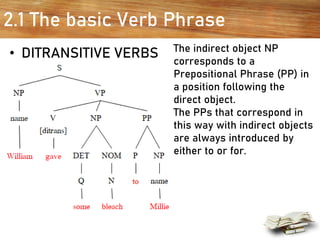
• DITRANSITIVE VERBS The indirect object NP
corresponds to a
Prepositional Phrase (PP) in
a position following the
direct object.
The PPs that correspond in
this way with indirect objects
are always introduced by
either to or for.
2.1 The basic Verb Phrase
• DITRANSITIVE VERBS
– Indirect objects can take the form of either an NP
or a PP containing to or for.
PPs that correspond to indirect objects are part
of the complementation of ditransitive verbs and
need to be represented as sisters of V within the
basic VP.
2.1 The basic Verb Phrase
• INTENSIVE VERBS
– Intensive verbs require a single complement,
which can take the form of an Adjective Phrase,
a Noun Phrase or a Prepositional Phrase. (Ex:
the verb “BE” [the copula])
Ed is rather extravagant. (AP)
Sigmund was an auctioneer. (NP)
Oscar and the First Mate were in the engine room.
(PP)
2.1 The basic Verb Phrase
• INTENSIVE VERBS
– The complement of an intensive verb functions
(more specifically) as a predicative (Example:
become, seem, appear, turn, remain, look, taste,
feel, smell, sound.)
– Predicatives are used to attribute PROPERTIES
to the things or people referred to by other
expressions.
– Compare:
Sigmund was an auctioneer.
Sigmund spotted an auctioneer.
2.1 The basic Verb Phrase
• INTENSIVE VERBS
– [38] Max turned a subtle shade of green.
– [39] Max turned another card.
– [40] Tarzan felt a tap on his shoulder.
– [41] Tarzan felt a real idiot.
– [42] The leopard-skin pillbox hat didn’t become
her.
– [43] The hat became a very useful wastepaper
basket.
– [44] The captain sounds an absolute tyrant.
– [45] The captain sounded the ship’s horn.
2.1 The basic Verb Phrase
• INTENSIVE VERBS
– [38] Max turned a subtle shade of green.
– [41] Tarzan felt a real idiot.
– [43] The hat became a very useful wastepaper
basket.
– [44] The captain sounds an absolute tyrant.
These NPs function as predicatives
SUBJECT-PREDICATIVES
2.1 The basic Verb Phrase
• INTENSIVE VERBS
– An [INTENS] verb takes
a subject-predicative.
– A [trans] verb takes a
direct object.
2.1 The basic Verb Phrase
• COMPLEX TRANSITIVE VERBS
– Complex transitive verbs take two complements:
a direct object (NP) and an object-predicative.
– The predicative can take the form of an AP, an
NP or a PP.
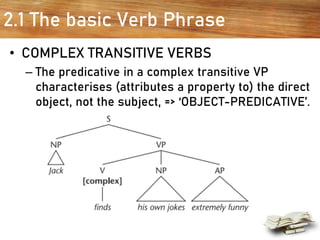
[48] Jack finds his own jokes extremely funny. (AP)
[49] They made Stella their spokesperson. (NP)
[50] Liza put the liquor under her bed. (PP)
2.1 The basic Verb Phrase
• COMPLEX TRANSITIVE VERBS
– The predicative in a complex transitive VP
characterises (attributes a property to) the direct
object, not the subject, => ‘OBJECT-PREDICATIVE’.
2.1 The basic Verb Phrase
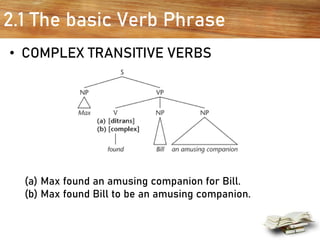
• COMPLEX TRANSITIVE VERBS
(a) Max found an amusing companion for Bill.
(b) Max found Bill to be an amusing companion.
2.1 The basic Verb Phrase
• PREPOSITIONAL VERBS
– Glance (at NP), reply (to NP), refer (to NP), listen
(to NP) and worry (about NP) are examples of
prepositional verbs – complemented by a
Prepositional Phrase. The PP that
complements a
[prepositional] verb
= a PREPOSITIONAL
COMPLEMENT
2.1 The basic Verb Phrase
• PREPOSITIONAL VERBS
– Three kinds of VP consisting of [V + PP]:
(a) V[intens] + PP. => The PP is a complement
(subject predicative);
(b) V[prep] + PP. => The PP is a complement
(prepositional complement);
(c) V[intrans] + PP. => The PP is an optional
modifier
Prepositional verbs are called ‘prepositional’
because they can only be complemented by a PP.
2.1 The basic Verb Phrase
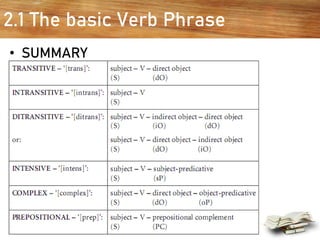
• SUMMARY
2.1 The basic Verb Phrase
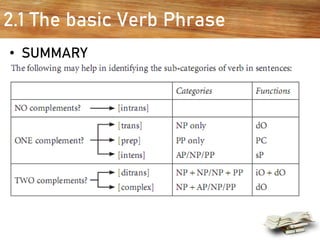
• SUMMARY
2.1 The basic Verb Phrase
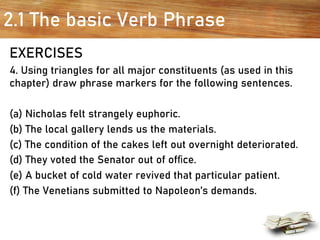
EXERCISES
4. Using triangles for all major constituents (as used in this
chapter) draw phrase markers for the following sentences.
(a) Nicholas felt strangely euphoric.
(b) The local gallery lends us the materials.
(c) The condition of the cakes left out overnight deteriorated.
(d) They voted the Senator out of office.
(e) A bucket of cold water revived that particular patient.
(f) The Venetians submitted to Napoleon’s demands.

M1 lesson 2.1 slides

  • 1.
    INSTRUCTOR: LE NGUYENNHU ANH LINGUISTICS 2 M1 LESSON 2.1 ALLPPT.com _ Free PowerPoint Templates, Diagrams and Charts
  • 2.
    2.1 The basicVerb Phrase • Contents: – A first look at verbs – The complements of lexical verbs • Transitive verbs • Intransitive verbs • Ditransitive verbs • Intensive verbs • Complex transitive verbs • Prepositional verbs
  • 3.
    2.1 The basicVerb Phrase • A first look at verbs: – The basic sentence consists of a Noun Phrase (functioning as subject) followed by a Verb Phrase (functioning as predicate). – The one constituent that a Verb Phrase (VP) must contain is a verb (V). VPs are centred on V. – 2 kinds of verb in English: LEXICAL & AUXILIARY – A full VP must contain a LEXICAL VERB and it may contain AUXILIARY VERBS.
  • 4.
    2.1 The basicVerb Phrase • A first look at verbs: Lexical verbs – take VERBAL INFLECTIONS -s, -ing, -ed, -en. – In VPs containing only a lexical verb, that verb will always carry a present or past meaning.
  • 5.
    2.1 The basicVerb Phrase • The complements of lexical verbs Phil dreads affectionate cats – VP: dreads affectionate cats – V: dreads – Relation between the V (dreads) and the NP (affectionate cats) is a head–complement relation. It’s a two-way (mutual) dependency between the verb (as head) and the NP (its complement). Phil sunbathed affectionate cats. The presence of the NP depends on the type of verb
  • 6.
    2.1 The basicVerb Phrase • The complements of lexical verbs – Lexical verbs are sub-categorised according to what other elements must appear with them in the VP. They are sub-categorised in terms of what complements they demand. – All VPs can include (optional) modification by a PP. Phil sunbathed beside a stream.
  • 7.
    2.1 The basicVerb Phrase • Six sub-categories of lexical verbs (1) TRANSITIVE, (2) INTRANSITIVE, (3) DITRANSITIVE, (4) INTENSIVE, (5) COMPLEX TRANSITIVE, (6) PREPOSITIONAL.
  • 8.
    2.1 The basicVerb Phrase • TRANSITIVE VERBS – A transitive verb is one which requires a single Noun Phrase to complement it. – Example: dread, make, spot, throw, inspect, etc. – The NP that complements a transitive verb is said to function as its DIRECT OBJECT. – When the form of an NP is determined by its complement relation with another constituent, it is said to be GOVERNED by that other constituent (in this case, the verb). NP a sister of the V
  • 9.
    2.1 The basicVerb Phrase • TRANSITIVE VERBS When an NP is the sister of a V bearing the [trans] feature, we know that the NP is functioning as DIRECT OBJECT.
  • 10.
    2.1 The basicVerb Phrase • INTRANSITIVE VERBS – An intransitive verb is one that does not require any further constituent as a sister in the VP. – ‘INtransitive’ means ‘has (and needs) no complement’ An intransitive verb counts as a complete VP in its own right.
  • 11.
    2.1 The basicVerb Phrase • DITRANSITIVE VERBS – Ditransitive verbs require TWO NPs as complements. William gave Millie some bleach. Indirect Direct Object Object – INDIRECT OBJECT: the recipient or beneficiary of the action. – DIRECT OBJECT: complements a transitive verb.
  • 12.
    2.1 The basicVerb Phrase • DITRANSITIVE VERBS
  • 13.
    2.1 The basicVerb Phrase • DITRANSITIVE VERBS The indirect object NP corresponds to a Prepositional Phrase (PP) in a position following the direct object. The PPs that correspond in this way with indirect objects are always introduced by either to or for.
  • 14.
    2.1 The basicVerb Phrase • DITRANSITIVE VERBS – Indirect objects can take the form of either an NP or a PP containing to or for. PPs that correspond to indirect objects are part of the complementation of ditransitive verbs and need to be represented as sisters of V within the basic VP.
  • 15.
    2.1 The basicVerb Phrase • INTENSIVE VERBS – Intensive verbs require a single complement, which can take the form of an Adjective Phrase, a Noun Phrase or a Prepositional Phrase. (Ex: the verb “BE” [the copula]) Ed is rather extravagant. (AP) Sigmund was an auctioneer. (NP) Oscar and the First Mate were in the engine room. (PP)
  • 16.
    2.1 The basicVerb Phrase • INTENSIVE VERBS – The complement of an intensive verb functions (more specifically) as a predicative (Example: become, seem, appear, turn, remain, look, taste, feel, smell, sound.) – Predicatives are used to attribute PROPERTIES to the things or people referred to by other expressions. – Compare: Sigmund was an auctioneer. Sigmund spotted an auctioneer.
  • 17.
    2.1 The basicVerb Phrase • INTENSIVE VERBS – [38] Max turned a subtle shade of green. – [39] Max turned another card. – [40] Tarzan felt a tap on his shoulder. – [41] Tarzan felt a real idiot. – [42] The leopard-skin pillbox hat didn’t become her. – [43] The hat became a very useful wastepaper basket. – [44] The captain sounds an absolute tyrant. – [45] The captain sounded the ship’s horn.
  • 18.
    2.1 The basicVerb Phrase • INTENSIVE VERBS – [38] Max turned a subtle shade of green. – [41] Tarzan felt a real idiot. – [43] The hat became a very useful wastepaper basket. – [44] The captain sounds an absolute tyrant. These NPs function as predicatives SUBJECT-PREDICATIVES
  • 19.
    2.1 The basicVerb Phrase • INTENSIVE VERBS – An [INTENS] verb takes a subject-predicative. – A [trans] verb takes a direct object.
  • 20.
    2.1 The basicVerb Phrase • COMPLEX TRANSITIVE VERBS – Complex transitive verbs take two complements: a direct object (NP) and an object-predicative. – The predicative can take the form of an AP, an NP or a PP. [48] Jack finds his own jokes extremely funny. (AP) [49] They made Stella their spokesperson. (NP) [50] Liza put the liquor under her bed. (PP)
  • 21.
    2.1 The basicVerb Phrase • COMPLEX TRANSITIVE VERBS – The predicative in a complex transitive VP characterises (attributes a property to) the direct object, not the subject, => ‘OBJECT-PREDICATIVE’.
  • 22.
    2.1 The basicVerb Phrase • COMPLEX TRANSITIVE VERBS (a) Max found an amusing companion for Bill. (b) Max found Bill to be an amusing companion.
  • 23.
    2.1 The basicVerb Phrase • PREPOSITIONAL VERBS – Glance (at NP), reply (to NP), refer (to NP), listen (to NP) and worry (about NP) are examples of prepositional verbs – complemented by a Prepositional Phrase. The PP that complements a [prepositional] verb = a PREPOSITIONAL COMPLEMENT
  • 24.
    2.1 The basicVerb Phrase • PREPOSITIONAL VERBS – Three kinds of VP consisting of [V + PP]: (a) V[intens] + PP. => The PP is a complement (subject predicative); (b) V[prep] + PP. => The PP is a complement (prepositional complement); (c) V[intrans] + PP. => The PP is an optional modifier Prepositional verbs are called ‘prepositional’ because they can only be complemented by a PP.
  • 25.
    2.1 The basicVerb Phrase • SUMMARY
  • 26.
    2.1 The basicVerb Phrase • SUMMARY
  • 27.
    2.1 The basicVerb Phrase EXERCISES 4. Using triangles for all major constituents (as used in this chapter) draw phrase markers for the following sentences. (a) Nicholas felt strangely euphoric. (b) The local gallery lends us the materials. (c) The condition of the cakes left out overnight deteriorated. (d) They voted the Senator out of office. (e) A bucket of cold water revived that particular patient. (f) The Venetians submitted to Napoleon’s demands.