The Noun Phrase
The Noun Phrase
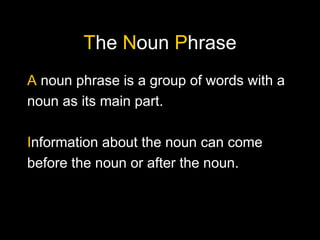
A noun phrase is a group of words with a
noun as its main part.
Information about the noun can come
before the noun or after the noun.
The Noun Phrase
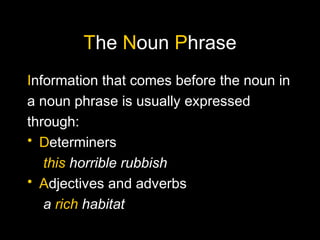
Information that comes before the noun in
a noun phrase is usually expressed
through:
• Determiners
this horrible rubbish
• Adjectives and adverbs
a rich habitat
The Noun Phrase
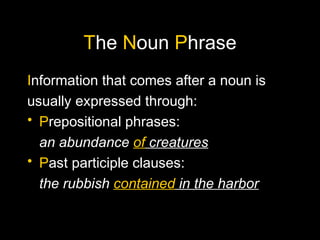
Information that comes after a noun is
usually expressed through:
• Prepositional phrases:
an abundance of creatures
• Past participle clauses:
the rubbish contained in the harbor
The Noun Phrase
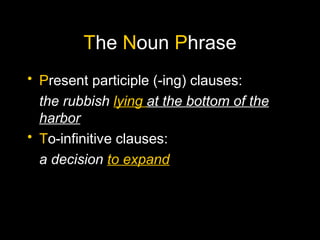
• Present participle (-ing) clauses:
the rubbish lying at the bottom of the
harbor
• To-infinitive clauses:
a decision to expand
Noun + Prepositional Phrase
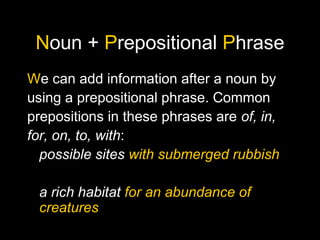
We can add information after a noun by
using a prepositional phrase. Common
prepositions in these phrases are of, in,
for, on, to, with:
possible sites with submerged rubbish
a rich habitat for an abundance of
creatures
Noun + Prepositional Phrase
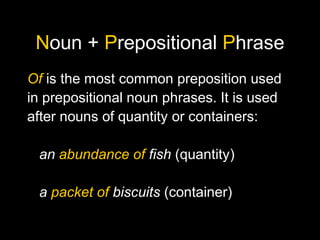
Of is the most common preposition used
in prepositional noun phrases. It is used
after nouns of quantity or containers:
an abundance of fish (quantity)
a packet of biscuits (container)
Noun + Prepositional Phrase
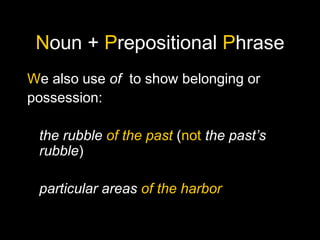
We also use of to show belonging or
possession:
the rubble of the past (not the past’s
rubble)
particular areas of the harbor
Noun + Prepositional Phrase
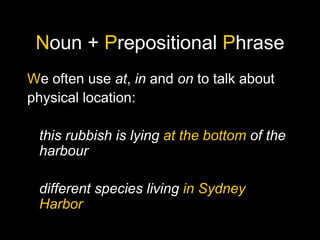
We often use at, in and on to talk about
physical location:
this rubbish is lying at the bottom of the
harbour
different species living in Sydney
Harbor
Noun + Prepositional Phrase
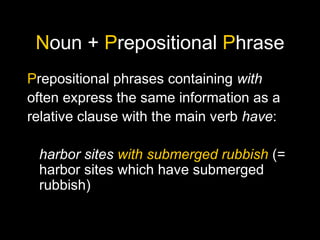
Prepositional phrases containing with
often express the same information as a
relative clause with the main verb have:
harbor sites with submerged rubbish (=
harbor sites which have submerged
rubbish)
Noun + Past Participle Clause
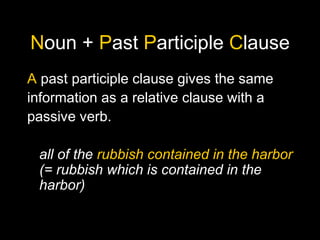
A past participle clause gives the same
information as a relative clause with a
passive verb.
all of the rubbish contained in the harbor
(= rubbish which is contained in the
harbor)
Noun + Past Participle Clause
Note
In both spoken and written English
using a noun + past participle is more
common than the equivalent relative
clause because it can express the same
information in fewer words.
Noun + Present Participle
(-ing) Clause
A present participle clause can give the
same information as a relative clause with
an active verb, often in the present or
past
continuous:
the other debris lying on the sea floor (=
the other debris which is lying on the
sea floor)
Noun + Present Participle
(-ing) Clause
Note
The noun + present participle clause is
also more common than the equivalent
relative clause.
Noun + to-infinitive Clause
To-infinite clauses are used to show a
purpose or intention and usually follow
nouns of time, place manner and quantity:
time to go
the place to visit
a way to look at it
Noun + to-infinitive Clause
Nouns followed by the to-infinitive are
related to verbs also followed by the to
infinitive (e.g. decide/decision; plan/plan):
a decision to expand (decide to)
our plan to build a new hospital (plan to)
Questions?
For more slide presentations visit:

The Noun Phrase

  • 1.
  • 2.
    The Noun Phrase Anoun phrase is a group of words with a noun as its main part. Information about the noun can come before the noun or after the noun.
  • 3.
    The Noun Phrase Informationthat comes before the noun in a noun phrase is usually expressed through: • Determiners this horrible rubbish • Adjectives and adverbs a rich habitat
  • 4.
    The Noun Phrase Informationthat comes after a noun is usually expressed through: • Prepositional phrases: an abundance of creatures • Past participle clauses: the rubbish contained in the harbor
  • 5.
    The Noun Phrase •Present participle (-ing) clauses: the rubbish lying at the bottom of the harbor • To-infinitive clauses: a decision to expand
  • 6.
    Noun + PrepositionalPhrase We can add information after a noun by using a prepositional phrase. Common prepositions in these phrases are of, in, for, on, to, with: possible sites with submerged rubbish a rich habitat for an abundance of creatures
  • 7.
    Noun + PrepositionalPhrase Of is the most common preposition used in prepositional noun phrases. It is used after nouns of quantity or containers: an abundance of fish (quantity) a packet of biscuits (container)
  • 8.
    Noun + PrepositionalPhrase We also use of to show belonging or possession: the rubble of the past (not the past’s rubble) particular areas of the harbor
  • 9.
    Noun + PrepositionalPhrase We often use at, in and on to talk about physical location: this rubbish is lying at the bottom of the harbour different species living in Sydney Harbor
  • 10.
    Noun + PrepositionalPhrase Prepositional phrases containing with often express the same information as a relative clause with the main verb have: harbor sites with submerged rubbish (= harbor sites which have submerged rubbish)
  • 11.
    Noun + PastParticiple Clause A past participle clause gives the same information as a relative clause with a passive verb. all of the rubbish contained in the harbor (= rubbish which is contained in the harbor)
  • 12.
    Noun + PastParticiple Clause Note In both spoken and written English using a noun + past participle is more common than the equivalent relative clause because it can express the same information in fewer words.
  • 13.
    Noun + PresentParticiple (-ing) Clause A present participle clause can give the same information as a relative clause with an active verb, often in the present or past continuous: the other debris lying on the sea floor (= the other debris which is lying on the sea floor)
  • 14.
    Noun + PresentParticiple (-ing) Clause Note The noun + present participle clause is also more common than the equivalent relative clause.
  • 15.
    Noun + to-infinitiveClause To-infinite clauses are used to show a purpose or intention and usually follow nouns of time, place manner and quantity: time to go the place to visit a way to look at it
  • 16.
    Noun + to-infinitiveClause Nouns followed by the to-infinitive are related to verbs also followed by the to infinitive (e.g. decide/decision; plan/plan): a decision to expand (decide to) our plan to build a new hospital (plan to)
  • 17.
    Questions? For more slidepresentations visit: