CASES Dr. Riceli Cano-Mendoza University of Southern Mindanao PHILIPPINES
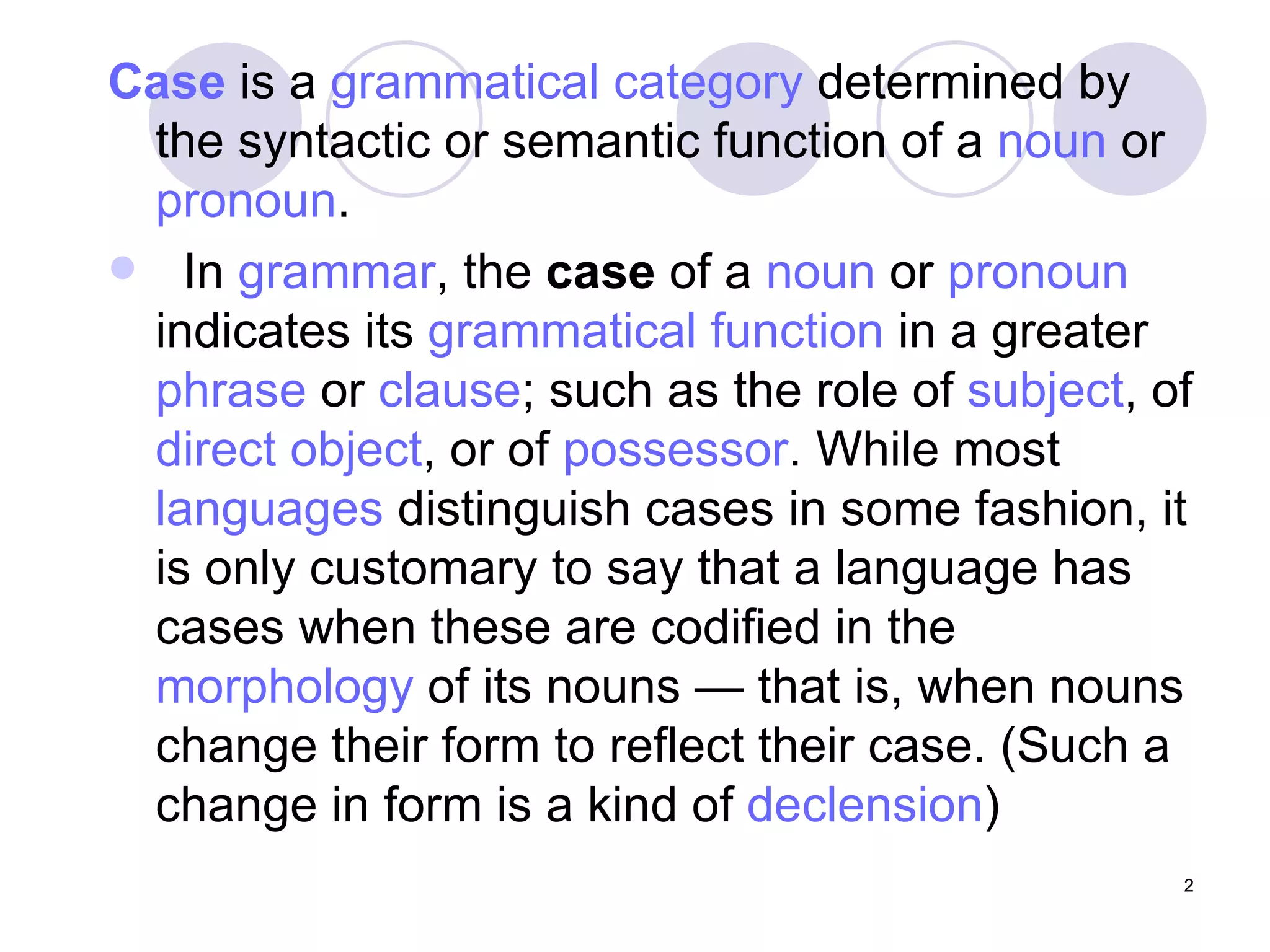
Case  is a  grammatical category  determined by the syntactic or semantic function of a  noun  or  pronoun .    In  grammar , the  case  of a  noun  or  pronoun  indicates its  grammatical function  in a greater  phrase  or  clause ; such as the role of  subject , of  direct object , or of  possessor . While most  languages  distinguish cases in some fashion, it is only customary to say that a language has cases when these are codified in the  morphology  of its nouns — that is, when nouns change their form to reflect their case. (Such a change in form is a kind of  declension )
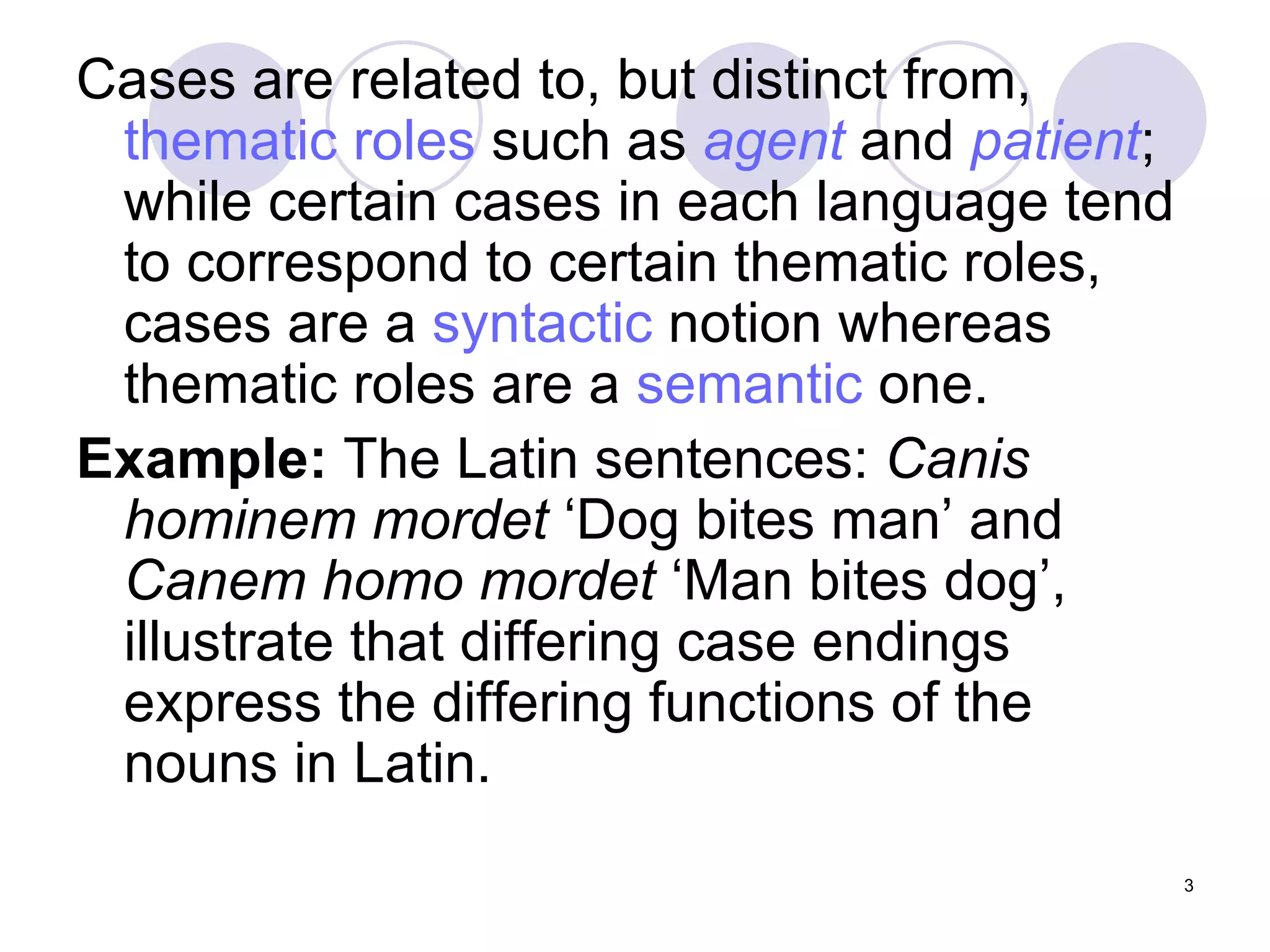
Cases are related to, but distinct from,  thematic roles  such as  agent  and  patient ; while certain cases in each language tend to correspond to certain thematic roles, cases are a  syntactic  notion whereas thematic roles are a  semantic  one. Example:  The Latin sentences:  Canis hominem mordet  ‘Dog bites man’ and  Canem homo mordet  ‘Man bites dog’, illustrate that differing case endings express the differing functions of the nouns in Latin. 
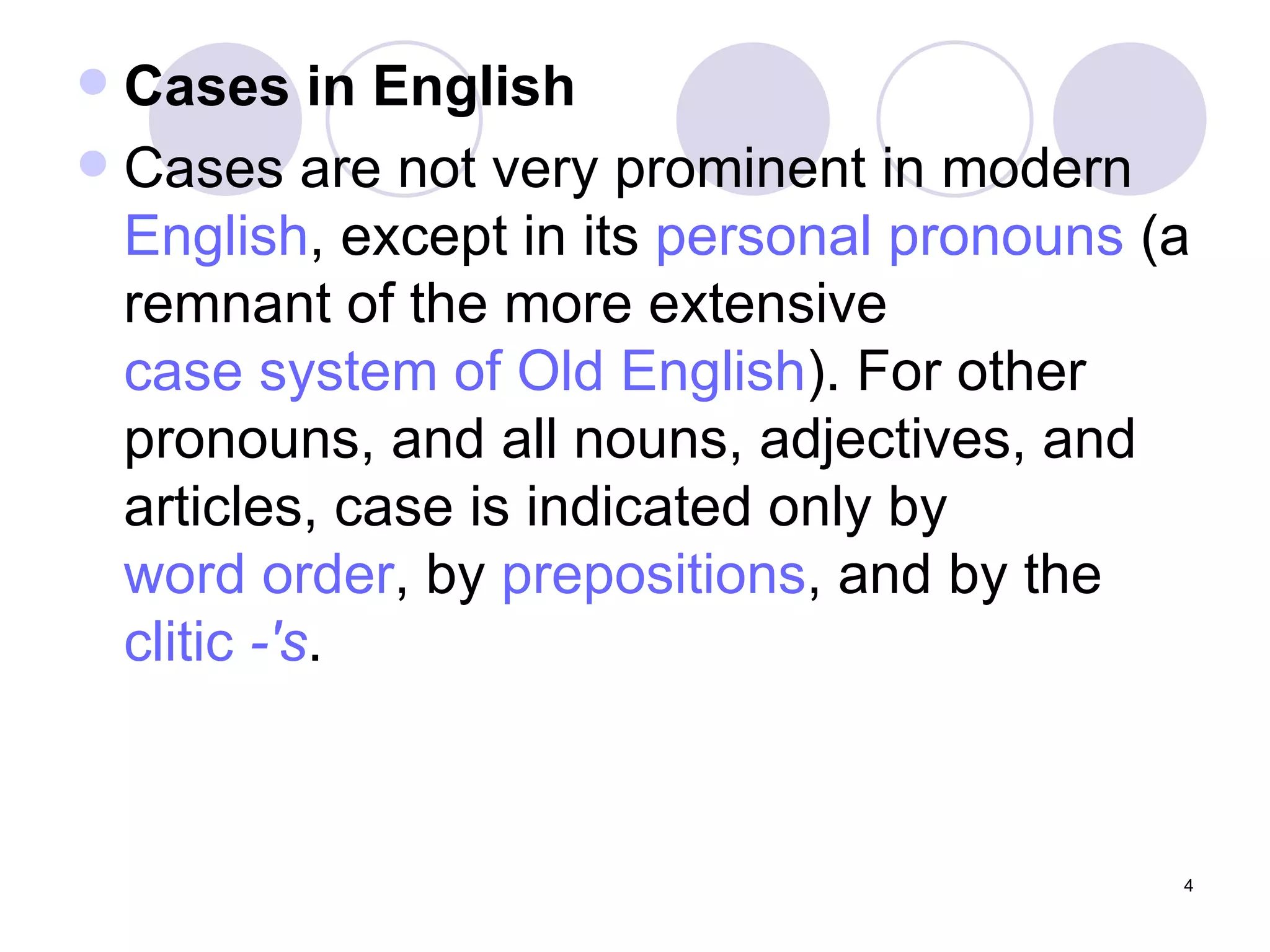
Cases in English Cases are not very prominent in modern  English , except in its  personal pronouns  (a remnant of the more extensive  case system of Old English ). For other pronouns, and all nouns, adjectives, and articles, case is indicated only by  word order , by  prepositions , and by the  clitic   -'s .
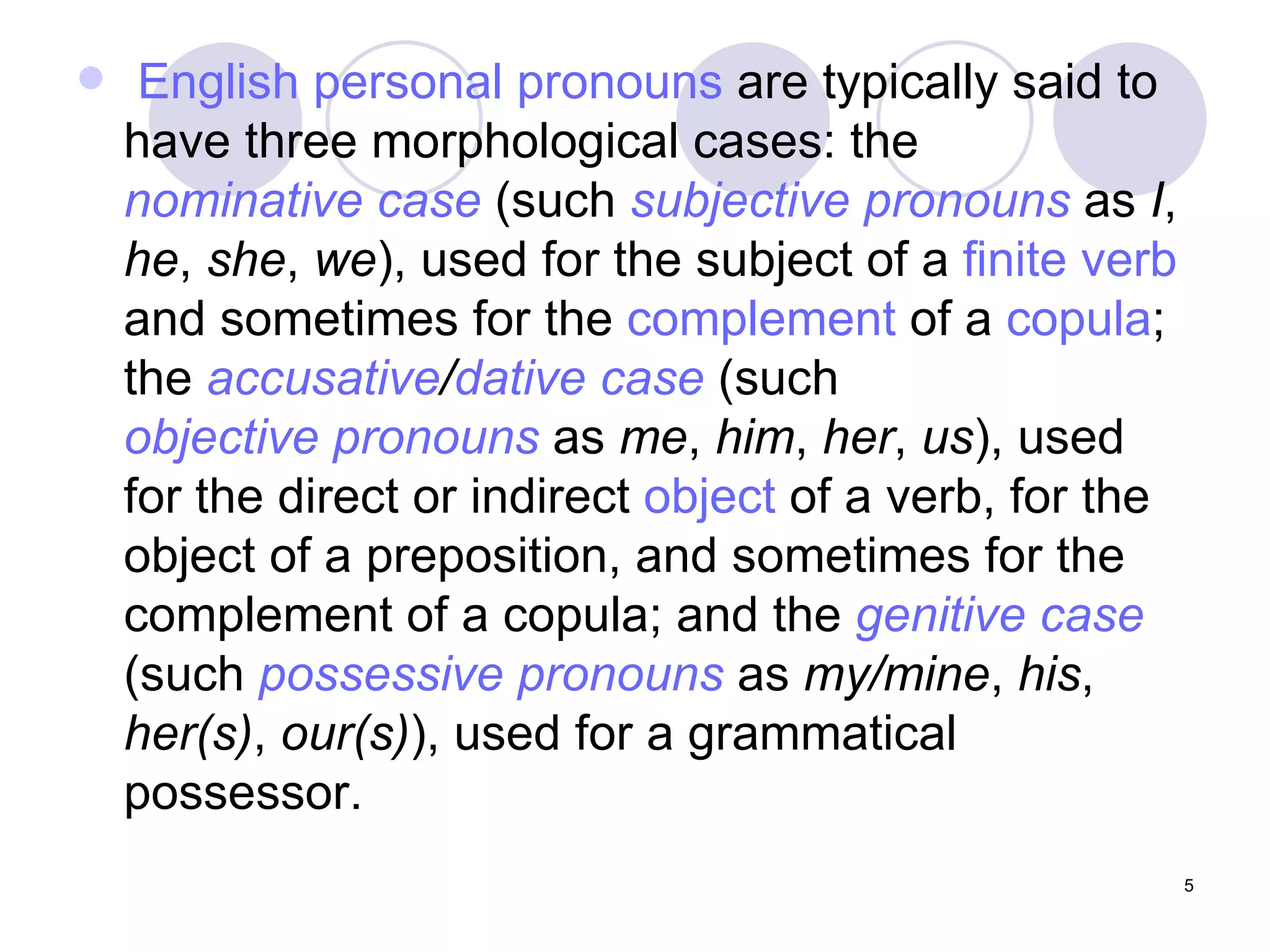
English personal pronouns  are typically said to have three morphological cases: the  nominative case  (such  subjective pronouns  as  I ,  he ,  she ,  we ), used for the subject of a  finite verb  and sometimes for the  complement  of a  copula ; the  accusative / dative case  (such  objective pronouns  as  me ,  him ,  her ,  us ), used for the direct or indirect  object  of a verb, for the object of a preposition, and sometimes for the complement of a copula; and the  genitive case  (such  possessive pronouns  as  my/mine ,  his ,  her(s) ,  our(s) ), used for a grammatical possessor.
A  finite verb  is a  verb  that is  inflected  for  person  and for  tense  according to the rules and categories of the languages in which it occurs. Finite verbs can form  independent clauses , which can stand by their own as complete  sentences . The finite forms of a verb are the forms where the verb shows tense, person or singular plural. Non-finite verb forms have no person, tense or number. I go, she goes, he went - These verb forms are finite. To go, going, gone - These verb forms are non-finite.
The eight historic cases are as follows, with examples: The  nominative case , which corresponds to English's subjective case, indicates the subject of a finite verb:  We  went to the store. The  accusative case , which together with the dative and ablative cases (below) corresponds to English's objective case, indicates the direct object of a verb:  The clerk remembered  us . The  dative case  indicates the indirect object of a verb:  The clerk gave  us  a discount.
The  ablative case  indicates the object of most common prepositions:  The victim went  with us  to see the doctor. The  genitive case , which corresponds to English's possessive case, indicates the possessor of another noun:  Our  citizens are proud of our country. The  vocative case  indicates an addressee:  You  there, are you O.K.? The  locative case  indicates a location:  We live  in China . The  instrumental case  indicates an object used in performing an action:  We wiped the floor  with it .
Verb valency  or  valence  refers to the number of  arguments  controlled by a verbal  predicate . It is related, though not identical, to  verb transitivity , which counts only  object  arguments of the verbal predicate. Verb valency, on the other hand, includes all arguments, including the  subject  of the verb.
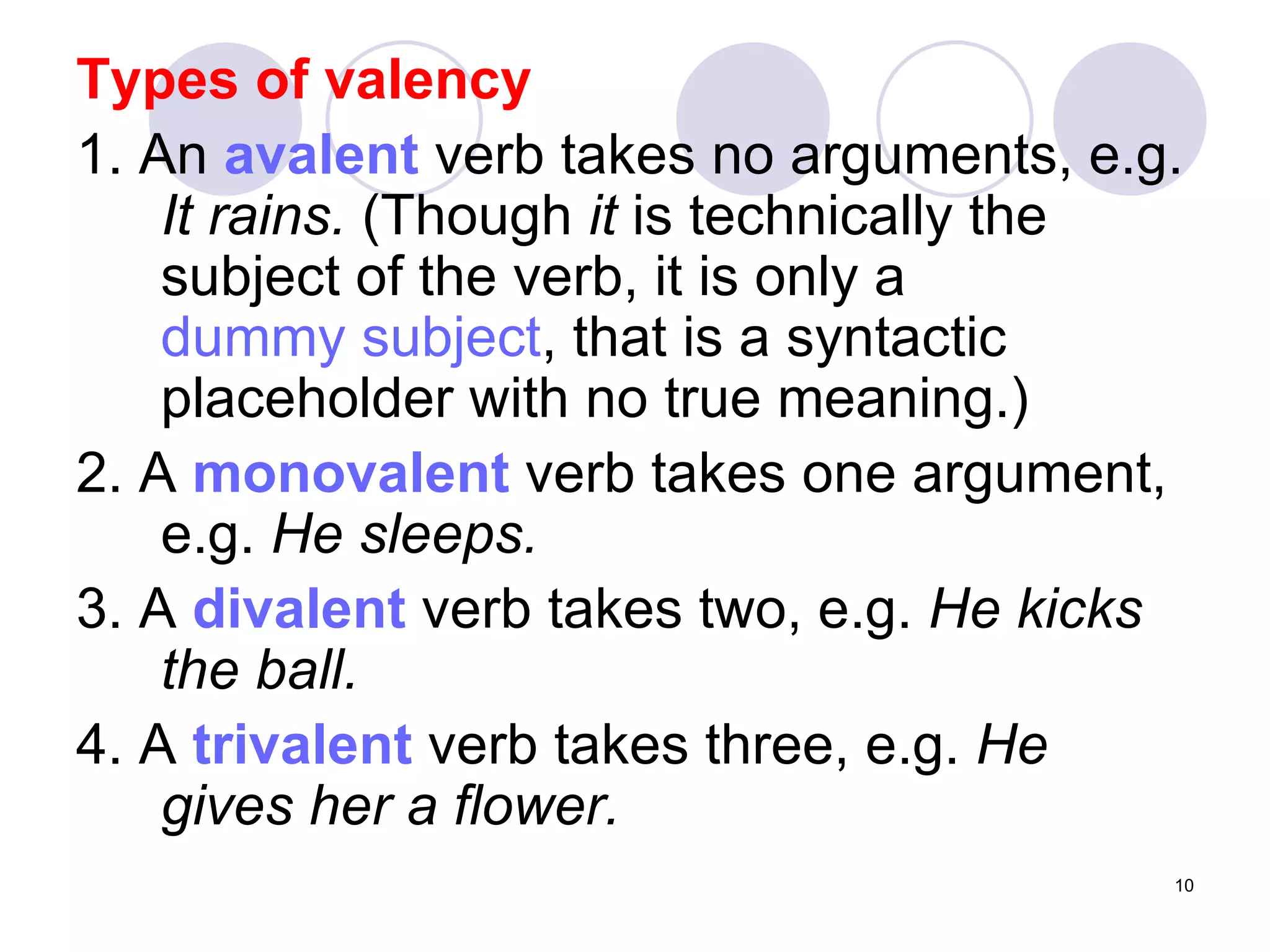
Types of valency 1. An  avalent  verb takes no arguments, e.g.  It rains.  (Though  it  is technically the subject of the verb, it is only a  dummy subject , that is a syntactic placeholder with no true meaning.) 2. A  monovalent  verb takes one argument, e.g.  He sleeps. 3. A  divalent  verb takes two, e.g.  He kicks the ball. 4. A  trivalent  verb takes three, e.g.  He gives her a flower.
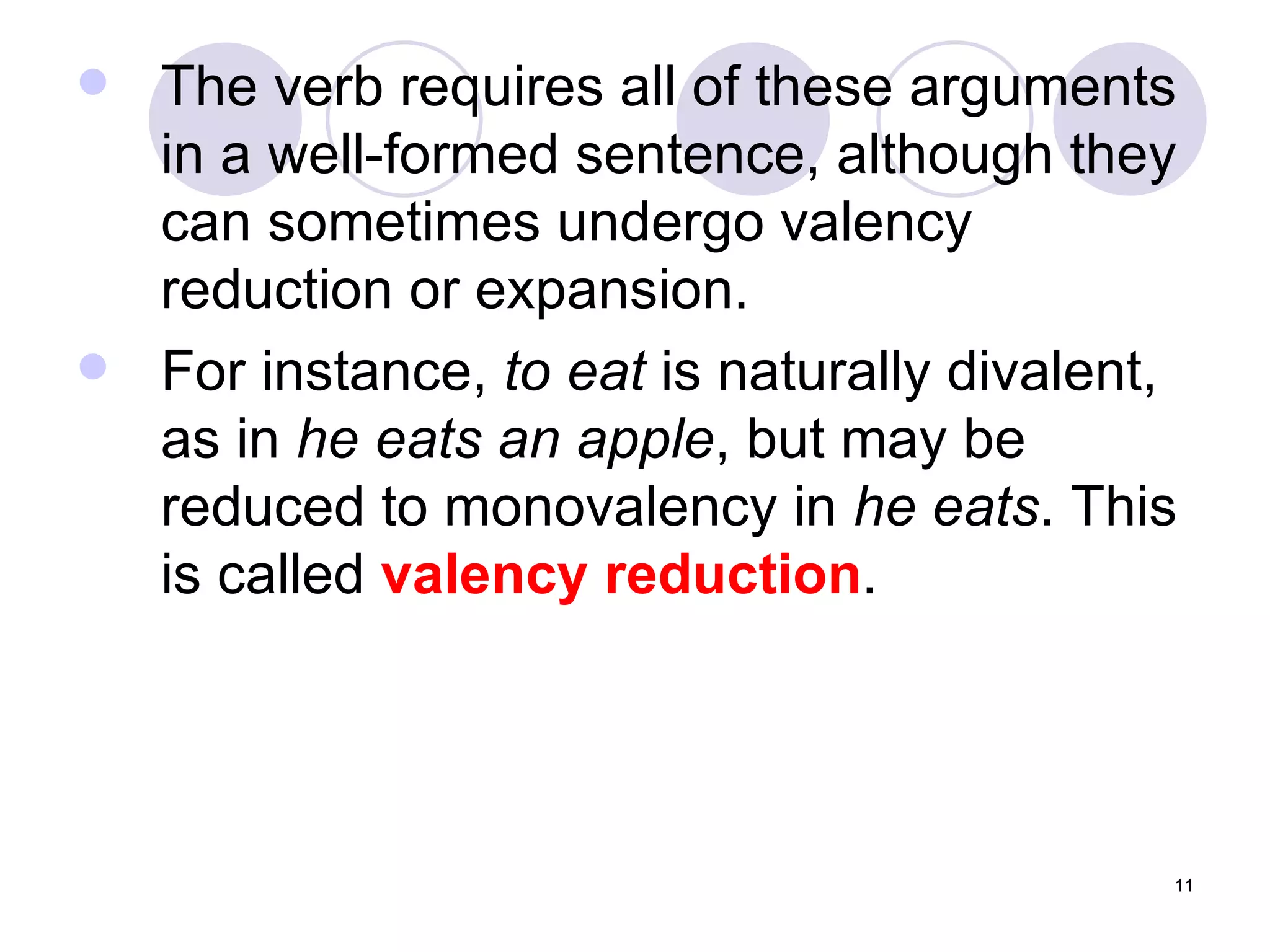
The verb requires all of these arguments in a well-formed sentence, although they can sometimes undergo valency reduction or expansion. For instance,  to eat  is naturally divalent, as in  he eats an apple , but may be reduced to monovalency in  he eats . This is called  valency reduction .
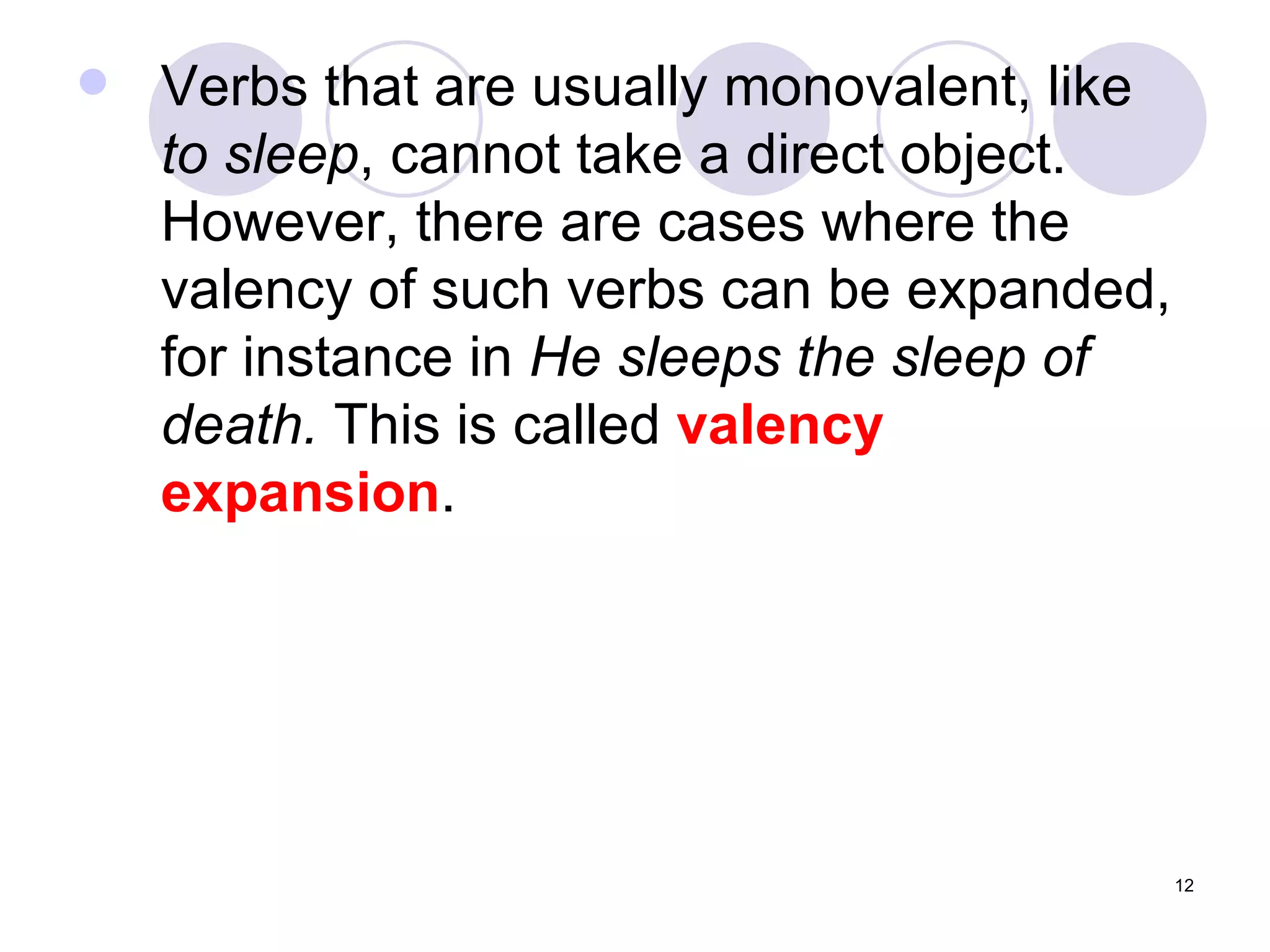
Verbs that are usually monovalent, like  to sleep , cannot take a direct object. However, there are cases where the valency of such verbs can be expanded, for instance in  He sleeps the sleep of death.  This is called  valency expansion .
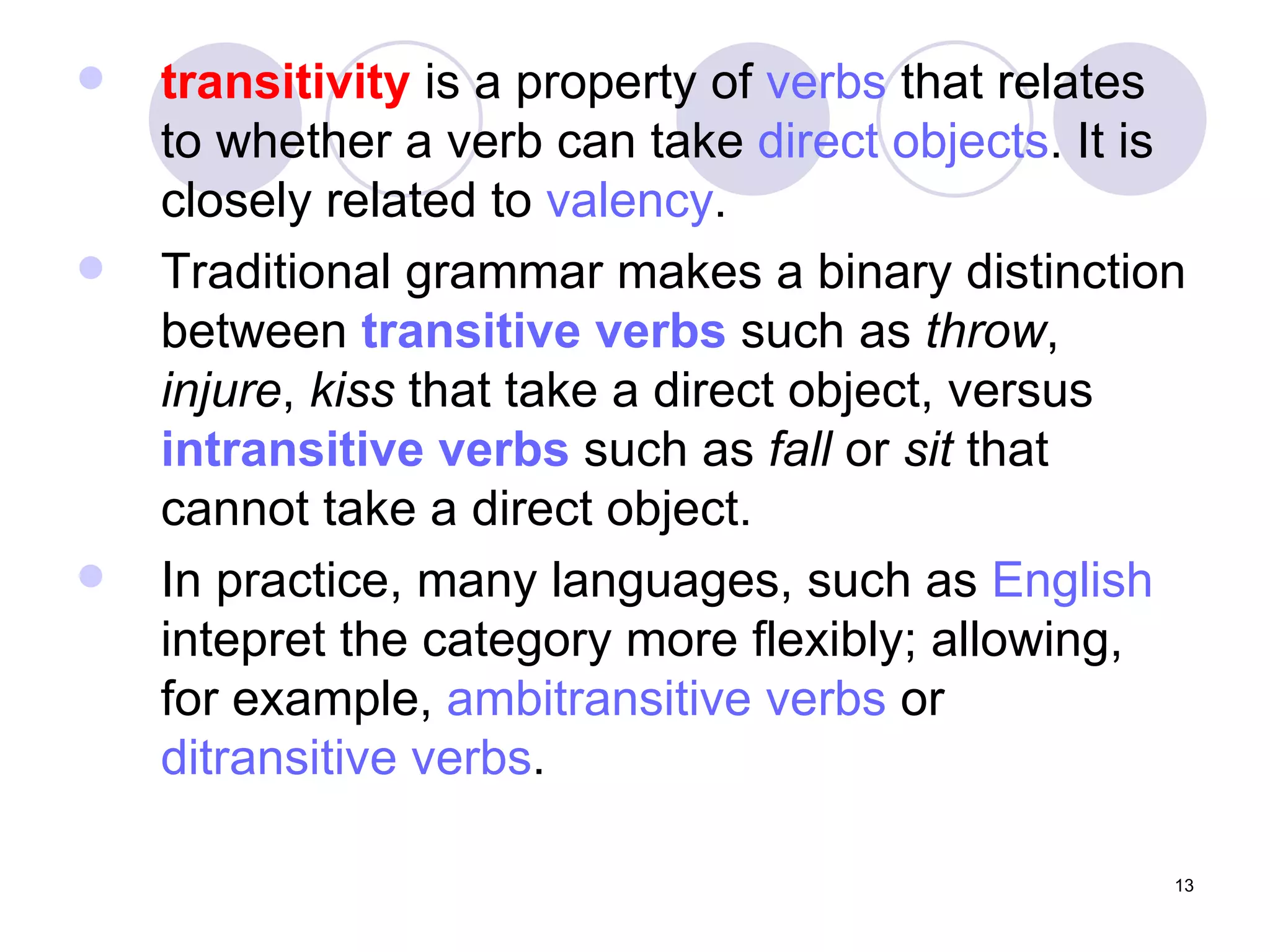
transitivity  is a property of  verbs  that relates to whether a verb can take  direct objects . It is closely related to  valency . Traditional grammar makes a binary distinction between  transitive verbs  such as  throw ,  injure ,  kiss  that take a direct object, versus  intransitive verbs  such as  fall  or  sit  that cannot take a direct object.  In practice, many languages, such as  English  intepret the category more flexibly; allowing, for example,  ambitransitive  verbs  or  ditransitive  verbs .
An  ambitransitive verb  is a  verb  that can be used both as  intransitive  or as  transitive  without requiring a  morphological  change. That is, the same verb form may or may not require a direct object.  English  has a large number of  ambitransitive verbs ; examples include  read ,  break ,  eat ,  follow ,  read ,  win  . and  understand  (e.g. "I read the book,"  "I read all afternoon").
Eat  and  read  and many other verbs can be used either transitively or intransitively. Often there is a  semantic  difference between the intransitive and transitive forms of a verb:  the water is boiling  versus  I boiled the water ;  the grapes grew  versus  I grew the grapes . In these examples, the role of the subject differs between intransitive and transitive verbs.
Universal Grammar allows case, just like tense, to be expressed either synthetically (as suffixes on nouns) or analytically (by means of prepositions or other syntactic heads that take an entire noun phrase as their argument). As we will see, English allows both ways of expressing case (just as it allows both ways of expressing tense in  watch-ed  and  will watch ). It is possible to describe both expressions of case in a unitary way by treating case as a feature on a noun phrase that is checked by a head. As we will show, case checking is subject to structural as well as nonstructural licensing conditions.
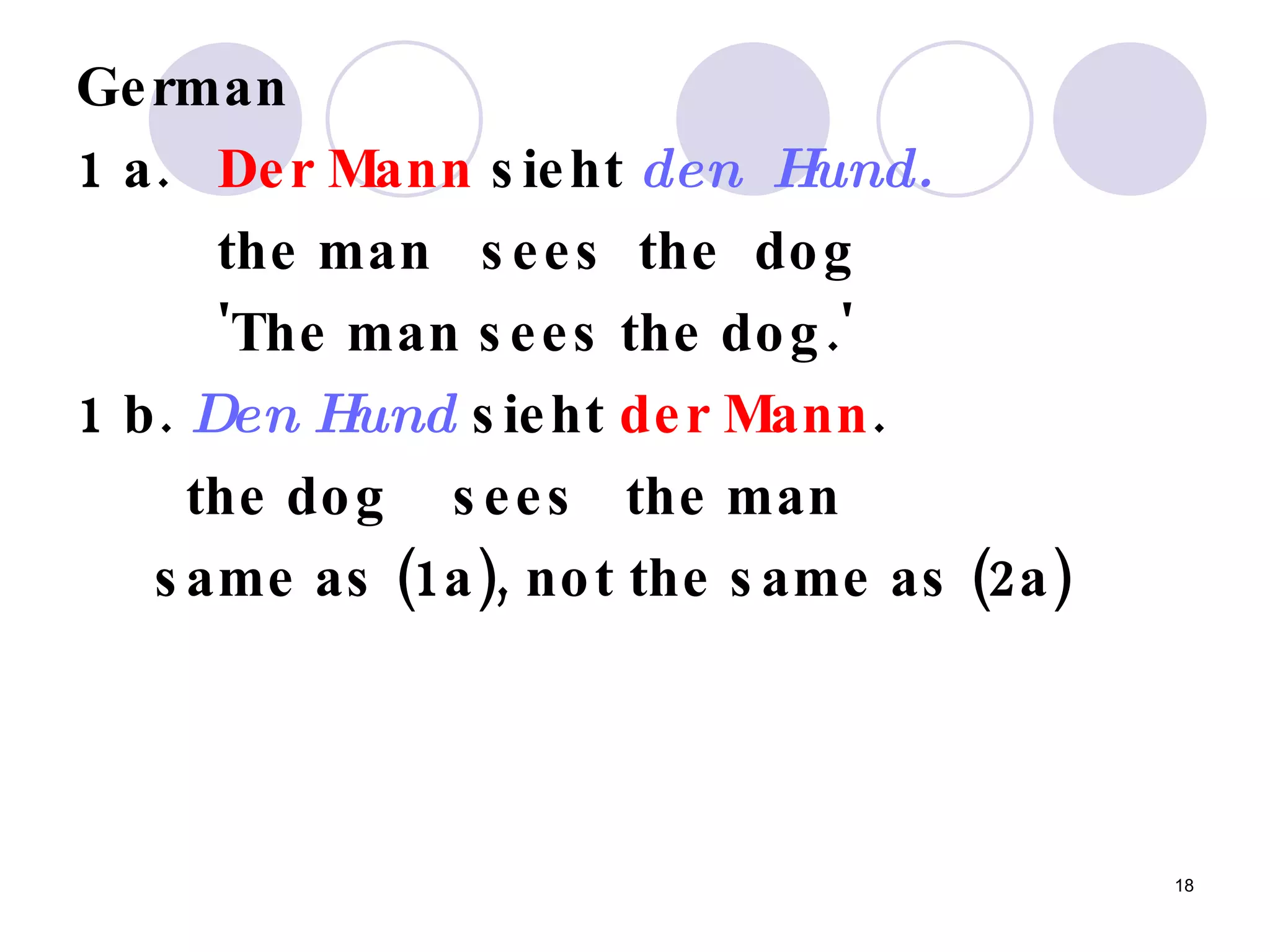
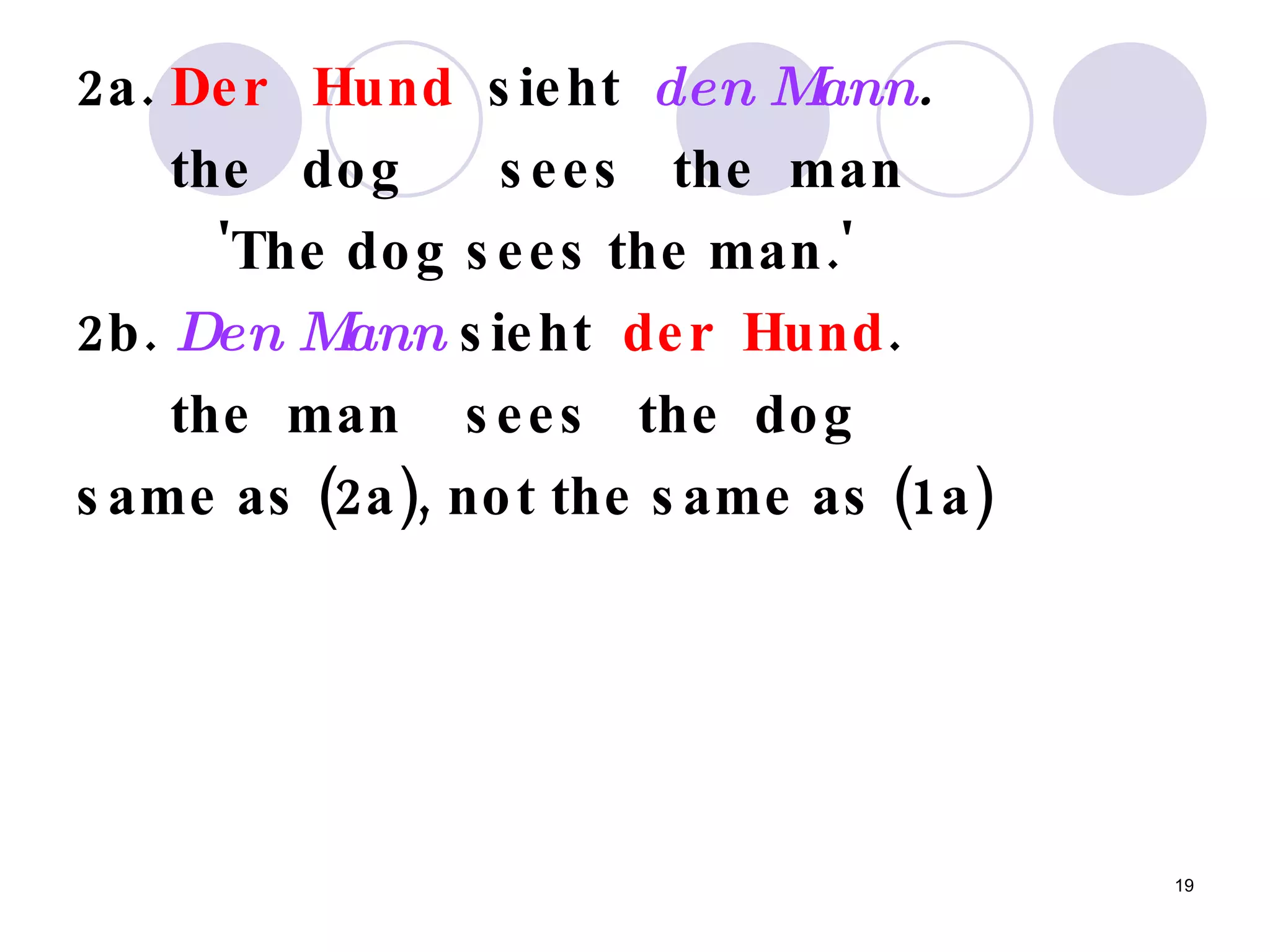
The basic purpose of case In order to understand the purpose of case in human language, it is useful to consider languages in which constituent order is not as fixed as it is in English. In German, for instance, unlike English, the subject of an ordinary declarative clause needn't precede the verb, as shown in (1) and (2). In the examples, boldface indicates the subject, and italics indicates the object.
German 1 a.    Der Mann  sieht  den  Hund.   the man  sees  the  dog  'The man sees the dog.'  1 b.  Den Hund  sieht  der Mann . the dog  sees  the man  same as (1a), not the same as (2a)
2a.  Der  Hund   sieht  den Mann .   the  dog  sees  the  man  'The dog sees the man.'  2b.  Den Mann  sieht  der  Hund .  the  man  sees  the  dog  same as (2a), not the same as (1a)
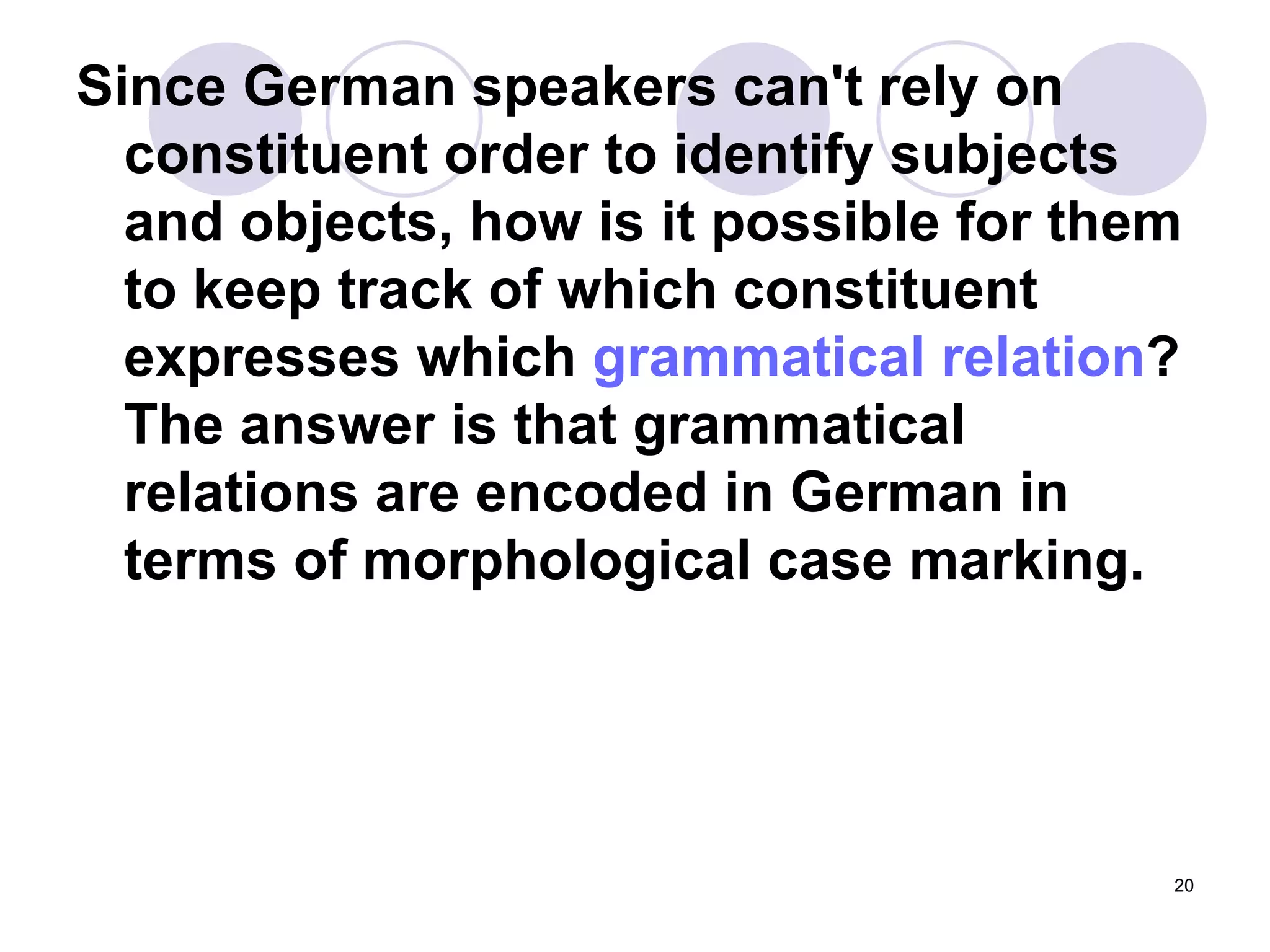
Since German speakers can't rely on constituent order to identify subjects and objects, how is it possible for them to keep track of which constituent expresses which  grammatical relation ? The answer is that grammatical relations are encoded in German in terms of morphological case marking.
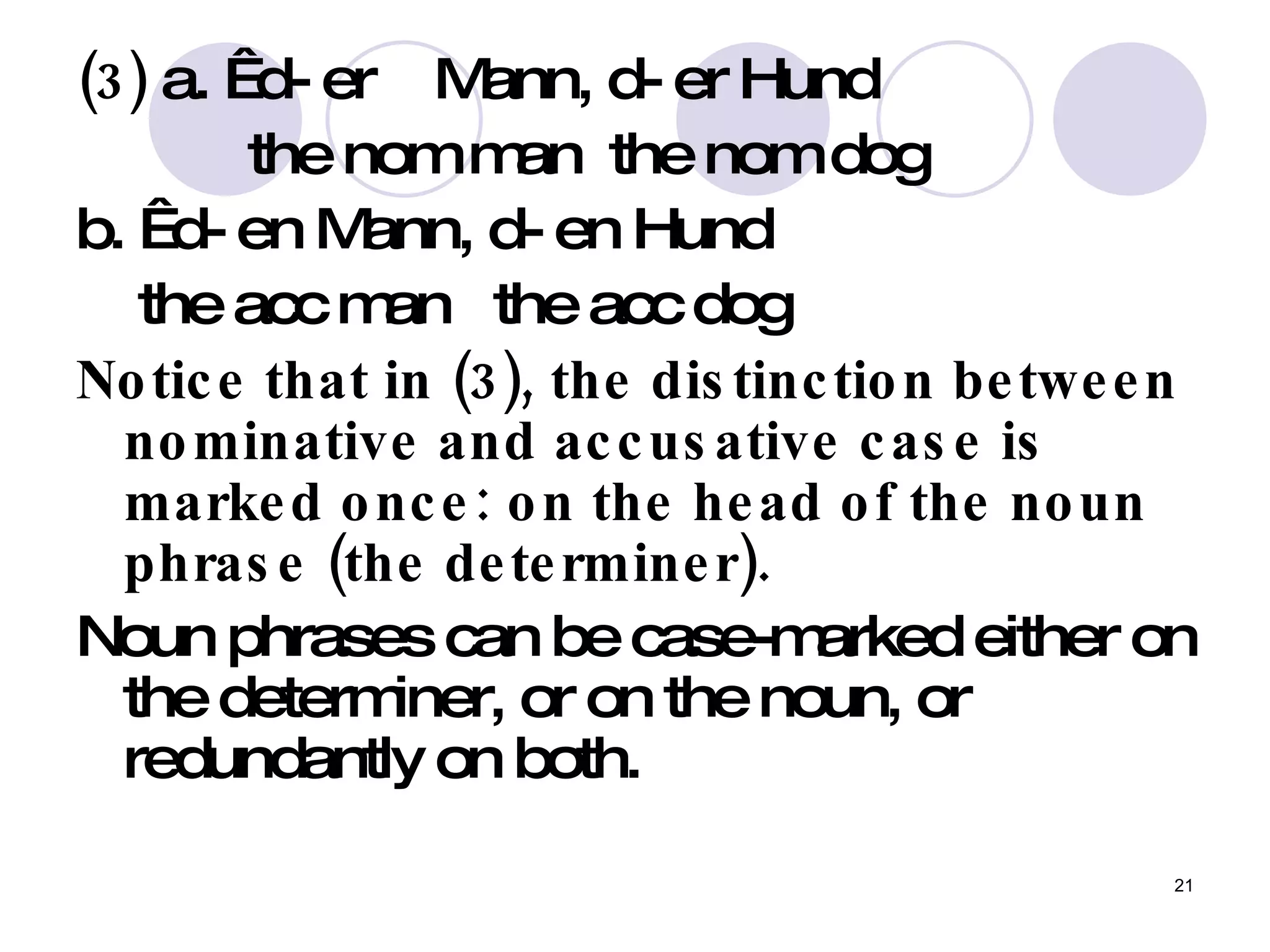
(3)  a.   d- er  Mann, d- er Hund  the nom man  the nom dog  b.   d- en Mann, d- en Hund the acc man  the acc dog  Notice that in (3), the distinction between nominative and accusative case is marked once: on the head of the noun phrase (the determiner).   Noun phrases can be case-marked either on the determiner, or on the noun, or redundantly on both.
(Japanese)   In the following sentence, case is indicated by the case markers  ga ,  ni ,  and  o : John   ga   Mary   ni  hon  o   yatta   ‘ John gave Mary a book.’   NOMINATIVE  John  DATIVE  Mary   ACCUSATIVE  book
1. ABESSIVE CASE abessive,  caritive  and  privative  are names for a  grammatical case  expressing the lack or absence of the marked noun.  In  English , the corresponding function is expressed by the  preposition   without  or by the  suffix   -less . The name  abessive  is derived from  Latin   abesse  "to be away/absent,"  caritive  is derived from Latin  carere  "to lack",  privative  is derived from Latin  privare  "to deprive."
In the  Finnish language , the abessive case is marked by  -tta  for back vowels and  -ttä  for front vowels according to  vowel harmony . For example: raha  "money" rahatta  "without money“ Estonian  also uses the abessive, which is marked by  -ta  in both the singular and the plural: autota  "without a car”
2. ACCUSATIVE CASE accusative case  of a  noun  is the  grammatical case  used to mark the  direct object  of a  transitive verb . The same case is used in many languages for the objects of (some or all)  prepositions . Modern  English , which almost entirely lacks  declension  in its nouns, still has an explicitly marked accusative case in a few pronouns as a remnant of  Old English , an earlier declined form of the language.
"Whom" is the accusative case of "who"; "him" is the accusative case of "he"; and "her" is the accusative case of "she". These words  also  serve as the  dative case  pronouns in English and could arguably be classified in the  oblique case  instead.
In the sentence  I see  the car , the  noun phrase   the car  is the direct object of the verb "see". In English, which has mostly lost the case system, the definite article and noun — "the car" — remain in the same form regardless of the grammatical role played by the words. One can correctly use "the car" as the subject of a sentence also: "The car is parked here."
In a declined language, the  morphology  of the article or noun changes in some way according to the grammatical role played by the noun in a given sentence. For example, in  German , one possible translation of "the car" is  der Wagen . This is the form in  nominative case , used for the subject of a sentence. If this article/noun pair is used as the object of a verb, it (usually) changes to the accusative case, which entails an article shift in German —  Ich sehe  den Wagen .
In German, masculine nouns change their definite article from  der  to  den  in accusative case. The accusative case is used for the direct object in a sentence. The masculine forms for  German articles , e.g. 'the', 'a', 'my', etc. change in the accusative case: they always end in -en. The feminine, neuter and plural forms don't change. Some  German pronouns  also change in the accusative case.
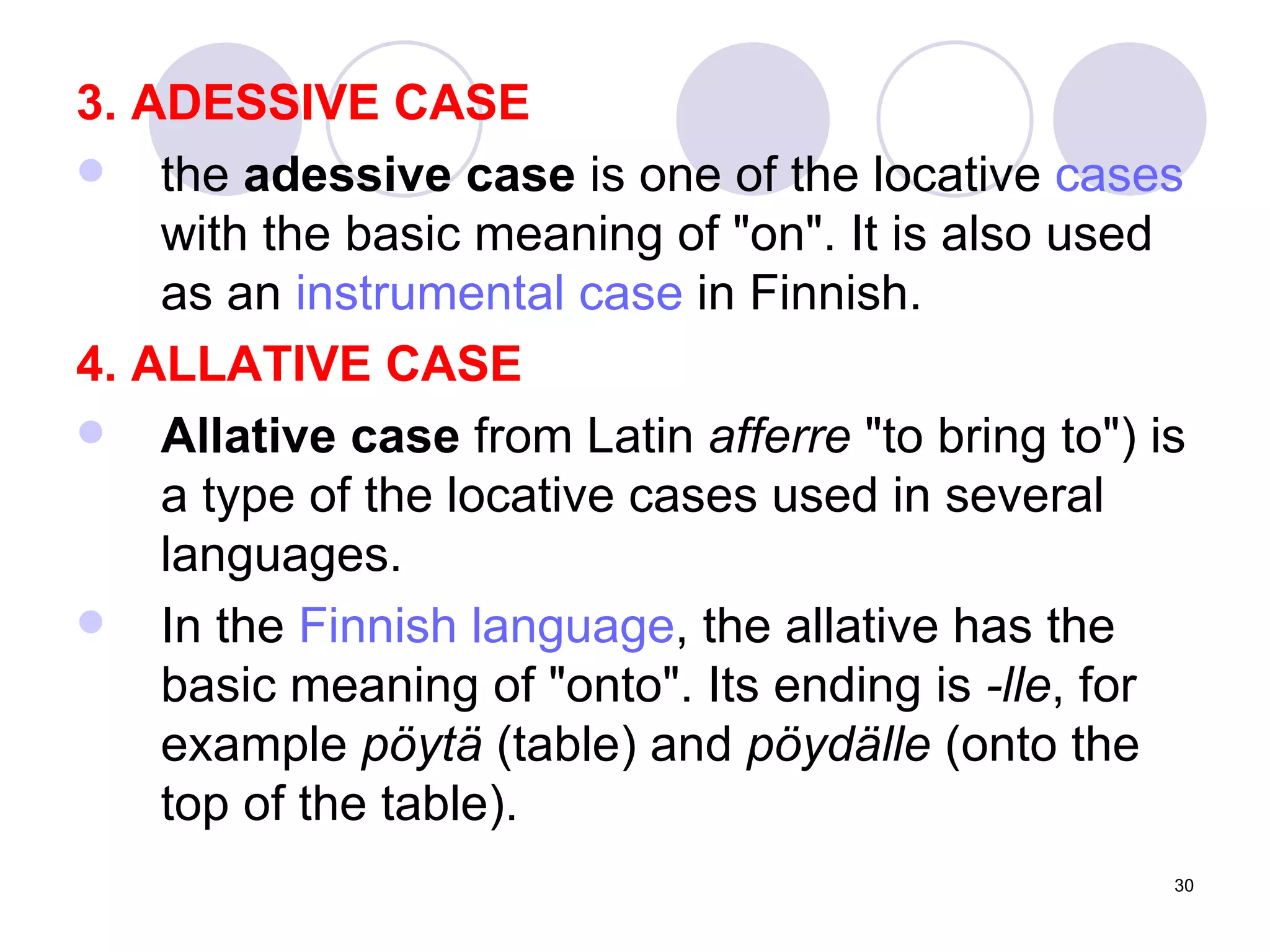
3. ADESSIVE CASE the  adessive case  is one of the locative  cases  with the basic meaning of "on". It is also used as an  instrumental case  in Finnish. 4. ALLATIVE CASE Allative case  from Latin  afferre  "to bring to") is a type of the locative cases used in several languages.  In the  Finnish language , the allative has the basic meaning of "onto". Its ending is  -lle , for example  pöytä  (table) and  pöydälle  (onto the top of the table).
5. INESSIVE CASE a  locative   grammatical case  that carries the basic meaning of "in": for example, "in the house" is "talo·ssa" in  Finnish , "maja·s" in  Estonian , "etxea·n" in  Basque , "nam·e" in  Lithuanian  and "ház·ban" in  Hungarian . In Finnish the inessive case is typically formed by adding "ssa/ssä". Estonian adds "s" to the genitive stem. In Hungarian, the  suffix  "ban/ben" is most commonly used for inessive case, although many others, such as -on, -en, -ön and others are also used, especially with  cities .
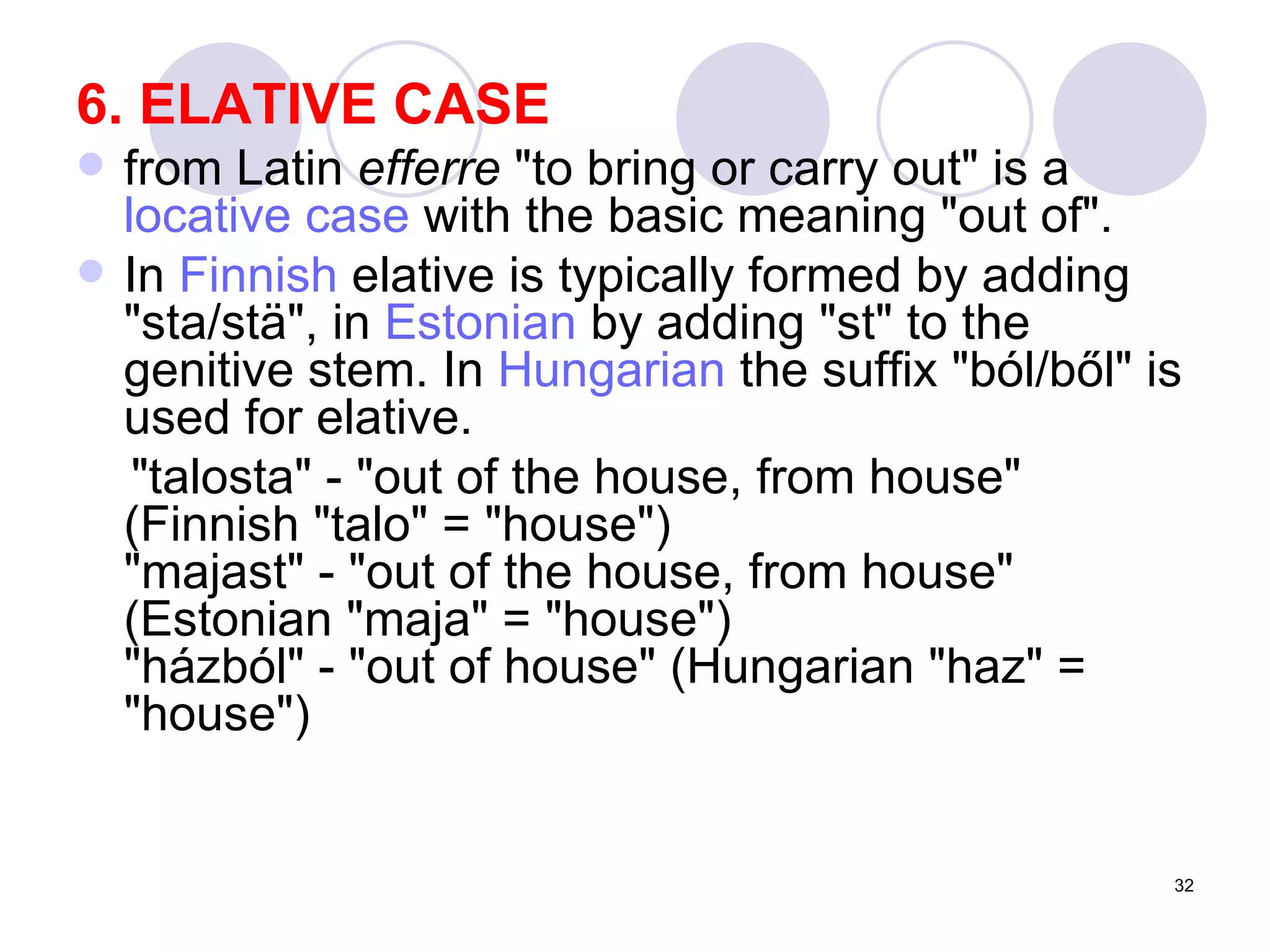
6.   ELATIVE CASE from Latin  efferre  "to bring or carry out" is a  locative   case  with the basic meaning "out of". In  Finnish  elative is typically formed by adding "sta/stä", in  Estonian  by adding "st" to the genitive stem. In  Hungarian  the suffix "ból/ből" is used for elative. "talosta" - "out of the house, from house" (Finnish "talo" = "house") "majast" - "out of the house, from house" (Estonian "maja" = "house") "házból" - "out of house" (Hungarian "haz" = "house")
7. ILLATIVE CASE from Latin  illatus  "brought in” has the basic meaning of "into (the inside of)". An example from Hungarian would be "a házba" (into the house). An example from Estonian would be "majasse" and "majja" (into the house), formed from "maja" (a house). An example from Finnish would be "taloon" (into the house), formed from "talo" (a house).
8. ANTESSIVE  is used for marking  before something  ("before the concert"). The case is found in some  Dravidian languages   9. APUDESSIVE CASE  is used for marking  location next to something  ("next to the house"). The case is found in  Tsez  language .
10. BENEFACTIVE CASE  is a  case  used where  English  would use "for", "for the benefit of", or "intended for", e.g. "She opened the door  for Tom " or "This book is  for Bob ". This meaning is often incorporated in a  dative case .  An example of a language with a benefactive case is  Basque , which has a benefactive case ending in  -entzat .  Quechua  is another example, and the benefactive case ending in Quechua is  -paq .
11. CAUSAL or CAUSATIVE CASE   is a  grammatical case  that indicates that the marked noun is the cause or reason for something.  This case in  Hungarian language  combines the  Causal case  and the  Final case : it can express the cause of  emotions  or the goal of actions (e.g. for bread).
12.  COMITATIVE CASE denotes companionship, and is used where English would use "in company with" or "together with".  In the  Estonian language  singular comitative is formed by adding the suffix '-ga' to the  genitive  in case of singular: nina  (nominative: nose) ->  nina  (genitive: of nose) ->  ninaga  (comitative: with a nose)  koer  (nominative: dog) ->  koera  (genitive: of dog) ->  koeraga  (comitative: with a dog)
13. DATIVE CASE   a  grammatical case  generally used to indicate the  noun  to whom something is given.  The thing being given may be a tangible object, such as "a book" or "a pen", or it may be an intangible abstraction, such as "an answer" or "help". The dative generally marks the  indirect object  of a  verb .
14. DISTRIBUTIVE CASE specifies how often something is done, as in regular maintenance or  expresses how often something happens (eg. monthly, daily) "I clean daily", implying that there's no day without cleaning. 15. DISTRIBUTIVE-TEMPORAL CASE specifies when something is done "I clean by day", implying the cleaning is done in the daytime.
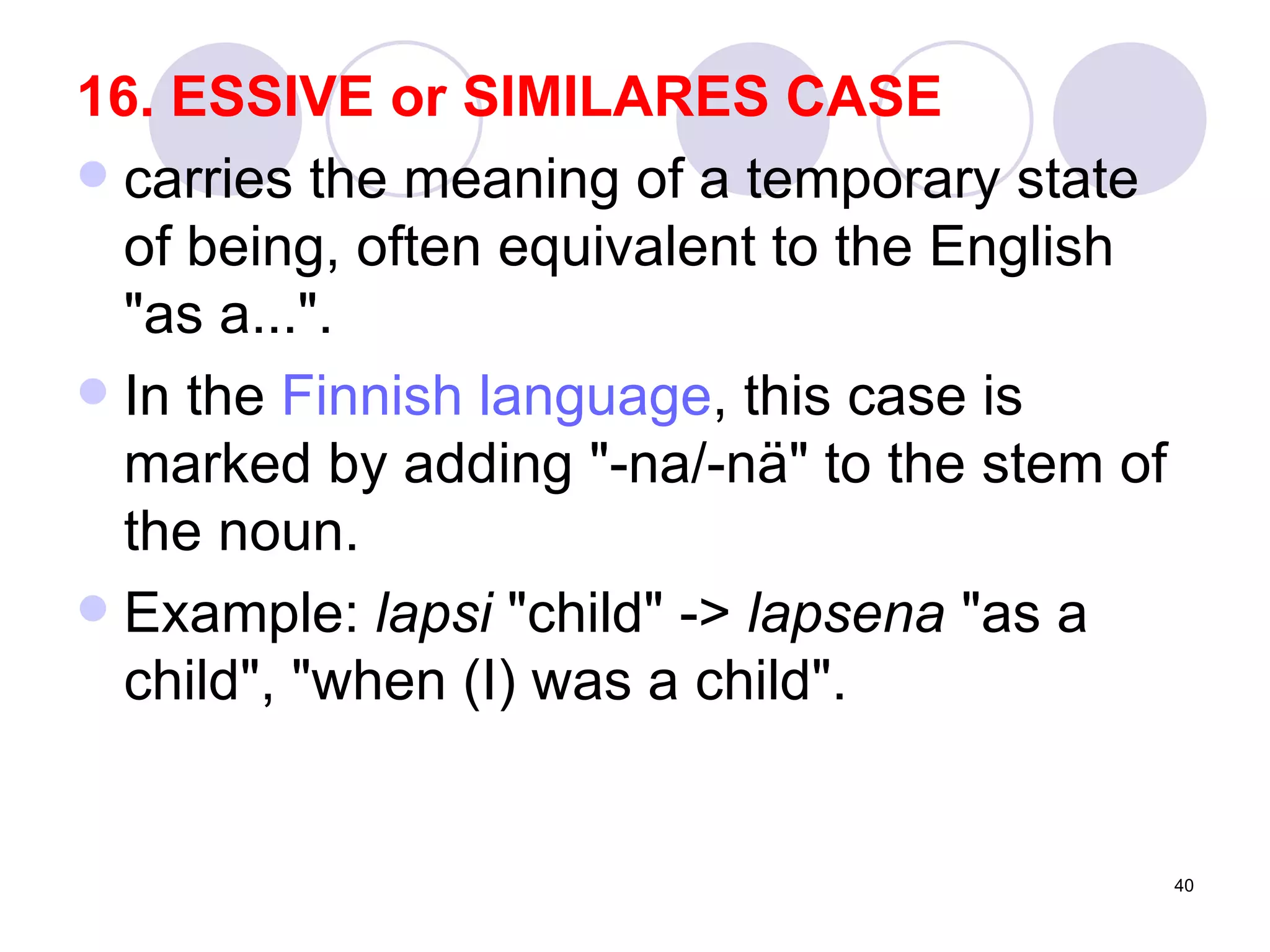
16. ESSIVE or SIMILARES CASE  carries the meaning of a temporary state of being, often equivalent to the English "as a...". In the  Finnish language , this case is marked by adding "-na/-nä" to the stem of the noun. Example:  lapsi  "child" ->  lapsena  "as a child", "when (I) was a child".
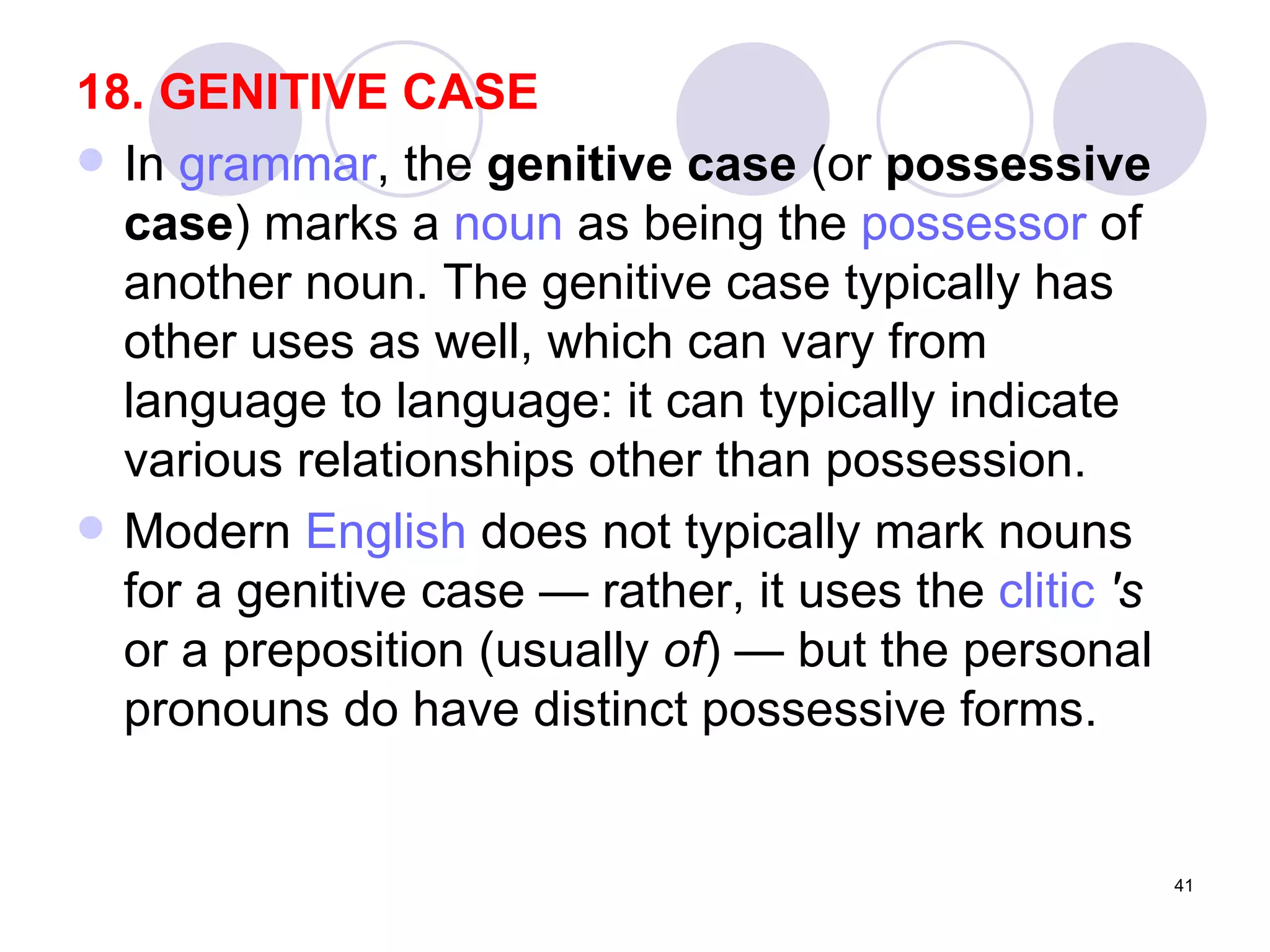
18. GENITIVE CASE In  grammar , the  genitive case  (or  possessive case ) marks a  noun  as being the  possessor  of another noun. The genitive case typically has other uses as well, which can vary from language to language: it can typically indicate various relationships other than possession. Modern  English  does not typically mark nouns for a genitive case — rather, it uses the  clitic   's  or a preposition (usually  of ) — but the personal pronouns do have distinct possessive forms.
Depending on the language, specific varieties of genitive-noun–main-noun relationships may include:  possession ( Possessive case ):  inalienable possession  (" Janet's  height", " Janet's  existence", " Janet's  long fingers")  alienable possession  (" Janet's  jacket", " Janet's  drink")  relationship indicated by the noun being modified (" Janet's  husband")  composition (  Partitive  case ):  substance ("a wheel  of cheese ")  elements ("a group  of men ")  source ("a portion  of the food ")
19. INSTRUCTIVE CASE   has the basic meaning of "by means of".  In Turkish, the suffix  -le  is used for this purpose. Ex: Trenle geldim "I came via train". 20.INSTRUMENTAL CASE a  grammatical case  used to indicate that a noun is the  instrument  or means by or with which the  subject  achieves or accomplishes an action. The noun may be either a physical object or an abstract concept.
English , lacking an instrumental case, might use a  preposition  (usually  with ) to express the same meaning: I wrote the note with/by means of a pen. Though the instrumental case does not exist in many languages, some languages use other cases to denote the means, or instrument, of an action.
Hungarian language  contains the  Instrumental case  and the  Comitative  case  at the same time. It is similar to the English preposition  with . It may refer to the means of the action (with a knife, fork; by tram etc.) and to the person in whose company the action is carried out (with his family etc).
21. MODAL CASE  a  grammatical case  used to express ability, intention, necessity, obligation, permission, possibility, etc. It takes the place of English  modal verbs  such as can, could, would, might, may. 22. MULTIPLICATIVE CASE  is used for marking  a number of something  ("three times"). The case is found in  Hungarian language .
23. NOMINATIVE CASE a  grammatical case  for a  noun , which generally marks the  subject  of a  verb , as opposed to its  object  or other  verb arguments .  English still retains some nominative  pronouns , as opposed to the  accusative case  or  oblique case :  I  (accusative,  me ),  we  (accusative,  us ),  he  (accusative,  him ),  she  (accusative,  her ) and  they  (accusative,  them ). An archaic usage is the singular second-person pronoun  thou  (accusative  thee ). A special case is the word  you : Originally  ye  was its nominative form and  you  the accusative, but over time  you  has come to be used for the nominative as well.
24. PROXIMATIVE CASE is used to describe a meaning similar to that of the English preposition "near to" or "close to". 25. TERMINATIVE CASE  indicates to what point; where something ends. These examples are from  Estonian , wherein it is indicated by the '-ni'  suffix : jõeni : "to the river" / "as far as the river"  kella kuueni : "until six o'clock"
26. VOCATIVE CASE Is used for a  noun  identifying the person (animal, object, etc.) being addressed and/or occasionally the  determiners  of that noun. A vocative expression is an expression of direct address, wherein the identity of the party being spoken to is set forth expressly within a sentence. For example, in the sentence, "I don't know, John,"  John  is a vocative expression indicating the party who is being addressed.
27. Partitive case refers to the selection of a part or quantity out of a group or amount. a  grammatical case  which denotes "partialness", "without result", or "without specific identity".
thank you

Cases

  • 1.
    CASES Dr. RiceliCano-Mendoza University of Southern Mindanao PHILIPPINES
  • 2.
    Case isa grammatical category determined by the syntactic or semantic function of a noun or pronoun .   In grammar , the case of a noun or pronoun indicates its grammatical function in a greater phrase or clause ; such as the role of subject , of direct object , or of possessor . While most languages distinguish cases in some fashion, it is only customary to say that a language has cases when these are codified in the morphology of its nouns — that is, when nouns change their form to reflect their case. (Such a change in form is a kind of declension )
  • 3.
    Cases are relatedto, but distinct from, thematic roles such as agent and patient ; while certain cases in each language tend to correspond to certain thematic roles, cases are a syntactic notion whereas thematic roles are a semantic one. Example: The Latin sentences: Canis hominem mordet ‘Dog bites man’ and Canem homo mordet ‘Man bites dog’, illustrate that differing case endings express the differing functions of the nouns in Latin. 
  • 4.
    Cases in EnglishCases are not very prominent in modern English , except in its personal pronouns (a remnant of the more extensive case system of Old English ). For other pronouns, and all nouns, adjectives, and articles, case is indicated only by word order , by prepositions , and by the clitic -'s .
  • 5.
    English personal pronouns are typically said to have three morphological cases: the nominative case (such subjective pronouns as I , he , she , we ), used for the subject of a finite verb and sometimes for the complement of a copula ; the accusative / dative case (such objective pronouns as me , him , her , us ), used for the direct or indirect object of a verb, for the object of a preposition, and sometimes for the complement of a copula; and the genitive case (such possessive pronouns as my/mine , his , her(s) , our(s) ), used for a grammatical possessor.
  • 6.
    A finiteverb is a verb that is inflected for person and for tense according to the rules and categories of the languages in which it occurs. Finite verbs can form independent clauses , which can stand by their own as complete sentences . The finite forms of a verb are the forms where the verb shows tense, person or singular plural. Non-finite verb forms have no person, tense or number. I go, she goes, he went - These verb forms are finite. To go, going, gone - These verb forms are non-finite.
  • 7.
    The eight historiccases are as follows, with examples: The nominative case , which corresponds to English's subjective case, indicates the subject of a finite verb: We went to the store. The accusative case , which together with the dative and ablative cases (below) corresponds to English's objective case, indicates the direct object of a verb: The clerk remembered us . The dative case indicates the indirect object of a verb: The clerk gave us a discount.
  • 8.
    The ablativecase indicates the object of most common prepositions: The victim went with us to see the doctor. The genitive case , which corresponds to English's possessive case, indicates the possessor of another noun: Our citizens are proud of our country. The vocative case indicates an addressee: You there, are you O.K.? The locative case indicates a location: We live in China . The instrumental case indicates an object used in performing an action: We wiped the floor with it .
  • 9.
    Verb valency or valence refers to the number of arguments controlled by a verbal predicate . It is related, though not identical, to verb transitivity , which counts only object arguments of the verbal predicate. Verb valency, on the other hand, includes all arguments, including the subject of the verb.
  • 10.
    Types of valency1. An avalent verb takes no arguments, e.g. It rains. (Though it is technically the subject of the verb, it is only a dummy subject , that is a syntactic placeholder with no true meaning.) 2. A monovalent verb takes one argument, e.g. He sleeps. 3. A divalent verb takes two, e.g. He kicks the ball. 4. A trivalent verb takes three, e.g. He gives her a flower.
  • 11.
    The verb requiresall of these arguments in a well-formed sentence, although they can sometimes undergo valency reduction or expansion. For instance, to eat is naturally divalent, as in he eats an apple , but may be reduced to monovalency in he eats . This is called valency reduction .
  • 12.
    Verbs that areusually monovalent, like to sleep , cannot take a direct object. However, there are cases where the valency of such verbs can be expanded, for instance in He sleeps the sleep of death. This is called valency expansion .
  • 13.
    transitivity isa property of verbs that relates to whether a verb can take direct objects . It is closely related to valency . Traditional grammar makes a binary distinction between transitive verbs such as throw , injure , kiss that take a direct object, versus intransitive verbs such as fall or sit that cannot take a direct object. In practice, many languages, such as English intepret the category more flexibly; allowing, for example, ambitransitive verbs or ditransitive verbs .
  • 14.
    An ambitransitiveverb is a verb that can be used both as intransitive or as transitive without requiring a morphological change. That is, the same verb form may or may not require a direct object. English has a large number of ambitransitive verbs ; examples include read , break , eat , follow , read , win . and understand (e.g. "I read the book," "I read all afternoon").
  • 15.
    Eat and read and many other verbs can be used either transitively or intransitively. Often there is a semantic difference between the intransitive and transitive forms of a verb: the water is boiling versus I boiled the water ; the grapes grew versus I grew the grapes . In these examples, the role of the subject differs between intransitive and transitive verbs.
  • 16.
    Universal Grammar allowscase, just like tense, to be expressed either synthetically (as suffixes on nouns) or analytically (by means of prepositions or other syntactic heads that take an entire noun phrase as their argument). As we will see, English allows both ways of expressing case (just as it allows both ways of expressing tense in watch-ed and will watch ). It is possible to describe both expressions of case in a unitary way by treating case as a feature on a noun phrase that is checked by a head. As we will show, case checking is subject to structural as well as nonstructural licensing conditions.
  • 17.
    The basic purposeof case In order to understand the purpose of case in human language, it is useful to consider languages in which constituent order is not as fixed as it is in English. In German, for instance, unlike English, the subject of an ordinary declarative clause needn't precede the verb, as shown in (1) and (2). In the examples, boldface indicates the subject, and italics indicates the object.
  • 18.
    German 1 a.  Der Mann sieht den Hund. the man sees the dog 'The man sees the dog.' 1 b. Den Hund sieht der Mann . the dog sees the man same as (1a), not the same as (2a)
  • 19.
    2a. Der Hund sieht den Mann . the dog sees the man 'The dog sees the man.' 2b. Den Mann sieht der Hund . the man sees the dog same as (2a), not the same as (1a)
  • 20.
    Since German speakerscan't rely on constituent order to identify subjects and objects, how is it possible for them to keep track of which constituent expresses which grammatical relation ? The answer is that grammatical relations are encoded in German in terms of morphological case marking.
  • 21.
    (3) a.  d- er Mann, d- er Hund the nom man the nom dog b.   d- en Mann, d- en Hund the acc man the acc dog Notice that in (3), the distinction between nominative and accusative case is marked once: on the head of the noun phrase (the determiner). Noun phrases can be case-marked either on the determiner, or on the noun, or redundantly on both.
  • 22.
    (Japanese)   Inthe following sentence, case is indicated by the case markers ga , ni , and o : John ga Mary ni hon o yatta ‘ John gave Mary a book.’ NOMINATIVE John DATIVE Mary ACCUSATIVE book
  • 23.
    1. ABESSIVE CASEabessive, caritive and privative are names for a grammatical case expressing the lack or absence of the marked noun. In English , the corresponding function is expressed by the preposition without or by the suffix -less . The name abessive is derived from Latin abesse "to be away/absent," caritive is derived from Latin carere "to lack", privative is derived from Latin privare "to deprive."
  • 24.
    In the Finnish language , the abessive case is marked by -tta for back vowels and -ttä for front vowels according to vowel harmony . For example: raha "money" rahatta "without money“ Estonian also uses the abessive, which is marked by -ta in both the singular and the plural: autota "without a car”
  • 25.
    2. ACCUSATIVE CASEaccusative case of a noun is the grammatical case used to mark the direct object of a transitive verb . The same case is used in many languages for the objects of (some or all) prepositions . Modern English , which almost entirely lacks declension in its nouns, still has an explicitly marked accusative case in a few pronouns as a remnant of Old English , an earlier declined form of the language.
  • 26.
    "Whom" is theaccusative case of "who"; "him" is the accusative case of "he"; and "her" is the accusative case of "she". These words also serve as the dative case pronouns in English and could arguably be classified in the oblique case instead.
  • 27.
    In the sentence I see the car , the noun phrase the car is the direct object of the verb "see". In English, which has mostly lost the case system, the definite article and noun — "the car" — remain in the same form regardless of the grammatical role played by the words. One can correctly use "the car" as the subject of a sentence also: "The car is parked here."
  • 28.
    In a declinedlanguage, the morphology of the article or noun changes in some way according to the grammatical role played by the noun in a given sentence. For example, in German , one possible translation of "the car" is der Wagen . This is the form in nominative case , used for the subject of a sentence. If this article/noun pair is used as the object of a verb, it (usually) changes to the accusative case, which entails an article shift in German — Ich sehe den Wagen .
  • 29.
    In German, masculinenouns change their definite article from der to den in accusative case. The accusative case is used for the direct object in a sentence. The masculine forms for German articles , e.g. 'the', 'a', 'my', etc. change in the accusative case: they always end in -en. The feminine, neuter and plural forms don't change. Some German pronouns also change in the accusative case.
  • 30.
    3. ADESSIVE CASEthe adessive case is one of the locative cases with the basic meaning of "on". It is also used as an instrumental case in Finnish. 4. ALLATIVE CASE Allative case from Latin afferre "to bring to") is a type of the locative cases used in several languages. In the Finnish language , the allative has the basic meaning of "onto". Its ending is -lle , for example pöytä (table) and pöydälle (onto the top of the table).
  • 31.
    5. INESSIVE CASEa locative grammatical case that carries the basic meaning of "in": for example, "in the house" is "talo·ssa" in Finnish , "maja·s" in Estonian , "etxea·n" in Basque , "nam·e" in Lithuanian and "ház·ban" in Hungarian . In Finnish the inessive case is typically formed by adding "ssa/ssä". Estonian adds "s" to the genitive stem. In Hungarian, the suffix "ban/ben" is most commonly used for inessive case, although many others, such as -on, -en, -ön and others are also used, especially with cities .
  • 32.
    6. ELATIVE CASE from Latin efferre "to bring or carry out" is a locative case with the basic meaning "out of". In Finnish elative is typically formed by adding "sta/stä", in Estonian by adding "st" to the genitive stem. In Hungarian the suffix "ból/ből" is used for elative. "talosta" - "out of the house, from house" (Finnish "talo" = "house") "majast" - "out of the house, from house" (Estonian "maja" = "house") "házból" - "out of house" (Hungarian "haz" = "house")
  • 33.
    7. ILLATIVE CASEfrom Latin illatus "brought in” has the basic meaning of "into (the inside of)". An example from Hungarian would be "a házba" (into the house). An example from Estonian would be "majasse" and "majja" (into the house), formed from "maja" (a house). An example from Finnish would be "taloon" (into the house), formed from "talo" (a house).
  • 34.
    8. ANTESSIVE is used for marking before something ("before the concert"). The case is found in some Dravidian languages 9. APUDESSIVE CASE is used for marking location next to something ("next to the house"). The case is found in Tsez language .
  • 35.
    10. BENEFACTIVE CASE is a case used where English would use "for", "for the benefit of", or "intended for", e.g. "She opened the door for Tom " or "This book is for Bob ". This meaning is often incorporated in a dative case . An example of a language with a benefactive case is Basque , which has a benefactive case ending in -entzat . Quechua is another example, and the benefactive case ending in Quechua is -paq .
  • 36.
    11. CAUSAL orCAUSATIVE CASE is a grammatical case that indicates that the marked noun is the cause or reason for something. This case in Hungarian language combines the Causal case and the Final case : it can express the cause of emotions or the goal of actions (e.g. for bread).
  • 37.
    12. COMITATIVECASE denotes companionship, and is used where English would use "in company with" or "together with". In the Estonian language singular comitative is formed by adding the suffix '-ga' to the genitive in case of singular: nina (nominative: nose) -> nina (genitive: of nose) -> ninaga (comitative: with a nose) koer (nominative: dog) -> koera (genitive: of dog) -> koeraga (comitative: with a dog)
  • 38.
    13. DATIVE CASE a grammatical case generally used to indicate the noun to whom something is given. The thing being given may be a tangible object, such as "a book" or "a pen", or it may be an intangible abstraction, such as "an answer" or "help". The dative generally marks the indirect object of a verb .
  • 39.
    14. DISTRIBUTIVE CASEspecifies how often something is done, as in regular maintenance or expresses how often something happens (eg. monthly, daily) "I clean daily", implying that there's no day without cleaning. 15. DISTRIBUTIVE-TEMPORAL CASE specifies when something is done "I clean by day", implying the cleaning is done in the daytime.
  • 40.
    16. ESSIVE orSIMILARES CASE carries the meaning of a temporary state of being, often equivalent to the English "as a...". In the Finnish language , this case is marked by adding "-na/-nä" to the stem of the noun. Example: lapsi "child" -> lapsena "as a child", "when (I) was a child".
  • 41.
    18. GENITIVE CASEIn grammar , the genitive case (or possessive case ) marks a noun as being the possessor of another noun. The genitive case typically has other uses as well, which can vary from language to language: it can typically indicate various relationships other than possession. Modern English does not typically mark nouns for a genitive case — rather, it uses the clitic 's or a preposition (usually of ) — but the personal pronouns do have distinct possessive forms.
  • 42.
    Depending on thelanguage, specific varieties of genitive-noun–main-noun relationships may include: possession ( Possessive case ): inalienable possession (" Janet's height", " Janet's existence", " Janet's long fingers") alienable possession (" Janet's jacket", " Janet's drink") relationship indicated by the noun being modified (" Janet's husband") composition ( Partitive case ): substance ("a wheel of cheese ") elements ("a group of men ") source ("a portion of the food ")
  • 43.
    19. INSTRUCTIVE CASE has the basic meaning of "by means of". In Turkish, the suffix -le is used for this purpose. Ex: Trenle geldim "I came via train". 20.INSTRUMENTAL CASE a grammatical case used to indicate that a noun is the instrument or means by or with which the subject achieves or accomplishes an action. The noun may be either a physical object or an abstract concept.
  • 44.
    English , lackingan instrumental case, might use a preposition (usually with ) to express the same meaning: I wrote the note with/by means of a pen. Though the instrumental case does not exist in many languages, some languages use other cases to denote the means, or instrument, of an action.
  • 45.
    Hungarian language contains the Instrumental case and the Comitative case at the same time. It is similar to the English preposition with . It may refer to the means of the action (with a knife, fork; by tram etc.) and to the person in whose company the action is carried out (with his family etc).
  • 46.
    21. MODAL CASE a grammatical case used to express ability, intention, necessity, obligation, permission, possibility, etc. It takes the place of English modal verbs such as can, could, would, might, may. 22. MULTIPLICATIVE CASE is used for marking a number of something ("three times"). The case is found in Hungarian language .
  • 47.
    23. NOMINATIVE CASEa grammatical case for a noun , which generally marks the subject of a verb , as opposed to its object or other verb arguments . English still retains some nominative pronouns , as opposed to the accusative case or oblique case : I (accusative, me ), we (accusative, us ), he (accusative, him ), she (accusative, her ) and they (accusative, them ). An archaic usage is the singular second-person pronoun thou (accusative thee ). A special case is the word you : Originally ye was its nominative form and you the accusative, but over time you has come to be used for the nominative as well.
  • 48.
    24. PROXIMATIVE CASEis used to describe a meaning similar to that of the English preposition "near to" or "close to". 25. TERMINATIVE CASE indicates to what point; where something ends. These examples are from Estonian , wherein it is indicated by the '-ni' suffix : jõeni : "to the river" / "as far as the river" kella kuueni : "until six o'clock"
  • 49.
    26. VOCATIVE CASEIs used for a noun identifying the person (animal, object, etc.) being addressed and/or occasionally the determiners of that noun. A vocative expression is an expression of direct address, wherein the identity of the party being spoken to is set forth expressly within a sentence. For example, in the sentence, "I don't know, John," John is a vocative expression indicating the party who is being addressed.
  • 50.
    27. Partitive caserefers to the selection of a part or quantity out of a group or amount. a grammatical case which denotes "partialness", "without result", or "without specific identity".
  • 51.