
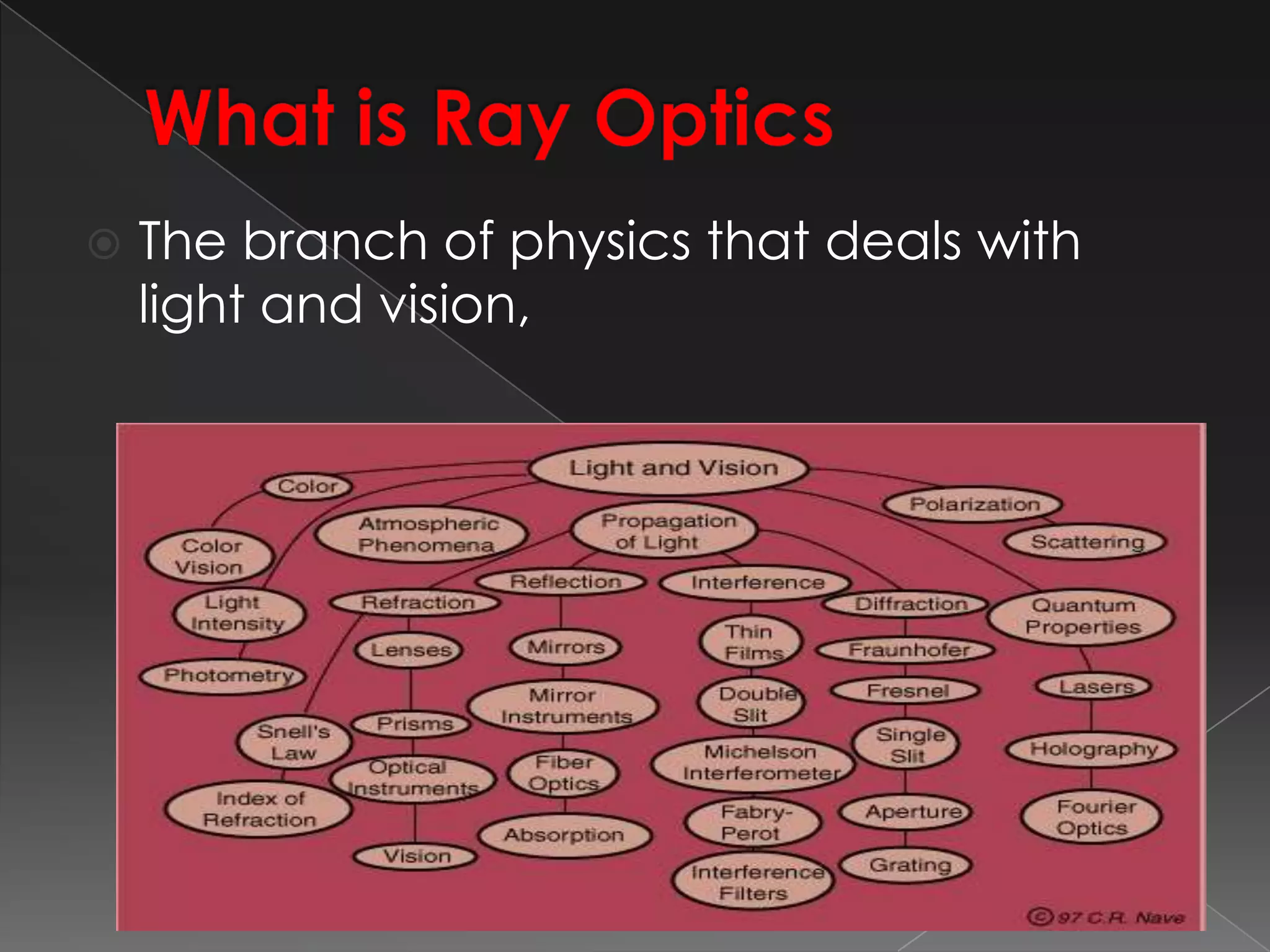

 The branch of physics that deals with
light and vision,
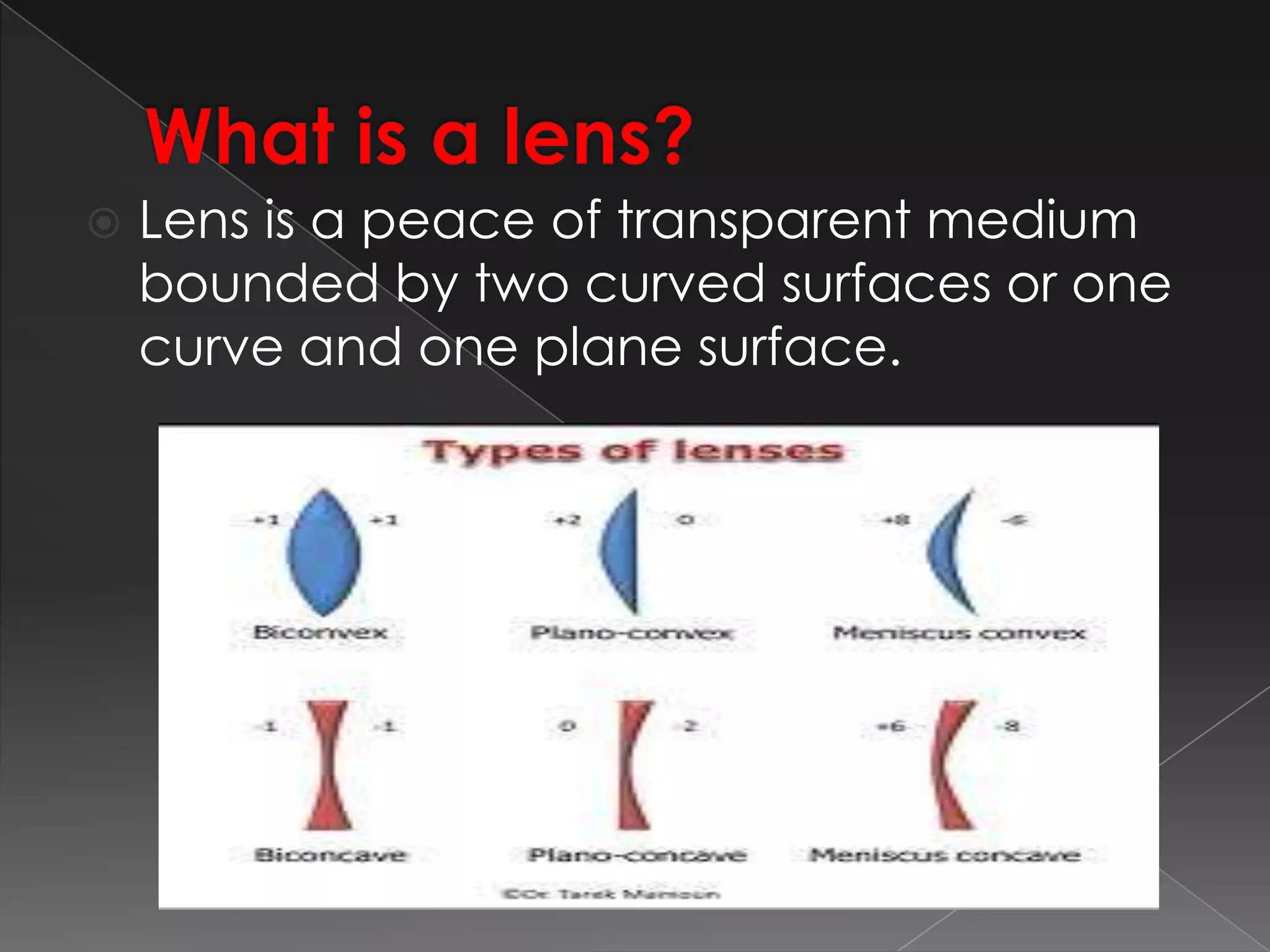
 Lens is a peace of transparent medium
bounded by two curved surfaces or one
curve and one plane surface.
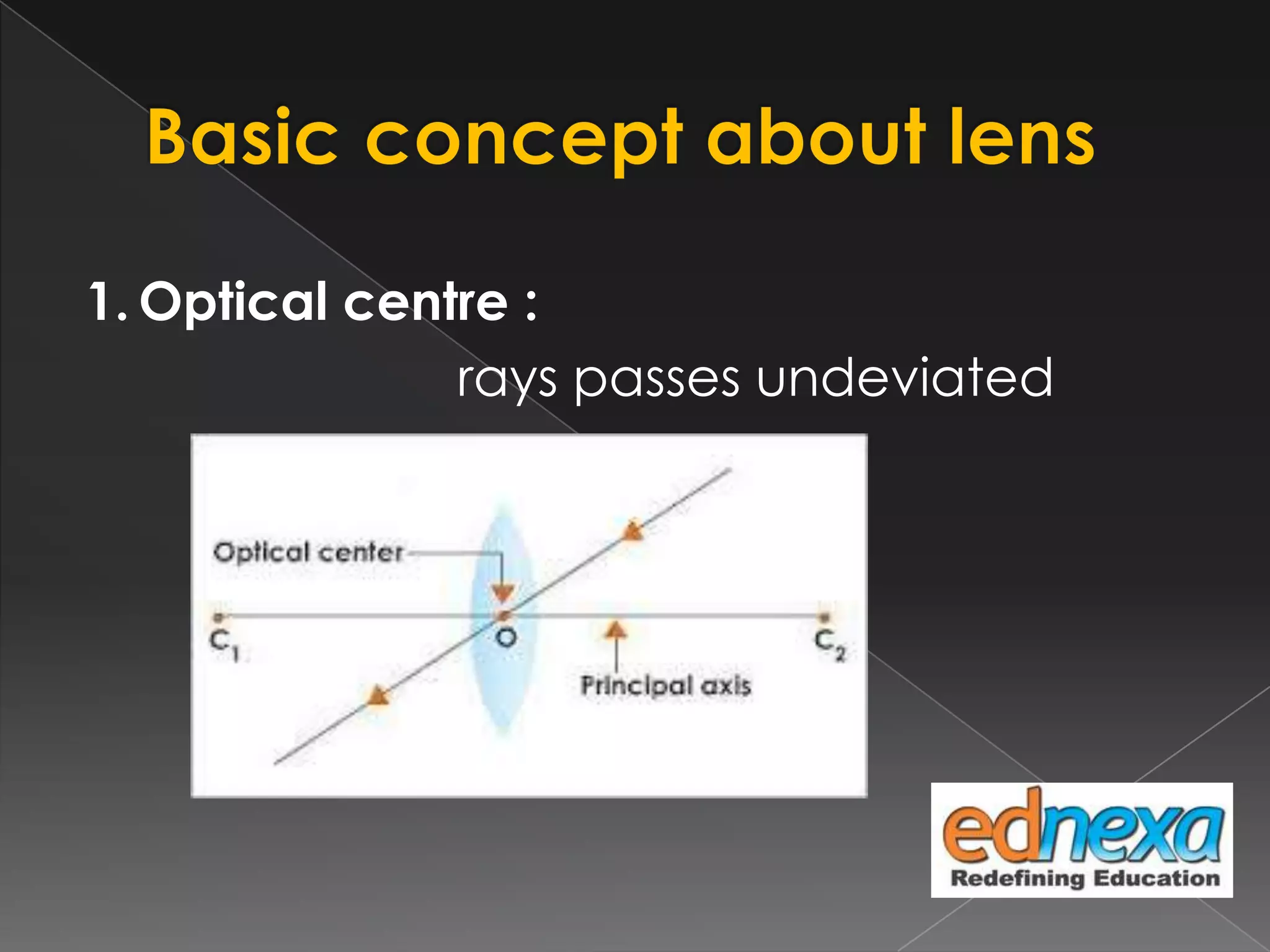
1. Optical centre :
rays passes undeviated
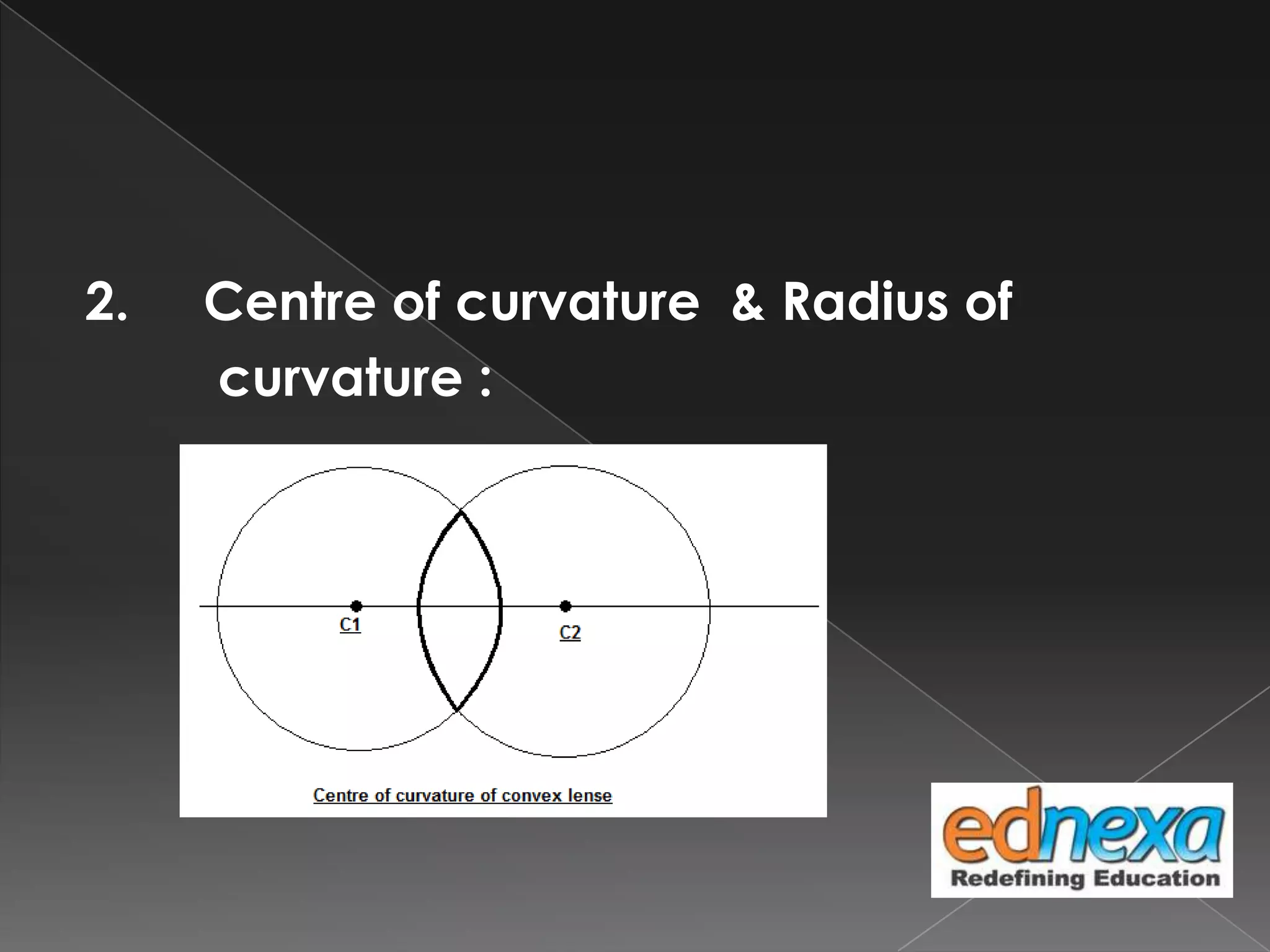
2. Centre of curvature & Radius of
curvature :
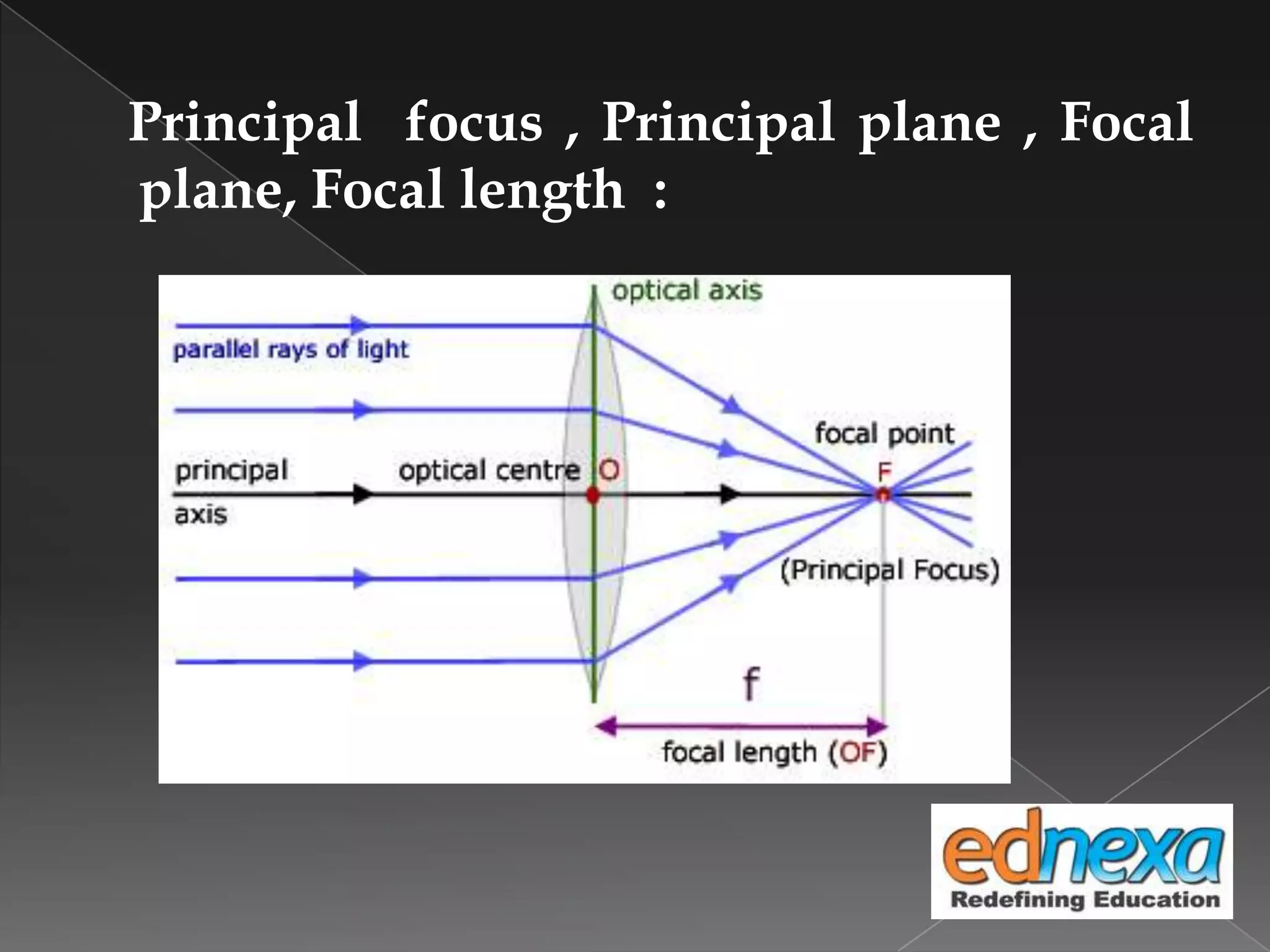
Principal focus , Principal plane , Focal
plane, Focal length :
2
1 2
1
1 2
2
1
2 1
2 1
(1)
According to Snell’s law
sin
(2)
sin
1 2
sin
sin
sinr sin i
sin r r and sin i i
r i .. 3
i
r
From and
i
r
For very small angles
2 1
2 2 1 1
2 1 1 2
2 1 1 2
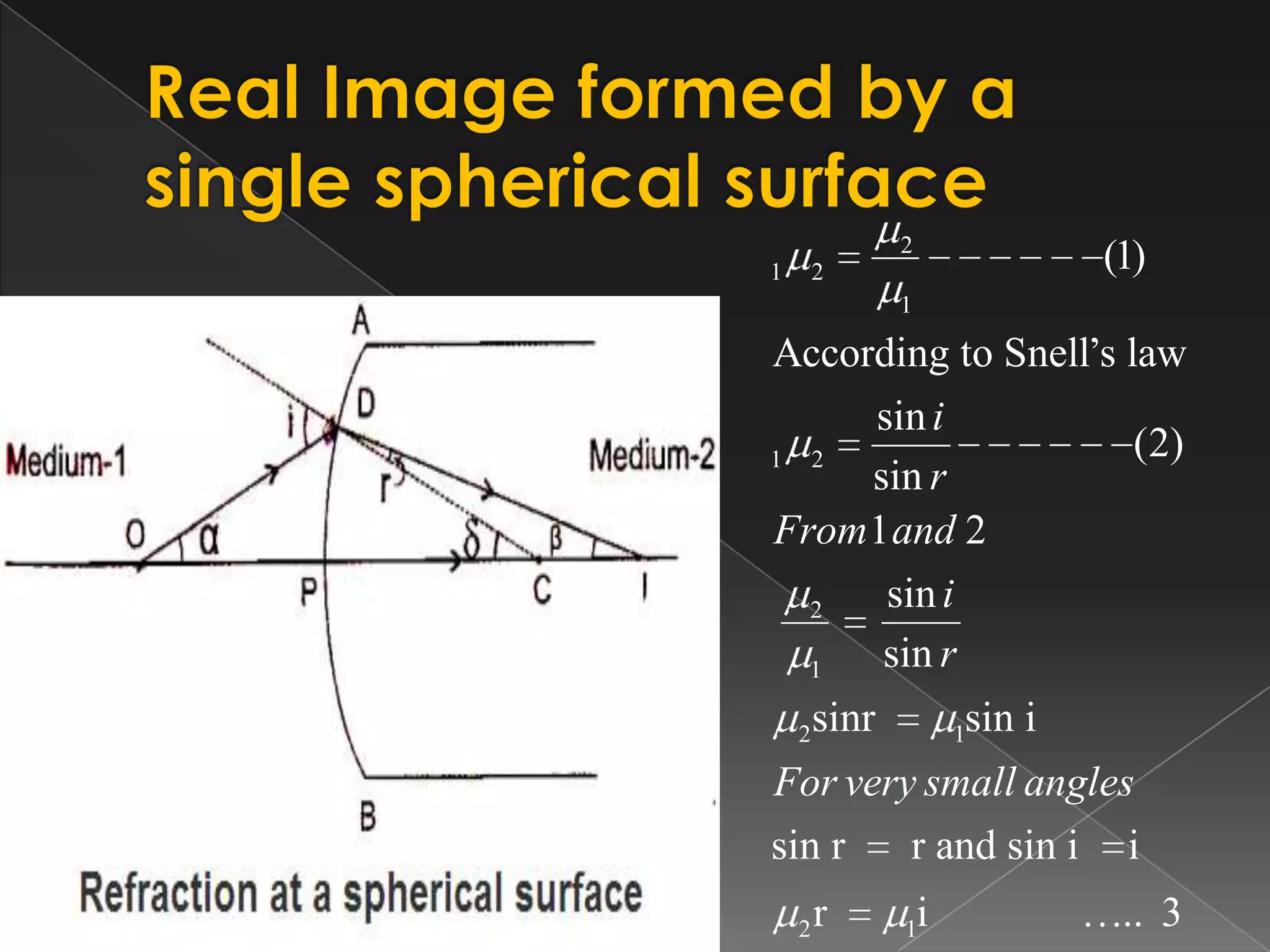
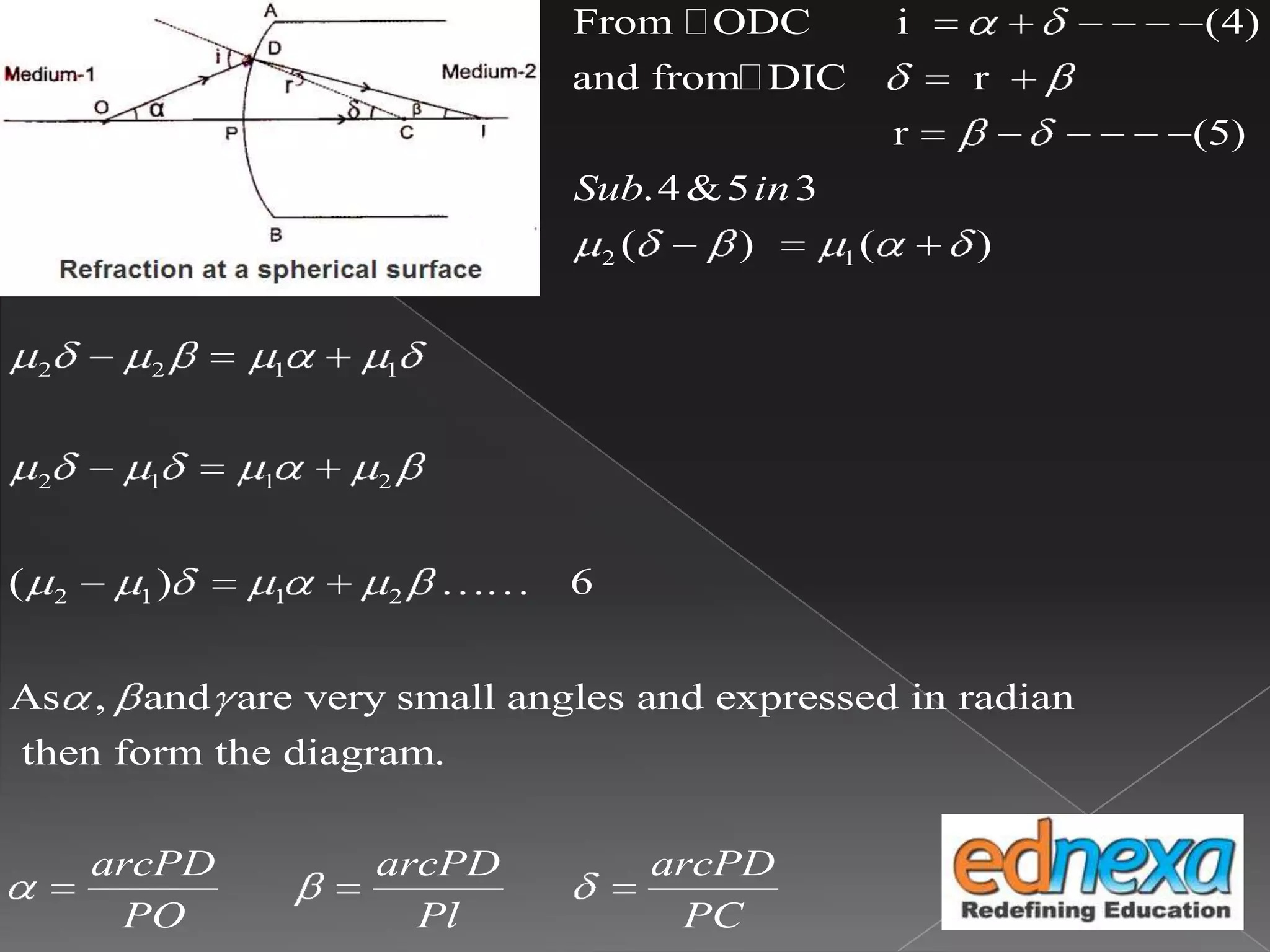
From ODC i (4)
and from DIC r
r (5)
.4&5 3
( ) ( )
( ) 6
As , and are very small angles and expressed in ra
Sub in


dian
then form the diagram.
arcPD arcPD arcPD
PO Pl PC
2 1 1 2
2 1 1 2
2 1 1 2
1 2 2 1
2 1
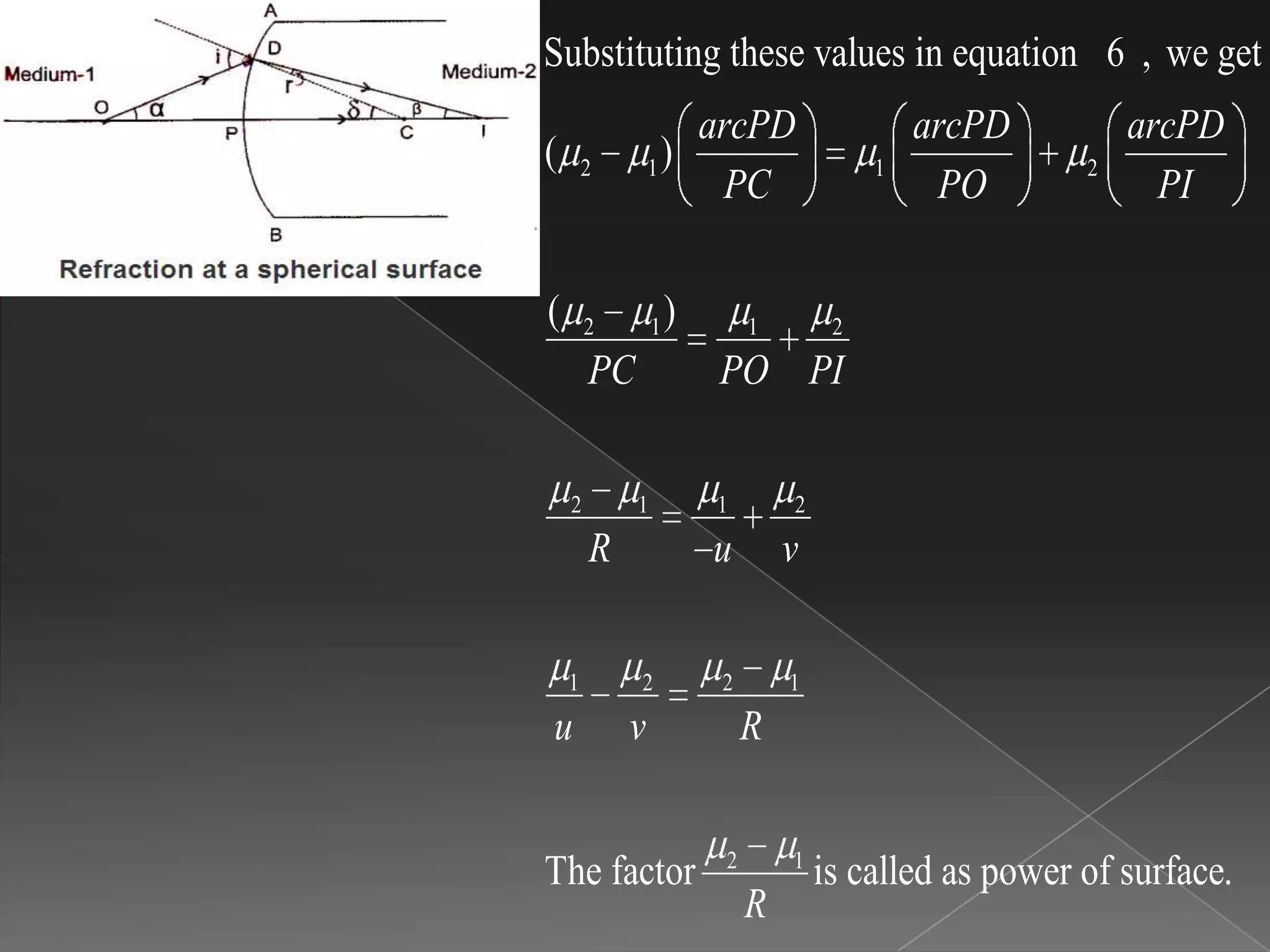
Substituting these values in equation 6 , we get
( )
( )
The factor is called as power of surface.
arcPD arcPD arcPD
PC PO PI
PC PO PI
R u v
u v R
R
1
'
1
1 1
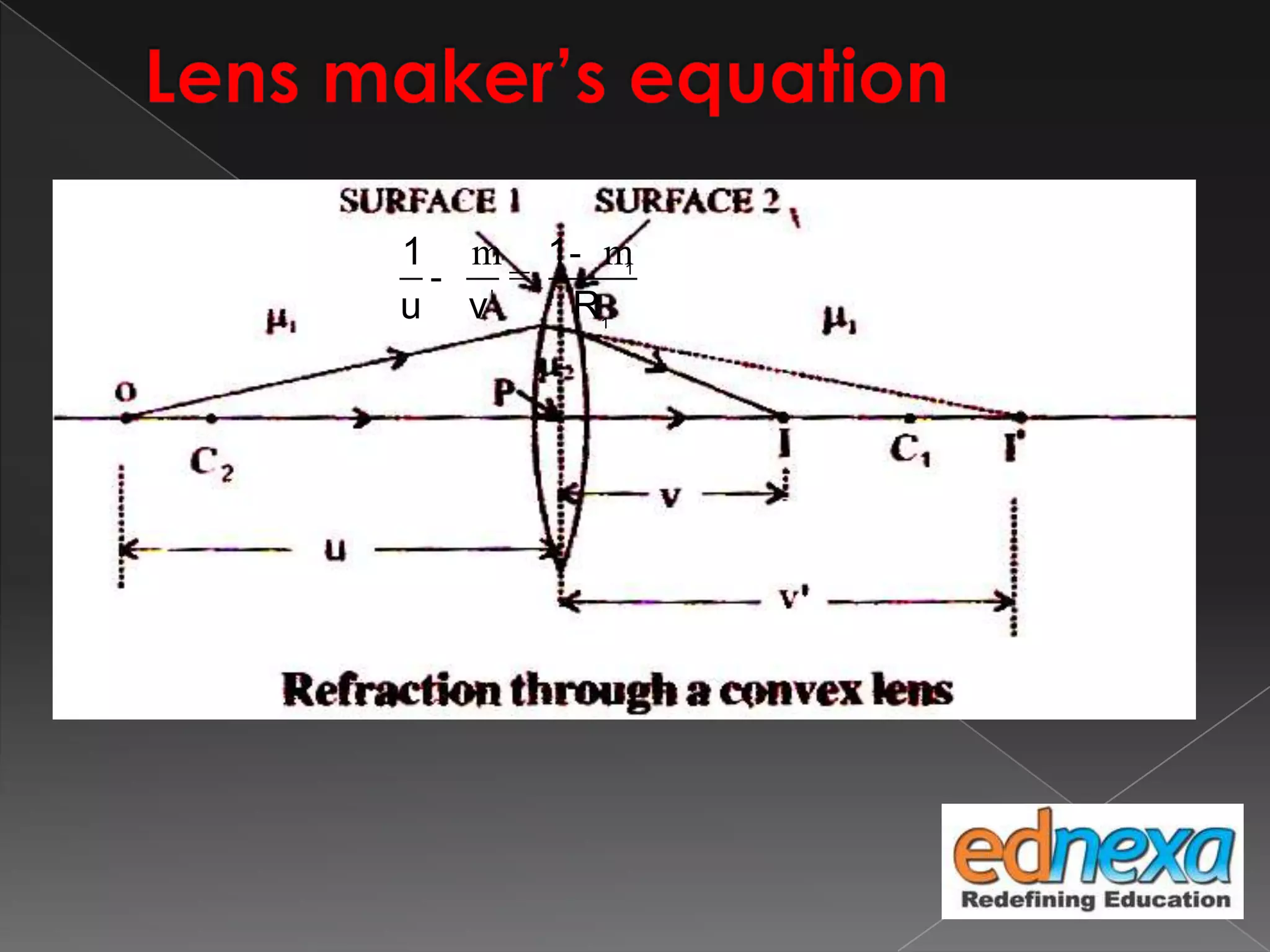
u v R
m - m
- =
1 2 2 1
1 2
'
1
'
2
1 2
1
1, '
1 1
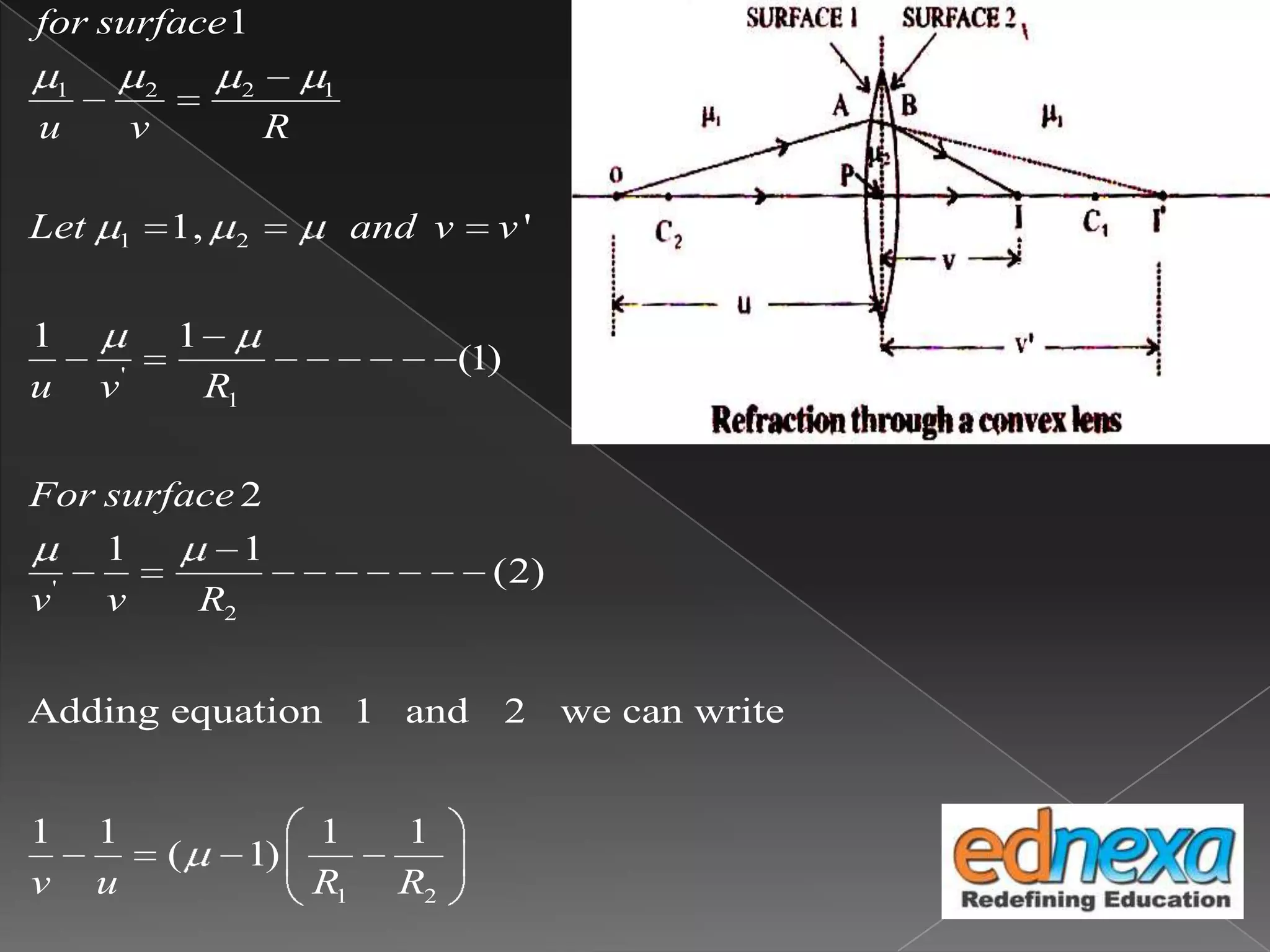
(1)
2
1 1
(2)
Adding equation 1 and 2 we can write
1 1 1 1
( 1)
for surface
u v R
Let and v v
u v R
For surface
v v R
v u R R

1 2
1 2
1 2
1 2
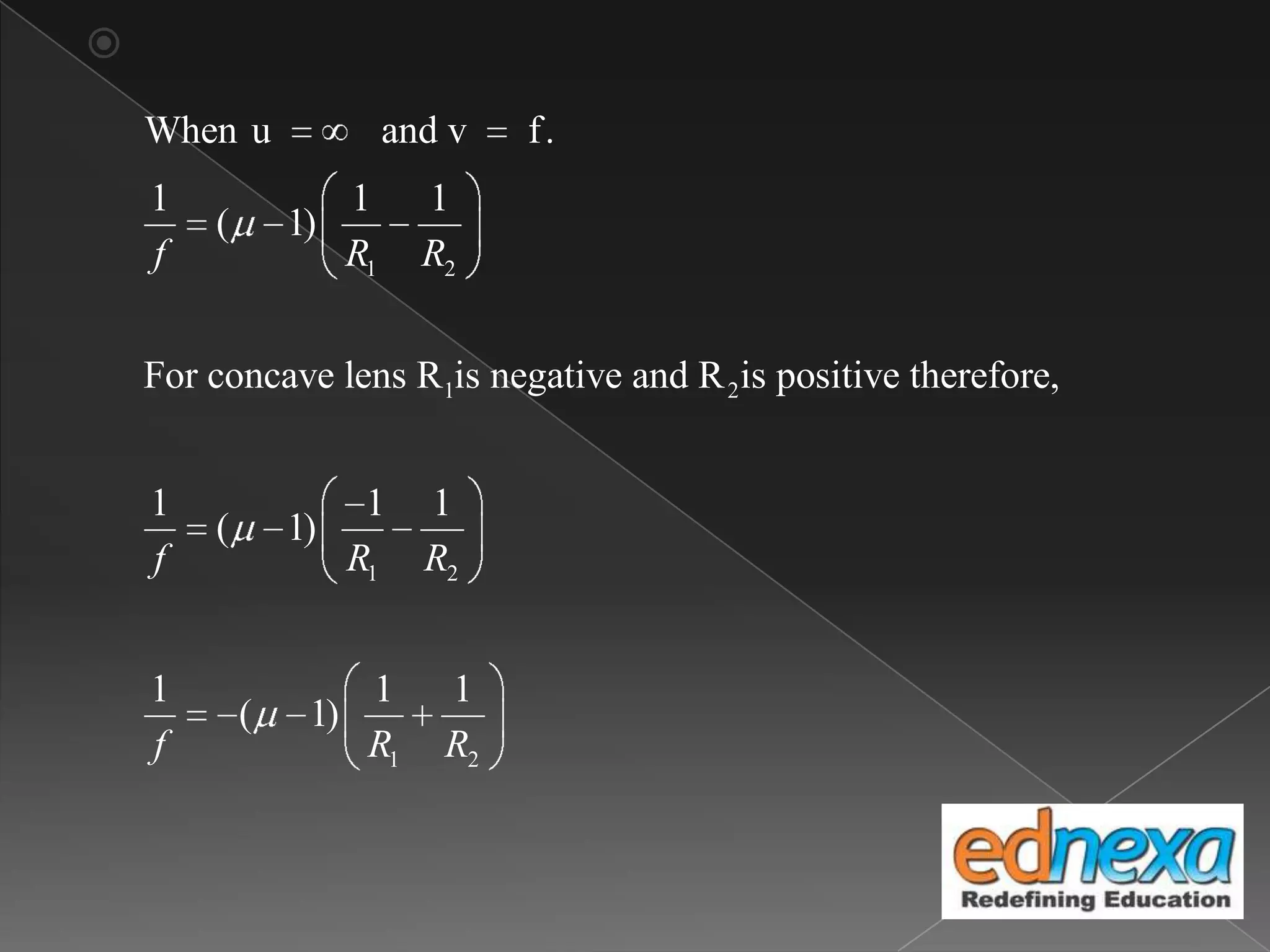
When u and v f.
1 1 1
( 1)
For concave lens R is negative and R is positive therefore,
1 1 1
( 1)
1 1 1
( 1)
f R R
f R R
f R R
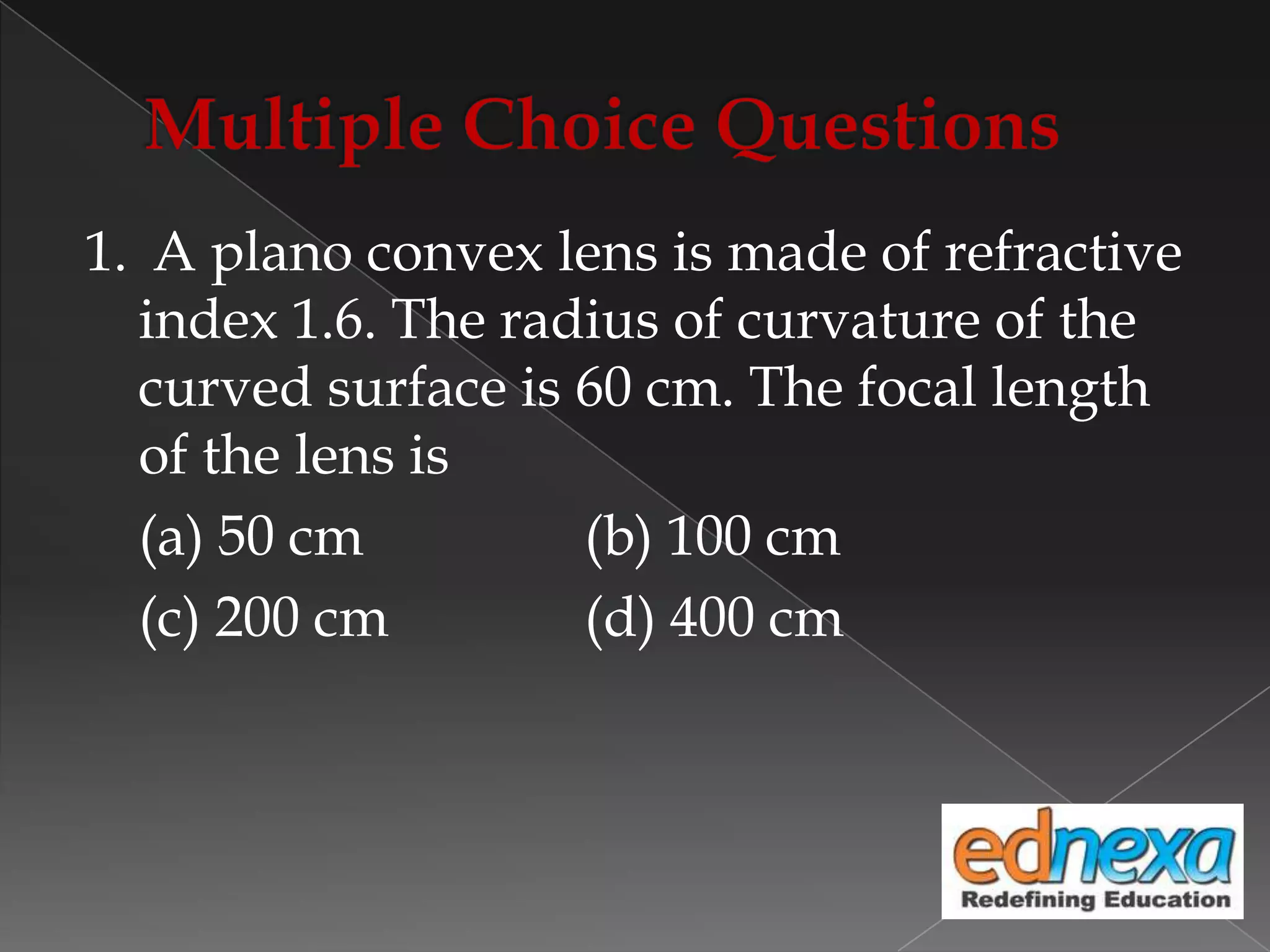
1. A plano convex lens is made of refractive
index 1.6. The radius of curvature of the
curved surface is 60 cm. The focal length
of the lens is
(a) 50 cm (b) 100 cm
(c) 200 cm (d) 400 cm
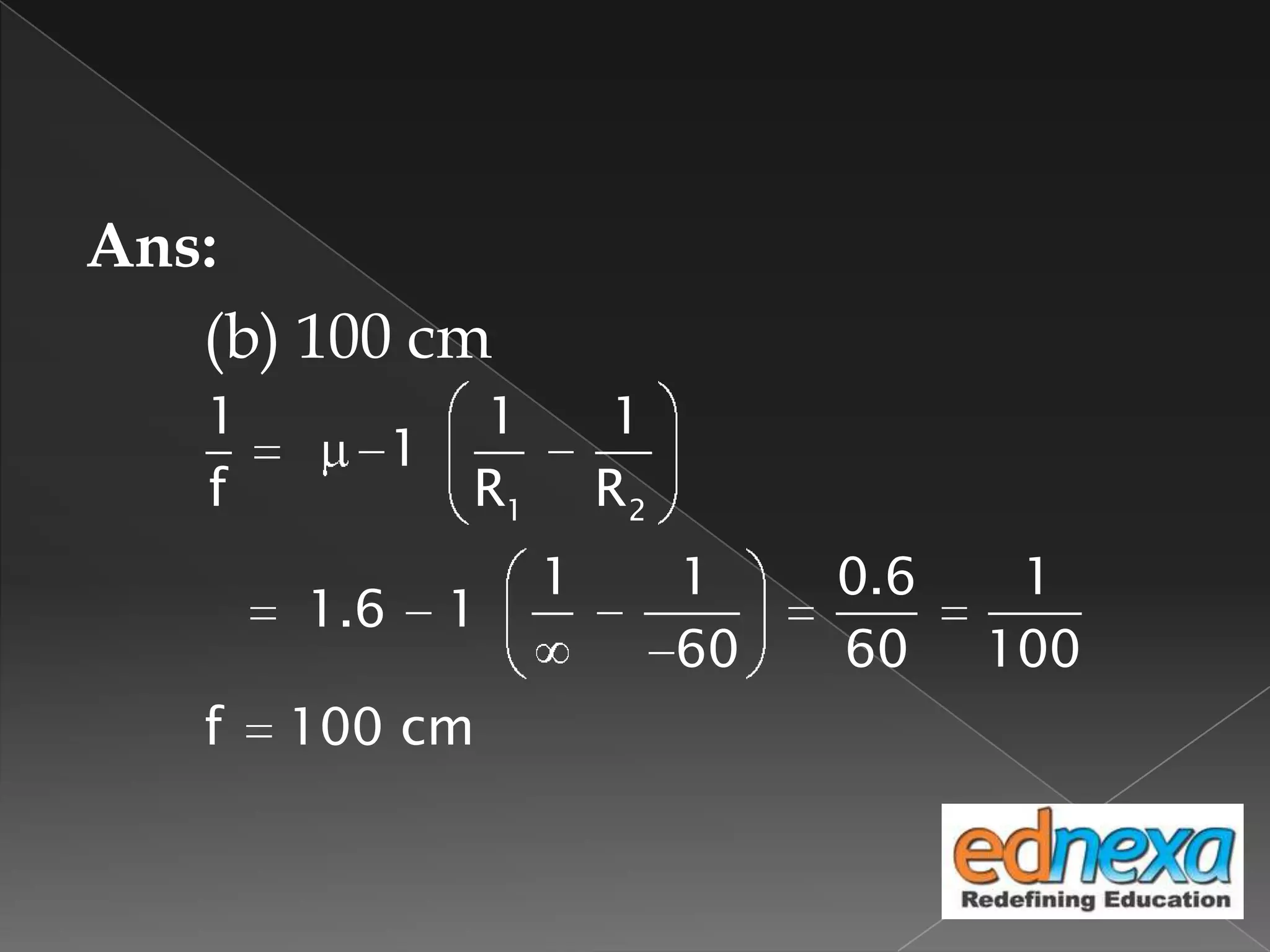
Ans:
(b) 100 cm
1 2
1 1 1
1
f R R
1 1 0.6 1
1.6 1
60 60 100
f 100 cm
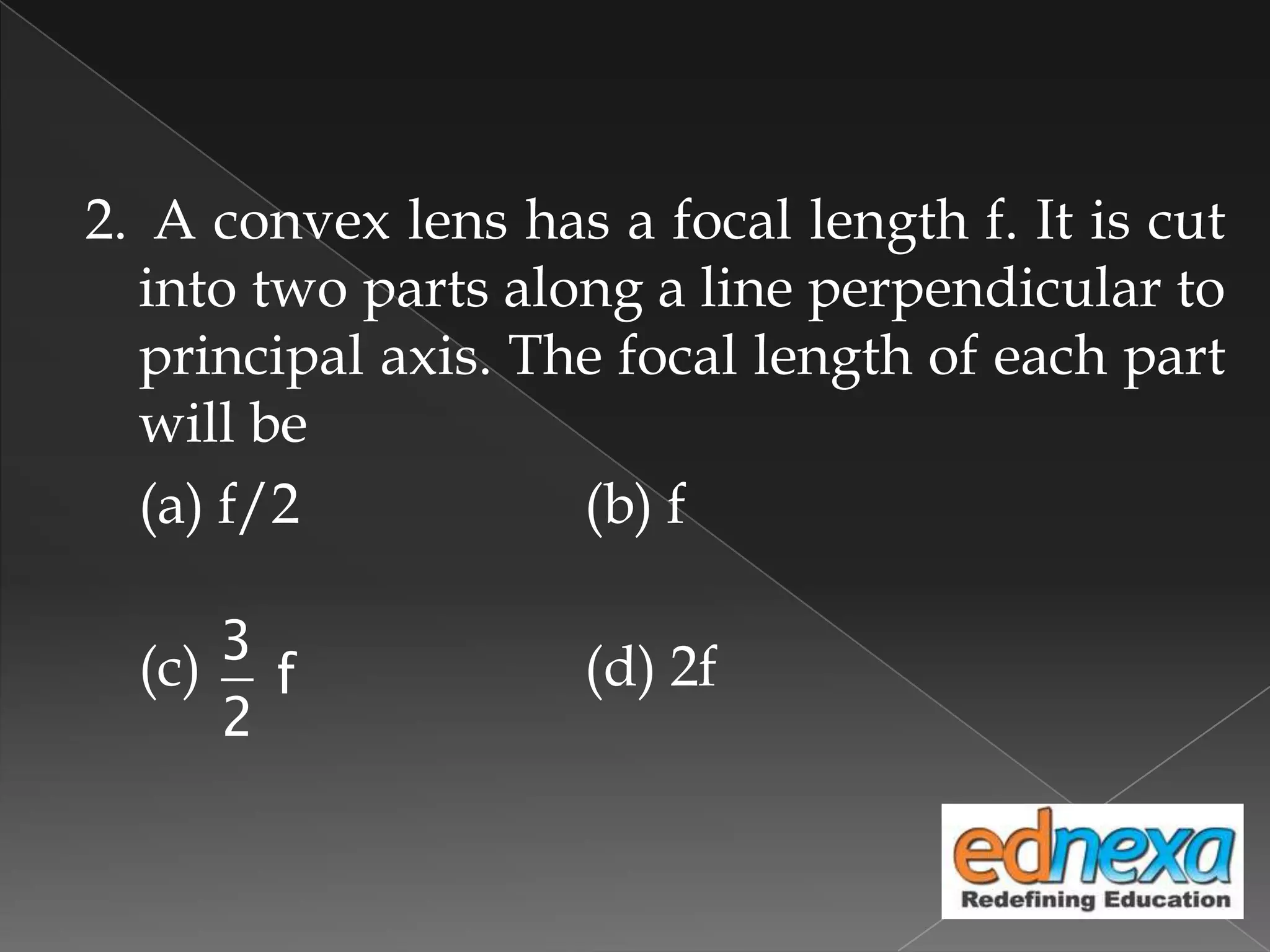
2. A convex lens has a focal length f. It is cut
into two parts along a line perpendicular to
principal axis. The focal length of each part
will be
(a) f/2 (b) f
(c) (d) 2f3
f
2
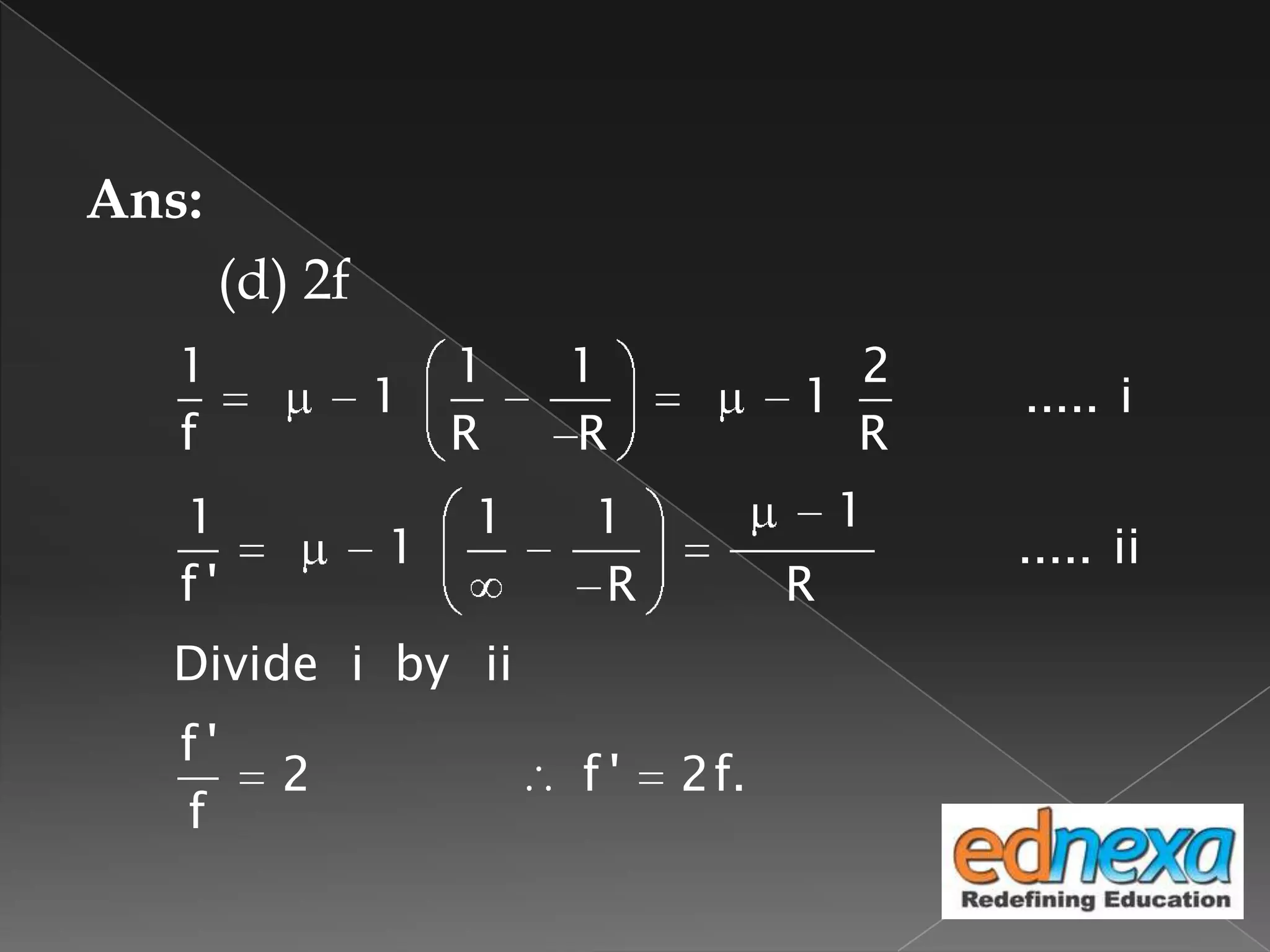
Ans:
(d) 2f
1 1 1 2
1 1 ..... i
f R R R
11 1 1
1 ..... ii
f ' R R
Divide i by ii
f '
2 f ' 2f.
f
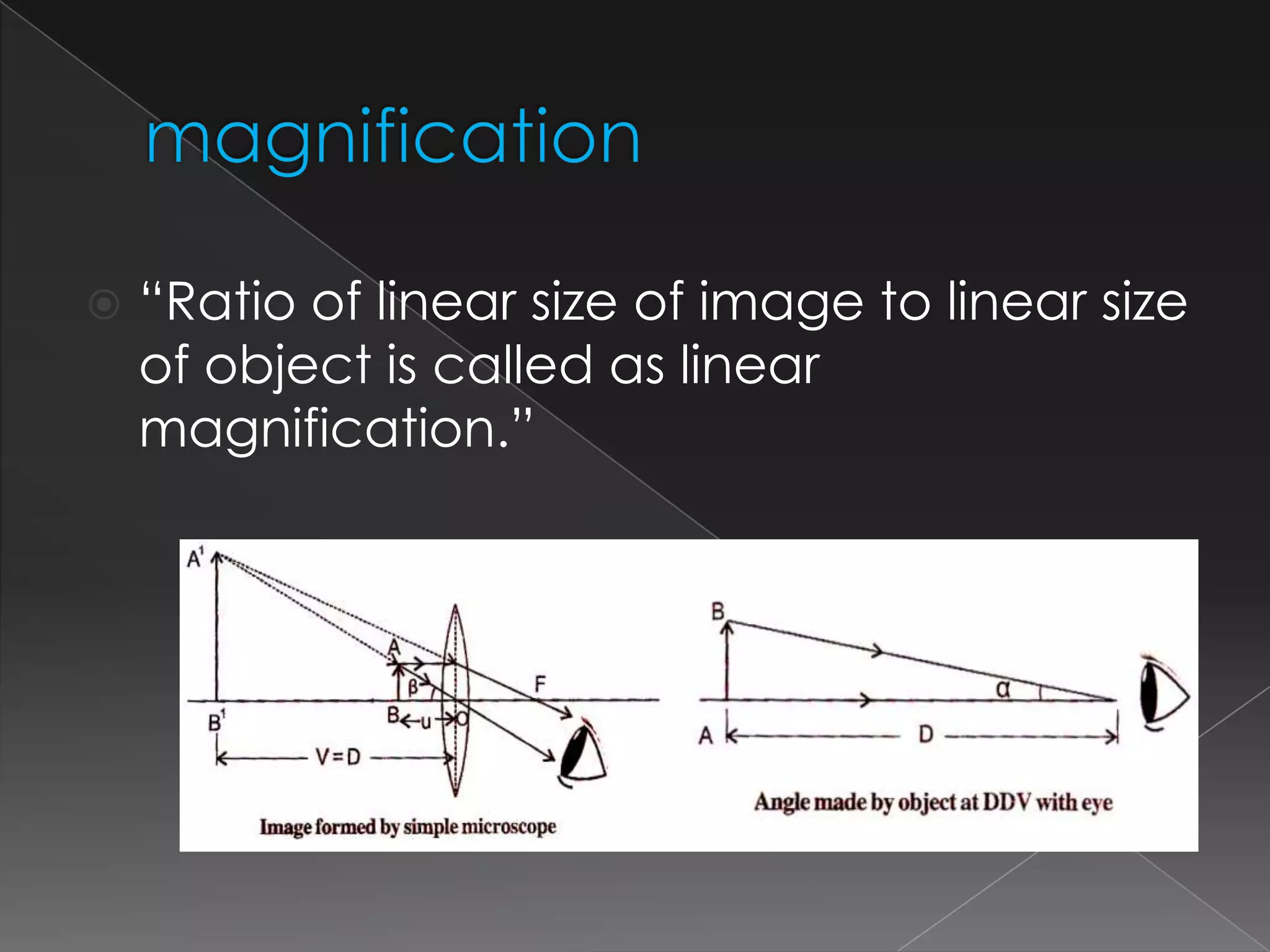
 “Ratio of linear size of image to linear size
of object is called as linear
magnification.”
 “The ability of a lens to converge or
diverge the rays passing through it is
called as power of lens.”
 “Power of lens can also be defined as
reciprocal of focal length in meter.”
 The minimum distance of an object from
eye at which the object can clearly seen
without causing strain to the eye is called
as least distance of distinct vision (D) or
distance of distinct vision (DDV)
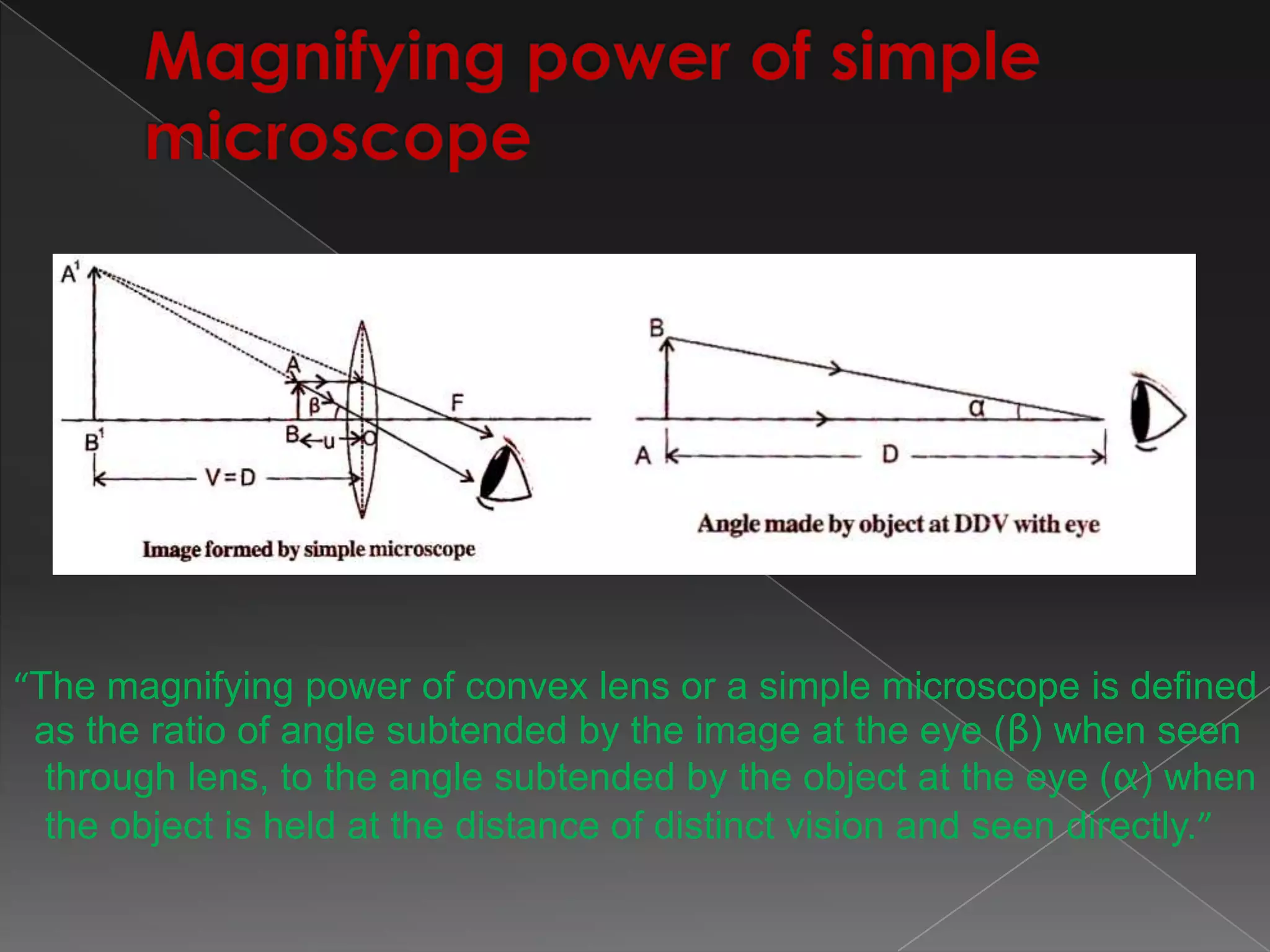
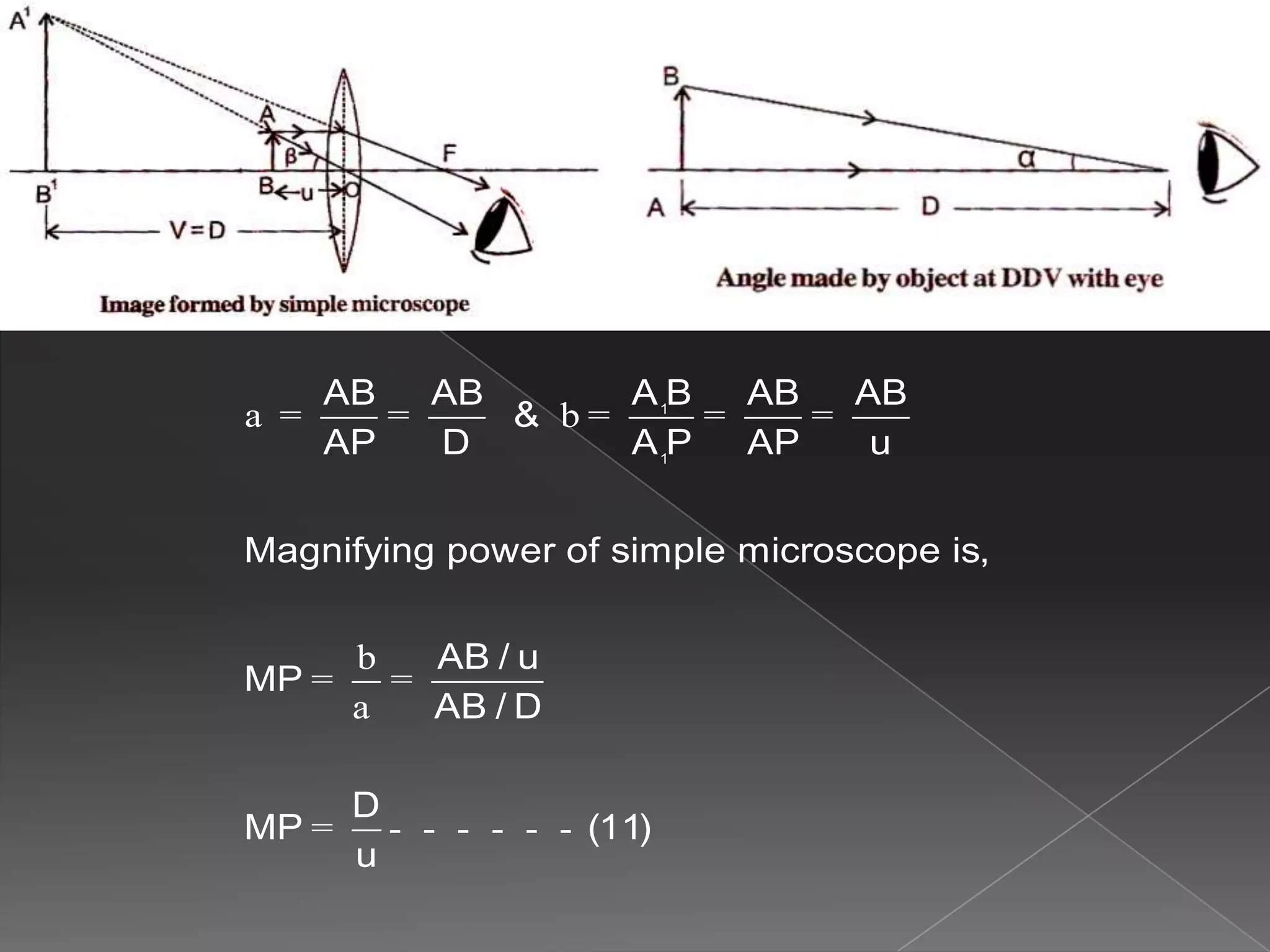
“The magnifying power of convex lens or a simple microscope is defined
as the ratio of angle subtended by the image at the eye (β) when seen
through lens, to the angle subtended by the object at the eye (α) when
the object is held at the distance of distinct vision and seen directly.”
1
1
AB AB A B AB AB
&
AP D A P AP u
Magnifying power of simple microscope is,
AB / u
MP
AB / D
D
MP (11)
u
a = = b = = =
b
= =
a
= - - - - - -
1 1 1
But
f v u
Applying new Cartesian sign conventions
1 1 1 1 1
f ( v) ( u) v u
1 1 1
u f v
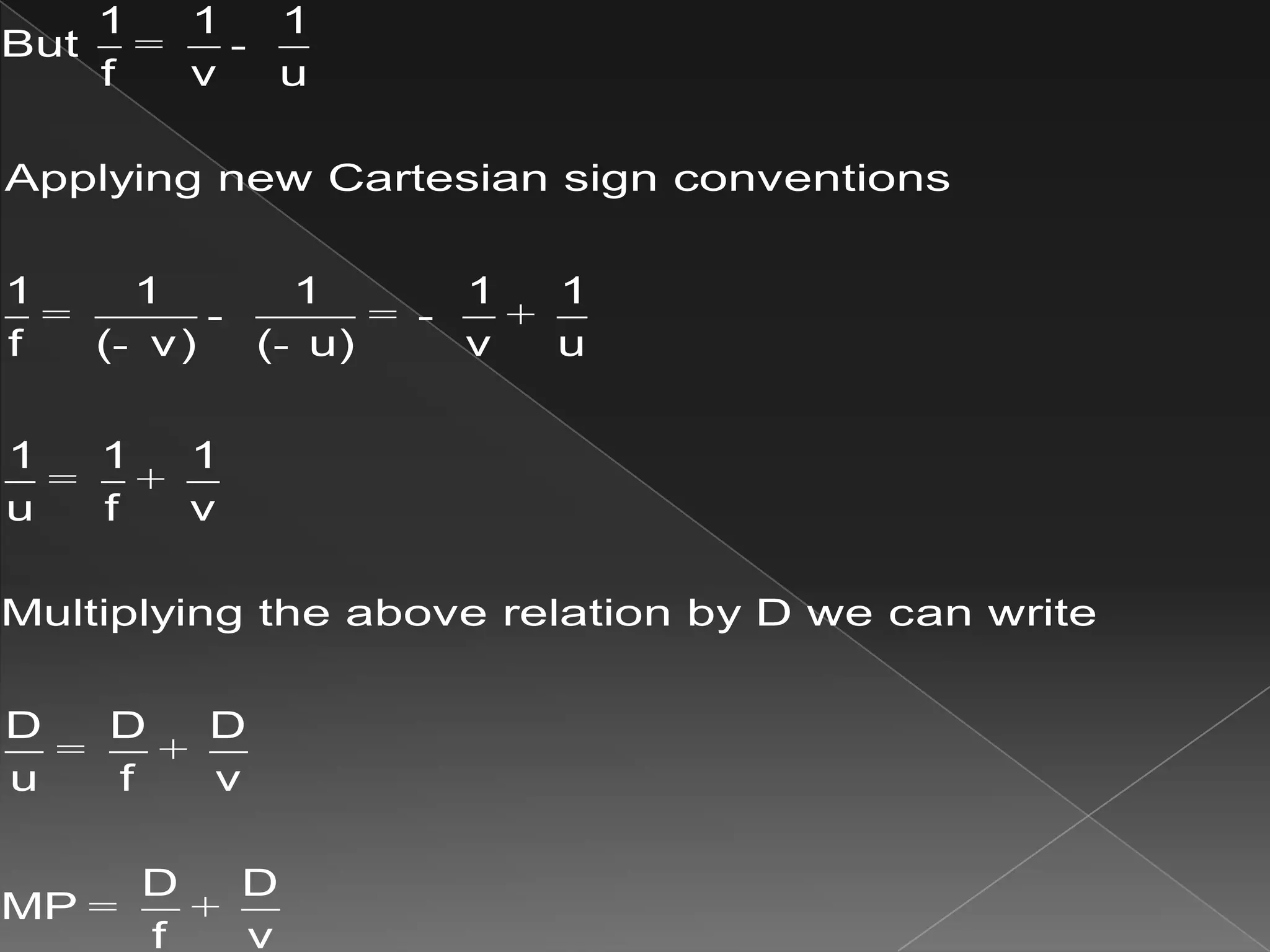
Multiplying the above relation by D we can write
D D D
u f v
D D
MP
f v
= -
= - = - +
- -
= +
= +
= +
1 1
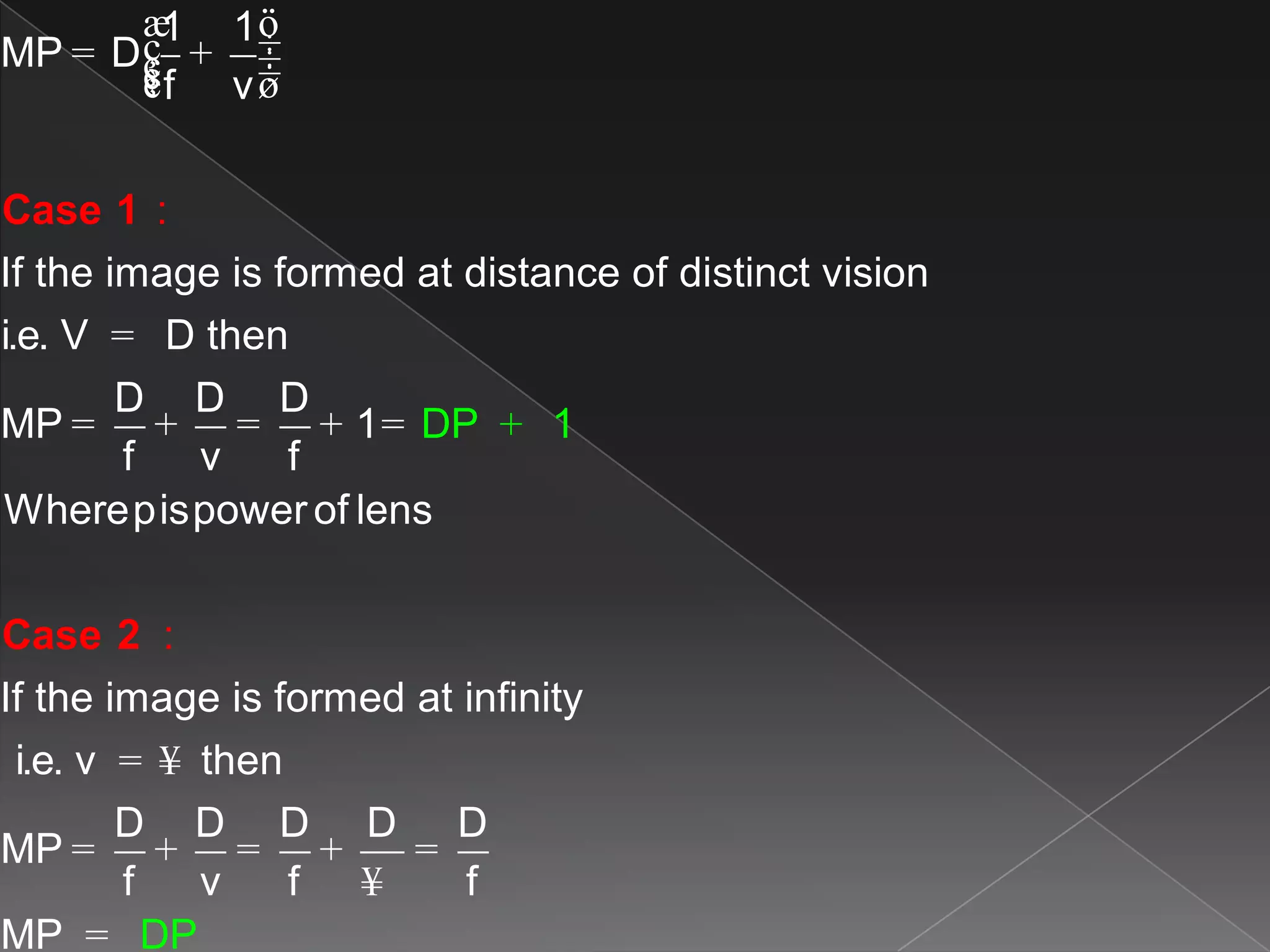
MP D
f v
If the image is formed at distance of distinct vision
i.e. V D then
D D D
MP 1
f
:
v f
Wherepispowerof lens
If the image is formed
DP
at infinity
i.e. v then
D D
MP
f v
1
:
æ ö
÷ç= + ÷ç ÷çè ø
=
= + = + =
= ¥
=
+
+ =
Case 1
Case 2
D D D
f f
MP DP
+ =
¥
=
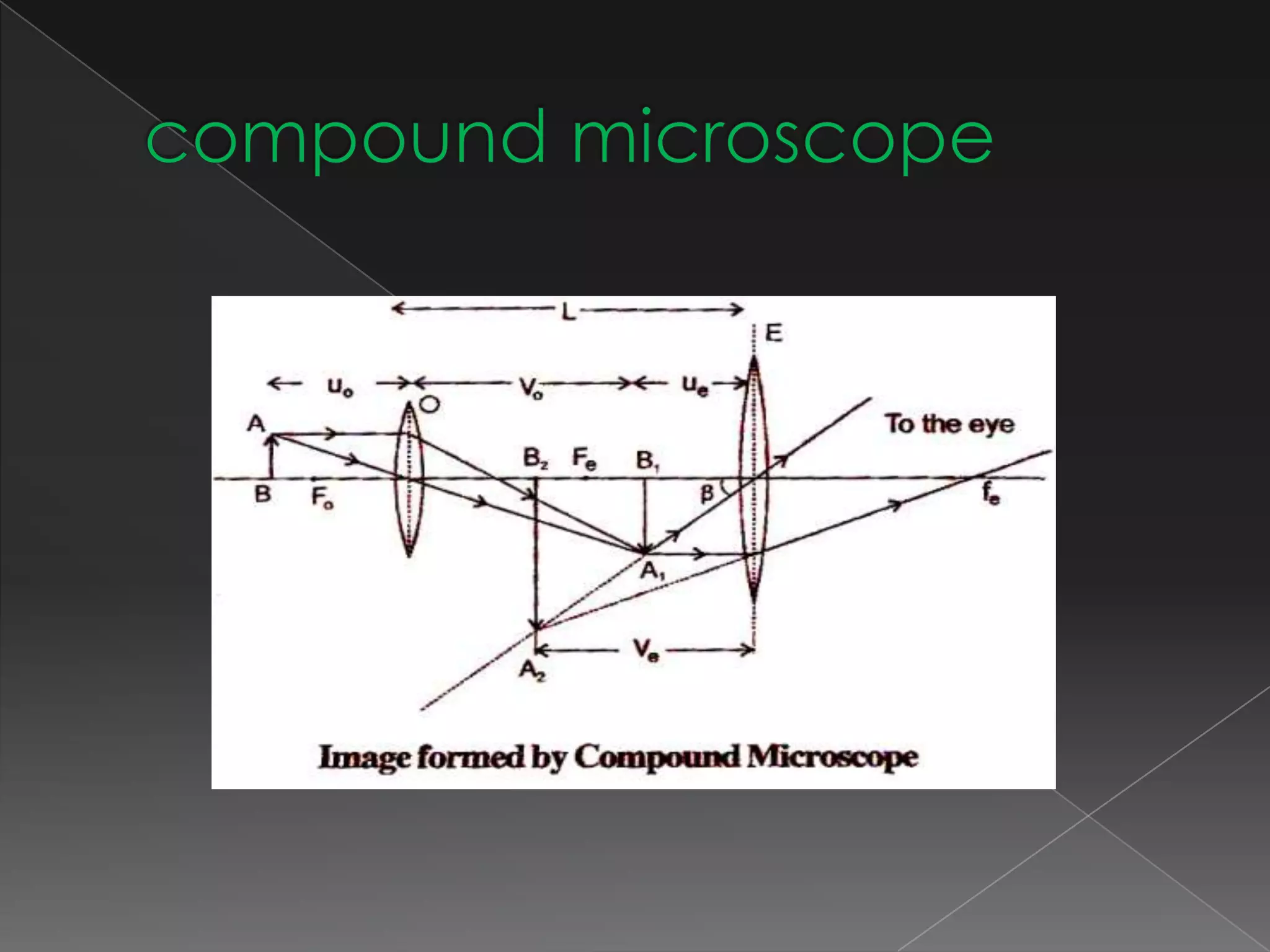
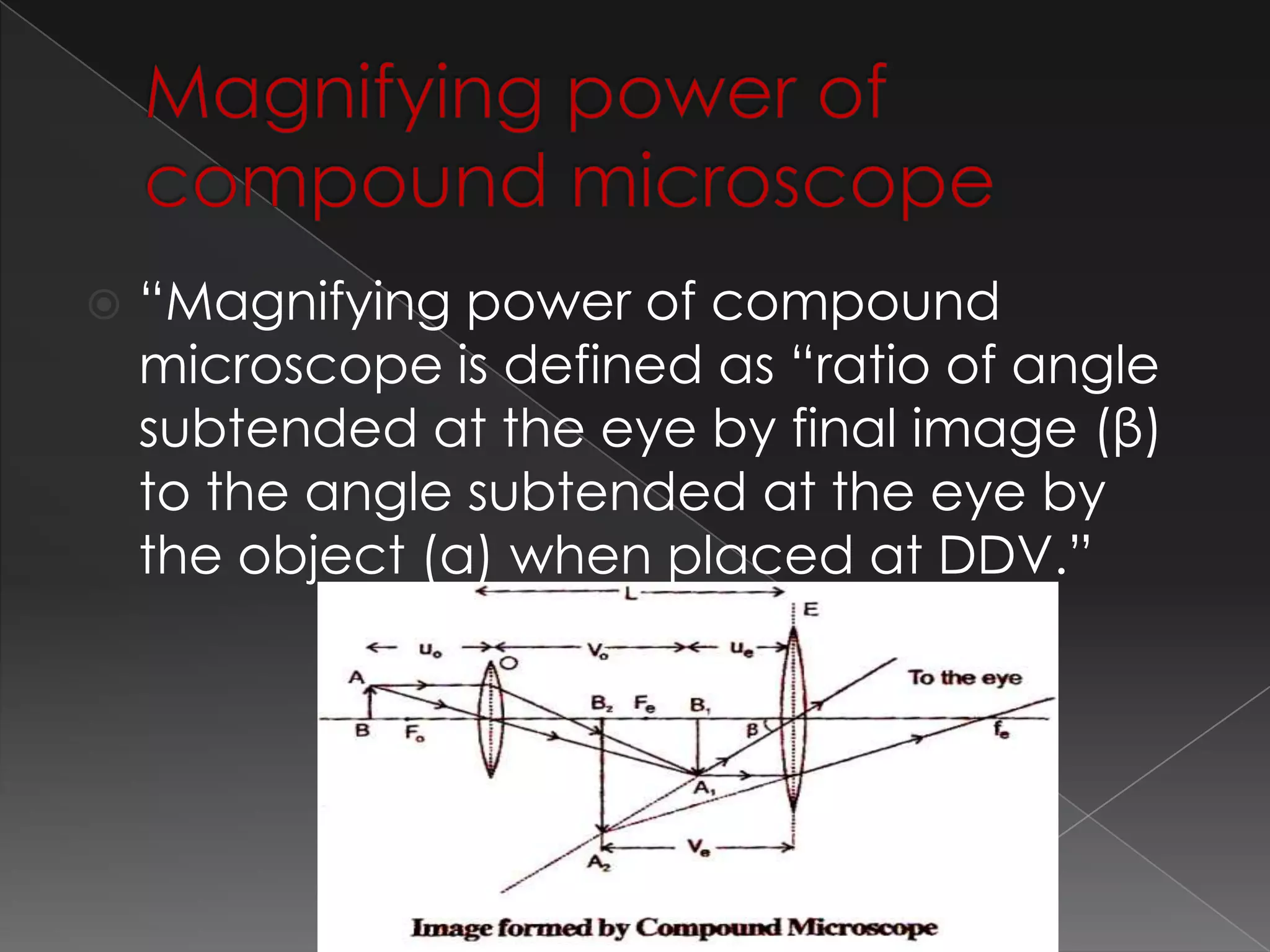
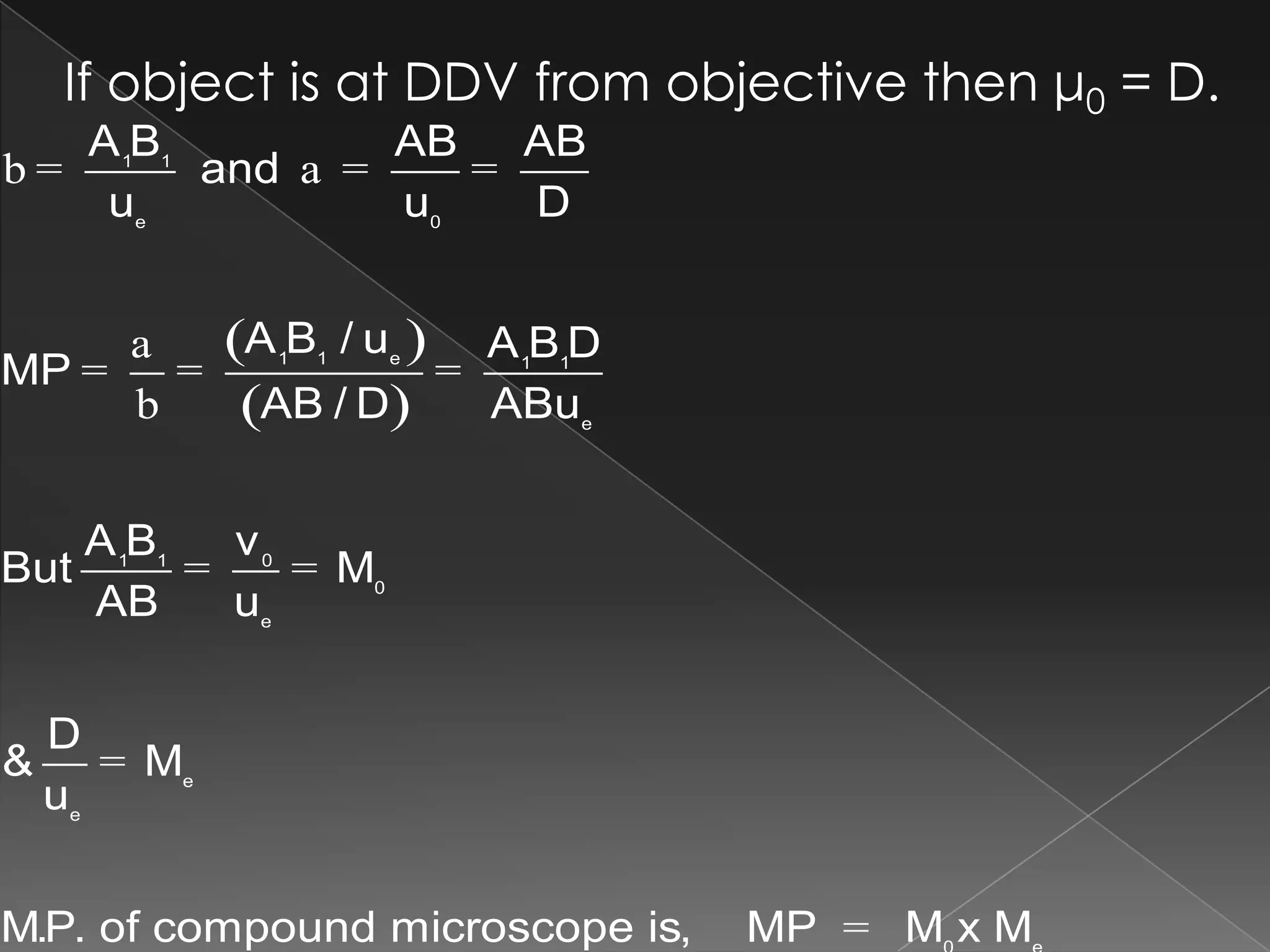
 “Magnifying power of compound
microscope is defined as “ratio of angle
subtended at the eye by final image (β)
to the angle subtended at the eye by
the object (α) when placed at DDV.”
If object is at DDV from objective then μ0 = D.
( )
( )
1 1
e 0
1 1 e 1 1
e
01 1
0
e
e
e
A B AB AB
and
u u D
A B / u A B D
MP
AB / D ABu
vA B
But M
AB u
D
& M
u
M.P. of compound microscope is, MP M x M
b = a = =
a
= = =
b
= =
=
=
0 e
0
0
0 e
0
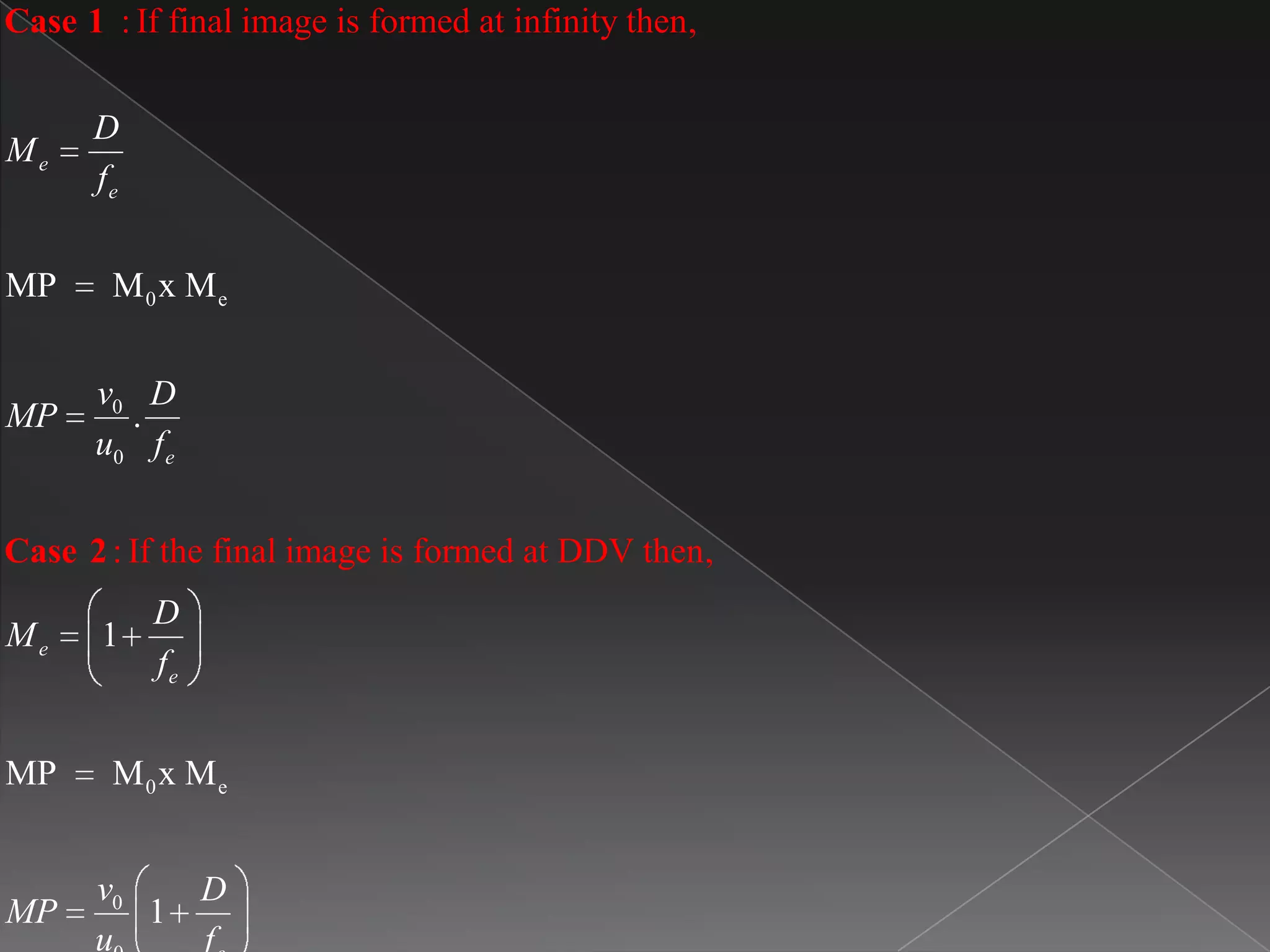
: If final image is formed at infinity then,
: If the final image is formed
MP M x M
.
1
MP M x M
1
at DDV then,
e
e
e
e
e
D
M
f
v D
MP
u f
D
M
f
v D
MP
u f
Case 1
Case 2
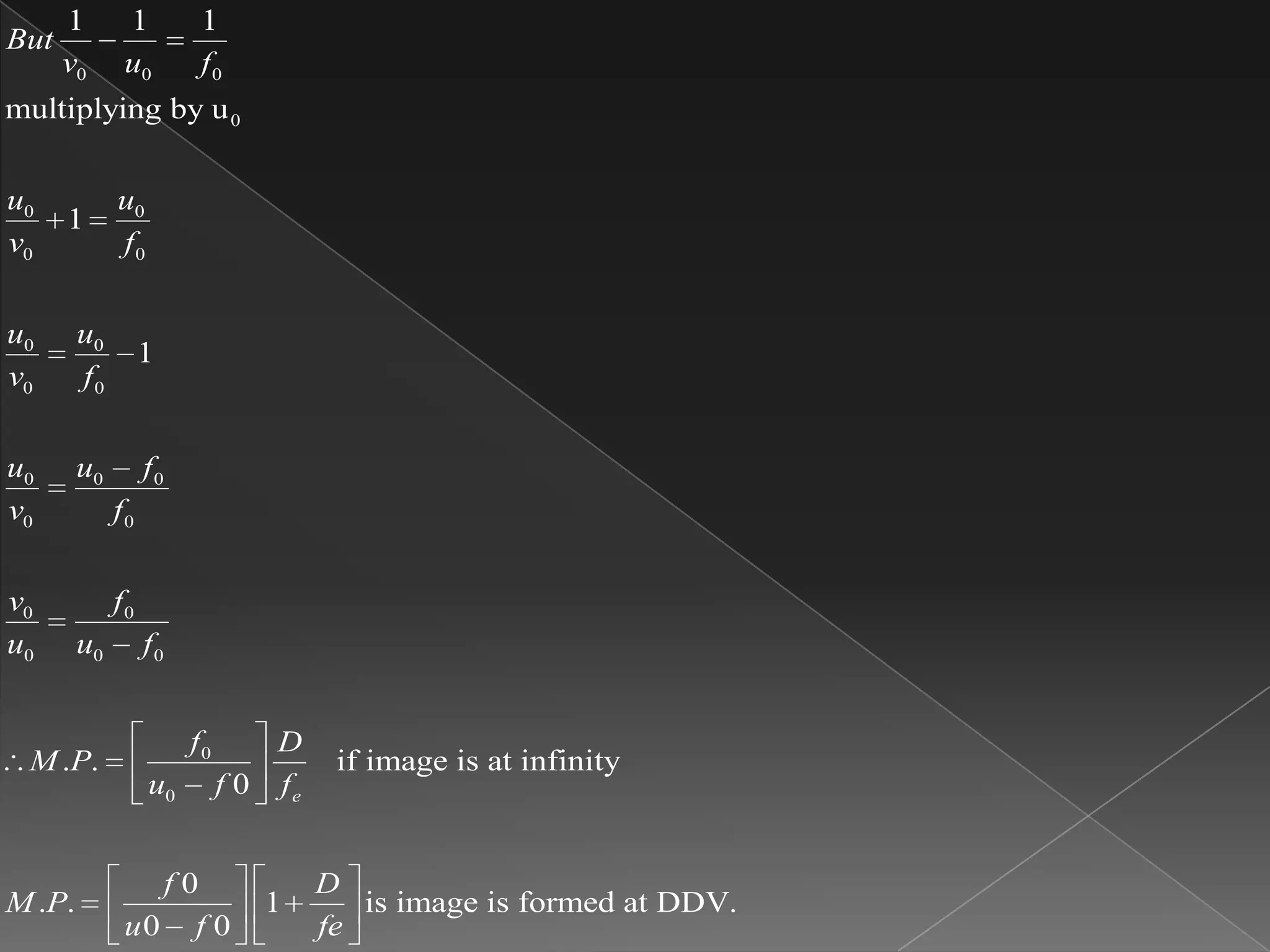
0 0 0
0
0 0
0 0
0 0
0 0
0 0 0
0 0
0 0
0 0 0
0
0
1 1 1
multiplying by u
1
1
. . if image is at infinity
0
0
. . 1 is image is formed at DDV.
0 0
e
But
v u f
u u
v f
u u
v f
u u f
v f
v f
u u f
f D
M P
u f f
f D
M P
u f fe
• Ask Your Doubts
• For inquiry and registration, call
9011041155 / 9011031155.

How to Study Ray Optics in Physics?

  • 3.
     The branchof physics that deals with light and vision,
  • 4.
     Lens isa peace of transparent medium bounded by two curved surfaces or one curve and one plane surface.
  • 5.
    1. Optical centre: rays passes undeviated
  • 6.
    2. Centre ofcurvature & Radius of curvature :
  • 7.
    Principal focus ,Principal plane , Focal plane, Focal length :
  • 10.
    2 1 2 1 1 2 2 1 21 2 1 (1) According to Snell’s law sin (2) sin 1 2 sin sin sinr sin i sin r r and sin i i r i .. 3 i r From and i r For very small angles
  • 11.
    2 1 2 21 1 2 1 1 2 2 1 1 2 From ODC i (4) and from DIC r r (5) .4&5 3 ( ) ( ) ( ) 6 As , and are very small angles and expressed in ra Sub in   dian then form the diagram. arcPD arcPD arcPD PO Pl PC
  • 12.
    2 1 12 2 1 1 2 2 1 1 2 1 2 2 1 2 1 Substituting these values in equation 6 , we get ( ) ( ) The factor is called as power of surface. arcPD arcPD arcPD PC PO PI PC PO PI R u v u v R R
  • 13.
    1 ' 1 1 1 u vR m - m - =
  • 14.
    1 2 21 1 2 ' 1 ' 2 1 2 1 1, ' 1 1 (1) 2 1 1 (2) Adding equation 1 and 2 we can write 1 1 1 1 ( 1) for surface u v R Let and v v u v R For surface v v R v u R R
  • 15.
     1 2 1 2 12 1 2 When u and v f. 1 1 1 ( 1) For concave lens R is negative and R is positive therefore, 1 1 1 ( 1) 1 1 1 ( 1) f R R f R R f R R
  • 17.
    1. A planoconvex lens is made of refractive index 1.6. The radius of curvature of the curved surface is 60 cm. The focal length of the lens is (a) 50 cm (b) 100 cm (c) 200 cm (d) 400 cm
  • 18.
    Ans: (b) 100 cm 12 1 1 1 1 f R R 1 1 0.6 1 1.6 1 60 60 100 f 100 cm
  • 19.
    2. A convexlens has a focal length f. It is cut into two parts along a line perpendicular to principal axis. The focal length of each part will be (a) f/2 (b) f (c) (d) 2f3 f 2
  • 20.
    Ans: (d) 2f 1 11 2 1 1 ..... i f R R R 11 1 1 1 ..... ii f ' R R Divide i by ii f ' 2 f ' 2f. f
  • 21.
     “Ratio oflinear size of image to linear size of object is called as linear magnification.”
  • 22.
     “The abilityof a lens to converge or diverge the rays passing through it is called as power of lens.”  “Power of lens can also be defined as reciprocal of focal length in meter.”
  • 23.
     The minimumdistance of an object from eye at which the object can clearly seen without causing strain to the eye is called as least distance of distinct vision (D) or distance of distinct vision (DDV)
  • 24.
    “The magnifying powerof convex lens or a simple microscope is defined as the ratio of angle subtended by the image at the eye (β) when seen through lens, to the angle subtended by the object at the eye (α) when the object is held at the distance of distinct vision and seen directly.”
  • 25.
    1 1 AB AB AB AB AB & AP D A P AP u Magnifying power of simple microscope is, AB / u MP AB / D D MP (11) u a = = b = = = b = = a = - - - - - -
  • 26.
    1 1 1 But fv u Applying new Cartesian sign conventions 1 1 1 1 1 f ( v) ( u) v u 1 1 1 u f v Multiplying the above relation by D we can write D D D u f v D D MP f v = - = - = - + - - = + = + = +
  • 27.
    1 1 MP D fv If the image is formed at distance of distinct vision i.e. V D then D D D MP 1 f : v f Wherepispowerof lens If the image is formed DP at infinity i.e. v then D D MP f v 1 : æ ö ÷ç= + ÷ç ÷çè ø = = + = + = = ¥ = + + = Case 1 Case 2 D D D f f MP DP + = ¥ =
  • 29.
     “Magnifying powerof compound microscope is defined as “ratio of angle subtended at the eye by final image (β) to the angle subtended at the eye by the object (α) when placed at DDV.”
  • 30.
    If object isat DDV from objective then μ0 = D. ( ) ( ) 1 1 e 0 1 1 e 1 1 e 01 1 0 e e e A B AB AB and u u D A B / u A B D MP AB / D ABu vA B But M AB u D & M u M.P. of compound microscope is, MP M x M b = a = = a = = = b = = = =
  • 31.
    0 e 0 0 0 e 0 :If final image is formed at infinity then, : If the final image is formed MP M x M . 1 MP M x M 1 at DDV then, e e e e e D M f v D MP u f D M f v D MP u f Case 1 Case 2
  • 32.
    0 0 0 0 00 0 0 0 0 0 0 0 0 0 0 0 0 0 0 0 0 0 0 1 1 1 multiplying by u 1 1 . . if image is at infinity 0 0 . . 1 is image is formed at DDV. 0 0 e But v u f u u v f u u v f u u f v f v f u u f f D M P u f f f D M P u f fe
  • 33.
    • Ask YourDoubts • For inquiry and registration, call 9011041155 / 9011031155.