Mirrors (Concave/
Convex)
By:Dallas Smith and Breanna Brisley
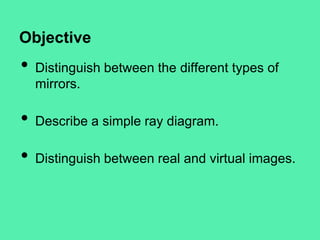
Objective

•

Distinguish between the different types of
mirrors.

•

Describe a simple ray diagram.

•

Distinguish between real and virtual images.
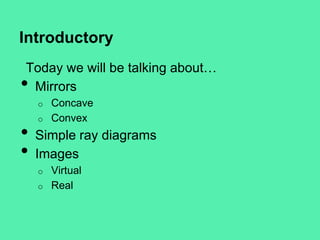
Introductory
Today we will be talking about…
Mirrors

•

o

•
•

o

Concave
Convex

Simple ray diagrams
Images
o
o

Virtual
Real
Concave Mirrors

•

•

A concave mirror is a mirror that has a
slightly inward curve like the inside of a
spoon.
The curved surface focuses parallel rays
from a great distance into a single point for
enhanced intensity.
Concave Mirrors

•
•

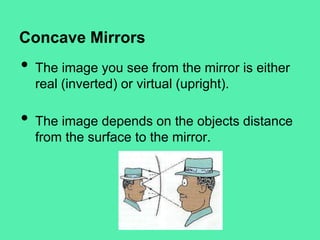
The image you see from the mirror is either
real (inverted) or virtual (upright).
The image depends on the objects distance
from the surface to the mirror.
Examples of Concave Mirrors

•

Headlights of a car
o

•

Dentist mirror
o

•

the source of light is placed at the focus of the
concave reflector

focus light on the tooth to be examined

Make-up mirrors
o

enlarges the image to be easier to see
Convex Mirrors

•
•

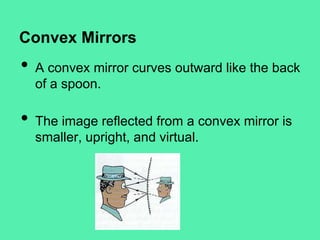
A convex mirror curves outward like the back
of a spoon.
The image reflected from a convex mirror is
smaller, upright, and virtual.
Examples of Convex Mirrors

•

Side-view mirror
o

•

Security mirrors
o

•

allows the driver to see more objects and a wider
view of what’s behind

used in malls, convenience stores, and
supermarkets to view a large portion of people

Camera phone
o

helps to aim correctly when taking a self- portrait
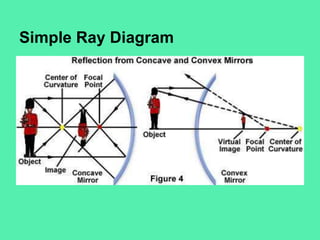
Simple Ray Diagram
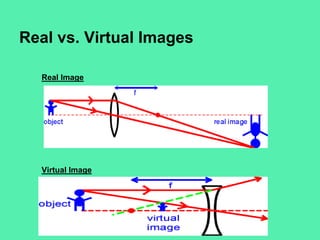
Real vs. Virtual Images
Real Image

Virtual Image
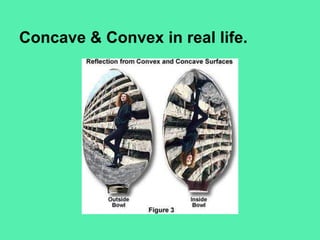
Concave & Convex in real life.
Citations
Davidson, M., Parry-Hill, M., & Fellers, T. (n.d.). Molecular Expressions: Physics of Light and Color - Concave Spherical
Mirrors: Interactive Java Tutorial. Molecular Expressions: Physics of Light and Color - Concave Spherical Mirrors: Interactive
Java Tutorial. Retrieved October 28, 2013, from http://micro.magnet.fsu.edu/primer/java/mirrors/concavemirrors/

Levine, J. (n.d.). Topic 18. Real and virtual images; plane mirrors. Topic 18. Real and Virtual images; plane mirrors. Retrieved
October 28, 2013, from http://www.colorado.edu/physics/phys1230/phys1230_fa01/topic18.html

Hewitt, P. G. (2002). Conceptual physics: the high school physics program. Needham, Mass.: Prentice Hall.

Serway, R. A., & Faughn, J. S. (2009). Holt physics. Austin, Tex.: Holt, Rinehart and Winston.

Neaves, S., & Davidson, M. (n.d.). Molecular Expressions: Science, Optics, and You: Light and Color - Reflection of Light.
Molecular Expressions: Science, Optics, and You: Light and Color - Reflection of Light. Retrieved October 28, 2013, from
http://micro.magnet.fsu.edu/optics/lightandcolor/reflection.html

Villanueva, John. "Convex Mirror." Universe Today RSS. N.p., n.d. Web. 29 Oct. 2013.
<http://www.universetoday.com/45228/convex-mirror/>.

Mirror ppt

  • 1.
  • 2.
    Objective • Distinguish between thedifferent types of mirrors. • Describe a simple ray diagram. • Distinguish between real and virtual images.
  • 3.
    Introductory Today we willbe talking about… Mirrors • o • • o Concave Convex Simple ray diagrams Images o o Virtual Real
  • 4.
    Concave Mirrors • • A concavemirror is a mirror that has a slightly inward curve like the inside of a spoon. The curved surface focuses parallel rays from a great distance into a single point for enhanced intensity.
  • 5.
    Concave Mirrors • • The imageyou see from the mirror is either real (inverted) or virtual (upright). The image depends on the objects distance from the surface to the mirror.
  • 6.
    Examples of ConcaveMirrors • Headlights of a car o • Dentist mirror o • the source of light is placed at the focus of the concave reflector focus light on the tooth to be examined Make-up mirrors o enlarges the image to be easier to see
  • 7.
    Convex Mirrors • • A convexmirror curves outward like the back of a spoon. The image reflected from a convex mirror is smaller, upright, and virtual.
  • 8.
    Examples of ConvexMirrors • Side-view mirror o • Security mirrors o • allows the driver to see more objects and a wider view of what’s behind used in malls, convenience stores, and supermarkets to view a large portion of people Camera phone o helps to aim correctly when taking a self- portrait
  • 9.
  • 10.
    Real vs. VirtualImages Real Image Virtual Image
  • 11.
    Concave & Convexin real life.
  • 12.
    Citations Davidson, M., Parry-Hill,M., & Fellers, T. (n.d.). Molecular Expressions: Physics of Light and Color - Concave Spherical Mirrors: Interactive Java Tutorial. Molecular Expressions: Physics of Light and Color - Concave Spherical Mirrors: Interactive Java Tutorial. Retrieved October 28, 2013, from http://micro.magnet.fsu.edu/primer/java/mirrors/concavemirrors/ Levine, J. (n.d.). Topic 18. Real and virtual images; plane mirrors. Topic 18. Real and Virtual images; plane mirrors. Retrieved October 28, 2013, from http://www.colorado.edu/physics/phys1230/phys1230_fa01/topic18.html Hewitt, P. G. (2002). Conceptual physics: the high school physics program. Needham, Mass.: Prentice Hall. Serway, R. A., & Faughn, J. S. (2009). Holt physics. Austin, Tex.: Holt, Rinehart and Winston. Neaves, S., & Davidson, M. (n.d.). Molecular Expressions: Science, Optics, and You: Light and Color - Reflection of Light. Molecular Expressions: Science, Optics, and You: Light and Color - Reflection of Light. Retrieved October 28, 2013, from http://micro.magnet.fsu.edu/optics/lightandcolor/reflection.html Villanueva, John. "Convex Mirror." Universe Today RSS. N.p., n.d. Web. 29 Oct. 2013. <http://www.universetoday.com/45228/convex-mirror/>.