SALAL MOHAMMAD
B.OPTOM,2ND YEAR
 Vergence and Power
 Conjugacy , Object space and Image
space
 Catoptric Power
 Cardinal Points
 Spherical mirror
 Sign Convention
 Magnification
 INTRODUCTION
 In optics Vergence describes the curvature of
the wave front geometric optics considers the
propagation of spherical wave front.
 Disjunctive or vergence eye movement are
movements of the eyes in opposite direction .
 They can be horizontal,vertical and cyclo.
 These serve the same function as conjugate
movements of the eyes which is to preserve
the alignment of the two retinal images on
corresponding retinal points.
Vergence is required when changing viewing
distance.
 TYPES:
 1.Convergence
 2.Divergence
 1.CONVERGENCE : When rays or wavefronts of the
light come together and join or collapse to a point
focus they are k/a convergence.
 2.DIVERGENCE : When rays or wavefronts of the
light spread out from their point source they are
k/a divergence.
Dysfunction of vergence :
 Basic exophoria
 Convergence insufficiency
 Convergence micropsia
 Divergence excess
 Basic esophoria
 Convergence excess
 Divergence insufficiency
 Fusional vergence dysfunction
 The ability of lens to converge or diverge light
rays depend upon its focal length .
 The degree of convergence and divergence of
light rays achieved by a lens in terms of its
power.
 The power of lens is a defined as reciprocal of its
focal length. It is represented by the letter P . The
power P of lens of focal length f is given by-
 P= 1/f
 The SI unit of power of lens is ‘Diopter’ .It is
denoted by D.
 You may note that the power of convex lens is
positive(+) and that of concave lens is negative (-
).
 TYPES :
 Approximate Power =F1 + F2
 Back vertex Power (BVP) =F1 +F2 +F1
2 .t/n
 Front Vertex Power (FVP)=F1 +F2 +F2
2 .t/n
 Equivalent power =F1 +F2 -CF1 F2
 Effective power,
FB =FA /1-dFA
 Definition : The concept that makes the nation
of same except for the point of view precise is
c/d conjugacy.
 It is the principle of reversibility.
 Conjugate Point : The object point and image
point of a lens system are said to be conjugate
point. Since all the light path from the object to
the image are reversible, it follows that if the
object were placed where the image is, an image
would be formed at the original object position.
 Object Space : It is the 3D space in which a graphic object is defined.
 The object space does not exit only on the input side of the system.
 All object space thus overlap completely.
 Image Space : A model is reduced to a picture by systematic
transformation through several coordinate system.
 The users coordinate system,commonly c/d world space is the
highest level,while the device coordinate system and device space is
the lowest.
 A set of 6 points situated on the optical axis
which are defined a such a way so ,as to facilate
the image formation by the lens system ,it is k/a
cardinal point.
 Every optical system has 6 cardinal points-
 1.Focal points (Primary and Secondary )
 2.Principal points (Primary and Secondary )
 3.Nodal Points (Primary and Secondary )
 1.Focal Points – It can be defined as the points
on the optical axis to which the light rays that
arrive parallel to the optical axis, are broad to a
common focus after refraction.
 2.Principal points- The principal points are the
points at the intersection of two imaginary rays,
created by extending the ray entering the
lens,and extending the ray exiting from the lens.
 3.Nodal Points- The nodal points are the two
axial points, such that a ray ,directed at the first
nodal point will seen to emerge from the second
nodal point parallel to its original direction.
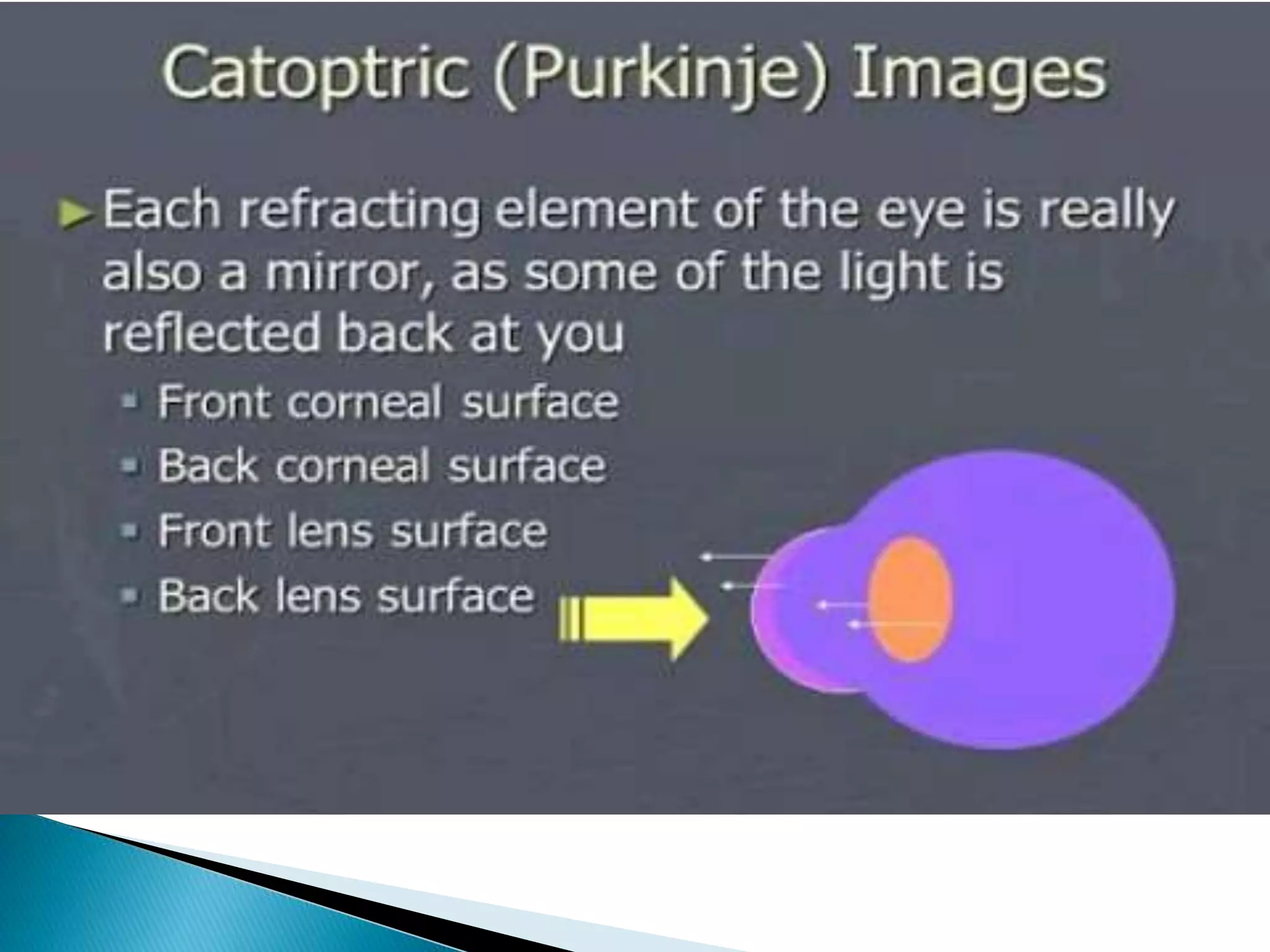
 The power of a surface to after the vergence of
incident pencil by reflection is sometimes termed
as catoptric power .
 Image 1st ,2nd and 3rd formed by reflection from the
anterior corneal ,posterior corneal and anterior lens
surface.
 The image from the convex reflecting surface is virtual
and erect.
 Image 4th formed by the reflection from the concave
posterior lens surface is real and inverted
Clinical and common Uses of Purkinje Images-
 Used to test cataract
 Measuring the corneal curvature ( Keratometry)
 Hirschberg corneal reflect test
Measuring eye movements and eye positions
 Measuring lens changes in accommodation
 Measuring lens position and curvature
 A spherical mirror is a mirror which has the
shape of a piece cut out of a spherical surface
 In spherical mirror one of the two curved surface
is coated with a thin layer of silver followed by a
coating or red lead oxide point.
 Thus the side of spherical mirror is opaque and
other side is highly polished reflecting surface.
 TYPES-
 1.Concave mirror (Converging mirror )
 2.Convex mirror (Diverging mirror )
 Mirror Formula – It is the relationship between
object distance (u),image distance (v),and focal
length (f).
1/f=1/v + 1/u
 1.Concave mirror :
 Used as shaving mirror
 Used as reflector in search light
 Used as head light of motor vehicles
 Used as solar cookers, torches and in table lamps
 Used by ENT and Dentist doctor
 2.Convex mirror
 Used in car and scooter for looking traffic
 Used in ATM machine
 Used in street light reflector
 POLE-The central point of the reflecting surface
of the mirror is c/d the pole of the mirror.
 CENTRE OF CURVATURE- The centre of the
sphere of which mirror forms a part is c/d centre
of curvature.
 RADIUS OF CURVATURE- The radius of the
sphere of which mirror forms a part is c/d the
radius of curvature.
 PRINCIPAL AXIS- The straight line joining the
pole and the centre of curvature of the mirror
and extended on both side is c/d principal axis
of the mirror.
 APERATURE-The diameter of the periphery of the
mirror is c/d the aperature of the mirror.
 PRINCIPAL FOCUS-The point on the principal axis
at which light rays parallel to the principal axis
,after reflection from the mirror actually meet or
appear to come from, is c/d the principal focus
of the mirror .
 The focus of the concave mirror is real and lies
infront of the mirror, while the focus of a convex
mirror is virtual and lies behind the mirror.
 FOCAL LENGTH-The distance of the principal
focus from the pole of the mirror is c/d the focal
length of the mirror
 FOCAL PLANE-The plane perpendicular to the
principal axis and passing through the principal
focus of the mirror is c/d the focal plane of the
mirror.
 REAL IMAGE- When the image is formed infront
of the lens or mirror is c/d the real image.
 VIRTUAL IMAGE-When the image is formed
behind of the lens or mirror is c/d the virtual
image.
 INTRODUCTION – Magnification is the process
of visually enlarge an object ,meaning that
the object itself does not become physically
larger but only larger in appearance .
 Examples of magnification :
 Some optical instruments provide visual aid
by magnifying small and distant subjects.
 A magnifying glass, which uses a positive
lens to make things look bigger by allowing
user to hold them closer to their eye.
 A telescope,which uses its large objective
lens to create an image of a distant object
and then allows the user to examine the
image closely with a smaller eye piece lens
thus making the object look larger.
 A microscope, which makes a small object
appear as a much larger image at a
comfortable distance for viewing .
 A slide projector which projects a large image
of a small slide on a screen .a photographic
enlarger is similar.
Review of geometric optics

Review of geometric optics

  • 1.
  • 2.
     Vergence andPower  Conjugacy , Object space and Image space  Catoptric Power  Cardinal Points  Spherical mirror  Sign Convention  Magnification
  • 3.
     INTRODUCTION  Inoptics Vergence describes the curvature of the wave front geometric optics considers the propagation of spherical wave front.  Disjunctive or vergence eye movement are movements of the eyes in opposite direction .  They can be horizontal,vertical and cyclo.  These serve the same function as conjugate movements of the eyes which is to preserve the alignment of the two retinal images on corresponding retinal points. Vergence is required when changing viewing distance.
  • 4.
     TYPES:  1.Convergence 2.Divergence  1.CONVERGENCE : When rays or wavefronts of the light come together and join or collapse to a point focus they are k/a convergence.  2.DIVERGENCE : When rays or wavefronts of the light spread out from their point source they are k/a divergence.
  • 5.
    Dysfunction of vergence:  Basic exophoria  Convergence insufficiency  Convergence micropsia  Divergence excess  Basic esophoria  Convergence excess  Divergence insufficiency  Fusional vergence dysfunction
  • 6.
     The abilityof lens to converge or diverge light rays depend upon its focal length .  The degree of convergence and divergence of light rays achieved by a lens in terms of its power.  The power of lens is a defined as reciprocal of its focal length. It is represented by the letter P . The power P of lens of focal length f is given by-  P= 1/f  The SI unit of power of lens is ‘Diopter’ .It is denoted by D.  You may note that the power of convex lens is positive(+) and that of concave lens is negative (- ).
  • 7.
     TYPES : Approximate Power =F1 + F2  Back vertex Power (BVP) =F1 +F2 +F1 2 .t/n  Front Vertex Power (FVP)=F1 +F2 +F2 2 .t/n  Equivalent power =F1 +F2 -CF1 F2  Effective power, FB =FA /1-dFA
  • 8.
     Definition :The concept that makes the nation of same except for the point of view precise is c/d conjugacy.  It is the principle of reversibility.  Conjugate Point : The object point and image point of a lens system are said to be conjugate point. Since all the light path from the object to the image are reversible, it follows that if the object were placed where the image is, an image would be formed at the original object position.
  • 10.
     Object Space: It is the 3D space in which a graphic object is defined.  The object space does not exit only on the input side of the system.  All object space thus overlap completely.  Image Space : A model is reduced to a picture by systematic transformation through several coordinate system.  The users coordinate system,commonly c/d world space is the highest level,while the device coordinate system and device space is the lowest.
  • 11.
     A setof 6 points situated on the optical axis which are defined a such a way so ,as to facilate the image formation by the lens system ,it is k/a cardinal point.  Every optical system has 6 cardinal points-  1.Focal points (Primary and Secondary )  2.Principal points (Primary and Secondary )  3.Nodal Points (Primary and Secondary )  1.Focal Points – It can be defined as the points on the optical axis to which the light rays that arrive parallel to the optical axis, are broad to a common focus after refraction.
  • 12.
     2.Principal points-The principal points are the points at the intersection of two imaginary rays, created by extending the ray entering the lens,and extending the ray exiting from the lens.  3.Nodal Points- The nodal points are the two axial points, such that a ray ,directed at the first nodal point will seen to emerge from the second nodal point parallel to its original direction.
  • 13.
     The powerof a surface to after the vergence of incident pencil by reflection is sometimes termed as catoptric power .
  • 15.
     Image 1st,2nd and 3rd formed by reflection from the anterior corneal ,posterior corneal and anterior lens surface.  The image from the convex reflecting surface is virtual and erect.  Image 4th formed by the reflection from the concave posterior lens surface is real and inverted Clinical and common Uses of Purkinje Images-  Used to test cataract  Measuring the corneal curvature ( Keratometry)  Hirschberg corneal reflect test Measuring eye movements and eye positions  Measuring lens changes in accommodation  Measuring lens position and curvature
  • 17.
     A sphericalmirror is a mirror which has the shape of a piece cut out of a spherical surface  In spherical mirror one of the two curved surface is coated with a thin layer of silver followed by a coating or red lead oxide point.  Thus the side of spherical mirror is opaque and other side is highly polished reflecting surface.  TYPES-  1.Concave mirror (Converging mirror )  2.Convex mirror (Diverging mirror )
  • 18.
     Mirror Formula– It is the relationship between object distance (u),image distance (v),and focal length (f). 1/f=1/v + 1/u  1.Concave mirror :  Used as shaving mirror  Used as reflector in search light  Used as head light of motor vehicles  Used as solar cookers, torches and in table lamps  Used by ENT and Dentist doctor  2.Convex mirror  Used in car and scooter for looking traffic  Used in ATM machine  Used in street light reflector
  • 21.
     POLE-The centralpoint of the reflecting surface of the mirror is c/d the pole of the mirror.  CENTRE OF CURVATURE- The centre of the sphere of which mirror forms a part is c/d centre of curvature.  RADIUS OF CURVATURE- The radius of the sphere of which mirror forms a part is c/d the radius of curvature.  PRINCIPAL AXIS- The straight line joining the pole and the centre of curvature of the mirror and extended on both side is c/d principal axis of the mirror.  APERATURE-The diameter of the periphery of the mirror is c/d the aperature of the mirror.
  • 22.
     PRINCIPAL FOCUS-Thepoint on the principal axis at which light rays parallel to the principal axis ,after reflection from the mirror actually meet or appear to come from, is c/d the principal focus of the mirror .  The focus of the concave mirror is real and lies infront of the mirror, while the focus of a convex mirror is virtual and lies behind the mirror.  FOCAL LENGTH-The distance of the principal focus from the pole of the mirror is c/d the focal length of the mirror  FOCAL PLANE-The plane perpendicular to the principal axis and passing through the principal focus of the mirror is c/d the focal plane of the mirror.  REAL IMAGE- When the image is formed infront of the lens or mirror is c/d the real image.  VIRTUAL IMAGE-When the image is formed behind of the lens or mirror is c/d the virtual image.
  • 23.
     INTRODUCTION –Magnification is the process of visually enlarge an object ,meaning that the object itself does not become physically larger but only larger in appearance .  Examples of magnification :  Some optical instruments provide visual aid by magnifying small and distant subjects.  A magnifying glass, which uses a positive lens to make things look bigger by allowing user to hold them closer to their eye.
  • 24.
     A telescope,whichuses its large objective lens to create an image of a distant object and then allows the user to examine the image closely with a smaller eye piece lens thus making the object look larger.  A microscope, which makes a small object appear as a much larger image at a comfortable distance for viewing .  A slide projector which projects a large image of a small slide on a screen .a photographic enlarger is similar.