


1
Team Members : Chinmay Samant
                                           Rajdeep Mandrekar
                                           Shanker Naik
Scale Invariant Feature Transform          Laxman Pednekar
                                   Guide : Prof. Rachael Dhanraj
Sub-Image Matching

• Sub-Image Matching – the main part of
  our project.

• Rejection of the Chain code Algorithm.

• Using Scale invariant Feature Transform
  (or SIFT) Algorithm.


                                            3
Sub-Image Matching

Scale-invariant feature transform Algorithm
• Creating Scale-space and Difference of
  Gaussian pyramid
• Extrema detection
• Noise Elimination
• Orientation assignment
• Descriptor Computation
• Keypoints matching
                                              4
Creating Scale-space and Difference of Gaussian
                   pyramid


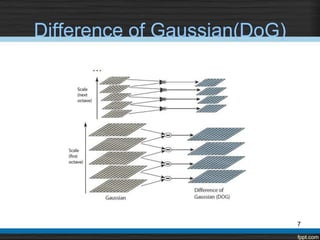
• In scale Space we take the image and
  generate progressively blurred out images,
  then resize the original image to half and
  generate blurred images.
• Images that are of same size but different
  scale are called octaves.


                                                  5
How Blurring is performed?
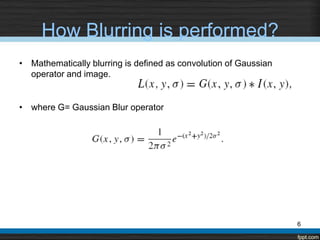
• Mathematically blurring is defined as convolution of Gaussian
  operator and image.


• where G= Gaussian Blur operator


                                                                  6
Difference of Gaussian(DoG)


                              7
Extrema detection
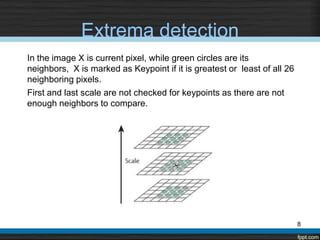
In the image X is current pixel, while green circles are its
neighbors, X is marked as Keypoint if it is greatest or least of all 26
neighboring pixels.
First and last scale are not checked for keypoints as there are not
enough neighbors to compare.


                                                                          8
Noise Elimination

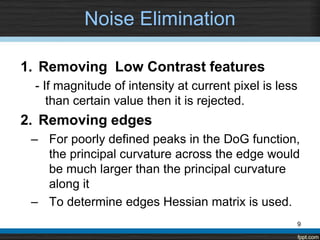
1. Removing Low Contrast features
 - If magnitude of intensity at current pixel is less
    than certain value then it is rejected.
2. Removing edges
 – For poorly defined peaks in the DoG function,
   the principal curvature across the edge would
   be much larger than the principal curvature
   along it
 – To determine edges Hessian matrix is used.
                                                    9
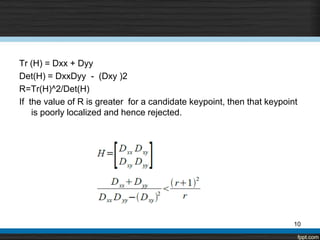
Tr (H) = Dxx + Dyy
Det(H) = DxxDyy - (Dxy )2
R=Tr(H)^2/Det(H)
If the value of R is greater for a candidate keypoint, then that keypoint
    is poorly localized and hence rejected.


                                                                        10
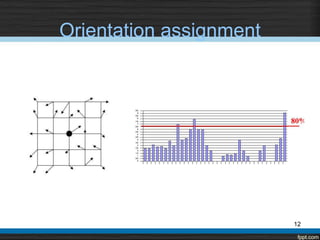
Orientation assignment

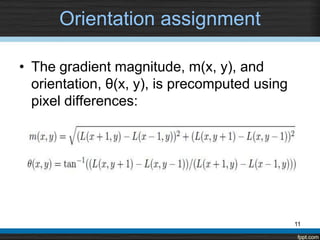
• The gradient magnitude, m(x, y), and
  orientation, θ(x, y), is precomputed using
  pixel differences:


                                               11
Orientation assignment


                         12
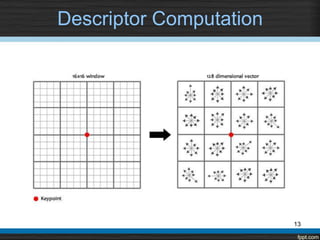
Descriptor Computation


                         13
Keypoints matching

• Each keypoint in the original image
  is compared to every keypoints in
  the transformed image using the
  descriptors.
• The descriptors of the two respective,
  keypoints must be closest. Then match is
  found.


                                         14
Thank You


            15

Scale Invariant feature transform

  • 1.
  • 2.
    Team Members :Chinmay Samant Rajdeep Mandrekar Shanker Naik Scale Invariant Feature Transform Laxman Pednekar Guide : Prof. Rachael Dhanraj
  • 3.
    Sub-Image Matching • Sub-ImageMatching – the main part of our project. • Rejection of the Chain code Algorithm. • Using Scale invariant Feature Transform (or SIFT) Algorithm. 3
  • 4.
    Sub-Image Matching Scale-invariant featuretransform Algorithm • Creating Scale-space and Difference of Gaussian pyramid • Extrema detection • Noise Elimination • Orientation assignment • Descriptor Computation • Keypoints matching 4
  • 5.
    Creating Scale-space andDifference of Gaussian pyramid • In scale Space we take the image and generate progressively blurred out images, then resize the original image to half and generate blurred images. • Images that are of same size but different scale are called octaves. 5
  • 6.
    How Blurring isperformed? • Mathematically blurring is defined as convolution of Gaussian operator and image. • where G= Gaussian Blur operator 6
  • 7.
  • 8.
    Extrema detection In theimage X is current pixel, while green circles are its neighbors, X is marked as Keypoint if it is greatest or least of all 26 neighboring pixels. First and last scale are not checked for keypoints as there are not enough neighbors to compare. 8
  • 9.
    Noise Elimination 1. RemovingLow Contrast features - If magnitude of intensity at current pixel is less than certain value then it is rejected. 2. Removing edges – For poorly defined peaks in the DoG function, the principal curvature across the edge would be much larger than the principal curvature along it – To determine edges Hessian matrix is used. 9
  • 10.
    Tr (H) =Dxx + Dyy Det(H) = DxxDyy - (Dxy )2 R=Tr(H)^2/Det(H) If the value of R is greater for a candidate keypoint, then that keypoint is poorly localized and hence rejected. 10
  • 11.
    Orientation assignment • Thegradient magnitude, m(x, y), and orientation, θ(x, y), is precomputed using pixel differences: 11
  • 12.
  • 13.
  • 14.
    Keypoints matching • Eachkeypoint in the original image is compared to every keypoints in the transformed image using the descriptors. • The descriptors of the two respective, keypoints must be closest. Then match is found. 14
  • 15.