Mirrors
By: Bailey Griggs and Katie Kennedy
Objectives

• Mirrors
o Distinguish between Concave and Convex

mirrors.
o Describe a simple ray diagram.
o Distinguish between real and virtual images.
Mirrors Outline

• Types of Mirrors
o Convex

o Concave
o Spherical
o Parabolic

• Convex Mirrors
o How light reflects
o Examples
Mirrors

• Concave
o How light reflects
o Examples

• Simple Ray Diagram
o Explanation and Examples
• Real vs. Virtual Images
o Real Images

o Virtual Images

• Demonstrations
• Evaluation Questions
We are going to explore how concave
and convex mirrors work along with
describing the simple ray diagrams that
go along with each one. We will also
discuss the real and/or virtual images
that both of these mirrors produce.
Different Types of Mirrors
Convex
Concave

Spherical
Parabolic
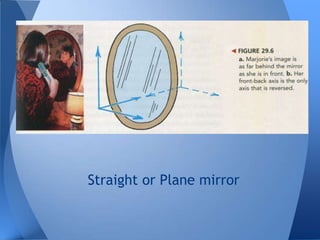
Straight or Plane mirror
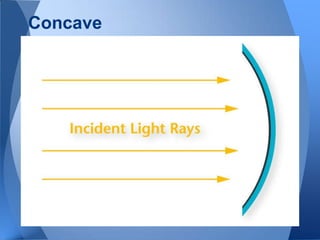
Concave
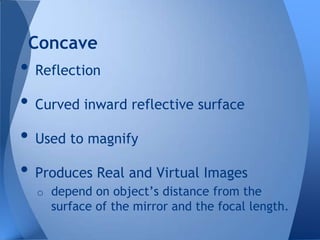
Concave

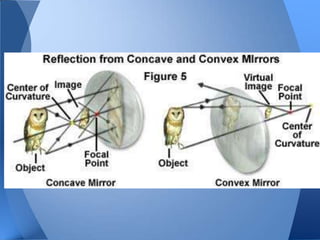
• Reflection
• Curved inward reflective surface
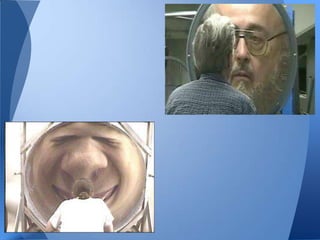
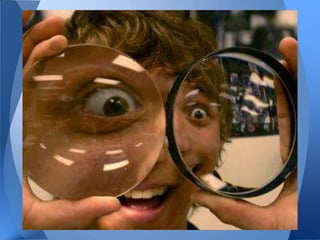
• Used to magnify
• Produces Real and Virtual Images
o depend on object’s distance from the

surface of the mirror and the focal length.
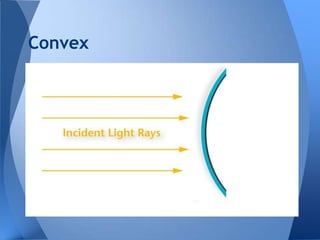
Convex
Convex

• Reflection
• Image is small or reduced in size
• Image is upright
• Image is located behind the convex
mirror

• Image is always virtual
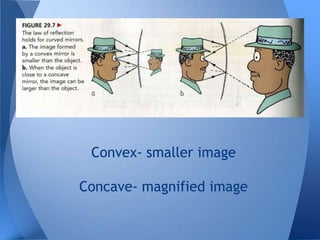
Convex- smaller image
Concave- magnified image
Simple Ray Diagram

• Tool used to determine
o location
o size
o orientation

o type of image formed
Real or Virtual

•
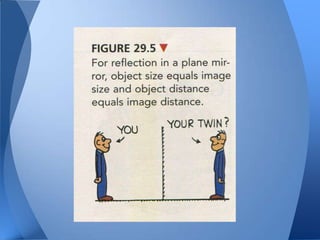
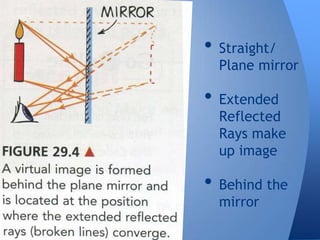
• Straight/

Plane mirror

• Extended

Reflected
Rays make
up image

• Behind the
mirror
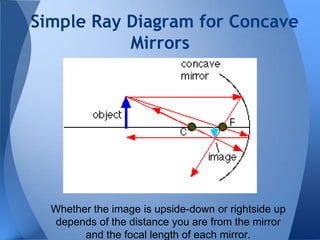
Simple Ray Diagram for Concave
Mirrors

Whether the image is upside-down or rightside up
depends of the distance you are from the mirror
and the focal length of each mirror.
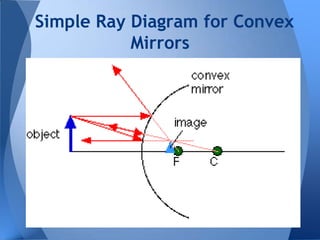
Simple Ray Diagram for Convex
Mirrors
Real vs. Virtual Images
•
•

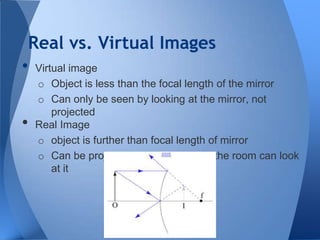
Virtual image
o Object is less than the focal length of the mirror
o Can only be seen by looking at the mirror, not
projected
Real Image
o object is further than focal length of mirror
o Can be projected and everyone in the room can look
at it
Demonstration Time!
Evaluation Questions
Evaluation Question #1
Which mirror produces an image behind
the mirror, Concave or Convex?

Convex
Evaluation Question #2
True or False: Concave mirrors are used to
magnify images.

True
Evaluation Question #3
A _____________ mirror takes a large
space and makes it small.

Convex
Evaluation Question #4
An image that is produced that is less than
the focal length of the mirror is a
______________ image.

Virtual
Evaluation Question #5
A ______________ image can be
projected.

Real
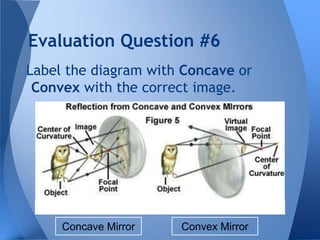
Evaluation Question #6
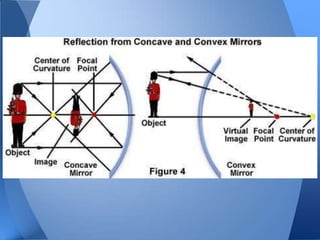
Label the diagram with Concave or
Convex with the correct image.

Concave Mirror

Convex Mirror
Evaluation Question #7
The point at which the extensions of the
reflected rays intersect is the _________
of the image being produced.
a. Bottom
b. Top
c. Center
Evaluation Question #8
Concave mirrors produce:
a. Real Images
b. Virtual Images
c. Both
Bibliography
Flinn, G. (n.d.). HowStuffWorks "Types of Mirrors". HowStuffWorks "Science". Retrieved October
21, 2013, from http://science.howstuffworks.com/innovation/everyday-innovations/mirror3.htm

Flinn, G. (n.d.). HowStuffWorks "Types of Mirrors". HowStuffWorks "Science". Retrieved October
21, 2013, from http://science.howstuffworks.com/innovation/everyday-innovations/mirror3.htm

Henderson, T. (n.d.). Reflection and Image Formation for Convex Mirrors. The Physics Classroom.
Retrieved October 21, 2013, from http://www.physicsclassroom.com/class/refln/u13l4a.cfm

Hewitt, P. G. (2002). Conceptual physics: the high school physics program. Needham, Mass.:
Prentice Hall.

Moore, C. (n.d.). Concave and Convex Mirrors. More House. Retrieved October 18, 2013, from
https://www.morehouse.edu/facstaff/cmoor

Mirrors ppt

  • 1.
    Mirrors By: Bailey Griggsand Katie Kennedy
  • 2.
    Objectives • Mirrors o Distinguishbetween Concave and Convex mirrors. o Describe a simple ray diagram. o Distinguish between real and virtual images.
  • 3.
    Mirrors Outline • Typesof Mirrors o Convex o Concave o Spherical o Parabolic • Convex Mirrors o How light reflects o Examples
  • 4.
    Mirrors • Concave o Howlight reflects o Examples • Simple Ray Diagram o Explanation and Examples • Real vs. Virtual Images o Real Images o Virtual Images • Demonstrations • Evaluation Questions
  • 5.
    We are goingto explore how concave and convex mirrors work along with describing the simple ray diagrams that go along with each one. We will also discuss the real and/or virtual images that both of these mirrors produce.
  • 6.
    Different Types ofMirrors Convex Concave Spherical Parabolic
  • 7.
  • 9.
  • 10.
    Concave • Reflection • Curvedinward reflective surface • Used to magnify • Produces Real and Virtual Images o depend on object’s distance from the surface of the mirror and the focal length.
  • 12.
  • 13.
    Convex • Reflection • Imageis small or reduced in size • Image is upright • Image is located behind the convex mirror • Image is always virtual
  • 15.
  • 17.
    Simple Ray Diagram •Tool used to determine o location o size o orientation o type of image formed Real or Virtual •
  • 18.
    • Straight/ Plane mirror •Extended Reflected Rays make up image • Behind the mirror
  • 19.
    Simple Ray Diagramfor Concave Mirrors Whether the image is upside-down or rightside up depends of the distance you are from the mirror and the focal length of each mirror.
  • 20.
    Simple Ray Diagramfor Convex Mirrors
  • 23.
    Real vs. VirtualImages • • Virtual image o Object is less than the focal length of the mirror o Can only be seen by looking at the mirror, not projected Real Image o object is further than focal length of mirror o Can be projected and everyone in the room can look at it
  • 24.
  • 25.
  • 26.
    Evaluation Question #1 Whichmirror produces an image behind the mirror, Concave or Convex? Convex
  • 27.
    Evaluation Question #2 Trueor False: Concave mirrors are used to magnify images. True
  • 28.
    Evaluation Question #3 A_____________ mirror takes a large space and makes it small. Convex
  • 29.
    Evaluation Question #4 Animage that is produced that is less than the focal length of the mirror is a ______________ image. Virtual
  • 30.
    Evaluation Question #5 A______________ image can be projected. Real
  • 31.
    Evaluation Question #6 Labelthe diagram with Concave or Convex with the correct image. Concave Mirror Convex Mirror
  • 32.
    Evaluation Question #7 Thepoint at which the extensions of the reflected rays intersect is the _________ of the image being produced. a. Bottom b. Top c. Center
  • 33.
    Evaluation Question #8 Concavemirrors produce: a. Real Images b. Virtual Images c. Both
  • 34.
    Bibliography Flinn, G. (n.d.).HowStuffWorks "Types of Mirrors". HowStuffWorks "Science". Retrieved October 21, 2013, from http://science.howstuffworks.com/innovation/everyday-innovations/mirror3.htm Flinn, G. (n.d.). HowStuffWorks "Types of Mirrors". HowStuffWorks "Science". Retrieved October 21, 2013, from http://science.howstuffworks.com/innovation/everyday-innovations/mirror3.htm Henderson, T. (n.d.). Reflection and Image Formation for Convex Mirrors. The Physics Classroom. Retrieved October 21, 2013, from http://www.physicsclassroom.com/class/refln/u13l4a.cfm Hewitt, P. G. (2002). Conceptual physics: the high school physics program. Needham, Mass.: Prentice Hall. Moore, C. (n.d.). Concave and Convex Mirrors. More House. Retrieved October 18, 2013, from https://www.morehouse.edu/facstaff/cmoor