Lens Formula Ray Optics:
Lenses
Lecture - 1
Jayant Nagda
Physics Educator
unacademy.com/@JayantNagda
B.Tech, IIT Bombay
IIT-JEE AIR - 161
9+ Years of Teaching Experience at
3 Coaching Institutes (multiple under 15 AIRs)
In top 1% INPhO
unacademy.com/plus
Live & Recorded Lectures
Personalized Interaction
Quizzes & Test Series
Dedicated Doubt Sessions
JEELIVE
PLUS Courses
Step 1 Step 2
INSTALL
Step 3 Step 4
Step 6
JEELIVE
Step 5
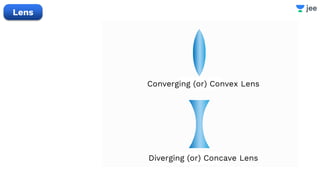
Lens
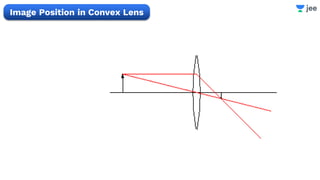
Converging (or) Convex Lens
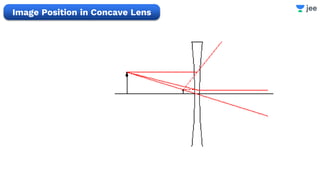
Diverging (or) Concave Lens
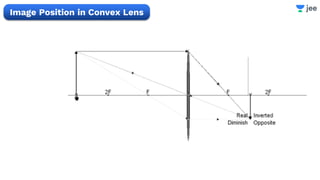
Image Position in Convex Lens
Image Position in Concave Lens
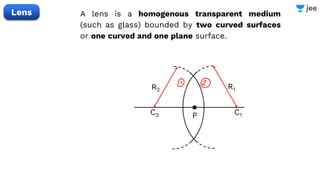
Lens A lens is a homogenous transparent medium
(such as glass) bounded by two curved surfaces
or one curved and one plane surface.
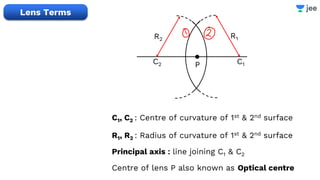
R2 R1
C1
C2 P
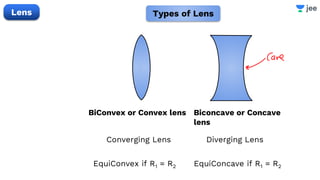
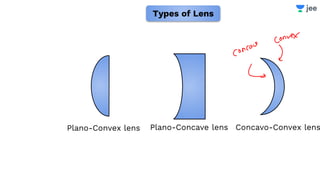
Lens Types of Lens
BiConvex or Convex lens Biconcave or Concave
lens
Converging Lens Diverging Lens
EquiConvex if R1 = R2 EquiConcave if R1 = R2
Plano-Concave lens Concavo-Convex lens
Plano-Convex lens
Types of Lens
R2 R1
C1
C2 P
C1, C2 : Centre of curvature of 1st & 2nd surface
R1, R2 : Radius of curvature of 1st & 2nd surface
Principal axis : line joining C1 & C2
Centre of lens P also known as Optical centre
Lens Terms
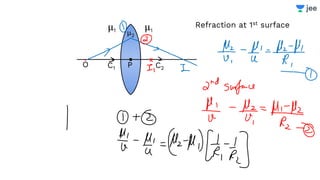
O P
μ1 μ1
μ2
C1 C2
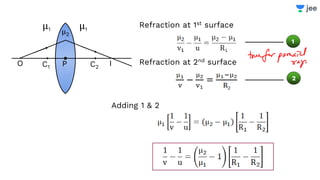
Refraction at 1st surface
O I
P
μ1 μ1
μ2
C1 C2
Refraction at 1st surface
Refraction at 2nd surface
Adding 1 & 2
1
2
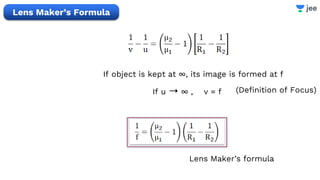
If object is kept at ∞, its image is formed at f
If u ➝ ∞ , v = f
Lens Maker’s formula
Lens Maker’s Formula
(Definition of Focus)
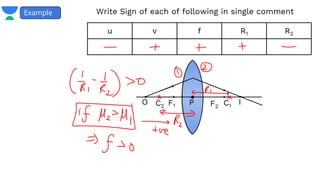
Write Sign of each of following in single comment
Example
O I
P
F1 C1
F2
C2
u v f R1 R2
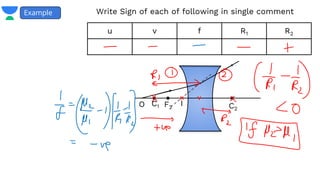
Example
O I
C1 F2 C2
u v f R1 R2
Write Sign of each of following in single comment
Find the focal length of lens
Example
10 cm
10 cm
1.5
Numerical Answer Type Question [ +4 , 0]
Find the focal length of lens
Example
1.5
10 cm
10 cm
Numerical Answer Type Question [ +4 , 0]
Find the focal length of lens
Example
μ = 2
20 cm
μ = 1
Numerical Answer Type Question [ +4 , 0]
20 cm
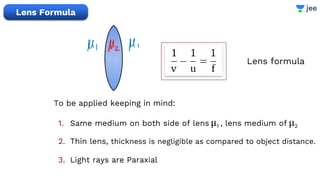
Lens formula
1. Same medium on both side of lens μ1 , lens medium of μ2
2. Thin lens, thickness is negligible as compared to object distance.
3. Light rays are Paraxial
Lens Formula
To be applied keeping in mind:
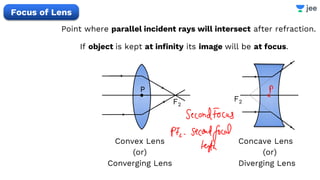
Focus of Lens
Point where parallel incident rays will intersect after refraction.
If object is kept at infinity its image will be at focus.
Convex Lens
(or)
Converging Lens
Concave Lens
(or)
Diverging Lens
F2
P
F2
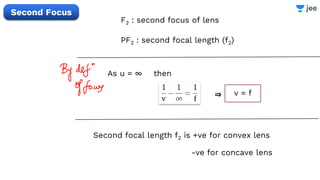
F2 : second focus of lens
PF2 : second focal length (f2)
As u = ∞ then
⇒ v = f
Second Focus
Second focal length f2 is +ve for convex lens
-ve for concave lens
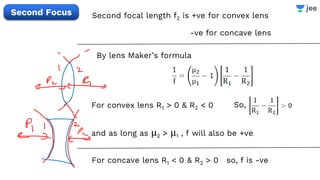
By lens Maker’s formula
For convex lens R1 > 0 & R2 < 0 So,
and as long as μ2 > μ1 , f will also be +ve
For concave lens R1 < 0 & R2 > 0 so, f is -ve
Second focal length f2 is +ve for convex lens
-ve for concave lens
Second Focus
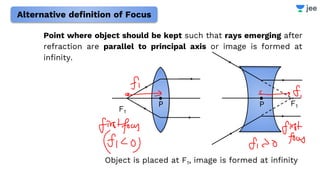
Alternative definition of Focus
Point where object should be kept such that rays emerging after
refraction are parallel to principal axis or image is formed at
infinity.
P F1
P
Object is placed at F1, image is formed at infinity
F1
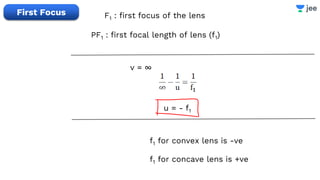
F1 : first focus of the lens
PF1 : first focal length of lens (f1)
v = ∞
u = - f1
f1 for convex lens is -ve
f1 for concave lens is +ve
First Focus
Example
Concave lens of focal length 20 cm has object placed 12 cm
from it. Determine position of image.
A. 12.5 cm B. -9.5 cm D. 11 cm
C. -7.5 cm
MCQ type Question [ +4 , -1]
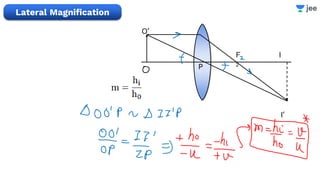
Lateral Magnification
P
O’
F
2
I
I’
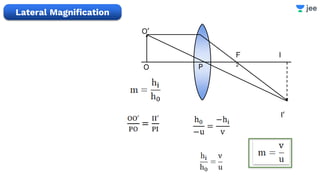
Lateral Magnification
P
O
O’
F
2
I
I’
Example
Convex lens of focal length 15 cm has object kept at 45 cm
from it. If height of Object is 15cm determine, position and
height of Image.
Numerical Answer Type Question [ +4 , 0]
Example
A. 25 m/s B. 15 m/s D. 5 m/s
C. 45 m/s
f = 30 cm
20 cm
5 m/s
Find velocity of image of Object O shown
MCQ type Question [ +4 , -1]
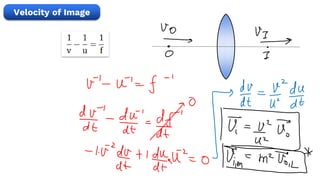
Velocity of Image
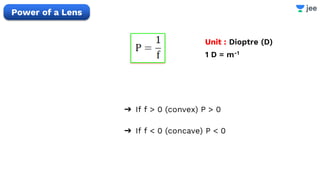
Power of a Lens
Unit : Dioptre (D)
1 D = m-1
➔ If f > 0 (convex) P > 0
➔ If f < 0 (concave) P < 0
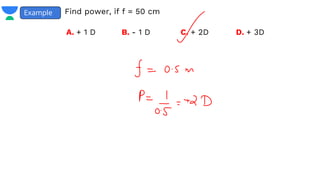
Example Find power, if f = 50 cm
A. + 1 D B. - 1 D C. + 2D D. + 3D
Daily Practice Problems
Find f
Example
60 cm 15 cm
1.5
A. 20 cm B. 18 cm D. 24 cm
C. 12 cm
MCQ type Question [ +4 , -1]
Example
f = 15 cm
45 cm
O
A. 22.5, +2.5 B. 23.5, +1.5 D. 20.5, +1.5
C. 22.5, -2.5
Determine position & height of image when Object is
5cm high kept as shown:
MCQ type Question [ +4 , -1]
Example
f = 12 cm
32 cm
Find position of object for which Image is formed 32 cm from
lens
A. 22.5 B. 17.5
D. 20
C. 19.2
MCQ type Question [ +4 , -1]
Example
Concave lens of focal length 20cm has object of height 2 cm
at 10 cm from it. Determine position and height of Image
formed?
Ans:
u = -10 cm,
h0 = 2 cm,
f = -20 cm,
v = -20/3 cm,
hi = +4/3cm
Numerical Answer Type Question [ +4 , 0]
Example
Find the position where convex lens of focal length 9cm
must be placed so that the image of both Objects is
formed at same place
O1 O2
24 cm
9 cm
18 cm from O1
Numerical Answer Type Question [ +4 , 0]
Convex lens made of glass (1.5) of focal length 50 cm is
immersed in water μ = 4/3. What is its focal length in water?
Example Numerical Answer Type Question [ +4 , 0]
Ans: 100 cm
Convince yourself that focal length derived by lens maker’s
formula is second focal length using sign of R1 & R2
Example
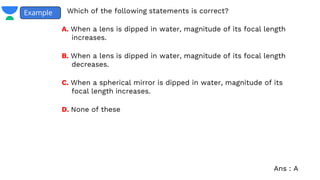
Which of the following statements is correct?
Example
A. When a lens is dipped in water, magnitude of its focal length
increases.
B. When a lens is dipped in water, magnitude of its focal length
decreases.
C. When a spherical mirror is dipped in water, magnitude of its
focal length increases.
D. None of these
Ans : A
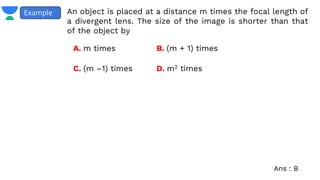
An object is placed at a distance m times the focal length of
a divergent lens. The size of the image is shorter than that
of the object by
Example
A. m times B. (m + 1) times
C. (m –1) times D. m2 times
Ans : B
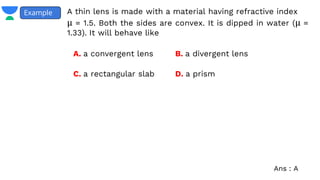
A thin lens is made with a material having refractive index
μ = 1.5. Both the sides are convex. It is dipped in water (μ =
1.33). It will behave like
Example
A. a convergent lens B. a divergent lens
C. a rectangular slab D. a prism
Ans : A
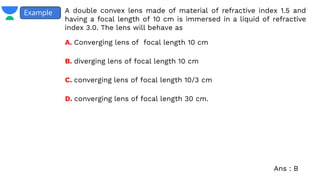
A double convex lens made of material of refractive index 1.5 and
having a focal length of 10 cm is immersed in a liquid of refractive
index 3.0. The lens will behave as
Example
A. Converging lens of focal length 10 cm
B. diverging lens of focal length 10 cm
C. converging lens of focal length 10/3 cm
D. converging lens of focal length 30 cm.
Ans : B
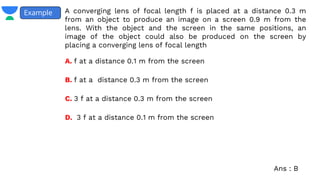
A converging lens of focal length f is placed at a distance 0.3 m
from an object to produce an image on a screen 0.9 m from the
lens. With the object and the screen in the same positions, an
image of the object could also be produced on the screen by
placing a converging lens of focal length
Example
A. f at a distance 0.1 m from the screen
B. f at a distance 0.3 m from the screen
C. 3 f at a distance 0.3 m from the screen
D. 3 f at a distance 0.1 m from the screen
Ans : B
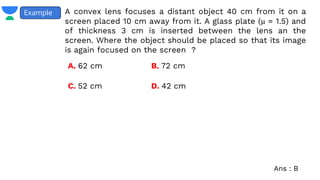
A convex lens focuses a distant object 40 cm from it on a
screen placed 10 cm away from it. A glass plate (μ = 1.5) and
of thickness 3 cm is inserted between the lens an the
screen. Where the object should be placed so that its image
is again focused on the screen ?
Example
Ans : B
A. 62 cm B. 72 cm
C. 52 cm D. 42 cm
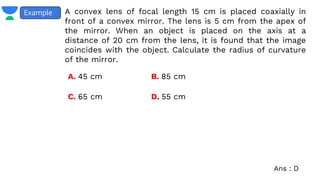
A convex lens of focal length 15 cm is placed coaxially in
front of a convex mirror. The lens is 5 cm from the apex of
the mirror. When an object is placed on the axis at a
distance of 20 cm from the lens, it is found that the image
coincides with the object. Calculate the radius of curvature
of the mirror.
Example
A. 45 cm B. 85 cm
C. 65 cm D. 55 cm
Ans : D
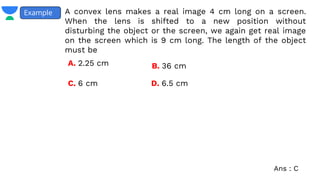
A convex lens makes a real image 4 cm long on a screen.
When the lens is shifted to a new position without
disturbing the object or the screen, we again get real image
on the screen which is 9 cm long. The length of the object
must be
Example
A. 2.25 cm B. 36 cm
C. 6 cm D. 6.5 cm
Ans : C
tinyurl.com/jeelivechat
Telegram
APP
L1  Ray Optics _ Lenses 15th Sep.pdf

L1 Ray Optics _ Lenses 15th Sep.pdf

  • 1.
    Lens Formula RayOptics: Lenses Lecture - 1
  • 2.
    Jayant Nagda Physics Educator unacademy.com/@JayantNagda B.Tech,IIT Bombay IIT-JEE AIR - 161 9+ Years of Teaching Experience at 3 Coaching Institutes (multiple under 15 AIRs) In top 1% INPhO
  • 3.
    unacademy.com/plus Live & RecordedLectures Personalized Interaction Quizzes & Test Series Dedicated Doubt Sessions
  • 4.
  • 5.
  • 6.
    Step 1 Step2 INSTALL
  • 7.
  • 8.
  • 9.
    Lens Converging (or) ConvexLens Diverging (or) Concave Lens
  • 10.
    Image Position inConvex Lens
  • 11.
    Image Position inConvex Lens
  • 12.
    Image Position inConcave Lens
  • 13.
    Lens A lensis a homogenous transparent medium (such as glass) bounded by two curved surfaces or one curved and one plane surface. R2 R1 C1 C2 P
  • 14.
    Lens Types ofLens BiConvex or Convex lens Biconcave or Concave lens Converging Lens Diverging Lens EquiConvex if R1 = R2 EquiConcave if R1 = R2
  • 15.
    Plano-Concave lens Concavo-Convexlens Plano-Convex lens Types of Lens
  • 16.
    R2 R1 C1 C2 P C1,C2 : Centre of curvature of 1st & 2nd surface R1, R2 : Radius of curvature of 1st & 2nd surface Principal axis : line joining C1 & C2 Centre of lens P also known as Optical centre Lens Terms
  • 17.
    O P μ1 μ1 μ2 C1C2 Refraction at 1st surface
  • 18.
    O I P μ1 μ1 μ2 C1C2 Refraction at 1st surface Refraction at 2nd surface Adding 1 & 2 1 2
  • 19.
    If object iskept at ∞, its image is formed at f If u ➝ ∞ , v = f Lens Maker’s formula Lens Maker’s Formula (Definition of Focus)
  • 20.
    Write Sign ofeach of following in single comment Example O I P F1 C1 F2 C2 u v f R1 R2
  • 21.
    Example O I C1 F2C2 u v f R1 R2 Write Sign of each of following in single comment
  • 22.
    Find the focallength of lens Example 10 cm 10 cm 1.5 Numerical Answer Type Question [ +4 , 0]
  • 23.
    Find the focallength of lens Example 1.5 10 cm 10 cm Numerical Answer Type Question [ +4 , 0]
  • 24.
    Find the focallength of lens Example μ = 2 20 cm μ = 1 Numerical Answer Type Question [ +4 , 0] 20 cm
  • 25.
    Lens formula 1. Samemedium on both side of lens μ1 , lens medium of μ2 2. Thin lens, thickness is negligible as compared to object distance. 3. Light rays are Paraxial Lens Formula To be applied keeping in mind:
  • 26.
    Focus of Lens Pointwhere parallel incident rays will intersect after refraction. If object is kept at infinity its image will be at focus. Convex Lens (or) Converging Lens Concave Lens (or) Diverging Lens F2 P F2
  • 27.
    F2 : secondfocus of lens PF2 : second focal length (f2) As u = ∞ then ⇒ v = f Second Focus Second focal length f2 is +ve for convex lens -ve for concave lens
  • 28.
    By lens Maker’sformula For convex lens R1 > 0 & R2 < 0 So, and as long as μ2 > μ1 , f will also be +ve For concave lens R1 < 0 & R2 > 0 so, f is -ve Second focal length f2 is +ve for convex lens -ve for concave lens Second Focus
  • 29.
    Alternative definition ofFocus Point where object should be kept such that rays emerging after refraction are parallel to principal axis or image is formed at infinity. P F1 P Object is placed at F1, image is formed at infinity F1
  • 30.
    F1 : firstfocus of the lens PF1 : first focal length of lens (f1) v = ∞ u = - f1 f1 for convex lens is -ve f1 for concave lens is +ve First Focus
  • 31.
    Example Concave lens offocal length 20 cm has object placed 12 cm from it. Determine position of image. A. 12.5 cm B. -9.5 cm D. 11 cm C. -7.5 cm MCQ type Question [ +4 , -1]
  • 32.
  • 33.
  • 34.
    Example Convex lens offocal length 15 cm has object kept at 45 cm from it. If height of Object is 15cm determine, position and height of Image. Numerical Answer Type Question [ +4 , 0]
  • 35.
    Example A. 25 m/sB. 15 m/s D. 5 m/s C. 45 m/s f = 30 cm 20 cm 5 m/s Find velocity of image of Object O shown MCQ type Question [ +4 , -1]
  • 36.
  • 37.
    Power of aLens Unit : Dioptre (D) 1 D = m-1 ➔ If f > 0 (convex) P > 0 ➔ If f < 0 (concave) P < 0
  • 38.
    Example Find power,if f = 50 cm A. + 1 D B. - 1 D C. + 2D D. + 3D
  • 39.
  • 40.
    Find f Example 60 cm15 cm 1.5 A. 20 cm B. 18 cm D. 24 cm C. 12 cm MCQ type Question [ +4 , -1]
  • 41.
    Example f = 15cm 45 cm O A. 22.5, +2.5 B. 23.5, +1.5 D. 20.5, +1.5 C. 22.5, -2.5 Determine position & height of image when Object is 5cm high kept as shown: MCQ type Question [ +4 , -1]
  • 42.
    Example f = 12cm 32 cm Find position of object for which Image is formed 32 cm from lens A. 22.5 B. 17.5 D. 20 C. 19.2 MCQ type Question [ +4 , -1]
  • 43.
    Example Concave lens offocal length 20cm has object of height 2 cm at 10 cm from it. Determine position and height of Image formed? Ans: u = -10 cm, h0 = 2 cm, f = -20 cm, v = -20/3 cm, hi = +4/3cm Numerical Answer Type Question [ +4 , 0]
  • 44.
    Example Find the positionwhere convex lens of focal length 9cm must be placed so that the image of both Objects is formed at same place O1 O2 24 cm 9 cm 18 cm from O1 Numerical Answer Type Question [ +4 , 0]
  • 45.
    Convex lens madeof glass (1.5) of focal length 50 cm is immersed in water μ = 4/3. What is its focal length in water? Example Numerical Answer Type Question [ +4 , 0] Ans: 100 cm
  • 46.
    Convince yourself thatfocal length derived by lens maker’s formula is second focal length using sign of R1 & R2 Example
  • 47.
    Which of thefollowing statements is correct? Example A. When a lens is dipped in water, magnitude of its focal length increases. B. When a lens is dipped in water, magnitude of its focal length decreases. C. When a spherical mirror is dipped in water, magnitude of its focal length increases. D. None of these Ans : A
  • 48.
    An object isplaced at a distance m times the focal length of a divergent lens. The size of the image is shorter than that of the object by Example A. m times B. (m + 1) times C. (m –1) times D. m2 times Ans : B
  • 49.
    A thin lensis made with a material having refractive index μ = 1.5. Both the sides are convex. It is dipped in water (μ = 1.33). It will behave like Example A. a convergent lens B. a divergent lens C. a rectangular slab D. a prism Ans : A
  • 50.
    A double convexlens made of material of refractive index 1.5 and having a focal length of 10 cm is immersed in a liquid of refractive index 3.0. The lens will behave as Example A. Converging lens of focal length 10 cm B. diverging lens of focal length 10 cm C. converging lens of focal length 10/3 cm D. converging lens of focal length 30 cm. Ans : B
  • 51.
    A converging lensof focal length f is placed at a distance 0.3 m from an object to produce an image on a screen 0.9 m from the lens. With the object and the screen in the same positions, an image of the object could also be produced on the screen by placing a converging lens of focal length Example A. f at a distance 0.1 m from the screen B. f at a distance 0.3 m from the screen C. 3 f at a distance 0.3 m from the screen D. 3 f at a distance 0.1 m from the screen Ans : B
  • 52.
    A convex lensfocuses a distant object 40 cm from it on a screen placed 10 cm away from it. A glass plate (μ = 1.5) and of thickness 3 cm is inserted between the lens an the screen. Where the object should be placed so that its image is again focused on the screen ? Example Ans : B A. 62 cm B. 72 cm C. 52 cm D. 42 cm
  • 53.
    A convex lensof focal length 15 cm is placed coaxially in front of a convex mirror. The lens is 5 cm from the apex of the mirror. When an object is placed on the axis at a distance of 20 cm from the lens, it is found that the image coincides with the object. Calculate the radius of curvature of the mirror. Example A. 45 cm B. 85 cm C. 65 cm D. 55 cm Ans : D
  • 54.
    A convex lensmakes a real image 4 cm long on a screen. When the lens is shifted to a new position without disturbing the object or the screen, we again get real image on the screen which is 9 cm long. The length of the object must be Example A. 2.25 cm B. 36 cm C. 6 cm D. 6.5 cm Ans : C
  • 57.