Principles of Writing
Wednesday 9 July 2014
Communicating Europe+
www.communicatingeu.com
Communicating Europe+
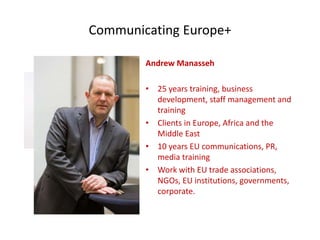
Andrew Manasseh
• 25 years training, business
development, staff management and
training
• Clients in Europe, Africa and the
Middle East
• 10 years EU communications, PR,
media training
• Work with EU trade associations,
NGOs, EU institutions, governments,
corporate.
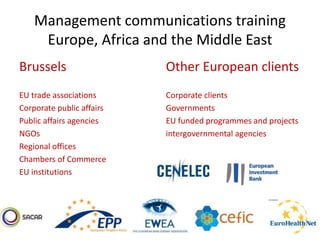
Management communications training
Europe, Africa and the Middle East
Brussels
EU trade associations
Corporate public affairs
Public affairs agencies
NGOs
Regional offices
Chambers of Commerce
EU institutions
Other European clients
Corporate clients
Governments
EU funded programmes and projects
intergovernmental agencies
I also work with colleagues
• Public relations consultants
• Public affairs practitioners
• Social media consultants and digital agencies
• Journalists and writers
• Lawyers
• Management trainers
Professional Development training
• Personal communication skills
• Writing skills
• Strategic communications
• Media relations, media training
• Management communications
• Performance management skills
www.communicatingeu.com
Part 1 Modern writing principles
Texts should be
clear
Communicating Europe 2014
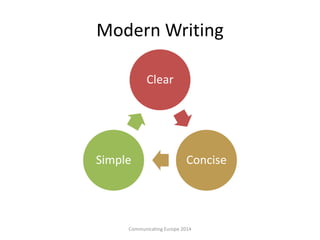
Modern Writing
Clear
ConciseSimple
Communicating Europe 2014
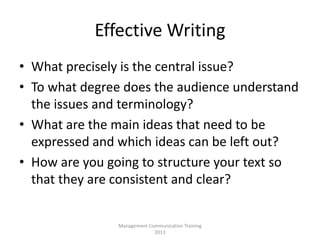
Effective Writing
• What precisely is the central issue?
• To what degree does the audience understand
the issues and terminology?
• What are the main ideas that need to be
expressed and which ideas can be left out?
• How are you going to structure your text so
that they are consistent and clear?
Management Communication Training
2013
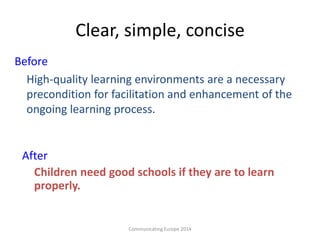
Clear, simple, concise
Before
High-quality learning environments are a necessary
precondition for facilitation and enhancement of the
ongoing learning process.
After
Children need good schools if they are to learn
properly.
Communicating Europe 2014
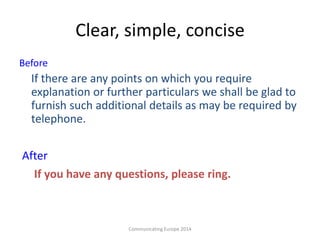
Clear, simple, concise
Before
If there are any points on which you require
explanation or further particulars we shall be glad to
furnish such additional details as may be required by
telephone.
After
If you have any questions, please ring.
Communicating Europe 2014
Part 2 Your readers
Who are you
writing for?
Communicating Europe 2014
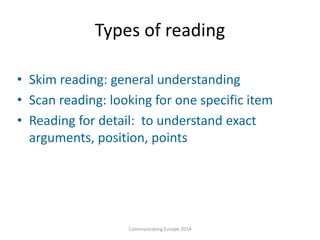
Types of reading
• Skim reading: general understanding
• Scan reading: looking for one specific item
• Reading for detail: to understand exact
arguments, position, points
Communicating Europe 2014
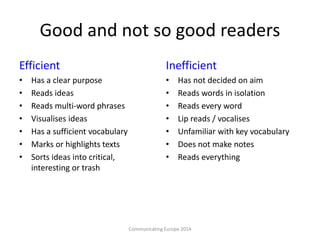
Good and not so good readers
Efficient
• Has a clear purpose
• Reads ideas
• Reads multi-word phrases
• Visualises ideas
• Has a sufficient vocabulary
• Marks or highlights texts
• Sorts ideas into critical,
interesting or trash
Inefficient
• Has not decided on aim
• Reads words in isolation
• Reads every word
• Lip reads / vocalises
• Unfamiliar with key vocabulary
• Does not make notes
• Reads everything
Communicating Europe 2014
Writing tips
Eight essential tips to more effective
writing
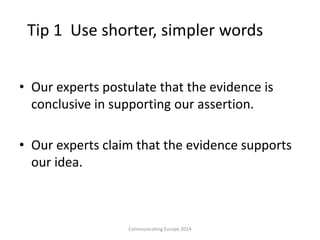
Tip 1 Use shorter, simpler words
• Our experts postulate that the evidence is
conclusive in supporting our assertion.
• Our experts claim that the evidence supports
our idea.
Communicating Europe 2014
Postulate
pos·tu·late
[v. pos-chuh-leyt; n. pos-chuh-lit, -leyt] Show IPA
verb (used with object), pos·tu·lat·ed, pos·tu·lat·ing.1.to ask, demand, or claim.
2.to claim or assume the existence or truth of, especially as a basis for reasoning or
arguing.
3.to assume without proof, or as self-evident; take for granted.
4.Mathematics, Logic. to assume as a postulate.
Noun
5.something taken as self-
evident or assumed without proof as a basis for reasoning.
6.Mathematics, Logic. a proposition that requires no proof, being self-
evident, or that is for a specificpurpose assumed true, and that is used in the proof
of other propositions; axiom.
7.a fundamental principle.
8.a necessary condition; prerequisite.
Tip 2 Put important
information at the beginning
• Even with the differences of opinions, the
members of the working groups agreed to
conclude the negotiation.
• Members of the working group agreed to
conclude the negotiation despite some
differences in opinion.
Communicating Europe 2014
Tip 3 Use verbs that carry meaning
• Please do an invoice and send it to the project
lead partner.
• Please invoice the project lead partner.
Communicating Europe 2014
Tip 4 Use active sentences
• Such revision procedures should be achieved
at the shortest possible delay possible by the
secretariat.
• The secretariat should revise the procedures
as soon as possible.
Communicating Europe 2014
Tip 5 Avoid redundant words
• Due to the ongoing , not yet conclusive,
discussions we will need to delay the decision
• We will need to delay the decision due to
ongoing discussions
Communicating Europe 2014
Redundant or not?
• When is it necessary to include two words
that mean the same thing?
• “Our processes are efficient and effective”
Question - Is it necessary to include both the
process and the outcome?
Tip 6 Avoid starting sentences with
the gerund (ing form)
• Being aware of the president’s negative
opinion we have prepared a statement
• We have prepared a statement as we are
aware of the president’s negative opinion
Communicating Europe 2014
Sentences should be simple
• Subject + Verb + Object
S + V + O
Tip 7 Minimize use of meaningless
phrases
• Basically, the fundamental problem is capacity
• The main problem is capacity
Communicating Europe 2014
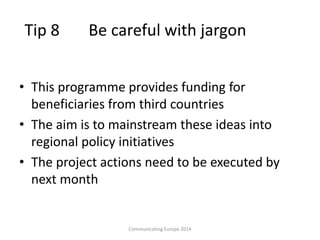
Tip 8 Be careful with jargon
• This programme provides funding for
beneficiaries from third countries
• The aim is to mainstream these ideas into
regional policy initiatives
• The project actions need to be executed by
next month
Communicating Europe 2014
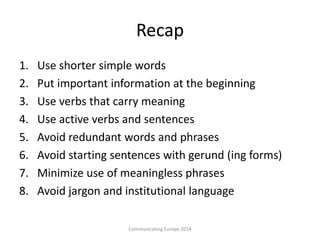
Recap
1. Use shorter simple words
2. Put important information at the beginning
3. Use verbs that carry meaning
4. Use active verbs and sentences
5. Avoid redundant words and phrases
6. Avoid starting sentences with gerund (ing forms)
7. Minimize use of meaningless phrases
8. Avoid jargon and institutional language
Communicating Europe 2014
Readability
On-line Utility tool to assess the
readability of your documents
Communicating Europe 2014
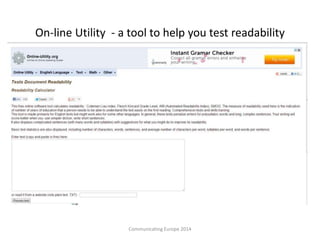
On-line Utility - a tool to help you test readability
Communicating Europe 2014
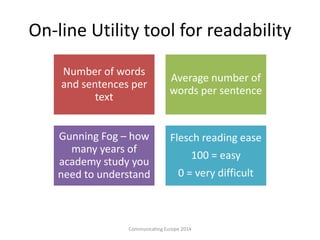
On-line Utility tool for readability
Communicating Europe 2014
Number of words
and sentences per
text
Average number of
words per sentence
Gunning Fog – how
many years of
academy study you
need to understand
Flesch reading ease
100 = easy
0 = very difficult
Paragraphs and sentences
Structure – the importance of
paragraphs and sentences
Communicating Europe 2014
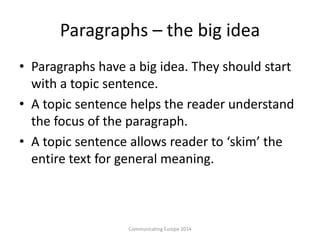
Paragraphs – the big idea
• Paragraphs have a big idea. They should start
with a topic sentence.
• A topic sentence helps the reader understand
the focus of the paragraph.
• A topic sentence allows reader to ‘skim’ the
entire text for general meaning.
Communicating Europe 2014
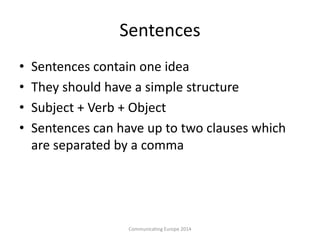
Sentences
• Sentences contain one idea
• They should have a simple structure
• Subject + Verb + Object
• Sentences can have up to two clauses which
are separated by a comma
Communicating Europe 2014
Sentences and clauses
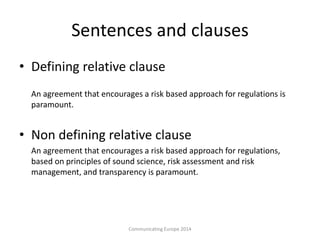
• Defining relative clause
An agreement that encourages a risk based approach for regulations is
paramount.
• Non defining relative clause
An agreement that encourages a risk based approach for regulations,
based on principles of sound science, risk assessment and risk
management, and transparency is paramount.
Communicating Europe 2014
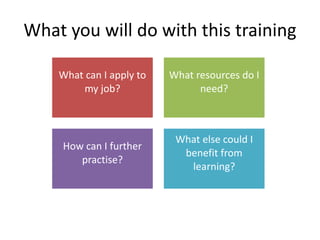
What you will do with this training
What can I apply to
my job?
What resources do I
need?
How can I further
practise?
What else could I
benefit from
learning?
Download our stuff from Slideshare
Follow us on Twitter
Follow us on Google+
Like us on Facebook
For more information about our training courses
info@communicatingeu.com
http://communicatingeu.com/
www.linkedin.com/A Manasseh
twitter.com/andimanas
www.communicatingeu.com
Communicating Europe 2014

Writing skills - the principles

  • 1.
    Principles of Writing Wednesday9 July 2014 Communicating Europe+ www.communicatingeu.com
  • 2.
    Communicating Europe+ Andrew Manasseh •25 years training, business development, staff management and training • Clients in Europe, Africa and the Middle East • 10 years EU communications, PR, media training • Work with EU trade associations, NGOs, EU institutions, governments, corporate.
  • 3.
    Management communications training Europe,Africa and the Middle East Brussels EU trade associations Corporate public affairs Public affairs agencies NGOs Regional offices Chambers of Commerce EU institutions Other European clients Corporate clients Governments EU funded programmes and projects intergovernmental agencies
  • 4.
    I also workwith colleagues • Public relations consultants • Public affairs practitioners • Social media consultants and digital agencies • Journalists and writers • Lawyers • Management trainers
  • 5.
    Professional Development training •Personal communication skills • Writing skills • Strategic communications • Media relations, media training • Management communications • Performance management skills www.communicatingeu.com
  • 6.
    Part 1 Modernwriting principles Texts should be clear Communicating Europe 2014
  • 7.
  • 8.
    Effective Writing • Whatprecisely is the central issue? • To what degree does the audience understand the issues and terminology? • What are the main ideas that need to be expressed and which ideas can be left out? • How are you going to structure your text so that they are consistent and clear? Management Communication Training 2013
  • 9.
    Clear, simple, concise Before High-qualitylearning environments are a necessary precondition for facilitation and enhancement of the ongoing learning process. After Children need good schools if they are to learn properly. Communicating Europe 2014
  • 10.
    Clear, simple, concise Before Ifthere are any points on which you require explanation or further particulars we shall be glad to furnish such additional details as may be required by telephone. After If you have any questions, please ring. Communicating Europe 2014
  • 11.
    Part 2 Yourreaders Who are you writing for? Communicating Europe 2014
  • 12.
    Types of reading •Skim reading: general understanding • Scan reading: looking for one specific item • Reading for detail: to understand exact arguments, position, points Communicating Europe 2014
  • 13.
    Good and notso good readers Efficient • Has a clear purpose • Reads ideas • Reads multi-word phrases • Visualises ideas • Has a sufficient vocabulary • Marks or highlights texts • Sorts ideas into critical, interesting or trash Inefficient • Has not decided on aim • Reads words in isolation • Reads every word • Lip reads / vocalises • Unfamiliar with key vocabulary • Does not make notes • Reads everything Communicating Europe 2014
  • 14.
    Writing tips Eight essentialtips to more effective writing
  • 15.
    Tip 1 Useshorter, simpler words • Our experts postulate that the evidence is conclusive in supporting our assertion. • Our experts claim that the evidence supports our idea. Communicating Europe 2014
  • 16.
    Postulate pos·tu·late [v. pos-chuh-leyt; n.pos-chuh-lit, -leyt] Show IPA verb (used with object), pos·tu·lat·ed, pos·tu·lat·ing.1.to ask, demand, or claim. 2.to claim or assume the existence or truth of, especially as a basis for reasoning or arguing. 3.to assume without proof, or as self-evident; take for granted. 4.Mathematics, Logic. to assume as a postulate. Noun 5.something taken as self- evident or assumed without proof as a basis for reasoning. 6.Mathematics, Logic. a proposition that requires no proof, being self- evident, or that is for a specificpurpose assumed true, and that is used in the proof of other propositions; axiom. 7.a fundamental principle. 8.a necessary condition; prerequisite.
  • 17.
    Tip 2 Putimportant information at the beginning • Even with the differences of opinions, the members of the working groups agreed to conclude the negotiation. • Members of the working group agreed to conclude the negotiation despite some differences in opinion. Communicating Europe 2014
  • 18.
    Tip 3 Useverbs that carry meaning • Please do an invoice and send it to the project lead partner. • Please invoice the project lead partner. Communicating Europe 2014
  • 19.
    Tip 4 Useactive sentences • Such revision procedures should be achieved at the shortest possible delay possible by the secretariat. • The secretariat should revise the procedures as soon as possible. Communicating Europe 2014
  • 20.
    Tip 5 Avoidredundant words • Due to the ongoing , not yet conclusive, discussions we will need to delay the decision • We will need to delay the decision due to ongoing discussions Communicating Europe 2014
  • 21.
    Redundant or not? •When is it necessary to include two words that mean the same thing? • “Our processes are efficient and effective” Question - Is it necessary to include both the process and the outcome?
  • 22.
    Tip 6 Avoidstarting sentences with the gerund (ing form) • Being aware of the president’s negative opinion we have prepared a statement • We have prepared a statement as we are aware of the president’s negative opinion Communicating Europe 2014
  • 23.
    Sentences should besimple • Subject + Verb + Object S + V + O
  • 24.
    Tip 7 Minimizeuse of meaningless phrases • Basically, the fundamental problem is capacity • The main problem is capacity Communicating Europe 2014
  • 25.
    Tip 8 Becareful with jargon • This programme provides funding for beneficiaries from third countries • The aim is to mainstream these ideas into regional policy initiatives • The project actions need to be executed by next month Communicating Europe 2014
  • 26.
    Recap 1. Use shortersimple words 2. Put important information at the beginning 3. Use verbs that carry meaning 4. Use active verbs and sentences 5. Avoid redundant words and phrases 6. Avoid starting sentences with gerund (ing forms) 7. Minimize use of meaningless phrases 8. Avoid jargon and institutional language Communicating Europe 2014
  • 27.
    Readability On-line Utility toolto assess the readability of your documents Communicating Europe 2014
  • 28.
    On-line Utility -a tool to help you test readability Communicating Europe 2014
  • 29.
    On-line Utility toolfor readability Communicating Europe 2014 Number of words and sentences per text Average number of words per sentence Gunning Fog – how many years of academy study you need to understand Flesch reading ease 100 = easy 0 = very difficult
  • 30.
    Paragraphs and sentences Structure– the importance of paragraphs and sentences Communicating Europe 2014
  • 31.
    Paragraphs – thebig idea • Paragraphs have a big idea. They should start with a topic sentence. • A topic sentence helps the reader understand the focus of the paragraph. • A topic sentence allows reader to ‘skim’ the entire text for general meaning. Communicating Europe 2014
  • 32.
    Sentences • Sentences containone idea • They should have a simple structure • Subject + Verb + Object • Sentences can have up to two clauses which are separated by a comma Communicating Europe 2014
  • 33.
    Sentences and clauses •Defining relative clause An agreement that encourages a risk based approach for regulations is paramount. • Non defining relative clause An agreement that encourages a risk based approach for regulations, based on principles of sound science, risk assessment and risk management, and transparency is paramount. Communicating Europe 2014
  • 34.
  • 35.
    What you willdo with this training What can I apply to my job? What resources do I need? How can I further practise? What else could I benefit from learning?
  • 36.
    Download our stufffrom Slideshare
  • 37.
    Follow us onTwitter
  • 38.
    Follow us onGoogle+
  • 39.
    Like us onFacebook
  • 40.
    For more informationabout our training courses info@communicatingeu.com http://communicatingeu.com/ www.linkedin.com/A Manasseh twitter.com/andimanas www.communicatingeu.com Communicating Europe 2014