© 2015
Stuff you Don't Learn in Engineering School:
Effective Communications
3rd
Educational International Technical Committee Workshop @SBU
Dr Mona Ghassemian
Communication tips that are not included in
any formal curriculum.
 Tips for effective email communications
 Hints for winning personal statements
 The impact of reference letters
 Power of presentation
 The essay-writing process
Objectives
• Teamwork
• Effective at meetings
• Leadership skills
• Writing
• Negotiating
• Creativity
• Ethics
Why should you attend
this workshop?
• Setting priorities
• Taking responsibility
• Public speaking
• Risk-taking
• Interpersonal skills
• Decisiveness
• Action oriented
Biggest “Gaps” for graduates
Effective Communications
- The power of presentation,
- Tips for effective email communications,
- The impact of reference letters.
- The essay-writing process,
- Hints for winning personal statements.
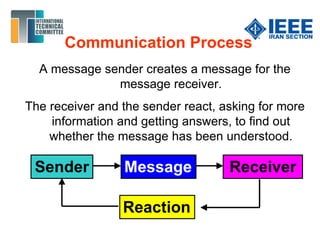
Communication Process
A message sender creates a message for the
message receiver.
The receiver and the sender react, asking for more
information and getting answers, to find out
whether the message has been understood.
Sender Message Receiver
Reaction
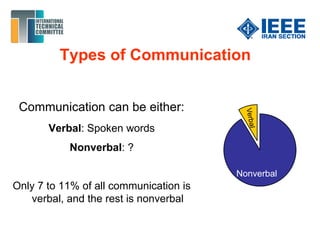
Types of Communication
Communication can be either:
Verbal: Spoken words
Nonverbal: ?
Only 7 to 11% of all communication is
verbal, and the rest is nonverbal
Nonverbal
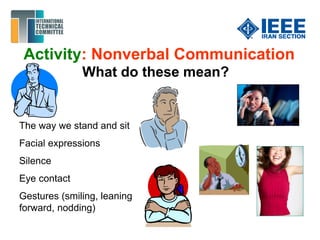
Activity: Nonverbal Communication
What do these mean?
The way we stand and sit
Facial expressions
Silence
Eye contact
Gestures (smiling, leaning
forward, nodding)
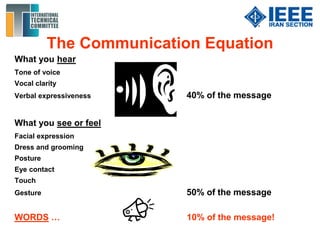
The Communication Equation
What you hear
Tone of voice
Vocal clarity
Verbal expressiveness 40% of the message
What you see or feel
Facial expression
Dress and grooming
Posture
Eye contact
Touch
Gesture 50% of the message
WORDS … 10% of the message!
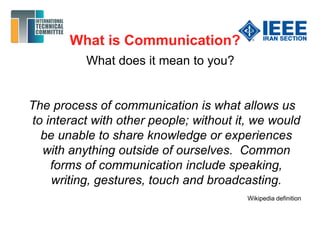
What is Communication?
What does it mean to you?
The process of communication is what allows us
to interact with other people; without it, we would
be unable to share knowledge or experiences
with anything outside of ourselves. Common
forms of communication include speaking,
writing, gestures, touch and broadcasting.
Wikipedia definition
Power of presentation
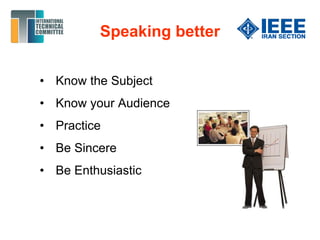
Speaking better
• Know the Subject
• Know your Audience
• Practice
• Be Sincere
• Be Enthusiastic
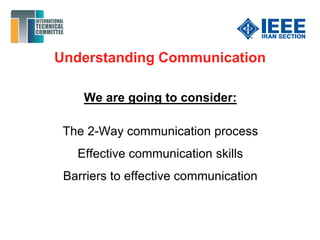
Understanding Communication
We are going to consider:
The 2-Way communication process
Effective communication skills
Barriers to effective communication
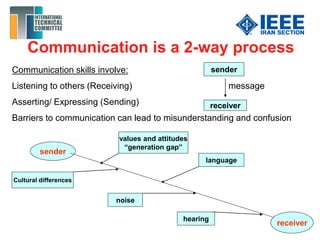
Communication is a 2-way process
Communication skills involve:
Listening to others (Receiving) message
Asserting/ Expressing (Sending)
Barriers to communication can lead to misunderstanding and confusion
sender
receiver
sender
receiver
values and attitudes
“generation gap”
Cultural differences
language
noise
hearing
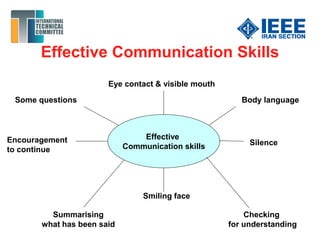
Effective Communication Skills
Effective
Communication skills
Eye contact & visible mouth
Body language
Silence
Checking
for understanding
Smiling face
Summarising
what has been said
Encouragement
to continue
Some questions
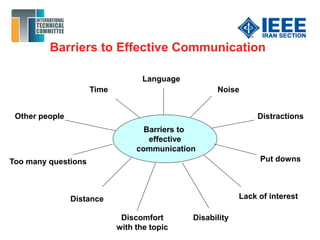
Barriers to Effective Communication
Barriers to
effective
communication
Language
NoiseTime
DistractionsOther people
Put downsToo many questions
Distance
Discomfort
with the topic
Disability
Lack of interest
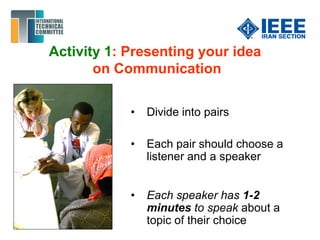
Activity 1: Presenting your idea
on Communication
• Divide into pairs
• Each pair should choose a
listener and a speaker
• Each speaker has 1-2
minutes to speak about a
topic of their choice
The Art of Listening
“If we were supposed to talk more than
listen, we would have been given two
mouths and one ear.”
Mark Twain
Listening Skills
Active Listening
Responding
Paraphrasing
Asking questions for clarification
Mirroring the other person’s language
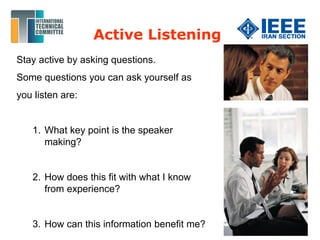
Stay active by asking questions.
Some questions you can ask yourself as
you listen are:
1. What key point is the speaker
making?
2. How does this fit with what I know
from experience?
3. How can this information benefit me?
Active Listening
• Turn your body and tilt your face toward the speaker.
• Use other parts of your body besides your ears to receive the
message:
1. Look at the speaker to pick up nonverbal signals or cues
2. Your eyes will also send signals to the speaker
3. When the speaker sees a receptive audience they are
motivated to work harder to communicate their message
• React to the speaker by nodding your head.
Looking and Acting Like a Good Listener
Active Listening:
Non-Verbal Communication
Responding
Responses to check that your perceptions are
correct
Responses to encourage further communication
Open ended and Closed questions
Cultural Diversity
What do we know about the communication styles
of different cultures?
Consider verbal and non verbal, including dress
constraints, language difficulties, taboos.
Constraints on Communication
Legal Obligations
Anti Discrimination
Privacy Laws
Code of Conduct of Organisation
Confidentiality and Gossip
Seeking Advice
Effective Communications
- The power of presentation,
- Tips for effective email communications,
- The impact of reference letters.
- The essay-writing process,
- Hints for winning personal statements.
How is it spelled?
email
Email
eMail
EMail
e-mail
E-mail
e-Mail
E-Mail
How is it spelled?
Gregg, Microsoft, and AP: e-mail
Wired: email
Email Experience Council:
email is standard
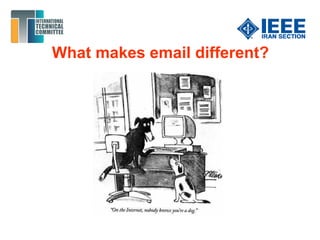
What makes email different?
Difference: Tone
 No nonverbal cues
 Tone becomes crucial
 In Germany and Britain, 23 percent
and 14 percent respectively [of
respondents to a Daily Mail survey]
admitted confrontations with
colleagues because of e-mail
misunderstandings.
Tone: Example One
To: Female employees
From: H. Honcho
Re: Dress code
Date: 1 July 2006
Clients will be visiting next week. Halter tops
and jeans will not make the right impression.
It’s time you started dressing for the office
instead of the beach. Leave your flip-flops at
home!
Tone: Example Two
To: All staff
From: H. Honcho
Re: Reminder about what to wear to work
Date: 1 July 2006
During the summer, our dress code is business casual. We think
“business casual” means clothes that feel comfortable and look
professional.
Men Women
•khaki pants •casual pants and skirts
•leather shoes… •leather or fabric shoes…
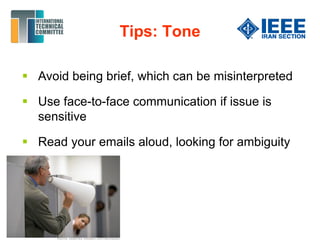
Tips: Tone
 Avoid being brief, which can be misinterpreted
 Use face-to-face communication if issue is
sensitive
 Read your emails aloud, looking for ambiguity
How to write email to an
academic
• You know that your lectures will always have different
teaching styles: serious, more relaxed, formal, and less
formal.
• However, you need to write appropriate academic
emails.
• You will need to use a more formal tone when you email.
• Emailing your lecturers is not the same as texting or
chatting. You must always capitalize your “I”, spell words
correctly and completely, and identify yourself when you
write one of your instructors an email.
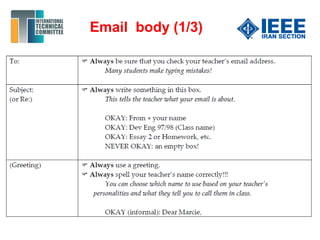
Email body (1/3)
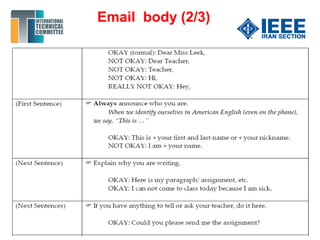
Email body (2/3)
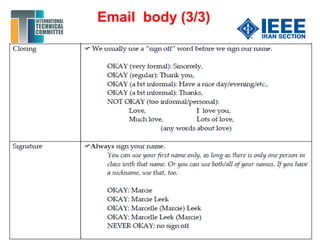
Email body (3/3)
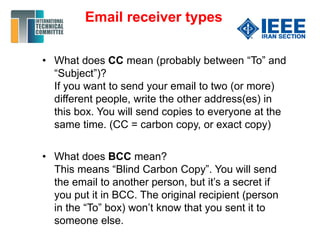
• What does CC mean (probably between “To” and
“Subject”)?
If you want to send your email to two (or more)
different people, write the other address(es) in
this box. You will send copies to everyone at the
same time. (CC = carbon copy, or exact copy)
• What does BCC mean?
This means “Blind Carbon Copy”. You will send
the email to another person, but it’s a secret if
you put it in BCC. The original recipient (person
in the “To” box) won’t know that you sent it to
someone else.
Email receiver types
Activity 2:
Emails about missing class:
· If you know in advance that you will be missing class due to
religious observance or a school-sanctioned activity (e.g.
athletic competition), notify your professors as soon as
possible, and ask how you can make up the work.
· If you miss class due to illness, explain why you missed
class without explicit details and make a plan for catching up.
· Talk to classmates and check the class website to find out
the most information possible regarding the class you have
missed before consulting your professor.
· Attempt to make up work ahead of time or soon after you
miss class.
Tip: Electronic ≠ Instant
Many expect a phone call to alert them
to an email labeled Urgent.
Allow a reasonable time (two days – week)
for a response.
Respond before senders have to follow up
or business is delayed.
Activity 3:
Emails requesting recommendations
 · Send this type of email at least two weeks in advance.
 · Make it clear that you are extremely appreciative for the time the
professor is spending to help you.
 · Provide all necessary information, such as a short description of the
program, deadlines, how to submit, and any requirements for the
recommendation.
 · Describe why you personally will benefit from the program or
experience.
 · Ask if the professor would like to see your resume and any other
application materials.
 · If the professor agrees to write the recommendation, follow up with a
handwritten thank you note, office visit, or an email to show your
appreciation.
Effective Communications
- The power of presentation,
- Tips for effective email communications,
- The impact of reference letters.
- The essay-writing process,
- Hints for winning personal statements.
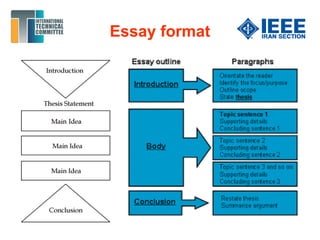
Essay format
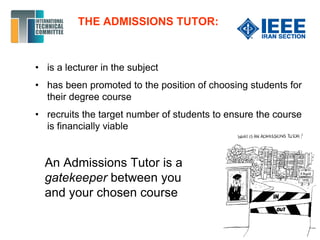
THE ADMISSIONS TUTOR:
• is a lecturer in the subject
• has been promoted to the position of choosing students for
their degree course
• recruits the target number of students to ensure the course
is financially viable
An Admissions Tutor is a
gatekeeper between you
and your chosen course
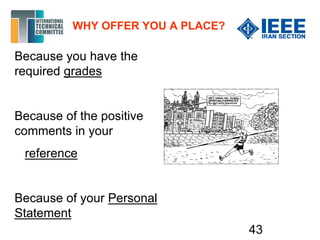
WHY OFFER YOU A PLACE?
Because you have the
required grades
Because of the positive
comments in your
reference
Because of your Personal
Statement
43
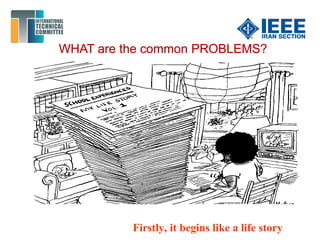
Firstly, it begins like a life story
MORE PROBLEMS….
Many long sentences
Making grammatical errors
Sets out to impress but comes across as arrogant
Not being proof read
Turn yourself into an Admissions Tutor
Admissions Tutors were asked
‘WHAT ARE YOU LOOKING FOR WHEN YOU READ A
PERSONAL STATEMENT?’
• Interest in the course (most important) – most
of the statement could deal with this
• Motivated student
• No spelling or grammatical mistakes
• Clearly written
• Balance studies with 'life‘
• Interesting person
• Work experience (if relevant)
• Wider key skills (e.g. teamwork, if relevant)
• Any interesting hobby (especially if relevant)
ADMISSIONS TUTORS WERE ASKED
‘WHAT SHOULD APPLICANTS AVOID?
• Waffle
• Swallowing a dictionary
• Statements with no
examples or evidence
• Very ordinary interests
e.g. visiting family
• Becoming somebody you
are not
• Religion and Politics
• Personal experiences &
extreme hardships/family
problems
• Rushing producing a
poorly written statement
• Lying (remember the
interview!)
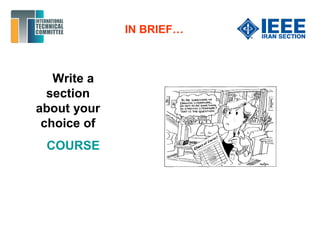
IN BRIEF…
Write a
section
about your
choice of
COURSE
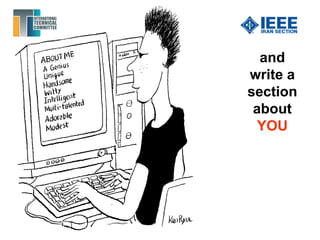
and
write a
section
about
YOU
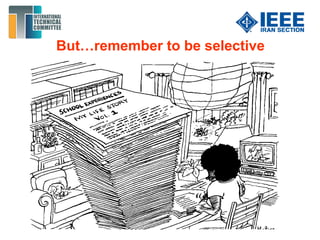
But…remember to be selective
HOW DO YOU WRITE A UNIQUE PERSONAL
STATEMENT?
Many admissions tutors complain of
reading statements that appear the same.
A response to this problem has been to
try to capture the reader’s attention
HOW DO YOU WRITE A UNIQUE PERSONAL
STATEMENT?
A more impressive and less risky way to sell
yourself is to convince an admissions
tutor that you are really passionate about
the course so….
do your course research
Need some help? Read on…
HOW DO I WRITE A UNIQUE PERSONAL
STATEMENT & PERSUADE AN ADMISSIONS TUTOR
THAT I AM KEEN TO STUDY THEIR COURSE?
Be * Motivated * &
* interested in the course
Write about any relevant books /
articles you have read
(even writing about a short article in a chapter /
journal / a few pages in a book is going to have
more of an impact than simply stating you want to
study the course)
HOW DO I WRITE A UNIQUE PERSONAL
STATEMENT & PERSUADE AN ADMISSIONS TUTOR
THAT I AM KEEN TO STUDY THEIR COURSE?
Write about your relevant current courses
(e.g. write about topics that interested you
most & why or skills you have developed
that you believe to be relevant)
HOW DO I WRITE A UNIQUE PERSONAL
STATEMENT & PERSUADE AN ADMISSIONS TUTOR
THAT I AM KEEN TO STUDY THEIR COURSE?
Write about experiences that relate to the course
Conferences, short courses, trips, people you
have met, something you have read, hobbies,
future plans, something you have seen –
anything relevant that will convince the
admissions tutor that you have given serious
thought to the choice of course
HOW DO I WRITE A UNIQUE PERSONAL
STATEMENT & PERSUADE AN ADMISSIONS TUTOR
THAT I AM KEEN TO STUDY THEIR COURSE?
By researching your choice of course carefully,
you should achieve two outcomes:
You will be more confident that you have chosen
the right degree for you
You will be able to write about the course in a
more informed and persuasive way
Reading materials
• Stuff You Don't Learn in Engineering School, Presenter: Carl Selinger
Recorded: 14 April 2011,
SOURCE : http://www.ieeeusa.org/careers/webinars/2011/webinar-04-14-11.html
• Stuff You Don't Learn in Engineering School: Communicating Effectively
SOURCE : https://ieee-elearning.org/CLE/mod/scorm/view.php?id=277
• THE FIVE-PARAGRAPH ESSAY-
SOURCE: http://grammar.ccc.commnet.edu/grammar/five_par.htm
• Email communication - SOURCE : http://word-crafter.net/email.html
• Handout accompanies the brain shark presentation at - SOURCE :
http://my.brainshark.com/Yo-Dear-or-Hello-Professor-Mastering-the-
Discourse-of-Academic-Email-437291938
• Reading aloud idea from Louise Dobson, “Avoiding Email Catasrophes,” -
SOURCE: http://www.psychologytoday.com/articles/pto-20060405-000001.html
Please write a feedback or an evaluation note
and email it to ITC@sbu.ac.ir
 THANK YOU 
Evaluation
E-mail: itc@sbu.ac.ir
Linkedin: ITC – International Technical Committee
Instagram: sbu_itc
Twitter: @sbu_itc
Website: http://itc.sbu.ac.ir

Effective communications workshop

  • 1.
    © 2015 Stuff youDon't Learn in Engineering School: Effective Communications 3rd Educational International Technical Committee Workshop @SBU Dr Mona Ghassemian
  • 2.
    Communication tips thatare not included in any formal curriculum.  Tips for effective email communications  Hints for winning personal statements  The impact of reference letters  Power of presentation  The essay-writing process Objectives
  • 3.
    • Teamwork • Effectiveat meetings • Leadership skills • Writing • Negotiating • Creativity • Ethics Why should you attend this workshop? • Setting priorities • Taking responsibility • Public speaking • Risk-taking • Interpersonal skills • Decisiveness • Action oriented Biggest “Gaps” for graduates
  • 4.
    Effective Communications - Thepower of presentation, - Tips for effective email communications, - The impact of reference letters. - The essay-writing process, - Hints for winning personal statements.
  • 5.
    Communication Process A messagesender creates a message for the message receiver. The receiver and the sender react, asking for more information and getting answers, to find out whether the message has been understood. Sender Message Receiver Reaction
  • 6.
    Types of Communication Communicationcan be either: Verbal: Spoken words Nonverbal: ? Only 7 to 11% of all communication is verbal, and the rest is nonverbal Nonverbal
  • 7.
    Activity: Nonverbal Communication Whatdo these mean? The way we stand and sit Facial expressions Silence Eye contact Gestures (smiling, leaning forward, nodding)
  • 8.
    The Communication Equation Whatyou hear Tone of voice Vocal clarity Verbal expressiveness 40% of the message What you see or feel Facial expression Dress and grooming Posture Eye contact Touch Gesture 50% of the message WORDS … 10% of the message!
  • 9.
    What is Communication? Whatdoes it mean to you? The process of communication is what allows us to interact with other people; without it, we would be unable to share knowledge or experiences with anything outside of ourselves. Common forms of communication include speaking, writing, gestures, touch and broadcasting. Wikipedia definition
  • 10.
  • 11.
    Speaking better • Knowthe Subject • Know your Audience • Practice • Be Sincere • Be Enthusiastic
  • 12.
    Understanding Communication We aregoing to consider: The 2-Way communication process Effective communication skills Barriers to effective communication
  • 13.
    Communication is a2-way process Communication skills involve: Listening to others (Receiving) message Asserting/ Expressing (Sending) Barriers to communication can lead to misunderstanding and confusion sender receiver sender receiver values and attitudes “generation gap” Cultural differences language noise hearing
  • 14.
    Effective Communication Skills Effective Communicationskills Eye contact & visible mouth Body language Silence Checking for understanding Smiling face Summarising what has been said Encouragement to continue Some questions
  • 15.
    Barriers to EffectiveCommunication Barriers to effective communication Language NoiseTime DistractionsOther people Put downsToo many questions Distance Discomfort with the topic Disability Lack of interest
  • 16.
    Activity 1: Presentingyour idea on Communication • Divide into pairs • Each pair should choose a listener and a speaker • Each speaker has 1-2 minutes to speak about a topic of their choice
  • 17.
    The Art ofListening “If we were supposed to talk more than listen, we would have been given two mouths and one ear.” Mark Twain
  • 18.
    Listening Skills Active Listening Responding Paraphrasing Askingquestions for clarification Mirroring the other person’s language
  • 19.
    Stay active byasking questions. Some questions you can ask yourself as you listen are: 1. What key point is the speaker making? 2. How does this fit with what I know from experience? 3. How can this information benefit me? Active Listening
  • 20.
    • Turn yourbody and tilt your face toward the speaker. • Use other parts of your body besides your ears to receive the message: 1. Look at the speaker to pick up nonverbal signals or cues 2. Your eyes will also send signals to the speaker 3. When the speaker sees a receptive audience they are motivated to work harder to communicate their message • React to the speaker by nodding your head. Looking and Acting Like a Good Listener Active Listening: Non-Verbal Communication
  • 21.
    Responding Responses to checkthat your perceptions are correct Responses to encourage further communication Open ended and Closed questions
  • 22.
    Cultural Diversity What dowe know about the communication styles of different cultures? Consider verbal and non verbal, including dress constraints, language difficulties, taboos.
  • 23.
    Constraints on Communication LegalObligations Anti Discrimination Privacy Laws Code of Conduct of Organisation Confidentiality and Gossip Seeking Advice
  • 24.
    Effective Communications - Thepower of presentation, - Tips for effective email communications, - The impact of reference letters. - The essay-writing process, - Hints for winning personal statements.
  • 25.
    How is itspelled? email Email eMail EMail e-mail E-mail e-Mail E-Mail
  • 26.
    How is itspelled? Gregg, Microsoft, and AP: e-mail Wired: email Email Experience Council: email is standard
  • 27.
    What makes emaildifferent?
  • 28.
    Difference: Tone  Nononverbal cues  Tone becomes crucial  In Germany and Britain, 23 percent and 14 percent respectively [of respondents to a Daily Mail survey] admitted confrontations with colleagues because of e-mail misunderstandings.
  • 29.
    Tone: Example One To:Female employees From: H. Honcho Re: Dress code Date: 1 July 2006 Clients will be visiting next week. Halter tops and jeans will not make the right impression. It’s time you started dressing for the office instead of the beach. Leave your flip-flops at home!
  • 30.
    Tone: Example Two To:All staff From: H. Honcho Re: Reminder about what to wear to work Date: 1 July 2006 During the summer, our dress code is business casual. We think “business casual” means clothes that feel comfortable and look professional. Men Women •khaki pants •casual pants and skirts •leather shoes… •leather or fabric shoes…
  • 31.
    Tips: Tone  Avoidbeing brief, which can be misinterpreted  Use face-to-face communication if issue is sensitive  Read your emails aloud, looking for ambiguity
  • 32.
    How to writeemail to an academic • You know that your lectures will always have different teaching styles: serious, more relaxed, formal, and less formal. • However, you need to write appropriate academic emails. • You will need to use a more formal tone when you email. • Emailing your lecturers is not the same as texting or chatting. You must always capitalize your “I”, spell words correctly and completely, and identify yourself when you write one of your instructors an email.
  • 33.
  • 34.
  • 35.
  • 36.
    • What doesCC mean (probably between “To” and “Subject”)? If you want to send your email to two (or more) different people, write the other address(es) in this box. You will send copies to everyone at the same time. (CC = carbon copy, or exact copy) • What does BCC mean? This means “Blind Carbon Copy”. You will send the email to another person, but it’s a secret if you put it in BCC. The original recipient (person in the “To” box) won’t know that you sent it to someone else. Email receiver types
  • 37.
    Activity 2: Emails aboutmissing class: · If you know in advance that you will be missing class due to religious observance or a school-sanctioned activity (e.g. athletic competition), notify your professors as soon as possible, and ask how you can make up the work. · If you miss class due to illness, explain why you missed class without explicit details and make a plan for catching up. · Talk to classmates and check the class website to find out the most information possible regarding the class you have missed before consulting your professor. · Attempt to make up work ahead of time or soon after you miss class.
  • 38.
    Tip: Electronic ≠Instant Many expect a phone call to alert them to an email labeled Urgent. Allow a reasonable time (two days – week) for a response. Respond before senders have to follow up or business is delayed.
  • 39.
    Activity 3: Emails requestingrecommendations  · Send this type of email at least two weeks in advance.  · Make it clear that you are extremely appreciative for the time the professor is spending to help you.  · Provide all necessary information, such as a short description of the program, deadlines, how to submit, and any requirements for the recommendation.  · Describe why you personally will benefit from the program or experience.  · Ask if the professor would like to see your resume and any other application materials.  · If the professor agrees to write the recommendation, follow up with a handwritten thank you note, office visit, or an email to show your appreciation.
  • 40.
    Effective Communications - Thepower of presentation, - Tips for effective email communications, - The impact of reference letters. - The essay-writing process, - Hints for winning personal statements.
  • 41.
  • 42.
    THE ADMISSIONS TUTOR: •is a lecturer in the subject • has been promoted to the position of choosing students for their degree course • recruits the target number of students to ensure the course is financially viable An Admissions Tutor is a gatekeeper between you and your chosen course
  • 43.
    WHY OFFER YOUA PLACE? Because you have the required grades Because of the positive comments in your reference Because of your Personal Statement 43
  • 44.
    Firstly, it beginslike a life story
  • 45.
    MORE PROBLEMS…. Many longsentences Making grammatical errors Sets out to impress but comes across as arrogant Not being proof read Turn yourself into an Admissions Tutor
  • 46.
    Admissions Tutors wereasked ‘WHAT ARE YOU LOOKING FOR WHEN YOU READ A PERSONAL STATEMENT?’ • Interest in the course (most important) – most of the statement could deal with this • Motivated student • No spelling or grammatical mistakes • Clearly written • Balance studies with 'life‘ • Interesting person • Work experience (if relevant) • Wider key skills (e.g. teamwork, if relevant) • Any interesting hobby (especially if relevant)
  • 47.
    ADMISSIONS TUTORS WEREASKED ‘WHAT SHOULD APPLICANTS AVOID? • Waffle • Swallowing a dictionary • Statements with no examples or evidence • Very ordinary interests e.g. visiting family • Becoming somebody you are not • Religion and Politics • Personal experiences & extreme hardships/family problems • Rushing producing a poorly written statement • Lying (remember the interview!)
  • 48.
    IN BRIEF… Write a section aboutyour choice of COURSE
  • 49.
  • 50.
  • 51.
    HOW DO YOUWRITE A UNIQUE PERSONAL STATEMENT? Many admissions tutors complain of reading statements that appear the same. A response to this problem has been to try to capture the reader’s attention
  • 52.
    HOW DO YOUWRITE A UNIQUE PERSONAL STATEMENT? A more impressive and less risky way to sell yourself is to convince an admissions tutor that you are really passionate about the course so…. do your course research Need some help? Read on…
  • 53.
    HOW DO IWRITE A UNIQUE PERSONAL STATEMENT & PERSUADE AN ADMISSIONS TUTOR THAT I AM KEEN TO STUDY THEIR COURSE? Be * Motivated * & * interested in the course Write about any relevant books / articles you have read (even writing about a short article in a chapter / journal / a few pages in a book is going to have more of an impact than simply stating you want to study the course)
  • 54.
    HOW DO IWRITE A UNIQUE PERSONAL STATEMENT & PERSUADE AN ADMISSIONS TUTOR THAT I AM KEEN TO STUDY THEIR COURSE? Write about your relevant current courses (e.g. write about topics that interested you most & why or skills you have developed that you believe to be relevant)
  • 55.
    HOW DO IWRITE A UNIQUE PERSONAL STATEMENT & PERSUADE AN ADMISSIONS TUTOR THAT I AM KEEN TO STUDY THEIR COURSE? Write about experiences that relate to the course Conferences, short courses, trips, people you have met, something you have read, hobbies, future plans, something you have seen – anything relevant that will convince the admissions tutor that you have given serious thought to the choice of course
  • 56.
    HOW DO IWRITE A UNIQUE PERSONAL STATEMENT & PERSUADE AN ADMISSIONS TUTOR THAT I AM KEEN TO STUDY THEIR COURSE? By researching your choice of course carefully, you should achieve two outcomes: You will be more confident that you have chosen the right degree for you You will be able to write about the course in a more informed and persuasive way
  • 57.
    Reading materials • StuffYou Don't Learn in Engineering School, Presenter: Carl Selinger Recorded: 14 April 2011, SOURCE : http://www.ieeeusa.org/careers/webinars/2011/webinar-04-14-11.html • Stuff You Don't Learn in Engineering School: Communicating Effectively SOURCE : https://ieee-elearning.org/CLE/mod/scorm/view.php?id=277 • THE FIVE-PARAGRAPH ESSAY- SOURCE: http://grammar.ccc.commnet.edu/grammar/five_par.htm • Email communication - SOURCE : http://word-crafter.net/email.html • Handout accompanies the brain shark presentation at - SOURCE : http://my.brainshark.com/Yo-Dear-or-Hello-Professor-Mastering-the- Discourse-of-Academic-Email-437291938 • Reading aloud idea from Louise Dobson, “Avoiding Email Catasrophes,” - SOURCE: http://www.psychologytoday.com/articles/pto-20060405-000001.html
  • 58.
    Please write afeedback or an evaluation note and email it to ITC@sbu.ac.ir  THANK YOU  Evaluation E-mail: itc@sbu.ac.ir Linkedin: ITC – International Technical Committee Instagram: sbu_itc Twitter: @sbu_itc Website: http://itc.sbu.ac.ir