 Introduction
 Meaning of ESP
 Types of ESP
 Characteristics of ESP courses
 The word ‘SPECIAL’ in ESP
 Conclusion
 English has become the internationally
accepted language of almost all the fields of
knowledge.
 Depending on their specific needs and
requirements, new learners who knew
specifically why they need English are created.
 In some cases people with inadequate
proficiency in English need to be taught to
handle specific jobs.
 To fulfill the needs of these new learners new
specific courses were designed and
introduced.
 ESP is one of these specific courses.
 From early 1960’s, ESP has emerged as
one of the major areas of EFL
teaching today.
 Various universities across the globe
are offering a number of ESP courses
nowadays.
 Examples: English for Chemists, English
for Educationists, English for
Advertisements, English for Media, etc.
 ESP means English for specific purposes.
 ESP is defined in the terms of its absolute
and variable characteristics by Tony
Dudley Evens.
 Absolute Characteristics:
› Meets specific needs of learners.
› Makes use of underlying methodology and
activities of the discipline it serves.
› Is centered on the language appropriate to
these activities in terms of grammar, lexis,
syntax, study skills, discourse, and genre.
 Variable Characteristics:
› May be related to or designed for specific
disciplines.
› May use, in particular situations, different
methodologies from general English.
› Is likely to be designed for adult learners,
either at an institute or at a work place.
› Is generally designed for intermediate and
advanced students.
› Most of the ESP courses assume some basic
knowledge of the language systems.
 ESP is an approach to teaching.
 ESP is an attitude of mind.
 ESP is concerned with turning learners
into users.
 Hutchinson et al. (1987:19) state,
› ESP is an approach to language teaching in
which all decisions as to content and
method are based on the learner’s reason of
learning.
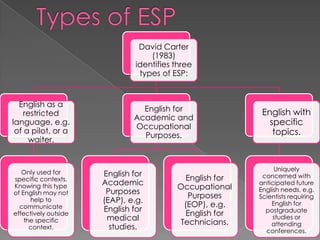
David Carter
(1983)
identifies three
types of ESP:
English as a
restricted
language, e.g.
of a pilot, or a
waiter.
Only used for
specific contexts.
Knowing this type
of English may not
help to
communicate
effectively outside
the specific
context.
English for
Academic and
Occupational
Purposes.
English for
Academic
Purposes
(EAP), e.g.
English for
medical
studies.
English for
Occupational
Purposes
(EOP), e.g.
English for
Technicians.
English with
specific
topics.
Uniquely
concerned with
anticipated future
English needs, e.g.
Scientists requiring
English for
postgraduate
studies or
attending
conferences.
 Carter (1983) discusses three
characteristics of ESP courses.
› Authentic material
 Study material must be authentic.
› Purpose-related orientation
 Orientation lessons must be according to the
needs of the learners.
› Self-direction
 Learners must have a degree of freedom to
decide what, when and how they will study.
The word SPECIAL refers to:
› Purpose for which learners learn
language; not the nature of
language.
› Restricted repertoire of words
and expressions selected from
the whole language.
 ESP-English for specific purposes has
emerged as a significant field in Applied
Linguistics. It is mostly concerned with the
learners’ needs for a specific field of
academics or occupation. Restricted
skills of words and expressions, purpose of
learning the language are the areas to
be considered in ESP.
Thank you

ESP - English for specific purposes

  • 2.
     Introduction  Meaningof ESP  Types of ESP  Characteristics of ESP courses  The word ‘SPECIAL’ in ESP  Conclusion
  • 3.
     English hasbecome the internationally accepted language of almost all the fields of knowledge.  Depending on their specific needs and requirements, new learners who knew specifically why they need English are created.  In some cases people with inadequate proficiency in English need to be taught to handle specific jobs.  To fulfill the needs of these new learners new specific courses were designed and introduced.  ESP is one of these specific courses.
  • 4.
     From early1960’s, ESP has emerged as one of the major areas of EFL teaching today.  Various universities across the globe are offering a number of ESP courses nowadays.  Examples: English for Chemists, English for Educationists, English for Advertisements, English for Media, etc.
  • 5.
     ESP meansEnglish for specific purposes.  ESP is defined in the terms of its absolute and variable characteristics by Tony Dudley Evens.  Absolute Characteristics: › Meets specific needs of learners. › Makes use of underlying methodology and activities of the discipline it serves. › Is centered on the language appropriate to these activities in terms of grammar, lexis, syntax, study skills, discourse, and genre.
  • 6.
     Variable Characteristics: ›May be related to or designed for specific disciplines. › May use, in particular situations, different methodologies from general English. › Is likely to be designed for adult learners, either at an institute or at a work place. › Is generally designed for intermediate and advanced students. › Most of the ESP courses assume some basic knowledge of the language systems.
  • 7.
     ESP isan approach to teaching.  ESP is an attitude of mind.  ESP is concerned with turning learners into users.  Hutchinson et al. (1987:19) state, › ESP is an approach to language teaching in which all decisions as to content and method are based on the learner’s reason of learning.
  • 8.
    David Carter (1983) identifies three typesof ESP: English as a restricted language, e.g. of a pilot, or a waiter. Only used for specific contexts. Knowing this type of English may not help to communicate effectively outside the specific context. English for Academic and Occupational Purposes. English for Academic Purposes (EAP), e.g. English for medical studies. English for Occupational Purposes (EOP), e.g. English for Technicians. English with specific topics. Uniquely concerned with anticipated future English needs, e.g. Scientists requiring English for postgraduate studies or attending conferences.
  • 9.
     Carter (1983)discusses three characteristics of ESP courses. › Authentic material  Study material must be authentic. › Purpose-related orientation  Orientation lessons must be according to the needs of the learners. › Self-direction  Learners must have a degree of freedom to decide what, when and how they will study.
  • 10.
    The word SPECIALrefers to: › Purpose for which learners learn language; not the nature of language. › Restricted repertoire of words and expressions selected from the whole language.
  • 11.
     ESP-English forspecific purposes has emerged as a significant field in Applied Linguistics. It is mostly concerned with the learners’ needs for a specific field of academics or occupation. Restricted skills of words and expressions, purpose of learning the language are the areas to be considered in ESP.
  • 12.