Writing Skills for Work
ACADEMIC LEARNING DEVELOPMENT
learningadvice@westminster.ac.uk
Workshop Outline
• Purpose and context
• Audience and Tone
• Evidence and critical
analysis
• Structure
• Flow
• Accuracy
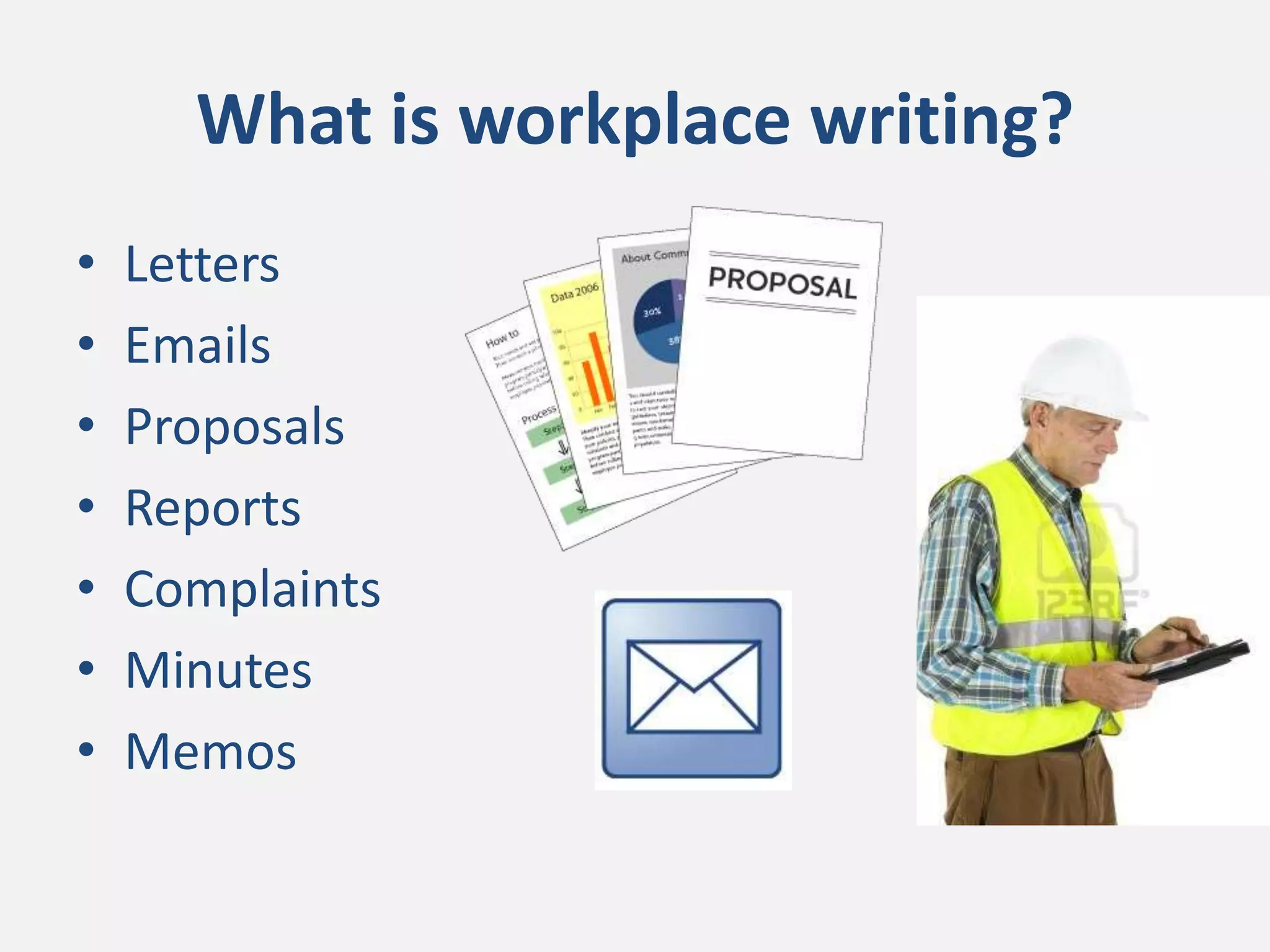
What is workplace writing?
• Letters
• Emails
• Proposals
• Reports
• Complaints
• Minutes
• Memos
PURPOSE, AUDIENCE, TONE…
Consider: Purpose and context
• Purpose (why the document is being written,
the final outcome of the document)
• Stakeholders (who may be affected by the
document or project)
• Context (the background of and situation in
which the document is created).
Target:
Who is your audience?
• Only write when you have a clear sense of
why you are writing
• Who is your audience? Identify the readers.
• What is the best way to reach your reader?
• Try to visualize the person reading and
reacting to your writing
• Write at an appropriate level of difficulty
Exercise!
Compare the following three e-mails. Think about:
 Function – the relationship to the reader and the purpose
 Form – the organization, format, construction
 Style – the type of writing
 Tone – the attitude of the writer
Write a reply to each reflecting the characteristics of each
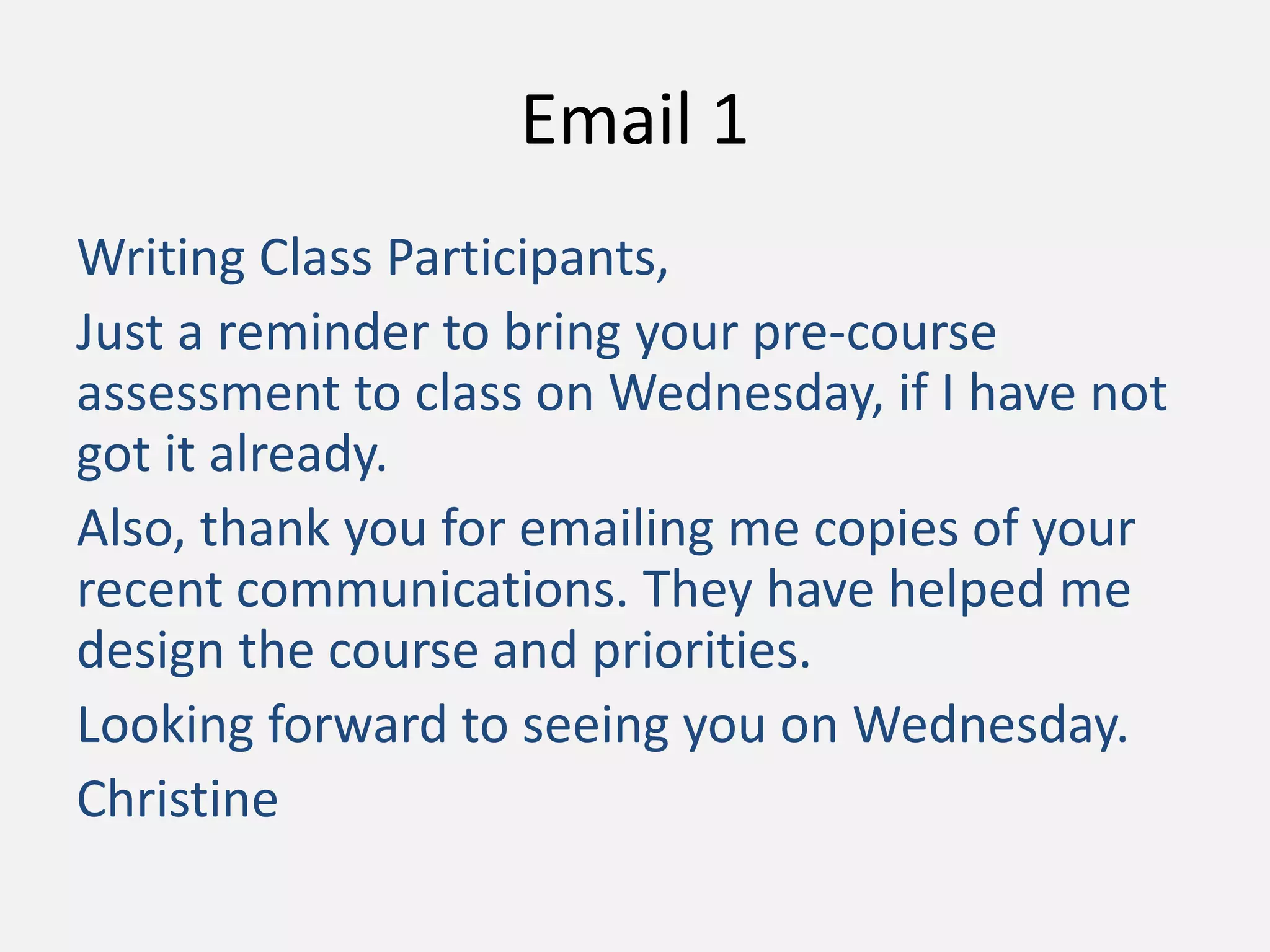
Email 1
Writing Class Participants,
Just a reminder to bring your pre-course
assessment to class on Wednesday, if I have not
got it already.
Also, thank you for emailing me copies of your
recent communications. They have helped me
design the course and priorities.
Looking forward to seeing you on Wednesday.
Christine
Email 2
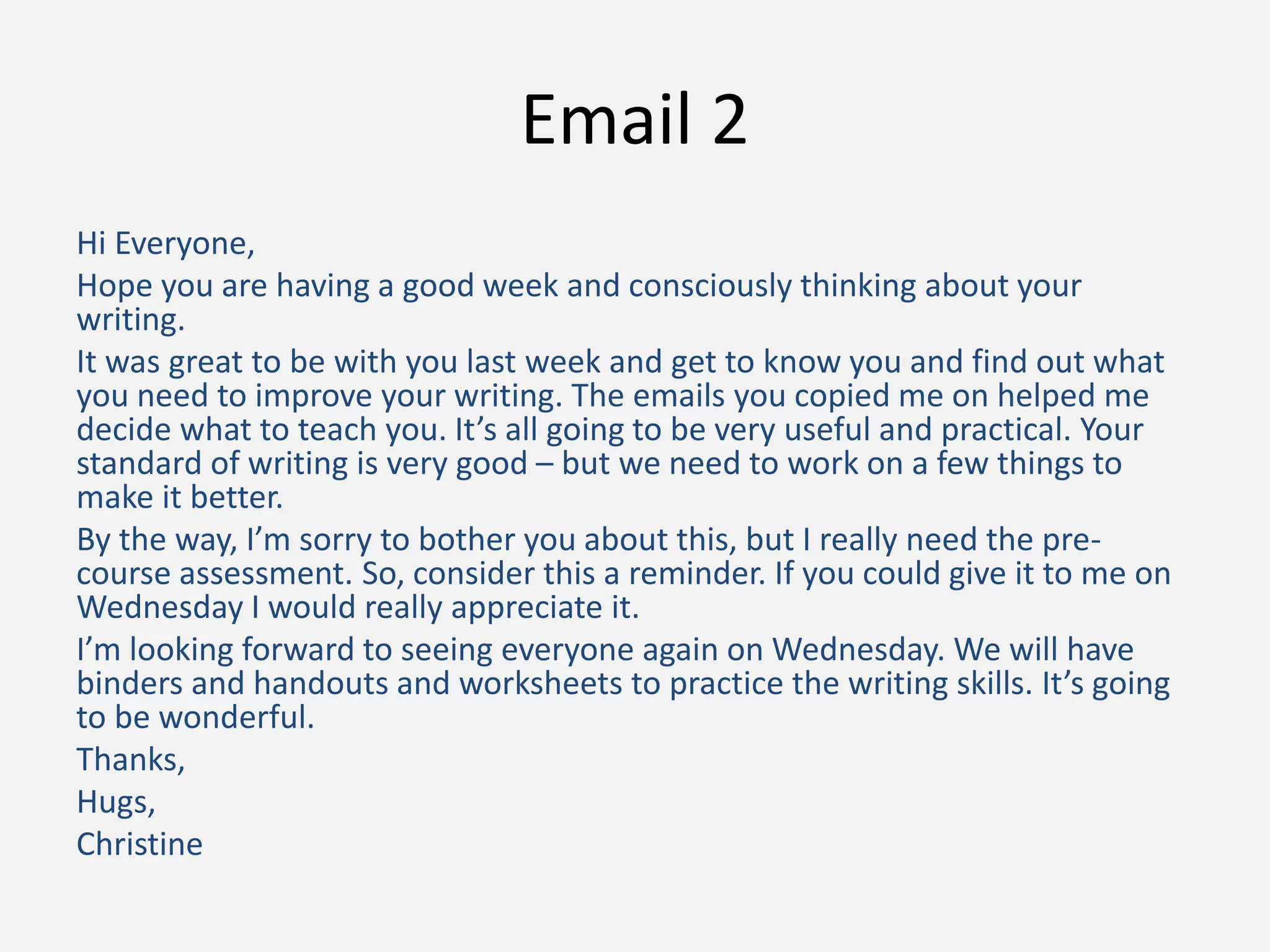
Hi Everyone,
Hope you are having a good week and consciously thinking about your
writing.
It was great to be with you last week and get to know you and find out what
you need to improve your writing. The emails you copied me on helped me
decide what to teach you. It’s all going to be very useful and practical. Your
standard of writing is very good – but we need to work on a few things to
make it better.
By the way, I’m sorry to bother you about this, but I really need the pre-
course assessment. So, consider this a reminder. If you could give it to me on
Wednesday I would really appreciate it.
I’m looking forward to seeing everyone again on Wednesday. We will have
binders and handouts and worksheets to practice the writing skills. It’s going
to be wonderful.
Thanks,
Hugs,
Christine
Email 3
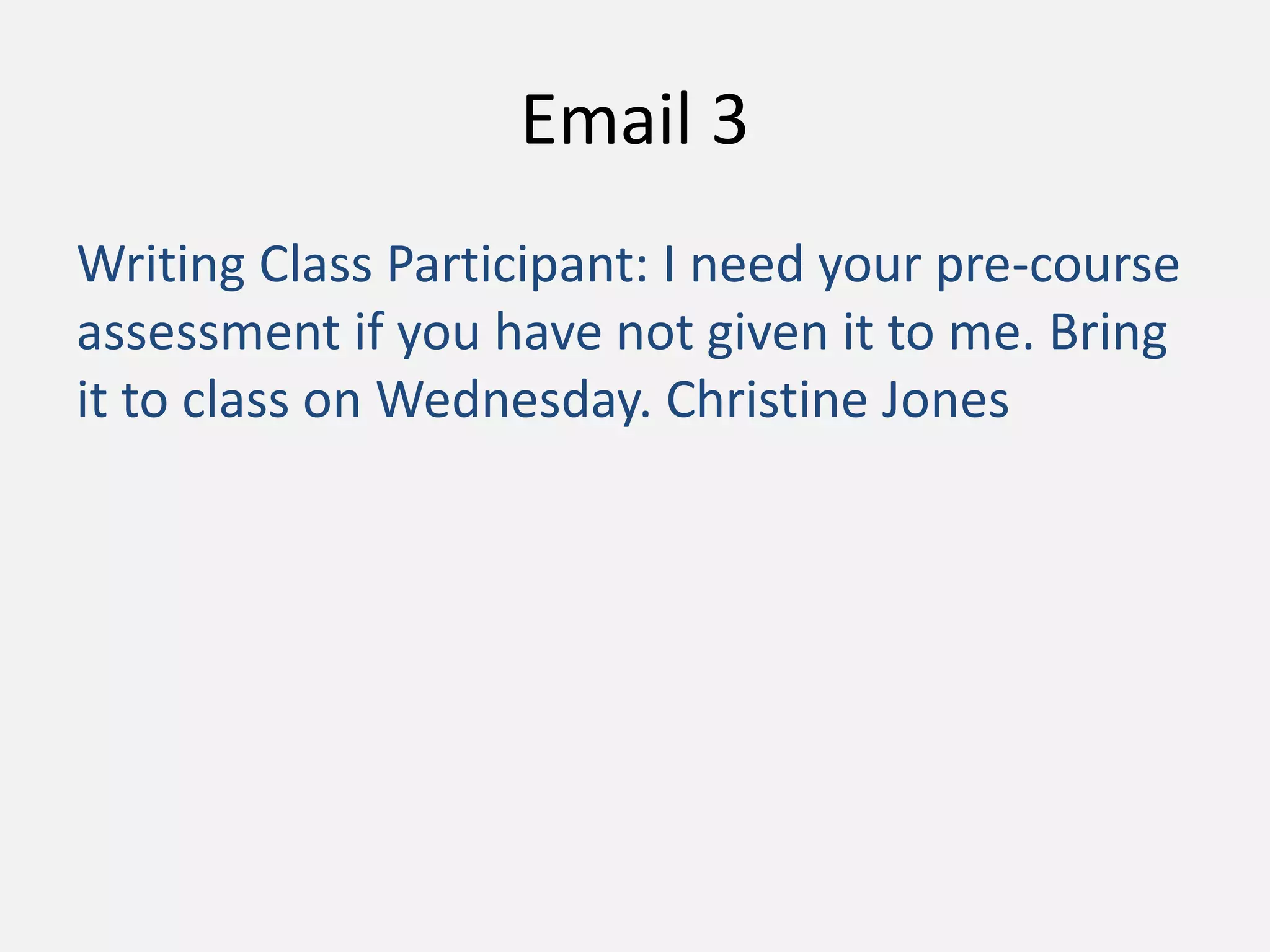
Writing Class Participant: I need your pre-course
assessment if you have not given it to me. Bring
it to class on Wednesday. Christine Jones
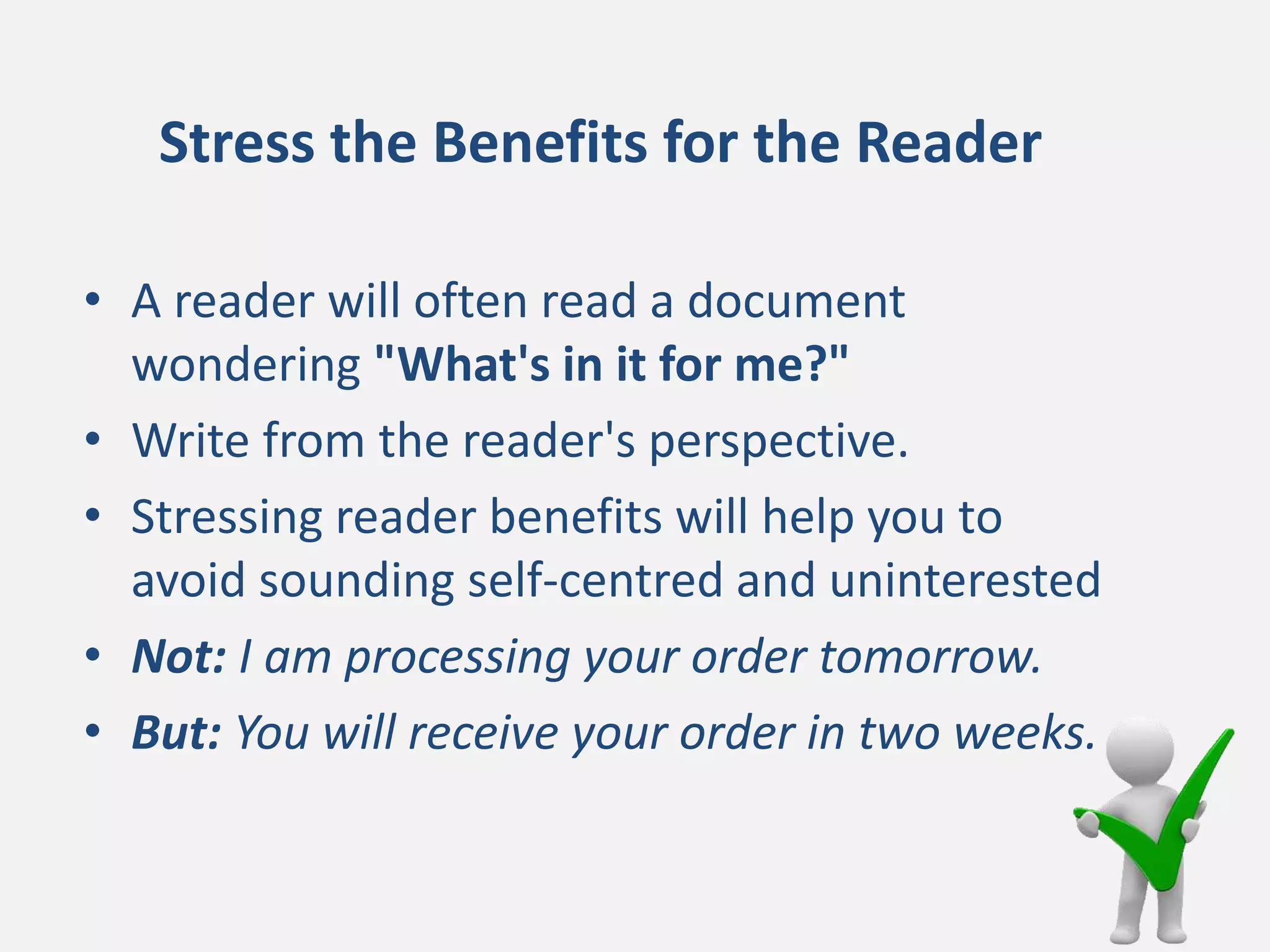
Stress the Benefits for the Reader
• A reader will often read a document
wondering "What's in it for me?"
• Write from the reader's perspective.
• Stressing reader benefits will help you to
avoid sounding self-centred and uninterested
• Not: I am processing your order tomorrow.
• But: You will receive your order in two weeks.
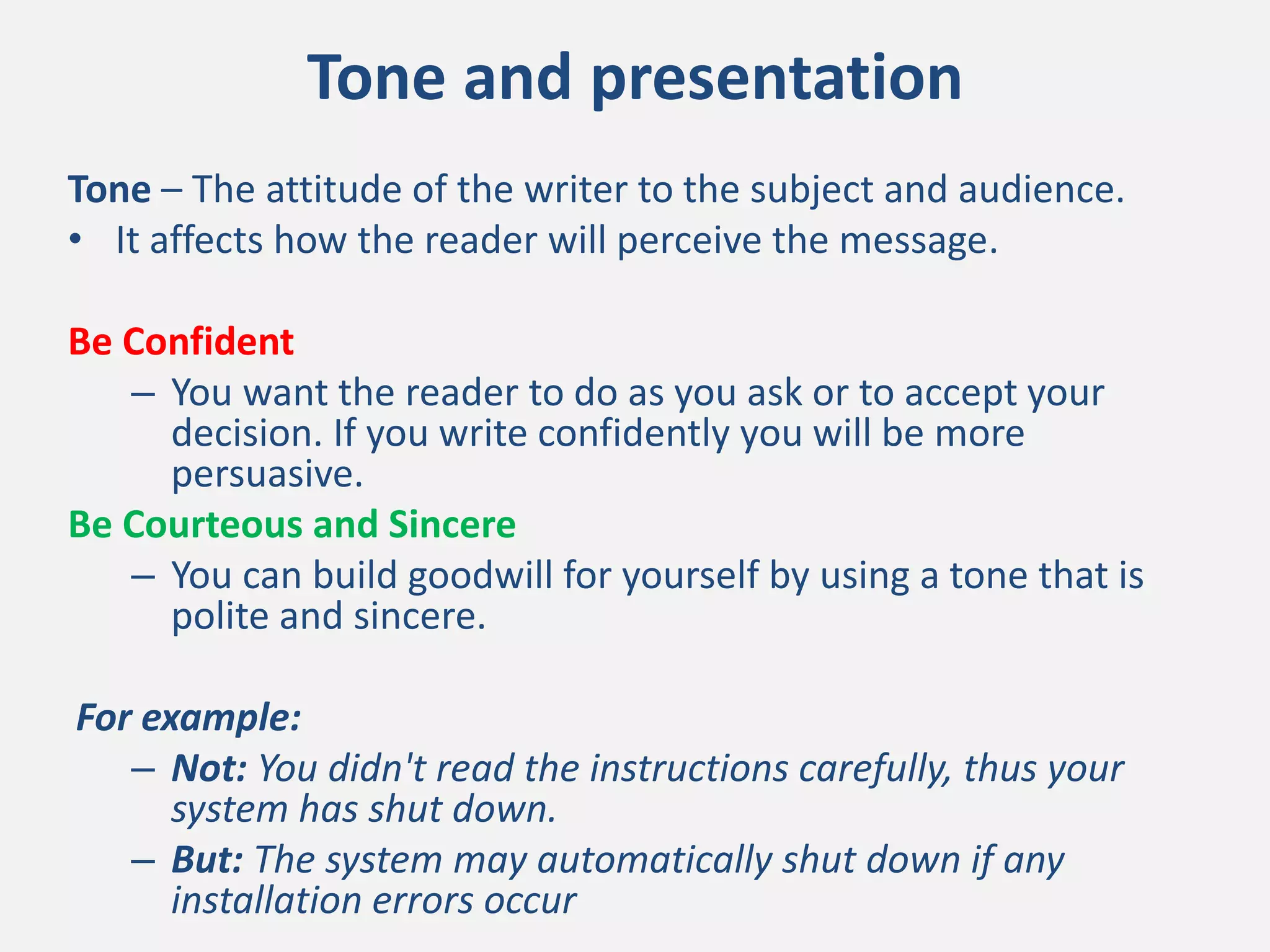
Tone and presentation
Tone – The attitude of the writer to the subject and audience.
• It affects how the reader will perceive the message.
Be Confident
– You want the reader to do as you ask or to accept your
decision. If you write confidently you will be more
persuasive.
Be Courteous and Sincere
– You can build goodwill for yourself by using a tone that is
polite and sincere.
For example:
– Not: You didn't read the instructions carefully, thus your
system has shut down.
– But: The system may automatically shut down if any
installation errors occur
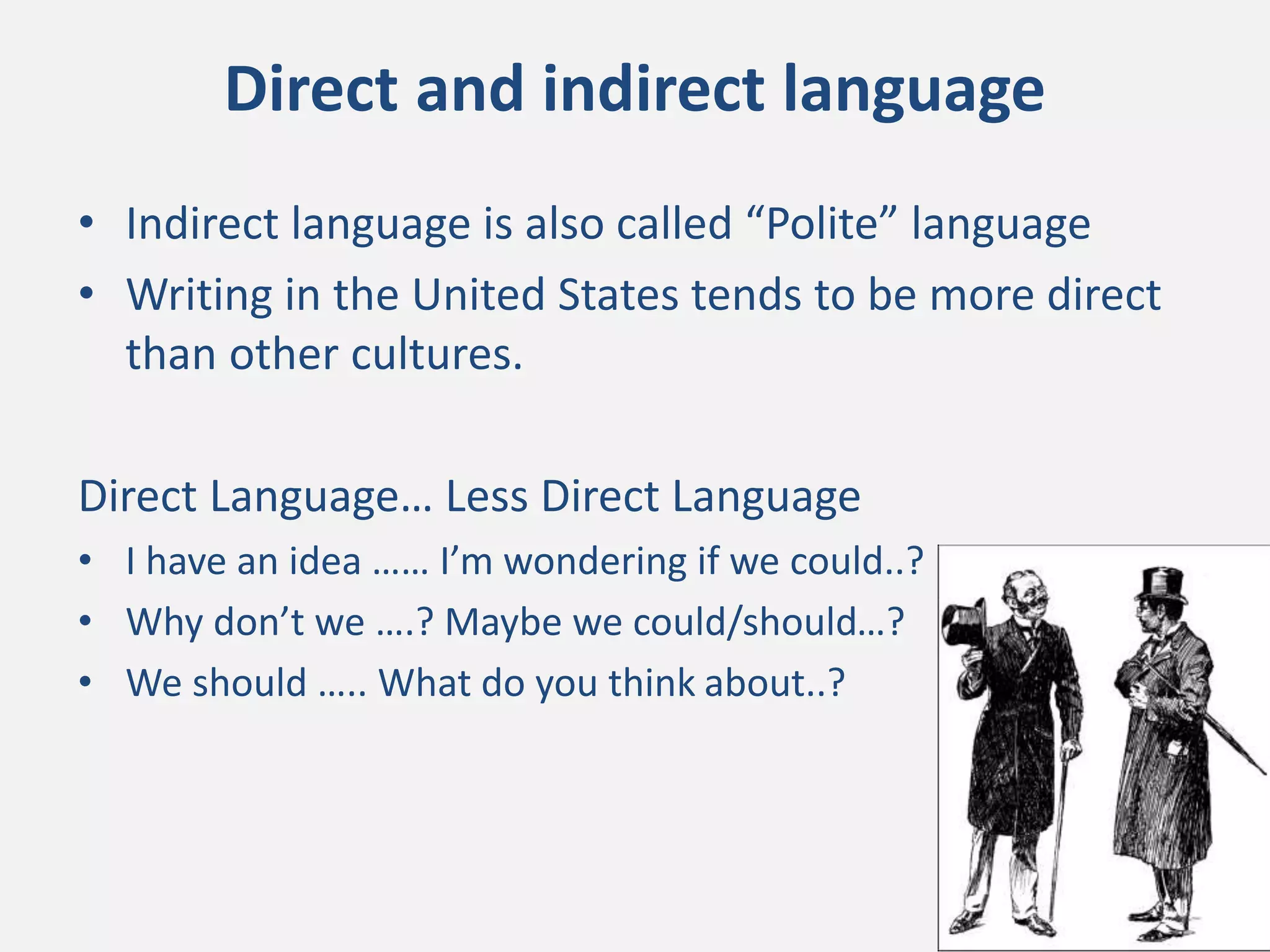
• Indirect language is also called “Polite” language
• Writing in the United States tends to be more direct
than other cultures.
Direct Language… Less Direct Language
• I have an idea …… I’m wondering if we could..?
• Why don’t we ….? Maybe we could/should…?
• We should ….. What do you think about..?
Direct and indirect language
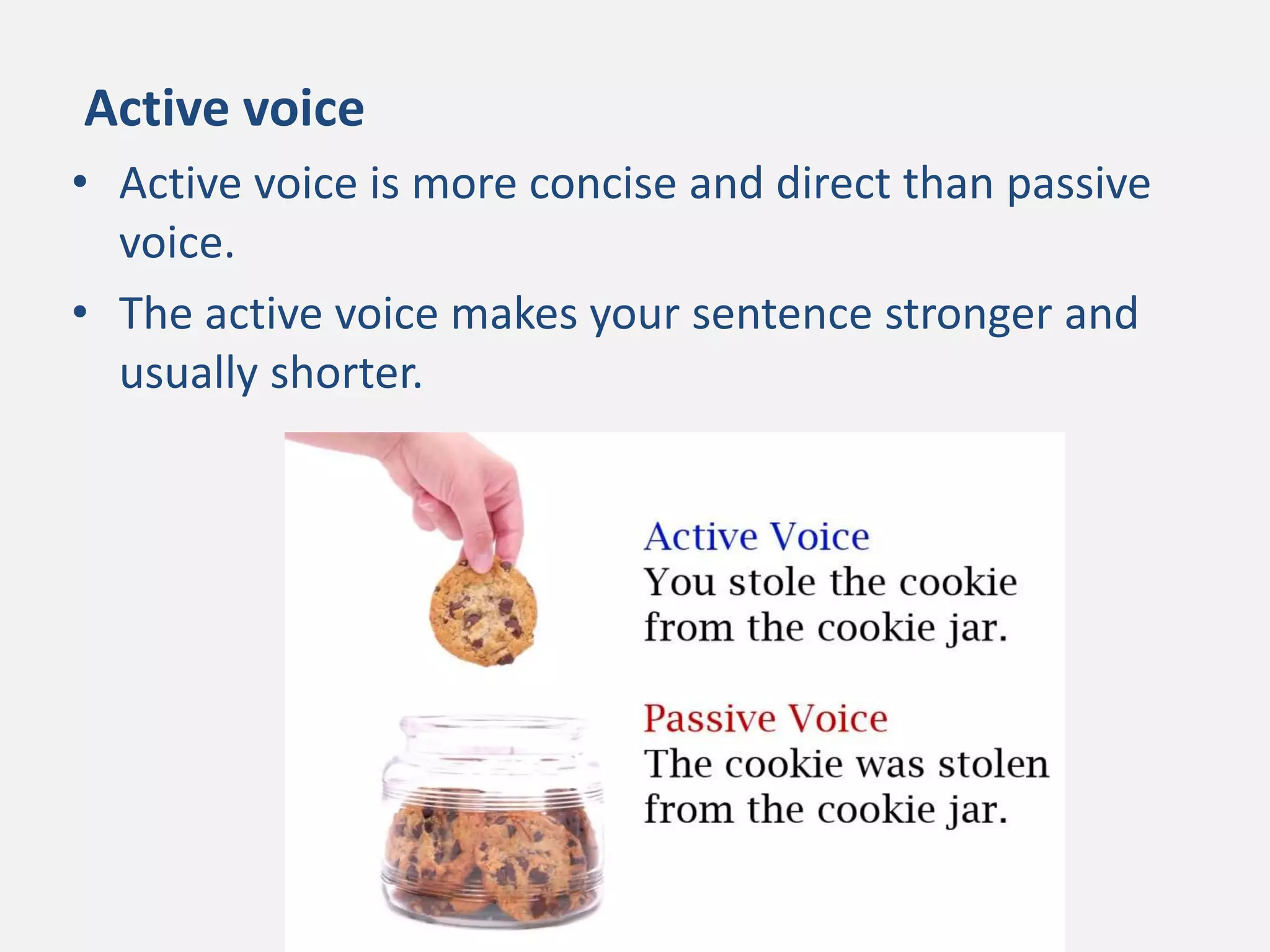
Active voice
• Active voice is more concise and direct than passive
voice.
• The active voice makes your sentence stronger and
usually shorter.
Active makes it clear
who is performing the
action in the sentence
(the doer).
Example:
Our two project officers
set up the vaccination
camp in December.
Passive tends to
emphasize the event,
rather than the doer.
Example:
The vaccination camp
was set up in December.
Passive may be useful
when the doer is not
known.
Example:
The package was lost en
route to Bhopal.
WHO (2015) http://colelearning.net/who/module1/page44.html
Active voice gives the
writer the option of
being more personal.
Example:
Based on my
observations, I
recommend the
following changes.
Passive voice removes the
personal connection.
Example:
Based on the observations
described, the following
changes are
recommended.
Passive voice can disguise
the doer.
Example:
It was decided that the
programme should be
cancelled without delay.
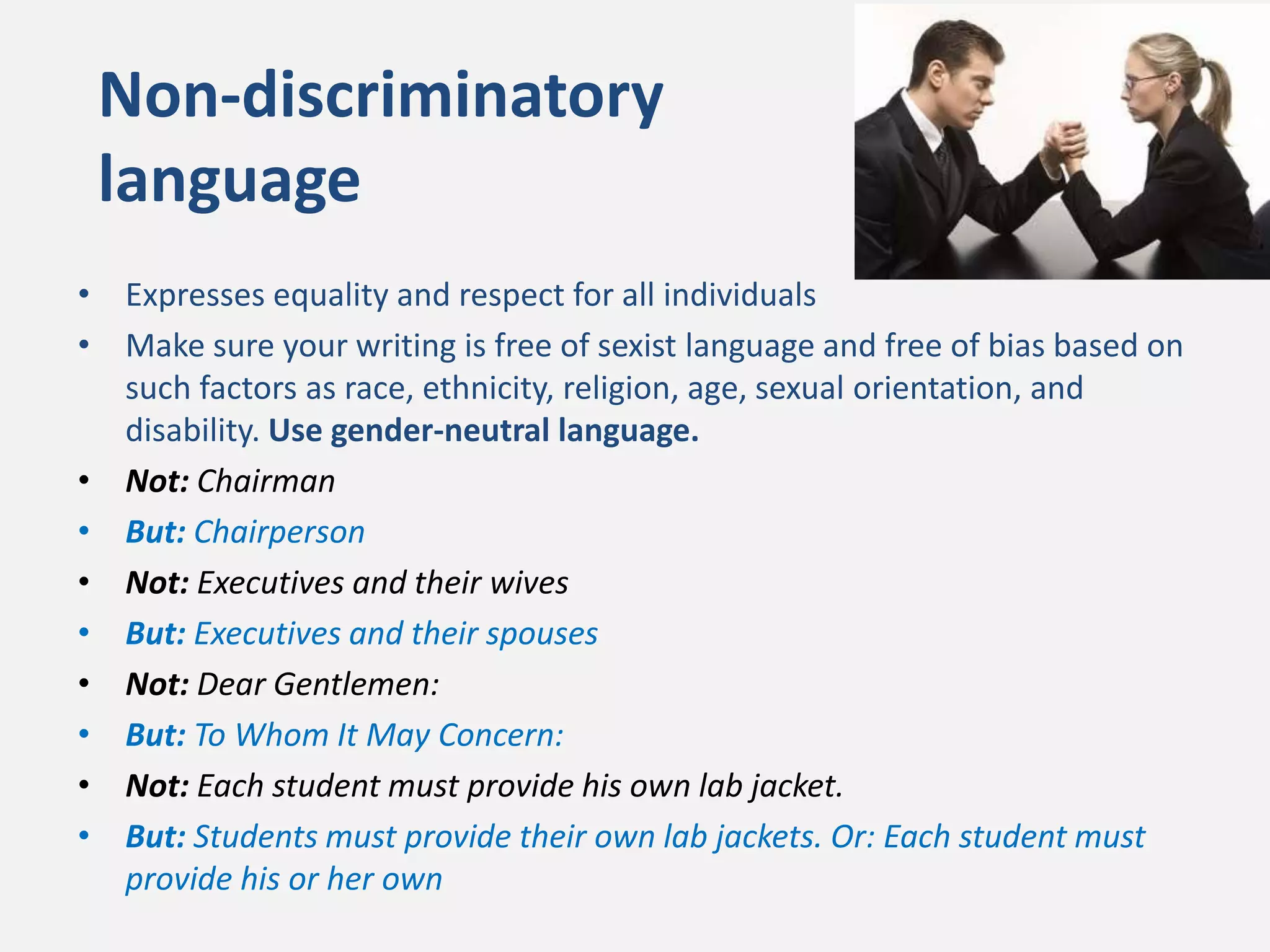
• Expresses equality and respect for all individuals
• Make sure your writing is free of sexist language and free of bias based on
such factors as race, ethnicity, religion, age, sexual orientation, and
disability. Use gender-neutral language.
• Not: Chairman
• But: Chairperson
• Not: Executives and their wives
• But: Executives and their spouses
• Not: Dear Gentlemen:
• But: To Whom It May Concern:
• Not: Each student must provide his own lab jacket.
• But: Students must provide their own lab jackets. Or: Each student must
provide his or her own
Non-discriminatory
language
Demeaning or
stereotypical terms
• Avoid demeaning or stereotypical terms.
– Not: After the girls in the office receive an order, our office
fills it within 24 hours.
– But: After the office receives an order, our office fills it
within 24 hours.
• Omit information about group membership.
– Not: Connie Green performed the job well for her age.
– But: Connie Green performed the job well.
CRITICAL ANALYSIS, EVIDENCE ,
PRECISION…
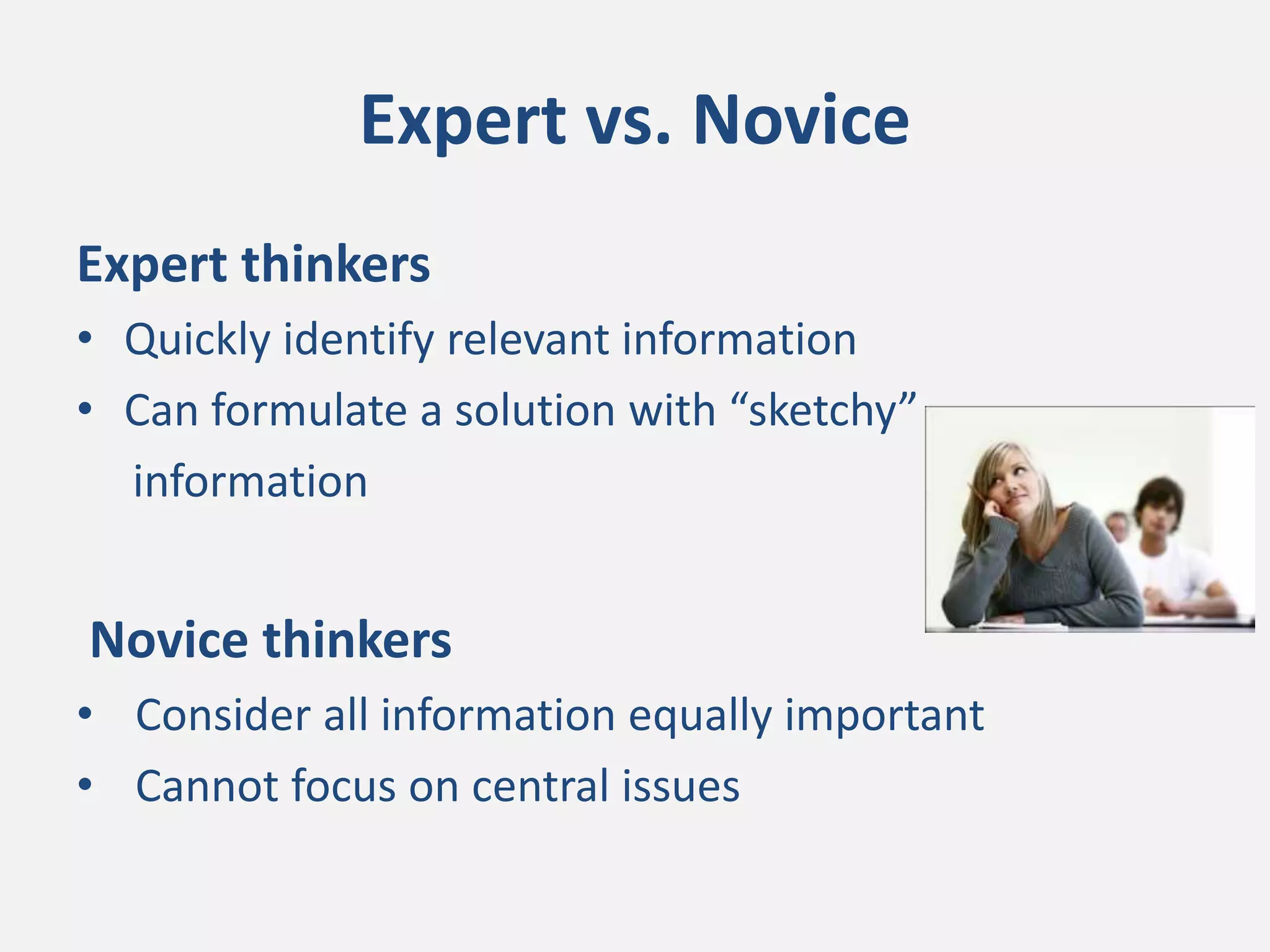
Expert vs. Novice
Expert thinkers
• Quickly identify relevant information
• Can formulate a solution with “sketchy”
information
Novice thinkers
• Consider all information equally important
• Cannot focus on central issues
Critical Thinking
• We can assess the accuracy of assumptions by trying
to look at them from multiple viewpoints
• We do critical thinking so we can take informed
actions
– Actions that are grounded in evidence, can be
explained to others
Critical Thinking
• Critical does not mean negative or destructive
• It means asking and answering questions
• Not accepting at ‘face value’ what you read or
hear
• “to get as near as possible to the truth”
Plymouth University:
http://www.learningdevelopment.plymouth.ac.uk/LDstudyguides/pdf/8Criticalth
inking.pdf
Questions to ask…
• 'Am I looking at this problem from many
different angles?'
• 'Have I paid close enough critical attention to
all my sources?'
• 'Have I supported my argument with the
strongest available evidence and reasons?’
• 'Is my argument consistent, or does it contain
internal contradictions?’
Precision
 The sentences below express some research findings. Do you
feel you understand the research results?
– ‘There was a significant decrease in the number of
emergency response activities from March to August 2010’
– ‘Most of the people interviewed claimed that complaints
were heard but not recorded’
– ‘Few people were aware of the changes to policy’
The findings are vague:
 general descriptors like most, few, significant,
considerable, apparently and seemingly are
problematic words because they are open to
interpretation.
Concise and Clear
• Don't use extra words unnecessarily.
Instead of "2 pm in the afternoon”
We could use: "2 pm"
Instead of "the expectant pregnant woman."
We could use: "the expectant woman" or "the pregnant
woman”
• Keep away from clichés (an overused phrase that
betrays a lack of original thought)
– e.g. ‘bite the bullet’, ‘when push comes to shove’ ‘take it to
the next level’
STRUCTURE, PARAGRAPHS, FLOW…
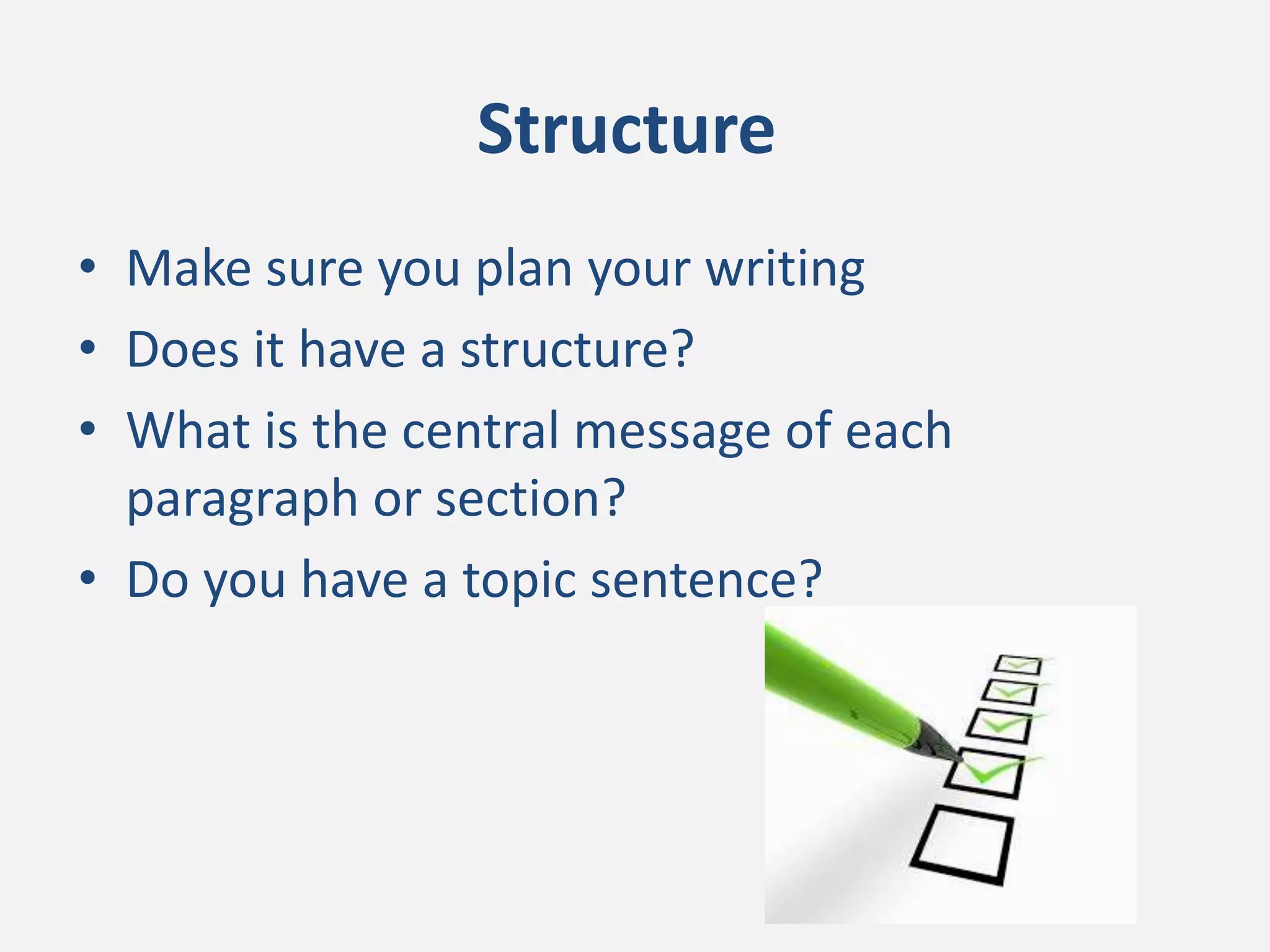
• Make sure you plan your writing
• Does it have a structure?
• What is the central message of each
paragraph or section?
• Do you have a topic sentence?
Structure
Write Strong Paragraphs
A paragraph is a group of sentences that are linked
coherently around one central topic/idea.
• Topic sentence
• Introduces the topic
• Often more general and the main point of the
paragraph
• Supporting sentences
• Develop your paragraph
• Expand on the point you are making: explain,
support with examples and/or evidence etc.
• Concluding statement
Structure
• Decide what you want to say. Then...
You need to:
Organise your ideas logically-step by step from
beginning to end
Make clear points
Relate everything to your task
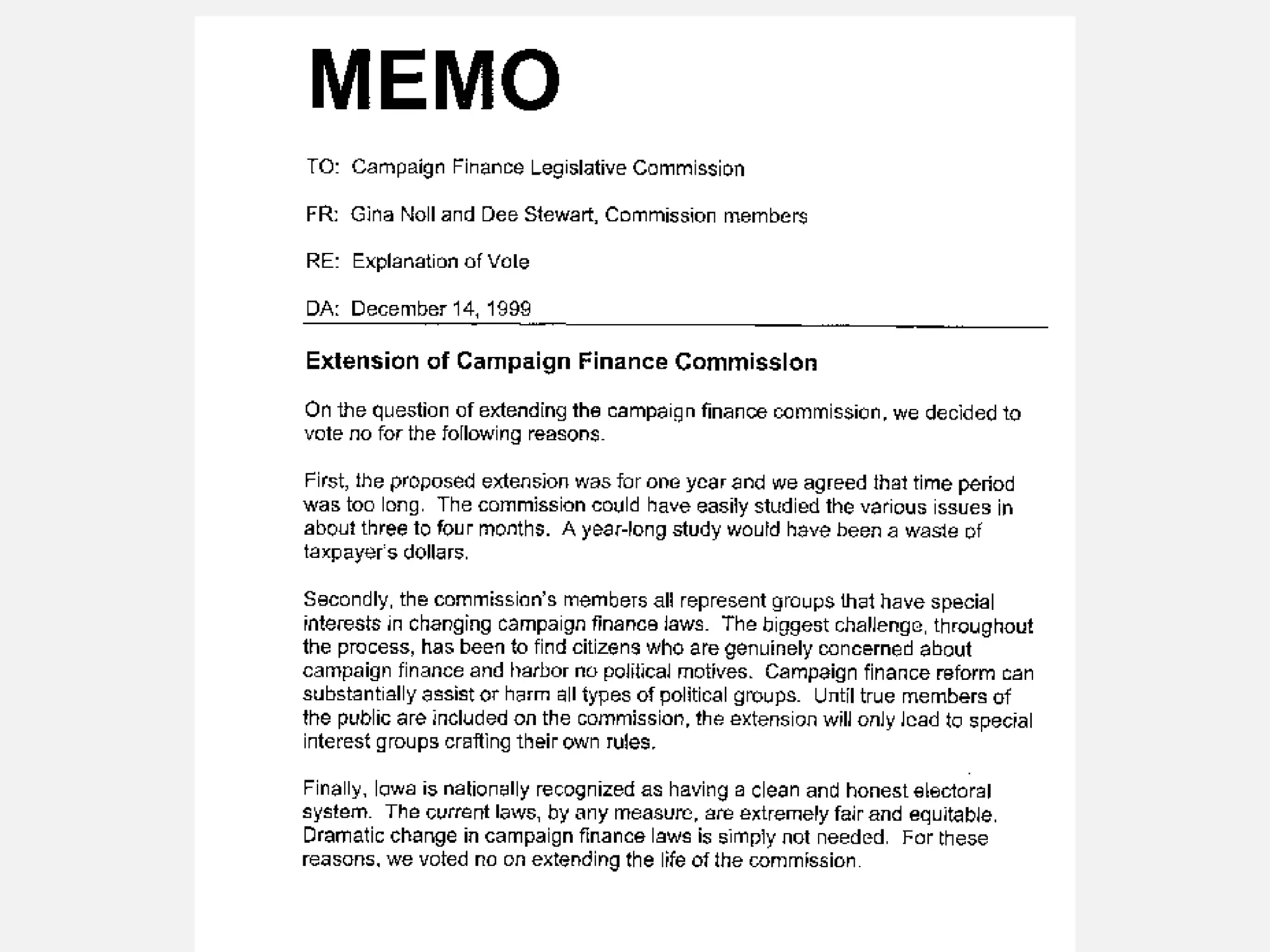
Example: Memo
1. List each item you need to discuss in your memo or report
2. Put them in order — from most to least important
3. Write a brief summary of your entire memo — this will be
your first paragraph
4. Expand on each item listed in step
5. If any action needs to be taken by the recipient, state that
in your closing paragraph
6. Gather information to backup what you plan to say, or to
help illustrate your points
7. If appropriate, get input from others who are involved in
the project you're discussing
Creating Flow
Transitional Words and Phrases
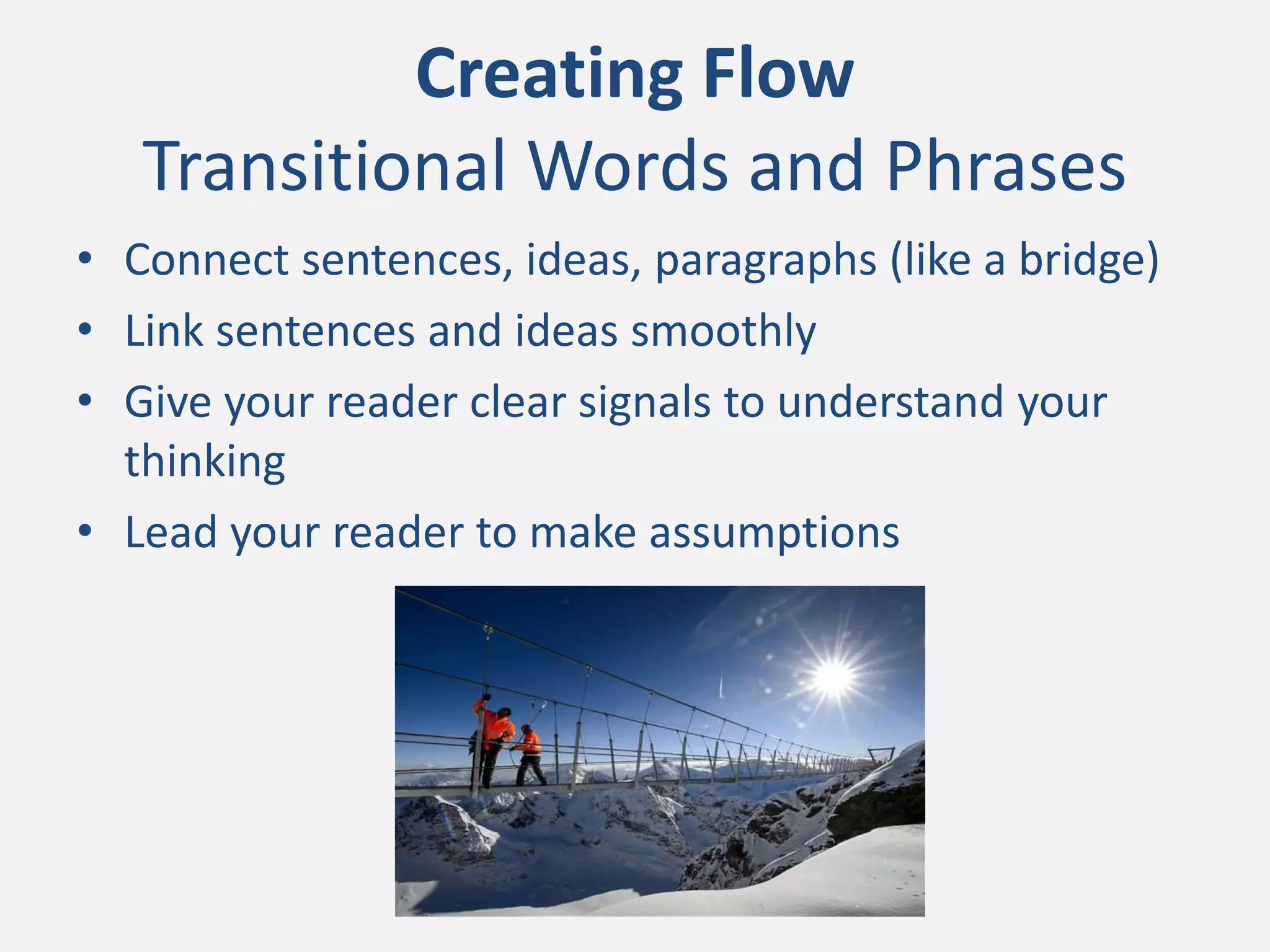
• Connect sentences, ideas, paragraphs (like a bridge)
• Link sentences and ideas smoothly
• Give your reader clear signals to understand your
thinking
• Lead your reader to make assumptions
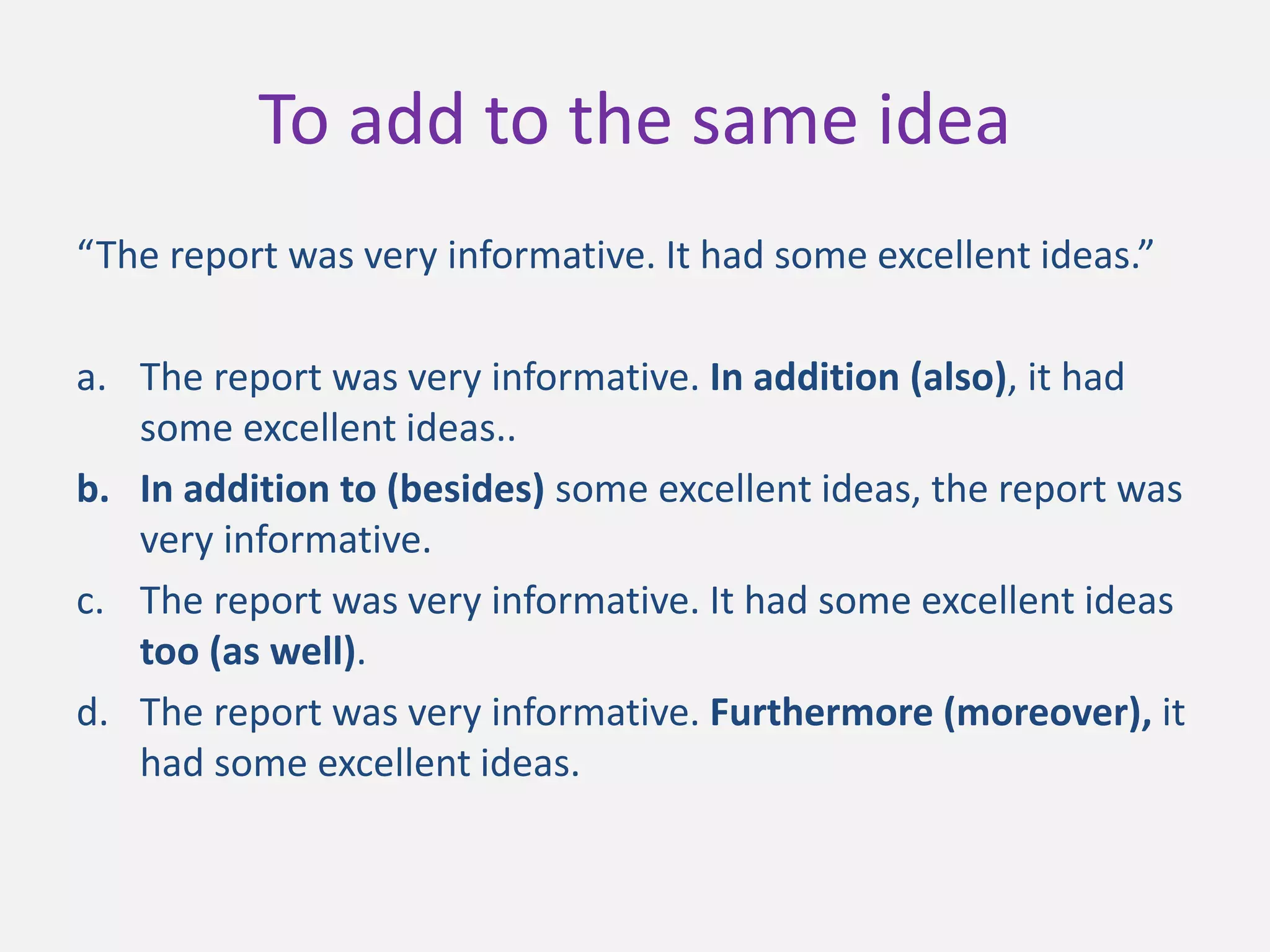
To add to the same idea
“The report was very informative. It had some excellent ideas.”
a. The report was very informative. In addition (also), it had
some excellent ideas..
b. In addition to (besides) some excellent ideas, the report was
very informative.
c. The report was very informative. It had some excellent ideas
too (as well).
d. The report was very informative. Furthermore (moreover), it
had some excellent ideas.
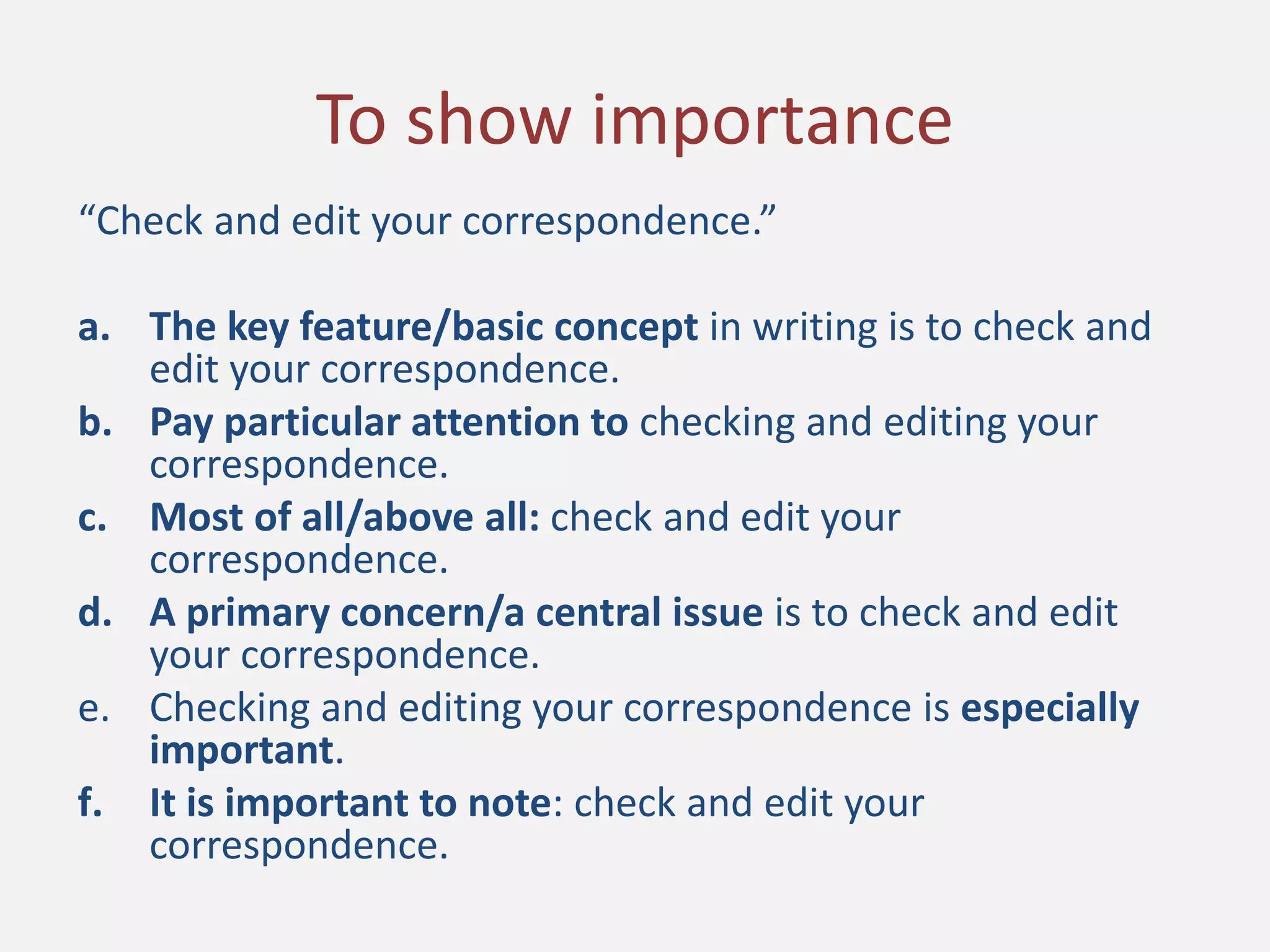
“Check and edit your correspondence.”
a. The key feature/basic concept in writing is to check and
edit your correspondence.
b. Pay particular attention to checking and editing your
correspondence.
c. Most of all/above all: check and edit your
correspondence.
d. A primary concern/a central issue is to check and edit
your correspondence.
e. Checking and editing your correspondence is especially
important.
f. It is important to note: check and edit your
correspondence.
To show importance
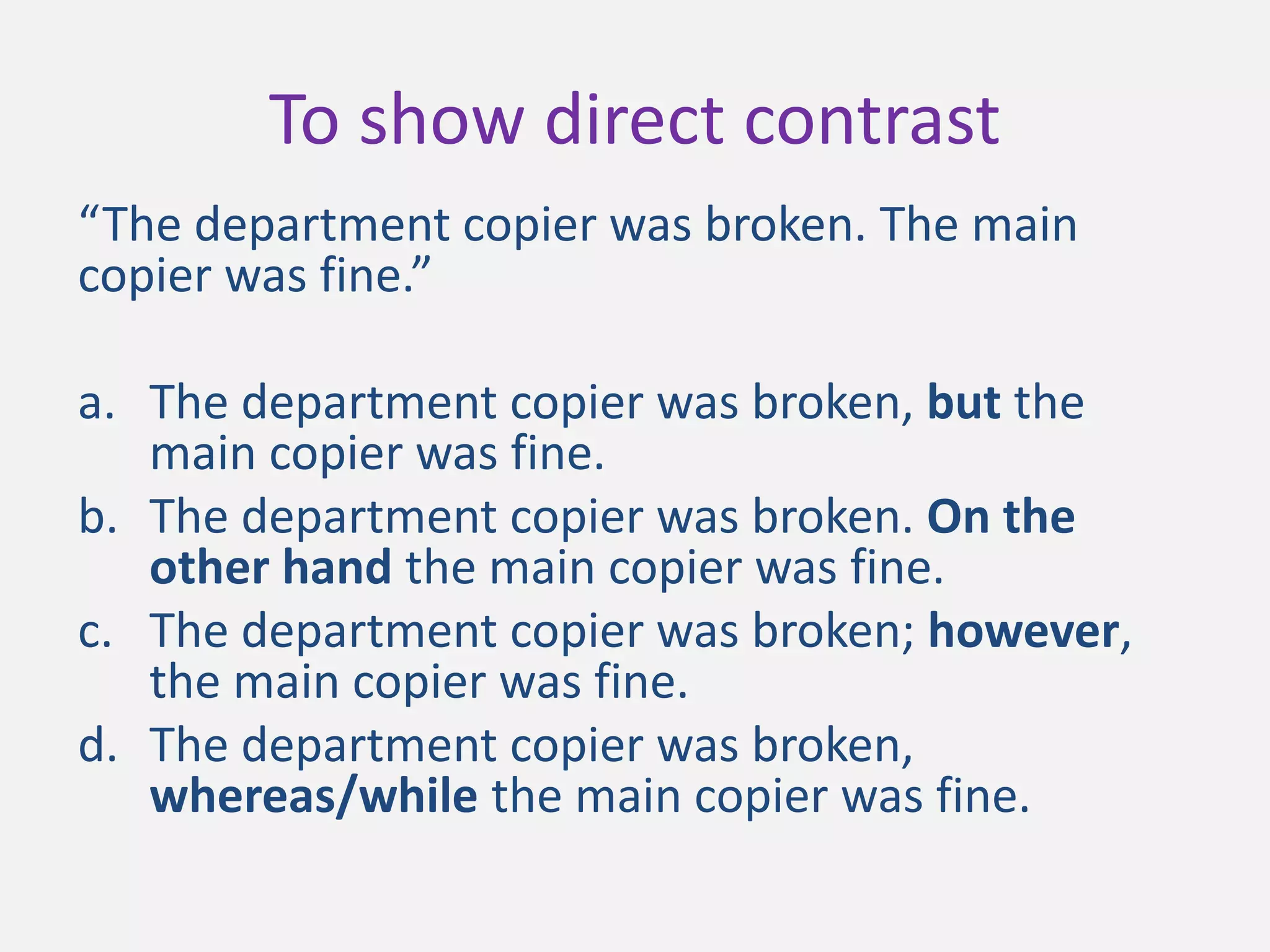
“The department copier was broken. The main
copier was fine.”
a. The department copier was broken, but the
main copier was fine.
b. The department copier was broken. On the
other hand the main copier was fine.
c. The department copier was broken; however,
the main copier was fine.
d. The department copier was broken,
whereas/while the main copier was fine.
To show direct contrast
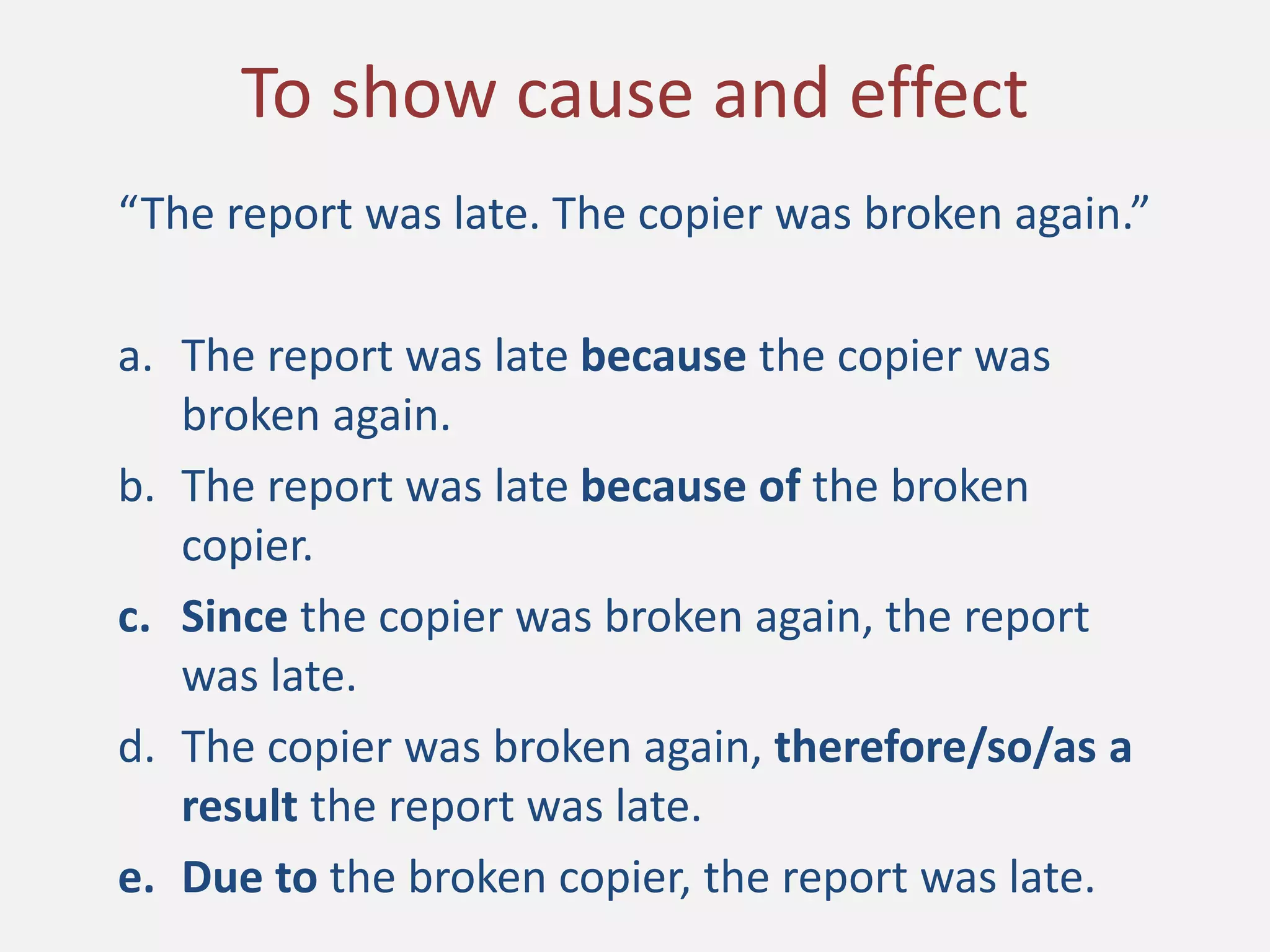
“The report was late. The copier was broken again.”
a. The report was late because the copier was
broken again.
b. The report was late because of the broken
copier.
c. Since the copier was broken again, the report
was late.
d. The copier was broken again, therefore/so/as a
result the report was late.
e. Due to the broken copier, the report was late.
To show cause and effect
To Show an Unexpected Result
“Everyone met their deadline. The report was late.”
a. The report was still late, although/even though everyone
met their deadline.
b. The report was still late, despite the fact that everyone
met their deadline
c. The report was still late, despite/in spite of everyone
meeting their deadline. (Note different form of the verb.)
d. Everyone met their deadline, but/yet the report was still
late.
e. Everyone met their deadline; however/nevertheless the
report was still late.
Exercise!
Add another sentence to continue the main
idea of each of the following sentences, using
transitional words or phrases.
• 1. I had a lot of work to do today.
• 2. Our budget is tight this month.
• 3. There will be no more overtime.
• 4. The latest shipment was damaged.
• 5. I didn’t get a good performance review.
• 6. Writing in English is difficult.
PUNCTUATION, GRAMMAR, ACCURACY…
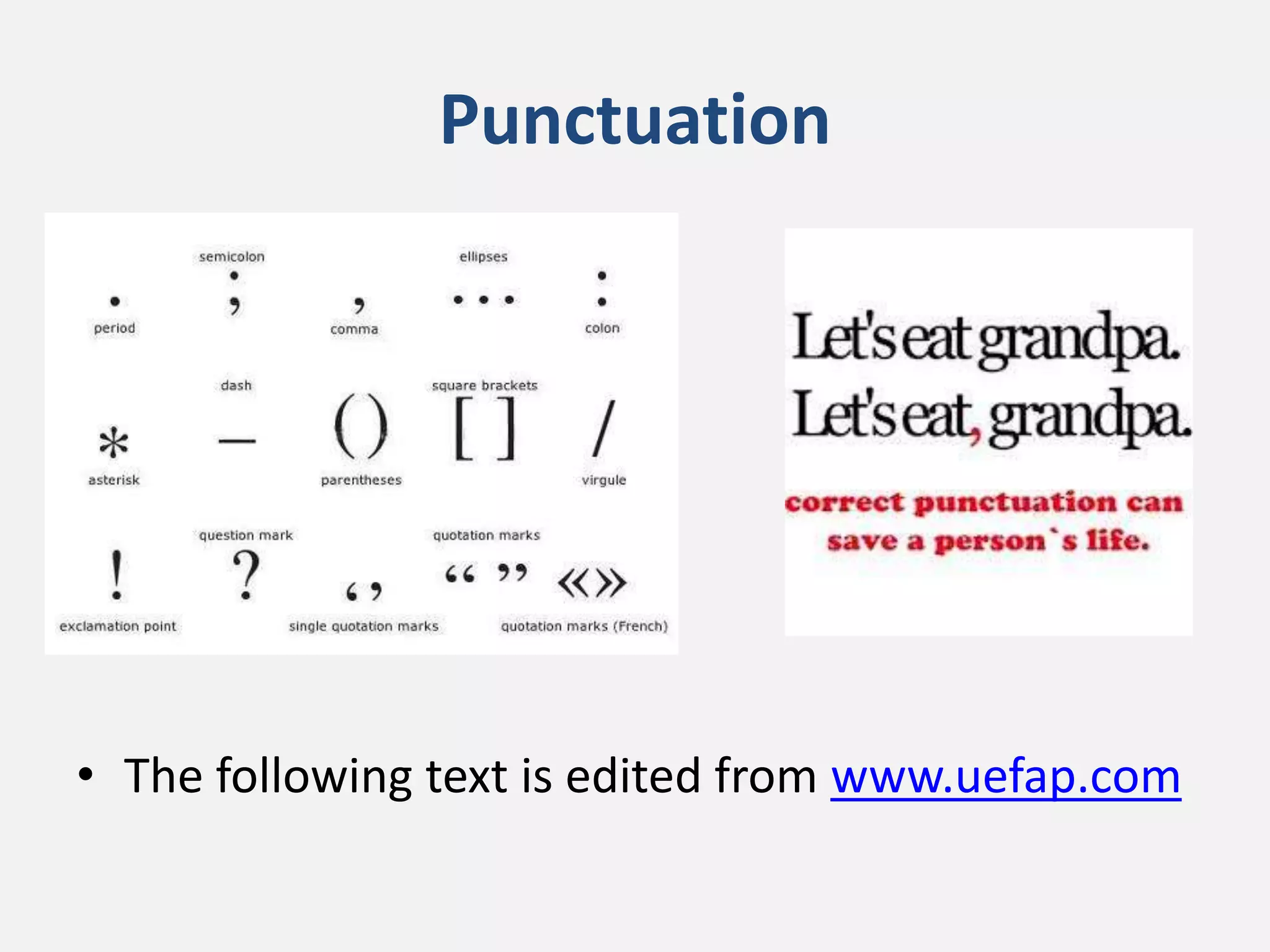
Punctuation
• The following text is edited from www.uefap.com
Avoid “run-on” sentences
• A “run-on” sentence is two or more sentences that
are written together without the correct
punctuation.
• A sentence needs to be about only one complete
idea.
• Limit the length of your sentences to 20 words
maximum.
Exercise!
Edit these “run-on” sentences. Add punctuation and capital letters.
You might need to add, delete and/or change words.
1. At two o’clock I have a meeting it will last an hour.
2. It was a very interesting meeting that proved to be very helpful to Michael
too and it finished on time.
3. Don’t worry about what I think worry about what your supervisor thinks.
4. Tell Mary hello if you see her it’s been weeks since we’ve talked.
5. The secretary typed the letter and then edited it and then copied it and
then mailed it.
6. When the meeting started Mr. Jones made his recommendation which was
discussed at length before the chairperson decided to take a vote and the
recommendation was defeated.
7. I told you I would type the letter but if you need it today you will have to do
it yourself because I have a report that my manager wants tomorrow.
8. The salesman made me a good offer I think I will buy it.
Proof reading
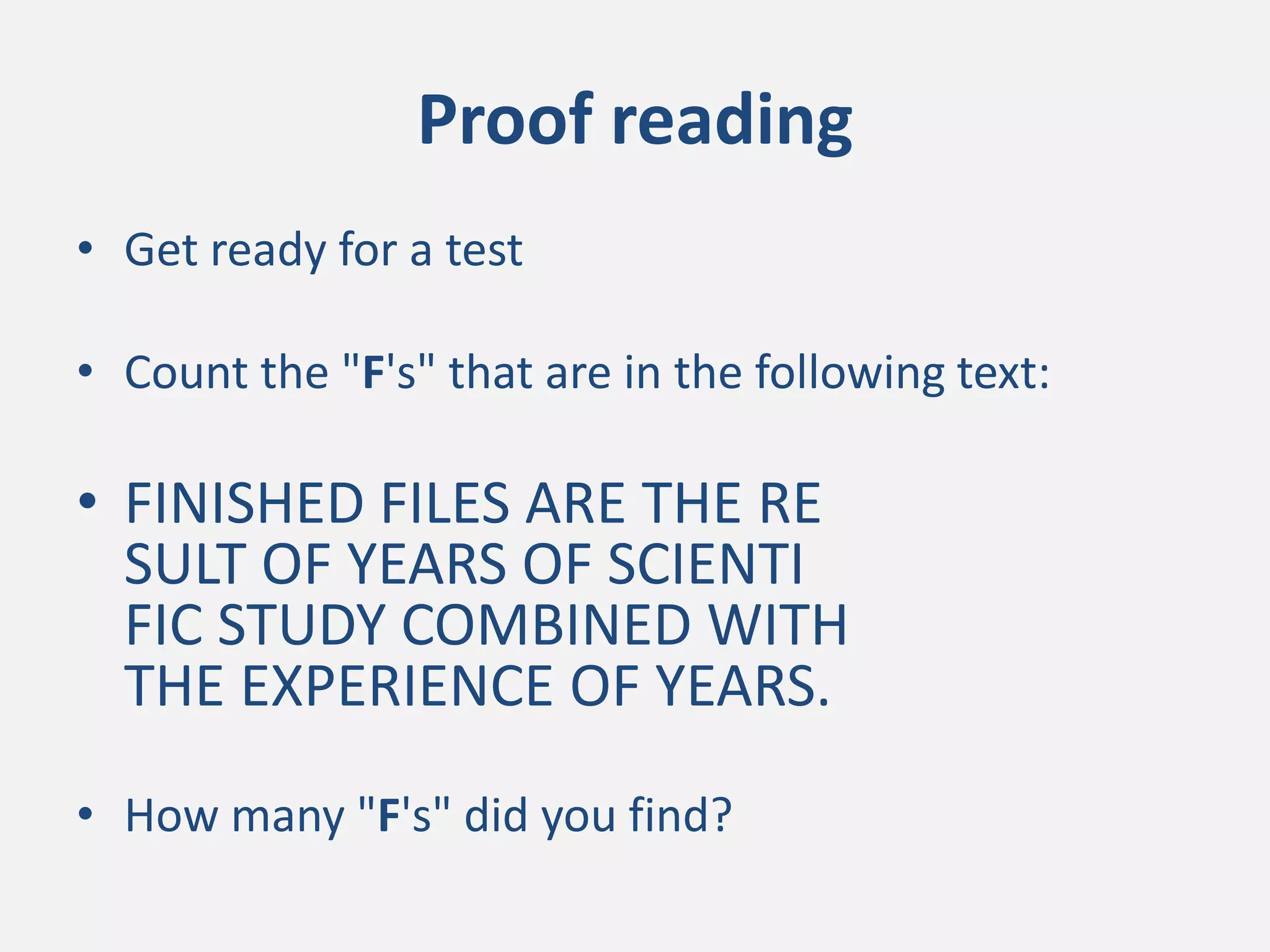
• Get ready for a test
• Count the "F's" that are in the following text:
• FINISHED FILES ARE THE RE
SULT OF YEARS OF SCIENTI
FIC STUDY COMBINED WITH
THE EXPERIENCE OF YEARS.
• How many "F's" did you find?
Proof reading
• Most probably, wrong. There are 6 F's in the text
above.
• How is this possible? Apparently your brain doesn’t
process the word OF. Everyone that finds the six F's at
once is a genius. Three is normal, four is very rare.
• So… when you write, be careful, self-critical, ‘objective’
– always think that you are writing for your reader!
• Tip: read your text out loud
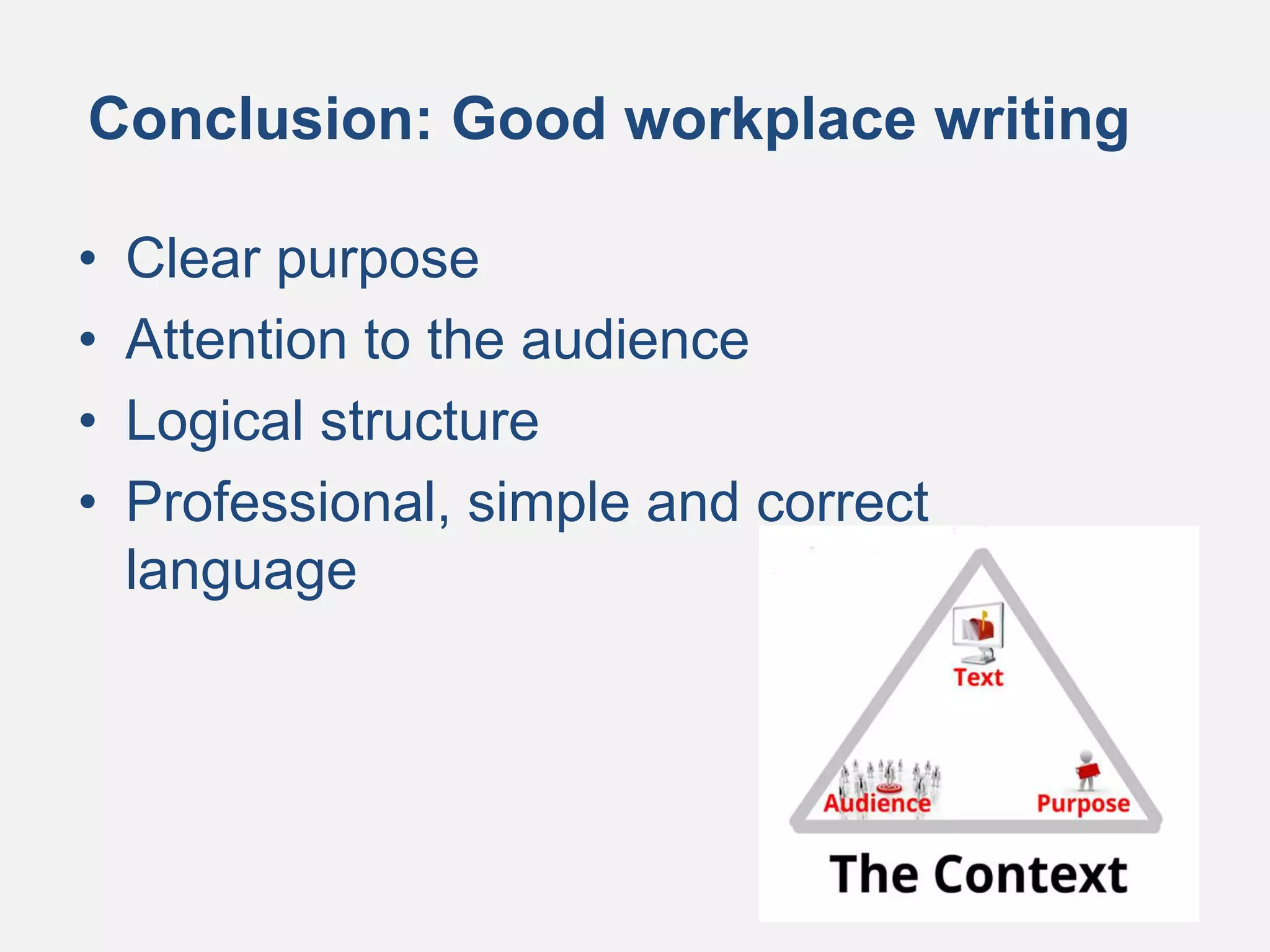
• Clear purpose
• Attention to the audience
• Logical structure
• Professional, simple and correct
language
Conclusion: Good workplace writing

Writing Skills for Work

  • 1.
    Writing Skills forWork ACADEMIC LEARNING DEVELOPMENT learningadvice@westminster.ac.uk
  • 2.
    Workshop Outline • Purposeand context • Audience and Tone • Evidence and critical analysis • Structure • Flow • Accuracy
  • 3.
    What is workplacewriting? • Letters • Emails • Proposals • Reports • Complaints • Minutes • Memos
  • 4.
  • 5.
    Consider: Purpose andcontext • Purpose (why the document is being written, the final outcome of the document) • Stakeholders (who may be affected by the document or project) • Context (the background of and situation in which the document is created).
  • 6.
    Target: Who is youraudience? • Only write when you have a clear sense of why you are writing • Who is your audience? Identify the readers. • What is the best way to reach your reader? • Try to visualize the person reading and reacting to your writing • Write at an appropriate level of difficulty
  • 7.
    Exercise! Compare the followingthree e-mails. Think about:  Function – the relationship to the reader and the purpose  Form – the organization, format, construction  Style – the type of writing  Tone – the attitude of the writer Write a reply to each reflecting the characteristics of each
  • 8.
    Email 1 Writing ClassParticipants, Just a reminder to bring your pre-course assessment to class on Wednesday, if I have not got it already. Also, thank you for emailing me copies of your recent communications. They have helped me design the course and priorities. Looking forward to seeing you on Wednesday. Christine
  • 9.
    Email 2 Hi Everyone, Hopeyou are having a good week and consciously thinking about your writing. It was great to be with you last week and get to know you and find out what you need to improve your writing. The emails you copied me on helped me decide what to teach you. It’s all going to be very useful and practical. Your standard of writing is very good – but we need to work on a few things to make it better. By the way, I’m sorry to bother you about this, but I really need the pre- course assessment. So, consider this a reminder. If you could give it to me on Wednesday I would really appreciate it. I’m looking forward to seeing everyone again on Wednesday. We will have binders and handouts and worksheets to practice the writing skills. It’s going to be wonderful. Thanks, Hugs, Christine
  • 10.
    Email 3 Writing ClassParticipant: I need your pre-course assessment if you have not given it to me. Bring it to class on Wednesday. Christine Jones
  • 11.
    Stress the Benefitsfor the Reader • A reader will often read a document wondering "What's in it for me?" • Write from the reader's perspective. • Stressing reader benefits will help you to avoid sounding self-centred and uninterested • Not: I am processing your order tomorrow. • But: You will receive your order in two weeks.
  • 12.
    Tone and presentation Tone– The attitude of the writer to the subject and audience. • It affects how the reader will perceive the message. Be Confident – You want the reader to do as you ask or to accept your decision. If you write confidently you will be more persuasive. Be Courteous and Sincere – You can build goodwill for yourself by using a tone that is polite and sincere. For example: – Not: You didn't read the instructions carefully, thus your system has shut down. – But: The system may automatically shut down if any installation errors occur
  • 13.
    • Indirect languageis also called “Polite” language • Writing in the United States tends to be more direct than other cultures. Direct Language… Less Direct Language • I have an idea …… I’m wondering if we could..? • Why don’t we ….? Maybe we could/should…? • We should ….. What do you think about..? Direct and indirect language
  • 14.
    Active voice • Activevoice is more concise and direct than passive voice. • The active voice makes your sentence stronger and usually shorter.
  • 15.
    Active makes itclear who is performing the action in the sentence (the doer). Example: Our two project officers set up the vaccination camp in December. Passive tends to emphasize the event, rather than the doer. Example: The vaccination camp was set up in December. Passive may be useful when the doer is not known. Example: The package was lost en route to Bhopal. WHO (2015) http://colelearning.net/who/module1/page44.html
  • 16.
    Active voice givesthe writer the option of being more personal. Example: Based on my observations, I recommend the following changes. Passive voice removes the personal connection. Example: Based on the observations described, the following changes are recommended. Passive voice can disguise the doer. Example: It was decided that the programme should be cancelled without delay.
  • 17.
    • Expresses equalityand respect for all individuals • Make sure your writing is free of sexist language and free of bias based on such factors as race, ethnicity, religion, age, sexual orientation, and disability. Use gender-neutral language. • Not: Chairman • But: Chairperson • Not: Executives and their wives • But: Executives and their spouses • Not: Dear Gentlemen: • But: To Whom It May Concern: • Not: Each student must provide his own lab jacket. • But: Students must provide their own lab jackets. Or: Each student must provide his or her own Non-discriminatory language
  • 18.
    Demeaning or stereotypical terms •Avoid demeaning or stereotypical terms. – Not: After the girls in the office receive an order, our office fills it within 24 hours. – But: After the office receives an order, our office fills it within 24 hours. • Omit information about group membership. – Not: Connie Green performed the job well for her age. – But: Connie Green performed the job well.
  • 19.
  • 20.
    Expert vs. Novice Expertthinkers • Quickly identify relevant information • Can formulate a solution with “sketchy” information Novice thinkers • Consider all information equally important • Cannot focus on central issues
  • 21.
    Critical Thinking • Wecan assess the accuracy of assumptions by trying to look at them from multiple viewpoints • We do critical thinking so we can take informed actions – Actions that are grounded in evidence, can be explained to others
  • 22.
    Critical Thinking • Criticaldoes not mean negative or destructive • It means asking and answering questions • Not accepting at ‘face value’ what you read or hear • “to get as near as possible to the truth” Plymouth University: http://www.learningdevelopment.plymouth.ac.uk/LDstudyguides/pdf/8Criticalth inking.pdf
  • 23.
    Questions to ask… •'Am I looking at this problem from many different angles?' • 'Have I paid close enough critical attention to all my sources?' • 'Have I supported my argument with the strongest available evidence and reasons?’ • 'Is my argument consistent, or does it contain internal contradictions?’
  • 24.
    Precision  The sentencesbelow express some research findings. Do you feel you understand the research results? – ‘There was a significant decrease in the number of emergency response activities from March to August 2010’ – ‘Most of the people interviewed claimed that complaints were heard but not recorded’ – ‘Few people were aware of the changes to policy’ The findings are vague:  general descriptors like most, few, significant, considerable, apparently and seemingly are problematic words because they are open to interpretation.
  • 25.
    Concise and Clear •Don't use extra words unnecessarily. Instead of "2 pm in the afternoon” We could use: "2 pm" Instead of "the expectant pregnant woman." We could use: "the expectant woman" or "the pregnant woman” • Keep away from clichés (an overused phrase that betrays a lack of original thought) – e.g. ‘bite the bullet’, ‘when push comes to shove’ ‘take it to the next level’
  • 26.
  • 27.
    • Make sureyou plan your writing • Does it have a structure? • What is the central message of each paragraph or section? • Do you have a topic sentence? Structure
  • 28.
    Write Strong Paragraphs Aparagraph is a group of sentences that are linked coherently around one central topic/idea. • Topic sentence • Introduces the topic • Often more general and the main point of the paragraph • Supporting sentences • Develop your paragraph • Expand on the point you are making: explain, support with examples and/or evidence etc. • Concluding statement
  • 29.
    Structure • Decide whatyou want to say. Then... You need to: Organise your ideas logically-step by step from beginning to end Make clear points Relate everything to your task
  • 30.
    Example: Memo 1. Listeach item you need to discuss in your memo or report 2. Put them in order — from most to least important 3. Write a brief summary of your entire memo — this will be your first paragraph 4. Expand on each item listed in step 5. If any action needs to be taken by the recipient, state that in your closing paragraph 6. Gather information to backup what you plan to say, or to help illustrate your points 7. If appropriate, get input from others who are involved in the project you're discussing
  • 32.
    Creating Flow Transitional Wordsand Phrases • Connect sentences, ideas, paragraphs (like a bridge) • Link sentences and ideas smoothly • Give your reader clear signals to understand your thinking • Lead your reader to make assumptions
  • 33.
    To add tothe same idea “The report was very informative. It had some excellent ideas.” a. The report was very informative. In addition (also), it had some excellent ideas.. b. In addition to (besides) some excellent ideas, the report was very informative. c. The report was very informative. It had some excellent ideas too (as well). d. The report was very informative. Furthermore (moreover), it had some excellent ideas.
  • 34.
    “Check and edityour correspondence.” a. The key feature/basic concept in writing is to check and edit your correspondence. b. Pay particular attention to checking and editing your correspondence. c. Most of all/above all: check and edit your correspondence. d. A primary concern/a central issue is to check and edit your correspondence. e. Checking and editing your correspondence is especially important. f. It is important to note: check and edit your correspondence. To show importance
  • 35.
    “The department copierwas broken. The main copier was fine.” a. The department copier was broken, but the main copier was fine. b. The department copier was broken. On the other hand the main copier was fine. c. The department copier was broken; however, the main copier was fine. d. The department copier was broken, whereas/while the main copier was fine. To show direct contrast
  • 36.
    “The report waslate. The copier was broken again.” a. The report was late because the copier was broken again. b. The report was late because of the broken copier. c. Since the copier was broken again, the report was late. d. The copier was broken again, therefore/so/as a result the report was late. e. Due to the broken copier, the report was late. To show cause and effect
  • 37.
    To Show anUnexpected Result “Everyone met their deadline. The report was late.” a. The report was still late, although/even though everyone met their deadline. b. The report was still late, despite the fact that everyone met their deadline c. The report was still late, despite/in spite of everyone meeting their deadline. (Note different form of the verb.) d. Everyone met their deadline, but/yet the report was still late. e. Everyone met their deadline; however/nevertheless the report was still late.
  • 38.
    Exercise! Add another sentenceto continue the main idea of each of the following sentences, using transitional words or phrases. • 1. I had a lot of work to do today. • 2. Our budget is tight this month. • 3. There will be no more overtime. • 4. The latest shipment was damaged. • 5. I didn’t get a good performance review. • 6. Writing in English is difficult.
  • 39.
  • 40.
    Punctuation • The followingtext is edited from www.uefap.com
  • 41.
    Avoid “run-on” sentences •A “run-on” sentence is two or more sentences that are written together without the correct punctuation. • A sentence needs to be about only one complete idea. • Limit the length of your sentences to 20 words maximum.
  • 42.
    Exercise! Edit these “run-on”sentences. Add punctuation and capital letters. You might need to add, delete and/or change words. 1. At two o’clock I have a meeting it will last an hour. 2. It was a very interesting meeting that proved to be very helpful to Michael too and it finished on time. 3. Don’t worry about what I think worry about what your supervisor thinks. 4. Tell Mary hello if you see her it’s been weeks since we’ve talked. 5. The secretary typed the letter and then edited it and then copied it and then mailed it. 6. When the meeting started Mr. Jones made his recommendation which was discussed at length before the chairperson decided to take a vote and the recommendation was defeated. 7. I told you I would type the letter but if you need it today you will have to do it yourself because I have a report that my manager wants tomorrow. 8. The salesman made me a good offer I think I will buy it.
  • 43.
    Proof reading • Getready for a test • Count the "F's" that are in the following text: • FINISHED FILES ARE THE RE SULT OF YEARS OF SCIENTI FIC STUDY COMBINED WITH THE EXPERIENCE OF YEARS. • How many "F's" did you find?
  • 44.
    Proof reading • Mostprobably, wrong. There are 6 F's in the text above. • How is this possible? Apparently your brain doesn’t process the word OF. Everyone that finds the six F's at once is a genius. Three is normal, four is very rare. • So… when you write, be careful, self-critical, ‘objective’ – always think that you are writing for your reader! • Tip: read your text out loud
  • 45.
    • Clear purpose •Attention to the audience • Logical structure • Professional, simple and correct language Conclusion: Good workplace writing

Editor's Notes

  • #13 You can feel confident if you have planned, organized, and are knowledgeable about the material. You want the reader to do as you ask or to accept your decision. If you write confidently you will be more persuasive. You can build goodwill for yourself by using a tone that is polite and sincere. Without sincerity, politeness can sound condescending. If you are respectful and honest, readers will be more willing to accept your message, even if it is negative.
  • #37 Cause: because/because of (followed by a noun)/ since Effect: therefore/due to (followed by a noun)/as a result/so
  • #38 despite in spite of despite the fact that although even though but yet however nevertheless
  • #44 Wrong. There are 6 F's in the text above. Read and try again. How is this possible? Your brain isn't capable of processing the word OF. Everyone that finds the six F's at once is a genius. Three is normal, four is very rare.