
Advanced Writing Skills
Management Communication Training
Andrew Manasseh PR and media
• 25 years training, business development, staff
management and training
• British Council 15 years in Thailand, Czech
Republic, Italy and Brussels
• 9 years EU communications and PR training
• Experience with governments in central Europe
and W. Balkans
• Extensive work with the European
Commission, European Parliament, EU agencies
Objectives - expected results
• Adopt an appropriately balanced and professional style and tone that
suits internal and external communications
• Tailor written language for different audiences and purposes
• Understand many forms and formats of writing – such as mission reports,
correspondence
• Plan and structure writing for your business impact and clear structure to
make it easier for the reader to comprehend
• Write condensed, targeted, precise texts such as emails, reports, updates,
that convey messages in clear and simple language.
Course overview
The aim of this training is to provide you input and
practice in modern writing skills
• Modern writing style
• Readers – who you are writing for
• Messages – what you are trying to say
• Writing style –tips and techniques
• Paragraphs and sentence building
• Proof reading and editing
Part 1 Modern writing principles
Effective Writing
• What precisely is the central issue?
• To what degree does the audience understand
the issues and terminology?
• What are the main ideas that need to be
expressed and which ideas can be left out?
• How are you going to structure your text so
that they are consistent and clear?
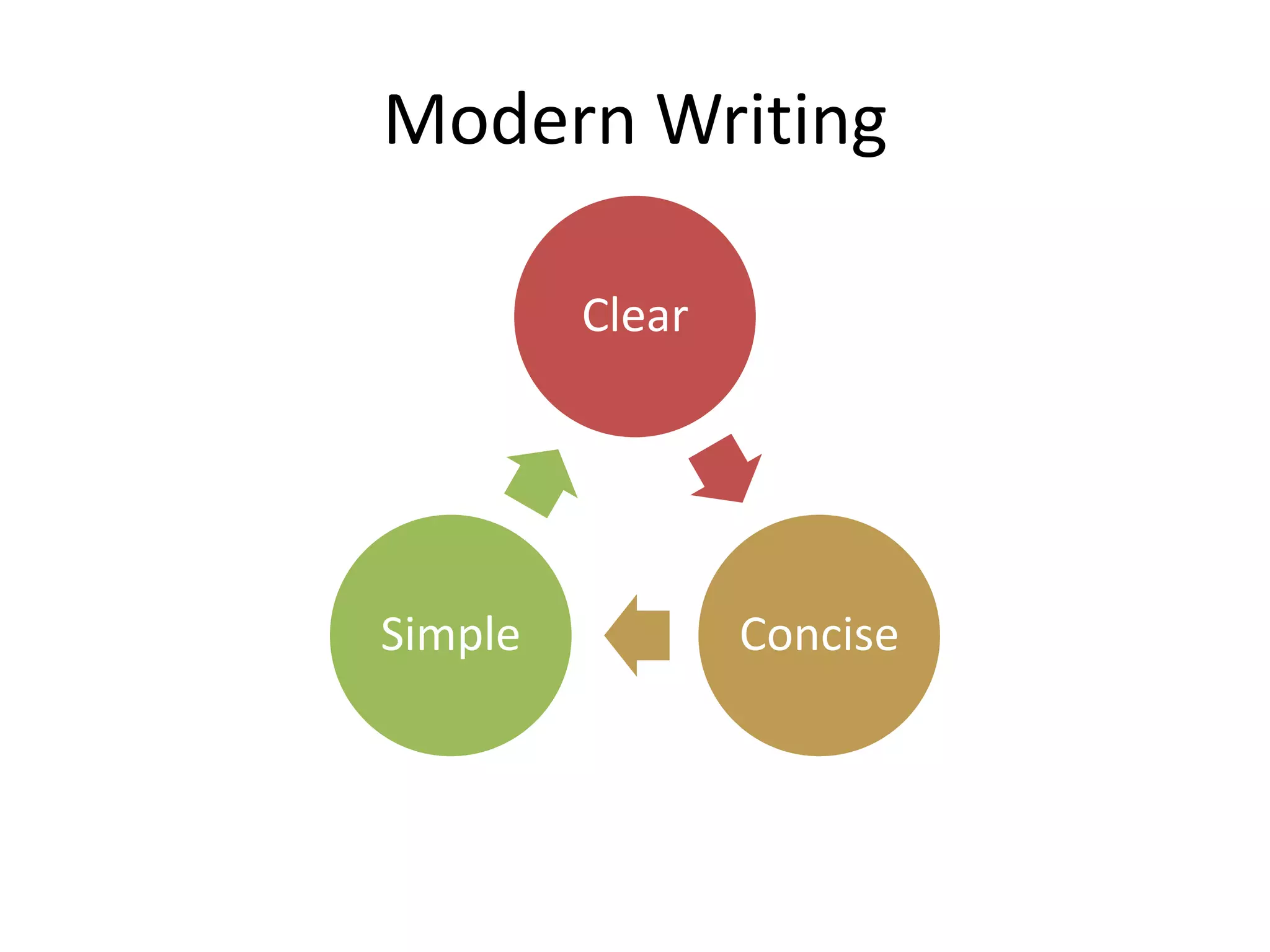
Modern Writing
Clear
ConciseSimple
Texts should be clear
1. The reader should be able to understand precisely what you
are saying.
2. The language should be adapted to the reader.
3. This means you should write in a matter-of-
fact, conversational tone.
4. Use specific examples that the reader can relate to.
5. Don’t assume that your reader understands the jargon of
your trade.
6. Remember that what you write can be read by people other
than the recipient.
7. Your writing shouldn’t be a collection of random ideas.
8. It should be single-minded in its purpose.
Part 4 Writing style
How are you
going to write it?
• I have been working in Brussels and across
Europe for over nine years and I see the same
problems with writing over and over again
• Here are six tips to help you improve your
writing skills
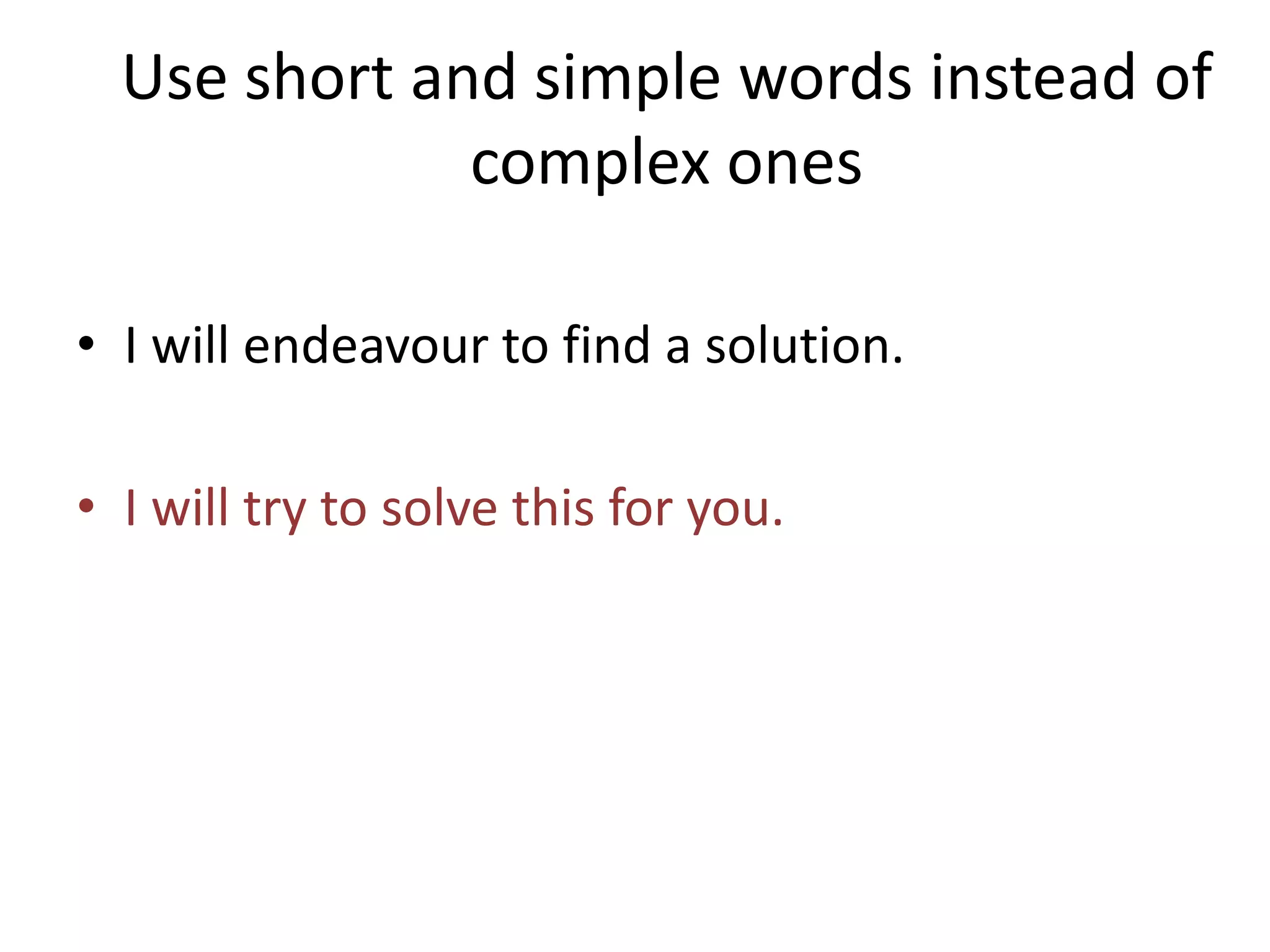
Use short and simple words instead of
complex ones
• I will endeavour to find a solution.
• I will try to solve this for you.
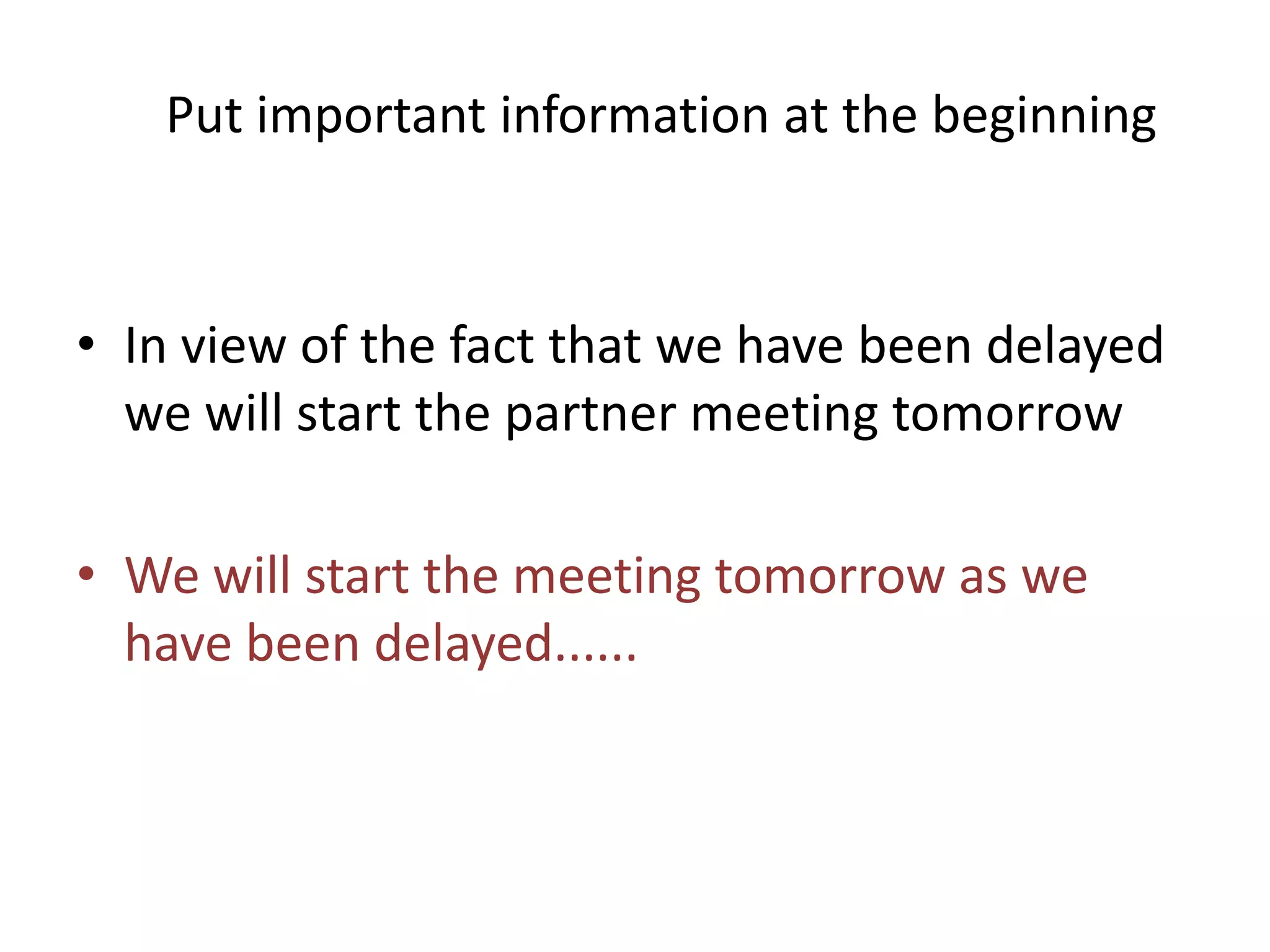
Put important information at the beginning
• In view of the fact that we have been delayed
we will start the partner meeting tomorrow
• We will start the meeting tomorrow as we
have been delayed......
Use verbs that carry meaning instead
of grammar verb phrases
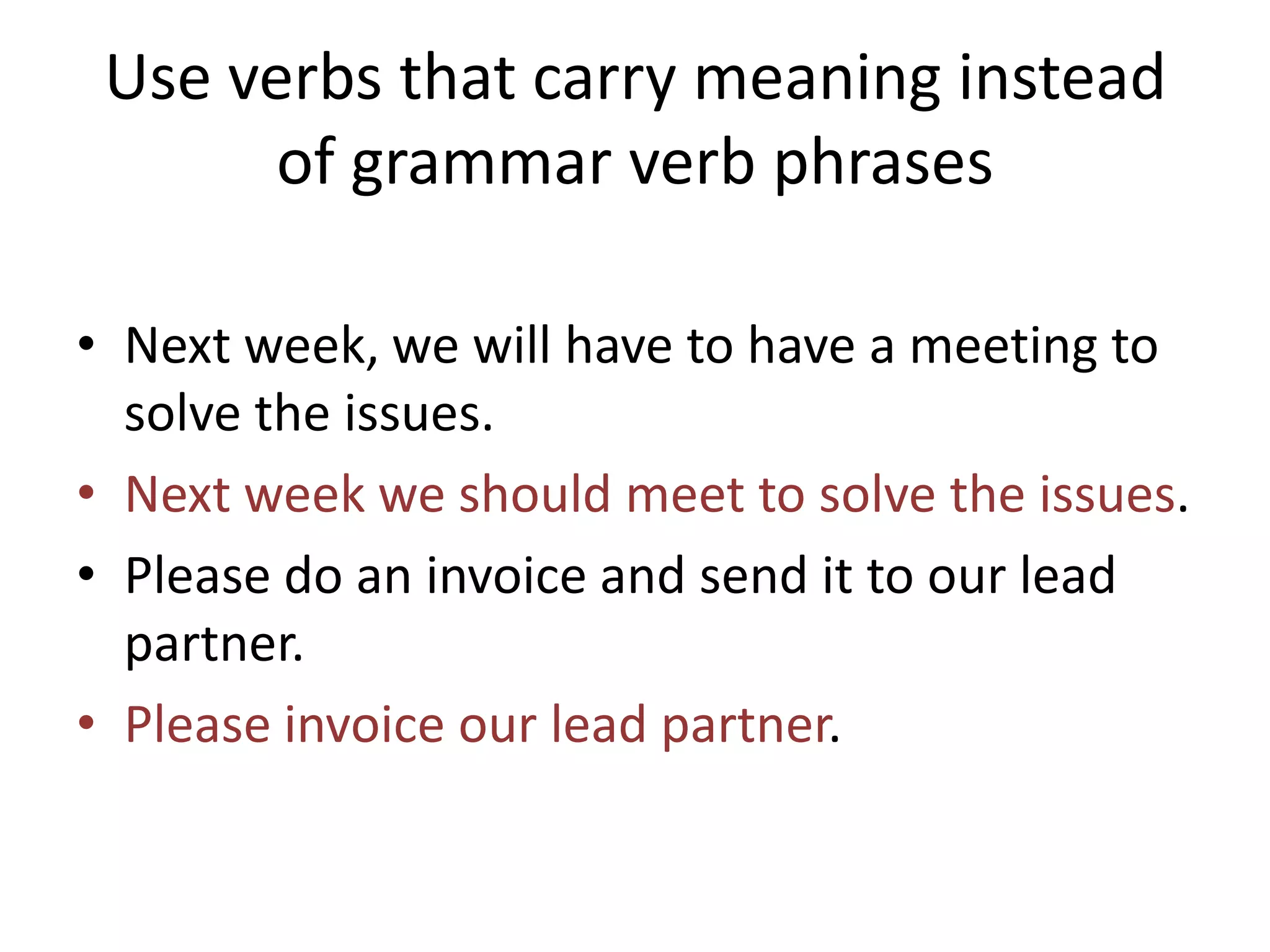
• Next week, we will have to have a meeting to
solve the issues.
• Next week we should meet to solve the issues.
• Please do an invoice and send it to our lead
partner.
• Please invoice our lead partner.
Use active sentences instead of the
passive voice
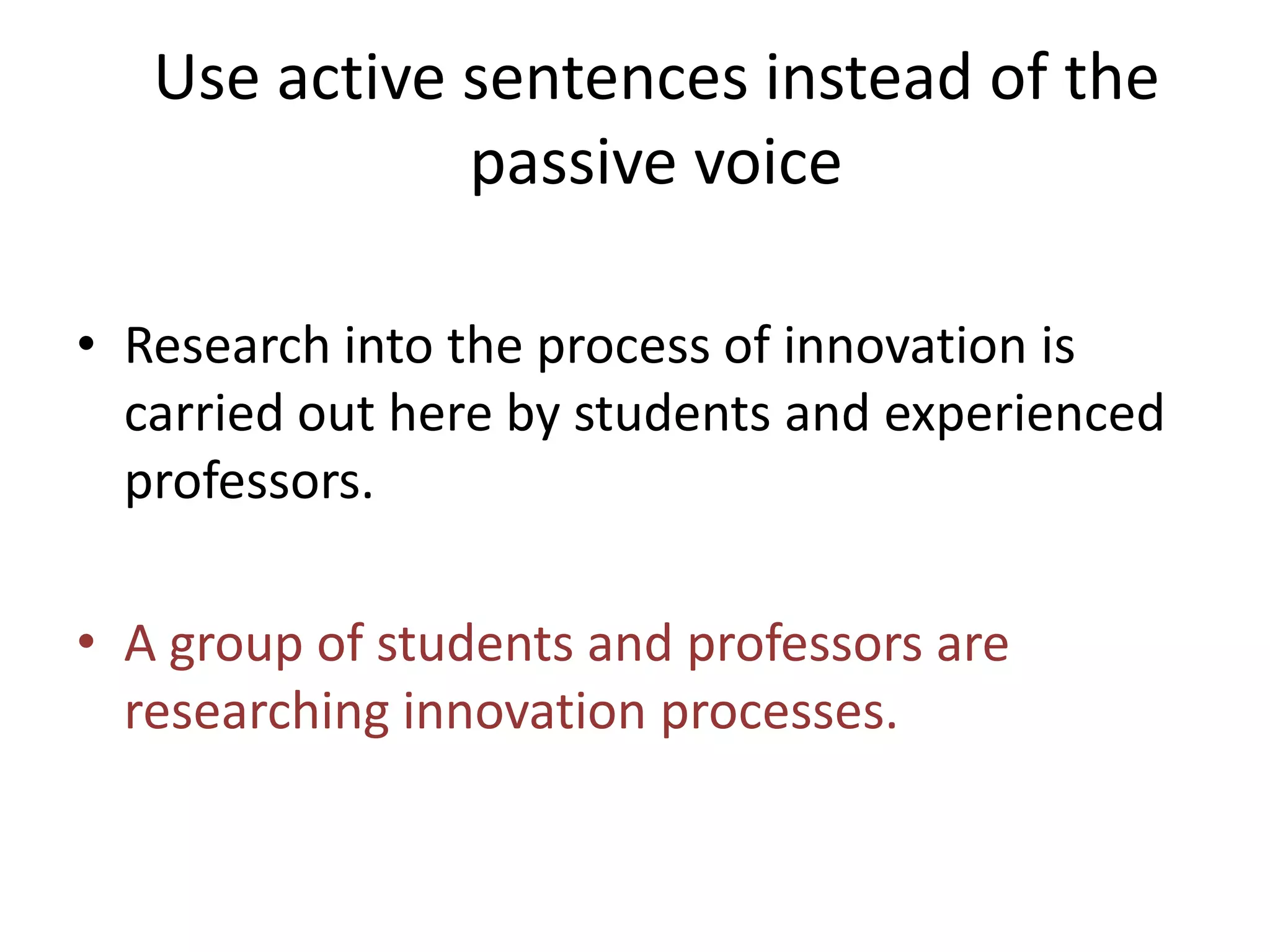
• Research into the process of innovation is
carried out here by students and experienced
professors.
• A group of students and professors are
researching innovation processes.
Avoid redundant words or phrases
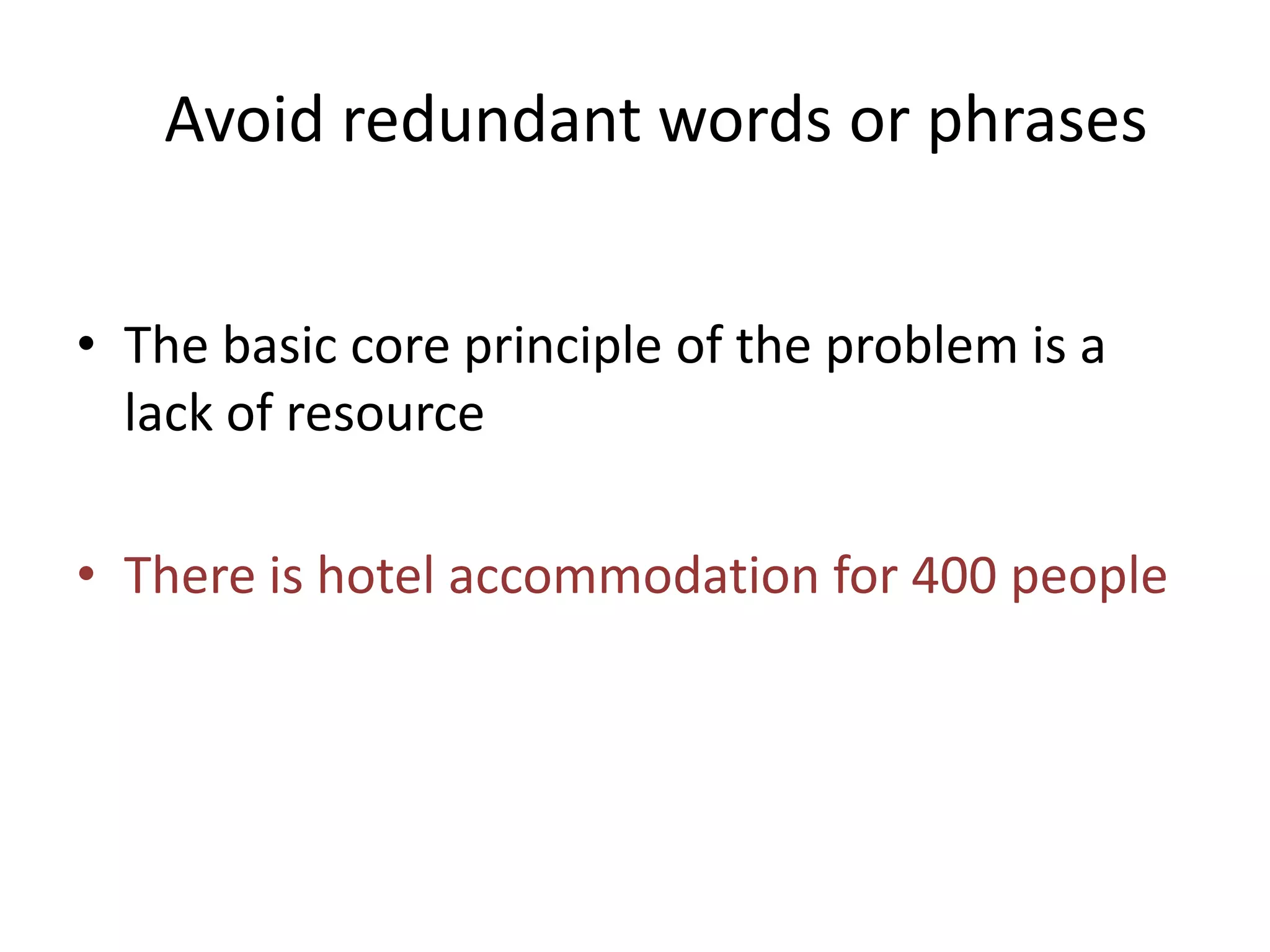
• The basic core principle of the problem is a
lack of resource
• There is hotel accommodation for 400 people
Beware of jargon, acronyms and
institutional language
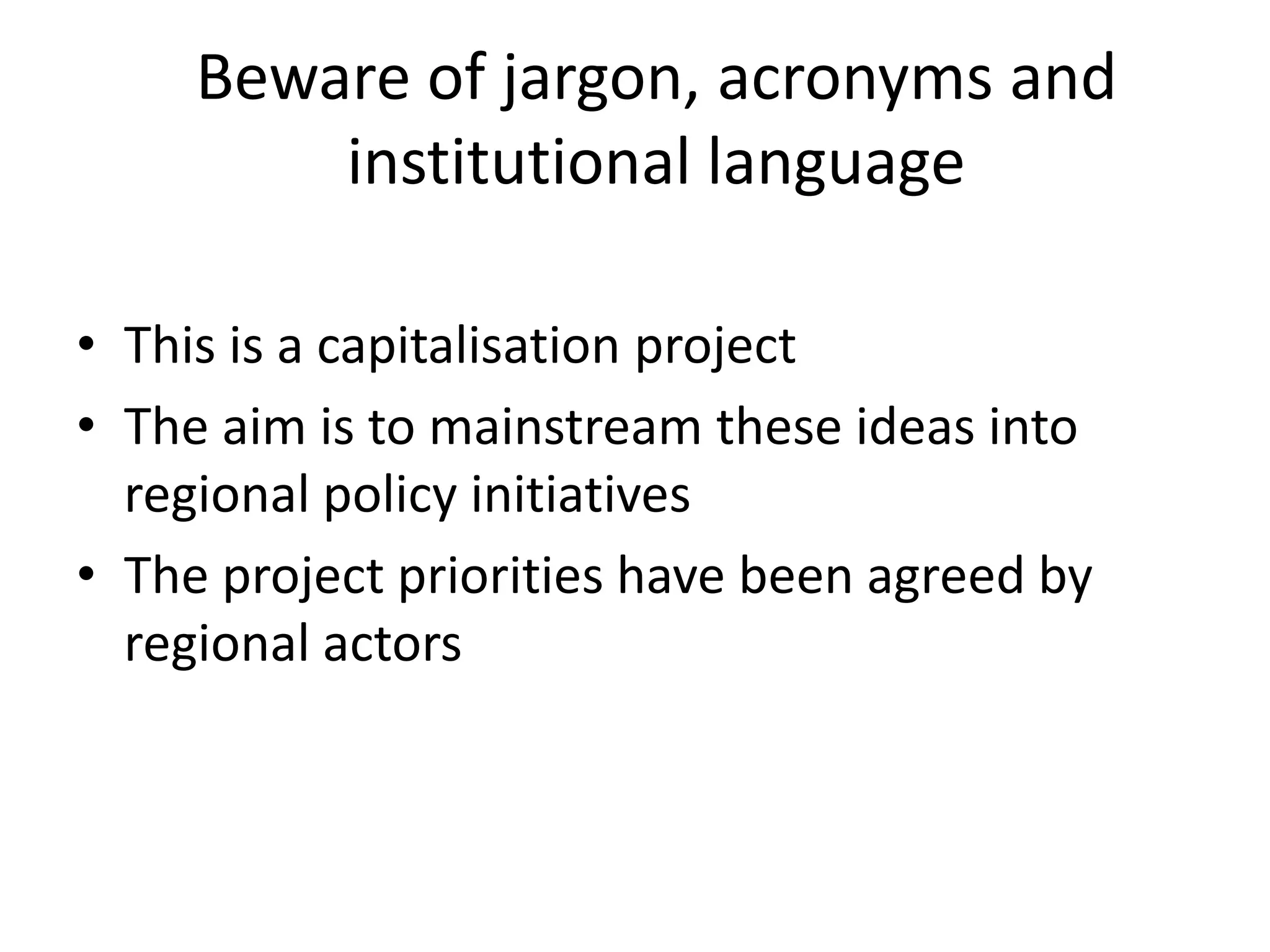
• This is a capitalisation project
• The aim is to mainstream these ideas into
regional policy initiatives
• The project priorities have been agreed by
regional actors
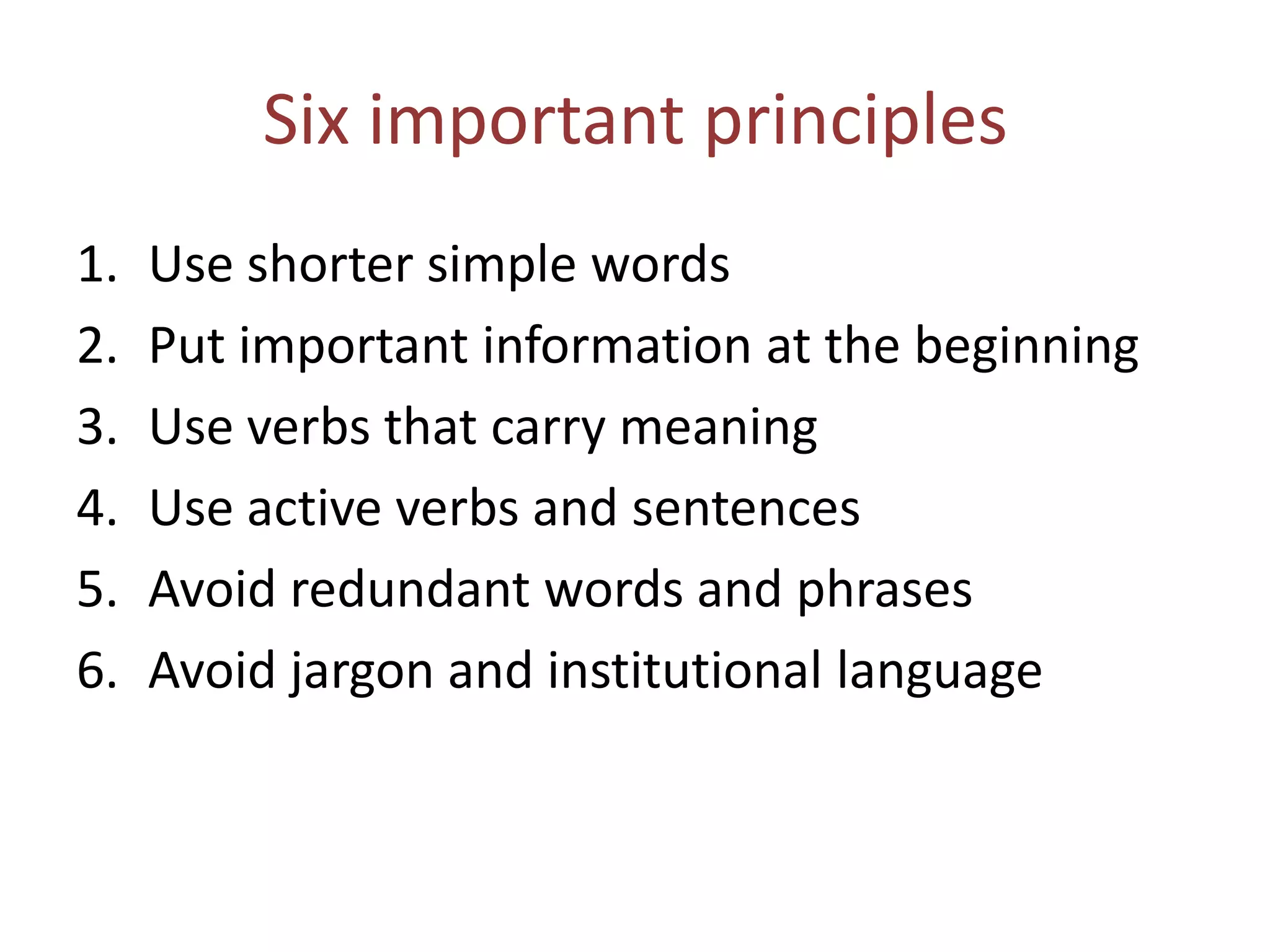
Six important principles
1. Use shorter simple words
2. Put important information at the beginning
3. Use verbs that carry meaning
4. Use active verbs and sentences
5. Avoid redundant words and phrases
6. Avoid jargon and institutional language
For more
materials please
contact us
For more information
Andrew Manasseh
• www.linkedin.com/A Manasseh
• twitter.com/andimanas
• communicatingeu.wordpress.com/

Advanced writing skills sample slides

  • 1.
    Advanced Writing Skills ManagementCommunication Training
  • 2.
    Andrew Manasseh PRand media • 25 years training, business development, staff management and training • British Council 15 years in Thailand, Czech Republic, Italy and Brussels • 9 years EU communications and PR training • Experience with governments in central Europe and W. Balkans • Extensive work with the European Commission, European Parliament, EU agencies
  • 3.
    Objectives - expectedresults • Adopt an appropriately balanced and professional style and tone that suits internal and external communications • Tailor written language for different audiences and purposes • Understand many forms and formats of writing – such as mission reports, correspondence • Plan and structure writing for your business impact and clear structure to make it easier for the reader to comprehend • Write condensed, targeted, precise texts such as emails, reports, updates, that convey messages in clear and simple language.
  • 4.
    Course overview The aimof this training is to provide you input and practice in modern writing skills • Modern writing style • Readers – who you are writing for • Messages – what you are trying to say • Writing style –tips and techniques • Paragraphs and sentence building • Proof reading and editing
  • 5.
    Part 1 Modernwriting principles
  • 6.
    Effective Writing • Whatprecisely is the central issue? • To what degree does the audience understand the issues and terminology? • What are the main ideas that need to be expressed and which ideas can be left out? • How are you going to structure your text so that they are consistent and clear?
  • 7.
  • 8.
    Texts should beclear 1. The reader should be able to understand precisely what you are saying. 2. The language should be adapted to the reader. 3. This means you should write in a matter-of- fact, conversational tone. 4. Use specific examples that the reader can relate to. 5. Don’t assume that your reader understands the jargon of your trade. 6. Remember that what you write can be read by people other than the recipient. 7. Your writing shouldn’t be a collection of random ideas. 8. It should be single-minded in its purpose.
  • 9.
    Part 4 Writingstyle How are you going to write it?
  • 10.
    • I havebeen working in Brussels and across Europe for over nine years and I see the same problems with writing over and over again • Here are six tips to help you improve your writing skills
  • 11.
    Use short andsimple words instead of complex ones • I will endeavour to find a solution. • I will try to solve this for you.
  • 12.
    Put important informationat the beginning • In view of the fact that we have been delayed we will start the partner meeting tomorrow • We will start the meeting tomorrow as we have been delayed......
  • 13.
    Use verbs thatcarry meaning instead of grammar verb phrases • Next week, we will have to have a meeting to solve the issues. • Next week we should meet to solve the issues. • Please do an invoice and send it to our lead partner. • Please invoice our lead partner.
  • 14.
    Use active sentencesinstead of the passive voice • Research into the process of innovation is carried out here by students and experienced professors. • A group of students and professors are researching innovation processes.
  • 15.
    Avoid redundant wordsor phrases • The basic core principle of the problem is a lack of resource • There is hotel accommodation for 400 people
  • 16.
    Beware of jargon,acronyms and institutional language • This is a capitalisation project • The aim is to mainstream these ideas into regional policy initiatives • The project priorities have been agreed by regional actors
  • 17.
    Six important principles 1.Use shorter simple words 2. Put important information at the beginning 3. Use verbs that carry meaning 4. Use active verbs and sentences 5. Avoid redundant words and phrases 6. Avoid jargon and institutional language
  • 18.
  • 19.
    For more information AndrewManasseh • www.linkedin.com/A Manasseh • twitter.com/andimanas • communicatingeu.wordpress.com/

Editor's Notes

  • #8 The methodological approach that we draw on is known as the three Es: Experience, Evaluate, Experiment.Participants experience a piece of communication in context either by reading or watching a communication task or are put into simulations in which they have to perform as work-based task, for example delivering a presentation, organising a meeting or drafting a document.The participants then evaluate the quality and effectiveness of the experience against criteria that have been established or input by the trainer. For example: is the presentation logically organised and delivered with clarity. What aspect worked well and which could be improved. Language points such as grammar and vocabulary are dealt with on a guided discovery basis. They then experiment with the language and skills in a different context or with a different example to demonstrate they are able to use the language effectively in different contexts.