English for Business Communication 2nd Edition Simon Sweeney
English for Business Communication 2nd Edition Simon Sweeney
English for Business Communication 2nd Edition Simon Sweeney
English for Business Communication 2nd Edition Simon Sweeney
English for Business Communication 2nd Edition Simon Sweeney
1.
English for BusinessCommunication 2nd Edition
Simon Sweeney download
https://ebookgate.com/product/english-for-business-
communication-2nd-edition-simon-sweeney/
Get Instant Ebook Downloads – Browse at https://ebookgate.com
2.
Get Your DigitalFiles Instantly: PDF, ePub, MOBI and More
Quick Digital Downloads: PDF, ePub, MOBI and Other Formats
English for Business Studies Audio CD Set 2 CDs 2nd
Edition Ian Mackenzie
https://ebookgate.com/product/english-for-business-studies-audio-
cd-set-2-cds-2nd-edition-ian-mackenzie/
Test Your Professional English Marketing Penguin Joint
Venture Readers 1st Edition Sweeney
https://ebookgate.com/product/test-your-professional-english-
marketing-penguin-joint-venture-readers-1st-edition-sweeney/
New Perspectives Portfolio Projects for Business
Communication 1st Edition Carol M. Cram
https://ebookgate.com/product/new-perspectives-portfolio-
projects-for-business-communication-1st-edition-carol-m-cram/
Intercultural Business Communication 1st Edition Robert
Gibson
https://ebookgate.com/product/intercultural-business-
communication-1st-edition-robert-gibson/
3.
Good Practice Students Book Communication Skills in
English for the Medical Practitioner Mccullagh
https://ebookgate.com/product/good-practice-student-s-book-
communication-skills-in-english-for-the-medical-practitioner-
mccullagh/
Solutions Manual for Signals and Systems 2nd Edition
Simon Haykin
https://ebookgate.com/product/solutions-manual-for-signals-and-
systems-2nd-edition-simon-haykin/
Rfid for Dummies 1st ed Edition Patrick J. Sweeney Ii
https://ebookgate.com/product/rfid-for-dummies-1st-ed-edition-
patrick-j-sweeney-ii/
Talking Business Making Communication Work 1st Edition
David Clutterbuck
https://ebookgate.com/product/talking-business-making-
communication-work-1st-edition-david-clutterbuck/
Excellence in Business Communication 10th Edition John
V. Thill
https://ebookgate.com/product/excellence-in-business-
communication-10th-edition-john-v-thill/
Introduction
Module 1 Culturaldiversity
and socialising
Unit 1 Building a relationship
Briefing
1 Cross-cultural understanding ( I)
2 Welcoming visitors
3 Small talk: keeping the conversation going
Unit 2 Culture and entertainment
Briefing
1 Cross-cultural understanding (2)
2 Inviting, and accepting or declining
3 Eating out
Module 2 Telephoning
Unit 3 Could I leave a message?
Briefing
1 Preparing to make a telephone call
2 Receiving calls
3 Taking and leaving messages
4 Asking for and giving repetition
5 The secretarial barrier
Unit 4 Good to hear from you again!
Briefing
1 Cross-cultural communication on the
telephone (1)
2 Setting up appointments
3 Changing arrangements
4 Ending a call
Unit 5 Unfortunately there's a problem ...
Briefing
1 Cross-cultural communication on the
telephone (2)
2 Problem-solving on the telephone
3 Complaints
Module 3 Presentations
Unit 6 Planning and getting started
Briefing
1 Presentation technique and preparation
2 The audience
3 Structure (1) The introduction
Unit 7 Image, impact and making an
• •
ImpreSSIOn
Briefing
1 Using visual aids: general principles
2 Talking about the content of visual aids
3 Describing change
•
IV
1
1
1
4
6
10
10
10
11
16
]8
18
18
19
20
23
24
27
27
27
29
32
33
36
36
36
36
38
43
43
43
45
46
50
50
50
SI
SS
Unit 8 The middle of the presentation
Briefing
1 Holding the audience's attention
2 Structure (2) The main body
3 Listing information
4 Linking ideas
5 Sequencing
Unit 9 The end is near ... this is the end
Briefing
1 Structure (3) The end
2 Summarising and concluding
3 Questions and discussion
Module 4 Meetings
Unit 10 Making meetings effective
Briefing
1 What makes a good meeting?
2 Chairing a meeting
3 Establishing the purpose of a meeting
Unit 11 Sorry to interrupt, but ...
Briefing
1 The structure of decision-making
2 Stating and asking for opinion
3 Interrupting and handling interruptions
Unit 12 What do you mean by ... ?
Briefing
1 Asking for and giving clarification
2 Delaying decisions
3 Ending the meeting
Module 5 Negotiations
Unit 13 Know what you want
Briefing
1 Types of negotiation
2 Preparation for a negotiation
3 Making an opening statement
Unit 14 Getting what you can
Briefing
1 Bargaining and making concessions
2 Accepting and confirming
3 Summarising and looking ahead
Unit 15 Not getting what you don't want
Briefing
1 Types of negotiator
2 Dealing with conflict
3 Rejecting
4 Ending the negotiation
Optional case studies
5R
58
58
59
59
61
62
65
65
65
66
6R
74
74
74
76
7R
83
83
83
84
86
91
9]
91
93
94
98
98
98
100
101
105
105
105
107
109
112
112
112
112
115
117
119
6.
•
I
This second editionprovides improvements to the
overall design and appearance of the book as well
as various small changes and updating of
material. The most important content change is
the introduction of more practice exercises in
response to users' requests. See the paragraph
Quick Communication Check below.
Aims of the course
The course is intended as an opportunity for
intermediate-level students to develop confidence
and fluency in five key communication contexts:
socialising, telephoning, presenting information,
participating in meetings and handling
negotiations. The course has twin aims: improving
communication technique and developing and
consolidating the target language appropriate to
the above communication contexts.
A further key aim is the development ofeffective
learning strategies for both language and
communication skills. The teacher's role in this is
critical. It is important that certain principles are
upheld, such as the need for preparation of
communication tasks, the importance of practice,
and the need for linking the teaching objectives
with perceived professional needs. The students
should be encouraged to reflect on their own
performance, to identify ways in which it can be
improved, and to monitor both the accuracy of
their language and the effectiveness of their
communication skills.
The course is primarily geared towards
improving speaking and listening skills, though
reading and writing tasks are also included. Part
of the method for the development of fluency and
confidence in speaking is the importance of
involving students in as much discussion as
possible. As a skills-driven course this is especially
suitable, as students are encouraged to make their
• •
I I n
own suggestions based on their own experience,
however limited. There is plenty of scope for
eliciting students' ideas, impressions and
opinions. Classes should be geared towards as
much participation as possible. Everyone has
experience of all five of the skill areas treated in
the course, whether in English or in their
own language.
Structure
The five modules can be studied consecutively as
a conventional course. However, with some
students a module may be studied where specific
training in one area of communication skills is
required.
There is, nonetheless, a certain logic in the
order of the five modules. The first module,
Socialising, is a scene setter. It establishes the
teaching and learning approach used in the
course. The second module, Telephoning, treats a
fairly restrictive amount of language as is typical
in telephoning. The third, Presentations, is in
many ways the core of the course, as skills
involved in presenting are often a feature of
participating in meetings and negotiations.
However, the more interactive nature of the latter
two contexts is reflected in the nature of the
material in the final two modules. These two, and
the Presentations module, contain many
recommendations for effective communication
strategies and at the same time build up the
students' repertoire in terms of language.
The final module, Negotiations, is perhaps,
unsurprisingly, the most challenging in terms of
language. In many ways, but partly because the
language is more complex, effective study of the
final module is dependent on having already dealt
with the previous module on Meetings.
7.
listening material
There areover 80 different recordings in the book.
The tasks accompanying them range from initial
general comprehension points to understanding
important details.
The first listening typically concentrates on
meaning. Students are asked to identify key
information. Check carefully that these main
points are understood. It is important that
meaning is established before students are asked
to think about language. As a general rule,
teaching aims should keep these two activities
separate. The distinction should be made clear to
the students and should influence students'
developing learning strategies.
The second listening task normally focuses on
the target language for the unit in question.
Encourage students to repeat what they hear and
to make notes. Writing down new language
normally aids recall, but not all students can be
persuaded to do this. In any case, avoid slowing
down lessons for excessive writing of models from
the tape.
Occasional writing - and even use of dictation
- can be helpful.
Some of the later listening material in the final
module on Negotiations is more difficult than the
earlier modules.
Pronunciation work
There is little overt treatment of pronunciation
features in the course. However, it is an option to
include this aspect of language training with this
material. It is recommended that if you want to
spend additional time to focus on features of
phonology, the course does offer good, authentic-
sounding dialogues. These can be used to sensitise
students to the implications of stress, intonation,
pausing and thought groups. For further guidance
on these aspects, see Speaking Clearly (Cambridge
University Press, 1991).
Reading texts
Throughout the book, certain principles relating
to efficient reading techniques should be upheld.
Explain that it is not necessary to understand
every word. The objective is to understand the
main ideas. Detailed reading or studying of texts
is neither desirable nor is it required.
The tasks accompanying reading texts mainly
relate to the identification of key points and are
designed to stimulate students' thoughts and ideas
on the topics included.
language Checklists
The Language Checklist at the end of each unit is
a summary of some of the key language that has
been introduced in the unit or that can be used in
practice tasks and role plays. The Language
Checklists are not prescriptive and offer only a
sample of the sort of language that can be used.
They are included as a support to students, as a
•
possible self-study resource and as quick reference
material.
Always check that students understand the
phrases offered and that they are able to
pronounce them correctly. Remind them that they
can be selective, choosing the phrases they prefer,
or even alternatives not included in the Checklists.
The Checklists are useful in preparation for the
role plays in each unit. Students should also refer
back to previous Checklists when they need to.
Quick Communication Check
Each unit now includes a page of exercises
designed to offer an additional check on students'
learning. The exercises reflect the target language
in each unit, typically represented in Language
Checklists. These exercises are desinged for self-
study use, having an integrated answer key on
each page. The Quick Communication Check thus
serves as further practice, as consolidation, and as
a simple test to check student's learning.
8.
•
VI
Skills Checklists
The SkillsChecklists summarise the key points of
technique for effective communication skills as
introduced in each unit. In some cases, further
points are included, either for discussion in class
or as additional recommendations for students to
think about in their own time.
Like the Language Checklists, the Skills
Checklists are intended as a source of reference
for future work, especially in preparing for
telephone calls, presentations, meetings or
negotiations where the language used will
be English.
Transfer tasks
In most cases the aim of the Transfer tasks is to
have students practise target language in defined
communication contexts that relate directly to
their own immediate environment, their home,
their studies or their work. In this way the
Transfers aim to create a bridge between the
classroom and the student's world.
Timing
Most units will take around three hours.
Approximate recommended timings are given in
the Teacher's Book for each section of each unit.
Guide times include neither any material marked
as optional nor the Transfer tasks. The latter
require homework or out-of-class preparation.
The times suggested are approximate and will
vary according to the preferences and competence
of the students involved, as well as student
numbers. It is important not to labour the
material. The tasks are intended to be fairly
quick, but use your discretion. Clearly with
extended role plays or where preparation is
involved there may be some variation beyond
the times suggested.
9.
• •
UI Ia
• Cross-cultural understanding (1)
• Welcoming visitors
Briefing
This module looks at issues relating to working
with professionals from other countries where
cultural misunderstandings may cause
embarrassment. It relates closely to the later
module on Meetings. This unit focuses on
developing personal relationships and mutual
understanding between business partners. Unit 2
looks more directly at socialising within a business
context, invitations, entertaining, and eating out.
The unit begins with an ice-breaker as a chance
to develop small talk, before looking specifically at
working with British and American people,
together with suggestions on preparing for
contacts with other countries. Knowledge and
understanding is essential in order to get on well
with one's partners from other countries.
Socialising is instrumental in this: it is about
making relations.
The second section deals with welcoming
visitors and helping them to feel at ease. This
theme is used as a lead-in to small talk, which is
developed in the final section of the unit and
again in Unit 2. Small talk is looked at in terms of
various topics and how to keep conversation
going. There is a lot of scope for discussion of
students' own ideas in the unit. The Transfer
includes an option on a small research project.
Think about the extent to which your students
may travel to other countries or are likely to
receive visitors. This is important. In the latter
case, discuss which aspects of the students' own
country, town or culture might be interesting or
unusual for a visitor.
, " ,
-- - - - - - , - - , .
-_ - _c__ - , _ _ •
I· ...
....... ,
ISlng
• Small talk: keeping the conversation
•
gOing
1:1 situation
Many of the activities which lend themselves to
discussion and brainstorming will require more
support from you. Prompt and elicit thoughts
from the student and feed in your own ideas and
those included here. There are two role plays
where you will need to take a part, as well as two
dialogues based on flow charts where you will
need to take the right-hand role in eventual
practice. With more competent speakers, you may
be able to add variations, thus increasing the need
for spontaneity on the part of the student.
Timing: 3hours
1 Cross-cultural understanding (1)
1 Circulate the groups, prompting comment on
the photograph. Different students will
comment on different things, but draw out
ideas on:
• where it might be (country / hotel/factory
/ office, etc.)
• why they are there (for a
meeting / seminar / new venture / chance /
tourism, etc.)
• what kind of relationships are represented
(friends / new business partners / same
company, etc.)
• topics of conversation (business/ non-
business, hobbies, interests, small talk such
as weather, travel, plans, the hotel, travel,
colleagues, other countries, etc.)
• what they won't be talking about ...
1
10.
Cultural diversity andsocialising
For five minutes, get groups of students to act out
a typical situation as shown in the photograph.
Join in yourself, exaggerating your speech
patterns, encouraging a playful and humorous
approach to the exercise. Then discuss issues
arising from the illustration:
• Humour. Ask to what extent humour enters
into business relationships - or even jokes.
In some countries, such as Britain, joking is
often used to relieve tension. In others, such
as Germany, that might be regarded as
flippant or unprofessional. Sean O'Casey, the
Irish playwright, said that the Irish turn a
crisis into a joke and a joke into a crisis.
• Women in business. In which cultures is this
unlikely? Where are women having an
increasingly prominent role in business?
(Italy and the UK are examples, although
less than 10% of company executives in the
UK are women.) In some countries, despite
legislation aimed at improving career
opportunities for women, few reach the top
(Norway, for example, although the field of
politics is an exception)..
• Alcohol and business. In cultures where
alcohol is taboo, this is, of course, not an
issue. However, while it is not unusual to
have a glass of wine or a beer with lunch in
Europe, it is very bad form to drink too
much. In Italy, a nation of wine drinkers, it
is very unusual to drink outside meal times,
whereas in Sweden it is not unusual to have
a beer with colleagues after work.
• Coffee. In many countries, coffee and
business seem inextricably linked. Coffee
seems to be what cements relationships,
everywhere from Saudi Arabia to Argentina,
via North America and Norway.
• Tea. In China and Japan, tea is more popular.
2 After ten minutes' discussion of these issues to
set the theme for the module, go on to the
reading task. Ask students to read the text and
quickly decide what is the main idea expressed
in the text.
Answer: Everybody is different. Signals mean
different things to people of different cultures.
3 If necessary, allow a second reading to find the
answers.
a) Eye contact is important. Not maintaining
eye contact indicates someone who is
unfriendly, insecure, untrustworthy,
inattentive and impersonal. But it is
considered rude to stare. Americans signal
interest and comprehension by bobbing
their heads or grunting.
b) Similar to Americans where eye contact is
concerned. The English (sic)><- pay strict
attention to a speaker, listen carefully, and
blink their eyes to let the speaker know he /
she has been heard and understood.
c) Taught to direct their gaze at their teacher's
Adam's apple or tie knot.
d) A gesture of respect.
e) If a person of a lower class stares at
someone of a higher class.
f) Anger.
><- Note: It is a small but significant point that the
text, from an American source, speaks of 'the
English'. Many foreigners refer to 'the English'
when perhaps it would be more correct to say
'the British'. Discuss with learners what the
terms Britain, the UK, Northern Ireland, Wales,
Scotland and England refer to. Incidentally, the
British often make the same mistake when they
refer to Holland, which is actually a region of
the Netherlands.
4 Introduce the question by asking why some
sort of research is a good idea before doing
business with people from different countries
or cultures.
a) Elicit / Suggest that:
• partnerships need to be built on trust and
shared understanding
• initial research can help one know more
about potential partners and their country,
so avoiding embarrassment.
Think about possibly taboo subjects, such as:
• politics in countries where open political
diversity is not tolerated, or where
democracy has a meaning different to your
understanding of the term
• talking about family relationships
11.
• alcohol andcertain foods
• discussing business too early, etc.
Refer to the Skills Checklist. Fundamental things
to consider include:
• some basic geographical knowledge
• some knowledge of political and economic
conditions
• religion and specific customs
• public holidays
• attitudes and expectations regarding
entertaining visitors
• business conventions.
El C;) b) Introduce the recording. The speaker is
an experienced negotiator, used to dealing with
people from varied cultural backgrounds. He
suggests seven areas that are important for
someone planning to do business across a
cultural frontier. Ask students to identify six
of them.
Key
The following seven areas are mentioned:
• the actual political and economic situation
- stability
- trends
- outlook
• infrastructure
- telecommunications
- transport
• religion / language
• geography / history
• culture / customs
- people
- food / drink / socialising
• attitudes / families
• business customs / conventions.
Option
As a further discussion point to develop, it might
be interesting to ask students if they think this
type of research is as important when one is
planning to receive a visitor as it is when one
plans to go abroad. In many cases, similar
research would be advisable in both instances.
Building a relationship
Tapescript
INTERVIEWER: SO if you are going on a business
trip, or meeting someone from
another country - perhaps a
different culture - what do you
need to think about?
PETER: Well, it's not so obvious. I always
try to know something about the
actual political and economic
situation in the other country -
the politics, the economics. I
should always know something
about that, about what's
happening. Also if I'm going
abroad, I find out a little about the
infrastructure - I mean the
telecommunications, the
transportation, that sort of thing.
INTERVIEWER: And do you find out about the
general background, basic
information about the country?
PETER: The· culture, yes. Certainly, the
religion, the language - I might
learn a few polite phrases - the
geography, maybe a little history.
And how people live, what kind of
culture it is, how people socialise,
food, drink, all that is very
•
Important.
INTERVIEWER: What about family life?
PETER: Yes, that too. How families live, if
private life and business ever mix
... and also business customs and
conventions. I don't want to be
surprised by anything.
PHOTOCOPIABLE (i) Cambridge University Press 2003
End by saying the list is not closed - there are
plenty of other things one could also mention.
Discussion
Facilitate a very brief discussion on the value of
the points included in this section. Students may
identify particularly useful considerations to think
about. Refer again to the Skills Checklist.
UNIT
3
12.
NIT 1 Culturaldiversity and socialising
Ask again why preparation for contact across
culture is important. Points to bring out include:
• it is a question of courtesy that one should
be interested in one's business partners and
in their countries
• tact and consideration are important
• knowing something about your partners can
save embarrassment
• one will not be expected to be an expert:
most people will be tolerant, so long as
goodwill and good manners are evident.
Timing: 70 minutes
2 Welcoming visitors
Welcoming visitors involves making people feel
relaxed and comfortable in a new environment.
An essential part of this is small talk - or making
conversation which is not directly concerned with
reaching a business deal. The theme of small talk
is developed in more detail later in the unit.
Read the opening questions, making sure
students understand the focus of this section.
Elicit suggested answers:
•
What happens when a visitor arrives with an
appointment to visit a company?
• goes to reception
• introduces himself / herself / states reason
for visit (who?)
• is taken to / met by the right person.
What are the typical stages ofthe first meeting?
Suggest the first stage to the students: welcome
and introductions. What might follow? Use the
board or OHP to illustrate this structure.
Stages ofa meeting
Welcome and introductions
I
Small talk / Settling in
I
Preliminaries / Plan for the visit
I
Begin discussions
What conversations take place (in stage two above)?
• offer of refreshments
• questions about trip
• first visit / previous visits
• length of stay / hotel, etc.
• special interests / needs
• reference to previous contact / other
small talk.
1
'-1 0 1 Introduce the recording at Evco S.A.
and play once. Elicit answers:
a) The meeting is quite informal. They use
first names, they interrupt each other a
little and generally seem relaxed.
b) They have never met: Louise and Klaus have
spoken on the phone a couple of times.
c) Klaus wants to buy some fish to take home.
1-1 0 2 Play the recording again. Given the
situation, Louise's interruption is probably
acceptable, as is the immediate use of first
names. On the other hand, Lars begins to talk
about the programme for the day quite
quickly. Poor Klaus! This is a bit soon, surely!
Let's hope they allow their visitor more time to
relax with more small talk and a sit-down.
Option
Decide whether to spend more time on the
language in this extract. Perhaps highlight
language for: introductions / questions about the
trip / taking of coat / offering refreshments /
referring to programme for the day, etc. Notice
too how the small talk begins in discussing the
weather and the fish. Ask learners how the
conversation could have developed - if Lars had
not decided to get down to business.
Note: The participants in this conversation are
lucky. Klaus asks about fish and the ice is broken.
Sometimes getting conversation going can be
difficult. Point out that the module contains ideas
for dealing with problems like this, beginning
with the next section in this unit.
Tapescript
KLAUS: Hello, my name's Klaus Ervald. I've an
appointment ...
LOUISE: Oh hello, Klaus, I'm Louise Scott. We've
spoken on the phone a couple of times.
Nice to meet you.
NIT 1
6
Cultural diversityand socialising
STEPHANIE: Er, perhaps! Right, I'll get you a
number for Interflora or something
like that. Maybe you have a special
message you'd like to send with the
flowers?
Yes, I'll think of one.
PETER:
PHOTOCOI'I/IBLE C9 Cambridge University Press 2003
language focus option
If you think it appropriate, ask students to identify
the phrases in the dialogue which concern offering
assistance and talking about one's needs.
Note: students are likely to know phrases like I'd
like ... / Could you get me ... but are less likely to
use introductory expressions like There is one
thing I need or I wonder ifyou could help me.
Practice 1
Procedure
• Whole class perform the dialogue in pairs.
•
• Switch roles and repeat.
• You prompt where necessary, listening to
parts from three or four pairs.
• Give group feedback, commenting on good
language and problems.
• Select a couple of pairs to perform for the
class.
• Finally, play the model version on the tape
and discuss points arising.
language focus option
Use the tape to focus on language of stating
needs, offering assistance.
Tapescript
VISITOR: Hello, my name's Henrik van der
Linden from Amtel. I have an
appointment with Sandra Bates.
RECEPTIONIST: Oh, yes, Mr van der Linden.
Welcome to Datalink. Ms Bates
will be along in a few minutes.
She's just finishing a meeting. Can
I get you something to drink?
VISITOR: No thanks, I'm fine. Er, but I
wonder if I could use a phone?
RECEPTIONIST: Yes, of course. And anything else
... if you need to send an email
or anything ...
VISITOR: No, it's okay, just the phone.
RECEPTIONIST: Right, well you can use this one.
VISITOR: Thanks. AHa.
(a few minutes later)
VISITOR: Pas du tout. .. Au revoir. Thank
you very much.
RECEPTIONIST: Not at all. If there's anything else
you need, please ask.
VISITOR: Yes, I was wondering how far is it
to the station?
RECEPTIONIST: It's about two miles - ten minutes
by taxi. Shall I book one?
VISITOR: Er, yes, thank you. That would be
good. Can we say four o'clock?
RECEPTIONIST: Right, I'll do that. Oh, I think Ms
Bates is free now. Shall J take you
to her office?
VISITOR: Thanks.
I'HOTOCOI'IABLE q) Cambridge University rr~ss 2()O'>
Timing: 15 minutes
3 Small talk: keeping the
conversation going
Introduce the section. Remind students that small
talk is always useful:
• at the beginning of a meeting, welcoming a
• •
VISItor
• at other moments in a business relationship.
Elicit suggestions for:
• during breaks
• meals
• social occasions
•
• eventngs
• moving from one place to another.
Ask what topics are useful for small talk. Remind
students that conversation normally arises from
the immediate physical environment: the weather,
buildings and places, hotels, arrival and departure,
meals, the time of day, entertainment, etc. or flows
The various topics- or others suggested by the
class - are written (or represented in pictures) on
flash cards and distributed among the class. Have
them stand up and circulate, discussing the topic
on one of the cards with anyone in the room.
When you call 'change' they have to discuss the
other student's topic. When you shout 'change
partner' they have to talk to someone else, and so
on. Leave two to three minutes between each call.
Timing: 15 minutes
Language Checklist
Students should study the Language and Skills
Checklist before practising the role plays on page
11. Tell them that the Language Checklists in the
book are usually only a snapshot of all the
available alternatives. Check pronunciation and
comprehension of what is included. Use this same
procedure throughout the book for both
Checklists.
Skills Checklist
The Skills Checklist is about preparing for
meetings with partners from other countries. It
includes suggestions for developing effective
cross-cultural understanding and builds on those
aspects introduced in the first section of the unit.
Spend a few minutes discussing the
recommendations and elicit students' comments
and any other suggestions.
Timing: 10 minutes
Role plays
Encourage students to make notes from the
Language Checklist if they need to. They should
study their role cards for a minute or two, then
act out the role play in pairs. The aim is to
develop fluency and confidence in handling
arrivals and engaging in small talk. You should try
to note any problems you hear and refer to them
in feedback.
If there is an odd number of students, you
should take one of the roles.
Timing: 15minutes x 2
Building a relationship
Role play option
An option is for you to play host or visitor and
perform a role play with one or more students in
front of the rest of the class. You can throw in
added complications and difficulties that learners
would probably not include - where's the toilet?
(washroom in American English), some other
difficulties - you need to cancel a hotel booking,
hire a car, buy a map, photocopy something, etc.
Transfer
This is an opportunity for students to put the
ideas suggested in the Skills Checklist into
practice with a specific country in mind. They
could work individually, in pairs or in groups.
Suggest they use a range of sources for finding out
information:
• Published sources
- books, guidebooks
- travel information
• Official bodies
- embassies •
- consulates
- cultural centres
- government offices and agents
• Commercial offices
- travel agents
- marketing consultants
- Import and Export offices and agents
• People
- colleagues who may know the place in
question
- nationals from the country concerned
- students' own knowledge.
Option
Develop the above into a mini-project for
individual or group presentation at a later
stage. This could be combined with Module 3
on Presentations.
UNIT 1
18.
10
, '," ,'" ',' '''''",
" ',; "
,. , "
. u,: '
- , "" - ,. '
- - ,. .. ,
.
" ,', , . , " " , -
u ture an entertainment
II Cross-cultural understanding (2)
II Inviting, and accepting or declining
Briefing
The unit opens with a short reading text designed
to emphasise the significance of cultural diversity.
Implicit in the text is the warning that working
with people from other countries requires an
awareness and understanding of differences and
that effective partnerships are rarely born out of
treating everyone the same.
The rest of the unit covers socialising in a
business or professional context. Section 2
comprises talking about social events and making
arrangements. Practice activitie~ include writing a
letter deferring a social engagement. The final
section looks at eating out and making
conversation, linking with the section on small talk
in the previoLis unit. There are two role plays, one
designed to practise making arrangements, the
other set in a restaurant and designed to include
functional language in the restaurant context and
an opportunity to practise developing small talk.
language option
The language in this unit covers talking about
entertainment options, inviting, accepting and
rejecting invitations, language relevant to dining
out and small talk. You may choose to focus on
the language used once the texts have been dealt
with in the ways specifically indicated in the
Student's Book.
Role plays
For the role plays, a little planning is necessary.
For the first, try to get hold of genuine local
materials such as a newspaper or a Tourist Office
publication advertising local entertainment. This
II Eating out
will require the 'host' to do some explaining for
the 'guest'. The same is true for the second role
play, set in a restaurant, where using a local menu
would be the most realistic approach.
1:1 situation
Naturally you will have to participate in practice
exercises and role plays. Do not labour discussion.
The language used in the unit is relatively simple.
There are many alternatives which could be used
equally well. Elicit alternatives and praise
appropriate language. Correct as necessary.
Timing: 3hours
1 Cross-cultural understanding (2)
Referring to the illustration, introduce the concept
of cultural diversity. Ensure that it is understood.
Ask students what it is that makes people culturally
diverse, eliciting a range of features, such as
conventions and customs, language, history,
religion, historical experience, social systems,
geography, regional influences and other features.
1 Have the class read the text once, without
attention to detail. Summarv B is the best. The
,
other two are, according to the text, wrong.
2 A second reading should enable students to
answer the more detailed questions.
Key
a) They are not 'universal'.
b) Pay-far-performance has failed in Africa
because there are particular unspoken rules
19.
about the sequenceand timing of reward
and promotions.
c) MBO has generally failed in southern
European subsidiaries of multinationals
because managers have not wanted to
conform to the abstract nature of
preconceived policy guidelines.
d) Human-resource management is a typically
Anglo-Saxon doctrine that is difficult to
translate to other cultures. It borrows from
economics the idea that human beings are
'resources' like physical and monetary
resources. It assumes individual
development. In countries without these
beliefs, this concept is hard to grasp and
unpopular once understood.
e) International managers' culture of origin,
the culture in which they are working, the
culture of the organisation employing
them.
f) Authority, bureaucracy, creativity, good
fellowship, verification and accountability.
Follow up with an explanation of any of the key
vocabulary in the text, inviting students'
questions. Check that students have understood
the text without getting bogged down in wanting
to understand absolutely everythillg. Make sure
they do not lose sight of the importance of
understanding the main ideas in a text rather than
every word.
Option
Spend a few minutes discussing bridly the
meaning of the management philosophies
referred to in the opening paragraph. Elicit
students' ideas and comments before offering
your own. Remember that according to
Trompenaars they are of little use when applied to
differen t cultures. You may wish to discuss this
point further.
Timing:25 minutes
,
Culture and entertainment
2 Inviting, and accepting or declining
Elicit ideas in response to the photographs and
students' own views on what is likely to provide
acceptable local entertainment for professionals
visiting their home town. Typical ideas are arts
and cultural events such as theatre, cinema,
concerts, exhibitions, famous monuments and
buildings, or sports events, golf, tourist trips,
excursions, restaurants and bars, etc., as well as
more private corporate hospitality such as parties,
receptions, and possibly invitations to someone's
home - though this is highly culture dependent
and may be more common in the USA, the UK
and some parts of Continental Europe than
elsewhere.
1-I C,i) 1 Play example 1 once and elicit answers
to the three questions.
a) a concert, play or show
b) a play would be good
c) the host will find out what is on and call
back. .
['-'I (<i') 2 Play example 2. Elicit and check the
answers given here:
a) an informal gathering then a meal in a
restaurant
b) accepts with pleasure
c) they will meet at the hotel at about 7.
language focus option
Highlight the indirect, very polite invitation in the
first example. It allows for the possibility of the
visitor declining the invitation.
It is a non-specific invitation expressed in three
sentences:
I WIlS wonderillg if we could fix sOlllcthing lip for
you when YOli come? Would YOIl bc Fec 011
Monday evening? TIyol/like we cOIl/d do something
together?
In the second recording, ask students which
sentence offers the visitor a similar opportunity to
turn down the invitation. The answer is:
Tdon't know iIyoII havc al1Y other plans this
evening?
UNIT
11
Culture and entertainment
Hereis a model answer to John Callam's letter:
-- -,
,
"
, .- -
South Australia Bank of Commerce
,
• ->
,' PO Box400 Bondi Junction New South Wales 2022 AUSTRALIA
, '
, ,
,r ,,';', " Tel. (02) 389 232 Fax. (02) 389 764
'; www.SABOC.com
- , -- - ,
"','" ' ',' .: " ,",
"". - <" - "."
__.)c , --;.' : ~_': _ ~ '~- .:--:
Your ref: GF6 18 March 20-
Dear John,
, ,Munich International Communications Fair
•
Thank you foryour letter of 15 March 20 and thanks also for the
'," information you. sent. I am sure we will have plenty to talk about when
wemeetn Munich.
; , Incite your suggestion that we should meet for a meal on Thursday
.' eyerting.Twouldb~ very pleased to come, but unfortunately on this
". "',', occl'lsici:n J hl'j."etod~dine your invitation as I have to leave Munich
, early. However, Iwillbe in London a month later and perhaps we could
meet then. If this idea suits you, we can make arrangements nearer the
time.
In the meantime, I look forward to seeing you as agreed at the
Munich Fair.
" ;;Besfwishes
" _, ' - · ·c I
. "
._' -,'
. " ...
.-
" ,.:MariaSaans ·· .. .. '" .
,';,Accoi.ints Dir~~tor ·, ;
·m:J:§~~sia~cp~t~@$aboc,co.au
'---'-!~>,:,:- :i·i/"", ' > :',--: - , - , ::.:,
- ::.: :~
'. ; :':: , _;-'~':)',: - .:';".___c-," :'>_ :., -.- "",_ -- - -- - - _
______ .y. 'N __,_' __ .... ~. ~ ____'_'h' = __
'_ ~~~ ....__ __, ,~. """-____,., v :-~ : •• _ &" ,,~ :_". :... ;;.,.,.~* ~F -;-,;;" ' ..V ___'~'_ ~~. _'___ _ - __ • • _•• _____ , ___ , __ _ " ___ _ _
~
v
-
-
-
______
~
.-_____ - .. ,----
Timing: 20 minutes PHOTOCOPIABLE @ Cambridge University Press 2003
UNIT 2
15
24.
UNIT 2
16
Cultural diversityand socialising
Role play 1
This is a simple role play that should require
minimal preparation. It will help if you can
provide copies of a local 'What's On' guide to
entertainment in the area.
Listen to students working and making notes
on any language points. Provide feedback for the
group as a whole. Choose a couple of pairs to
perform their role play before the class.
Timing: 15 minutes
3 Eating out
1 Divide the class into threes and have them
brainstorm different phrases for each of the
three functions indicated.
2 Once they have done that for five minutes,
redivide the class to make new teams of three
consisting of individuals from each of the first
three groups. Each new group compiles a list
of possible phrases to complete the grid.
•
1'-'leG
; 3 Introduce the situation in a New York
restaurant. Explain that the recording has four
parts. Play the recording once without
stopping. Play it again if necessary.
Optional language focus
For weaker students only, play the recording
again, stopping it at various points to highlight
the functional language. Ask learners to repeat the
phrases out loud as you stop the recording.
Note that the dialogue is in American English.
appetizer =starter, check = bill, colorful =colourful,
cab = taxi
Tapescript
PATRICIA:
WAITER:
PATRICIA:
SANDRA:
Let's order ... er ... Can I have
a menu, please?
The menu ...
Well, it all looks terrific. Shall
we have an appetizer?
Sure, in fact I'm pretty hungry
... oh, I see they have venison
on the menu.
PATRICIA: Oh yeah, the venison's really
good.
SANDRA: Actually, I don't eat a lot of red
meat, I'm more of a fish eater.
PATRICIA: Oh, I'd recommend the fish.
SANDRA: Great. Well, I'll have the
oysters to start.
PATRICIA: I think I'll have the shrimp.
Then why don't we share a
mixed seafood grill for two as
the main course?
SANDRA: That would be great. Let's
have that ...
PATRICIA: And wine?
SANDRA: Well, I prefer white wine, a
dry one. Red gives me a
headache.
WAITER: Would you care to order
drinks now?
PATRICIA: Sure, in fact we're ready. To
drink we'll try a bottle of
Chardonnay, and water,
bottled water, please.
WAITER: Okay, I'll take your food order
• •
In Just a moment ...
PATRICIA: SO, how does it feel to be back
here - it must be a while, a
year or two at least ...
PATRICIA: This looks wonderful ... How
are the oysters?
SANDRA: Just fine. What about the
shrimp?
PATRICIA: Okay, a little spicy.
SANDRA: It's very busy here.
PATRICIA: It usually is on Thursdays and
on weekends ...
PATRICIA: You get a lot of business
people in here, local and
passing through. Ah, here
comes the fish grill.
SANDRA: Oh, it looks fantastic ... what a
lot!
PATRICIA: It's very colourful.
WAITER: Everything okay with your
meal?
SANDRA/PATRICIA: Perfect / great ...
SANDRA: That was really great.
18
"," , '
," '.
, ',', ,; ,', ',' ,
, , , . ',' ~: ,
, " " , .
, ,': :", ~, ' : ,:
. ,-- -
- -, .
- - "
Telephoning ·
eave a messa e?
Briefing
II Preparing to make atelephone call
II Receiving calis
II Taking and leaving messages
Many students at intermediate level or below will
do everything possible to avoid telephoning in
English. For obvious reasons, using the phone has
special difficulties.
However, it is worth pointing out three things
before beginning this module. Firstly, most of the
language used on the telephone in the business
context is fairly restricted. There are numerous
functions that recur repeatedly in various phone
calls. As a result, the language needed in most
situations is well within reach of intermediate-
level students. The second point is that with
increased practice, confidence develops and so
does efficient performance. The third is that it is
possible to control what happens in a telephone
conversation, to ask the caller to call back, to ask
for repetition, to ask the other person to speak
more slowly, to check and to summarise
information.
A recurrent theme throughout the course is
that communication activities benefit from good
preparation and this preparation should be
conducted - as much as possible - in English. The
module begins with a section on preparing for a
phone call. It is important that students see the
value of treating preparation as a vital part of the
process of telephoning in English.
A few moments thinking about the call will
certainly improve performance. The middle
sections of Unit 3 looks at some basic language
functions common in phone calls. The final
section, The secretarial barrier, is concerned with
cold calls.
II Asking for and giving repetition
II The secretarial barrier
1:1 situation
The unit works perfectly well with a single
student. You will need to take a part in the role
plays and Transfer exercises and a more directive
role in discussions, eliciting as much as you can
but feeding in your own opinions where relevant.
Timing: 3hours
1 Preparing to make atelephone call
1 Begin by brainstorming on what is required in
preparing to make a call. Write students'
suggestions on the board. Now let students
suggest what the people in the cartoon might
be saying to each other. Have students act out
the conversation in pairs. Elicit comments on
what went wrong and highlight the lack of
preparation involved in each situation.
Obviously the caller has not checked the
time in Tokyo when it's 11.00 a.lll. in New York.
There is a time difference of ten hours! Clearlv,
,
one should always check times when calling
different time zones.
Timing: 5 minutes
i - I(';') 2 Introduce the recording of a company
director talking about how she prepares to
make a telephone call. Students should tick the
second, fourth and fifth suggestions. Elicit any
other ideas / comments from the class.
• Do not try to guess what the other person
will say. No! You should do this.
• Think about your objectives from the call -
GERDA H OENESS:Yes, Gerda Hoeness, that's
G ... E ... R ... D ... A - Gerda
and Hoeness, spelt
H ... 0 ... E ... N ... E ... S ... S.
MEDIA: Yes, Ms Hoeness, from
frankfurt?
GE RDA HOENESS: That's right. Could you ask him
to call me when he's got a
moment?
MEDIA: Yes, I'll ask him to do that. Does
he have your number?
GE RDA HOENESS: Yes, I think so, but in any case
it's 49-69-75-45-22.
MEDIA: I'll repeat that - 49-69-75-45-22.
GE RDA HO ENESS: Correct.
MEDIA: Okay, thanks for calling. Mr
Pavlov will call you later today.
GE RDA HOE NESS: Oh, that's very good. Many
thanks.
Call b)
ASSISTANT: Hello, Harris & Co, how can I
help you?
MICHAEL: Hi, Michael Horgan here from Baylis
in Miami. Is Mari Jeangeorges there?
ASSISTANT: I beg your pardon? Who would YOLl
like to speak to?
MICHAEL: Mari Jeangeorges? Is she there?
ASSISTANT: Who's calling, please?
MICHAEL: Michael Horgan.
ASSISTANT: I'm sorry, Mrs Jeangeorges has
already left the office today. Shall I ask
her to call YOLl tomorrow?
MICHAEL: No, it's okay. I'll send her an email.
ASSISTANT: Oh, okay. That'll be fine. Do YOLl have
her address?
MICHAEL: Yeah, no problem. I'll email her. Bye
for now.
ASSISTANT: Bye.
I'HOTOCOPIARLE <[) Cambridge University Press 2003
c) Introduce recording c as a call to Altona
Helpline, a customer service department
for a computer software company.
Play the recording twice, the first time
asking two general questions. First, what
kind of a call is this? Formal, request for
assIstance.
c)
d)
Could I leave a message?
What do you think is the relationship
between the people involved? Formal,
business - they do not know each other.
Play the conversation again. Get students to
complete the message pad as shown below:
TO: Fred Roper o URGENT
DATE TIME:
WHILE YOU WERE OUT
M John Curly
OF
PHONE
AREA _ SER E){TENSION
1!1 TELEPI">ON( t:. o Plu£A!';E C.lLl
o c~ TO SEll you o WIl.( CAl!. AG....N
o WANTS TO SEE YOU o n ElURNEC 10l1R CA.l.l
MESSAGE
Pie re-gena email ~jth i!tta&hmen~.
AI60, fiend attachment ~ regular mail to
John Curly, Auto Matrix, 270 James Road.
5tretfor'tf Road Ea9tl
Mancnesur MU161DY,
El1alaria.
SIGNED
"- ./
d) Introduce extract d as a call to the
Computer Services Helpdesk in a large
company. The first time, ask two general
questions:
Is the caller ringing from inside the
company? Is it formal or informal?
Internal, informal.
What do you think is the relationship
between the people involved?
Though they work for the same company,
they probably don't know each other very
well.
During the second listening, students
should complete the message pad.
Here is the completed message pad:
. Computer ServiCe~Usel'Support
TO
FROM Paul Maley
----------------------
TIME
.PrOblem/enquiry:
Cat1'#;46e:erllaH to Italy.
, , , '
. , :. '
-----_ ._-- ----------- - -
---------
EXTENSION
WORKSTATION
NOTES
Discussion
The called person in c is very service-minded. In
d, there is a contrast, as Angela sounds totally
bored and disinterested. The caller clearly is not
getting satisfaction. Point out how Angela uses no
UNIT 3
21
UNIT 3
24
Telephoning
KIT-MEE LEUNG:L ... E ... U ... N ... G. Leung. And
Kit-Mee is K ... I ... T ... hyphen
M ... E ... E.
RECEPTIONIST: I see. And who did you write to?
KIT-MEE LEUNC: To Mr Malley in Human
Resources.
RECEPTIONIST: I beg your pardon - I didn't
catch that.
KIT-MEE LEUNG: To Allan P. Malley, or Malley-
Human Resources Department.
RECEPTIONIST: Oh yes. Did you suggest an
interview date?
KIT-MEE LEUNG: Originally I had a date for May
12 but I had to ask you to
change it. I wrote requesting any
day between May 14 and 17.
RECEPTIONIST: SO - you could not come on May
12 - you asked for May 14 or 17?
KIT-MEE LEUNG: Not exactly. I asked for any day
between May 14 and 17.
HECEPTIONIST: OK. I've got that now. Could
you hold on, please?
PHOTOCOPIABLE ~) Cambridge Uniwrsity Press 20()3
•
1
- ,1 ') 3 Students should look at the illustrations
while you play the extracts. Ask students to
suggest why someone might ask for repetition
and suggest a suitable phrase.
Picture 1
• Unfamiliarity of foreign name.
• Sorry, could you spell that, please?
Picture 2
• Too many numbers spoken too rapidly, with
a noisy environment.
• rill sorry, I didn't catch the dimensions. Can
you repeat them Illore slowly?
Picture 3
• Technical information given to a non-
specialist.
• Sorry, I don't understand. (Can you explain
that?)
Tapescript
CallI
A: Who shalll say is calling, please?
B: Theodor Phylaxeos from Boston,
Massachusetts.
Call 2
c: So the dimensions have to be 225 by 45 by 3.5
and for the other one 125 by 50 by 5.5 and we
need 240 of the first and 180 of the others.
Did you get that?
Call 3
D: They're registered shares with restricted
transferability.
PHOTOCOPIABLE rD Cambridge Universitv Press ' ()O.1
Timing: 10 minutes
Role plays 1and 2
Using role plays in the telephoning module
As with other role plays, you may wish to record
conversations. However, it is perhaps more
important to listen to students' own observations
on what problems they have had and to offer
some selective feedback based on what YOU have
,
noted as you listen. Decide if some or all of the
students should perform their conversation for
the rest of the group to hear.
With telephoning practice, of course, the ideal
is a telephone link between two roOIllS. Teaching
telephones are perfect and you should use them if
you can as they lend authenticity to the practice
exercises. Alternatively, and at the very least, sit
pairs of students back to back so they cannot see
each other.
Role plays 1 and 2 are designed to practise
taking messages in a situation where both sides
are keen to be as helpful as possible.
Timing: 75 minutes
5 The secretarial barrier
Discuss the implications of the cartoon introducing
this section. Ask students about their experience of
dealing with hostile secretaries or if they themselves
have ever performed a similar role.
One implication is that here is a company that
does not want to do business!
1
- ,1
~ 1 Introduce the recording by discussing the
term 'cold call'. Who makes such calls and why?
Introduce the situation in the recording,
33.
Key
explaining who DominiquePeron is. Play the
recording once, asking students to say what
Dominique is trying to do.
a) The Personal Assistant does not want the
caller to talk to her boss - she puts him off.
b) She finally suggests he sends information
about his products.
EJ @ 2 Play the recording again, stopping the
tape at the relevant points to give students
time to write down the phrases used by
Dominique Peron to block the caller. These are
highlighted in the script below.
Tapescript
CTG: Bonjour, ici la CTG.
WALTER BARRY: Good morning, Walter Barry,
here, calling from London. Could
I speak to M. Le Grand, please?
C TG: Who's calling, please?
WALTER BARRY: I'm sorry - Walter Barry, from
London.
CTG: Er, what is it about, please?
WALTER BARRY: Well, I understand that your
company has a chemical
processing plant. My own
company, LCP, Liquid Control
Products, is a leader in safety in the
field of chemical processing. T
would like to speak to M. Le
Grand to discuss ways in which we
could help CTG protect itself from
problems and save money at the
same time.
CTG: Yes, I see. Well, M. Le Grand is
not available just now.
WALTER BARRY: Can you tell me when I could
reach him?
CTG: He's very busy for the next few
days - then he'll be away in New
York. So it is difficult to give you
a time.
WALTER BARRY: Could you ask him to ring me?
C TG: I don't think I could do that -
he's very busy just now.
WALTER BARRY: Could I speak to someone else,
perhaps?
Could I leave a message?
CTG: Who in particular?
WALTER BARRY: A colleague, for example?
CTG: You are speaking to his Personal
Assistant. I can deal with calls for
M. Le Grand.
WALTER BARRY: Yes, well ... er ... yes ... could I
ring him tomorrow?
CTG: No, I'm sorry he won't be free
tomorrow. Listen, let me suggest
something. You send us details of
your products and services,
together with references from
other companies and then we'll
contact you.
WALTER BARRY: Yes, that's very kind. I have your
address.
CTG: Very good, Mr ... er ... er ...
WALTER BARRY: Barry. Walter Barry from LCP in
London.
CTG: Right, Mr Barry. We look forward
to hearing from you.
WALTER BARRY: Thank you. Goodbye.
CTG: Bye. .
PHOTOCOPIAIH.E @ Cambridge University Press 2003
Timing: 15minutes
Discussion
Elicit comments on how Dominique Peron
handles the caller. She could be complimented for
carrying out her brief competently - she certainly
shields her boss. But isn't she a little rude (she
consistently forgets the caller's name)? If she really
thinks it is okay for the caller to send information
about his products, she could have suggested this
at the beginning and not wasted so much time. If
not, she should not have suggested it but merely
said 'Thanks for your call, but we are happy with
our present systems and suppliers' - if she really is
sure that that is the case.
The caller could have asked permission to send
some documentation about his products and
tentatively floated the idea of a subsequent
meeting. He could have tried to speak to someone
other than the Production Controller.
Timing: 5minutes
UNIT 3
25
ear rom in!
IICross-cultural communication on the
telephone (1)
II Changing arrangements
m Ending acall
Ii Making arrangements
Briefing
This includes work on telephoning technique and
looks at some cross-cultural considerations, vital
for telephoning across international frontiers.
This is further developed in Unit 5.
The language work builds on the foundations
established in Unit 3 and looks at making
arrangements. The unit also includes
recommendations concerning the end of a call.
1:1 situation
You will need to take a part in the role plays and
Transfer exercises and have a more directive role
in discussions, eliciting as much as you can but
feeding in your own opinions where relevant.
Timing: 3hours
1 Cross-cultural communication on the
telephone (1)
60 1 Play each extract in turn, with a brief
discussion after each one to check students'
answers to the matching exercise, identification of
the problem in each case and suggested solutions.
Key
Conversation 1 Picture b
Problem
The person receiving the call speaks only
Japanese.
Solution
The caller should have sent a fax first to say when
he would call and indicate the reason for calling.
Conversation 2 Picture c
Problem
The caller obviously speaks English very well,
but uses a metaphor - very difficult for most
non-native speakers to understand.
Solution
International English tends to avoid use of
complex metaphors.
Conversation 3 Picture a
Problem
One side is incredibly unforthcoming - no
"
active listening. This sounds disinterested
and rude.
Solution
Active listening supports the speaker with
expressions which indicate interest and
understanding, like Yes, okay, right, etc. Elicit
other examples.
Tapescript
Conversation 1
KYOTO: ['--l"VV U'~'v J"UU'U''''"tU''l.J'I.
GALLO: Hello, Michael Piccolo, here, calling from
New York. Could I speak to someone in
Exports, please?
KYOTO:
GALLO: I beg your pardon? Could you speak
English, please?
KYOTO:
GALLO: Hello? Is there anyone there who speaks
English?
KYOTO:
GALLO: Oh dear. Er ... I'll call again later.
27
2 Setting upappointments
I'->I ~) 1 Introduce the extract as a call between
two colleagues, Lara and Bob, needing to
discuss a personnel problem. Another
colleague, Leon, has resigned. Students should
write the details of the appointment in the
diary.
• Meeting with Lara at 9.00 a.m. Thursday.
Tapescript
LARA: Bob? Lara here. Listen, Bob. I really think
we should meet to work out what to do
about replacing Leon, we have to find
someone.
ROB: Okay, when? When do you mean?
LARA: Now, if you like.
BOB: No, no - I can't right now - I've a meeting
with Ravesi. A difficult one ... er ... might
take all day. Tomorrow. It'll have to be
tomorrow - or late today?
LARA: No, no, tomorrow's okay. You'll come here?
BOB: Yeah, I'll come to you - say 9 o'clock?
LARA: Right, okay, we'l! meet in the morning, at
9.00.
BOB: Okay. Bye then.
LARA: See you.
PHOTOCOPIABLE (i) Cambridge Universit y Press 2003
1
- '1 00 2 Introduce the situation: Vladimir
Kramnik from Moscow calls Swallow Exports
for an appointment with Ms Hannam.
Students should write the arrangements made
in Ms Hannam's diary.
Key
June 5th, evening: meal with Mr Kramnik.
June 6th, morning: meeting with Mr Kramnik.
Tapescript
RECEPTION IST: Good morning, Swallow Exports,
how can I help you?
VLADIMIR: Hello, Vladimir Kramnik calling
from Moscow. I wrote to Ms
Hannam last week and she sent
me an email suggesting 1 called to
make an appointment ... for me
Good to hear from you again!
to visit her in London. We need to
discuss the renewal of a
distribution contract.
RECEPTIONIST: Oh yes, I'll put you through to Ms
Hannam's secretary. Hold the line,
please.
SECRETARY: Hello, Mr Kramnik. Thanks for
calling. Now, when would suit
you?
VLADIMIR: Well, in fact I can come almost
any time next month, and
probably towards the end of a
week would suit me best.
SECRETARY: I see. Well, how about the week
beginning June 24th? Ms Hannam
is away during the middle of the
month, so either the end of June
or the first week of July would be
best.
VLADIMIR:
SECRETARY:
VLADIMIR:
SECRETARY:
VLADIMIR:
SECRETARY:
VLADIMIR:
SECRETARY:
VLADIMIR:
SECRETARY:
Well, could we make it earlier
then? I mean - early in June? How
about the week beginning the 3rd?
Let me see ... Could we say
Thursday 6th?
Yes, that's alright. What time shall
I come?
Well, would you plan to arrive in
London that day, or come the
night before and stay in a hotel?
Oh, I think it would be better to
arrive the night before and meet
early in the day. Then r think I'd
plan to leave the same day.
Well, I'm sure Ms Hannam would
like to meet you for dinner on the
Wednesday evening, so ...
That would be very nice.
Well, shalll send you an email
confirming this, then you can
send me your flight details. Oh,
and I'll ... I'll fix you a hotel in
the centre of London and send
you details of that, too.
Oh, thank you very much, that's
very kind.
Not at all. Is that everything?
UNIT 4
29
NIT 4
32
Telephoning
3 Changingarrangements
[-I (, 1 Introduce the conversation on the
recording between two colleagues, John and
Pamela. Elicit answers to the introductory
Key
•
questions:
a) 4 o'clock today.
b) Something has happened and so John has
to go home early.
c) They will have a 'working lunch' together
on Thursday at 12.30.
2 If necessary, play the recording again to
confirm the above, but also asking students to
note the style of the conversation. Elicit the
following:
Key
a) Very informal, very colloquial.
b) Friends and colleagues, native English
speakers.
~...<:J(o. 3 Play the extract again. This time ask
students to follow the four-part structure of a
conversation about changing arrangements
and to complete the missing words from the
given phrases.
Make sure the four-part structure is clear.
( 1) Reference to original arrangement
'We're supposed to meet today ... '
I
(2) Statement of problem ~ Need for change
'I'm sorry, I really can't make it.'
I
(3) Fixing new appointment
'Can we meet some other time?'
etc.
I
(4) Confirmation
'See you Thursday, then.'
Tapescript
JOHN: Hello, it's John, Pamela. Listen, I'm sorry
Pamela, we're supposed to meet at 4
0'clock today about the trip to Riyadh
next month. Urn ... I'm sorry, I really
can't make it, something's happened and
I've got to go home early. Can we meet
some other time, perhaps?
PAMELA: Just a minute, I'll look at my calendar ...
yes, well ... Wednesday ... I've got a
meeting in the morning - we won't
need too long, will we? It's only to talk
about a few general ideas ... can we
meet over lunch? You know, have a
working lunch ... ?
JOHN: Yes, I guess that'd be fine. I'll come up to
you at about 12.30.
PAMELA: Fine, okay. Oh, wait a minute ... there is
something ... I've got to go out
tomorrow for lunch ... can we make it
Thursday?
JOHN: Thursday? Yes, okay - 12.30. See you
Thursday then.
PAMELA: Great. See you later.
JOHN: Okay, thanks.
PHOTOCOPIABLE (f) Cambridge University Press 20(L'
Timing: 15 minutes
Role play 1
Students should work in pairs, A and B.
Allow a couple of minutes' preparation before
carrying out the role plays with all pairs working
simultaneously. Take notes to provide feedback.
Depending on the class, you may choose to have
students perform their role plays.
The role play is about fixing a meeting with
someone from a different company - a client /
customer relationship. Remind students of the
sorts of considerations they should make in
preparing for such a telephone call.
Timing: 10 minutes
Role play 2
Students should keep to the same roles A and B.
This exercise is to rearrange the agreement made
in the first role play. Follow the same procedure as
above, with different students performing in front
of the class.
Timing: 10 minutes
Skills Checklist
Introduce discussionon the contents of the Skills
Checklist by asking about the qualities of an
effective telephone call. Suggest students think in
terms of the headings Voice, Structure and Style
and elicit ideas relating to these.
Under the heading Structure, students should
suggest Beginning, Middle and End. Ask students
to suggest what should be included under these
three sub-headings.
Good to hear from you again!
Emphasise that the Skills Checklist offers only
guidelines. Naturally in some situations there will
be variations from these suggestions.
Note: This unit includes only passing reference to
small talk. This aspect of communication is given
more extensive treatment in Module 1,
Socialising, Units 1 and 2.
Timing: 15 minutes
•
UNIT
35
44.
, - --- - --- , -
~; - -
. ,
,
." ~: ,'-
,
,
""" "'"
n ortunate ere's a em ...
• Cross-cultural communication on the
telephone (2)
• Problem-solving on the telephone
• Complaints
Briefing
This unit develops the cross-cultural theme
introduced in Unit 4. The unit focuses on
problem-solving, covering skills areas such as
handling customer enquiries, complaining and
dealing with complaints.
The Practice and Role play activities offer
opportunities for handling problems from both
sides, both telephoning about a difficulty and
dealing with such a call. As with other telephone
practice activities, have students sit in pairs, back-
to-back. Even better, use internal phone links if
they are available.
1:1 situation
The unit works well with a single student. You will
need to take part in the role plays and adopt a
more direct role in discussions, eliciting as much
as you can but feeding in your own opinions
where relevant.
In 1:1 classes you can also spend a little more
time giving feedback on student performance,
especially in the role plays.
Timing: 3hours
1 Cross-cultural communication on the
telephone (2)
1 The first exercise is a warmer, to focus students
on good reading strategies. After just a few
seconds, check the answers:
Key
a) Communication across cultures, trying to
reduce embarrassment.
b) Five paragraphs.
c) Therefore, probably five main ideas.
2 Before students read the text, remind them to
look for the main points, not to try to
understand everything. Remind them that a
paragraph normally consists of a single topic
and related comment.
Key
Topic + comment ~ main idea = paragraph.
After five minutes, check the answers to the
True / False exercise.
a) True
b) True
c) False
d) False
e) True
f) False
3 Probably e (sensitivity, politeness). The text
includes the phrase Above all ... Elicit any
other comments or discussion on the text.
Timing: 15minutes
2 Problem-solving on the telephone
1'-'1
0 1 Begin with a brief general discussion on
what is meant by customer service. Ask what it
involves, why it is important, etc. Then
introduce the recording, explaining that a
retailer, Lee Santana, calls Yoshinaga Takafumi,
a representative of AKA Company,
• he shouldhave apologised
• he should have made a commitment to
ensure no repetition of the delay
• communication with the client should be
better
• communication between Peter Carr and his
engineer should be better
• perhaps Peter Carr and his engineer need
training in customer service and
communication skills.
Tapescript
RECEPTIONIST: Good morning. This is Stella
Communications. How can I help
you?
HAMID: Hello. My name's Hamid Nadimi
from Ahmed AI-Hamid and
Company in Riyadh. I'd like to
speak to Peter Carr, please.
REC EPTIONiST: Could you hold for one moment,
Mr Nadimi? Mr Carr's on another
line - or shall I ask him to call
you back?
HAMID: I'll hold.
REC EPTIONIST: Okay - I think he's free now ...
you're through now, Mr Nadimi.
PETER: Hello, Mr Nadimi. How are things
in Riyadh?
HAMID: Not as good as I had hoped,
Mr Carr.
PETER:
HAMID:
PETER:
HAMID:
Oh, I'm sorry to hear that.
What's wrong?
You sent an engineer, a Mr Bains,
to repair the faulty valves on the
pipe system you installed last year
and he came without the necessary
equipment. He tells me it will take
him a week to get what he needs.
We told him what he needed and
yet he came here with nothing.
I guess he had to make an
inspection to see what he had to
get to do the repair.
Mr Carr. You know that is not
true. We told you what was
PETER:
HAMID:
PETER:
HAMID:
PETER:
HAMID:
PETER:
HAMID:
PETER:
PHOTOCOPIABLE
Unfortunately there's a problem ...
needed and now we have a further
delay. It seems to me your
engineer has wasted his time
coming to Riyadh. And in the
meantime, we cannot use the
•
pIpes.
Well, where is Mr Bains now, is he
still with you?
I think he has gone now. To his
hotel. He told me he would return
with the parts he needs but he
didn't say when exactly.
Leave it with me, Mr Nadimi. I'll
call him and talk to him myself.
I'm sure we'll sort something out
in a day or two.
I hope so, Mr Carr, because you
know, we are not very happy with
the service you have provided for
us. At the beginning it was fine,
there were no problems, but now
we have a little technical fault and
•
we have wasted a lot of time.
I understand. Don't worry. We'll
sort it out.
Yes. It's very important, Mr Carr.
We don't have much time.
Okay, I'll talk to Mr Bains and call
you later today - or tomorrow
•
mornmg.
Right. I hope you have good news
for me. Goodbye for now.
Goodbye, Mr Nadimi.
C0 Cambridge University Press 2003
Timing: 20minutes
2 Have students suggest a completely new
version of the above problem, in which Peter Carr
provides better customer service. They should
work in pairs and roughly script what they say
before reading their new versions.
Timing: 75 minutes
UNIT
39
purlieus of horse-racingand of play; into whose precincts, from the
delusive difference of their surface from their foundation, no
incursions can be hazarded without as perilous a shake to character
and disposition, as to fortune and conduct. And Mr. Greville, who,
always honourable, was almost necessarily a frequent loser, was
evidently on the high road to turn from a man of pleasure to a man
of spleen; venting his wrath at his failures upon the turf and at the
clubs, by growing fastidious and cavilling in general society. Mr.
Crisp, therefore, bent to maintain the dear bought quiet of his
worldly sacrifices as unmingled with the turbulent agitations of
querulous debate, as with the restless solicitudes of active life,
shunned the now pertinacious disputant almost with dread.
Yet Mr. Greville, about this period, was rescued, for a while, from this
hovering deterioration, through the exertions of his friends in the
government, by whom he was named minister plenipotentiary to the
court of Bavaria; in the hope that such an appointment, with its
probable consequences, might re-establish his affairs.
No change, however, of situation, caused any change in Mr. Greville
to his early protegé and attached and attaching friend, Mr. Burney,
to whom he still shewed himself equally eager to communicate his
opinions, and reveal his proceedings. A letter from Munich, written
when his Excellency was first installed in his new dignity, will display
the pleasant openness of their correspondence; at the same time
that it depicts the humours and expenses of the official ceremonials
then in use, with a frankness that makes them both curious and
entertaining.[30]
A letter to the Earl of Eglinton from the celebrated David Hume,
written also about this time, gave Mr. Burney very peculiar
satisfaction, from the sincere disposition to esteem and to serve him,
which it manifested in that dangerously renowned philosopher;
51.
whose judgment ofmen was as skilfully inviting, as his sophistry in
theology was fearfully repelling.
Yet upon the circumstances of this letter hung a cutting
disappointment, which, in the midst of his rising prospects, severely
pierced the hopes of Mr. Burney; and, from the sharpness of its
injury, and its future aggravating repetitions, would permanently
have festered them, had their composition been of less elastic
quality.
To be Master of the King’s Band, as the highest professional honour
to be obtained, had been the earliest aim of Mr. Burney; and,
through the medium of warm friends, joined to his now well
approved and obvious merit, the promise of the then Lord
Chamberlain had been procured for the first vacancy. This arrived in
1765; but when the consequent claim was made, how great, how
confounding to Mr. Burney was the intelligence, that the place was
disposed of already.
He hastened with a relation of this grievance, as unexpected as it
was undeserved, to the celebrated historian, to whom his rights had
been well known at Paris. And Mr. Hume, whose sense of justice—
one fatal warp excepted—was as luminous as it was profound,
shocked by such a breach of its simplest and most unchangeable
statutes, instantly undertook, with the courage imbibed by his great
abilities and high moral character, to make a representation on the
subject to Lord Hertford.
Failing, however, of meeting with an immediate opportunity, and well
aware of the importance of expedition in such applications, he
addressed himself to the Countess; and from her he learnt, and with
expressions of benevolent concern, that it was the Duke of York[31]
who had demanded the nomination to the place.
It now occurred to Mr. Hume that the present applicant might
possibly be himself the object for whom his Royal Highness had
interfered, as Mr. Burney had frequently been seen, and treated with
marked kindness, by the Royal Duke at private concerts; which were
52.
then often, atthe sudden request of that prince, formed by the Earl
of Eglinton; and at which Mr. Burney, when in London, was always a
principal and favoured assistant. With this in his recollection, and
naturally concluding Lord Eglinton, who always shewed an animated
partiality for Mr. Burney, to be chief in the application to the Lord
Chamberlain, Mr. Hume wrote the following letter.
To the Earl of Eglinton.
“My Lord,
“Not finding an opportunity of speaking yesterday to Lord Hertford, in
favour of Mr. Burney, I spoke to my lady, and told her the whole case. She
already knows Mr. Burney, and has an esteem for him. She said it gave
her great uneasiness, and was [Pg 187] sure it would do so to my lord,
that he was already engaged, and, she believed, to the Duke of York.
“It occurred to me, that his Royal Highness’s application might, also, be in
favour of Mr. Burney; in which case the matter is easy. If not, it is
probable your Lordship may engage his Royal Highness to depart from his
application; for really Mr. Burney’s case, independently of his merit, is very
hard and cruel.
“I have the honour to be,
“My Lord, your Lordship’s
“Most humble and most obedient servant,
“David Hume.”
“P. S. If your Lordship honour me with an answer in the forenoon, please
send it to General Conway’s, in Little Warwick Street; if in the afternoon,
at Miss Elliot’s, Brewer Street, Golden Square.”
A reclamation such as this, from a man who was then almost
universally held to be at the head of British literature, could not be
read unmoved; and an opinion so positive of the justice and merits
of the case, manifested by two directions for an immediate reply,
both given for the same day, and without any apology for such
precipitancy, shewed a warmth of personal zeal and interest for the
53.
welfare of Mr.Burney, that was equally refreshing to his spirits, and
stimulating to his hopes.
The place, however, was decidedly gone. The first word from the
Duke had fixed its fate; though, from the real amenity of the
character of the prince, joined to the previous favour he had shewn
to Mr. Burney, there cannot be a doubt that, had the history of the
affair reached the ear of his Royal Highness, he would have been
foremost himself, as Mr. Hume suggested, to have nominated Mr.
Burney.
Here the matter dropped; and the expressed regret and civilities of
the Countess, with the implied ones of the Earl, somewhat softened
the infliction: but the active services, and manly appeal of David
Hume, conduced far more to awaken and to fortify the philosophy
that so unexpected a mortification required.
In mingling again with the world upon its common terms of
cultivating what was good, and supporting what was evil, Mr. Burney
now, no longer bewitched by beauty, nor absorbed by social
sympathies, found literature and its pursuits without rival in his
estimation; yet, in missing those vanished delights, he deemed that
he had the world to re-begin: for though prosperity met his
professional toils with heightened reputation and reward, they were
joyless, however essential, since participation was gone!
The time had arrived, and now was passed, for the long-settled
project of Mr. Burney of conveying to Paris his second and, then,
youngest daughters, Frances and Charlotte, to replace his eldest and
his third, Esther and Susanna; now both returned thence, with every
improvement that a kind parent could reasonably desire.
The time had arrived—and was passed.—But if no man can with
certainty pronounce what at any stated period he will perform, how
54.
much less ishe gifted with fore-knowledge of what, at any stated
period, he may wish!
Six heartless, nearly desolate, years of lonely conjugal chasm, had
succeeded to double their number of nearly unparalleled conjugal
enjoyment—and the void was still fallow and hopeless!—when the
yet very handsome, though no longer in her bloom, Mrs. Stephen
Allen, of Lynn, now become a widow, decided, for promoting the
education of her eldest daughter, to make London her winter
residence.
Mr. Burney was, of course, applied to for assistance in the musical
line; and not less called upon as the most capable judge and
counsellor in every other.
The loss that had been sustained by Mrs. Allen was that of a very
worthy man, whom she esteemed, but to whom she had been
married by her parents early in life, without either choice or
aversion. In her situation, therefore, and that of Mr. Burney, there
was no other affinity than that each had been widowed by the hand
of death.
Highly intellectual, and fond even to passion of books, Mrs. Allen
delighted in the conversation of Mr. Burney; and the hour for his
instructions to Miss Allen was fixed to be that of tea-time; to the end
that, when he was liberated from the daughter, he might be
engaged with the mother.
The superior grief of Mr. Burney, as deep as it was acute, was not
more prominent than the feeling admiration that it inspired in Mrs.
Allen: and if moved by his sorrows, while charmed by his merit, Mrs.
Allen saw him with daily increasing interest, Mr. Burney was not less
moved by her commiseration, nor less penetrated by her sympathy;
and insensibly he became solaced, while involuntarily she grew
grateful, upon observing her rising influence over his spirits.
To the tender sentiments of the heart, the avenues are as infinite for
entrance as they are difficult for escape; but there are none so
55.
direct, and, consequently,none so common, as those through whose
gentle mazes soft pity encounters soothing sensibility.
The task of consoling the sorrower seems, to its participator, nearly
a devout one; and the sorrower, most especially where beauty and
spirit meet in that participator, would think resistance to such
benevolence might savour of ingratitude.
Those who judge of the sincerity of pristine connubial tenderness
merely by its abhorrence of succession, take a very unenlightened, if
not false, view of human grief; unless they limit their stigma to an
eager or a facile repetition of those rites which, on their first
inauguration, had seemed inviolable and irreplaceable.
So still, in fact, they may faithfully, though silently continue, even
under a subsequent new connexion. The secret breast, alive to
memory though deprived of sympathy, may still internally adhere to
its own choice and fondness; notwithstanding the various and
imperious calls of current existence may urge a second alliance: and
urge it, from feelings and from affections as clear of inconstancy as
of hypocrisy; urge it, from the best of motives, that of
accommodating ourselves to our lot, with all its piercing privations;
since our lot is dependent upon causes we have no means to either
evade or fathom; and as remote from our direction as from our
wishes.
If, by any exertion of which mortal man is capable, or any suffering
which mortal man can sustain, Mr. Burney could have called back his
vanished Esther to his ecstatic consciousness, labour, even to
decrepitude, endurance even to torture, he would have borne, would
have sought, would have blessed, for the most transient sight of her
adored form. But she was taken away from him by that decree
against which there is no appeal.
He who loses a parent, a brother, a sister, a friend, however deeply
and deservedly they may be lamented, is never branded with want
of feeling if he seek another counsellor and guide, if he accept
another companion and favourite. It is but considered to be meeting
56.
his destiny asa man who knows he must not choose it; it is but
consenting to receive such good as is attainable, while bowing down
submissively to such evil as is unavoidable.
Succession is the law of nature; and, as far as her laws are obvious,
it is that which stands foremost.
The angel whom Mr. Burney had lost—for an angel both without and
within she had seemed to him—had the generous disinterestedness,
on the bed of death, to recommend to her miserable husband that
he would marry again; well knowing that the tenderness of female
friendship would come nearest,—however distant,—to the softness
of consolation: and, maternally weighing, no doubt, that a well
chosen partner might prove a benediction to her poor children. And
this injunction, though heard at the time with agony scarcely
supportable, might probably, and strongly, influence his future
conduct, when the desperation of hopelessness was somewhat worn
away by all-subduing time, joined to forced exertions in business.
His Esther had even named to him the lady whom she thought most
capable to suit him as a companion, and most tenderly disposed to
becoming a mother to his children,—Miss Dorothy Young, who was
her most valued friend. Mrs. Allen, Dorothy’s nearest competitor, was
not then a widow. But Mr. Burney, sacred as he held the opinions
and the wishes of his Esther, was too ardent an admirer of beauty to
dispense, in totality, with that attractive embellishment of the female
frame. He honoured and esteemed, with a brother’s affection, the
excellent Dorothy Young: but those charms which awaken softer
sensations, were utterly and unhappily denied to that estimable
woman, through her peculiarly unfortunate personal defects.
Not early, and not easily, did Mr. Burney and Mrs. Allen reveal their
mutual partiality. The wounded heart of Mr. Burney recoiled from
such anodyne as demanded new vows to a new object: and Mrs.
Allen, at that period, lived in a state of affluence that made such a
marriage require severe worldly sacrifices. Only, however transiently;
for by an unfortunate trust in an unfortunate, though honourable
speculatist, Dr. King, she completely lost all that, independently, was
57.
at her owndisposal of fortune. And the noble disinterestedness of
Mr. Burney upon this occasion, rivetted to him her affections, with
the highest esteem.
Yet even when these scruples were mutually overwhelmed by
increasing force of regard, so many unlooked for obstacles stood in
the way of their union, that, wearied by delays that seemed at once
captious and interminable, Mr. Burney earnestly entreated that an
immediate private marriage might avert, at least, a final breach of
their engagement: solemnly promising, at the same time, that they
should keep the alliance secret, and still live apart, till all prudential
exactions should be satisfied.
As they were each wholly independent, save from the influence of
opinion,—which, however, is frequently more difficult to subdue than
that of authority,—Mrs. Allen saw no objection of sufficient force to
counteract her pleasure in compliance.
Their plan was confided to four persons, indispensably requisite for
its execution; Mrs., afterwards Lady Strange, Miss Young, Mr. Crisp,
and the Rev. Mr. Pugh, curate of St. James’s church.
Mr. Pugh, who was of very long standing a friend of Mr. Burney,
aided personally in promoting such measures as secured secrecy
with success; and in St. James’s church, Mr. Pugh tied that
indissoluble knot, which, however fairly promising, is inevitably
rigorous, since it can be loosened only by Crime or by Death: but
which, where it binds the destinies of those whose hearts are
already knit together by reciprocated regard, gives a charm to
captivity that robs liberty of regret.
At the porch of St. James’s church, Mrs. Strange and Mr. Pugh
whispered their congratulations to the new married couple, as they
entered a prepared post-chaise; which, in a very few hours, galloped
them to the obscure skirts of the then pathless, and nearly
uninhabited, Chesington common; where Mr. Crisp had engaged for
them a rural and fragrant retreat, at a small farm-house in a little
hamlet, a mile or two from Chesington Hall.
58.
The secret, asusual in matrimonial concealments, was faithfully
preserved, for a certain time, by scrupulous discretion in the parties,
and watchful circumspection in the witnesses: but, as usual also,
error and accident were soon at work to develop the transaction;
and the loss of a letter, through some carelessness of conveyance,
revealed suddenly but irrevocably the state of the connexion.
This circumstance, however, though, at the time, cruelly distressing,
served ultimately but to hasten their own views; as the discovery
was necessarily followed by the personal union for which their hands
had been joined.
Mrs. Burney,—now no longer Mrs. Stephen Allen—came openly to
town to inhabit, for a while, a house in Poland-street, a few doors
from that of her husband; while alterations, paintings, and
embellishments were progressively preparing the way for her better
reception at his home.
The two families, however, awaited not the completion of these
improvements for a junction. The younger branches, who already,
and from their birth, were well known to one another, were as eager
as their parents for a general union; and the very amiable Miss Allen,
[32] the most important personage in the juvenile group, conducted
herself upon the disclosure of the marriage, with a generous warmth
of kindness that quickened the new establishment. And her example
would forcibly have weighed with her deserving brother, Stephen
Allen,[33] had such example been wanting; but he entertained so
true and affectionate a respect for Mr. Burney, that he required
neither duty nor influence to reconcile him to the match.
The four daughters of Mr. Burney,—Esther, Frances, Susan, and
Charlotte,—were all earnest to contribute their small mites to the
happiness of one of the most beloved of parents, by receiving, with
the most respectful alacrity, the lady on whom he had cast his future
hopes of regaining domestic comfort.
The Paris scheme for the two daughters, who were to have followed
the route of their sisters, long remitted, from the fluctuating affairs
59.
and feelings ofMr. Burney, was now finally abandoned. The
youngest daughter, Charlotte, was sent to a school in Norfolk. The
second, Frances, was the only one of Mr. Burney’s family who never
was placed in any seminary, and never was put under any governess
or instructor whatsoever. Merely and literally self-educated, her sole
emulation for improvement, and sole spur for exertion, were her
unbounded veneration for the character, and affection for the
person, of her father; who, nevertheless, had not, at the time, a
moment to spare for giving her any personal lessons; or even for
directing her pursuits.[34]
POLAND STREET.
The friends of Mr. Burney were not slack in paying their devoirs to
his new partner, whose vivacious society, set off by far more than
remains of uncommon beauty, failed not to attract various visitors to
the house; and whose love, or rather passion, for conversation and
argument, were of that gay and brilliant sort, that offers too much
entertainment to be ever left in the lurch for want of partakers.
Fortunate was it that such was the success of her social spirit; which
success was by no means less flourishing, from her strong bent to
displaying the rites of hospitality. She must else have lived the life of
a recluse, Mr. Burney, during the whole of the day, being devoted to
his profession; with the single exception of one poor hour of repast,
to re-fit him for every other of labour.
But the affection and pleasure with which, as
“The curfew toll’d the knell of parting day,”
he finished his toils, were so animated and so genuine, that the sun,
in the zenith of its splendour, was never more ardently hailed, than
the cool, silent, evening star, whose soft glimmering light restored
him to the bosom of his family; not there to murmur at his fatigues,
lament his troubles, nor recount his wearisome exertions; but to
60.
return, with cheerfulkindness, their tender greetings; to enliven
them with the news, the anecdotes, and the rumours of the day; to
make a spontaneous catalogue raisonné of the people he had mixed
with or seen; and always to bring home any new publication,
political, poetical, or ethical, that was making any noise in the world.
Amongst those of the old friends of Mr. Burney who were the most
eager to judge his second choice, Roscius and Violetta, Mr. and Mrs.
Garrick, seem entitled to be first mentioned, from the pleasurable
remembrance of the delight bestowed upon the whole family by
their presence.
THE GREVILLES.
And equally alert with the same congratulatory courtesies, were his
long and rootedly attached friends, the Grevilles. Mr. Greville, curious
to behold the successor of her whom he had never named, but as
one of the prettiest women he had ever seen, hastened to make his
marriage visit on the first morning that he heard of the bride’s arrival
in town: while of Mrs. Greville, the bridal visit was arranged in such
form, and with such attention, as she thought would shew most
consideration to its object. She came on an appointed day, that Mr.
Burney might be certainly at home, to present her to his wife; and
she stayed to spend the whole evening in Poland-street.
Her nearly peerless daughter, then in the first radiance of her
matchless bloom, who had been lately married to Mr. Crewe, of
Cheshire, with the same zeal as her parents to manifest esteem and
affection for Mr. Burney, joined the party; which consisted but of
themselves, and of Mr. Burney’s new and original young families.
Mrs. Greville, as was peculiarly in her power, took the lead, and bore
the burthen of the conversation; which chiefly turned upon Sterne’s
Sentimental Journey, at that time the reigning reading in vogue: but
when the new Mrs. Burney recited, with animated encomiums,
61.
various passages ofSterne’s seducing sensibility, Mrs. Greville,
shrugging her shoulders, exclaimed: “A feeling heart is certainly a
right heart; nobody will contest that: but when a man chooses to
walk about the world with a cambrick handkerchief always in his
hand, that he may always be ready to weep, either with man or
beast,—he only turns me sick.”
DR. HAWKESWORTH.
With Dr. Hawkesworth Mr. Burney renewed an acquaintance that he
had begun at Wilbury House, where he who could write the
Adventurer, was not likely to have wanted the public voice to awaken
his attention to a youth of such striking merit. Long before that voice
had sounded, Dr. Hawkesworth had formed the most liberal and
impartial opinion of the young favourite of Mr. Greville. And when,
upon the occasion of the Doctor’s writing a hymn for the children of
the Foundling Hospital, Mr. Burney, through the medium of Mr.
Greville, was applied to for setting it to music, the expressions,
incidentally dropt, of genius and judgment, in a letter of thanks from
Dr. Hawkesworth, would have been in perfect accord with the
attributes of the composer, had they been bestowed after the
History of Music had stamped them as his due.
No opportunity was omitted by Mr. Burney for cultivating the already
established kindness of Mr. Mason and of Dr. Armstrong.
Mr. Burney had frequent relations also, with that scientific diver into
natural history, and whatever was ingenious, quaint, and little
known, the Hon. Daines Barrington.
Arthur Young, the afterwards famous agriculturist, who had married
a younger sister of Mr. Burney, was, when in London, all but an
inmate of the Poland-street family; and the high, nay, at that time,
volatile spirits of Arthur Young, though always kept within certain
bounds by natively well-bred manners, and instinctive powers of
62.
pleasing, made him,to the younger group especially, the most
entertaining guest that enlivened the fire side.
Amongst those whom neither literature nor science, but taste and
choice, taught to signalise Mr. Burney, foremost in the list of youthful
beauty, native talents, and animated softness, appeared Mrs.
Pleydell, daughter of Governor Holwell; so highly celebrated for the
dreadful sufferings, which he almost miraculously survived to record,
of incarceration, in what was denominated the Black Hole of
Calcutta.
Mrs. Pleydell, like the first, or Mrs. Linley Sheridan, was encircled
with charms that, but for comparison with Mrs. Sheridan, might, at
that time, have been called unrivalled; charms at once so personal,
yet so mental, that they seemed entwined together by a texture so
fine of beauty and sensibility, that her first glance was attraction,
and her first speech was captivation.
Nothing could surpass the sweetness with which this lovely East
Indian attached herself to Mr. Burney; nor the delicacy of her
arrangements for appearing to receive favours in conferring them
upon his daughters; who were enamoured of her with an ardour
that, happily, he escaped; though his admiration was lively and
sincere.
This lady, in taking leave of Mr. Burney, upon her return to India,
presented to him a Chinese painting on ivory, which she had
inherited from her father; and which he, Governor Holwell,
estimated as a sort of treasure. The following is the description of it,
drawn up by Mr. Burney, from the account of Mrs. Pleydell.
“It is the representation of a music gallery over a triumphal arch, through
which the great Mogul passed at Agra, or Delhi, before his fall. The
procession consists of the Emperor, mounted on an elephant, and
accompanied by his wives, concubines, and attendants; great officers of
state, &c., all exquisitely painted. The heads of the females, Sir Joshua
Reynolds and Sir Robert Strange, to whom this painting was shewn,
thought sufficiently highly finished to be set in rings.”
63.
GEORGE COLMAN, THEELDER.
With that dramatic genius, man of wit, and elegant scholar, George
Colman the elder, Mr. Burney had frequent and pleasant meetings at
the mansion of Roscius; for who, at that time, could know Mr.
Garrick, and be a stranger to Mr. Colman?[35]
KIT SMART.
Nor amongst the early friends of Mr. Burney must ever be omitted
that learned, ingenious, most poetical, but most unfortunate son of
Apollo, Kit Smart; whom Mr. Burney always was glad to see, and
active to serve; though whatever belonged to that hapless poet
seemed to go in constant deterioration; his affairs and his senses
annually and palpably darkening together; and nothing, unhappily,
flourishing in the attempts made for his relief, save the friendship of
Mr. Burney; in speaking of which in a letter, Kit Smart touchingly
says: “I bless God for your good nature, which please to take for a
receipt.”
SIR ROBERT AND LADY STRANGE.
The worthy, as well as eminent, Sir Robert Strange, the first
engraver of his day, with his extraordinary wife and agreeable family,
were, from the time of the second marriage, amongst the most
familiar visitors of the Burney house.
The term extraordinary is not here applied to Lady Strange to denote
any singularity of action, conduct, or person; it is simply limited to
her conversational powers; which, for mother wit in brilliancy of
64.
native ideas, andreadiness of associating analogies, placed her
foremost in the rank of understanding females, with whom Mr.
Burney delighted to reciprocate sportive, yet deeply reflective,
discourse. For though the education of Lady Strange had not been
cultivated by scholastic lore, she might have said, with the famous
Sarah, Duchess of Marlborough, “My books are men, and I read
them very currently.” And in that instinctive knowledge of human
nature which penetration develops, and observation turns to
account, she was a profound adept.
Yet, with these high-seasoned powers of exhilaration for others, she
was palpably far from happy herself; and sometimes, when
felicitated upon her delightful gaiety, she would smile through a face
of woe, and, sorrowfully shaking her head, observe how superficial
was judgment upon the surface of things, and how wide from each
other might be vivacity and happiness! the one springing only from
native animal spirits; the other being always held in subjection by
the occurrences that meet, or that mar our feelings. And often, even
in the midst of the lively laugh that she had sent around her, there
would issue quite aloud, from the inmost recesses of her breast, a
sigh so deep it might rather be called a groan.
Very early in life, she had given away her heart and her hand
without the sanction of a father whom, while she disobeyed, she
ardently loved. And though she was always, and justly, satisfied with
her choice, and her deserving mate, she could never so far subdue
her retrospective sorrow, as to regain that inward serenity of mind,
that has its source in reflections that have never been broken by
jarring interests and regrets.
MR. CRISP.
But the social enjoyment that came closest to the bosom of Mr.
Burney, and of all his race, sprang spontaneously and unremittingly
65.
from the delightof all their hearts, Mr. Crisp; who, from his never
abating love of music, of painting, of his early friend, and of that
friend’s progeny, never failed to make his almost secret visit once a
year to town; though still, save for those few weeks, he adhered,
with inflexible perseverance, to his retirement and his concealment.
Yet whatever disinclination to general society had been worked upon
his temper by disappointment, and fastened to his habits by ill
health, the last reproach that could be cast upon his conduct was
that of misanthropy; though upon his opinions it might deserve,
perhaps, to be the first.
He professed himself to be a complete disciple of Swift, where that
satirist, in defending his Yahoos, in Gulliver’s Travels, avows that,
dearly as he loves John, William, and Thomas, when taken
individually, mankind, taken in the lump, he abhors or despises.
Nevertheless, Mr. Crisp had so pitying a humanity for wrongs or
misfortunes that were casual, or that appeared to be incurred
without vice or crime, that, to serve a fellow-creature who called for
assistance, whether from his purse or his kindness, was so almost
involuntarily his common practice, that it was performed as a thing
of course, without emotion or commentary.
Mr. Crisp, at this time, was the chief supporter of Chesington Hall,
which had now lost the long dignity of its title, and was sunk into
plain Chesington, by the death of its last male descendant,
Christopher Hamilton; whose extravagances had exhausted, and
whose negligence had dilapidated the old and venerable domain
which, for centuries, had belonged to his family.
The mansion, and the estate, fell, by law, into the hands of Mrs.
Sarah Hamilton, a maiden sister of Christopher’s. But this helpless
ancient lady was rescued from the intricacies of so involved a
succession, by the skilful counsel of Mr. Crisp; who proposed that
she should have the capacious old house parted nearly in halves,
between herself and an honest farmer, Master Woodhatch; who
hired of her, also, what little remained of grounds, for a farm.
66.
Yet, this done,Mrs. Sarah Hamilton was by no means in a situation
to reside in the share left to her disposal: Mr. Crisp, therefore,
suggested that she should form a competent establishment for
receiving a certain number of boarders; and, to encourage the
project, entered his own name the first upon her list; and secured to
his own use a favourite apartment, with a light and pleasant closet
at the end of a long corridor. This closet, some years afterwards, he
devoted to his friend Burney, for whom, and for his pen, while he
was writing the History of Music, it was held sacred.
And here, in this long-loved rural abode, during the very few
intervals that Mr. Burney could snatch from the toils of his
profession, and the cares of his family, he had resorted in his
widowhood, with his delighted children, to enjoy the society of this
most valued and dearly-loved friend; whose open arms, open
countenance, faithful affection, and enchanting converse, greeted
the group with such expansive glee, that here, in this long-loved
rural abode, the Burneys and happiness seemed to make a stand.
INSTALLATION ODE.
The first attempt of Mr. Burney, after his recent marriage, to vary,
though not to quit his professional occupations, was seeking to set
to music the Ode written in the year 1769, by that most delicately
perfect, perhaps, of British poets, Gray, for the installation of the
Duke of Grafton as Chancellor of the University of Cambridge.
The application to the Duke for this purpose met with no opposition
from his Grace; and the earnest wish of Mr. Burney was to learn, and
to gratify, the taste of the exquisite poet whose verses he was
musically to harmonize, with regard to the mode of composition that
would best accord with the poet’s own lyrical ideas.
To this effect, he addressed himself both for counsel and assistance
to his early friend, Mr. Mason; from whom he received a trusting and
67.
obliging, but notvery comfortable answer.[36]
Not a second did Mr. Burney lose in forwarding every preparation for
obviating any disgrace to his melodious muse, Terpsichore, when the
poetry of the enchanting bard should come in contact with her lyre.
He formed upon a large scale a well chosen band, vocal and
instrumental, for the performance; and he engaged, as leader of the
orchestra, the celebrated Giardini, who was the acknowledged first
violinist of Europe.
But, in the midst of these preliminary measures, he was called upon,
by an agent of the Duke, to draw up an estimate of the expense.
This he did, and delivered, with the cheerfulest confidence that his
selection fully deserved its appointed retribution, and was elegantly
appropriate to the dignity of its purpose.
Such, however, was not the opinion of the advisers of the Duke; and
Mr. Burney had the astonished chagrin of a note to inform him, that
the estimate was so extravagant that it must be reduced to at least
one half.
Cruelly disappointed, and, indeed, offended, the charge of every
performer being merely what was customary for professors of
eminence, Mr. Burney was wholly overset. His own musical fame
might be endangered, if his composition should be sung and played
by such a band as would accept of terms so disadvantageous; and
his sense of his reputation, whether professional or moral, always
took place of his interest. He could not, therefore, hesitate to resist
so humiliating a proposition; and he wrote, almost on the instant, a
cold, though respectful resignation of the office of composer of the
Installation Ode.
Not without extreme vexation did he take this decided measure; and
he was the more annoyed, as it had been his intention to make use
of so favourable an opportunity for taking his degree of Doctor of
Music, at the University of Cambridge, for which purpose he had
composed an exercise. And, when his disturbance at so unlooked for
68.
an extinction ofhis original project was abated, he still resolved to
fulfil that part of his design.
He could not, however, while under the infliction of so recent a
rebuff, visit, in this secondary manner, the spot he had thought
destined for his greatest professional elevation. He repaired,
therefore, to Oxford, where his academic exercise was performed
with singular applause, and where he took his degree as Doctor in
Music, in the year 1769.
And he then formed many connexions amongst the professors and
the learned belonging to that University, that led him to revisit it with
pleasure, from new views and pursuits, in after-times.
So warmly was this academic exercise approved, that it was called
for at three successive annual choral meetings at Oxford; at the
second of which the principal soprano part was sung by the
celebrated and most lovely Miss Linley, afterwards the St. Cecilia of
Sir Joshua Reynolds, and the wife of the famous Mr. Sheridan; and
sung with a sweetness and pathos of voice and expression that,
joined to the beauty of her nearly celestial face, almost maddened
with admiring enthusiasm, not only the susceptible young students,
then in the first glow of the dominion of the passions, but even the
gravest and most profound among the learned professors of the
University, in whom the “hey-day of the blood” might be presumed,
long since, to have been cooled.
From this period, in which the composer and the songstress, in
reflecting new credit, raised new plaudits for each other, there arose
between them a reciprocation of goodwill and favour, that lasted
unbroken, till the retirement of that fairest of syrens from the world.
The Oxonian new lay-dignitary, recruited in health and spirits, from
the flattering personal consideration with which his academical
degree had been taken, gaily returned to town with his new title of
Doctor.
The following little paragraph is copied from a memorandum book of
that year.
69.
“I did not,for some time after the honour that had been conferred on me
at Oxford, display my title by altering the plate on my street door; for
which omission I was attacked by Mr. Steel, author of an essay on the
melody of speech. ‘Burney,’ says he, ‘why don’t you tip us the Doctor upon
your door?’ I replied, in provincial dialect, ‘I wants dacity!—’ ‘I’m
ashaeemed!’ ‘Pho, pho,’ says he, ‘you had better brazen it.’”
HALLEY’S COMET.
No production had as yet transpired publicly from the pen of Dr.
Burney, his new connexion having induced him to consign every
interval of leisure to domestic and social circles, whether in London,
or at the dowry-house of Mrs. Burney, in Lynn Regis, to which the
joint families resorted in the summer.
But when, from peculiar circumstances, Mrs. Burney, and a part of
the younger set, remained for a season in Norfolk, the spirit of
literary composition resumed its sway; though not in the dignified
form in which, afterwards, it fixed its standard.
The long-predicted comet of the immortal Halley, was to make its
luminously-calculated appearance this year, 1769; and the Doctor
was ardently concurrent with the watchers and awaiters of this
prediction.
In the course of this new pursuit, and the researches to which it led,
Dr. Burney, no doubt, dwelt even unusually upon the image and the
recollection of his Esther; who, with an avidity for knowledge
consonant to his own, had found time—made it, rather—in the midst
of her conjugal, her maternal, and her domestic devoirs, to translate
from the French, the celebrated Letter of Astronomical renown of
Maupertuis; not with any prospect of fame; her husband himself was
not yet entered upon its annals, nor emerged, save anonymously,
from his timid obscurity: it was simply from a love of improvement,
and a delight in its acquirement. To view with him the stars, and
70.
exchange with himher rising associations of ideas, bounded all the
ambition of her exertions.
The recurrence to this manuscript translation, at a moment when
astronomy was the nearly universal subject of discourse, was not
likely to turn the Doctor aside from this aerial direction of his
thoughts; and the little relic, of which even the hand-writing could
not but be affecting as well as dear to him, was now read and re-
read, till he considered it as too valuable to be lost; and determined,
after revising and copying it, to send it to the press.
Whether any tender notion of first, though unsuspectedly, appearing
before the public by the side of his Esther, stimulated the production
of the Essay that ensued from the revision of this letter; or whether
the stimulus of the subject itself led to the publication of the letter, is
uncertain; but that they hung upon each other is not without
interest, as they unlocked, in concert, the gates through which
Doctor Burney first passed to that literary career which, ere long,
greeted his more courageous entrance into a publicity that
conducted him to celebrity; for it was now that his first prose
composition, an Abridged History of Comets, was written; and was
printed in a pamphlet that included his Esther’s translation of the
Letter of Maupertuis.
This opening enterprize cannot but seem extraordinary, the
profession, education, and indispensable business of the Doctor
considered; and may bear upon its face a character contradictory to
what has been said of his prudent resolve, to avoid any attempt that
might warp, or wean him from his own settled occupation; till it is
made known that this essay was neither then, nor ever after
avowed; nor ever printed with his works.
It was the offspring of the moment, springing from the subject of
the day; and owing its birth, there scarcely can be a doubt, to a
fond, though unacknowledged indulgence of tender recollections.
The title of the little treatise is, “An Essay towards a History of
Comets, previous to the re-appearance of the Comet whose return
71.
had been predictedby Edmund Halley.”
In a memorandum upon this subject, by Dr. Burney, are these
words:
“The Countess of Pembroke, being reported to have studied astronomy,
and to have accustomed herself to telescopical observations, [Pg 218] I
dedicated, anonymously, this essay to her ladyship, who was much
celebrated for her love of the arts and sciences, and many other
accomplishments. I had not the honour of being known to her; and I am
not certain whether she ever heard by whom the pamphlet was written.
[37]
”
This Essay once composed and printed, the Doctor consigned it to
its fate, and thought of it no more.
And the public, after the re-invisibility of the meteor, and the
declension of the topic, followed the same course.
But not equally passive either with the humility of the author, or with
the indifferency of the readers, were the consequences of this little
work; which, having been written wholly in moments stolen from
repose, though requiring researches and studies that frequently kept
him to his pen till four o’clock in the morning, without exempting
him from rising at his common hour of seven; terminated in an acute
rheumatic fever, that confined him to his bed, or his chamber, during
twenty days.
This sharp infliction, however, though it ill recompensed his ethereal
flights, by no means checked his literary ambition; and the ardour
which was cooled for gazing at the stars, soon seemed doubly re-
animated for the music of the spheres.
A wish, and a design, energetic, though vague, of composing some
considerable work on his own art, had long roved in his thoughts,
and flattered his fancy: and he now began seriously to concentrate
his meditations, and arrange his schemes to that single point. And
the result of these cogitations, when no longer left wild to desultory
wanderings, produced his enlightened and scientific plan for a
72.
GENERAL HISTORY OFMUSIC.
This project was no sooner fixed than, transiently, it appeared to him
to be executed; so quick was the rush upon his imagination of
illuminating and varying ideas; and so vast, so prolific, the material
which his immense collection of notes, abridgments, and remarks,
had amassed, that it seemed as if he had merely to methodize his
manuscripts, and entrust them to a copyist, for completing his
purpose.
But how wide from the rapidity of such incipient perceptions were
the views by which, progressively, they were superseded! Mightier
and mightier appeared the enterprize upon every new investigation;
more difficult, more laborious, and more precarious in all its results:
yet, also, as is usual where Genius is coupled with Application, more
inviting, more inciting, and more alluring to the hope of literary
glory. ’Tis only where the springs of Genius are clogged by “the
heavy and retarding weight” of Indolence; or where they are relaxed
by the nervous and trembling irresolutions of timidity, that difficulties
and dangers produce desertion.
Far, however, from the desired goal, as was the measured distance
of reality compared with the visionary approaches of imagination, he
had nothing to lament from time thrown away by previous labours
lost: his long, multifarious, and curious, though hitherto unpointed
studies, all, ultimately, turned to account; for he found that his
chosen subject involved, circuitously, almost every other.
Thus finally fixed to an enterprize which, in this country, at least,
was then new, he gave to it all the undivided energies of his mind;
and, urged by the spur of ambition, and glowing with the vivacity of
hope, he determined to complete his materials before he consigned
them to their ultimate appropriations, by making a scientific musical
tour through France and Italy.
73.
A letter,[38] ofwhich a copy in his own hand-writing remains,
containing the opening view of his plan and of his tour, addressed to
the Reverend William Mason, will shew how fully he was prepared
for what he engaged to perform, before he called for a subscription
to aid the publication of so expensive a work.
Through various of his friends amongst persons in power, he
procured recommendatory letters to the several ambassadors and
ministers from our Court, who were stationed in the countries
through which he meant to travel.
And, through the yet more useful services of persons of influence in
letters and in the arts, he obtained introductions, the most felicitous
for his enterprize, to those who, then, stood highest in learning, in
the sciences, and in literature.
None in this latter class so eminently advanced his undertaking as
Mr. Garrick; whose solicitations in his favour were written with a
warmth of friendship, and an animation of genius, that carried all
before them.
Here stops, for this period, the pen of the memorialist.
From the month of June, 1770, to that of January, 1771, the life of
Doctor Burney is narrated by himself, in his “Tour to France and
Italy.”
And few who have read, or who may read that Tour, but will regret
that the same pen, while in its full fair vigour, had not drawn up
what preceded, and what will follow this epoch.
Such, however, not being the case, the memorialist must resume her
pen where that of Dr. Burney, in his narrative, drops,—namely, upon
his regaining the British shore.
74.
QUEEN’S SQUARE.
With allthe soaring feelings of the first sun-beams of hope that
irradiate from a bright, though distant glimpse of renown; untamed
by difficulties, superior to fatigue, and springing over the hydra-
headed monsters of impediment that every where jutted forth their
thwarting obstacles to his enterprize, Dr. Burney came back to his
country, his friends, his business, and his pursuits, with the vigour of
the first youth in spirits, expectations, and activity.
He was received by his longing family, enlivened by the presence of
Mr. Crisp, in a new house, purchased in his absence by Mrs. Burney,
at the upper end of Queen-Square; which was then beautifully open
to a picturesque view of Hampstead and Highgate. And no small
recommendation to an enthusiastic admirer of the British classics,
was a circumstance belonging to this property, of its having been the
dwelling of Alderman Barber, a friend of Dean Swift; who might
himself, therefore, be presumed to have occasionally made its roof
resound with the convivial hilarity, which his strong wit, and stronger
humour, excited in every hearer; and which he himself, however
soberly holding back, enjoyed, probably, in secret, with still more
zest than he inspired.
CHESINGTON.
This new possession, however, Dr. Burney could as yet scarcely even
view, from his eagerness to bring out the journal of his tour. No
sooner, therefore, had he made arrangements for a prolongation of
leisure, that he hastened to Chesington and to Mr. Crisp; where he
exchanged his toils and labours for the highest delights of
friendship; and a seclusion the most absolute, from the noisy
75.
vicissitudes, and unceasing,though often unmeaning persecution, of
trivial interruptions.
THE MUSICAL TOURS.
Here he prepared his French and Italian musical tours for the press;
omitting all that was miscellaneous of observation or of anecdote, in
deference to the opinions of the Earl of Holdernesse, Mr. Mason, and
Mr. Garrick; who conjointly believed that books of general travels
were already so numerous, and so spread, that their merits were
over-looked from their multiplicity.
If such, at that distant period, was the numerical condemnation of
this species of writing, which circumscribed the first published tour
of Dr. Burney to its own professional subject, what would be now the
doom of the endless herd of tourists of all ranks, qualifications, or
deficiencies, who, in these later times, have sent forth their divers
effusions, without sparing an idea, a recollection, or scarcely a
dream, to work their way in the world, through that general master
of the ceremonies, the press? whose portals, though guarded by two
vis à vis sentinels in eternal hostility with each other, Fame and
Disgrace, open equally to publicity.
Mr. Crisp, nevertheless, saw in a totally different light the
miscellaneous part of the French and Italian tours, and reprehended
its rejection with the high and spirited energy that always marked
his zeal, whether of censure or approbation, for whatever affected
the welfare of his favourites. But Dr. Burney, having first consulted
these celebrated critics, who lived in the immediate world, was too
timid to resist their representations of the taste of the moment;
though in all that belonged not to the modesty of apprehended
partiality, he had the firmest persuasion that the judgment of Mr.
Crisp was unrivalled.
The work was entitled:
76.
THE PRESENT STATEOF MUSIC
IN FRANCE AND ITALY:
OR THE JOURNAL OF A TOUR THROUGH THOSE COUNTRIES,
UNDERTAKEN TO COLLECT MATERIALS FOR A
GENERAL HISTORY OF MUSIC,
BY CHARLES BURNEY, MUS. D.
Il Canterono allor si dolcemonte
Che la dolcerra ancor destra mi suona.
Dante.
The motto was thus translated, though not printed, by Dr. Burney.
“They sung their strains in notes so sweet and clear
The sound still vibrates on my ravished ear.”
The reception of this first acknowledged call for public attention from
Dr. Burney, was of the most encouraging description; for though no
renown had yet been fastened upon his name, his acquirements and
his character, wherever he had been known, had excited a general
goodwill that prepared the way to kindly approbation for this, and
indeed for every work that issued from his pen.
There was, in truth, something so spirited and uncommon, yet of so
antique a cast, in the travels, or pilgrimage, that he had undertaken,
in search of materials for the history of his art, that curiosity was
awakened to the subject, and expectation was earnest for its
execution: and it was no sooner published, than orders were
received, by most of the great booksellers of the day, for its
purchase; and no sooner read, than letters the most flattering, from
the deepest theorists of the science, and the best judges of the
practice of the art of music, reached the favoured author; who was
of too modest a character to have been robbed of the pleasure of
77.
praise by presumptuousanticipation; and of too natural a one to
lose any of its gratification by an apathetic suppression of its
welcome. And the effect, impulsive and unsophisticated, of his
success, was so ardent an encouragement to his purpose, that
while, mentally, it animated his faculties to a yet more forcible
pursuit of their decided object, it darted him, corporeally, into a
travelling vehicle, which rapidly wheeled him back again to Dover;
where, with new spirit and eagerness, he set sail upon a similar
musical tour in the Low Countries and in Germany, to that which he
had so lately accomplished in France and Italy.
With respect to the French and Italian tour, the restraint from all but
its professional business, was much lamented by the friends to
whom the sacrifice of the miscellaneous matter was communicated.
Upon the German tour not a comment will be offered; it is before
the public with an approvance that has been stamped by the
sanction of time. At the period of its publication, Dr. Burney,
somewhat assured, though incapable of being rendered arrogant by
favour, ventured to listen only to the voice of his first friend and
monitor, who exhorted him to mingle personal anecdotes with his
musical information.
The consequence was such as his sage adviser prognosticated; for
both the applause and the sale of this second and more diffuse
social diary, greatly surpassed those of its more technical
predecessor.
Nevertheless, the German tour, though thus successful for narration
to the public, terminated for himself in sickness, fatigue, exorbitant
expense, and poignant bodily suffering.
While yet far away from his country, and equally distant from
accomplishing the purpose of his travels, his solicitude not to leave it
incomplete, joined to his anxiety not to break his professional
engagements, led him to over-work and over-hurry his mental
powers, at the same time that he inflicted a similar harass upon his
corporeal strength. And while thus doubly overwhelmed, he was
78.
assaulted, during hisprecipitated return, by the rudest fierceness of
wintry elemental strife; through which, with bad accommodations,
and innumerable accidents, he became a prey to the merciless
pangs of the acutest spasmodic rheumatism; which barely suffered
him to reach his home, ere, long and piteously, it confined him, a
tortured prisoner, to his bed.
Such was the check that almost instantly curbed, though it could not
subdue, the rising pleasure of his hopes of entering upon a new
species of existence, that of an approved man of letters; for it was
on the bed of sickness, exchanging the light wines of France, Italy,
and Germany, for the black and loathsome potions of the
Apothecaries’ Hall; writhed by darting stitches, and burning with
fiery fever; that he felt the full force of that sublunary equipoise, that
seems evermore to hang suspended over the attainment of long-
sought and uncommon felicity, just as it is ripening to burst forth
into enjoyment!
Again he retired to Chesington, to his care-healing, heart-expanding,
and head-informing Mr. Crisp: and there, under the auspices of all
that could sooth or animate him; and nursed with incessant assiduity
by his fondly-attached wife and daughters, he repaired his shattered
frame; to fit it, once again, for the exercise of those talents and
faculties, which illumine, in their expansive effects, the whole race of
mankind; long after the apparent beings whence they have issued,
seem faded, dissolved away; leaving not, visibly, a track behind.
In Dr. Burney, disease was no sooner conquered, than the vigour of
his character brought back to him pleasure and activity, through the
spirited wisdom with which he dismissed Regret for Anticipation.
There are few things in which his perfect good-humour was more
playfully demonstrated, than by the looks, arch yet reproachful, and
piteous though burlesque, with which he was wont to recount a
most provoking and painful little incident that occurred to him in his
last voyage home; but of which he was well aware that the relation
must excite irresistible risibility in even the most friendly of his
auditors.
79.
After travelling byday and by night to expedite his return, over
mountains, through marshes, by cross-roads; on horseback, on
mules, in carriages of any and every sort that could but hurry him
on, he reached Calais in a December so dreadfully stormy, that not a
vessel of any kind could set sail for England. Repeatedly he secured
his hammock, and went on board to take possession of it; but as
repeatedly was driven back by fresh gales, during the space of nine
fatiguing days and tempestuous nights. And when, at last, the
passage was effected, so nearly annihilating had been his sufferings
from sea-sickness, that it was vainly he was told he might now, at
his pleasure, arise, go forth, and touch English ground; he had
neither strength nor courage to move, and earnestly desired to be
left awhile to himself.
Exhaustion, then, with tranquillity of mind, cast him into a sound
sleep.
From this repose, when, much refreshed, he awoke, he called to the
man who was in waiting, to help him up, that he might get out of
the ship.
“Get out of the ship, sir?” repeated the man. “Good lauk! you’ll be
drowned!”
“Drowned?—What’s to drown me? I want to go ashore.”
“Ashore, sir?” again repeated the man; “why you’re in the middle of
the sea! There ar’nt a bit of ground for your toe nail.”
“What do you mean?” cried the Doctor, starting up; “the sea? did
you not tell me we were safe in at Dover?”
“O lauk! that’s two good hours ago, sir! I could not get you up then,
say what I would. You fell downright asleep, like a top. And so I told
them. But that’s all one. You may go, or you may stay, as you like;
but them pilots never stops for nobody.”
Filled with alarm, the Doctor now rushed up to the deck, where he
had the dismay to discover that he was half-way back to France.
80.
And he wasforced to land again at Calais; where again, with the
next mail, and a repetition of his sea-sickness, he re-embarked for
Dover.
On quitting Chesington, upon his recovery, for re-entering his house
in Queen-Square, the Doctor compelled himself to abstain from his
pen, his papers, his new acquisitions in musical lore, and all that
demanded study for the subject that nearly engrossed his thoughts,
in order to consecrate the whole of his time to his family and his
affairs.
He renewed, therefore, his wonted diurnal course, as if he had never
diverged from it; and attended his young pupils as if he had neither
ability nor taste for any superior occupation: and he neither rested
his body, nor liberated his ideas, till he had re-instated himself in the
professional mode of life, upon which his substantial prosperity, and
that of his house, depended.
But, this accomplished, his innate propensities sprang again into
play, urging him to snatch at every instant he could purloin, without
essential mischief from these sage regulations; with a redundance of
vivacity for new movement, new action, and elastic procedure,
scarcely conceivable to those who, balancing their projects, their
wishes, and their intentions, by the opposing weights of time, of
hazard, and of trouble, undertake only what is obviously to their
advantage, or indisputably their duty. His Fancy was his dictator; his
Spirit was his spur; and whatever the first started, the second
pursued to the goal.
81.
Welcome to OurBookstore - The Ultimate Destination for Book Lovers
Are you passionate about books and eager to explore new worlds of
knowledge? At our website, we offer a vast collection of books that
cater to every interest and age group. From classic literature to
specialized publications, self-help books, and children’s stories, we
have it all! Each book is a gateway to new adventures, helping you
expand your knowledge and nourish your soul
Experience Convenient and Enjoyable Book Shopping Our website is more
than just an online bookstore—it’s a bridge connecting readers to the
timeless values of culture and wisdom. With a sleek and user-friendly
interface and a smart search system, you can find your favorite books
quickly and easily. Enjoy special promotions, fast home delivery, and
a seamless shopping experience that saves you time and enhances your
love for reading.
Let us accompany you on the journey of exploring knowledge and
personal growth!
ebookgate.com


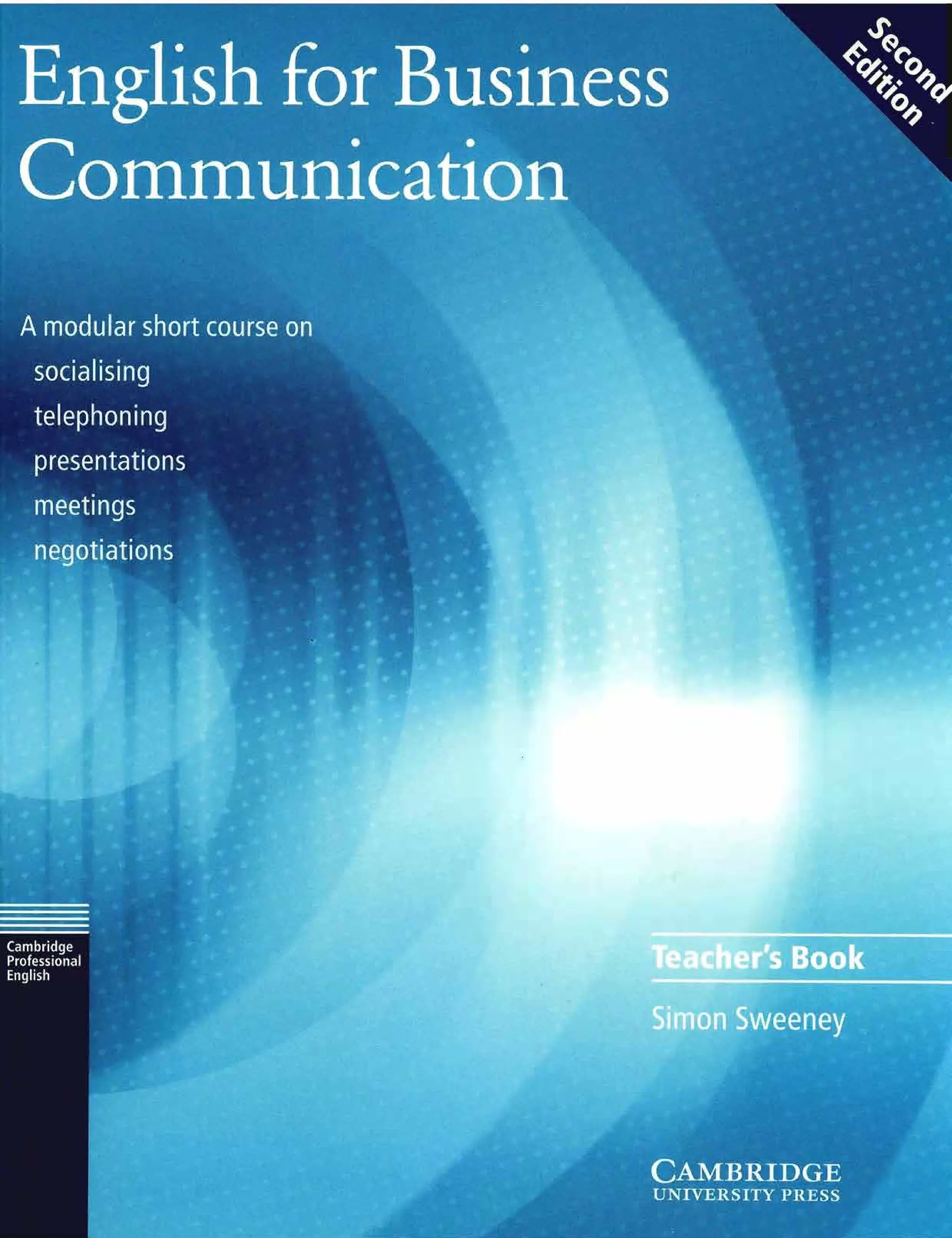
![Introduction
Module 1 Cultural diversity
and socialising
Unit 1 Building a relationship
Briefing
1 Cross-cultural understanding ( I)
2 Welcoming visitors
3 Small talk: keeping the conversation going
Unit 2 Culture and entertainment
Briefing
1 Cross-cultural understanding (2)
2 Inviting, and accepting or declining
3 Eating out
Module 2 Telephoning
Unit 3 Could I leave a message?
Briefing
1 Preparing to make a telephone call
2 Receiving calls
3 Taking and leaving messages
4 Asking for and giving repetition
5 The secretarial barrier
Unit 4 Good to hear from you again!
Briefing
1 Cross-cultural communication on the
telephone (1)
2 Setting up appointments
3 Changing arrangements
4 Ending a call
Unit 5 Unfortunately there's a problem ...
Briefing
1 Cross-cultural communication on the
telephone (2)
2 Problem-solving on the telephone
3 Complaints
Module 3 Presentations
Unit 6 Planning and getting started
Briefing
1 Presentation technique and preparation
2 The audience
3 Structure (1) The introduction
Unit 7 Image, impact and making an
• •
ImpreSSIOn
Briefing
1 Using visual aids: general principles
2 Talking about the content of visual aids
3 Describing change
•
IV
1
1
1
4
6
10
10
10
11
16
]8
18
18
19
20
23
24
27
27
27
29
32
33
36
36
36
36
38
43
43
43
45
46
50
50
50
SI
SS
Unit 8 The middle of the presentation
Briefing
1 Holding the audience's attention
2 Structure (2) The main body
3 Listing information
4 Linking ideas
5 Sequencing
Unit 9 The end is near ... this is the end
Briefing
1 Structure (3) The end
2 Summarising and concluding
3 Questions and discussion
Module 4 Meetings
Unit 10 Making meetings effective
Briefing
1 What makes a good meeting?
2 Chairing a meeting
3 Establishing the purpose of a meeting
Unit 11 Sorry to interrupt, but ...
Briefing
1 The structure of decision-making
2 Stating and asking for opinion
3 Interrupting and handling interruptions
Unit 12 What do you mean by ... ?
Briefing
1 Asking for and giving clarification
2 Delaying decisions
3 Ending the meeting
Module 5 Negotiations
Unit 13 Know what you want
Briefing
1 Types of negotiation
2 Preparation for a negotiation
3 Making an opening statement
Unit 14 Getting what you can
Briefing
1 Bargaining and making concessions
2 Accepting and confirming
3 Summarising and looking ahead
Unit 15 Not getting what you don't want
Briefing
1 Types of negotiator
2 Dealing with conflict
3 Rejecting
4 Ending the negotiation
Optional case studies
5R
58
58
59
59
61
62
65
65
65
66
6R
74
74
74
76
7R
83
83
83
84
86
91
9]
91
93
94
98
98
98
100
101
105
105
105
107
109
112
112
112
112
115
117
119](https://image.slidesharecdn.com/15456-250508144748-d1665526/75/English-for-Business-Communication-2nd-Edition-Simon-Sweeney-5-2048.jpg)
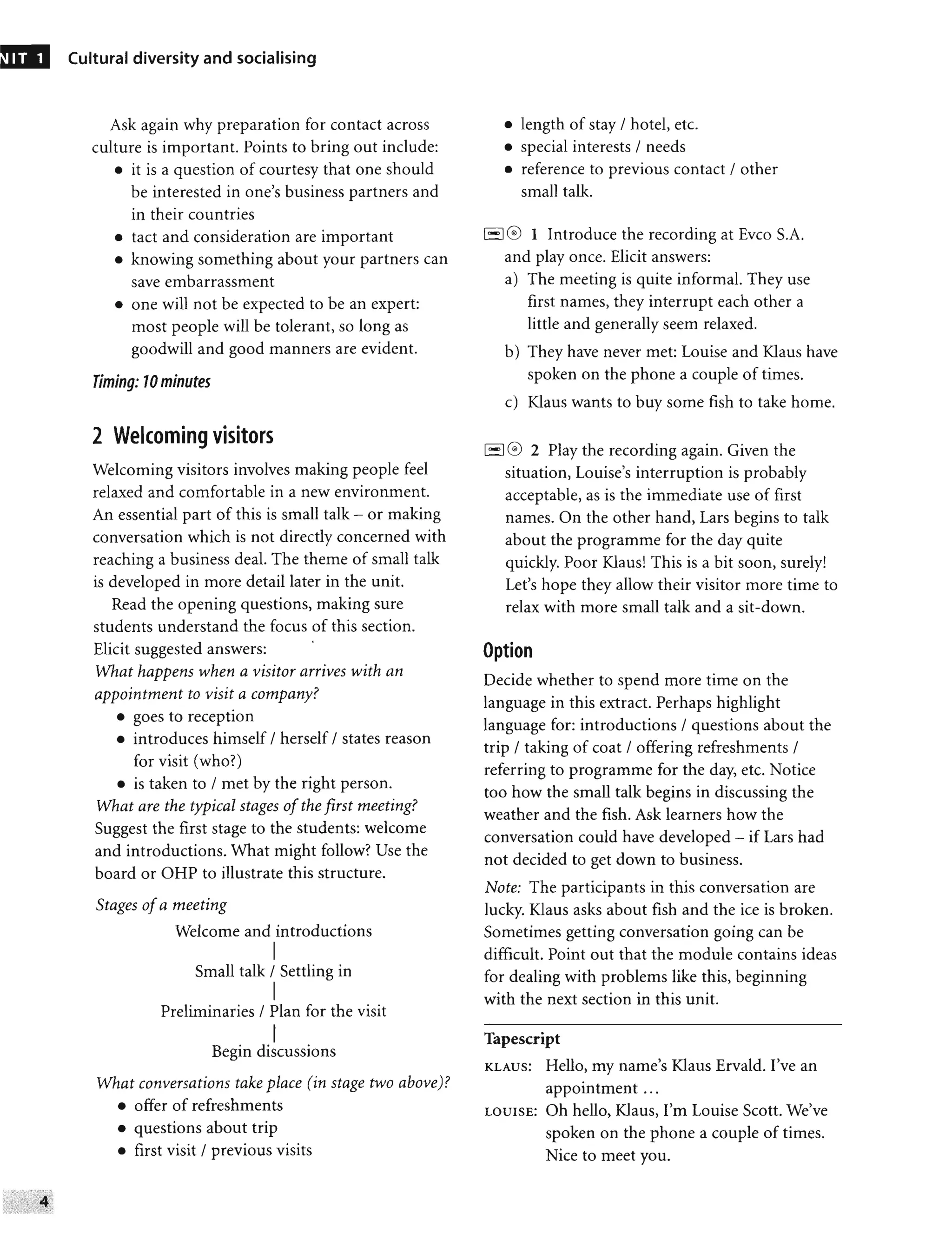
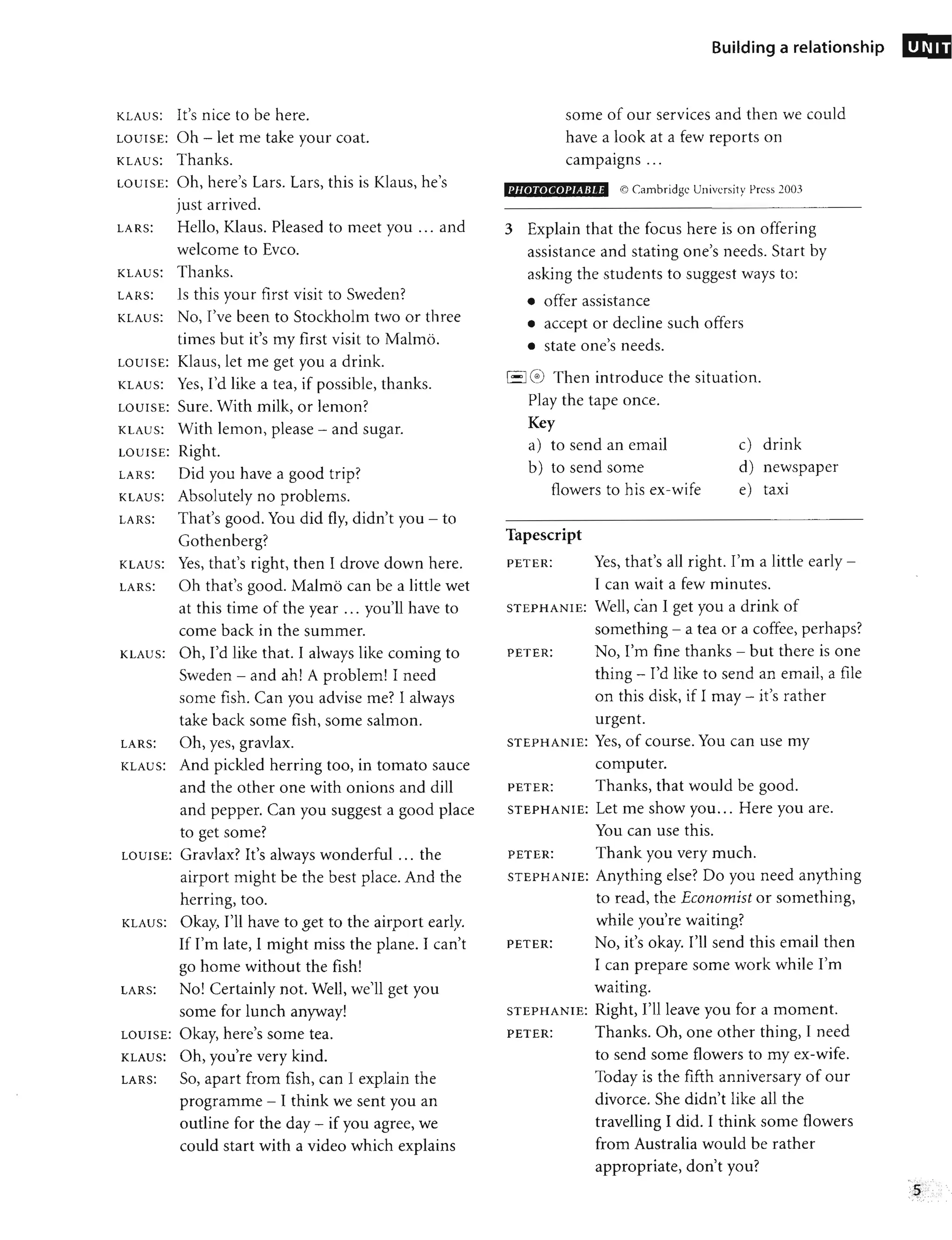
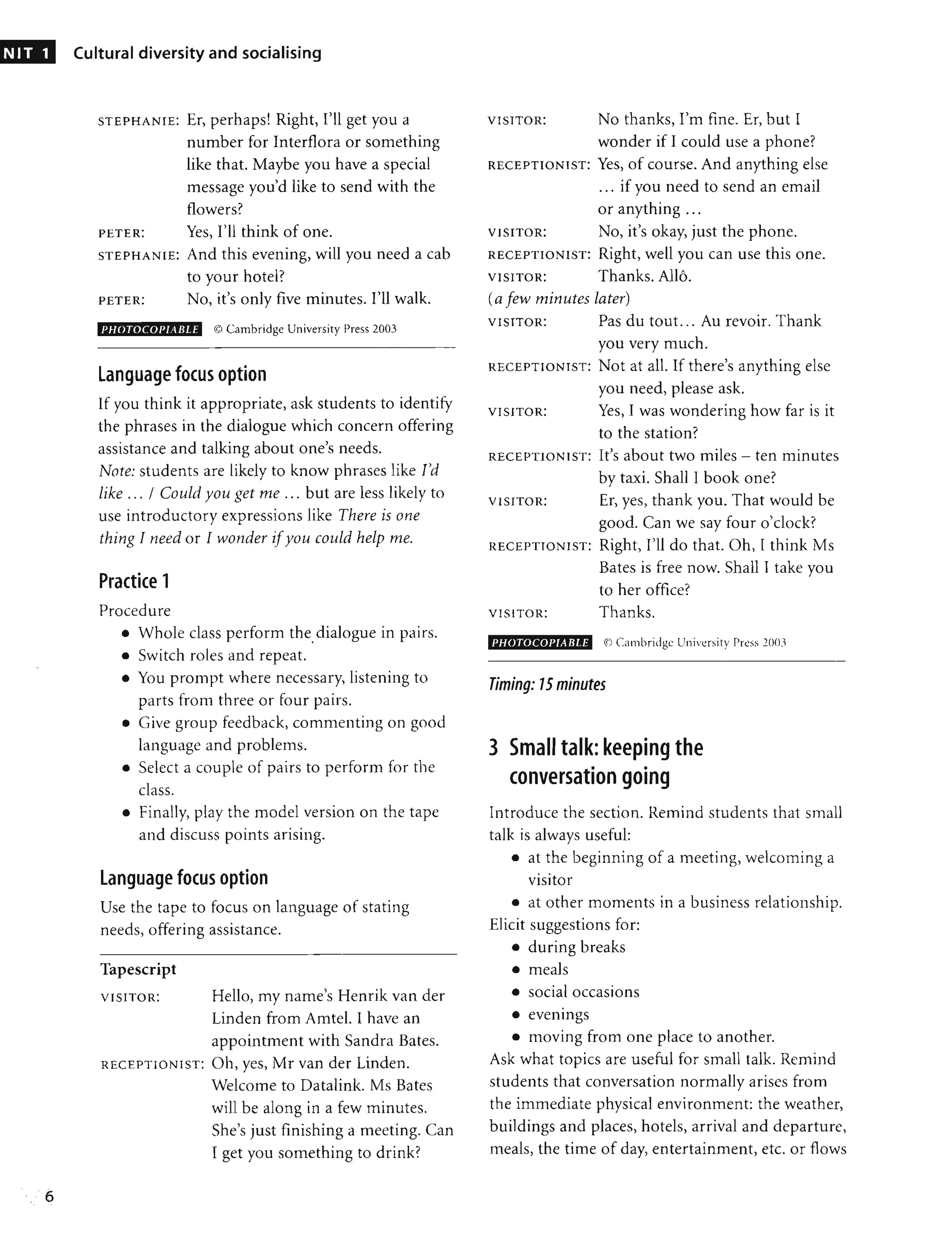
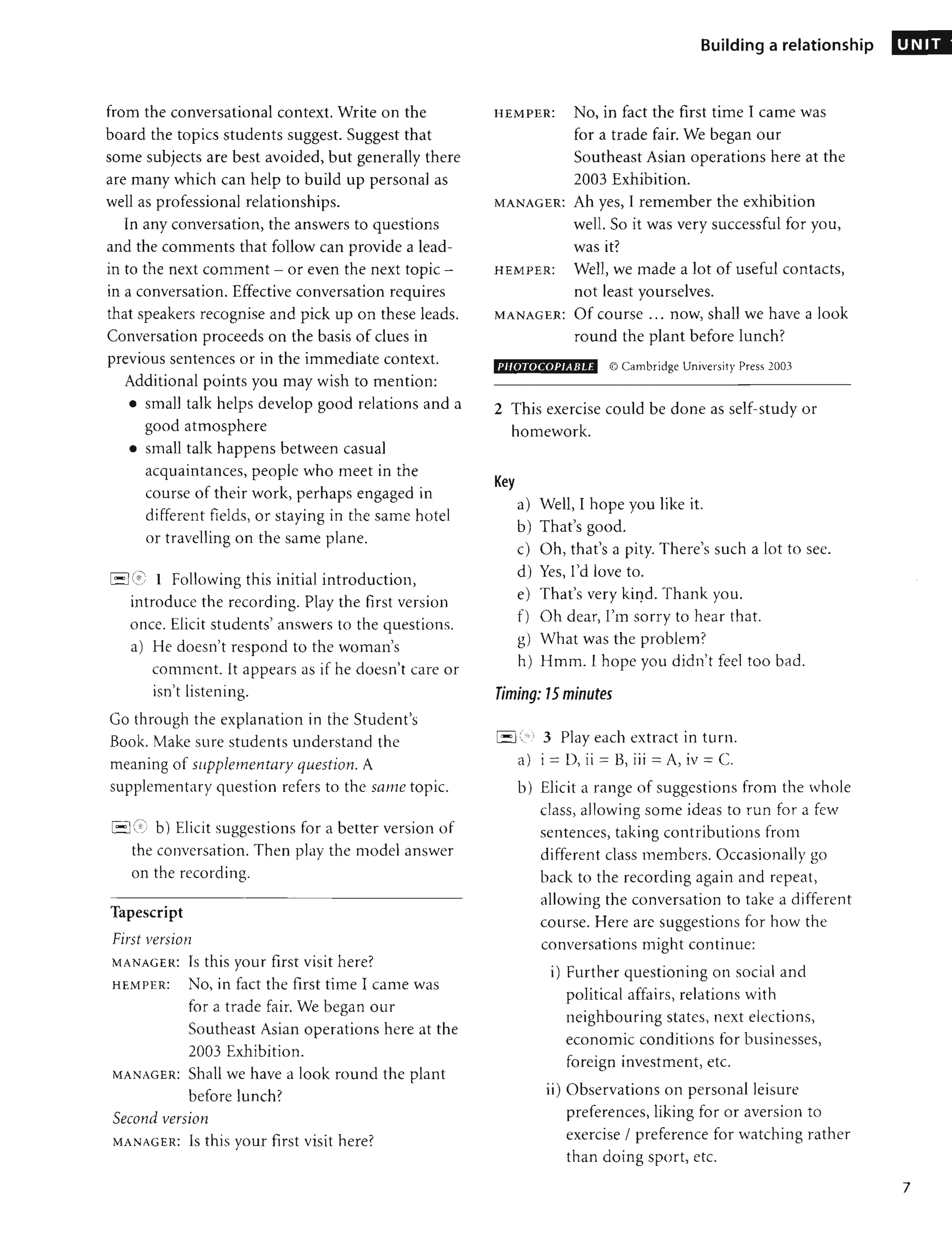
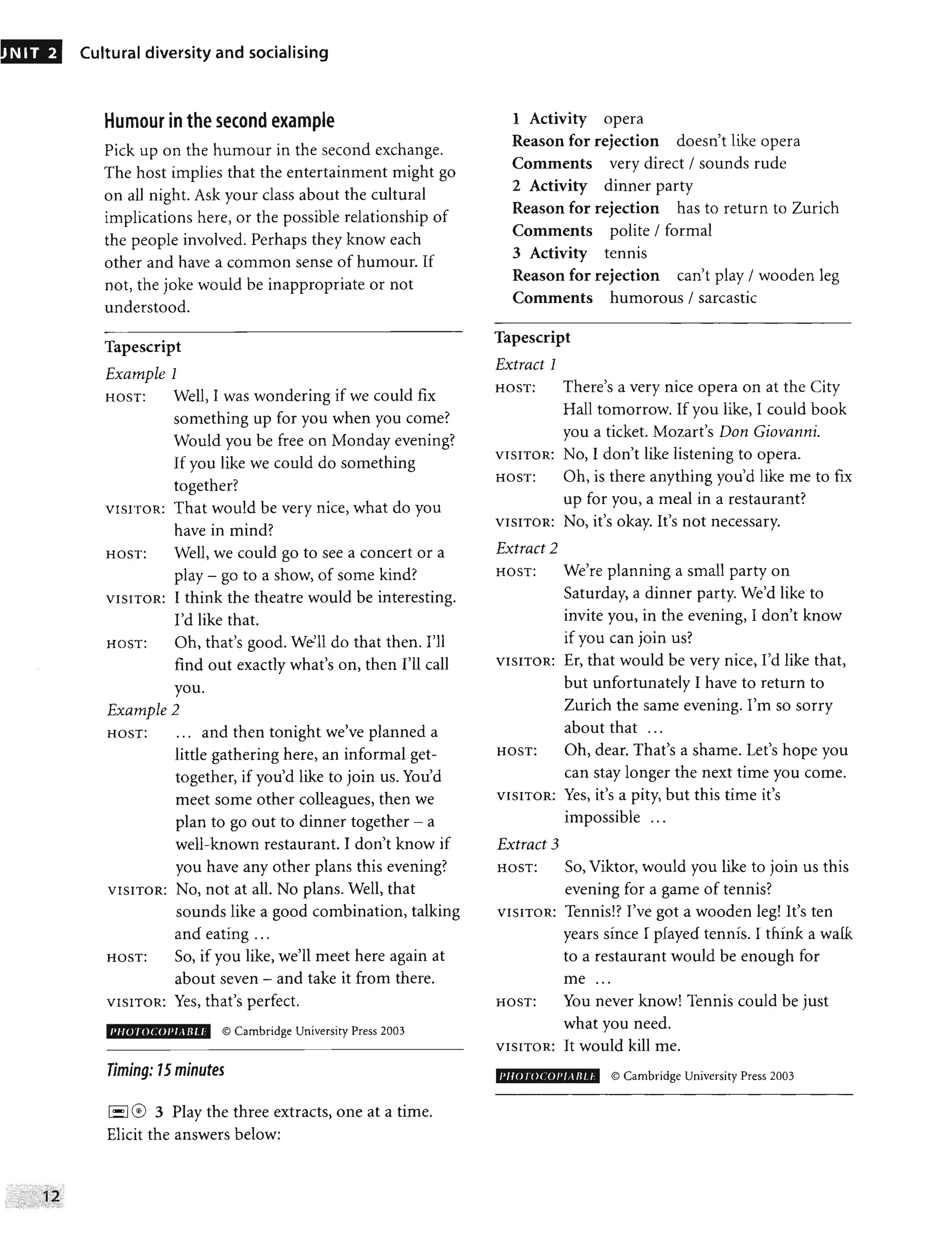
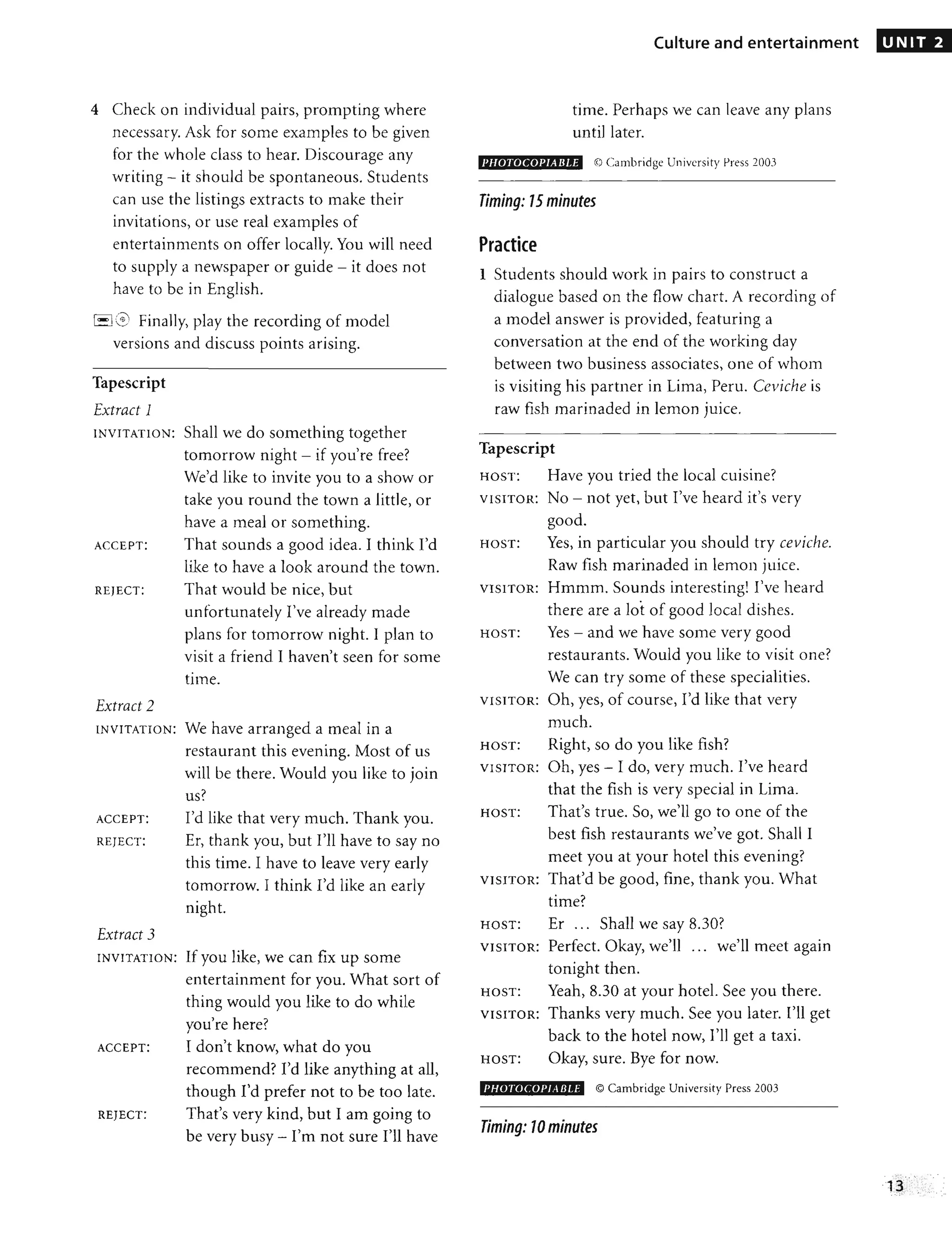
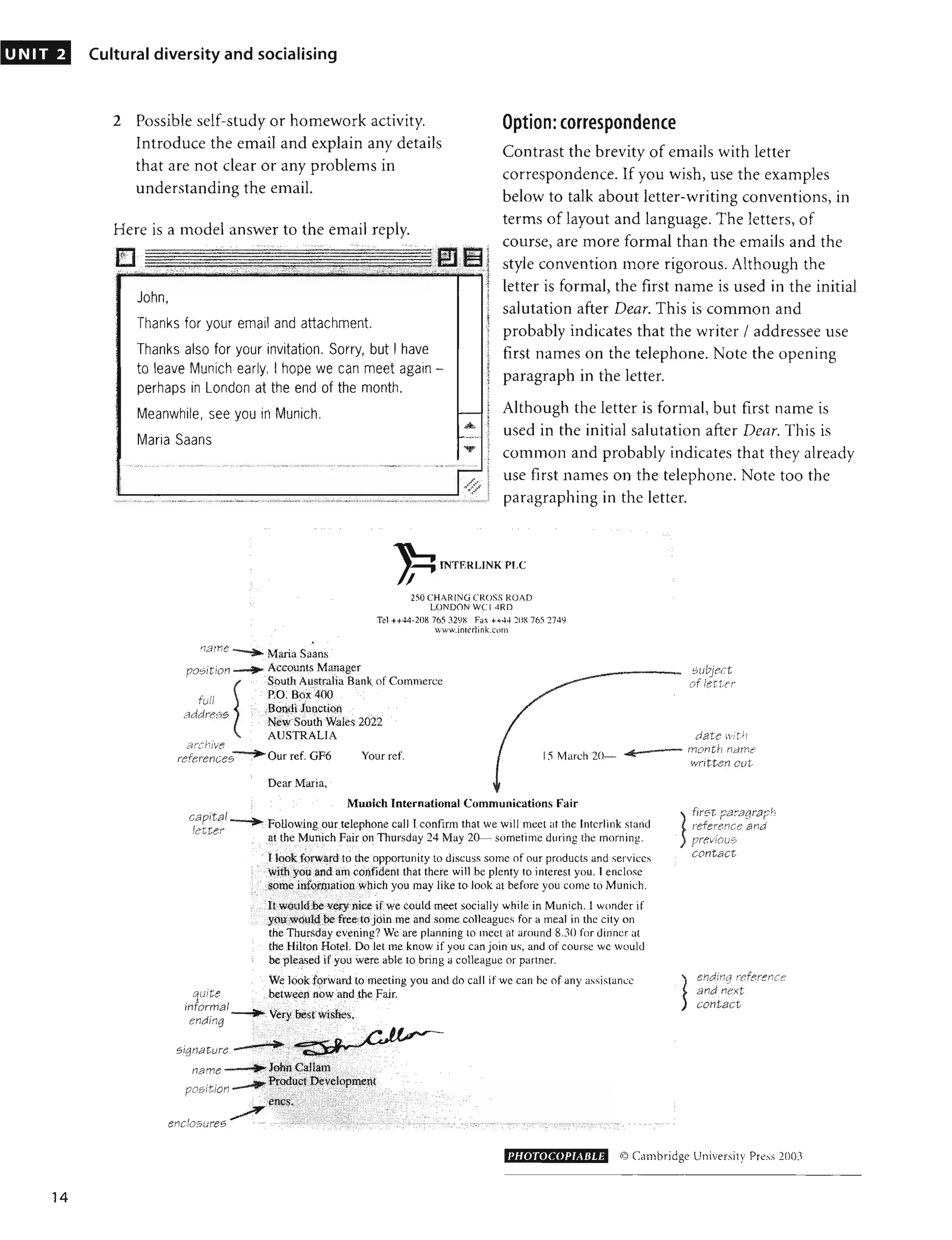
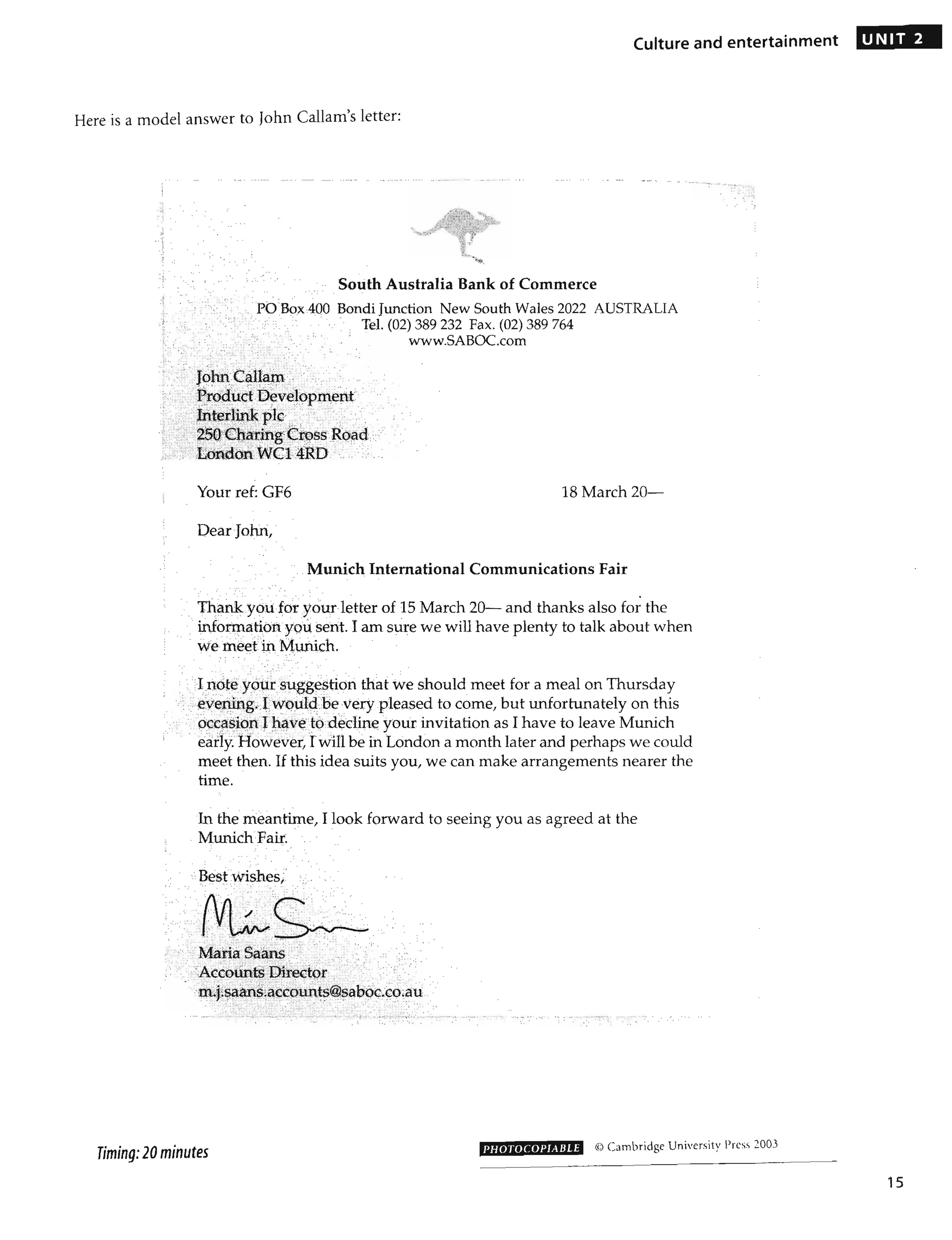
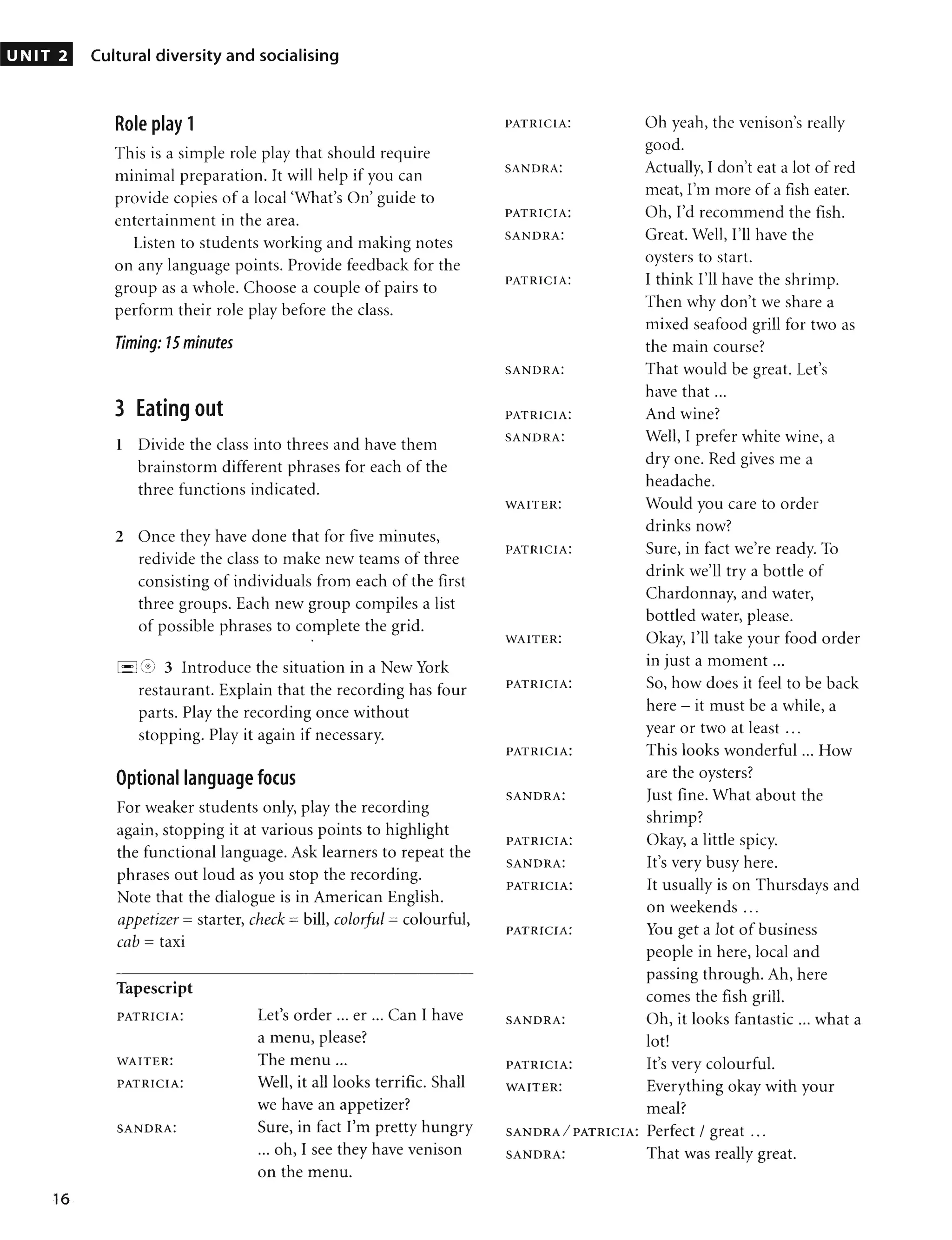
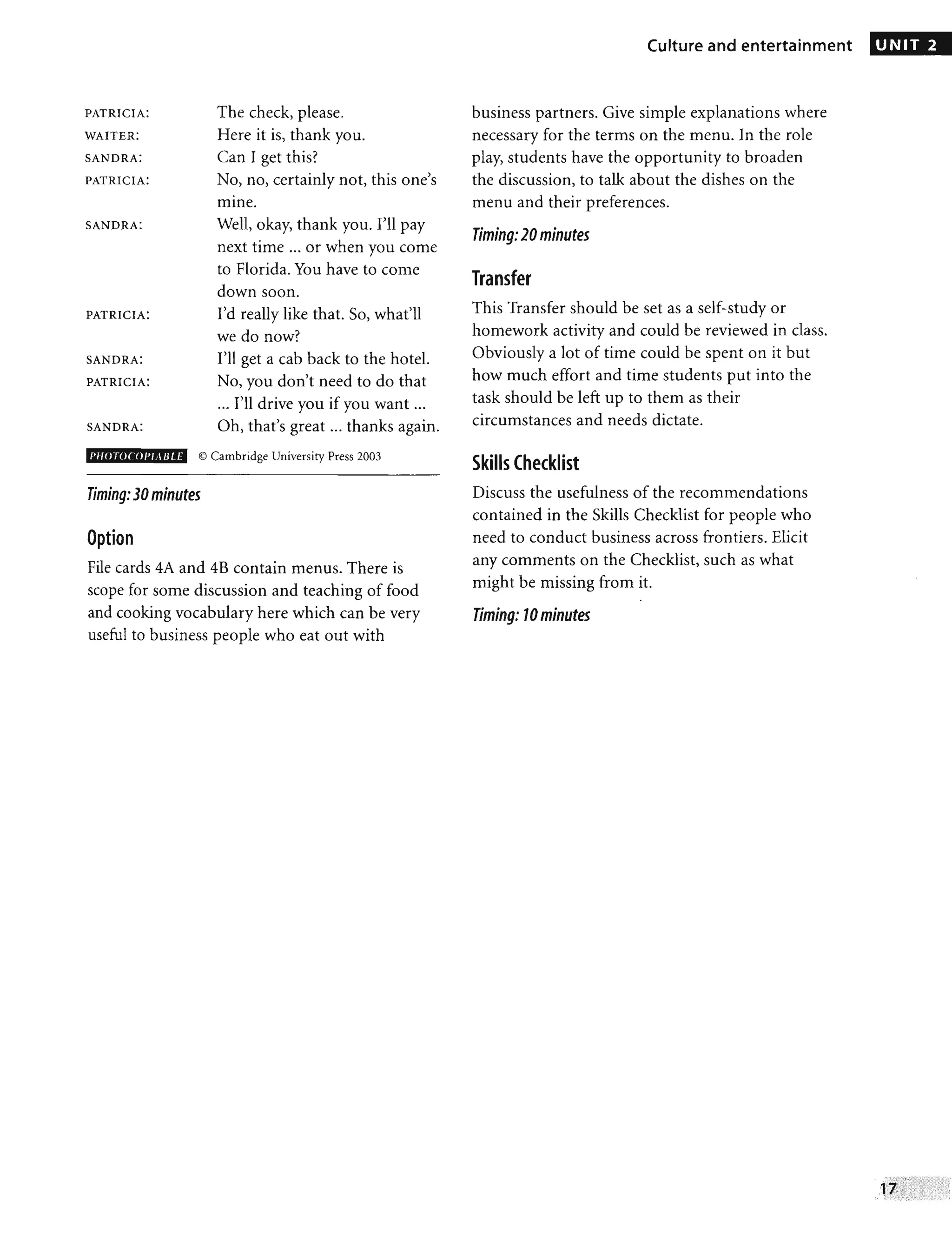
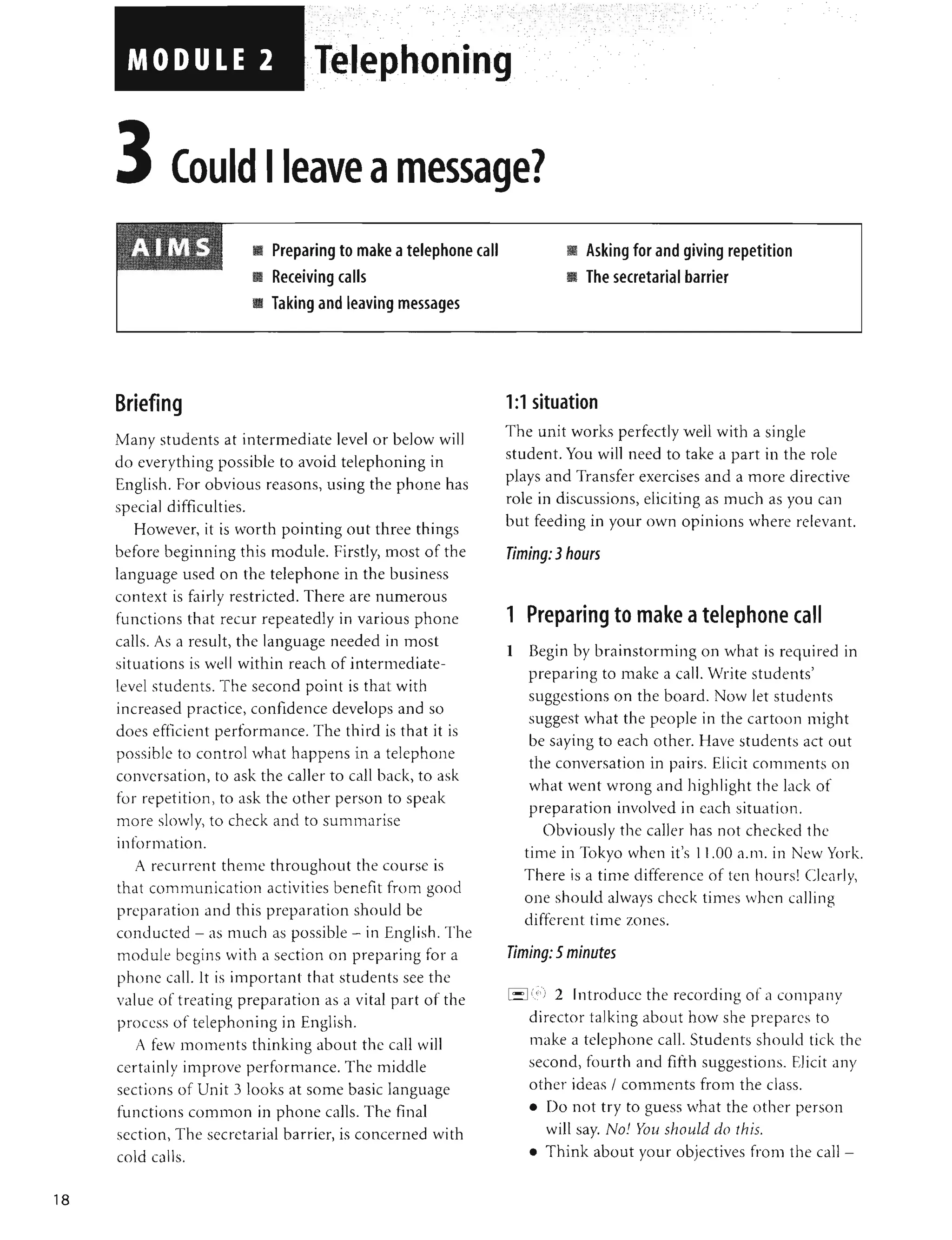
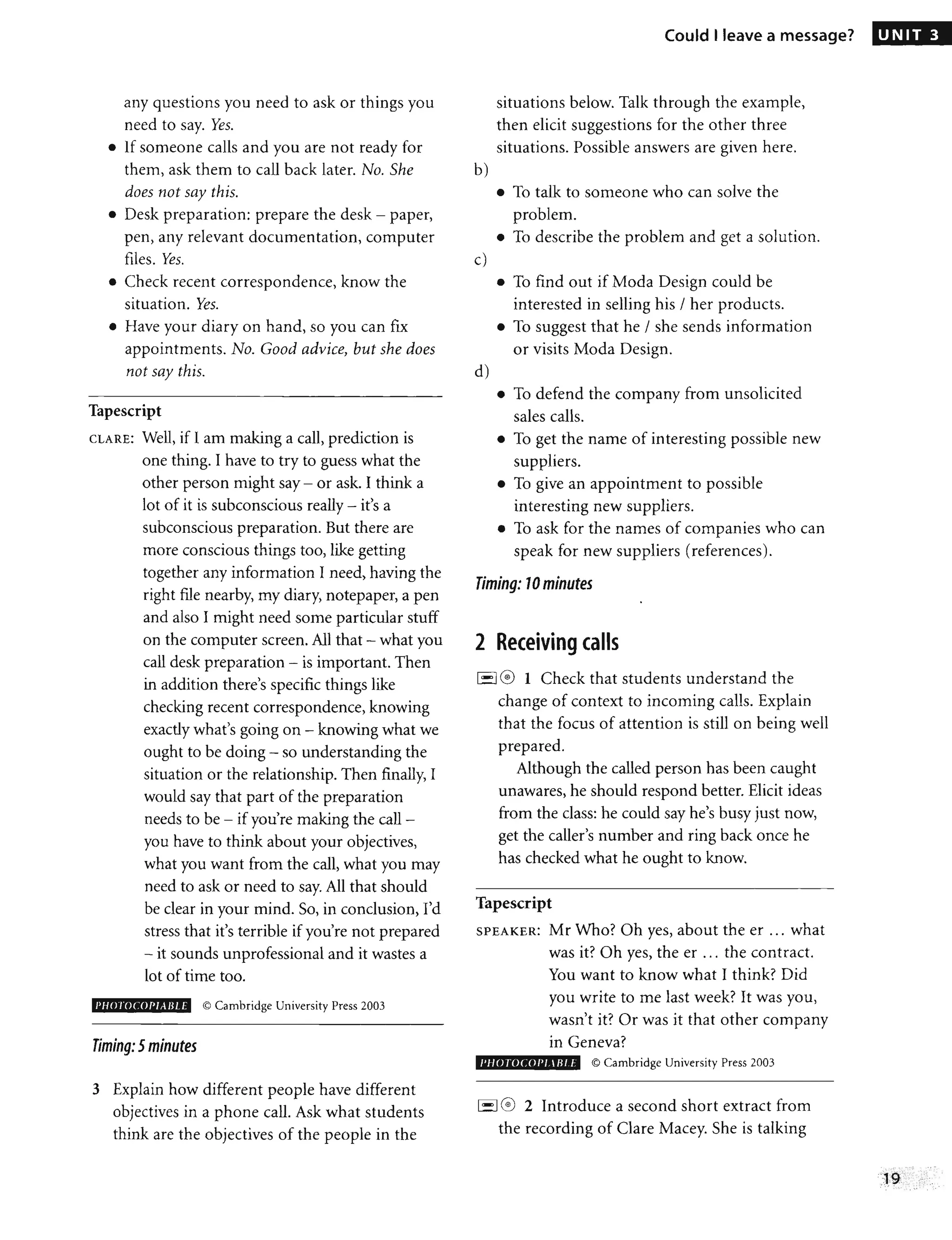
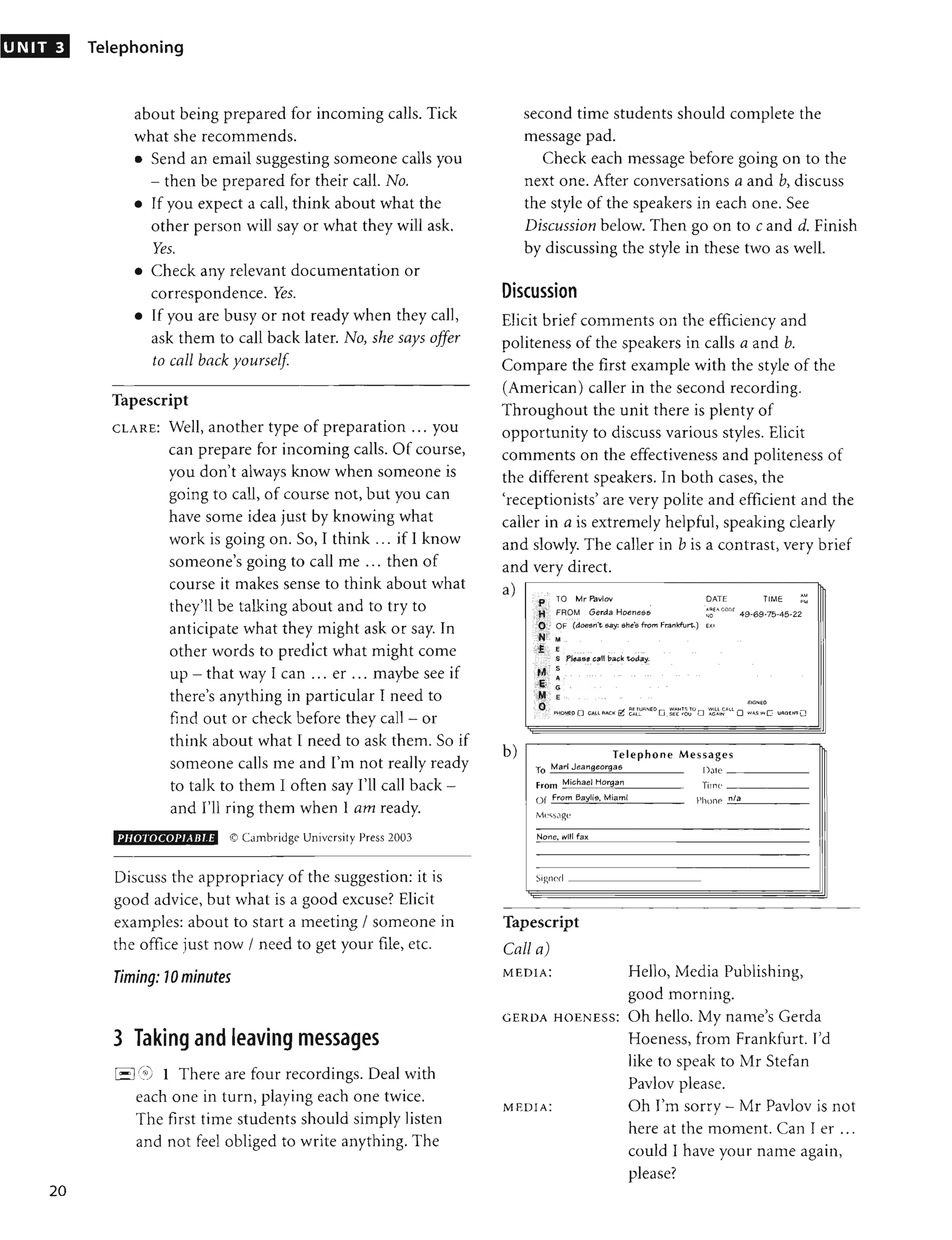
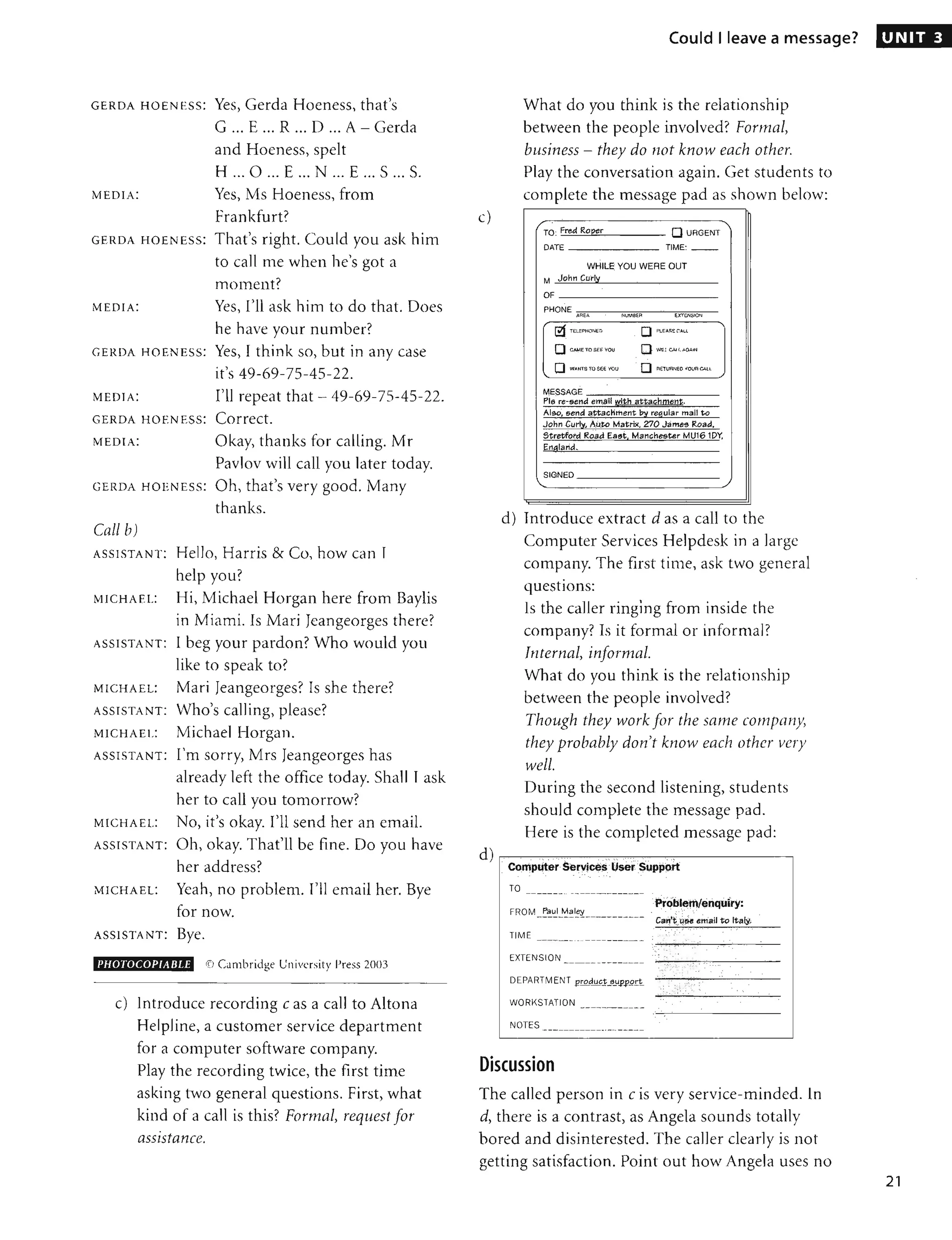
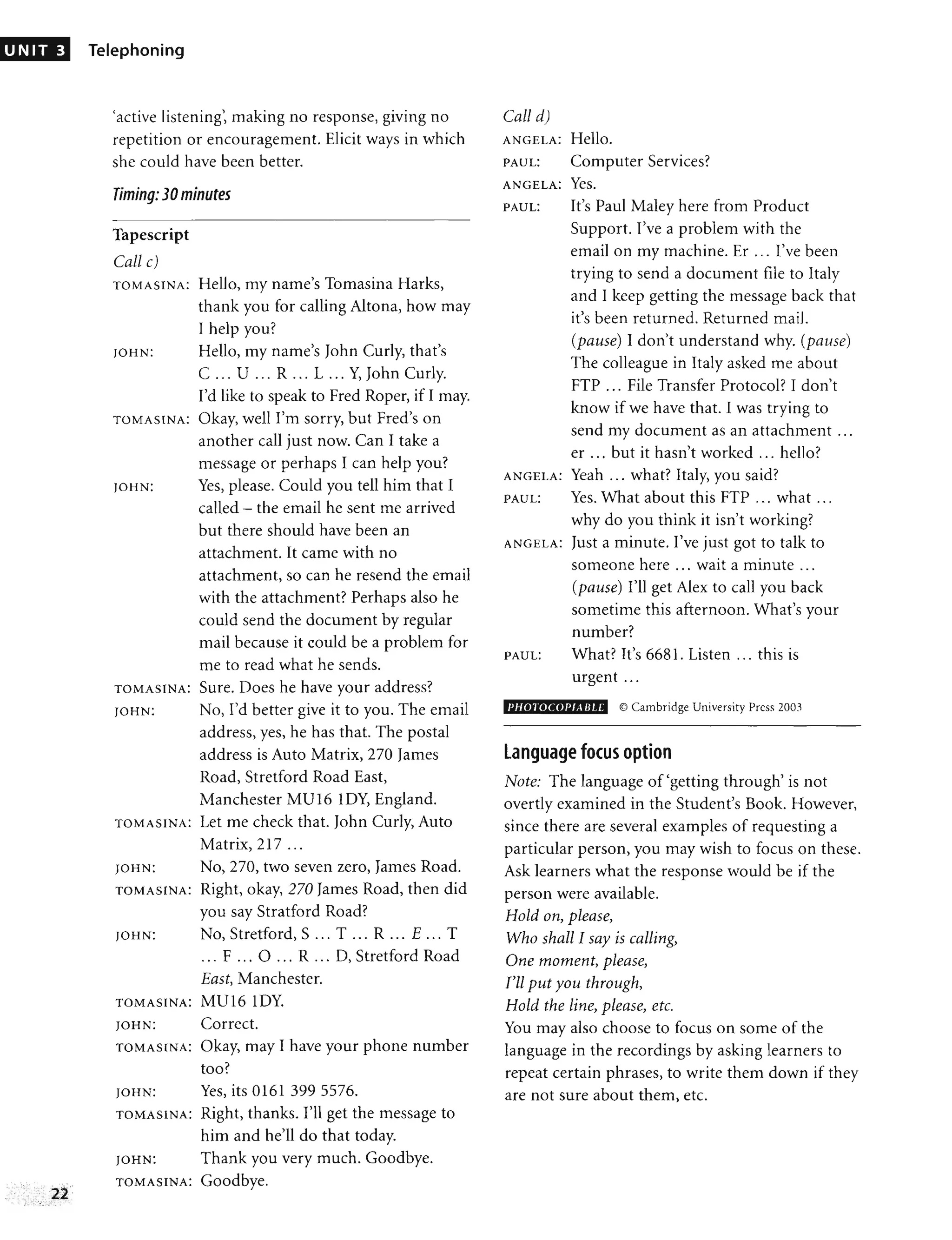

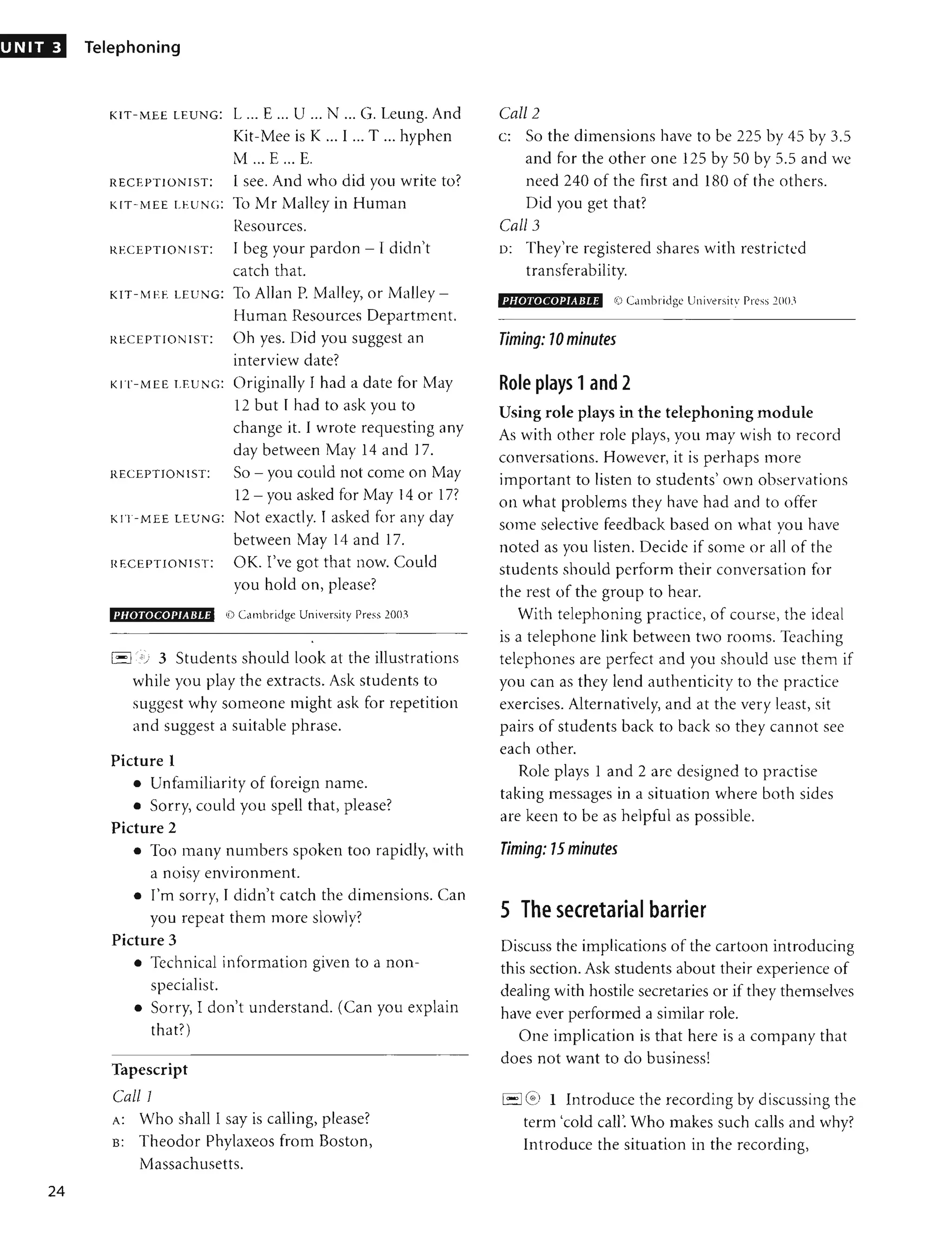


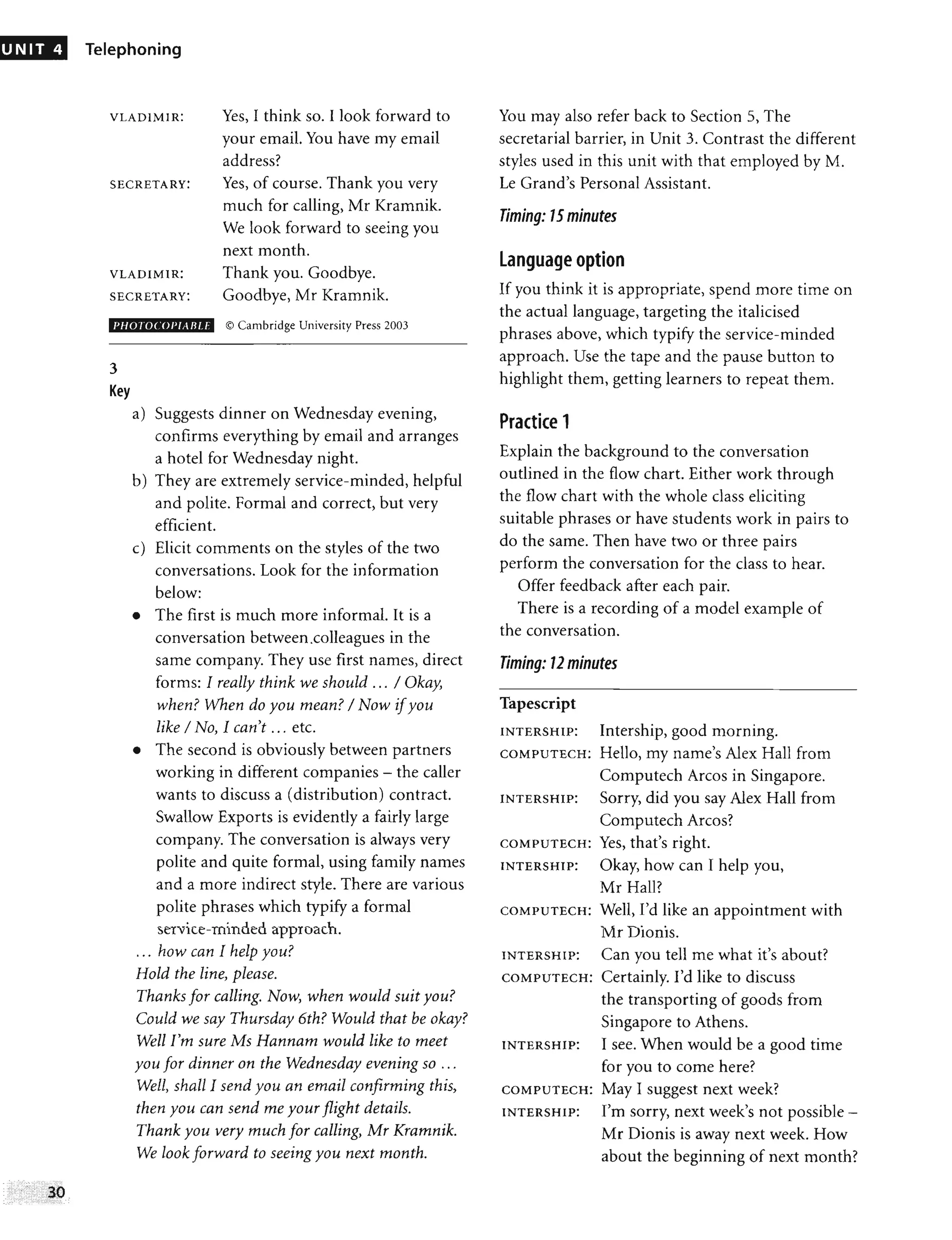
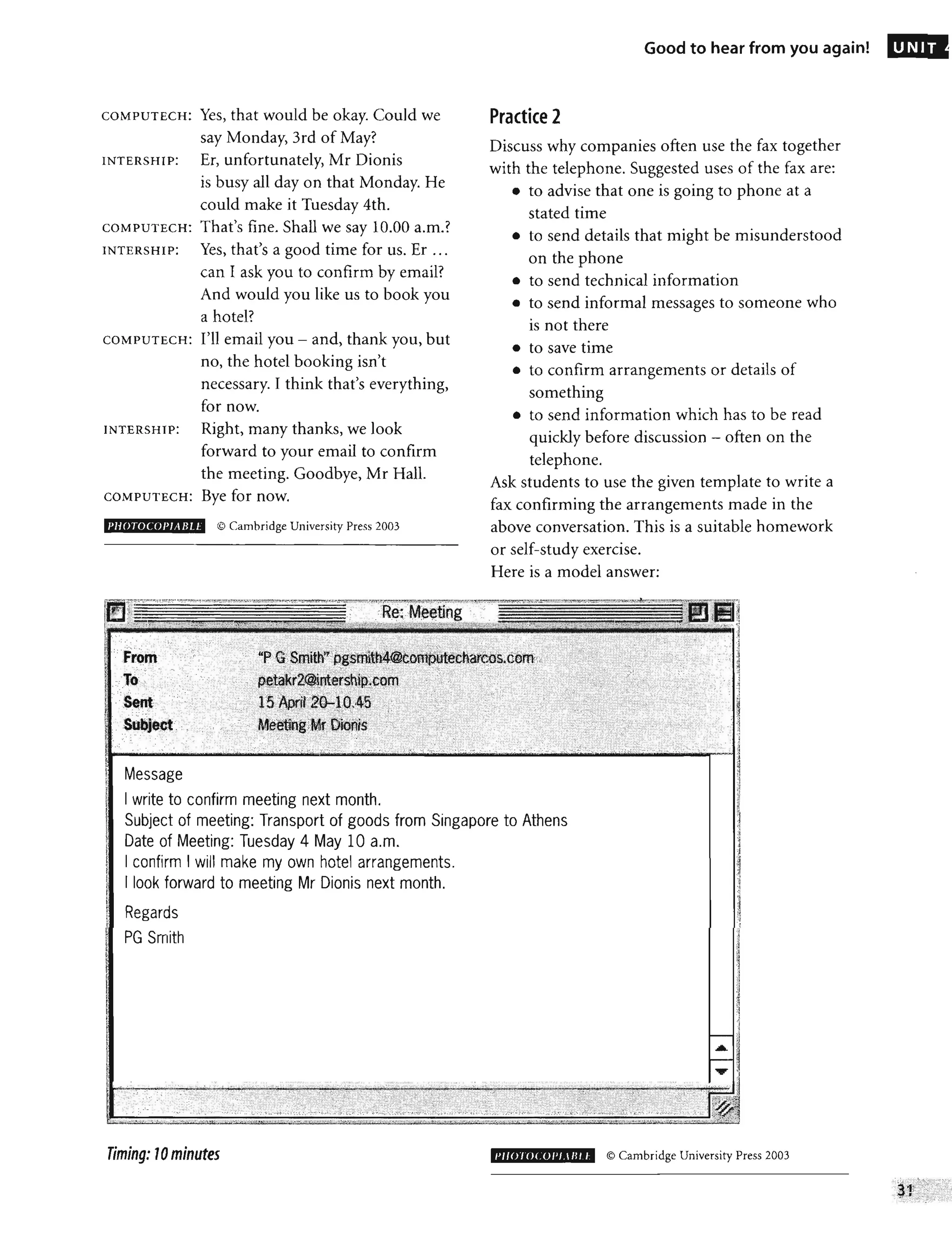
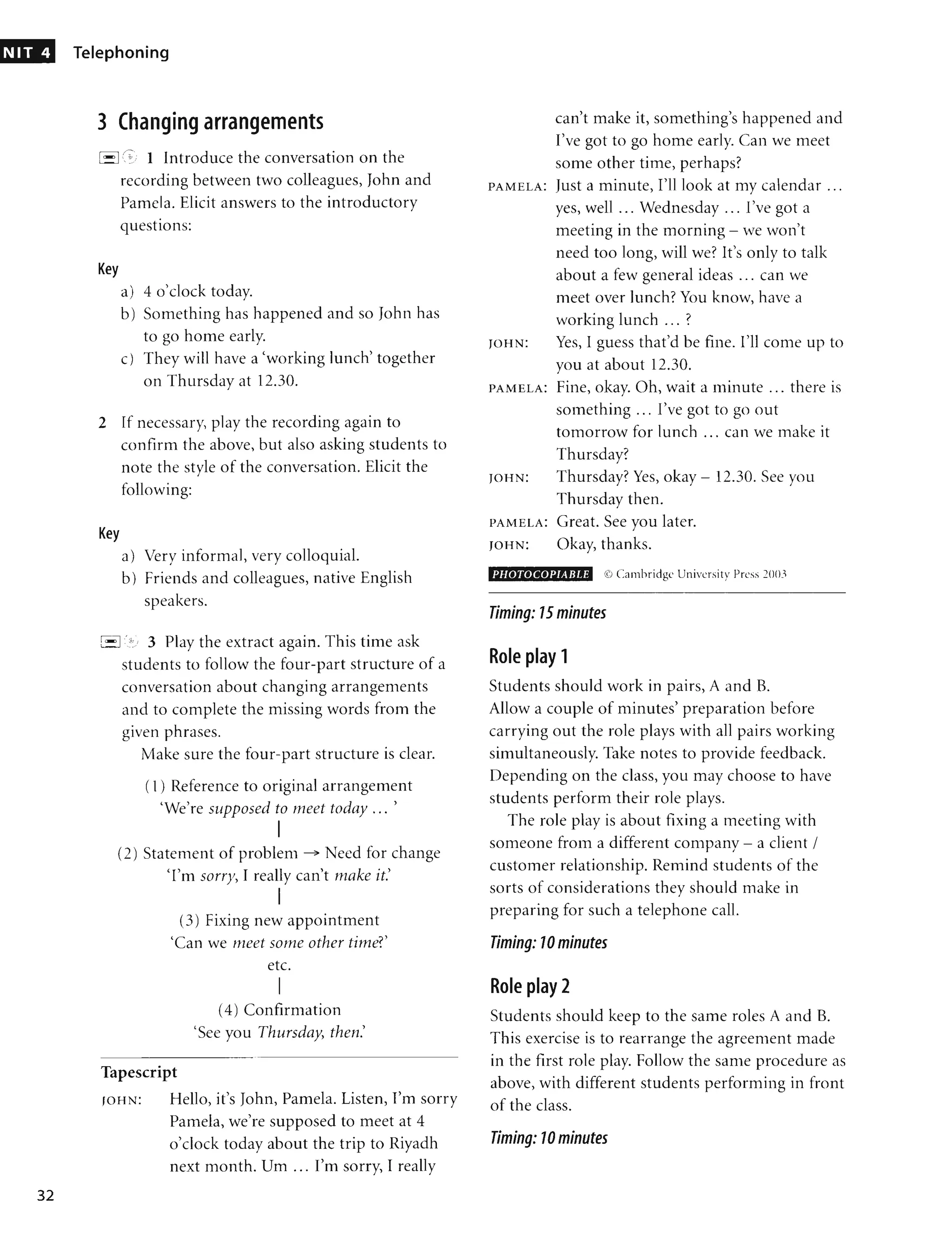
![4 Ending acall
1 Explain that students will listen to a recording
of Catherine Welsh, a Communications
Consultant, talking about telephoning and, in
particular, ending calls. But tell them that
before they hear what she says, you want them
to think about possible solutions to the
problems. Have them work in pairs to suggest
ideas. Do not examine their answers yet.
Key
a) Repeat details, confirm agreements, send
a fax.
b) Is that all? or Anything else?
c) Small talk helps to build and maintain
friendly relationships - but keep it brief]
d) Make a polite excuse, say you have a
meeting, offer to call back later.
1
'- 16 2 Now introduce the recording. Students
should compare Catherine's suggestions with
their own, adding any new suggestions she
makes. Elicit answers and comments on this
and the previous question.
Tapescript
CATHERINE: Well, on the phone, you need to
check everything - or a lot of things
- to avoid misunderstandings. You
should repeat details, specifications,
times, spellings, dates, all that sort of
thing. Prices, even. And if you make
agreements, you should confirm
them. I think it's best to end calls
with some sort of check or
confirmation. You might even ask for
a fax confirmation.
MAN: Yes, that's quite common. What else
would you include in the end of a
phone call?
CATHERINE: Well, there's checking that there's
nothing left to say. How many times
does it happen that you put the
phone down and then say'Oh I
forgot to say such and such' or 'I
meant to ask about something else'.
Good to hear from you again!
You have to phone back - it's such a
waste of time. You can usually avoid
that if one of you says something like
'Is that am' or 'Anything else?'
MAN: Okay. And do you think the business
phone call is strictly about business?
CATHERINE: Well, in a sense, yes. Small talk can be
very important - and it is all
business. There's usually a bit of
small talk in phone calls, even if it's
just a comment on the weather - or
how someone is, or your last trip
away. It's easy to underestimate the
importance of small talk ... you have
to learn to feel confident with it.
MAN: Why do you think small talk is so
important?
CATHERINE: Well, it helps to build and maintain
relationships. There are dangers
though - it should be kept brief]
MA N: And how do you get off the phone
when the other side is talking about
the weather for ages ... and you
don't want to be rude?
CATHERINE: Oh, yes. That can be difficult. I think
it's best to interrupt politely, say you
have to go somewhere. You can say
'Er, yes, we'll have to talk again soon.
I really had better go now, I've a
meeting in five minutes', or
something like that. If it's a customer,
you can offer to call back later if
there's anything else to discuss.
PHOTOCOPIABLE © Cambridge Universit y Press 2003
Timing: 10 minutes
I,- I(~) 3 Explain the situation: Hans Rossler is in
his office in Munich. He is on the phone to
Hassam Akhtar from Morocco, who is
planning to visit him. Students will hear two
versions of how Hans ends the same
conversation. Play the recording of both
endings once. Ask students to listen, and say
a)what is wrong in the first version, and
b) which key phrase is in the second ending
that was not in the first one.
UNIT
33](https://image.slidesharecdn.com/15456-250508144748-d1665526/75/English-for-Business-Communication-2nd-Edition-Simon-Sweeney-41-2048.jpg)
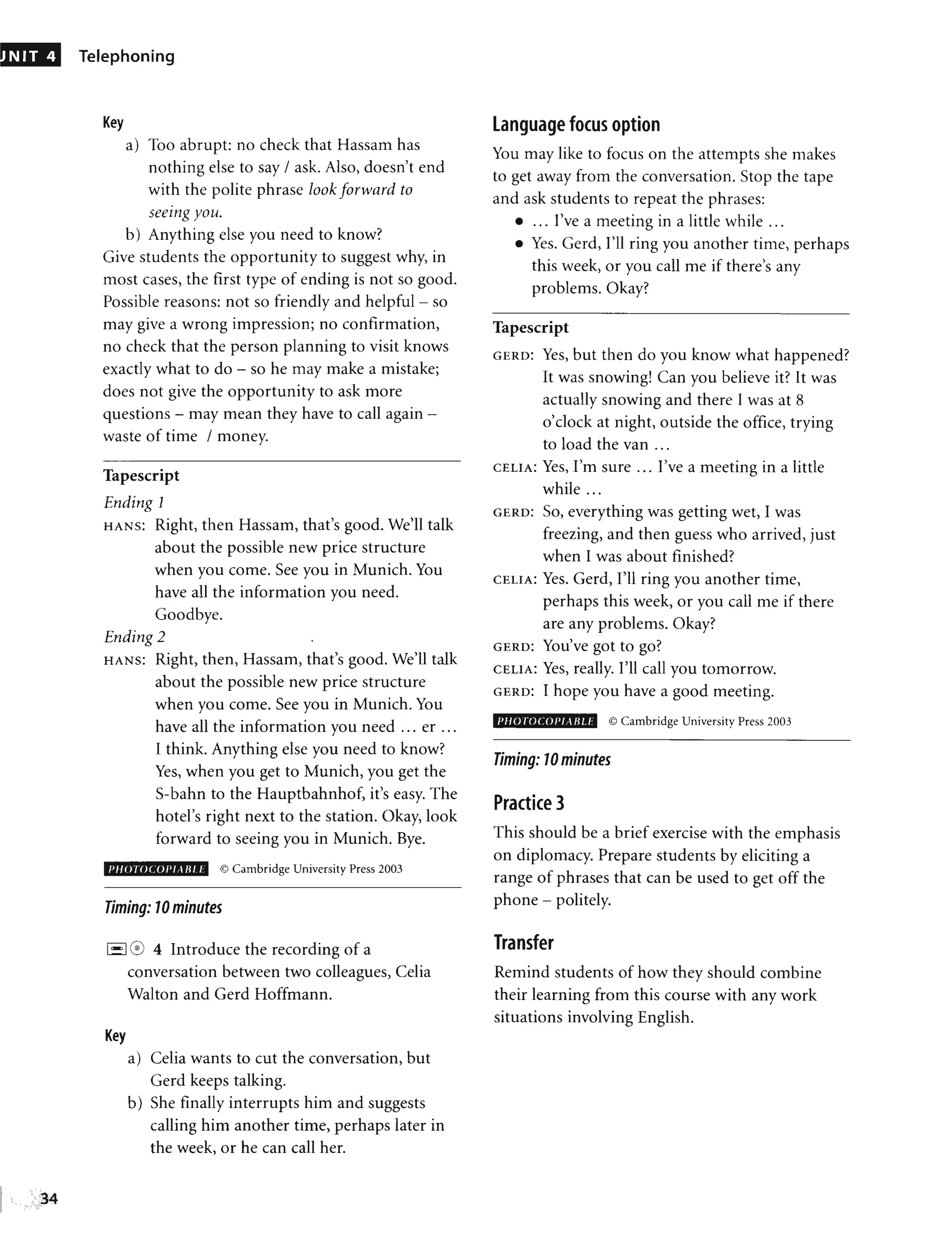


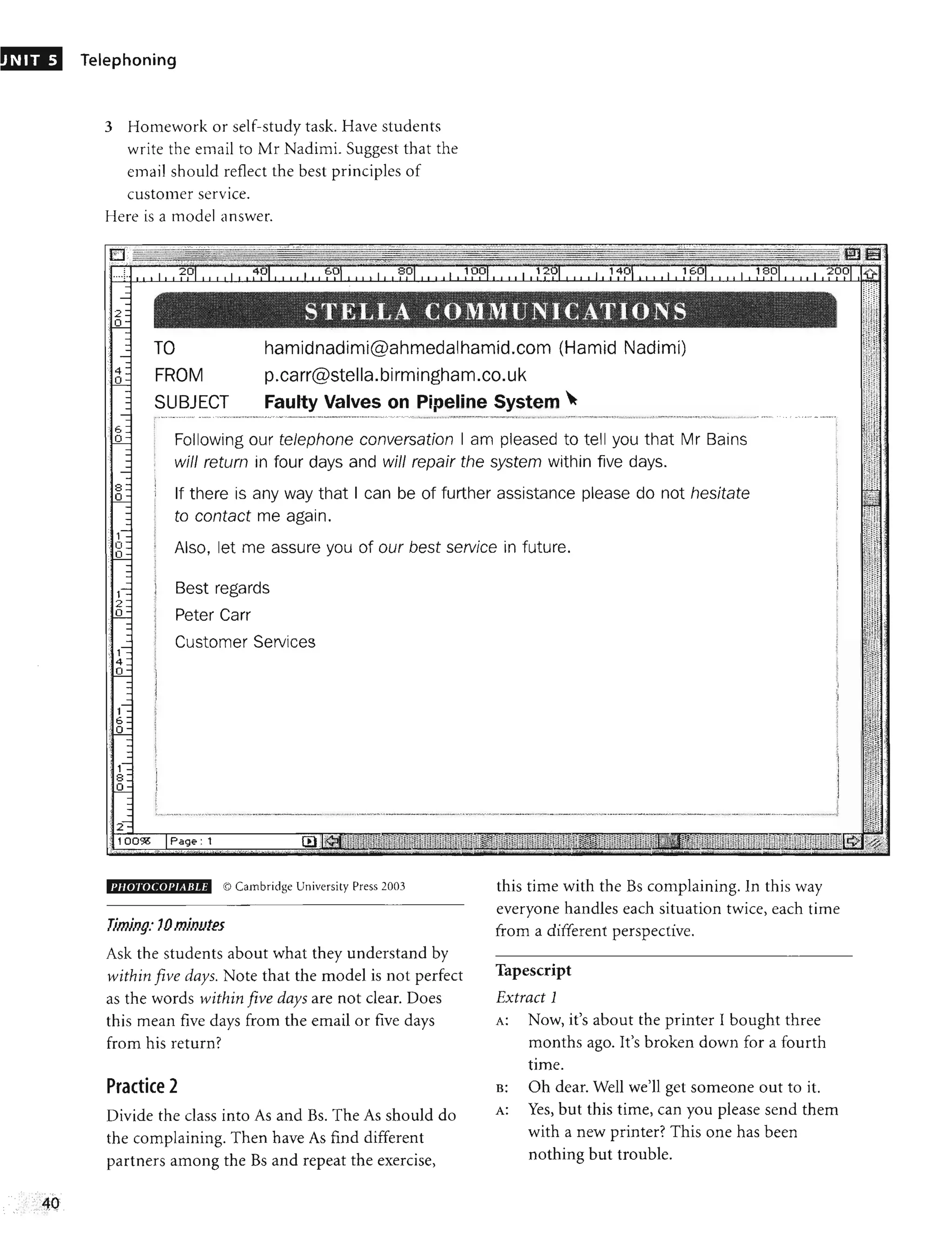

![purlieus of horse-racing and of play; into whose precincts, from the
delusive difference of their surface from their foundation, no
incursions can be hazarded without as perilous a shake to character
and disposition, as to fortune and conduct. And Mr. Greville, who,
always honourable, was almost necessarily a frequent loser, was
evidently on the high road to turn from a man of pleasure to a man
of spleen; venting his wrath at his failures upon the turf and at the
clubs, by growing fastidious and cavilling in general society. Mr.
Crisp, therefore, bent to maintain the dear bought quiet of his
worldly sacrifices as unmingled with the turbulent agitations of
querulous debate, as with the restless solicitudes of active life,
shunned the now pertinacious disputant almost with dread.
Yet Mr. Greville, about this period, was rescued, for a while, from this
hovering deterioration, through the exertions of his friends in the
government, by whom he was named minister plenipotentiary to the
court of Bavaria; in the hope that such an appointment, with its
probable consequences, might re-establish his affairs.
No change, however, of situation, caused any change in Mr. Greville
to his early protegé and attached and attaching friend, Mr. Burney,
to whom he still shewed himself equally eager to communicate his
opinions, and reveal his proceedings. A letter from Munich, written
when his Excellency was first installed in his new dignity, will display
the pleasant openness of their correspondence; at the same time
that it depicts the humours and expenses of the official ceremonials
then in use, with a frankness that makes them both curious and
entertaining.[30]
A letter to the Earl of Eglinton from the celebrated David Hume,
written also about this time, gave Mr. Burney very peculiar
satisfaction, from the sincere disposition to esteem and to serve him,
which it manifested in that dangerously renowned philosopher;](https://image.slidesharecdn.com/15456-250508144748-d1665526/75/English-for-Business-Communication-2nd-Edition-Simon-Sweeney-50-2048.jpg)
![whose judgment of men was as skilfully inviting, as his sophistry in
theology was fearfully repelling.
Yet upon the circumstances of this letter hung a cutting
disappointment, which, in the midst of his rising prospects, severely
pierced the hopes of Mr. Burney; and, from the sharpness of its
injury, and its future aggravating repetitions, would permanently
have festered them, had their composition been of less elastic
quality.
To be Master of the King’s Band, as the highest professional honour
to be obtained, had been the earliest aim of Mr. Burney; and,
through the medium of warm friends, joined to his now well
approved and obvious merit, the promise of the then Lord
Chamberlain had been procured for the first vacancy. This arrived in
1765; but when the consequent claim was made, how great, how
confounding to Mr. Burney was the intelligence, that the place was
disposed of already.
He hastened with a relation of this grievance, as unexpected as it
was undeserved, to the celebrated historian, to whom his rights had
been well known at Paris. And Mr. Hume, whose sense of justice—
one fatal warp excepted—was as luminous as it was profound,
shocked by such a breach of its simplest and most unchangeable
statutes, instantly undertook, with the courage imbibed by his great
abilities and high moral character, to make a representation on the
subject to Lord Hertford.
Failing, however, of meeting with an immediate opportunity, and well
aware of the importance of expedition in such applications, he
addressed himself to the Countess; and from her he learnt, and with
expressions of benevolent concern, that it was the Duke of York[31]
who had demanded the nomination to the place.
It now occurred to Mr. Hume that the present applicant might
possibly be himself the object for whom his Royal Highness had
interfered, as Mr. Burney had frequently been seen, and treated with
marked kindness, by the Royal Duke at private concerts; which were](https://image.slidesharecdn.com/15456-250508144748-d1665526/75/English-for-Business-Communication-2nd-Edition-Simon-Sweeney-51-2048.jpg)
![then often, at the sudden request of that prince, formed by the Earl
of Eglinton; and at which Mr. Burney, when in London, was always a
principal and favoured assistant. With this in his recollection, and
naturally concluding Lord Eglinton, who always shewed an animated
partiality for Mr. Burney, to be chief in the application to the Lord
Chamberlain, Mr. Hume wrote the following letter.
To the Earl of Eglinton.
“My Lord,
“Not finding an opportunity of speaking yesterday to Lord Hertford, in
favour of Mr. Burney, I spoke to my lady, and told her the whole case. She
already knows Mr. Burney, and has an esteem for him. She said it gave
her great uneasiness, and was [Pg 187] sure it would do so to my lord,
that he was already engaged, and, she believed, to the Duke of York.
“It occurred to me, that his Royal Highness’s application might, also, be in
favour of Mr. Burney; in which case the matter is easy. If not, it is
probable your Lordship may engage his Royal Highness to depart from his
application; for really Mr. Burney’s case, independently of his merit, is very
hard and cruel.
“I have the honour to be,
“My Lord, your Lordship’s
“Most humble and most obedient servant,
“David Hume.”
“P. S. If your Lordship honour me with an answer in the forenoon, please
send it to General Conway’s, in Little Warwick Street; if in the afternoon,
at Miss Elliot’s, Brewer Street, Golden Square.”
A reclamation such as this, from a man who was then almost
universally held to be at the head of British literature, could not be
read unmoved; and an opinion so positive of the justice and merits
of the case, manifested by two directions for an immediate reply,
both given for the same day, and without any apology for such
precipitancy, shewed a warmth of personal zeal and interest for the](https://image.slidesharecdn.com/15456-250508144748-d1665526/75/English-for-Business-Communication-2nd-Edition-Simon-Sweeney-52-2048.jpg)

![The secret, as usual in matrimonial concealments, was faithfully
preserved, for a certain time, by scrupulous discretion in the parties,
and watchful circumspection in the witnesses: but, as usual also,
error and accident were soon at work to develop the transaction;
and the loss of a letter, through some carelessness of conveyance,
revealed suddenly but irrevocably the state of the connexion.
This circumstance, however, though, at the time, cruelly distressing,
served ultimately but to hasten their own views; as the discovery
was necessarily followed by the personal union for which their hands
had been joined.
Mrs. Burney,—now no longer Mrs. Stephen Allen—came openly to
town to inhabit, for a while, a house in Poland-street, a few doors
from that of her husband; while alterations, paintings, and
embellishments were progressively preparing the way for her better
reception at his home.
The two families, however, awaited not the completion of these
improvements for a junction. The younger branches, who already,
and from their birth, were well known to one another, were as eager
as their parents for a general union; and the very amiable Miss Allen,
[32] the most important personage in the juvenile group, conducted
herself upon the disclosure of the marriage, with a generous warmth
of kindness that quickened the new establishment. And her example
would forcibly have weighed with her deserving brother, Stephen
Allen,[33] had such example been wanting; but he entertained so
true and affectionate a respect for Mr. Burney, that he required
neither duty nor influence to reconcile him to the match.
The four daughters of Mr. Burney,—Esther, Frances, Susan, and
Charlotte,—were all earnest to contribute their small mites to the
happiness of one of the most beloved of parents, by receiving, with
the most respectful alacrity, the lady on whom he had cast his future
hopes of regaining domestic comfort.
The Paris scheme for the two daughters, who were to have followed
the route of their sisters, long remitted, from the fluctuating affairs](https://image.slidesharecdn.com/15456-250508144748-d1665526/75/English-for-Business-Communication-2nd-Edition-Simon-Sweeney-58-2048.jpg)
![and feelings of Mr. Burney, was now finally abandoned. The
youngest daughter, Charlotte, was sent to a school in Norfolk. The
second, Frances, was the only one of Mr. Burney’s family who never
was placed in any seminary, and never was put under any governess
or instructor whatsoever. Merely and literally self-educated, her sole
emulation for improvement, and sole spur for exertion, were her
unbounded veneration for the character, and affection for the
person, of her father; who, nevertheless, had not, at the time, a
moment to spare for giving her any personal lessons; or even for
directing her pursuits.[34]
POLAND STREET.
The friends of Mr. Burney were not slack in paying their devoirs to
his new partner, whose vivacious society, set off by far more than
remains of uncommon beauty, failed not to attract various visitors to
the house; and whose love, or rather passion, for conversation and
argument, were of that gay and brilliant sort, that offers too much
entertainment to be ever left in the lurch for want of partakers.
Fortunate was it that such was the success of her social spirit; which
success was by no means less flourishing, from her strong bent to
displaying the rites of hospitality. She must else have lived the life of
a recluse, Mr. Burney, during the whole of the day, being devoted to
his profession; with the single exception of one poor hour of repast,
to re-fit him for every other of labour.
But the affection and pleasure with which, as
“The curfew toll’d the knell of parting day,”
he finished his toils, were so animated and so genuine, that the sun,
in the zenith of its splendour, was never more ardently hailed, than
the cool, silent, evening star, whose soft glimmering light restored
him to the bosom of his family; not there to murmur at his fatigues,
lament his troubles, nor recount his wearisome exertions; but to](https://image.slidesharecdn.com/15456-250508144748-d1665526/75/English-for-Business-Communication-2nd-Edition-Simon-Sweeney-59-2048.jpg)

![GEORGE COLMAN, THE ELDER.
With that dramatic genius, man of wit, and elegant scholar, George
Colman the elder, Mr. Burney had frequent and pleasant meetings at
the mansion of Roscius; for who, at that time, could know Mr.
Garrick, and be a stranger to Mr. Colman?[35]
KIT SMART.
Nor amongst the early friends of Mr. Burney must ever be omitted
that learned, ingenious, most poetical, but most unfortunate son of
Apollo, Kit Smart; whom Mr. Burney always was glad to see, and
active to serve; though whatever belonged to that hapless poet
seemed to go in constant deterioration; his affairs and his senses
annually and palpably darkening together; and nothing, unhappily,
flourishing in the attempts made for his relief, save the friendship of
Mr. Burney; in speaking of which in a letter, Kit Smart touchingly
says: “I bless God for your good nature, which please to take for a
receipt.”
SIR ROBERT AND LADY STRANGE.
The worthy, as well as eminent, Sir Robert Strange, the first
engraver of his day, with his extraordinary wife and agreeable family,
were, from the time of the second marriage, amongst the most
familiar visitors of the Burney house.
The term extraordinary is not here applied to Lady Strange to denote
any singularity of action, conduct, or person; it is simply limited to
her conversational powers; which, for mother wit in brilliancy of](https://image.slidesharecdn.com/15456-250508144748-d1665526/75/English-for-Business-Communication-2nd-Edition-Simon-Sweeney-63-2048.jpg)
![obliging, but not very comfortable answer.[36]
Not a second did Mr. Burney lose in forwarding every preparation for
obviating any disgrace to his melodious muse, Terpsichore, when the
poetry of the enchanting bard should come in contact with her lyre.
He formed upon a large scale a well chosen band, vocal and
instrumental, for the performance; and he engaged, as leader of the
orchestra, the celebrated Giardini, who was the acknowledged first
violinist of Europe.
But, in the midst of these preliminary measures, he was called upon,
by an agent of the Duke, to draw up an estimate of the expense.
This he did, and delivered, with the cheerfulest confidence that his
selection fully deserved its appointed retribution, and was elegantly
appropriate to the dignity of its purpose.
Such, however, was not the opinion of the advisers of the Duke; and
Mr. Burney had the astonished chagrin of a note to inform him, that
the estimate was so extravagant that it must be reduced to at least
one half.
Cruelly disappointed, and, indeed, offended, the charge of every
performer being merely what was customary for professors of
eminence, Mr. Burney was wholly overset. His own musical fame
might be endangered, if his composition should be sung and played
by such a band as would accept of terms so disadvantageous; and
his sense of his reputation, whether professional or moral, always
took place of his interest. He could not, therefore, hesitate to resist
so humiliating a proposition; and he wrote, almost on the instant, a
cold, though respectful resignation of the office of composer of the
Installation Ode.
Not without extreme vexation did he take this decided measure; and
he was the more annoyed, as it had been his intention to make use
of so favourable an opportunity for taking his degree of Doctor of
Music, at the University of Cambridge, for which purpose he had
composed an exercise. And, when his disturbance at so unlooked for](https://image.slidesharecdn.com/15456-250508144748-d1665526/75/English-for-Business-Communication-2nd-Edition-Simon-Sweeney-67-2048.jpg)
![had been predicted by Edmund Halley.”
In a memorandum upon this subject, by Dr. Burney, are these
words:
“The Countess of Pembroke, being reported to have studied astronomy,
and to have accustomed herself to telescopical observations, [Pg 218] I
dedicated, anonymously, this essay to her ladyship, who was much
celebrated for her love of the arts and sciences, and many other
accomplishments. I had not the honour of being known to her; and I am
not certain whether she ever heard by whom the pamphlet was written.
[37]
”
This Essay once composed and printed, the Doctor consigned it to
its fate, and thought of it no more.
And the public, after the re-invisibility of the meteor, and the
declension of the topic, followed the same course.
But not equally passive either with the humility of the author, or with
the indifferency of the readers, were the consequences of this little
work; which, having been written wholly in moments stolen from
repose, though requiring researches and studies that frequently kept
him to his pen till four o’clock in the morning, without exempting
him from rising at his common hour of seven; terminated in an acute
rheumatic fever, that confined him to his bed, or his chamber, during
twenty days.
This sharp infliction, however, though it ill recompensed his ethereal
flights, by no means checked his literary ambition; and the ardour
which was cooled for gazing at the stars, soon seemed doubly re-
animated for the music of the spheres.
A wish, and a design, energetic, though vague, of composing some
considerable work on his own art, had long roved in his thoughts,
and flattered his fancy: and he now began seriously to concentrate
his meditations, and arrange his schemes to that single point. And
the result of these cogitations, when no longer left wild to desultory
wanderings, produced his enlightened and scientific plan for a](https://image.slidesharecdn.com/15456-250508144748-d1665526/75/English-for-Business-Communication-2nd-Edition-Simon-Sweeney-71-2048.jpg)
![A letter,[38] of which a copy in his own hand-writing remains,
containing the opening view of his plan and of his tour, addressed to
the Reverend William Mason, will shew how fully he was prepared
for what he engaged to perform, before he called for a subscription
to aid the publication of so expensive a work.
Through various of his friends amongst persons in power, he
procured recommendatory letters to the several ambassadors and
ministers from our Court, who were stationed in the countries
through which he meant to travel.
And, through the yet more useful services of persons of influence in
letters and in the arts, he obtained introductions, the most felicitous
for his enterprize, to those who, then, stood highest in learning, in
the sciences, and in literature.
None in this latter class so eminently advanced his undertaking as
Mr. Garrick; whose solicitations in his favour were written with a
warmth of friendship, and an animation of genius, that carried all
before them.
Here stops, for this period, the pen of the memorialist.
From the month of June, 1770, to that of January, 1771, the life of
Doctor Burney is narrated by himself, in his “Tour to France and
Italy.”
And few who have read, or who may read that Tour, but will regret
that the same pen, while in its full fair vigour, had not drawn up
what preceded, and what will follow this epoch.
Such, however, not being the case, the memorialist must resume her
pen where that of Dr. Burney, in his narrative, drops,—namely, upon
his regaining the British shore.](https://image.slidesharecdn.com/15456-250508144748-d1665526/75/English-for-Business-Communication-2nd-Edition-Simon-Sweeney-73-2048.jpg)





![Comm bba[1][1]](https://cdn.slidesharecdn.com/ss_thumbnails/commbba11-100817091607-phpapp02-thumbnail.jpg?width=640&height=640&fit=bounds)


