Paper 2 Wednesday 18 th  May
This examination is  two hours long  and consists of the following: Section A: Assessing READING. 50 minutes. 40 marks.  You will read two examples of non-literary texts on a common theme and answer questions on them. Section B: Assessing WRITING. 70 minutes. 40 marks (20 for each piece of writing) You need to produce two pieces of transactional writing – writing that pays special attention to  audience ,  purpose  and  format .
The reading section Section A: Assessing READING. 50 minutes. 40 marks. You will read two examples of non-literary texts on a common theme. These could be an advert, a newspaper or magazine article, a page from the Internet or an essay (e.g. travel writing). You then answer questions on these texts. One question (usually the last one) will ask you to compare the texts.
Reading paper The questions you will be asked fall into  seven basic types : Locating and retrieving information Impressions and images Viewpoint and attitude Intended audience Analysis of persuasive techniques Comparison of texts Evaluation of texts
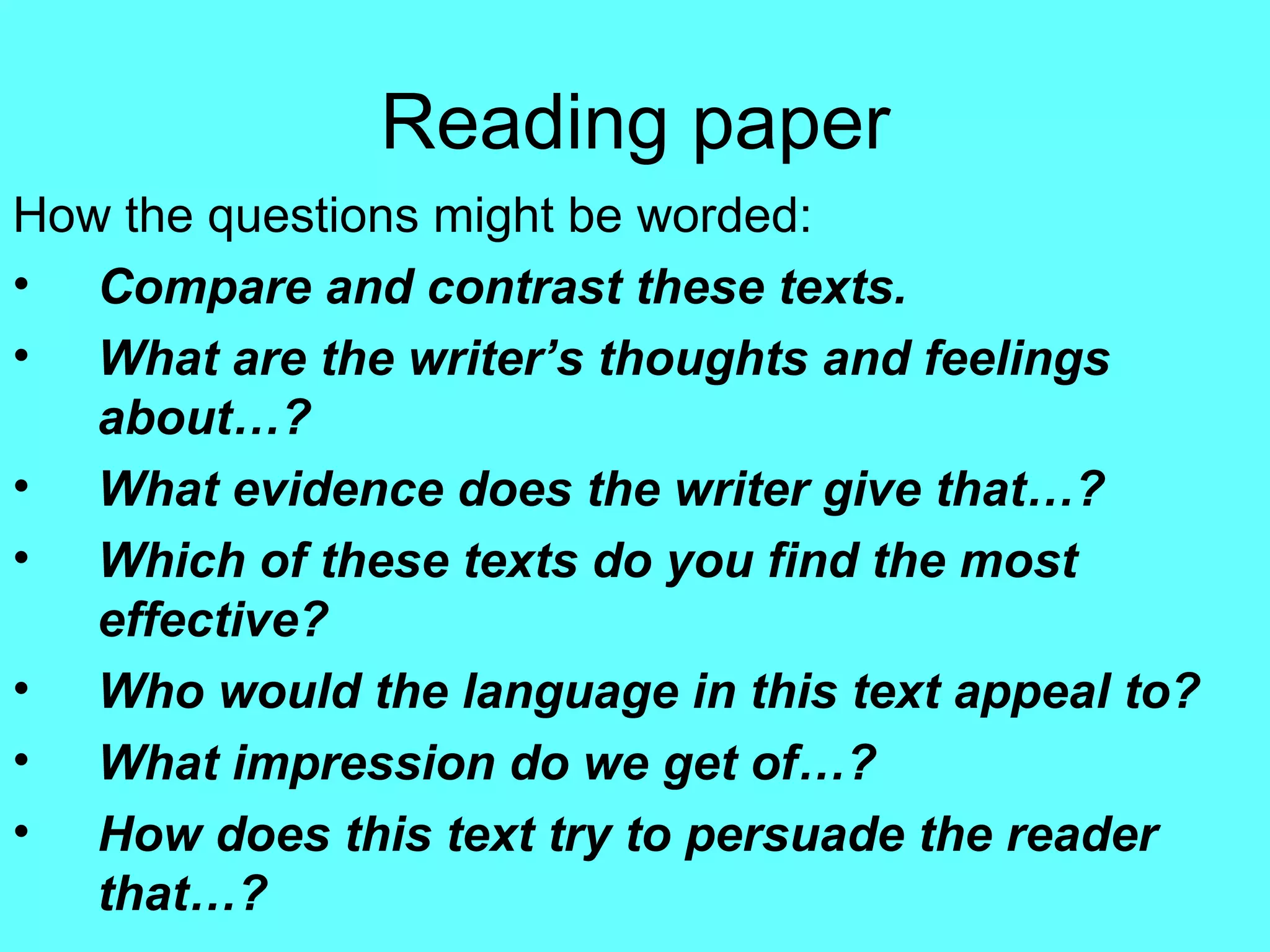
Reading paper How the questions might be worded: Compare and contrast these texts. What are the writer’s thoughts and feelings about…? What evidence does the writer give that…? Which of these texts do you find the most effective? Who would the language in this text appeal to? What impression do we get of…? How does this text try to persuade the reader that…?
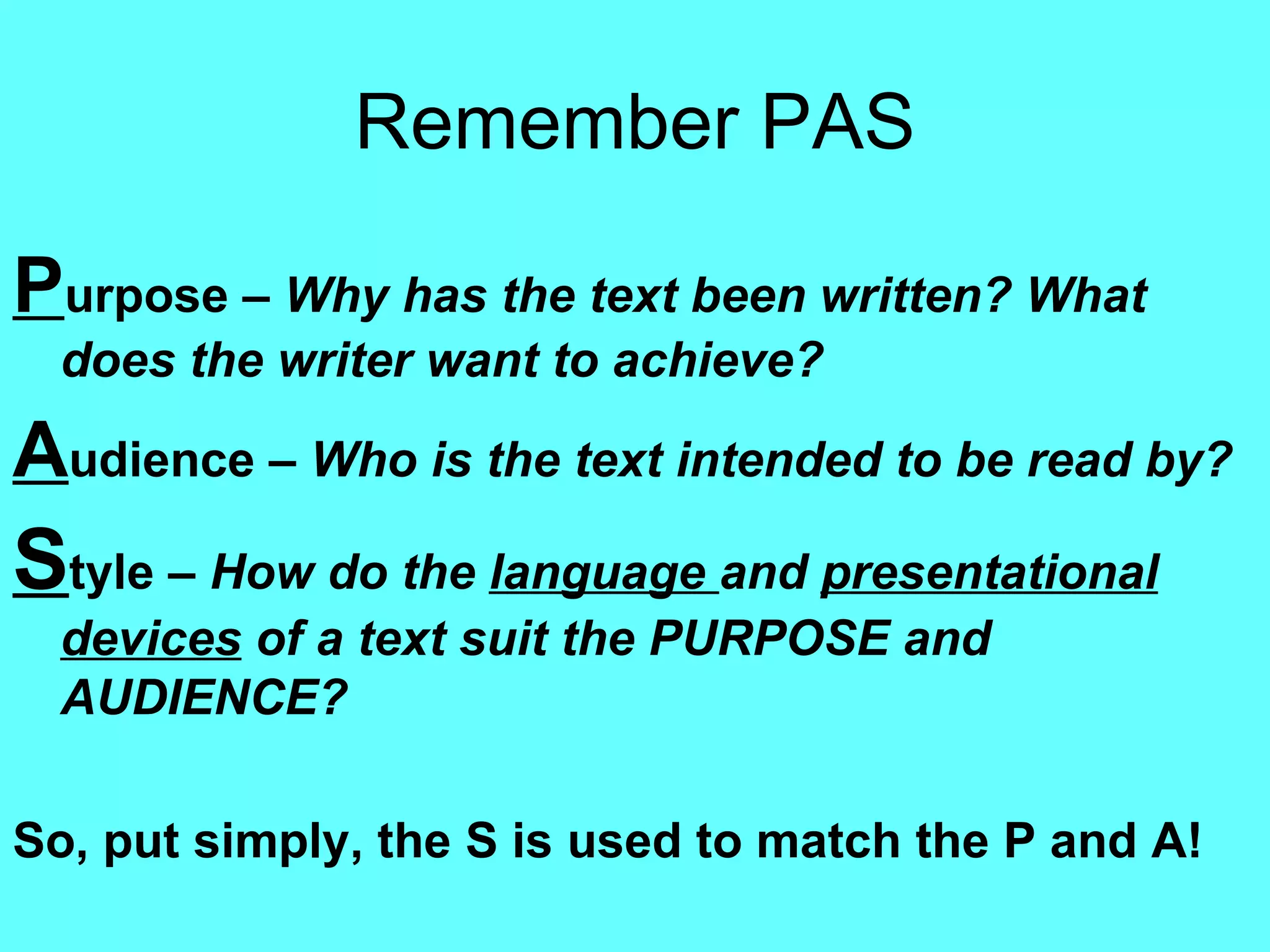
Remember PAS P urpose –  Why has the text been written? What does the writer want to achieve? A udience –  Who is the text intended to be read by? S tyle –  How do the  language  and  presentational devices  of a text suit the PURPOSE and AUDIENCE? So, put simply, the S is used to match the P and A!
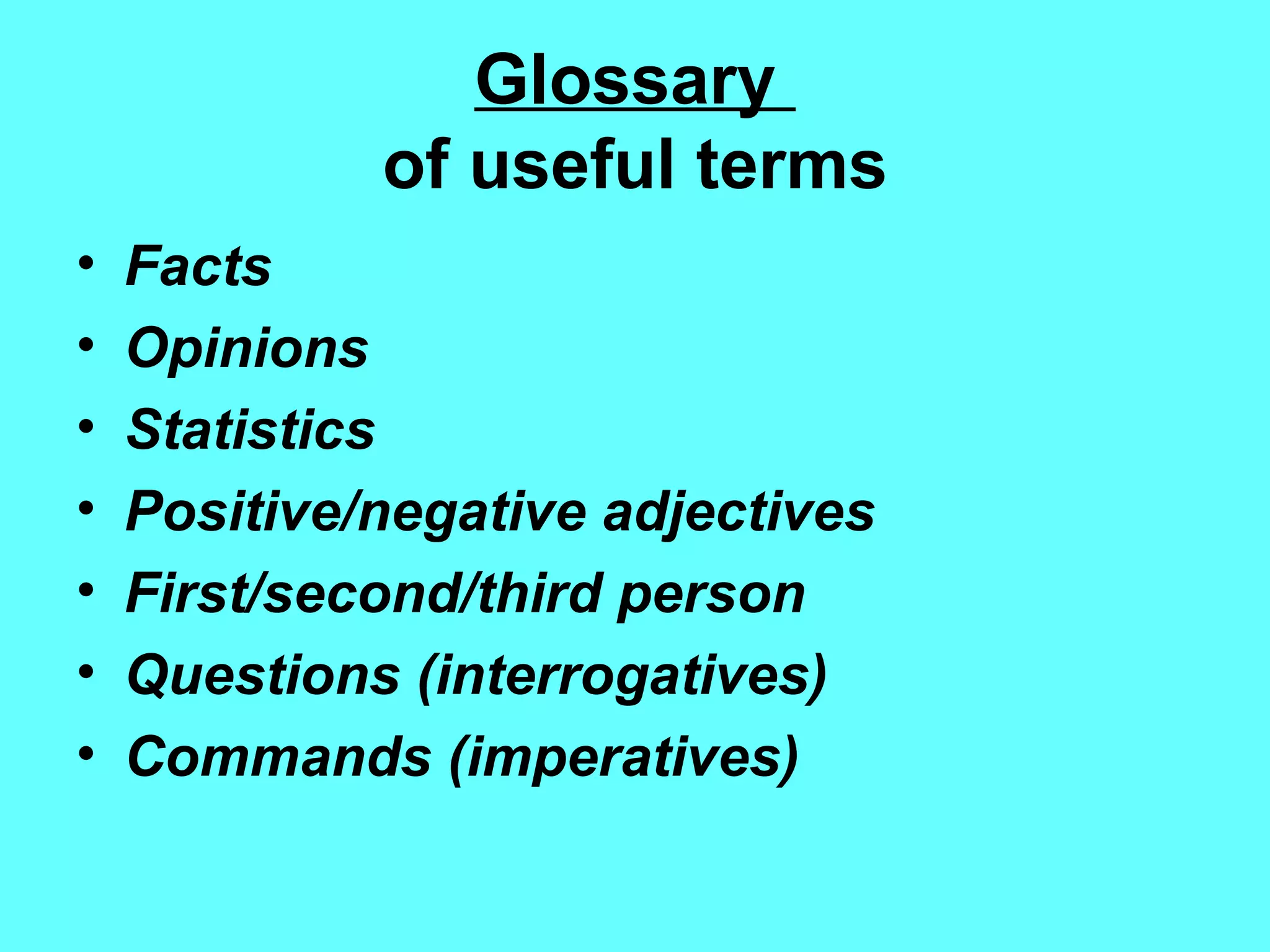
Glossary  of useful terms Facts Opinions Statistics  Positive/negative adjectives First/second/third person Questions (interrogatives) Commands (imperatives)
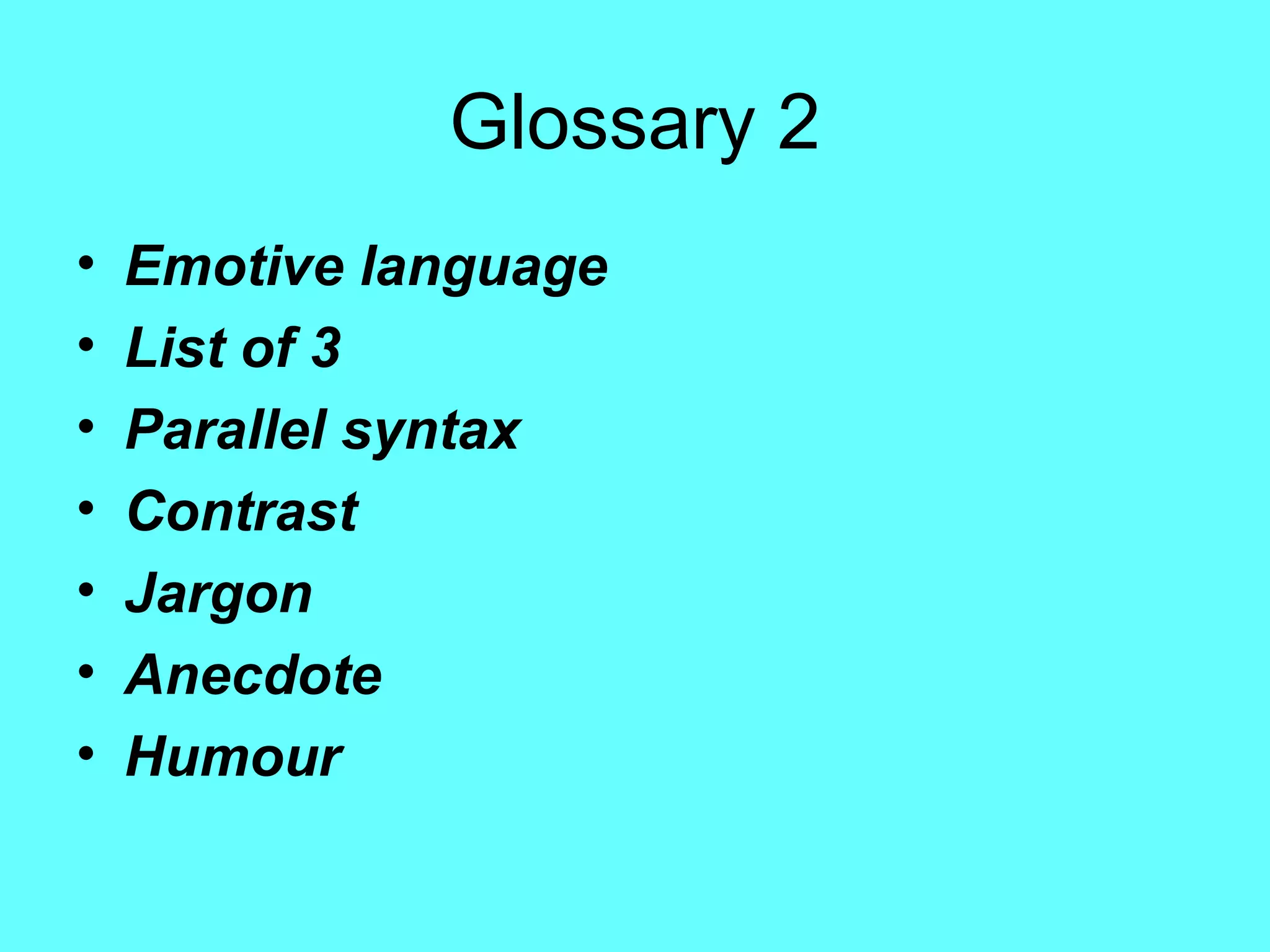
Glossary 2 Emotive language List of 3 Parallel syntax Contrast Jargon  Anecdote  Humour
Glossary 3 Pun (play on words) Coining Statements from people Modal verbs to indicate the ‘mood’ of the text (can, could, may, might, will, would, shall, should, must)
Persuasive language uses the following tactics: scare tactics (playing on your fears or insecurities) shock tactics (often sensational or creating outrage) an appeal to your hopes, dreams or ambitions an appeal to your vanity or snobbery an appeal to your better nature or idealism an appeal to your self-image
Structure Structure  = how a text is organised or put together. You may well be asked to discuss how an argument is structured in the exam. You need to think carefully about WHY the writer chose to put particular details/information in the place/order they did.
Tone Tone  = the way something is said or written which shows the mood or feelings of the writer. Here are some useful words you could use to describe a writer’s tone.  calm aggressive measured ranting serious ironic/sarcastic reasonable emotional factual  opinionated formal informal earnest elevated flippant/lighthearted conversational/colloquial
Headlines and titles The advice given in the WJEC textbook is that  “All headlines and titles try to   ‘catch the eye’ or ‘grab the attention’, so you will get little or   no credit if that is all you say in an   exam answer”.   You need to say something more specific about the headline. Why has the writer chosen those particular words?
Use evidence DON’T FORGET TO USE QUOTES FOR YOUR EVIDENCE
Section B: Assessing WRITING. 70 minutes. 40 marks (20 for each piece of writing) You need to produce two pieces of transactional writing – writing that pays special attention to  audience ,  purpose  and  format . You will be asked to write two of the following: a letter, a report, an article, a leaflet, a speech or a review.
The two tasks One will test your ability to  argue, persuade or advise ; and the other to  analyse, review or comment.
Tips Read the instructions carefully  – they are there to help you. Divide your time equally – about  35  minutes per question – and make sure your answers are about the length suggested. Think carefully before you write –  plan   what you will say in your  introduction , in  each paragraph  and in the  conclusion . When you have finished writing, read through and  check for errors  – don’t be afraid to make changes if they will  improve your work .
Before you begin When tackling a piece of writing of this sort, always bear in mind these things. Purpose :  Why  am I writing this piece? Audience :  Who  is it written for? Format :  How  should my work be set out?
AUDIENCE What you write and the way you write it will depend on who  the reader  is. For a friend, your  tone  will be friendly, chatty and informal. For an  employer , on the other hand, you will adapt a more serious and formal tone.
Purpose Purpose means  the reason  behind the piece of writing – for example, to  argue ,  persuade,   comment  or  review . Make sure you are clear about the purpose of your writing.
Format Format means  how you set something out . For example, a report contains headings and sub headings so that different topics are dealt with separately and the report is easier for the reader to follow.
These are important! Paragraphing  Spelling  Grammar  Punctuation.
Formal letter Remember that if you write a formal letter then use: ‘ Yours sincerely’  if you  know  their name. ‘ Yours faithfully’  if you  don’t know  their name.
Formal letter layout Use the correct layout for a formal letter (unless it says otherwise). Your Address Date Their address Dear…

Paper 2 revision ppt

  • 1.
  • 2.
    This examination is two hours long and consists of the following: Section A: Assessing READING. 50 minutes. 40 marks. You will read two examples of non-literary texts on a common theme and answer questions on them. Section B: Assessing WRITING. 70 minutes. 40 marks (20 for each piece of writing) You need to produce two pieces of transactional writing – writing that pays special attention to audience , purpose and format .
  • 3.
    The reading sectionSection A: Assessing READING. 50 minutes. 40 marks. You will read two examples of non-literary texts on a common theme. These could be an advert, a newspaper or magazine article, a page from the Internet or an essay (e.g. travel writing). You then answer questions on these texts. One question (usually the last one) will ask you to compare the texts.
  • 4.
    Reading paper Thequestions you will be asked fall into seven basic types : Locating and retrieving information Impressions and images Viewpoint and attitude Intended audience Analysis of persuasive techniques Comparison of texts Evaluation of texts
  • 5.
    Reading paper Howthe questions might be worded: Compare and contrast these texts. What are the writer’s thoughts and feelings about…? What evidence does the writer give that…? Which of these texts do you find the most effective? Who would the language in this text appeal to? What impression do we get of…? How does this text try to persuade the reader that…?
  • 6.
    Remember PAS Purpose – Why has the text been written? What does the writer want to achieve? A udience – Who is the text intended to be read by? S tyle – How do the language and presentational devices of a text suit the PURPOSE and AUDIENCE? So, put simply, the S is used to match the P and A!
  • 7.
    Glossary ofuseful terms Facts Opinions Statistics Positive/negative adjectives First/second/third person Questions (interrogatives) Commands (imperatives)
  • 8.
    Glossary 2 Emotivelanguage List of 3 Parallel syntax Contrast Jargon Anecdote Humour
  • 9.
    Glossary 3 Pun(play on words) Coining Statements from people Modal verbs to indicate the ‘mood’ of the text (can, could, may, might, will, would, shall, should, must)
  • 10.
    Persuasive language usesthe following tactics: scare tactics (playing on your fears or insecurities) shock tactics (often sensational or creating outrage) an appeal to your hopes, dreams or ambitions an appeal to your vanity or snobbery an appeal to your better nature or idealism an appeal to your self-image
  • 11.
    Structure Structure = how a text is organised or put together. You may well be asked to discuss how an argument is structured in the exam. You need to think carefully about WHY the writer chose to put particular details/information in the place/order they did.
  • 12.
    Tone Tone = the way something is said or written which shows the mood or feelings of the writer. Here are some useful words you could use to describe a writer’s tone. calm aggressive measured ranting serious ironic/sarcastic reasonable emotional factual opinionated formal informal earnest elevated flippant/lighthearted conversational/colloquial
  • 13.
    Headlines and titlesThe advice given in the WJEC textbook is that “All headlines and titles try to ‘catch the eye’ or ‘grab the attention’, so you will get little or no credit if that is all you say in an exam answer”. You need to say something more specific about the headline. Why has the writer chosen those particular words?
  • 14.
    Use evidence DON’TFORGET TO USE QUOTES FOR YOUR EVIDENCE
  • 15.
    Section B: AssessingWRITING. 70 minutes. 40 marks (20 for each piece of writing) You need to produce two pieces of transactional writing – writing that pays special attention to audience , purpose and format . You will be asked to write two of the following: a letter, a report, an article, a leaflet, a speech or a review.
  • 16.
    The two tasksOne will test your ability to argue, persuade or advise ; and the other to analyse, review or comment.
  • 17.
    Tips Read theinstructions carefully – they are there to help you. Divide your time equally – about 35 minutes per question – and make sure your answers are about the length suggested. Think carefully before you write – plan what you will say in your introduction , in each paragraph and in the conclusion . When you have finished writing, read through and check for errors – don’t be afraid to make changes if they will improve your work .
  • 18.
    Before you beginWhen tackling a piece of writing of this sort, always bear in mind these things. Purpose : Why am I writing this piece? Audience : Who is it written for? Format : How should my work be set out?
  • 19.
    AUDIENCE What youwrite and the way you write it will depend on who the reader is. For a friend, your tone will be friendly, chatty and informal. For an employer , on the other hand, you will adapt a more serious and formal tone.
  • 20.
    Purpose Purpose means the reason behind the piece of writing – for example, to argue , persuade, comment or review . Make sure you are clear about the purpose of your writing.
  • 21.
    Format Format means how you set something out . For example, a report contains headings and sub headings so that different topics are dealt with separately and the report is easier for the reader to follow.
  • 22.
    These are important!Paragraphing Spelling Grammar Punctuation.
  • 23.
    Formal letter Rememberthat if you write a formal letter then use: ‘ Yours sincerely’ if you know their name. ‘ Yours faithfully’ if you don’t know their name.
  • 24.
    Formal letter layoutUse the correct layout for a formal letter (unless it says otherwise). Your Address Date Their address Dear…