Topic :
 Function of language
 Transactional view
 Interactional view
What is language?
Meaning of Language :
 The word "Language" is derived from the Latin word
"lingue" which means Produced with the tongue.
 Language is set of arbitrary vocal symbols by means
of which a social group operates, communicates and
express emotions, feelings and desires.
No language was created in a day or by single person. It
is mutually created by a group of humans to
communicate.
Languages also change and die, grow and expand.
Language plays an important role in human life, we try
learning and using language as a mean of
communication, as well as a social symbol of a humanity.
 By using language one can make statements, convey
facts or information, explain or report something and
maintain social relations.
Defining function
 The word function is often used in different senses in
the literature of linguistics:
 In sociological studies of language, function is often
used to refer to the role language plays in society.
In ethnography, scholars use function to refer to the
specific uses of language.
In systemic-functional linguistics, functions of language
are highly generalized categories of meaning which
simultaneously underlie an utterance.
Proponents of language functions
In the history of linguistics we find many renowned
personalities who worked on language functions but
some of the prominent are:
Roman Jakobson
Bronislaw Malinowski
Micheal Halliday
Finch
Functions of language
According to linguistics and
sociolinguistics language perform two
main funtions.
Transactional
 Interactional
Transactional view
Transactional view is concerned with the
transmission of information.
Transactional function
The function that language servers in expressing of
content or any information is called transactional funtion.
Example
Making a telephone call to obtain flight information.
Lyons observes that the notion of communication is
readily used 'of feelings, moods and attitudes' but
suggests that he will be primarily interested in the
intentional transmission of factual, or propositional,
information'.
 Bennett remarks 'it seems likely that communication
is primarily a matter of a speaker's seeking either to
inform a hearer of something or to enjoin some action
upon him'.
Transactional language.
 The language use to perform transactional function is
called transactional language.
 Primarily transactional language.
 In primarily transactional language we assume that what
the speaker or writer has primarily in mind is the efficient
transference of information.
 Language used in such a situation is primarily 'message
oriented'. It is important that the recipient gets the
informative detail correct.
Features of Transactional
 Giving or obtaining information, or getting goods
and services
 Focus on message
 Making oneself understood completely.
 Grammatical accuracy may not be a priority
Communication strategies
Information oriented:
– asking for directions
– describing how to use something
– sharing opinions and ideas
– discussing plans
Goods and services oriented:
 – focus on achieving a goal or service
 – checking into a hotel
 – shopping
 – ordering a meal
Interactional view
The interactional view involve in expressing
social relations and personal attitude by
language.
Examples:
Greetings
Small talk and chit chat
Interactional function
The interactional function is concerned with the
maintenance of social relationships.
For example
if two people pass in the street and say
A : Hi, all right?
B : Yeah, fine thanks.
The function of the exchange is purely interactional it
serves only as an acknowledgement of the relationship.
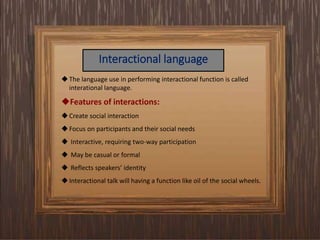
Interactional language
The language use in performing interactional function is called
interational language.
Features of interactions:
Create social interaction
Focus on participants and their social needs
 Interactive, requiring two-way participation
 May be casual or formal
 Reflects speakers’ identity
Interactional talk will having a function like oil of the social wheels.
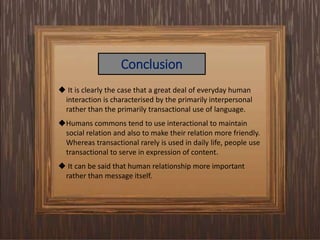
Conclusion
 It is clearly the case that a great deal of everyday human
interaction is characterised by the primarily interpersonal
rather than the primarily transactional use of language.
Humans commons tend to use interactional to maintain
social relation and also to make their relation more friendly.
Whereas transactional rarely is used in daily life, people use
transactional to serve in expression of content.
 It can be said that human relationship more important
rather than message itself.
Thank you

Functions of language

  • 1.
    Topic :  Functionof language  Transactional view  Interactional view
  • 2.
    What is language? Meaningof Language :  The word "Language" is derived from the Latin word "lingue" which means Produced with the tongue.  Language is set of arbitrary vocal symbols by means of which a social group operates, communicates and express emotions, feelings and desires.
  • 3.
    No language wascreated in a day or by single person. It is mutually created by a group of humans to communicate. Languages also change and die, grow and expand. Language plays an important role in human life, we try learning and using language as a mean of communication, as well as a social symbol of a humanity.  By using language one can make statements, convey facts or information, explain or report something and maintain social relations.
  • 4.
    Defining function  Theword function is often used in different senses in the literature of linguistics:  In sociological studies of language, function is often used to refer to the role language plays in society. In ethnography, scholars use function to refer to the specific uses of language. In systemic-functional linguistics, functions of language are highly generalized categories of meaning which simultaneously underlie an utterance.
  • 5.
    Proponents of languagefunctions In the history of linguistics we find many renowned personalities who worked on language functions but some of the prominent are: Roman Jakobson Bronislaw Malinowski Micheal Halliday Finch
  • 6.
    Functions of language Accordingto linguistics and sociolinguistics language perform two main funtions. Transactional  Interactional
  • 7.
    Transactional view Transactional viewis concerned with the transmission of information. Transactional function The function that language servers in expressing of content or any information is called transactional funtion. Example Making a telephone call to obtain flight information.
  • 8.
    Lyons observes thatthe notion of communication is readily used 'of feelings, moods and attitudes' but suggests that he will be primarily interested in the intentional transmission of factual, or propositional, information'.  Bennett remarks 'it seems likely that communication is primarily a matter of a speaker's seeking either to inform a hearer of something or to enjoin some action upon him'.
  • 9.
    Transactional language.  Thelanguage use to perform transactional function is called transactional language.  Primarily transactional language.  In primarily transactional language we assume that what the speaker or writer has primarily in mind is the efficient transference of information.  Language used in such a situation is primarily 'message oriented'. It is important that the recipient gets the informative detail correct.
  • 10.
    Features of Transactional Giving or obtaining information, or getting goods and services  Focus on message  Making oneself understood completely.  Grammatical accuracy may not be a priority
  • 11.
    Communication strategies Information oriented: –asking for directions – describing how to use something – sharing opinions and ideas – discussing plans Goods and services oriented:  – focus on achieving a goal or service  – checking into a hotel  – shopping  – ordering a meal
  • 12.
    Interactional view The interactionalview involve in expressing social relations and personal attitude by language. Examples: Greetings Small talk and chit chat
  • 13.
    Interactional function The interactionalfunction is concerned with the maintenance of social relationships. For example if two people pass in the street and say A : Hi, all right? B : Yeah, fine thanks. The function of the exchange is purely interactional it serves only as an acknowledgement of the relationship.
  • 14.
    Interactional language The languageuse in performing interactional function is called interational language. Features of interactions: Create social interaction Focus on participants and their social needs  Interactive, requiring two-way participation  May be casual or formal  Reflects speakers’ identity Interactional talk will having a function like oil of the social wheels.
  • 15.
    Conclusion  It isclearly the case that a great deal of everyday human interaction is characterised by the primarily interpersonal rather than the primarily transactional use of language. Humans commons tend to use interactional to maintain social relation and also to make their relation more friendly. Whereas transactional rarely is used in daily life, people use transactional to serve in expression of content.  It can be said that human relationship more important rather than message itself.
  • 16.