Co mmu n i c at i o n s

 Top Tips for Communicators

    This guide has been produced to help Business Change
   write and deliver better communications to stakeholders
What’s in this guide

• Why we should communicate in a consistent way
• Things to think about before you start
• How to write in our tone of voice
• Some of the key messages to get across
• What not to say
• Your role as an ambassador for Business Change
• Getting support for your message
• Tips and techniques for presentations / communication sessions
Before you begin communication…….
Think about your audience

• Who are they? (keep a Key Stakeholder of the project in
  mind while you’re writing)
   –   How old are they?
   –   What job do they do?
   –   Are they married with kids?
   –   What newspaper do they read?
   –   What’s their background?
   –   What’s their favourite music or TV programme?
   –   All these things can help when tailoring a communication and
       gaining buy in from your stakeholders
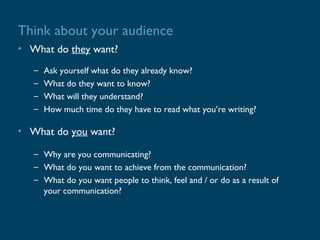
Think about your audience
• What do they want?
   –   Ask yourself what do they already know?
   –   What do they want to know?
   –   What will they understand?
   –   How much time do they have to read what you’re writing?

• What do you want?

   – Why are you communicating?
   – What do you want to achieve from the communication?
   – What do you want people to think, feel and / or do as a result of
     your communication?
Writing in Tone of Voice…….
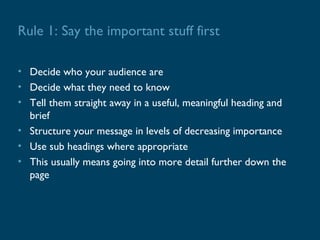
Rule 1: Say the important stuff first

• Decide who your audience are
• Decide what they need to know
• Tell them straight away in a useful, meaningful heading and
  brief
• Structure your message in levels of decreasing importance
• Use sub headings where appropriate
• This usually means going into more detail further down the
  page
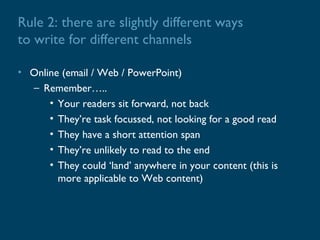
Rule 2: there are slightly different ways
to write for different channels

• Online (email / Web / PowerPoint)
  – Remember…..
      • Your readers sit forward, not back
      • They’re task focussed, not looking for a good read
      • They have a short attention span
      • They’re unlikely to read to the end
      • They could ‘land’ anywhere in your content (this is
        more applicable to Web content)
Rule 2: there are slightly different ways
to write for different channels

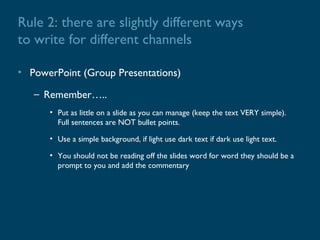
• PowerPoint (Group Presentations)

   – Remember…..
      • Put as little on a slide as you can manage (keep the text VERY simple).
        Full sentences are NOT bullet points.

      • Use a simple background, if light use dark text if dark use light text.

      • You should not be reading off the slides word for word they should be a
        prompt to you and add the commentary
Rule 2: there are slightly different ways
to write for different channels
• Magazines and editorial articles
   – Remember
       • Avoid business speak
       • Give people “a good read”
       • Write about “us” and “we” rather than “you” and “the
         company”
       • Be positive but be honest
       • Don’t waffle to fill a layout
       • Use a plain, down to earth style
       • Use vibrant, bright language
       • Avoid acronyms and jargon
Rule 2: there are slightly different ways
to write for different channels
• Emails
   – Remember
       • Always ensure you have a subject statement and that it is that is meaningful
       • Use “Hi” or “Hello” rather than “Dear”
       • Use an easy chatty style (as if you were talking)
       • Sign off using “Thanks, Many thanks, regards or all the best” rather than the more
         formal “yours sincerely or faithfully”
       • Make sure your full name, job role and contact details are on the message so
         people can contact you easily if they need to. Create a Outlook signature so the
         signature is always consistent.
       • Always use your email Signature regardless of if it is a new, reply or forwarded
         email.
Rule 3: Use Plain English

• Be direct and to the point
• Avoid jargon and unusual words and avoid acronyms
• If using acronyms on the initial mention give the full wording
  and bracket the acronym i.e. Business As Usual (BAU)
• Avoid long, complicated sentences
• Think about your audience and what they’re likely to
  understand
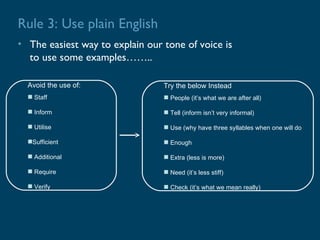
Rule 3: Use plain English
• The easiest way to explain our tone of voice is
  to use some examples……..

  Avoid the use of:              Try the below Instead
   Staff                         People (it’s what we are after all)

   Inform                        Tell (inform isn’t very informal)

   Utilise                       Use (why have three syllables when one will do

  Sufficient                     Enough

   Additional                    Extra (less is more)

   Require                       Need (it’s less stiff)

   Verify                        Check (it’s what we mean really)
Rule 4: be ‘user friendly’

• Don’t use over complicated words or jargon
• Always check if there’s a simpler way of saying something
• Try not to write in several sentences what you can write in
  one
• Use words like ‘our’ and ‘we’ or people’s names, to include
  the reader in what you’re saying
• Try to make it interesting
Rule 5: Review

• Always read what you have written before sending

• If in doubt ask a colleague to review

• Try reading it out allowed

• Put yourself in the stakeholders shoes

• pre-empt questions - Ask yourself what questions might the
  stakeholder have once reviewing the document
    – If so try including the answers in the communication
What not to say…….
What to avoid

• Don’t speculate - stick to the facts
• Don’t make promises you or Business Change can’t
  keep!
• Don’t present Business Change as the answer to all
  that ails the business / your audience
• Don’t ‘sugar coat’ information - the organisation
  needs to prepare for change
Your role as an Business Change
ambassador…….
Being an ambassador

• You should…….
  –   Be positive!
  –   Be honest, if you don’t know – say so!
  –   Endeavour to answer in 24 hours
  –   Be responsible and responsive
  –   Be on time for appointments, meetings etc
  –   Capture names, dates, numbers, next steps
  –   Avoid using jargon - explain it if you have to use it
  –   Encourage open discussion and capture concerns
  –   Be conscious of potential resistance. Some people might not want to
      hear the message you’re giving
Getting support for your
message…….
Getting support for your message
• Some of the following might help…..
   – Tell the person you have their manager’s support
     to participate
   – With their support we can ensure this is a
     success.
   – By getting involved in this stage of the analysis,
     you will be aware of some of the changes and can
     help educate your people at your site.
Tops tips for presentations /
Communication sessions…….
Top tips for face to face

• Getting started
• When you’re introducing something that’s new
  to the audience, it might be difficult to get the
  conversation going. Break the ice by asking:
   – What is your understanding of the Project?
   – What benefits do you expect from the implementation
     of the project?
   – What do you consider to be the biggest challenges
     facing your area as a result of the project?
Top tips for face to face
During a Presentation

• If you feel like you’re losing your audience, just take a
  break in your presentation. Do a quick recap of your
  information and ask your audience if they are following the
  content by asking some of your opening questions again
  (previous slide).
• If you’re having difficulty getting a Q&A session started,
  here are some questions you could pose to your audience
  to encourage discussion:
    – How might the project benefit your area?
    – What are your concerns about the project?
    – What do you see as your role in making the project a
      success?
Top tips for face to face

Wrapping up

• Always be sure to review your presentation agenda to
  ensure the audience understands what you covered

• Make reference to any items on the flip charts or parked
  issues and have a plan to address them (within 24 hours if
  possible)

• Clearly identify next steps for the audience – outline what
  they will be expected to do.

Top tips for communications slide share

  • 1.
    Co mmu ni c at i o n s Top Tips for Communicators This guide has been produced to help Business Change write and deliver better communications to stakeholders
  • 2.
    What’s in thisguide • Why we should communicate in a consistent way • Things to think about before you start • How to write in our tone of voice • Some of the key messages to get across • What not to say • Your role as an ambassador for Business Change • Getting support for your message • Tips and techniques for presentations / communication sessions
  • 3.
    Before you begincommunication…….
  • 4.
    Think about youraudience • Who are they? (keep a Key Stakeholder of the project in mind while you’re writing) – How old are they? – What job do they do? – Are they married with kids? – What newspaper do they read? – What’s their background? – What’s their favourite music or TV programme? – All these things can help when tailoring a communication and gaining buy in from your stakeholders
  • 5.
    Think about youraudience • What do they want? – Ask yourself what do they already know? – What do they want to know? – What will they understand? – How much time do they have to read what you’re writing? • What do you want? – Why are you communicating? – What do you want to achieve from the communication? – What do you want people to think, feel and / or do as a result of your communication?
  • 6.
    Writing in Toneof Voice…….
  • 7.
    Rule 1: Saythe important stuff first • Decide who your audience are • Decide what they need to know • Tell them straight away in a useful, meaningful heading and brief • Structure your message in levels of decreasing importance • Use sub headings where appropriate • This usually means going into more detail further down the page
  • 8.
    Rule 2: thereare slightly different ways to write for different channels • Online (email / Web / PowerPoint) – Remember….. • Your readers sit forward, not back • They’re task focussed, not looking for a good read • They have a short attention span • They’re unlikely to read to the end • They could ‘land’ anywhere in your content (this is more applicable to Web content)
  • 9.
    Rule 2: thereare slightly different ways to write for different channels • PowerPoint (Group Presentations) – Remember….. • Put as little on a slide as you can manage (keep the text VERY simple). Full sentences are NOT bullet points. • Use a simple background, if light use dark text if dark use light text. • You should not be reading off the slides word for word they should be a prompt to you and add the commentary
  • 10.
    Rule 2: thereare slightly different ways to write for different channels • Magazines and editorial articles – Remember • Avoid business speak • Give people “a good read” • Write about “us” and “we” rather than “you” and “the company” • Be positive but be honest • Don’t waffle to fill a layout • Use a plain, down to earth style • Use vibrant, bright language • Avoid acronyms and jargon
  • 11.
    Rule 2: thereare slightly different ways to write for different channels • Emails – Remember • Always ensure you have a subject statement and that it is that is meaningful • Use “Hi” or “Hello” rather than “Dear” • Use an easy chatty style (as if you were talking) • Sign off using “Thanks, Many thanks, regards or all the best” rather than the more formal “yours sincerely or faithfully” • Make sure your full name, job role and contact details are on the message so people can contact you easily if they need to. Create a Outlook signature so the signature is always consistent. • Always use your email Signature regardless of if it is a new, reply or forwarded email.
  • 12.
    Rule 3: UsePlain English • Be direct and to the point • Avoid jargon and unusual words and avoid acronyms • If using acronyms on the initial mention give the full wording and bracket the acronym i.e. Business As Usual (BAU) • Avoid long, complicated sentences • Think about your audience and what they’re likely to understand
  • 13.
    Rule 3: Useplain English • The easiest way to explain our tone of voice is to use some examples…….. Avoid the use of: Try the below Instead  Staff  People (it’s what we are after all)  Inform  Tell (inform isn’t very informal)  Utilise  Use (why have three syllables when one will do Sufficient  Enough  Additional  Extra (less is more)  Require  Need (it’s less stiff)  Verify  Check (it’s what we mean really)
  • 14.
    Rule 4: be‘user friendly’ • Don’t use over complicated words or jargon • Always check if there’s a simpler way of saying something • Try not to write in several sentences what you can write in one • Use words like ‘our’ and ‘we’ or people’s names, to include the reader in what you’re saying • Try to make it interesting
  • 15.
    Rule 5: Review •Always read what you have written before sending • If in doubt ask a colleague to review • Try reading it out allowed • Put yourself in the stakeholders shoes • pre-empt questions - Ask yourself what questions might the stakeholder have once reviewing the document – If so try including the answers in the communication
  • 16.
    What not tosay…….
  • 17.
    What to avoid •Don’t speculate - stick to the facts • Don’t make promises you or Business Change can’t keep! • Don’t present Business Change as the answer to all that ails the business / your audience • Don’t ‘sugar coat’ information - the organisation needs to prepare for change
  • 18.
    Your role asan Business Change ambassador…….
  • 19.
    Being an ambassador •You should……. – Be positive! – Be honest, if you don’t know – say so! – Endeavour to answer in 24 hours – Be responsible and responsive – Be on time for appointments, meetings etc – Capture names, dates, numbers, next steps – Avoid using jargon - explain it if you have to use it – Encourage open discussion and capture concerns – Be conscious of potential resistance. Some people might not want to hear the message you’re giving
  • 20.
    Getting support foryour message…….
  • 21.
    Getting support foryour message • Some of the following might help….. – Tell the person you have their manager’s support to participate – With their support we can ensure this is a success. – By getting involved in this stage of the analysis, you will be aware of some of the changes and can help educate your people at your site.
  • 22.
    Tops tips forpresentations / Communication sessions…….
  • 23.
    Top tips forface to face • Getting started • When you’re introducing something that’s new to the audience, it might be difficult to get the conversation going. Break the ice by asking: – What is your understanding of the Project? – What benefits do you expect from the implementation of the project? – What do you consider to be the biggest challenges facing your area as a result of the project?
  • 24.
    Top tips forface to face During a Presentation • If you feel like you’re losing your audience, just take a break in your presentation. Do a quick recap of your information and ask your audience if they are following the content by asking some of your opening questions again (previous slide). • If you’re having difficulty getting a Q&A session started, here are some questions you could pose to your audience to encourage discussion: – How might the project benefit your area? – What are your concerns about the project? – What do you see as your role in making the project a success?
  • 25.
    Top tips forface to face Wrapping up • Always be sure to review your presentation agenda to ensure the audience understands what you covered • Make reference to any items on the flip charts or parked issues and have a plan to address them (within 24 hours if possible) • Clearly identify next steps for the audience – outline what they will be expected to do.