Effective Report Writing Prepared by: Mrs. Najmunnisa Siddiqui
Recall your memory What is report? What is the purpose of it? What does it contain?
Report Report means a statement or description of what has been said, seen, done, etc. It contains facts figures, information, analysis, opinion, suggestions, recommendations, drafts , charts, pictures, statistical tables specially complied for a particular purpose.
Purpose of Report writing Business report writing serves the purpose of exploring a problem.  The purpose of a Business Reports  to communicate information to assist in the business Decision Making Process. Some reports might propose solutions for business problems or might present relevant information to assist in the problem solving process.
What is a Good Report? A good report is one that is read and action taken because of it (not just filed and ignored). An effective report is one that is read; and that stimulates some sort of an action as a result of being read.
What Makes a Report Good?   Students` Response
Essentials of Report Writing With Style Clear   Complete   Concise   Creative   Considerate   Correct   Credible   Courtesy Concreteness
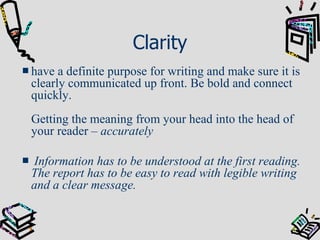
Clarity have a definite purpose for writing and make sure it is clearly communicated up front. Be bold and connect quickly.  Getting the meaning from your head into the head of your reader –  accurately Information has to be understood at the first reading. The report has to be easy to read with legible writing and a clear message.
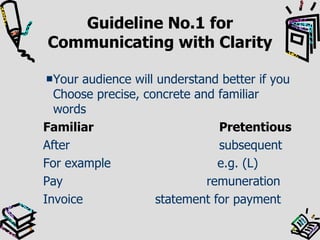
Guideline No.1 for Communicating with Clarity Your audience will understand better if you Choose precise, concrete and familiar words   Familiar Pretentious After subsequent For example   e.g. (L) Pay    remuneration Invoice  statement for payment
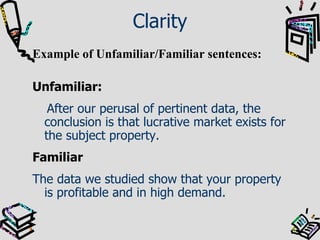
Clarity Example of Unfamiliar/Familiar sentences: Unfamiliar:  After our perusal of pertinent data, the conclusion is that lucrative market exists for the subject property. Familiar The data we studied show that your property is profitable and in high demand.
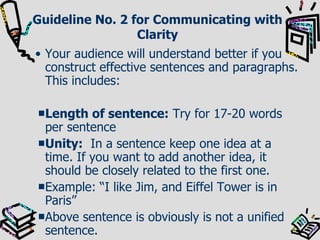
Guideline No. 2 for Communicating with Clarity Your audience will understand better if you construct effective sentences and paragraphs. This includes: Length of sentence:  Try for 17-20 words per sentence Unity:   In a sentence keep one idea at a time. If you want to add another idea, it should be closely related to the first one. Example: “I like Jim, and Eiffel Tower is in Paris” Above sentence is obviously is not a unified sentence.
Coherence In a coherent sentence the words are correctly arranged so that the ideas clearly express the intended meaning. Example of Coherent and non-coherent sentences: Unclear: Our report is about testing, broken down in unit and functional methods Clear: Our report on testing focused on unit and functional methods
Unclear: After planting 10, 000 berry plants, the deer came into our botanist’s arm and crushed them. Clear: After our botanist had planted 10,000 berry plants, the deer came into his farm and crushed them
Completeness Your business message is complete when it contains all the facts, according to the reader or listener needs for reaction you desire. Communicators-Sender and receivers-differ in their mental filters; they are influenced by their backgrounds, viewpoints, needs, experiences, attitudes, status, and emotions.
Because of these differences, communication senders need to assess their messages through the eyes of receivers. To be sure they have included all relevant information. Provide all necessary information Who, what, where, when, why, how? Answer all questions asked Give something extra, when desirable
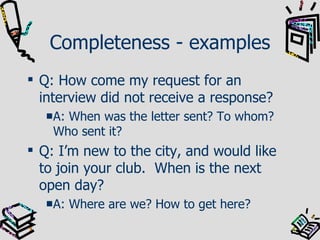
Completeness - examples Q: How come my request for an interview did not receive a response? A: When was the letter sent? To whom? Who sent it? Q: I’m new to the city, and would like to join your club.  When is the next open day? A: Where are we? How to get here?
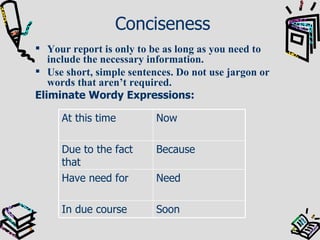
Conciseness Your report is only to be as long as you need to include the necessary information.  Use short, simple sentences. Do not use jargon or words that aren’t required. Eliminate Wordy Expressions:  Soon In due course Need Have need for Because Due to the fact that Now At this time
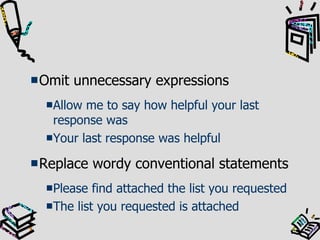
Omit unnecessary expressions Allow me to say how helpful your last response was Your last response was helpful Replace wordy conventional statements Please find attached the list you requested The list you requested is attached
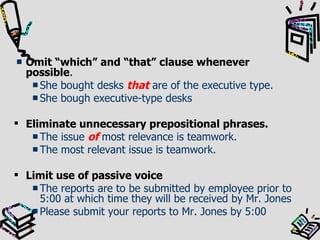
Omit “which” and “that” clause whenever possible . She bought desks  that  are of the executive type. She bough executive-type desks Eliminate unnecessary prepositional phrases. The issue  of  most relevance is teamwork. The most relevant issue is teamwork. Limit use of passive voice The reports are to be submitted by employee prior to 5:00 at which time they will be received by Mr. Jones Please submit your reports to Mr. Jones by 5:00
Consideration Consideration means preparing every message to keep your audience in your mind. Focus on you instead of I and we You are foremost aware of their desires, problems, circumstances, emotions, and probable reactions to your request.   This thoughtful consideration is also called “you attitude,” empathy, the human touch, and understanding.
Take an interest in the reader, show how the reader will benefit. Readers react positively when benefits are shown to them Emphasise positive, pleasant facts Readers will react positively or negatively to certain words
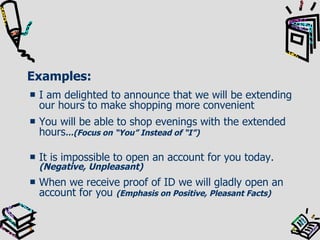
Examples: I am delighted to announce that we will be extending our hours to make shopping more convenient You will be able to shop evenings with the extended hours …(Focus on “You” Instead of “I”) It is impossible to open an account for you today.  (Negative, Unpleasant) When we receive proof of ID we will gladly open an account for you  (Emphasis on Positive, Pleasant Facts)
Concreteness Communicating concretely means being specific, definite, and vivid rather than vague and general. Often it means using denotative (direct, explicit, often dictionary based) rather than connotative words (ideas or notions suggested by or associated with a word or  phrase)
Guide Lines for creating concrete messages Use specific facts and figures It is desirable in both oral & written communication Example: She’s a brain   (Vague, General, Indefinite) Her grade-point average in 2006 was 3.9 on a four-point scale.   (Concrete, Precise)
Guide Lines for Creating Concrete Messages : Put action in your verbs Verbs propel thought:   Verbs can activate other words and help make your sentences alive, more vigorous. That is to have dynamic sentences in your communication. Active verbs help your sentence more: Specific:  “The dream decided” is more explicit than “A decision has been made” Personal:  “You will note” is both personal and specific; “It will be noted” is impersonal.” Concise:  The passive requires more words and thus shows both writing and reading. Compare “Figures show” with “It is shown in the figure.” Emphatic:  Passive verbs dull action. Compare “The students held a contest” with “A contest was held by the students.”
Courtesy The courtesy involves being aware not only of the perspective of others, but also their feelings. Knowing your audience allows you to use statements of courtesy Be sincerely tactful, thoughtful and appreciative Use expressions that show respect
Choose non-discriminatory expressions, for example i n order to avoid gender discrimination you can use: Entering student instead of freshman Workers, employees instead of manpower The best candidate for the position instead of the best man for the position.
Clearly, you did not read my latest fax Sometimes my wording is not precise; let me try again  (Tactfulness) Manpower vs.  Employees   (More Desirable as its non-sexist term) Man-made vs. manufactured The best man for the job vs.  The Best Candidate
Correctness At the core of Correctness is proper grammar, punctuation, and spelling. However, a message may be perfect grammatically and mechanically but still insult or lose a customer The term “Correctness,” as applied to business messages, also means the following three characteristics: Use the right level of language Check accuracy of figures, facts, and words Maintain acceptable writing mechanics.
Use the right level of Language: There are three levels of language: formal, informal, and substandard. Formal  writing this often associated with scholarly writing: doctoral dissertations, scholarly articles, legal documents, top level government agreements, and other material where formality is demanded. Informal  writing is more characteristic of business writing. Here you use words that are short, well known, and conversational as follows:
Formal vs. informal Participate/ join Procure /get Endeavor/ try Ascertain/ find out Deem/ think
Check accuracy of figures & facts Verify your statistical data. Double-check your totals Have someone else read your message if the topic involves data Determine whether a “fact” has changed overtime.
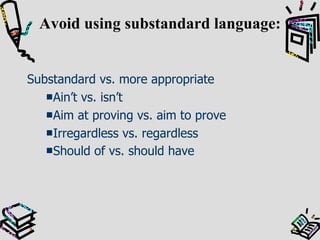
Avoid using substandard language: Substandard vs. more appropriate Ain’t vs. isn’t Aim at proving vs. aim to prove Irregardless vs. regardless Should of vs. should have
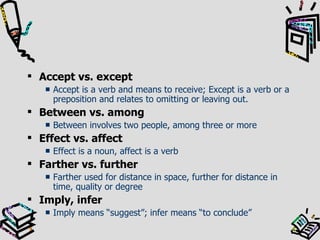
Accept vs. except Accept is a verb and means to receive; Except is a verb or a preposition and relates to omitting or leaving out. Between vs. among Between involves two people, among three or more Effect vs. affect Effect is a noun, affect is a verb Farther vs. further Farther used for distance in space, further for distance in time, quality or degree Imply, infer Imply means “suggest”; infer means “to conclude”
Be credible: strive to present yourself from a position of reliability and competence. Write to reinforce your message and make it more believable.
Considerate .  Be considerate:  keep your reader's needs in mind as you write. Ask yourself, 'Why should my reader spend time reading this?'
Be Creative Be creative:  use different formats (vs. straight narrative) to communicate your message. Q & A format, graphics, Idea lists, etc.
References http://www.articlesbase.com/business-articles/how-to-write-a-business-report-130904.html http://www.personal-writer.com/blog/what-makes-a-good-report-write http://www.lancs.ac.uk/depts/conted/learningskillsresources/Learning%20skills%20resources/Get%20good%20marks/GGM-U4.pdf

Writing Research Report

  • 1.
    Effective Report WritingPrepared by: Mrs. Najmunnisa Siddiqui
  • 2.
    Recall your memoryWhat is report? What is the purpose of it? What does it contain?
  • 3.
    Report Report meansa statement or description of what has been said, seen, done, etc. It contains facts figures, information, analysis, opinion, suggestions, recommendations, drafts , charts, pictures, statistical tables specially complied for a particular purpose.
  • 4.
    Purpose of Reportwriting Business report writing serves the purpose of exploring a problem. The purpose of a Business Reports to communicate information to assist in the business Decision Making Process. Some reports might propose solutions for business problems or might present relevant information to assist in the problem solving process.
  • 5.
    What is aGood Report? A good report is one that is read and action taken because of it (not just filed and ignored). An effective report is one that is read; and that stimulates some sort of an action as a result of being read.
  • 6.
    What Makes aReport Good? Students` Response
  • 7.
    Essentials of ReportWriting With Style Clear Complete Concise Creative Considerate Correct Credible Courtesy Concreteness
  • 8.
    Clarity have adefinite purpose for writing and make sure it is clearly communicated up front. Be bold and connect quickly. Getting the meaning from your head into the head of your reader – accurately Information has to be understood at the first reading. The report has to be easy to read with legible writing and a clear message.
  • 9.
    Guideline No.1 forCommunicating with Clarity Your audience will understand better if you Choose precise, concrete and familiar words Familiar Pretentious After subsequent For example e.g. (L) Pay remuneration Invoice statement for payment
  • 10.
    Clarity Example ofUnfamiliar/Familiar sentences: Unfamiliar: After our perusal of pertinent data, the conclusion is that lucrative market exists for the subject property. Familiar The data we studied show that your property is profitable and in high demand.
  • 11.
    Guideline No. 2for Communicating with Clarity Your audience will understand better if you construct effective sentences and paragraphs. This includes: Length of sentence: Try for 17-20 words per sentence Unity: In a sentence keep one idea at a time. If you want to add another idea, it should be closely related to the first one. Example: “I like Jim, and Eiffel Tower is in Paris” Above sentence is obviously is not a unified sentence.
  • 12.
    Coherence In acoherent sentence the words are correctly arranged so that the ideas clearly express the intended meaning. Example of Coherent and non-coherent sentences: Unclear: Our report is about testing, broken down in unit and functional methods Clear: Our report on testing focused on unit and functional methods
  • 13.
    Unclear: After planting10, 000 berry plants, the deer came into our botanist’s arm and crushed them. Clear: After our botanist had planted 10,000 berry plants, the deer came into his farm and crushed them
  • 14.
    Completeness Your businessmessage is complete when it contains all the facts, according to the reader or listener needs for reaction you desire. Communicators-Sender and receivers-differ in their mental filters; they are influenced by their backgrounds, viewpoints, needs, experiences, attitudes, status, and emotions.
  • 15.
    Because of thesedifferences, communication senders need to assess their messages through the eyes of receivers. To be sure they have included all relevant information. Provide all necessary information Who, what, where, when, why, how? Answer all questions asked Give something extra, when desirable
  • 16.
    Completeness - examplesQ: How come my request for an interview did not receive a response? A: When was the letter sent? To whom? Who sent it? Q: I’m new to the city, and would like to join your club. When is the next open day? A: Where are we? How to get here?
  • 17.
    Conciseness Your reportis only to be as long as you need to include the necessary information. Use short, simple sentences. Do not use jargon or words that aren’t required. Eliminate Wordy Expressions: Soon In due course Need Have need for Because Due to the fact that Now At this time
  • 18.
    Omit unnecessary expressionsAllow me to say how helpful your last response was Your last response was helpful Replace wordy conventional statements Please find attached the list you requested The list you requested is attached
  • 19.
    Omit “which” and“that” clause whenever possible . She bought desks that are of the executive type. She bough executive-type desks Eliminate unnecessary prepositional phrases. The issue of most relevance is teamwork. The most relevant issue is teamwork. Limit use of passive voice The reports are to be submitted by employee prior to 5:00 at which time they will be received by Mr. Jones Please submit your reports to Mr. Jones by 5:00
  • 20.
    Consideration Consideration meanspreparing every message to keep your audience in your mind. Focus on you instead of I and we You are foremost aware of their desires, problems, circumstances, emotions, and probable reactions to your request. This thoughtful consideration is also called “you attitude,” empathy, the human touch, and understanding.
  • 21.
    Take an interestin the reader, show how the reader will benefit. Readers react positively when benefits are shown to them Emphasise positive, pleasant facts Readers will react positively or negatively to certain words
  • 22.
    Examples: I amdelighted to announce that we will be extending our hours to make shopping more convenient You will be able to shop evenings with the extended hours …(Focus on “You” Instead of “I”) It is impossible to open an account for you today. (Negative, Unpleasant) When we receive proof of ID we will gladly open an account for you (Emphasis on Positive, Pleasant Facts)
  • 23.
    Concreteness Communicating concretelymeans being specific, definite, and vivid rather than vague and general. Often it means using denotative (direct, explicit, often dictionary based) rather than connotative words (ideas or notions suggested by or associated with a word or phrase)
  • 24.
    Guide Lines forcreating concrete messages Use specific facts and figures It is desirable in both oral & written communication Example: She’s a brain (Vague, General, Indefinite) Her grade-point average in 2006 was 3.9 on a four-point scale. (Concrete, Precise)
  • 25.
    Guide Lines forCreating Concrete Messages : Put action in your verbs Verbs propel thought: Verbs can activate other words and help make your sentences alive, more vigorous. That is to have dynamic sentences in your communication. Active verbs help your sentence more: Specific: “The dream decided” is more explicit than “A decision has been made” Personal: “You will note” is both personal and specific; “It will be noted” is impersonal.” Concise: The passive requires more words and thus shows both writing and reading. Compare “Figures show” with “It is shown in the figure.” Emphatic: Passive verbs dull action. Compare “The students held a contest” with “A contest was held by the students.”
  • 26.
    Courtesy The courtesyinvolves being aware not only of the perspective of others, but also their feelings. Knowing your audience allows you to use statements of courtesy Be sincerely tactful, thoughtful and appreciative Use expressions that show respect
  • 27.
    Choose non-discriminatory expressions,for example i n order to avoid gender discrimination you can use: Entering student instead of freshman Workers, employees instead of manpower The best candidate for the position instead of the best man for the position.
  • 28.
    Clearly, you didnot read my latest fax Sometimes my wording is not precise; let me try again (Tactfulness) Manpower vs. Employees (More Desirable as its non-sexist term) Man-made vs. manufactured The best man for the job vs. The Best Candidate
  • 29.
    Correctness At thecore of Correctness is proper grammar, punctuation, and spelling. However, a message may be perfect grammatically and mechanically but still insult or lose a customer The term “Correctness,” as applied to business messages, also means the following three characteristics: Use the right level of language Check accuracy of figures, facts, and words Maintain acceptable writing mechanics.
  • 30.
    Use the rightlevel of Language: There are three levels of language: formal, informal, and substandard. Formal writing this often associated with scholarly writing: doctoral dissertations, scholarly articles, legal documents, top level government agreements, and other material where formality is demanded. Informal writing is more characteristic of business writing. Here you use words that are short, well known, and conversational as follows:
  • 31.
    Formal vs. informalParticipate/ join Procure /get Endeavor/ try Ascertain/ find out Deem/ think
  • 32.
    Check accuracy offigures & facts Verify your statistical data. Double-check your totals Have someone else read your message if the topic involves data Determine whether a “fact” has changed overtime.
  • 33.
    Avoid using substandardlanguage: Substandard vs. more appropriate Ain’t vs. isn’t Aim at proving vs. aim to prove Irregardless vs. regardless Should of vs. should have
  • 34.
    Accept vs. exceptAccept is a verb and means to receive; Except is a verb or a preposition and relates to omitting or leaving out. Between vs. among Between involves two people, among three or more Effect vs. affect Effect is a noun, affect is a verb Farther vs. further Farther used for distance in space, further for distance in time, quality or degree Imply, infer Imply means “suggest”; infer means “to conclude”
  • 35.
    Be credible: striveto present yourself from a position of reliability and competence. Write to reinforce your message and make it more believable.
  • 36.
    Considerate . Be considerate: keep your reader's needs in mind as you write. Ask yourself, 'Why should my reader spend time reading this?'
  • 37.
    Be Creative Becreative: use different formats (vs. straight narrative) to communicate your message. Q & A format, graphics, Idea lists, etc.
  • 38.
    References http://www.articlesbase.com/business-articles/how-to-write-a-business-report-130904.html http://www.personal-writer.com/blog/what-makes-a-good-report-writehttp://www.lancs.ac.uk/depts/conted/learningskillsresources/Learning%20skills%20resources/Get%20good%20marks/GGM-U4.pdf