MORPHOLOG
Y
(Linguistics)
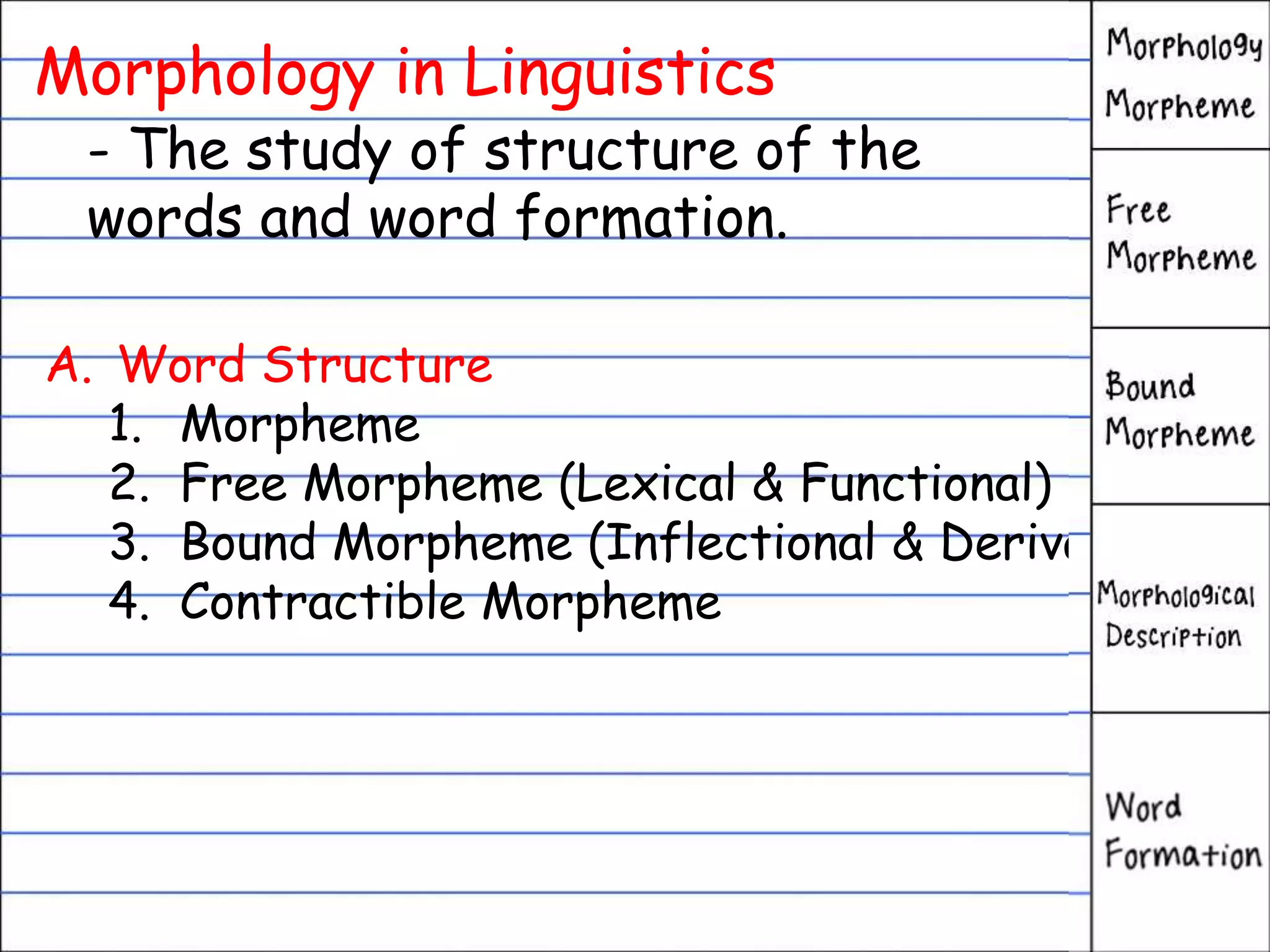
Morphology in Linguistics
- The study of structure of the
words and word formation.
A. Word Structure
1. Morpheme
2. Free Morpheme (Lexical & Functional)
3. Bound Morpheme (Inflectional & Derivational)
4. Contractible Morpheme
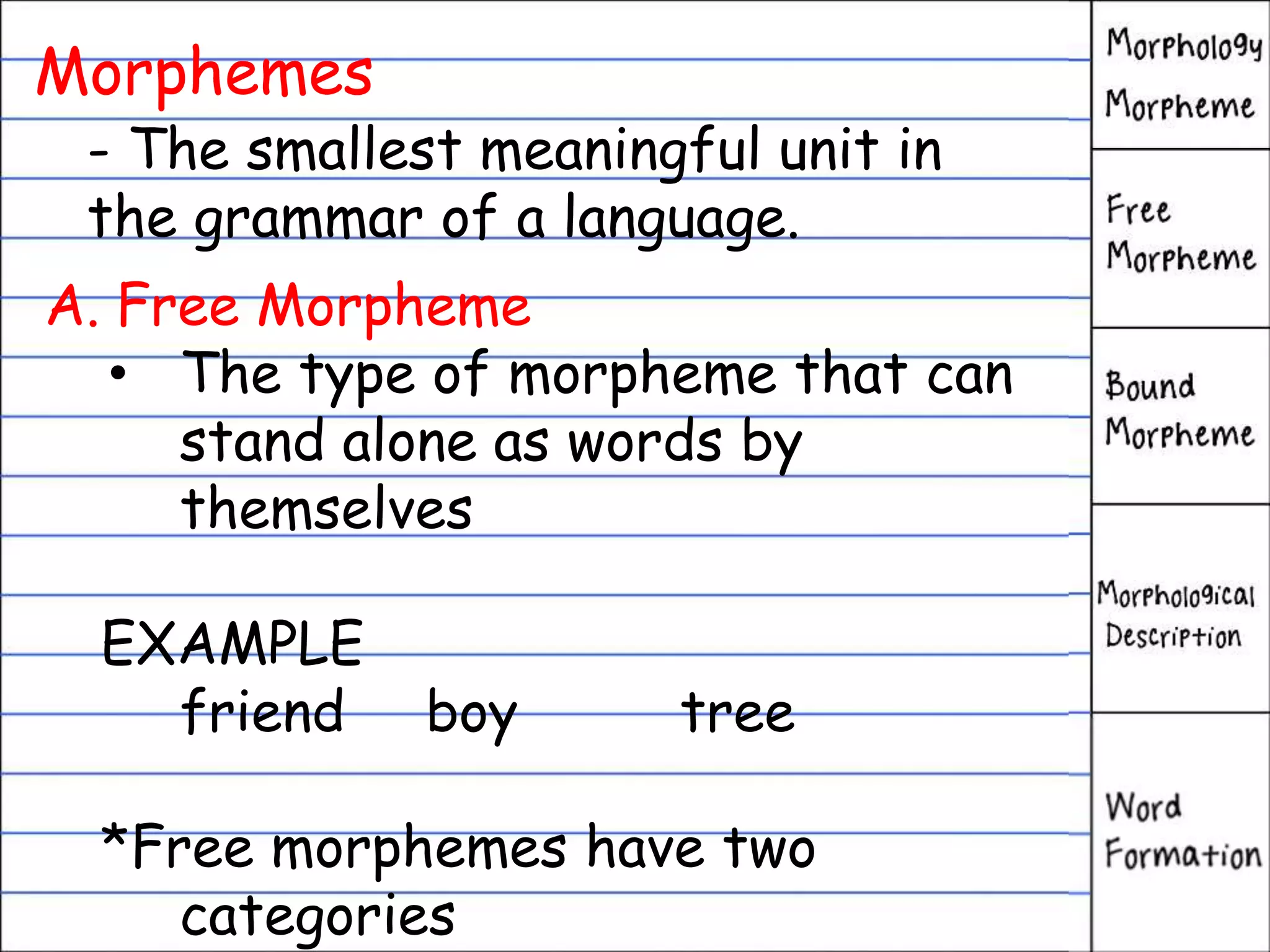
Morphemes
- The smallest meaningful unit in
the grammar of a language.
A. Free Morpheme
• The type of morpheme that can
stand alone as words by
themselves
EXAMPLE
friend boy tree
*Free morphemes have two
categories
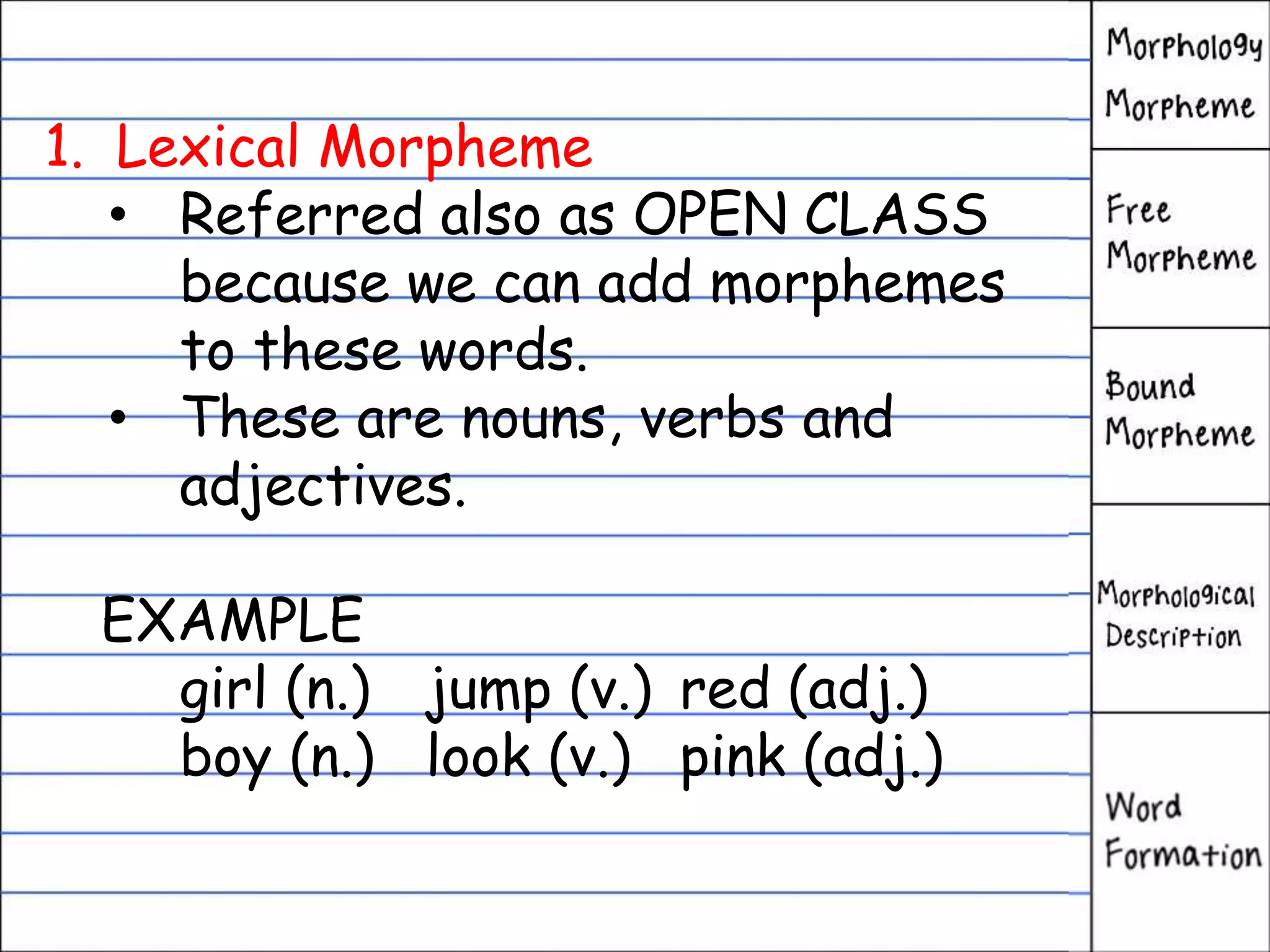
1. Lexical Morpheme
• Referred also as OPEN CLASS
because we can add morphemes
to these words.
• These are nouns, verbs and
adjectives.
EXAMPLE
girl (n.) jump (v.) red (adj.)
boy (n.) look (v.) pink (adj.)
2. Functional Morpheme
• Words that do not have clear
meaning but has grammatical
functions.
• These are conjunctions,
prepositions, articles,
auxiliaries and pronouns.
• Referred also as CLOSED
CLASS because it cannot be
added to other morphemes.
EXAMPLE
he she we but nor
B. Bound Morpheme
• These are AFFIXES that must
be attached to the word.
AFFIXES
a) Prefix - unclean
b) Infix - nowadays
c) Suffix - adjustment
*Bound morphemes have also two
categories, Inflectional and
Derivational morphemes
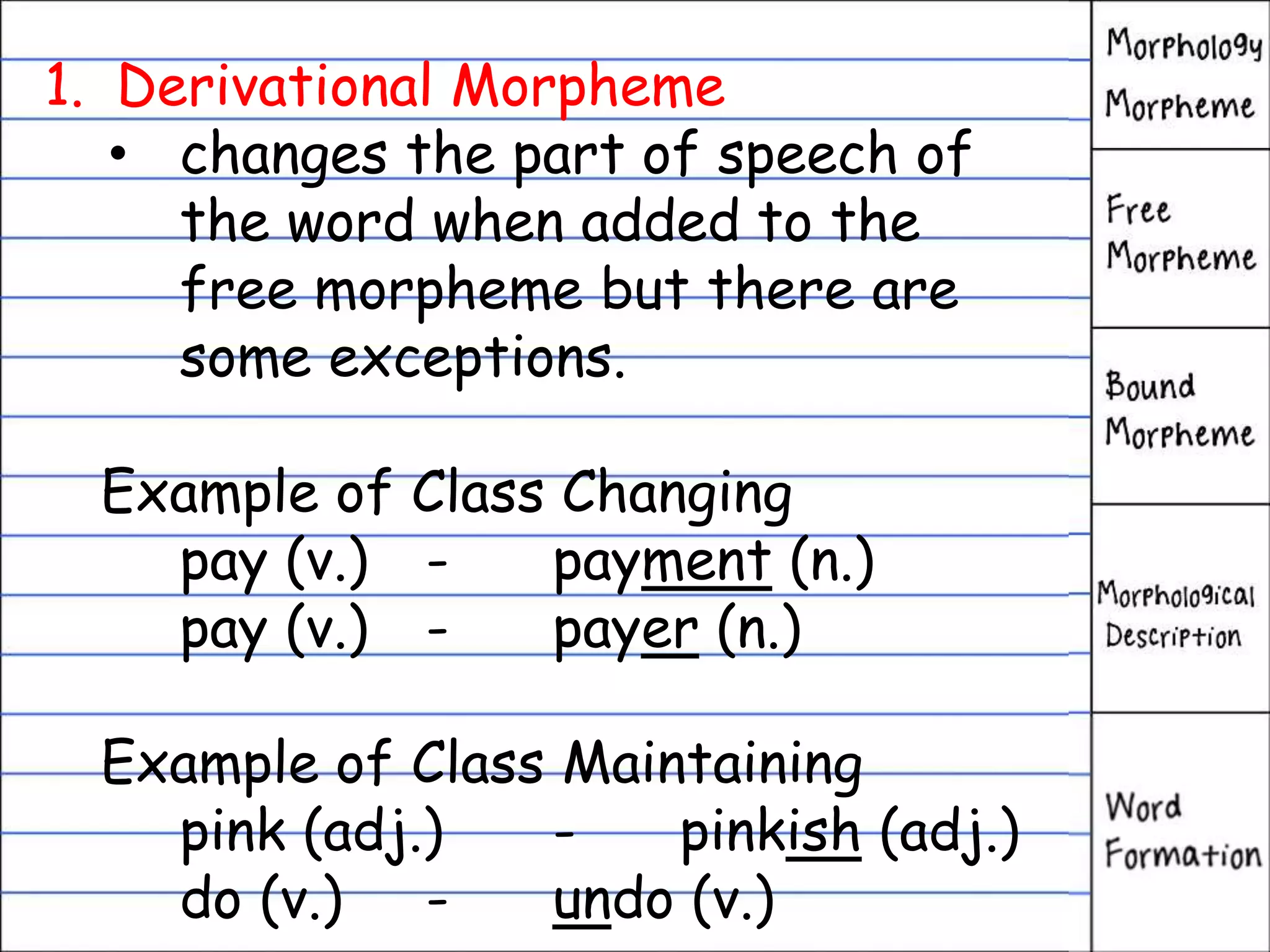
1. Derivational Morpheme
• changes the part of speech of
the word when added to the
free morpheme but there are
some exceptions.
Example of Class Changing
pay (v.) - payment (n.)
pay (v.) - payer (n.)
Example of Class Maintaining
pink (adj.) - pinkish (adj.)
do (v.) - undo (v.)
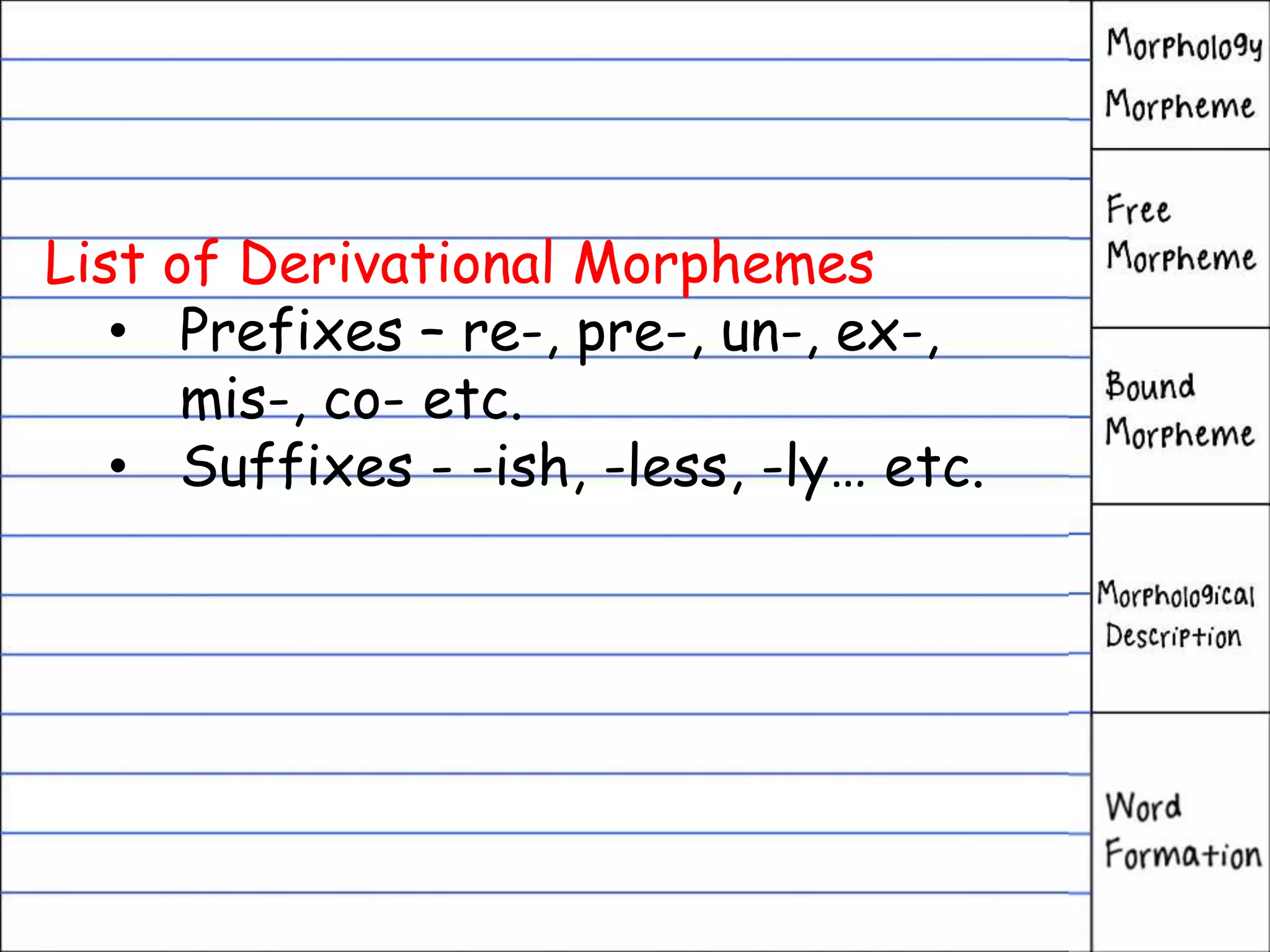
List of Derivational Morphemes
• Prefixes – re-, pre-, un-, ex-,
mis-, co- etc.
• Suffixes - -ish, -less, -ly… etc.
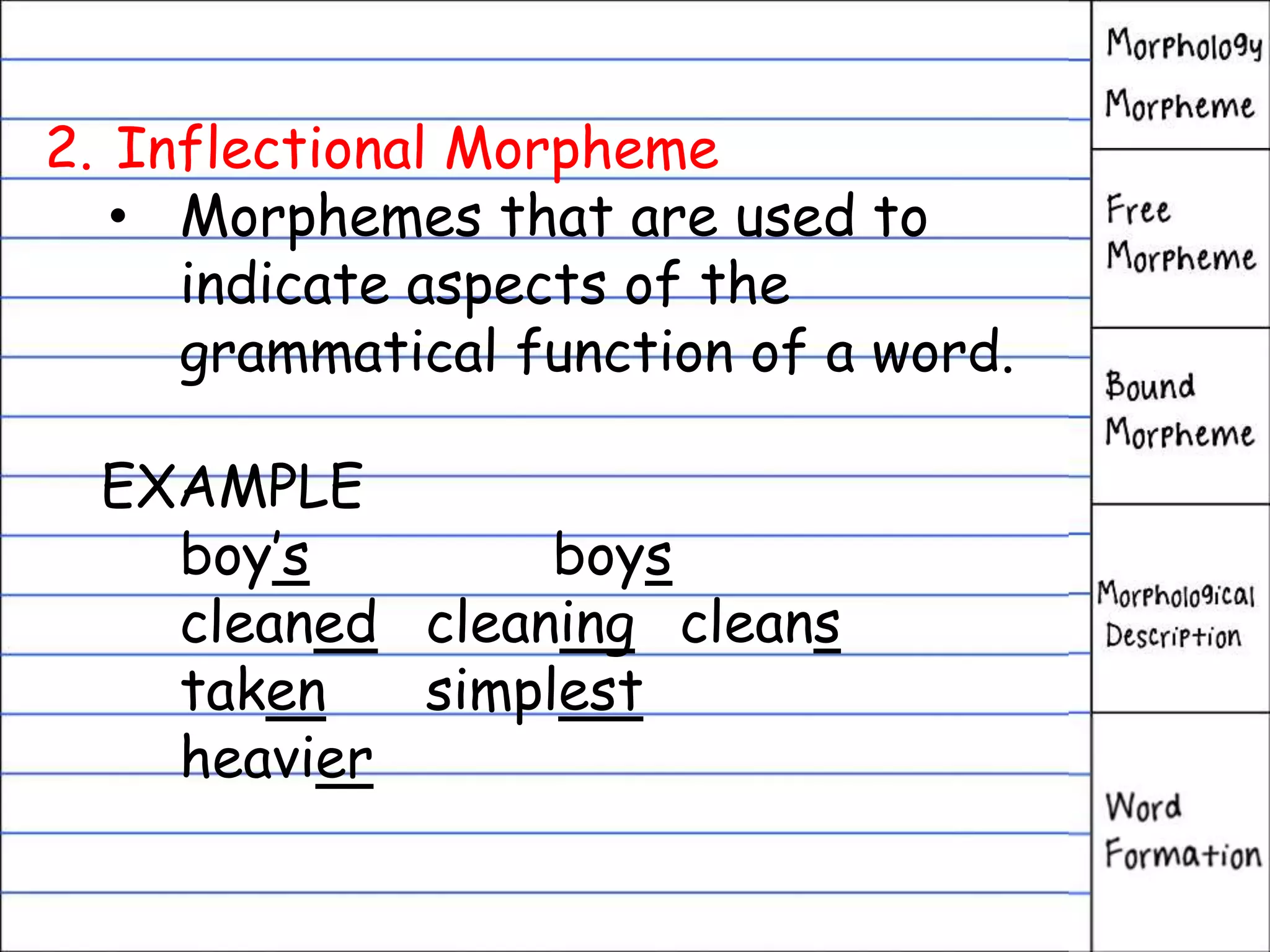
2. Inflectional Morpheme
• Morphemes that are used to
indicate aspects of the
grammatical function of a word.
EXAMPLE
boy’s boys
cleaned cleaning cleans
taken simplest
heavier
List of Inflectional Morphemes
-in English we have 8 Inflectional
Morphemes.
• Noun – Possessive noun (‘s),
Plural form (s).
• Verb – 3rd person singular (s),
Progressive verb (-ing), Past
tense (-ed), Past Participle (-en).
• Adjective – Comparative (-er),
Superlative (-est).
4. Contractible Morphemes
- these are auxiliary modals such
as will, shall, have, had and would.
- these can be contracted in
informal style of language.
Example
I will – I’ll
They had – They’d
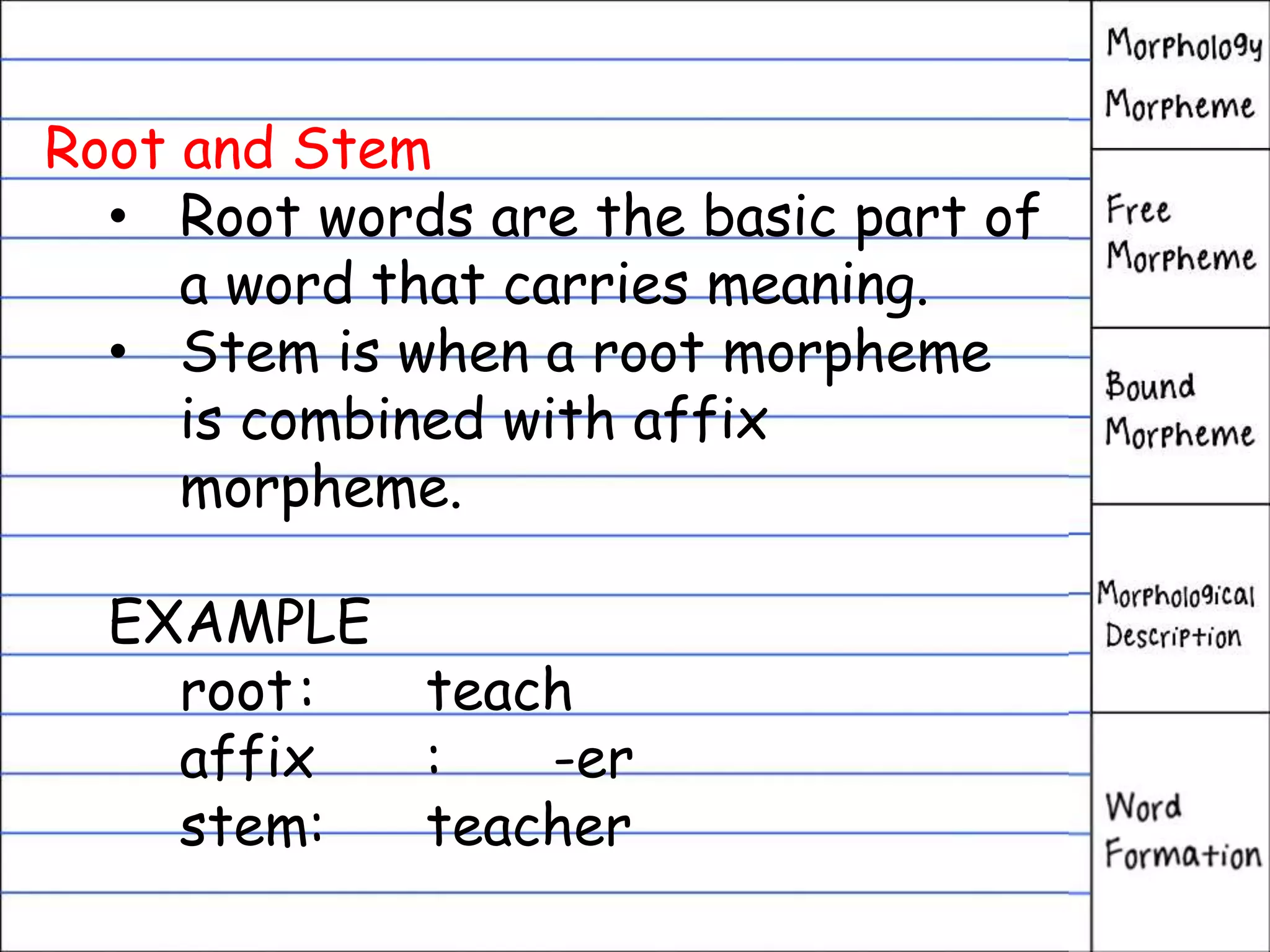
Root and Stem
• Root words are the basic part of
a word that carries meaning.
• Stem is when a root morpheme
is combined with affix
morpheme.
EXAMPLE
root: teach
affix : -er
stem: teacher
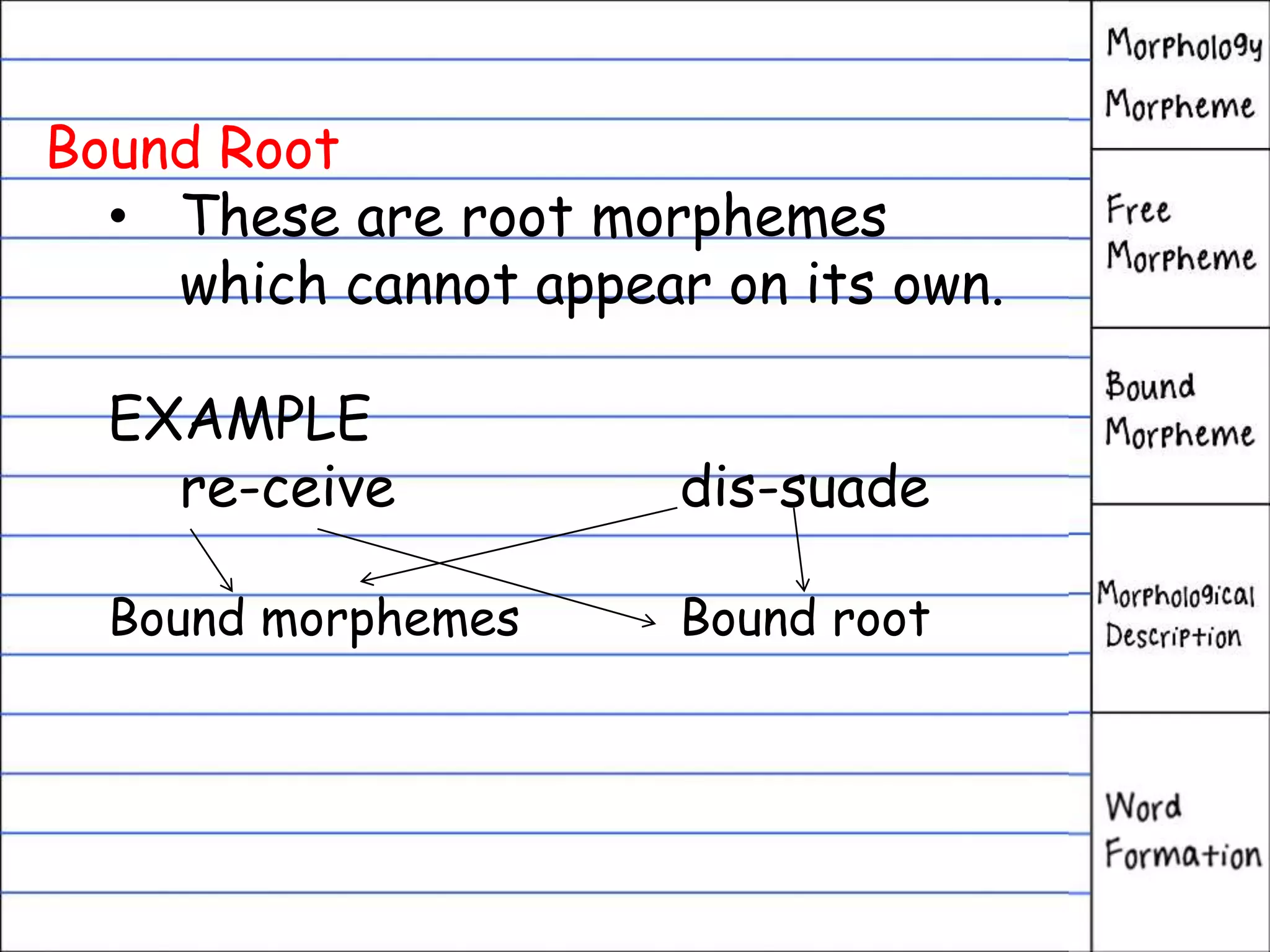
Bound Root
• These are root morphemes
which cannot appear on its own.
EXAMPLE
re-ceive dis-suade
Bound morphemes Bound root
Segmenting words into its
constituent morphemes.
EXAMPLE
repayment
re – pay – ment
prefix root suffix
Morphological Description
a) The difference between
Inflectional and Derivational
Morpheme?
• Inflectional morpheme never
change the grammatical
category of the word.
Old (adj.) older (adj.)
b) While Derivational Morpheme can
change the grammatical category
of a word.
Morphological Description
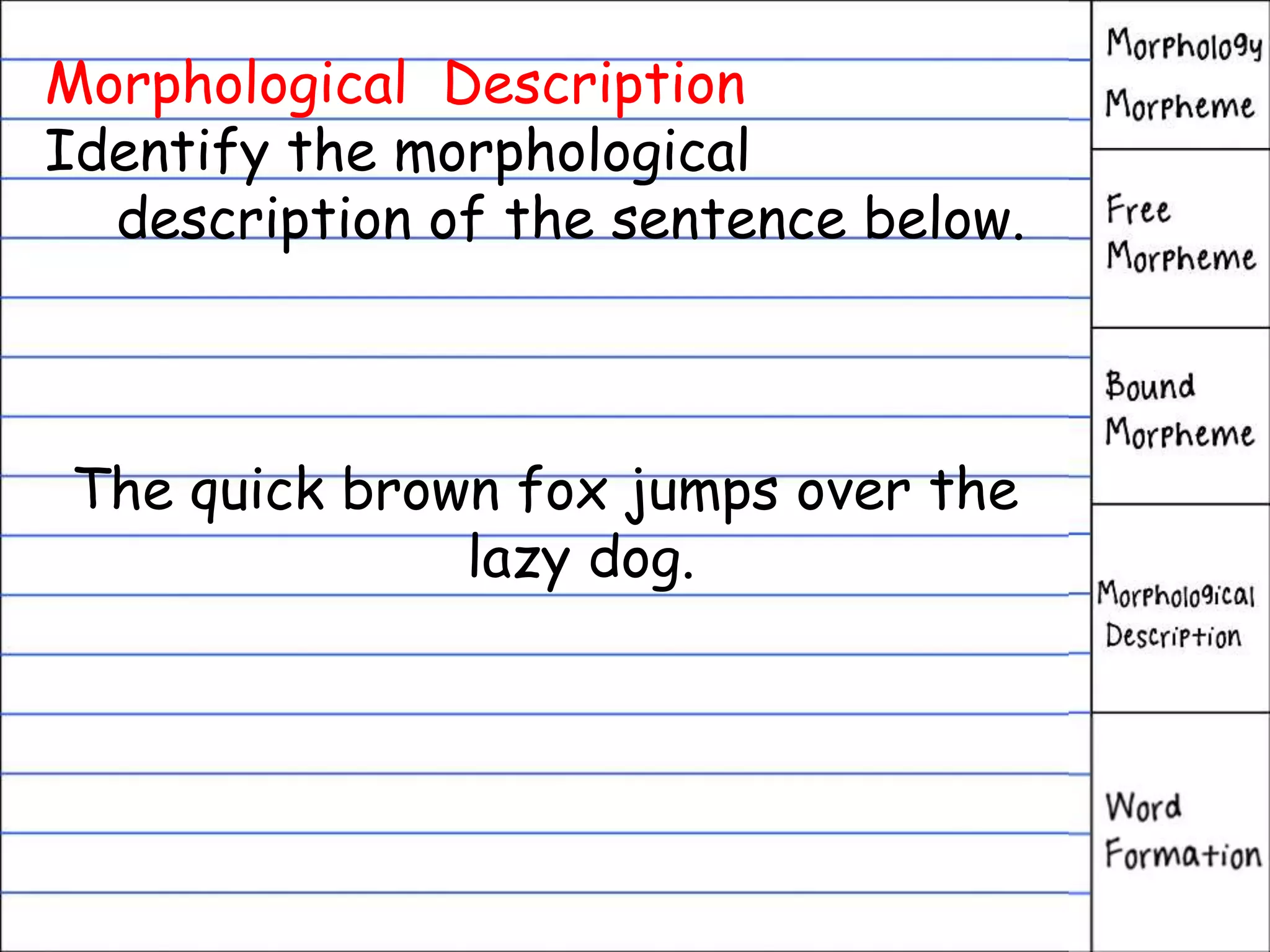
Identify the morphological
description of the sentence below.
The quick brown fox jumps over the
lazy dog.
Summing up
• Morphology is the study of word
structure and word formation.
• The smallest meaningful part of the
word is called morpheme.
• Morphemes have two classification
these are Free and Bound Morphemes.
• Free morphemes categories are Lexical
and Functional Morphemes.
• Bound morphemes includes Inflectional
and derivational morphemes
Thank You!
-Renedict 

Morphology (Linguistics)

  • 1.
  • 2.
    Morphology in Linguistics -The study of structure of the words and word formation. A. Word Structure 1. Morpheme 2. Free Morpheme (Lexical & Functional) 3. Bound Morpheme (Inflectional & Derivational) 4. Contractible Morpheme
  • 3.
    Morphemes - The smallestmeaningful unit in the grammar of a language. A. Free Morpheme • The type of morpheme that can stand alone as words by themselves EXAMPLE friend boy tree *Free morphemes have two categories
  • 4.
    1. Lexical Morpheme •Referred also as OPEN CLASS because we can add morphemes to these words. • These are nouns, verbs and adjectives. EXAMPLE girl (n.) jump (v.) red (adj.) boy (n.) look (v.) pink (adj.)
  • 5.
    2. Functional Morpheme •Words that do not have clear meaning but has grammatical functions. • These are conjunctions, prepositions, articles, auxiliaries and pronouns. • Referred also as CLOSED CLASS because it cannot be added to other morphemes. EXAMPLE he she we but nor
  • 6.
    B. Bound Morpheme •These are AFFIXES that must be attached to the word. AFFIXES a) Prefix - unclean b) Infix - nowadays c) Suffix - adjustment *Bound morphemes have also two categories, Inflectional and Derivational morphemes
  • 7.
    1. Derivational Morpheme •changes the part of speech of the word when added to the free morpheme but there are some exceptions. Example of Class Changing pay (v.) - payment (n.) pay (v.) - payer (n.) Example of Class Maintaining pink (adj.) - pinkish (adj.) do (v.) - undo (v.)
  • 8.
    List of DerivationalMorphemes • Prefixes – re-, pre-, un-, ex-, mis-, co- etc. • Suffixes - -ish, -less, -ly… etc.
  • 9.
    2. Inflectional Morpheme •Morphemes that are used to indicate aspects of the grammatical function of a word. EXAMPLE boy’s boys cleaned cleaning cleans taken simplest heavier
  • 10.
    List of InflectionalMorphemes -in English we have 8 Inflectional Morphemes. • Noun – Possessive noun (‘s), Plural form (s). • Verb – 3rd person singular (s), Progressive verb (-ing), Past tense (-ed), Past Participle (-en). • Adjective – Comparative (-er), Superlative (-est).
  • 11.
    4. Contractible Morphemes -these are auxiliary modals such as will, shall, have, had and would. - these can be contracted in informal style of language. Example I will – I’ll They had – They’d
  • 12.
    Root and Stem •Root words are the basic part of a word that carries meaning. • Stem is when a root morpheme is combined with affix morpheme. EXAMPLE root: teach affix : -er stem: teacher
  • 13.
    Bound Root • Theseare root morphemes which cannot appear on its own. EXAMPLE re-ceive dis-suade Bound morphemes Bound root
  • 14.
    Segmenting words intoits constituent morphemes. EXAMPLE repayment re – pay – ment prefix root suffix
  • 15.
    Morphological Description a) Thedifference between Inflectional and Derivational Morpheme? • Inflectional morpheme never change the grammatical category of the word. Old (adj.) older (adj.) b) While Derivational Morpheme can change the grammatical category of a word.
  • 16.
    Morphological Description Identify themorphological description of the sentence below. The quick brown fox jumps over the lazy dog.
  • 17.
    Summing up • Morphologyis the study of word structure and word formation. • The smallest meaningful part of the word is called morpheme. • Morphemes have two classification these are Free and Bound Morphemes. • Free morphemes categories are Lexical and Functional Morphemes. • Bound morphemes includes Inflectional and derivational morphemes
  • 18.