INDUS VALLEY
• 2500-1500 B.C.E.
GEOGRAPHY
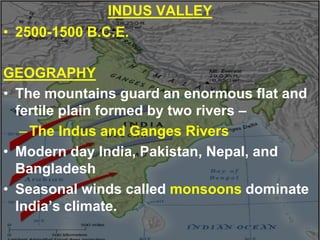
• The mountains guard an enormous flat and
fertile plain formed by two rivers –
–The Indus and Ganges Rivers
• Modern day India, Pakistan, Nepal, and
Bangladesh
• Seasonal winds called monsoons dominate
India’s climate.
GOVERNMENT
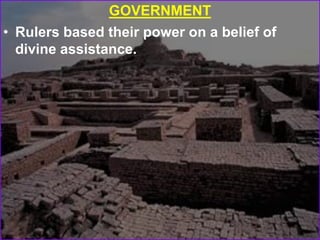
• Rulers based their power on a belief of
divine assistance.
CITY PLANNING
• No one is really sure how human settlement
began in India – perhaps they arrived by
sea from Africa and settled the south.
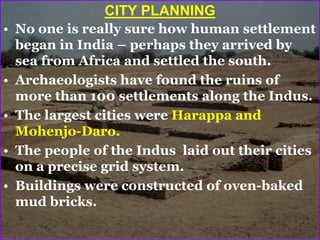
• Archaeologists have found the ruins of
more than 100 settlements along the Indus.
• The largest cities were Harappa and
Mohenjo-Daro.
• The people of the Indus laid out their cities
on a precise grid system.
• Buildings were constructed of oven-baked
mud bricks.
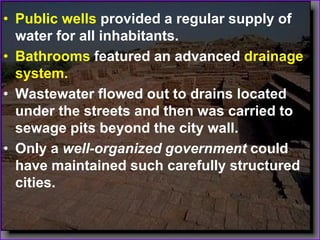
• Public wells provided a regular supply of
water for all inhabitants.
• Bathrooms featured an advanced drainage
system.
• Wastewater flowed out to drains located
under the streets and then was carried to
sewage pits beyond the city wall.
• Only a well-organized government could
have maintained such carefully structured
cities.
CONTRIBUTIONS
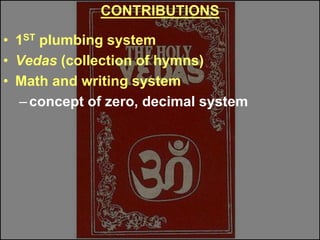
• 1ST plumbing system
• Vedas (collection of hymns)
• Math and writing system
–concept of zero, decimal system
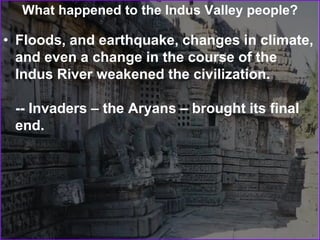
What happened to the Indus Valley people?
• Floods, and earthquake, changes in climate,
and even a change in the course of the
Indus River weakened the civilization.
-- Invaders – the Aryans – brought its final
end.
ARYANS
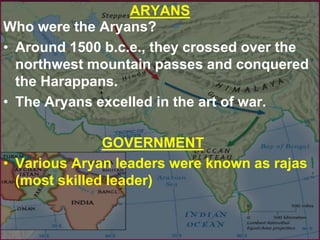
Who were the Aryans?
• Around 1500 b.c.e., they crossed over the
northwest mountain passes and conquered
the Harappans.
• The Aryans excelled in the art of war.
GOVERNMENT
• Various Aryan leaders were known as rajas
(most skilled leader)
SOCIETY & RELIGION
• Out of the clash between conqueror and
conquered came a set of social institutions
and class divisions that has lasted in India,
with only minor changes, to the present day.
• The caste system was a set of rigid social
categories that determined not only a
person’s occupation and economic
potential, but also his or her position in
society.
• It was based in part on skin color.
The Caste System
1. Brahmans -- priestly class
2. Kshatriyas -- warriors
3. Vaisyas -- commoners
4. Sudras -- dark-skinned peasants; did the work
that the above three would not do; made up a
large percentage of the Indian population
5. Untouchables -- Those who were considered
impure because of their work (butchers,
gravediggers, collectors of trash); were not
considered human; made up 5% of the
population
Family
• Life in ancient India centered on the family,
the most basic unit in society.
• The ideal was an extended family, with three
generations – grandparents, parents, and
children – living under the same roof.
• The family was patriarchal.
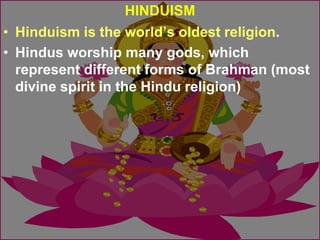
HINDUISM
• Hinduism is the world’s oldest religion.
• Hindus worship many gods, which
represent different forms of Brahman (most
divine spirit in the Hindu religion)
Basic Belief
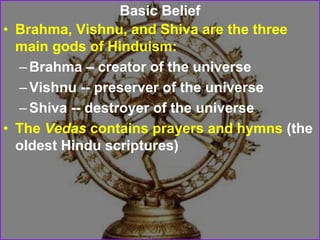
• Brahma, Vishnu, and Shiva are the three
main gods of Hinduism:
–Brahma – creator of the universe
–Vishnu -- preserver of the universe
–Shiva -- destroyer of the universe
• The Vedas contains prayers and hymns (the
oldest Hindu scriptures)
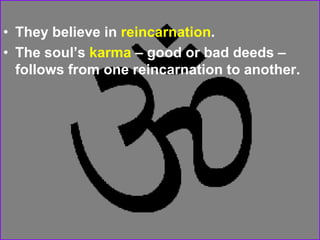
• They believe in reincarnation.
• The soul’s karma – good or bad deeds –
follows from one reincarnation to another.
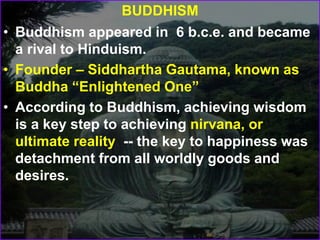
BUDDHISM
• Buddhism appeared in 6 b.c.e. and became
a rival to Hinduism.
• Founder – Siddhartha Gautama, known as
Buddha “Enlightened One”
• According to Buddhism, achieving wisdom
is a key step to achieving nirvana, or
ultimate reality -- the key to happiness was
detachment from all worldly goods and
desires.
Rituals
• They have a special regard or veneration to
cattle.
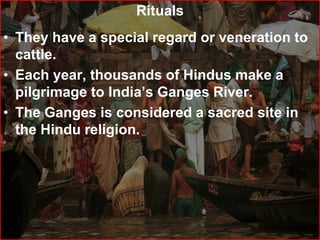
• Each year, thousands of Hindus make a
pilgrimage to India’s Ganges River.
• The Ganges is considered a sacred site in
the Hindu religion.
CONTRIBUTIONS
• Hinduism
• Buddhism
• Epic Mahabharata
–Mix of history, mythology, religion

Indus Valley.ppt

  • 2.
    INDUS VALLEY • 2500-1500B.C.E. GEOGRAPHY • The mountains guard an enormous flat and fertile plain formed by two rivers – –The Indus and Ganges Rivers • Modern day India, Pakistan, Nepal, and Bangladesh • Seasonal winds called monsoons dominate India’s climate.
  • 3.
    GOVERNMENT • Rulers basedtheir power on a belief of divine assistance.
  • 4.
    CITY PLANNING • Noone is really sure how human settlement began in India – perhaps they arrived by sea from Africa and settled the south. • Archaeologists have found the ruins of more than 100 settlements along the Indus. • The largest cities were Harappa and Mohenjo-Daro. • The people of the Indus laid out their cities on a precise grid system. • Buildings were constructed of oven-baked mud bricks.
  • 5.
    • Public wellsprovided a regular supply of water for all inhabitants. • Bathrooms featured an advanced drainage system. • Wastewater flowed out to drains located under the streets and then was carried to sewage pits beyond the city wall. • Only a well-organized government could have maintained such carefully structured cities.
  • 6.
    CONTRIBUTIONS • 1ST plumbingsystem • Vedas (collection of hymns) • Math and writing system –concept of zero, decimal system
  • 7.
    What happened tothe Indus Valley people? • Floods, and earthquake, changes in climate, and even a change in the course of the Indus River weakened the civilization. -- Invaders – the Aryans – brought its final end.
  • 8.
    ARYANS Who were theAryans? • Around 1500 b.c.e., they crossed over the northwest mountain passes and conquered the Harappans. • The Aryans excelled in the art of war. GOVERNMENT • Various Aryan leaders were known as rajas (most skilled leader)
  • 9.
    SOCIETY & RELIGION •Out of the clash between conqueror and conquered came a set of social institutions and class divisions that has lasted in India, with only minor changes, to the present day. • The caste system was a set of rigid social categories that determined not only a person’s occupation and economic potential, but also his or her position in society. • It was based in part on skin color.
  • 10.
    The Caste System 1.Brahmans -- priestly class 2. Kshatriyas -- warriors 3. Vaisyas -- commoners 4. Sudras -- dark-skinned peasants; did the work that the above three would not do; made up a large percentage of the Indian population 5. Untouchables -- Those who were considered impure because of their work (butchers, gravediggers, collectors of trash); were not considered human; made up 5% of the population
  • 11.
    Family • Life inancient India centered on the family, the most basic unit in society. • The ideal was an extended family, with three generations – grandparents, parents, and children – living under the same roof. • The family was patriarchal.
  • 12.
    HINDUISM • Hinduism isthe world’s oldest religion. • Hindus worship many gods, which represent different forms of Brahman (most divine spirit in the Hindu religion)
  • 13.
    Basic Belief • Brahma,Vishnu, and Shiva are the three main gods of Hinduism: –Brahma – creator of the universe –Vishnu -- preserver of the universe –Shiva -- destroyer of the universe • The Vedas contains prayers and hymns (the oldest Hindu scriptures)
  • 14.
    • They believein reincarnation. • The soul’s karma – good or bad deeds – follows from one reincarnation to another.
  • 15.
    BUDDHISM • Buddhism appearedin 6 b.c.e. and became a rival to Hinduism. • Founder – Siddhartha Gautama, known as Buddha “Enlightened One” • According to Buddhism, achieving wisdom is a key step to achieving nirvana, or ultimate reality -- the key to happiness was detachment from all worldly goods and desires.
  • 16.
    Rituals • They havea special regard or veneration to cattle. • Each year, thousands of Hindus make a pilgrimage to India’s Ganges River. • The Ganges is considered a sacred site in the Hindu religion.
  • 17.
    CONTRIBUTIONS • Hinduism • Buddhism •Epic Mahabharata –Mix of history, mythology, religion