The Ancient Near East Section 2 
Fertile Crescent Empires 
Preview 
• Main Idea / Reading Focus 
• The Hittites 
• Maps: Conquering the Fertile Crescent 
• The Assyrians and the Chaldeans 
• Faces of History: Nebuchadnezzar II 
• The Phoenicians 
• Map: Phoenician Trade 
• Quick Facts: Alphabet
The Ancient Near East Section 2 
Fertile Crescent Empires 
Main Idea 
1. Indo-European invaders introduced new technologies to the 
Fertile Crescent while adapting earlier technologies developed 
by the civilizations they encountered there. 
Reading Focus 
• What military advantages helped the Hittites establish an 
empire in Asia Minor? 
• What events led to the rise and fall of the Assyrian and 
Chaldean empires? 
• What were the main achievements of the Phoenicians?
The Ancient Near East Section 2 
The Hittites 
Decline of Babylonian Empire 
• Nomadic tribes moved into the region, drawn by wealth 
• Included Indo-Europeans 
• Steppes: arid grasslands north of the Black Sea 
2. Hittite Military Might 
• Hittites: warlike Indo-European tribe 
• Built strong empire in Asia Minor (now Turkey) 
• Horse-drawn war chariot and new techniques 
Hittite Culture 
• Blended their culture with cultures around them 
• First to make objects out of iron 
• Rule reached peak in 1300s BC
The Ancient Near East Section 2
The Ancient Near East Section 2 
Summarize 
How were the Hittites able to build an 
empire in Asia Minor? 
Answer(s): With their military advantages, they 
were able to conquer people in surrounding areas.
The Ancient Near East Section 2 
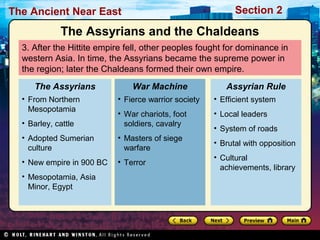
The Assyrians and the Chaldeans 
3. After the Hittite empire fell, other peoples fought for dominance in 
western Asia. In time, the Assyrians became the supreme power in 
the region; later the Chaldeans formed their own empire. 
The Assyrians 
• From Northern 
Mesopotamia 
• Barley, cattle 
• Adopted Sumerian 
culture 
• New empire in 900 BC 
• Mesopotamia, Asia 
Minor, Egypt 
War Machine 
• Fierce warrior society 
• War chariots, foot 
soldiers, cavalry 
• Masters of siege 
warfare 
• Terror 
Assyrian Rule 
• Efficient system 
• Local leaders 
• System of roads 
• Brutal with opposition 
• Cultural 
achievements, library
The Ancient Near East Section 2 
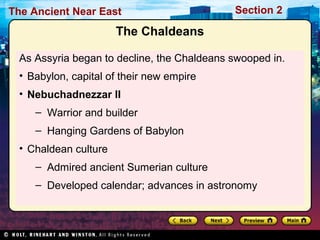
The Chaldeans 
As Assyria began to decline, the Chaldeans swooped in. 
• Babylon, capital of their new empire 
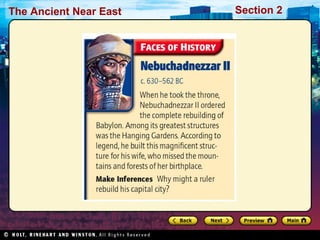
• Nebuchadnezzar II 
– Warrior and builder 
– Hanging Gardens of Babylon 
• Chaldean culture 
– Admired ancient Sumerian culture 
– Developed calendar; advances in astronomy
The Ancient Near East Section 2
The Ancient Near East Section 2 
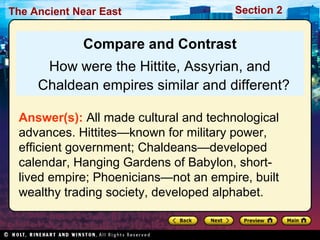
Compare and Contrast 
How were the Hittite, Assyrian, and 
Chaldean empires similar and different? 
Answer(s): All made cultural and technological 
advances. Hittites—known for military power, 
efficient government; Chaldeans—developed 
calendar, Hanging Gardens of Babylon, short-lived 
empire; Phoenicians—not an empire, built 
wealthy trading society, developed alphabet.
The Ancient Near East Section 2 
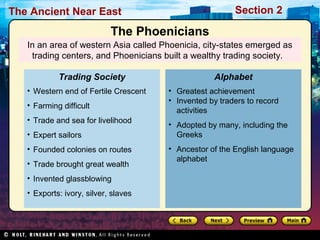
The Phoenicians 
In an area of western Asia called Phoenicia, city-states emerged as 
trading centers, and Phoenicians built a wealthy trading society. 
Trading Society 
• Western end of Fertile Crescent 
• Farming difficult 
• Trade and sea for livelihood 
• Expert sailors 
• Founded colonies on routes 
• Trade brought great wealth 
• Invented glassblowing 
• Exports: ivory, silver, slaves 
Alphabet 
• Greatest achievement 
• Invented by traders to record 
activities 
• Adopted by many, including the 
Greeks 
• Ancestor of the English language 
alphabet
The Ancient Near East Section 2
The Ancient Near East Section 2 
Find the Main Idea 
What were the Phoenicians’ most significant 
achievements? 
Answer(s): purple dye, glassblowing, alphabet

World History Ch. 2 Section 2 Notes

  • 1.
    The Ancient NearEast Section 2 Fertile Crescent Empires Preview • Main Idea / Reading Focus • The Hittites • Maps: Conquering the Fertile Crescent • The Assyrians and the Chaldeans • Faces of History: Nebuchadnezzar II • The Phoenicians • Map: Phoenician Trade • Quick Facts: Alphabet
  • 2.
    The Ancient NearEast Section 2 Fertile Crescent Empires Main Idea 1. Indo-European invaders introduced new technologies to the Fertile Crescent while adapting earlier technologies developed by the civilizations they encountered there. Reading Focus • What military advantages helped the Hittites establish an empire in Asia Minor? • What events led to the rise and fall of the Assyrian and Chaldean empires? • What were the main achievements of the Phoenicians?
  • 3.
    The Ancient NearEast Section 2 The Hittites Decline of Babylonian Empire • Nomadic tribes moved into the region, drawn by wealth • Included Indo-Europeans • Steppes: arid grasslands north of the Black Sea 2. Hittite Military Might • Hittites: warlike Indo-European tribe • Built strong empire in Asia Minor (now Turkey) • Horse-drawn war chariot and new techniques Hittite Culture • Blended their culture with cultures around them • First to make objects out of iron • Rule reached peak in 1300s BC
  • 4.
    The Ancient NearEast Section 2
  • 5.
    The Ancient NearEast Section 2 Summarize How were the Hittites able to build an empire in Asia Minor? Answer(s): With their military advantages, they were able to conquer people in surrounding areas.
  • 6.
    The Ancient NearEast Section 2 The Assyrians and the Chaldeans 3. After the Hittite empire fell, other peoples fought for dominance in western Asia. In time, the Assyrians became the supreme power in the region; later the Chaldeans formed their own empire. The Assyrians • From Northern Mesopotamia • Barley, cattle • Adopted Sumerian culture • New empire in 900 BC • Mesopotamia, Asia Minor, Egypt War Machine • Fierce warrior society • War chariots, foot soldiers, cavalry • Masters of siege warfare • Terror Assyrian Rule • Efficient system • Local leaders • System of roads • Brutal with opposition • Cultural achievements, library
  • 7.
    The Ancient NearEast Section 2 The Chaldeans As Assyria began to decline, the Chaldeans swooped in. • Babylon, capital of their new empire • Nebuchadnezzar II – Warrior and builder – Hanging Gardens of Babylon • Chaldean culture – Admired ancient Sumerian culture – Developed calendar; advances in astronomy
  • 8.
    The Ancient NearEast Section 2
  • 9.
    The Ancient NearEast Section 2 Compare and Contrast How were the Hittite, Assyrian, and Chaldean empires similar and different? Answer(s): All made cultural and technological advances. Hittites—known for military power, efficient government; Chaldeans—developed calendar, Hanging Gardens of Babylon, short-lived empire; Phoenicians—not an empire, built wealthy trading society, developed alphabet.
  • 10.
    The Ancient NearEast Section 2 The Phoenicians In an area of western Asia called Phoenicia, city-states emerged as trading centers, and Phoenicians built a wealthy trading society. Trading Society • Western end of Fertile Crescent • Farming difficult • Trade and sea for livelihood • Expert sailors • Founded colonies on routes • Trade brought great wealth • Invented glassblowing • Exports: ivory, silver, slaves Alphabet • Greatest achievement • Invented by traders to record activities • Adopted by many, including the Greeks • Ancestor of the English language alphabet
  • 11.
    The Ancient NearEast Section 2
  • 12.
    The Ancient NearEast Section 2
  • 13.
    The Ancient NearEast Section 2 Find the Main Idea What were the Phoenicians’ most significant achievements? Answer(s): purple dye, glassblowing, alphabet