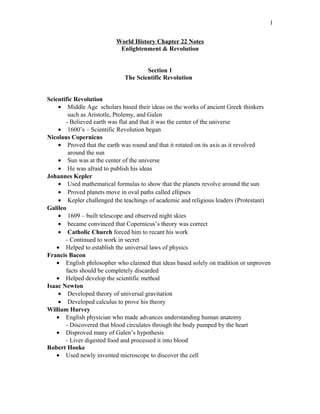
World History Chapter 22 Notes
Enlightenment & Revolution
Section 1
The Scientific Revolution
Scientific Revolution
• Middle Age scholars based their ideas on the works of ancient Greek thinkers
such as Aristotle, Ptolemy, and Galen
- Believed earth was flat and that it was the center of the universe
• 1600’s – Scientific Revolution began
Nicolaus Copernicus
• Proved that the earth was round and that it rotated on its axis as it revolved
around the sun
• Sun was at the center of the universe
• He was afraid to publish his ideas
Johannes Kepler
• Used mathematical formulas to show that the planets revolve around the sun
• Proved planets move in oval paths called ellipses
• Kepler challenged the teachings of academic and religious leaders (Protestant)
Galileo
• 1609 – built telescope and observed night skies
• became convinced that Copernicus’s theory was correct
• Catholic Church forced him to recant his work
- Continued to work in secret
• Helped to establish the universal laws of physics
Francis Bacon
• English philosopher who claimed that ideas based solely on tradition or unproven
facts should be completely discarded
• Helped develop the scientific method
Isaac Newton
• Developed theory of universal gravitation
• Developed calculus to prove his theory
William Harvey
• English physician who made advances understanding human anatomy
- Discovered that blood circulates through the body pumped by the heart
• Disproved many of Galen’s hypothesis
- Liver digested food and processed it into blood
Robert Hooke
• Used newly invented microscope to discover the cell
1
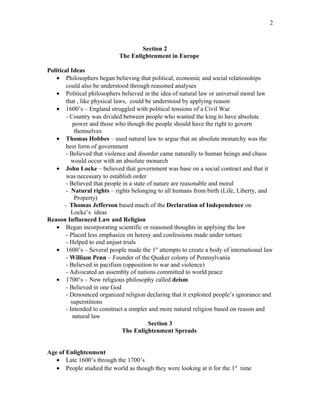
Section 2
The Enlightenment in Europe
Political Ideas
• Philosophers began believing that political, economic and social relationships
could also be understood through reasoned analyses
• Political philosophers believed in the idea of natural law or universal moral law
that , like physical laws, could be understood by applying reason
• 1600’s – England struggled with political tensions of a Civil War
- Country was divided between people who wanted the king to have absolute
power and those who though the people should have the right to govern
themselves
• Thomas Hobbes – used natural law to argue that an absolute monarchy was the
best form of government
- Believed that violence and disorder came naturally to human beings and chaos
would occur with an absolute monarch
• John Locke – believed that government was base on a social contract and that it
was necessary to establish order
- Believed that people in a state of nature are reasonable and moral
- Natural rights – rights belonging to all humans from birth (Life, Liberty, and
Property)
- Thomas Jefferson based much of the Declaration of Independence on
Locke’s ideas
Reason Influenced Law and Religion
• Began incorporating scientific or reasoned thoughts in applying the law
- Placed less emphasize on heresy and confessions made under torture
- Helped to end unjust trials
• 1600’s – Several people made the 1st
attempts to create a body of international law
- William Penn – Founder of the Quaker colony of Pennsylvania
- Believed in pacifism (opposition to war and violence)
- Advocated an assembly of nations committed to world peace
• 1700’s – New religious philosophy called deism
- Believed in one God
- Denounced organized religion declaring that it exploited people’s ignorance and
superstitions
- Intended to construct a simpler and more natural religion based on reason and
natural law
Section 3
The Enlightenment Spreads
Age of Enlightenment
• Late 1600’s through the 1700’s
• People studied the world as though they were looking at it for the 1st
time
2
- No longer held back by tradition
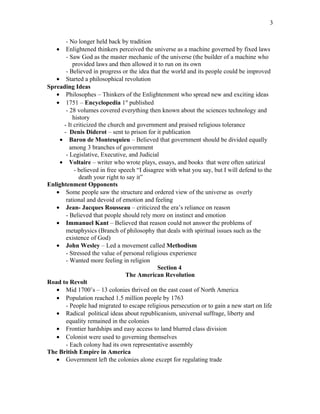
• Enlightened thinkers perceived the universe as a machine governed by fixed laws
- Saw God as the master mechanic of the universe (the builder of a machine who
provided laws and then allowed it to run on its own
- Believed in progress or the idea that the world and its people could be improved
• Started a philosophical revolution
Spreading Ideas
• Philosophes – Thinkers of the Enlightenment who spread new and exciting ideas
• 1751 – Encyclopedia 1st
published
- 28 volumes covered everything then known about the sciences technology and
history
- It criticized the church and government and praised religious tolerance
- Denis Diderot – sent to prison for it publication
• Baron de Montesquieu – Believed that government should be divided equally
among 3 branches of government
- Legislative, Executive, and Judicial
• Voltaire – writer who wrote plays, essays, and books that were often satirical
- believed in free speech “I disagree with what you say, but I will defend to the
death your right to say it”
Enlightenment Opponents
• Some people saw the structure and ordered view of the universe as overly
rational and devoid of emotion and feeling
• Jean- Jacques Rousseau – criticized the era’s reliance on reason
- Believed that people should rely more on instinct and emotion
• Immanuel Kant – Believed that reason could not answer the problems of
metaphysics (Branch of philosophy that deals with spiritual issues such as the
existence of God)
• John Wesley – Led a movement called Methodism
- Stressed the value of personal religious experience
- Wanted more feeling in religion
Section 4
The American Revolution
Road to Revolt
• Mid 1700’s – 13 colonies thrived on the east coast of North America
• Population reached 1.5 million people by 1763
- People had migrated to escape religious persecution or to gain a new start on life
• Radical political ideas about republicanism, universal suffrage, liberty and
equality remained in the colonies
• Frontier hardships and easy access to land blurred class division
• Colonist were used to governing themselves
- Each colony had its own representative assembly
The British Empire in America
• Government left the colonies alone except for regulating trade
3
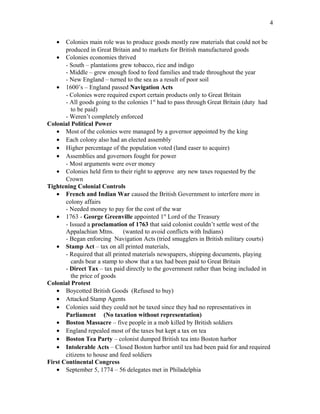
• Colonies main role was to produce goods mostly raw materials that could not be
produced in Great Britain and to markets for British manufactured goods
• Colonies economies thrived
- South – plantations grew tobacco, rice and indigo
- Middle – grew enough food to feed families and trade throughout the year
- New England – turned to the sea as a result of poor soil
• 1600’s – England passed Navigation Acts
- Colonies were required export certain products only to Great Britain
- All goods going to the colonies 1st
had to pass through Great Britain (duty had
to be paid)
- Weren’t completely enforced
Colonial Political Power
• Most of the colonies were managed by a governor appointed by the king
• Each colony also had an elected assembly
• Higher percentage of the population voted (land easer to acquire)
• Assemblies and governors fought for power
- Most arguments were over money
• Colonies held firm to their right to approve any new taxes requested by the
Crown
Tightening Colonial Controls
• French and Indian War caused the British Government to interfere more in
colony affairs
- Needed money to pay for the cost of the war
• 1763 - George Greenville appointed 1st
Lord of the Treasury
- Issued a proclamation of 1763 that said colonist couldn’t settle west of the
Appalachian Mtns. (wanted to avoid conflicts with Indians)
- Began enforcing Navigation Acts (tried smugglers in British military courts)
• Stamp Act – tax on all printed materials,
- Required that all printed materials newspapers, shipping documents, playing
cards bear a stamp to show that a tax had been paid to Great Britain
- Direct Tax – tax paid directly to the government rather than being included in
the price of goods
Colonial Protest
• Boycotted British Goods (Refused to buy)
• Attacked Stamp Agents
• Colonies said they could not be taxed since they had no representatives in
Parliament (No taxation without representation)
• Boston Massacre – five people in a mob killed by British soldiers
• England repealed most of the taxes but kept a tax on tea
• Boston Tea Party – colonist dumped British tea into Boston harbor
• Intolerable Acts – Closed Boston harbor until tea had been paid for and required
citizens to house and feed soldiers
First Continental Congress
• September 5, 1774 – 56 delegates met in Philadelphia
4
• 1st
time colonies were united as a group
• Congress resolved that the colonies were entitled to a free and exclusive power of
legislation
- Only colonial legislatures had the right to make laws
• Agreed not import goods from Great Britain after December 1774
• Agreed not to export goods to Greta Britain after September 1775
• Volunteer armies were organized in every colony (minutemen)
A War for Independence
• April 19, 1775 – Massachusetts governor ordered General Thomas Gauge to
seize colonist military supplies at Concord
- Paul Revere and William Dawes warned the minutemen
- British met resistance as they marched to Concord and back to Boston
Moving Toward Separation
• May 1775 – Second Continental Congress met in Philadelphia
• Organized an army
- Named George Washington military commander
• Tried one last time to arrange a peaceful compromise
- Sent Olive Branch Petition to King George III
- British government refused the petition
- Ended chances of peaceful settlement
• Thomas Paine – wrote Common Sense
- Called upon colonist to break away from Great Britain
• Thomas Jefferson – wrote
- Stated the colonist reasons for The Declaration of Independence separation
from Great Britain
- Jefferson influenced by John Locke’s concept of the “social contract”
- July 4 1776 – Congress adopted the Declaration of Independence
- Made reconciliation with Great Britain impossible
The War for Independence
• Revolution – the violent overthrow of a government
• Britain had a stronger army
• Had to fight a long distance war
- Had to conquer the whole country to win
• Battle of Saratoga - turning point of the war
- Colonies victory convinced France help
- Spain followed in 1779
- England became less interested in defeating the colonies
• Battle of Yorktown – last battle of the
- British surrender in October 1781
The United States Government
• United States was a confederation or loose union of independent states in the
beginning
• Articles of Confederation – 1st
government in U.S
5
- Too weak to deal with national problems
• The Constitution – set up a federal government in which political power was
divided between the national and states governments
- Also provided for separation of powers
- U.S. was a republic in which the President was elected
The Republic’s Significance
• Proved the Enlightenment values could work in practice
• Has inspired peoples throughout the world seeking freedom from oppression
6
- Too weak to deal with national problems
• The Constitution – set up a federal government in which political power was
divided between the national and states governments
- Also provided for separation of powers
- U.S. was a republic in which the President was elected
The Republic’s Significance
• Proved the Enlightenment values could work in practice
• Has inspired peoples throughout the world seeking freedom from oppression
6

World history chapter 22 notes

  • 1.
    World History Chapter22 Notes Enlightenment & Revolution Section 1 The Scientific Revolution Scientific Revolution • Middle Age scholars based their ideas on the works of ancient Greek thinkers such as Aristotle, Ptolemy, and Galen - Believed earth was flat and that it was the center of the universe • 1600’s – Scientific Revolution began Nicolaus Copernicus • Proved that the earth was round and that it rotated on its axis as it revolved around the sun • Sun was at the center of the universe • He was afraid to publish his ideas Johannes Kepler • Used mathematical formulas to show that the planets revolve around the sun • Proved planets move in oval paths called ellipses • Kepler challenged the teachings of academic and religious leaders (Protestant) Galileo • 1609 – built telescope and observed night skies • became convinced that Copernicus’s theory was correct • Catholic Church forced him to recant his work - Continued to work in secret • Helped to establish the universal laws of physics Francis Bacon • English philosopher who claimed that ideas based solely on tradition or unproven facts should be completely discarded • Helped develop the scientific method Isaac Newton • Developed theory of universal gravitation • Developed calculus to prove his theory William Harvey • English physician who made advances understanding human anatomy - Discovered that blood circulates through the body pumped by the heart • Disproved many of Galen’s hypothesis - Liver digested food and processed it into blood Robert Hooke • Used newly invented microscope to discover the cell 1
  • 2.
    Section 2 The Enlightenmentin Europe Political Ideas • Philosophers began believing that political, economic and social relationships could also be understood through reasoned analyses • Political philosophers believed in the idea of natural law or universal moral law that , like physical laws, could be understood by applying reason • 1600’s – England struggled with political tensions of a Civil War - Country was divided between people who wanted the king to have absolute power and those who though the people should have the right to govern themselves • Thomas Hobbes – used natural law to argue that an absolute monarchy was the best form of government - Believed that violence and disorder came naturally to human beings and chaos would occur with an absolute monarch • John Locke – believed that government was base on a social contract and that it was necessary to establish order - Believed that people in a state of nature are reasonable and moral - Natural rights – rights belonging to all humans from birth (Life, Liberty, and Property) - Thomas Jefferson based much of the Declaration of Independence on Locke’s ideas Reason Influenced Law and Religion • Began incorporating scientific or reasoned thoughts in applying the law - Placed less emphasize on heresy and confessions made under torture - Helped to end unjust trials • 1600’s – Several people made the 1st attempts to create a body of international law - William Penn – Founder of the Quaker colony of Pennsylvania - Believed in pacifism (opposition to war and violence) - Advocated an assembly of nations committed to world peace • 1700’s – New religious philosophy called deism - Believed in one God - Denounced organized religion declaring that it exploited people’s ignorance and superstitions - Intended to construct a simpler and more natural religion based on reason and natural law Section 3 The Enlightenment Spreads Age of Enlightenment • Late 1600’s through the 1700’s • People studied the world as though they were looking at it for the 1st time 2
  • 3.
    - No longerheld back by tradition • Enlightened thinkers perceived the universe as a machine governed by fixed laws - Saw God as the master mechanic of the universe (the builder of a machine who provided laws and then allowed it to run on its own - Believed in progress or the idea that the world and its people could be improved • Started a philosophical revolution Spreading Ideas • Philosophes – Thinkers of the Enlightenment who spread new and exciting ideas • 1751 – Encyclopedia 1st published - 28 volumes covered everything then known about the sciences technology and history - It criticized the church and government and praised religious tolerance - Denis Diderot – sent to prison for it publication • Baron de Montesquieu – Believed that government should be divided equally among 3 branches of government - Legislative, Executive, and Judicial • Voltaire – writer who wrote plays, essays, and books that were often satirical - believed in free speech “I disagree with what you say, but I will defend to the death your right to say it” Enlightenment Opponents • Some people saw the structure and ordered view of the universe as overly rational and devoid of emotion and feeling • Jean- Jacques Rousseau – criticized the era’s reliance on reason - Believed that people should rely more on instinct and emotion • Immanuel Kant – Believed that reason could not answer the problems of metaphysics (Branch of philosophy that deals with spiritual issues such as the existence of God) • John Wesley – Led a movement called Methodism - Stressed the value of personal religious experience - Wanted more feeling in religion Section 4 The American Revolution Road to Revolt • Mid 1700’s – 13 colonies thrived on the east coast of North America • Population reached 1.5 million people by 1763 - People had migrated to escape religious persecution or to gain a new start on life • Radical political ideas about republicanism, universal suffrage, liberty and equality remained in the colonies • Frontier hardships and easy access to land blurred class division • Colonist were used to governing themselves - Each colony had its own representative assembly The British Empire in America • Government left the colonies alone except for regulating trade 3
  • 4.
    • Colonies mainrole was to produce goods mostly raw materials that could not be produced in Great Britain and to markets for British manufactured goods • Colonies economies thrived - South – plantations grew tobacco, rice and indigo - Middle – grew enough food to feed families and trade throughout the year - New England – turned to the sea as a result of poor soil • 1600’s – England passed Navigation Acts - Colonies were required export certain products only to Great Britain - All goods going to the colonies 1st had to pass through Great Britain (duty had to be paid) - Weren’t completely enforced Colonial Political Power • Most of the colonies were managed by a governor appointed by the king • Each colony also had an elected assembly • Higher percentage of the population voted (land easer to acquire) • Assemblies and governors fought for power - Most arguments were over money • Colonies held firm to their right to approve any new taxes requested by the Crown Tightening Colonial Controls • French and Indian War caused the British Government to interfere more in colony affairs - Needed money to pay for the cost of the war • 1763 - George Greenville appointed 1st Lord of the Treasury - Issued a proclamation of 1763 that said colonist couldn’t settle west of the Appalachian Mtns. (wanted to avoid conflicts with Indians) - Began enforcing Navigation Acts (tried smugglers in British military courts) • Stamp Act – tax on all printed materials, - Required that all printed materials newspapers, shipping documents, playing cards bear a stamp to show that a tax had been paid to Great Britain - Direct Tax – tax paid directly to the government rather than being included in the price of goods Colonial Protest • Boycotted British Goods (Refused to buy) • Attacked Stamp Agents • Colonies said they could not be taxed since they had no representatives in Parliament (No taxation without representation) • Boston Massacre – five people in a mob killed by British soldiers • England repealed most of the taxes but kept a tax on tea • Boston Tea Party – colonist dumped British tea into Boston harbor • Intolerable Acts – Closed Boston harbor until tea had been paid for and required citizens to house and feed soldiers First Continental Congress • September 5, 1774 – 56 delegates met in Philadelphia 4
  • 5.
    • 1st time colonieswere united as a group • Congress resolved that the colonies were entitled to a free and exclusive power of legislation - Only colonial legislatures had the right to make laws • Agreed not import goods from Great Britain after December 1774 • Agreed not to export goods to Greta Britain after September 1775 • Volunteer armies were organized in every colony (minutemen) A War for Independence • April 19, 1775 – Massachusetts governor ordered General Thomas Gauge to seize colonist military supplies at Concord - Paul Revere and William Dawes warned the minutemen - British met resistance as they marched to Concord and back to Boston Moving Toward Separation • May 1775 – Second Continental Congress met in Philadelphia • Organized an army - Named George Washington military commander • Tried one last time to arrange a peaceful compromise - Sent Olive Branch Petition to King George III - British government refused the petition - Ended chances of peaceful settlement • Thomas Paine – wrote Common Sense - Called upon colonist to break away from Great Britain • Thomas Jefferson – wrote - Stated the colonist reasons for The Declaration of Independence separation from Great Britain - Jefferson influenced by John Locke’s concept of the “social contract” - July 4 1776 – Congress adopted the Declaration of Independence - Made reconciliation with Great Britain impossible The War for Independence • Revolution – the violent overthrow of a government • Britain had a stronger army • Had to fight a long distance war - Had to conquer the whole country to win • Battle of Saratoga - turning point of the war - Colonies victory convinced France help - Spain followed in 1779 - England became less interested in defeating the colonies • Battle of Yorktown – last battle of the - British surrender in October 1781 The United States Government • United States was a confederation or loose union of independent states in the beginning • Articles of Confederation – 1st government in U.S 5
  • 6.
    - Too weakto deal with national problems • The Constitution – set up a federal government in which political power was divided between the national and states governments - Also provided for separation of powers - U.S. was a republic in which the President was elected The Republic’s Significance • Proved the Enlightenment values could work in practice • Has inspired peoples throughout the world seeking freedom from oppression 6
  • 7.
    - Too weakto deal with national problems • The Constitution – set up a federal government in which political power was divided between the national and states governments - Also provided for separation of powers - U.S. was a republic in which the President was elected The Republic’s Significance • Proved the Enlightenment values could work in practice • Has inspired peoples throughout the world seeking freedom from oppression 6