Chapter 19:
The New Industrial Order,
1870-1914
Experience History
DAVIDSON • GIENAPP • HEYRMAN • LYTLE • STOFF

© 2011 The McGraw-Hill Companies, Inc. All Rights Reserved.
2

Preview


“What made America in the 1880s so different
from just a few decades earlier was not the
speed and comfort of travel or the wonders of
new technology. The true marvel was the
emerging industrial order that underlay those
technologies and made them possible. …Its
growth in scale, scope, and complexity…was at
first slow and required innovations in many
different areas of society.”

© 2011 The McGraw-Hill Companies, Inc. All Rights Reserved.
3

The Highlights






The Development of Industrial Systems
Railroads: America’s First Big Business
The Growth of Big Business
The Workers’ World
The Systems of Labor

© 2011 The McGraw-Hill Companies, Inc. All Rights Reserved.
4

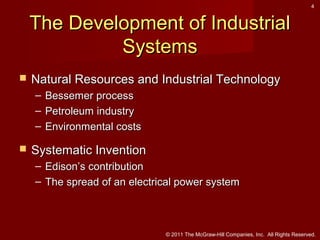
The Development of Industrial
Systems


Natural Resources and Industrial Technology
–
–
–



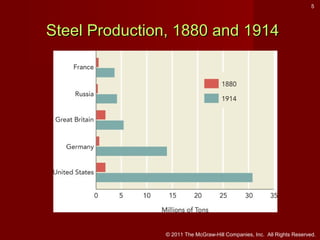
Bessemer process
Petroleum industry
Environmental costs

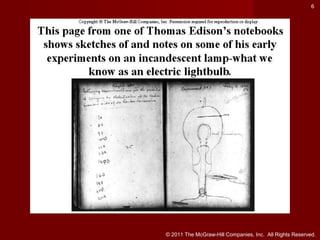
Systematic Invention
– Edison’s contribution
– The spread of an electrical power system

© 2011 The McGraw-Hill Companies, Inc. All Rights Reserved.
5

Steel Production, 1880 and 1914

© 2011 The McGraw-Hill Companies, Inc. All Rights Reserved.
6

© 2011 The McGraw-Hill Companies, Inc. All Rights Reserved.
7



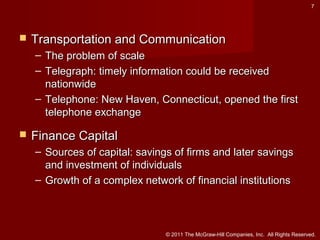
Transportation and Communication
– The problem of scale
– Telegraph: timely information could be received
nationwide
– Telephone: New Haven, Connecticut, opened the first
telephone exchange



Finance Capital
– Sources of capital: savings of firms and later savings
and investment of individuals
– Growth of a complex network of financial institutions

© 2011 The McGraw-Hill Companies, Inc. All Rights Reserved.
8



The Corporation
– Advantages of the corporation: raise large sums of
money, outlive its owners, limited liability, separated
owners from day-to-day management
– By the turn of the century, corporations were making
two-thirds of all manufactured products in the U.S.



An International Pool of Labor
–
–
–

Global labor network
Migration chains
Domestic sources

© 2011 The McGraw-Hill Companies, Inc. All Rights Reserved.
9

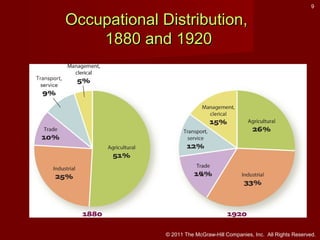
Occupational Distribution,
1880 and 1920

© 2011 The McGraw-Hill Companies, Inc. All Rights Reserved.
10

Railroads: America’s First
Big Business


A Managerial Revolution
– Pioneering trunk lines
– The new managers: beneath owners but with wide
authority over operations

© 2011 The McGraw-Hill Companies, Inc. All Rights Reserved.
11



Competition and Consolidation
– Railroads saddled with enormous fixed costs:
equipment, payroll, high debts
– Rate wars
– Pooling: informal agreements among competing
companies to act together



The Challenge of Finance
– New ways of raising money
– Investment bankers advised companies about their
business affairs

© 2011 The McGraw-Hill Companies, Inc. All Rights Reserved.
12

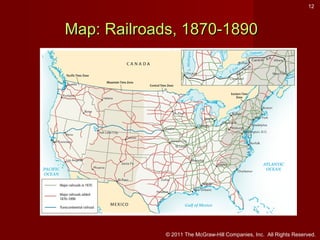
Map: Railroads, 1870-1890

© 2011 The McGraw-Hill Companies, Inc. All Rights Reserved.
13

The Growth of Big Business


Strategies of Growth
–
–
–



Salt makers drew together in the nation’s first pool
Horizontal growth: joining loosely together with rivals
Vertical integration: integrated several different
activities inside one company

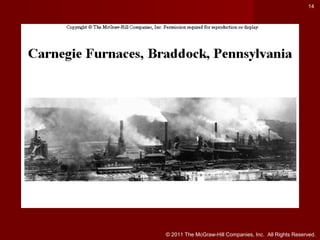
Carnegie Integrates Steel
– 1875: Carnegie opens first mill in midst of a severe
depression
– Expanded horizontally, purchasing rival steel mills
and constructing new ones
© 2011 The McGraw-Hill Companies, Inc. All Rights Reserved.
14

© 2011 The McGraw-Hill Companies, Inc. All Rights Reserved.
15



Rockefeller and the Great Standard Oil Trust
– Rockefeller’s methods of expansion
– The trust: stockholders of corporation surrendered
their shares “in trust”



The Mergers of J. Pierpont Morgan
– The holding company
– The merger movement



Corporate Defenders
– The gospel of wealth
– Social Darwinism

© 2011 The McGraw-Hill Companies, Inc. All Rights Reserved.
16



Corporate Critics
– Socialist Labor party
– Sherman Antitrust Act
– United States v. E. C. Knight Co.



The Costs of Doing Business
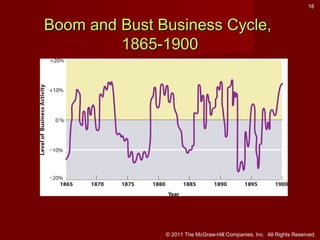
– The boom-and-bust cycle
– Three severe depressions rocked the economy in the
last third of the nineteenth century

© 2011 The McGraw-Hill Companies, Inc. All Rights Reserved.
17

“Andrew Carnegie invoked the gospel of wealth to justify
his millions, but a group of radical critics looked
on his libraries and foundations as desperate attempts
to buy peace of mind.”

© 2011 The McGraw-Hill Companies, Inc. All Rights Reserved.
18

Boom and Bust Business Cycle,
1865-1900

© 2011 The McGraw-Hill Companies, Inc. All Rights Reserved.
19

The Workers’ World


Industrial Work
–
–
–

Pattern of industrial work
Taylorism: time-and-motion studies
Worker citizens: expected enough money to support
and educate, as well as enough time to stay abreast
of current affairs

© 2011 The McGraw-Hill Companies, Inc. All Rights Reserved.
20



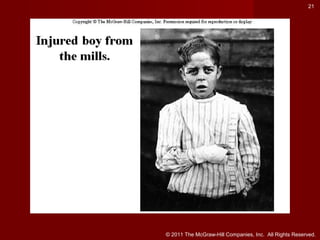
Children, Women, and African Americans
– On average, children worked 60 hours a week
– Even more than women, African American men faced
discrimination in the workplace



The American Dream of Success
– Rising real wages
– Social mobility

© 2011 The McGraw-Hill Companies, Inc. All Rights Reserved.
21

© 2011 The McGraw-Hill Companies, Inc. All Rights Reserved.
22

The Systems of Labor


Early Unions
– National Labor Union
– NLU wilted during the depression of 1873



The Knights of Labor
– Terence Powderly
– Looked to abolish the wage system and replace with
a cooperative economy

© 2011 The McGraw-Hill Companies, Inc. All Rights Reserved.
23



The American Federation of Labor
– Samuel Gompers
– Failure of organized labor



The Limits of Industrial Systems
–
–
–
–
–

Spontaneous protests
Molly Maguires
Great Railroad Strike
Laundresses strike
Haymarket Square riot

© 2011 The McGraw-Hill Companies, Inc. All Rights Reserved.
24



Management Strikes
– Pullman strike (1894)
– Management weapons: “yellow dog” contracts,
lockouts

“In a matter of only 30 or 40 years, the new industrial
order transformed the landscape of America. It left its
mark elsewhere in the world, too.”

© 2011 The McGraw-Hill Companies, Inc. All Rights Reserved.

Chapter 19

  • 1.
    Chapter 19: The NewIndustrial Order, 1870-1914 Experience History DAVIDSON • GIENAPP • HEYRMAN • LYTLE • STOFF © 2011 The McGraw-Hill Companies, Inc. All Rights Reserved.
  • 2.
    2 Preview  “What made Americain the 1880s so different from just a few decades earlier was not the speed and comfort of travel or the wonders of new technology. The true marvel was the emerging industrial order that underlay those technologies and made them possible. …Its growth in scale, scope, and complexity…was at first slow and required innovations in many different areas of society.” © 2011 The McGraw-Hill Companies, Inc. All Rights Reserved.
  • 3.
    3 The Highlights      The Developmentof Industrial Systems Railroads: America’s First Big Business The Growth of Big Business The Workers’ World The Systems of Labor © 2011 The McGraw-Hill Companies, Inc. All Rights Reserved.
  • 4.
    4 The Development ofIndustrial Systems  Natural Resources and Industrial Technology – – –  Bessemer process Petroleum industry Environmental costs Systematic Invention – Edison’s contribution – The spread of an electrical power system © 2011 The McGraw-Hill Companies, Inc. All Rights Reserved.
  • 5.
    5 Steel Production, 1880and 1914 © 2011 The McGraw-Hill Companies, Inc. All Rights Reserved.
  • 6.
    6 © 2011 TheMcGraw-Hill Companies, Inc. All Rights Reserved.
  • 7.
    7  Transportation and Communication –The problem of scale – Telegraph: timely information could be received nationwide – Telephone: New Haven, Connecticut, opened the first telephone exchange  Finance Capital – Sources of capital: savings of firms and later savings and investment of individuals – Growth of a complex network of financial institutions © 2011 The McGraw-Hill Companies, Inc. All Rights Reserved.
  • 8.
    8  The Corporation – Advantagesof the corporation: raise large sums of money, outlive its owners, limited liability, separated owners from day-to-day management – By the turn of the century, corporations were making two-thirds of all manufactured products in the U.S.  An International Pool of Labor – – – Global labor network Migration chains Domestic sources © 2011 The McGraw-Hill Companies, Inc. All Rights Reserved.
  • 9.
    9 Occupational Distribution, 1880 and1920 © 2011 The McGraw-Hill Companies, Inc. All Rights Reserved.
  • 10.
    10 Railroads: America’s First BigBusiness  A Managerial Revolution – Pioneering trunk lines – The new managers: beneath owners but with wide authority over operations © 2011 The McGraw-Hill Companies, Inc. All Rights Reserved.
  • 11.
    11  Competition and Consolidation –Railroads saddled with enormous fixed costs: equipment, payroll, high debts – Rate wars – Pooling: informal agreements among competing companies to act together  The Challenge of Finance – New ways of raising money – Investment bankers advised companies about their business affairs © 2011 The McGraw-Hill Companies, Inc. All Rights Reserved.
  • 12.
    12 Map: Railroads, 1870-1890 ©2011 The McGraw-Hill Companies, Inc. All Rights Reserved.
  • 13.
    13 The Growth ofBig Business  Strategies of Growth – – –  Salt makers drew together in the nation’s first pool Horizontal growth: joining loosely together with rivals Vertical integration: integrated several different activities inside one company Carnegie Integrates Steel – 1875: Carnegie opens first mill in midst of a severe depression – Expanded horizontally, purchasing rival steel mills and constructing new ones © 2011 The McGraw-Hill Companies, Inc. All Rights Reserved.
  • 14.
    14 © 2011 TheMcGraw-Hill Companies, Inc. All Rights Reserved.
  • 15.
    15  Rockefeller and theGreat Standard Oil Trust – Rockefeller’s methods of expansion – The trust: stockholders of corporation surrendered their shares “in trust”  The Mergers of J. Pierpont Morgan – The holding company – The merger movement  Corporate Defenders – The gospel of wealth – Social Darwinism © 2011 The McGraw-Hill Companies, Inc. All Rights Reserved.
  • 16.
    16  Corporate Critics – SocialistLabor party – Sherman Antitrust Act – United States v. E. C. Knight Co.  The Costs of Doing Business – The boom-and-bust cycle – Three severe depressions rocked the economy in the last third of the nineteenth century © 2011 The McGraw-Hill Companies, Inc. All Rights Reserved.
  • 17.
    17 “Andrew Carnegie invokedthe gospel of wealth to justify his millions, but a group of radical critics looked on his libraries and foundations as desperate attempts to buy peace of mind.” © 2011 The McGraw-Hill Companies, Inc. All Rights Reserved.
  • 18.
    18 Boom and BustBusiness Cycle, 1865-1900 © 2011 The McGraw-Hill Companies, Inc. All Rights Reserved.
  • 19.
    19 The Workers’ World  IndustrialWork – – – Pattern of industrial work Taylorism: time-and-motion studies Worker citizens: expected enough money to support and educate, as well as enough time to stay abreast of current affairs © 2011 The McGraw-Hill Companies, Inc. All Rights Reserved.
  • 20.
    20  Children, Women, andAfrican Americans – On average, children worked 60 hours a week – Even more than women, African American men faced discrimination in the workplace  The American Dream of Success – Rising real wages – Social mobility © 2011 The McGraw-Hill Companies, Inc. All Rights Reserved.
  • 21.
    21 © 2011 TheMcGraw-Hill Companies, Inc. All Rights Reserved.
  • 22.
    22 The Systems ofLabor  Early Unions – National Labor Union – NLU wilted during the depression of 1873  The Knights of Labor – Terence Powderly – Looked to abolish the wage system and replace with a cooperative economy © 2011 The McGraw-Hill Companies, Inc. All Rights Reserved.
  • 23.
    23  The American Federationof Labor – Samuel Gompers – Failure of organized labor  The Limits of Industrial Systems – – – – – Spontaneous protests Molly Maguires Great Railroad Strike Laundresses strike Haymarket Square riot © 2011 The McGraw-Hill Companies, Inc. All Rights Reserved.
  • 24.
    24  Management Strikes – Pullmanstrike (1894) – Management weapons: “yellow dog” contracts, lockouts “In a matter of only 30 or 40 years, the new industrial order transformed the landscape of America. It left its mark elsewhere in the world, too.” © 2011 The McGraw-Hill Companies, Inc. All Rights Reserved.