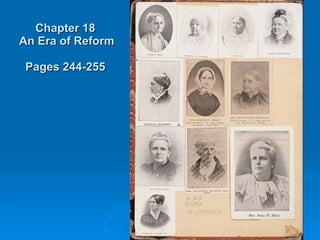
Chapter 18  An Era of Reform Pages 244-255
People to Know! Henry David Thoreau Ralph Waldo Emerson Sojourner Truth William Lloyd Garrison Dorothea Dix Horace Mann Frederick Douglass Lucretia Mott Susan B. Anthony Elizabeth Cady Stanton Look up these famous Americans and see what you can find.  Print out  information about them.  Highlight their achievements and be able to comment about them Tuesday!  NO WIKIPEDIA
Ch. 18 quiz on Friday! Use a highlight terms and people from the chapter.  These are the items you should study.
First Great Awakening: Check Page 56 Time period: Purpose of the movement? What did preachers do? Have your textbook & 3 pieces of paper!
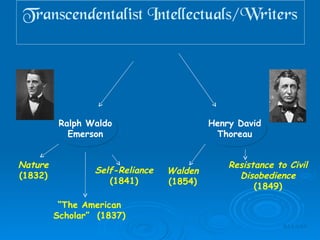
Transcendentalist Intellectuals/Writers Ralph Waldo Emerson Henry David Thoreau Nature (1832) Walden (1854) Resistance to Civil Disobedience (1849) Self-Reliance  (1841) “ The American Scholar”  (1837) R3-1/3/4/5
Ch 18 -- An Era of Reform Take a preview sheet Read Page 245-248 in the Textbook
Ch 18 -- An Era of Reform 18.1 Introduction Reformers:  People who work to correct failings or injustices.  OR  -- copy one of these definitions! People who help to change society when it treats others unfairly.
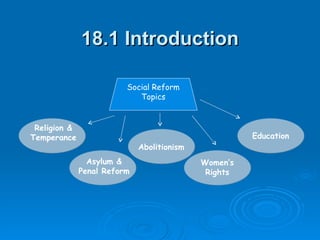
18.1 Introduction Religion & Temperance Asylum & Penal Reform Education Women’s Rights Abolitionism Social Reform Topics
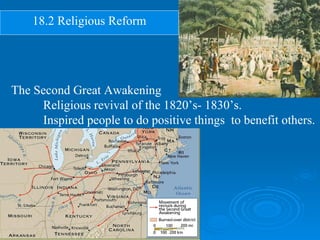
18.2 Religious Reform The Second Great Awakening Religious revival of the 1820’s- 1830’s.  Inspired people to do positive things  to benefit others.
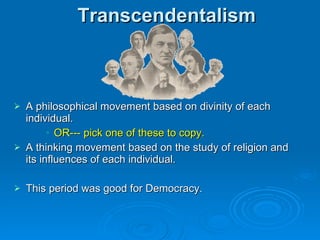
Transcendentalism A philosophical movement based on divinity of each individual.  OR--- pick one of these to copy. A thinking movement based on the study of religion and its influences of each individual.  This period was good for Democracy.
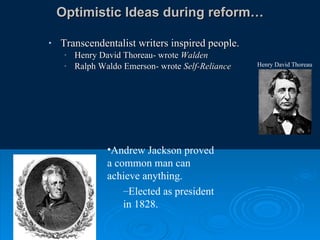
Optimistic Ideas during reform… Transcendentalist writers inspired people. Henry David Thoreau- wrote  Walden Ralph Waldo Emerson- wrote  Self-Reliance Andrew Jackson proved a common man can achieve anything.  Elected as president in 1828. Henry David Thoreau
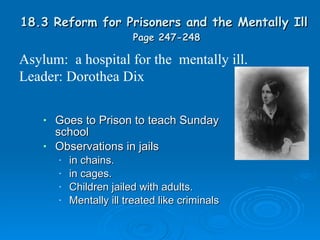
18.3 Reform for Prisoners and the Mentally Ill  Page 247-248 Goes to Prison to teach Sunday school Observations in jails in chains. in cages. Children jailed with adults. Mentally ill treated like criminals Asylum:  a hospital for the  mentally ill. Leader: Dorothea Dix
Treatment of the Mentally Ill Asylums For wealthy Not enough facilities Dix takes a stand by… Gathering data for two years. Preparing a report to present to the legislature. Reaction: Eliminated debtor’s prisons. Justice systems for children. Outlawed cruel punishment  Asylums were created Showing that women could make a social difference ! http://www.easternstate.org/
After your notes…. Draw an artifact to represent the time. Keep it simple Visually appealing Create a slogan Catchy & short phrase Easy to remember
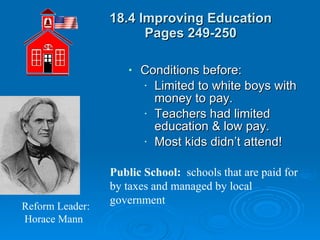
18.4 Improving Education Pages 249-250 Conditions before: Limited to white boys with money to pay. Teachers had limited education & low pay. Most kids didn’t attend! Reform Leader: Horace Mann Public School:   schools that are paid for  by taxes and managed by local government
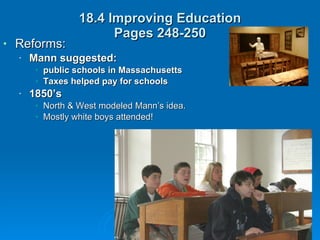
18.4 Improving Education Pages 248-250 Reforms:  Mann suggested: public schools in Massachusetts Taxes helped pay for schools 1850’s   North & West modeled Mann’s idea. Mostly white boys attended!
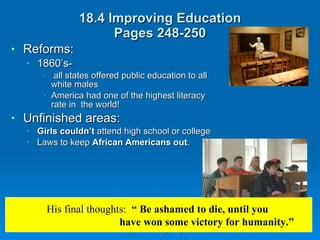
18.4 Improving Education Pages 248-250 Reforms:  1860’s- all states offered public education to all white males America had one of the highest literacy rate in  the world! Unfinished areas: Girls couldn’t  attend high school or college Laws to keep  African Americans out . His final thoughts:  “ Be ashamed to die, until you  have won some victory for humanity.”
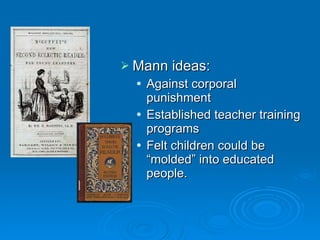
Mann ideas: Against corporal punishment Established teacher training programs Felt children could be “molded” into educated people.
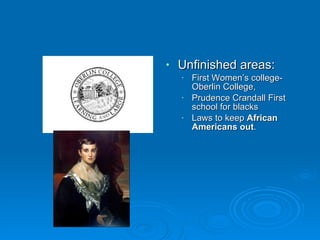
Unfinished areas: First Women’s college- Oberlin College, Prudence Crandall First school for blacks Laws to keep  African Americans out .
After your notes…. Draw an artifact to represent the time. Keep it simple Visually appealing Create a slogan Catchy & short phrase Easy to remember
Thursday 11/11- Veterans Day Get your textbook &  paper for today! Have your journal out to be collected. http://www.history.com/this-day-in-history
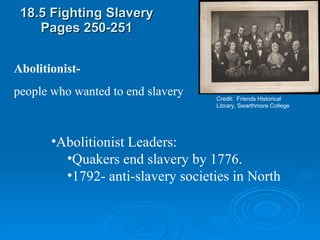
18.5 Fighting Slavery Pages 250-251 Credit:  Friends Historical Library, Swarthmore College Abolitionist- people who wanted to end slavery Abolitionist Leaders:  Quakers end slavery by 1776. 1792- anti-slavery societies in North
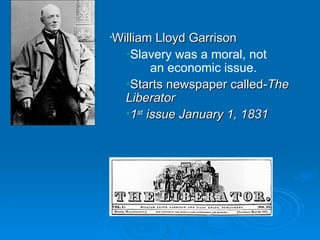
William Lloyd Garrison  Slavery was a moral, not   an economic issue. Starts newspaper called- The Liberator 1 st  issue January 1, 1831
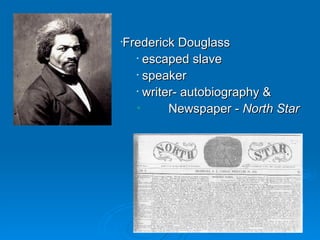
Frederick Douglass escaped slave speaker writer- autobiography &  Newspaper -  North Star
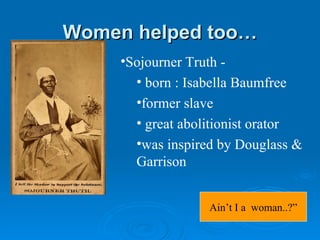
Women helped too… Sojourner Truth -  born : Isabella Baumfree former slave  great abolitionist orator was inspired by Douglass & Garrison Ain’t I a  woman..?”
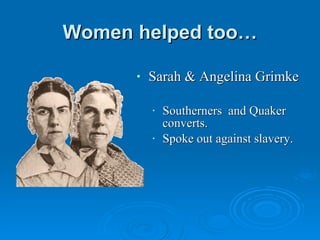
Women helped too… Sarah & Angelina Grimke  Southerners  and Quaker converts.  Spoke out against slavery.
Who said that…? Right is of no sex- Truth is of no color-  God is the father of us all, and we are all Brethren. “ I will not retreat a single inch-  and I will be heard.” W.L.Garrison Frederick Douglass Copy and Rewrite the quotes  in your own words..
After your notes…. Draw an artifact to represent the time. Keep it simple Visually appealing Create a slogan Catchy & short phrase Easy to remember
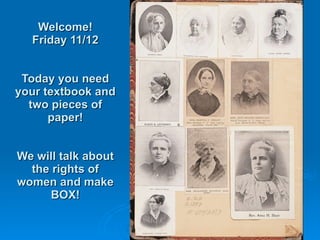
Welcome! Friday 11/12 Today you need your textbook and two pieces of paper! We will talk about the rights of women and make BOX!
18.6  Equal Rights for Women Page 252-253 Early conditions: Couldn’t vote or hold office Legal status of a minor. Money & property controlled by fathers or husbands. Could be physically disciplined Couldn’t file for divorce. Couldn’t make a will or sign contract. Realization:  Women and slaves had things in common!
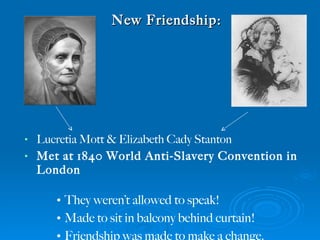
New Friendship: Lucretia Mott & Elizabeth Cady Stanton  Met at 1840 World Anti-Slavery Convention in London They weren’t allowed to speak! Made to sit in balcony behind curtain! Friendship was made to make a change.
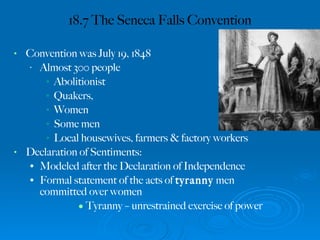
18.7 The Seneca Falls Convention Convention was July 19, 1848 Almost 300 people Abolitionist Quakers, Women Some men Local housewives, farmers & factory workers Declaration of Sentiments: Modeled after the Declaration of Independence Formal statement of the acts of  tyranny  men committed over women Tyranny – unrestrained exercise of power
18.7 The Seneca Falls Convention   The convention demands the right to vote. Frederick Douglass supported women’s right to vote. Sojourner Truth spoke  Susan B. Anthony spoke Elizabeth C. Stanton’s wrote  speeches-  she was too shy Reformers made progress slowly. 19 th  Amendment- gives women the right to vote was not passed until 1920!
After your notes…. Draw an artifact to represent the time. Keep it simple Visually appealing Create a slogan Catchy & short phrase Easy to remember
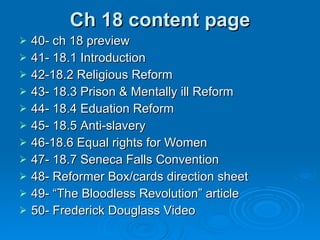
Ch 18 content page 40- ch 18 preview 41- 18.1 Introduction 42-18.2 Religious Reform 43- 18.3 Prison & Mentally ill Reform 44- 18.4 Eduation Reform 45- 18.5 Anti-slavery 46-18.6 Equal rights for Women 47- 18.7 Seneca Falls Convention 48- Reformer Box/cards direction sheet 49- “The Bloodless Revolution” article 50- Frederick Douglass Video
Museum Exhibit For each section draw an scene with one or more artifacts that will pop out and represents the section. At the base, write a description of the artifact and explain how this reform was important to our history.  This should be a paragraph  Use your slogan at the top. Make sure your exhibit is colorful. Reform Box:  For each section create  two sentences to connect it to the reform movement  like described in class. Draw a scene and artifact that can represent the reform movement in a creative way on the box you made. One side should have the title or slogan and the other three sides should have a detailed explanation of how this reform movement was impacted our history.
2007  Care toon Contest What is it? An original cartoon that reflects a positive theme.-- Anti-violence Who? Anyone interested Deadline: school-December 10th Judging:  on creativity, originality & message- groups ADULT & STUDENT Prize:  $1,000 in each category How? Original creation No copyrighted or pre-designed material Create freehand or electronically Medium: black & white OR color Size: 8.5x 11
 Women’s rights sites… http://www.pbs.org/stantonanthony/ \ Statistics about medical profession http://www.ama-assn.org/ama/pub/category/171.html Demographics about the Congress http://www.congress.org/congressorg/directory/congdir.tt Bush’s cabinet members http://www.whitehouse.gov/government/cabinet.html
Seneca Falls Convention The convention demands the right to vote. Reformers made progress slowly. But not see the right to vote until 1920

Chapter 18 11-10

  • 1.
    Chapter 18 An Era of Reform Pages 244-255
  • 2.
    People to Know!Henry David Thoreau Ralph Waldo Emerson Sojourner Truth William Lloyd Garrison Dorothea Dix Horace Mann Frederick Douglass Lucretia Mott Susan B. Anthony Elizabeth Cady Stanton Look up these famous Americans and see what you can find. Print out information about them. Highlight their achievements and be able to comment about them Tuesday! NO WIKIPEDIA
  • 3.
    Ch. 18 quizon Friday! Use a highlight terms and people from the chapter. These are the items you should study.
  • 4.
    First Great Awakening:Check Page 56 Time period: Purpose of the movement? What did preachers do? Have your textbook & 3 pieces of paper!
  • 5.
    Transcendentalist Intellectuals/Writers RalphWaldo Emerson Henry David Thoreau Nature (1832) Walden (1854) Resistance to Civil Disobedience (1849) Self-Reliance (1841) “ The American Scholar” (1837) R3-1/3/4/5
  • 6.
    Ch 18 --An Era of Reform Take a preview sheet Read Page 245-248 in the Textbook
  • 7.
    Ch 18 --An Era of Reform 18.1 Introduction Reformers: People who work to correct failings or injustices. OR -- copy one of these definitions! People who help to change society when it treats others unfairly.
  • 8.
    18.1 Introduction Religion& Temperance Asylum & Penal Reform Education Women’s Rights Abolitionism Social Reform Topics
  • 9.
    18.2 Religious ReformThe Second Great Awakening Religious revival of the 1820’s- 1830’s. Inspired people to do positive things to benefit others.
  • 10.
    Transcendentalism A philosophicalmovement based on divinity of each individual. OR--- pick one of these to copy. A thinking movement based on the study of religion and its influences of each individual. This period was good for Democracy.
  • 11.
    Optimistic Ideas duringreform… Transcendentalist writers inspired people. Henry David Thoreau- wrote Walden Ralph Waldo Emerson- wrote Self-Reliance Andrew Jackson proved a common man can achieve anything. Elected as president in 1828. Henry David Thoreau
  • 12.
    18.3 Reform forPrisoners and the Mentally Ill Page 247-248 Goes to Prison to teach Sunday school Observations in jails in chains. in cages. Children jailed with adults. Mentally ill treated like criminals Asylum: a hospital for the mentally ill. Leader: Dorothea Dix
  • 13.
    Treatment of theMentally Ill Asylums For wealthy Not enough facilities Dix takes a stand by… Gathering data for two years. Preparing a report to present to the legislature. Reaction: Eliminated debtor’s prisons. Justice systems for children. Outlawed cruel punishment Asylums were created Showing that women could make a social difference ! http://www.easternstate.org/
  • 14.
    After your notes….Draw an artifact to represent the time. Keep it simple Visually appealing Create a slogan Catchy & short phrase Easy to remember
  • 15.
    18.4 Improving EducationPages 249-250 Conditions before: Limited to white boys with money to pay. Teachers had limited education & low pay. Most kids didn’t attend! Reform Leader: Horace Mann Public School: schools that are paid for by taxes and managed by local government
  • 16.
    18.4 Improving EducationPages 248-250 Reforms: Mann suggested: public schools in Massachusetts Taxes helped pay for schools 1850’s North & West modeled Mann’s idea. Mostly white boys attended!
  • 17.
    18.4 Improving EducationPages 248-250 Reforms: 1860’s- all states offered public education to all white males America had one of the highest literacy rate in the world! Unfinished areas: Girls couldn’t attend high school or college Laws to keep African Americans out . His final thoughts: “ Be ashamed to die, until you have won some victory for humanity.”
  • 18.
    Mann ideas: Againstcorporal punishment Established teacher training programs Felt children could be “molded” into educated people.
  • 19.
    Unfinished areas: FirstWomen’s college- Oberlin College, Prudence Crandall First school for blacks Laws to keep African Americans out .
  • 20.
    After your notes….Draw an artifact to represent the time. Keep it simple Visually appealing Create a slogan Catchy & short phrase Easy to remember
  • 21.
    Thursday 11/11- VeteransDay Get your textbook & paper for today! Have your journal out to be collected. http://www.history.com/this-day-in-history
  • 22.
    18.5 Fighting SlaveryPages 250-251 Credit: Friends Historical Library, Swarthmore College Abolitionist- people who wanted to end slavery Abolitionist Leaders: Quakers end slavery by 1776. 1792- anti-slavery societies in North
  • 23.
    William Lloyd Garrison Slavery was a moral, not an economic issue. Starts newspaper called- The Liberator 1 st issue January 1, 1831
  • 24.
    Frederick Douglass escapedslave speaker writer- autobiography & Newspaper - North Star
  • 25.
    Women helped too…Sojourner Truth - born : Isabella Baumfree former slave great abolitionist orator was inspired by Douglass & Garrison Ain’t I a woman..?”
  • 26.
    Women helped too…Sarah & Angelina Grimke Southerners and Quaker converts. Spoke out against slavery.
  • 27.
    Who said that…?Right is of no sex- Truth is of no color- God is the father of us all, and we are all Brethren. “ I will not retreat a single inch- and I will be heard.” W.L.Garrison Frederick Douglass Copy and Rewrite the quotes in your own words..
  • 28.
    After your notes….Draw an artifact to represent the time. Keep it simple Visually appealing Create a slogan Catchy & short phrase Easy to remember
  • 29.
    Welcome! Friday 11/12Today you need your textbook and two pieces of paper! We will talk about the rights of women and make BOX!
  • 30.
    18.6 EqualRights for Women Page 252-253 Early conditions: Couldn’t vote or hold office Legal status of a minor. Money & property controlled by fathers or husbands. Could be physically disciplined Couldn’t file for divorce. Couldn’t make a will or sign contract. Realization: Women and slaves had things in common!
  • 31.
    New Friendship: LucretiaMott & Elizabeth Cady Stanton Met at 1840 World Anti-Slavery Convention in London They weren’t allowed to speak! Made to sit in balcony behind curtain! Friendship was made to make a change.
  • 32.
    18.7 The SenecaFalls Convention Convention was July 19, 1848 Almost 300 people Abolitionist Quakers, Women Some men Local housewives, farmers & factory workers Declaration of Sentiments: Modeled after the Declaration of Independence Formal statement of the acts of tyranny men committed over women Tyranny – unrestrained exercise of power
  • 33.
    18.7 The SenecaFalls Convention The convention demands the right to vote. Frederick Douglass supported women’s right to vote. Sojourner Truth spoke Susan B. Anthony spoke Elizabeth C. Stanton’s wrote speeches- she was too shy Reformers made progress slowly. 19 th Amendment- gives women the right to vote was not passed until 1920!
  • 34.
    After your notes….Draw an artifact to represent the time. Keep it simple Visually appealing Create a slogan Catchy & short phrase Easy to remember
  • 35.
    Ch 18 contentpage 40- ch 18 preview 41- 18.1 Introduction 42-18.2 Religious Reform 43- 18.3 Prison & Mentally ill Reform 44- 18.4 Eduation Reform 45- 18.5 Anti-slavery 46-18.6 Equal rights for Women 47- 18.7 Seneca Falls Convention 48- Reformer Box/cards direction sheet 49- “The Bloodless Revolution” article 50- Frederick Douglass Video
  • 36.
    Museum Exhibit Foreach section draw an scene with one or more artifacts that will pop out and represents the section. At the base, write a description of the artifact and explain how this reform was important to our history. This should be a paragraph Use your slogan at the top. Make sure your exhibit is colorful. Reform Box: For each section create two sentences to connect it to the reform movement like described in class. Draw a scene and artifact that can represent the reform movement in a creative way on the box you made. One side should have the title or slogan and the other three sides should have a detailed explanation of how this reform movement was impacted our history.
  • 37.
    2007 Caretoon Contest What is it? An original cartoon that reflects a positive theme.-- Anti-violence Who? Anyone interested Deadline: school-December 10th Judging: on creativity, originality & message- groups ADULT & STUDENT Prize: $1,000 in each category How? Original creation No copyrighted or pre-designed material Create freehand or electronically Medium: black & white OR color Size: 8.5x 11
  • 38.
    Women’s rightssites… http://www.pbs.org/stantonanthony/ \ Statistics about medical profession http://www.ama-assn.org/ama/pub/category/171.html Demographics about the Congress http://www.congress.org/congressorg/directory/congdir.tt Bush’s cabinet members http://www.whitehouse.gov/government/cabinet.html
  • 39.
    Seneca Falls ConventionThe convention demands the right to vote. Reformers made progress slowly. But not see the right to vote until 1920