Workshop on
Talent
management
AY 2015-16
What is talent?
• In sport?
• In Entertainment?
• In Business?
• In Politics?
• Why do people work for organizations? What does it
mean for employees to work “ here”
Part I
•SOME STATISTICS
Today’s Employees---
• Want a voice
• Want to balance life and work
• Are opportunity seeking
• Are averse to transactional work activities
• Want to know what is going on
• Want freedom of choice
New realities in today’s
workforce
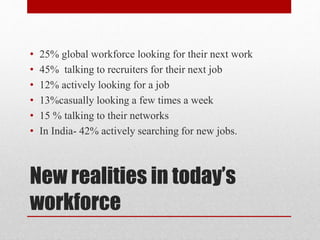
• 25% global workforce looking for their next work
• 45% talking to recruiters for their next job
• 12% actively looking for a job
• 13%casually looking a few times a week
• 15 % talking to their networks
• In India- 42% actively searching for new jobs.
Satisfaction levels
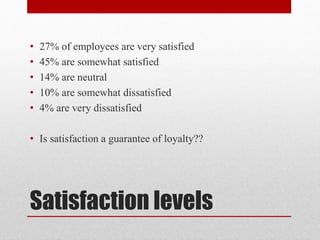
• 27% of employees are very satisfied
• 45% are somewhat satisfied
• 14% are neutral
• 10% are somewhat dissatisfied
• 4% are very dissatisfied
• Is satisfaction a guarantee of loyalty??
Most important factors in
seeking or considering a job
• Greater opportunities for advancement
• Better compensation and benefits
• More challenging work
• Better fit for skill sets
• More learning opportunities
Other important factors
• Improved job title
• Better office location
• Equation with current team
• Relationship with manager
• Personal reasons
Factors influencing
choice of company
• Company has a reputation as a great place to
work in
• Reputation for great products and services
• Reputation for great people
• Reputation for being prestigious
An engaged employee---
• Is passionate about what he does
• Constantly learns and grows at work
• Comfortable promoting himself and his ideas at work
• Very career focused
• Actively seeks information that helps him fit better at his
job.
Top professionals----
• Engage in professional networking
• Research ways to update skills and improve career path
• Research new career opportunities
• Apply for new job with current employer
• consider starting new business/ venture
Implications for HR team
• Active engagement with prospective / current employees
• Invest in strengthening talent brand
• Take local attitudes into account
• Don’t get complacent about current employees
• Don’t sell a position on compensation and title alone
• Don’t get put off by passive candidates
Source- Linkedin Global
workforce survey 2014
PART II
•TALENT
MANAGEMENT
INPERATIVES
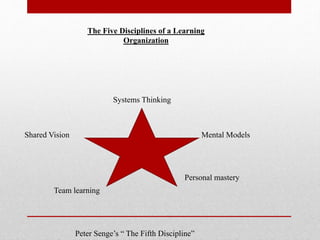
Systems Thinking
Mental Models
Personal mastery
Team learning
Shared Vision
The Five Disciplines of a Learning
Organization
Peter Senge’s “ The Fifth Discipline”
SYSTEMS OVERVIEW
• BUSINESS STRATEGY
• HR STRATEGY ALIGNED WITH BUSINESS STRATEGY
• INTEGRATED BUSINESS AND HUMAN RESOURCES
PLANNING
• MANPOWER GAPS AND NEEDS
• STRATEGY ADOPTED TO CURRENT GAPS AND NEEDS
• FUTURE NEEDS
• MANPOWER PLANNING TO MEET FUTURE NEEDS
• SUCCESSION MANAGEMENT
WHAT ARE THE CHARACTERISTICS
OF A TALENTED WORKFORCE?
Is talent upwardly mobile?
Why?
Categories of employees
• Super keeper
• Keeper
• Solid citizen
• Misfit
Talent management
• Organizations commitment to recruit, retain and develop
the most talented and superior employees in the job
market
• The development and integration of HR processes that
attract, develop, engage and retain the knowledge, skills
and abilities of employees that will meet current and
future business needs business needs.
Building Blocks Of Talent
management
• Block #1- Competencies
• Block #2- Performance management
• Block #3- Evaluating Employee Potential
• Block #4- Recruiting Superkeepers
#1 COMPETENCIES
Competency- what is it?
• A job competency is an underlying characteristic of a
person, in that it may be a motive, a trait, a skill, an
aspect of one’s self- image or social role, or a body of
knowledge which he or she uses- Boyatzis 1982
Competency Titles
• Action orientation
• Leadership
• Communications
• Creativity/ innovation
• Critical judgment
• Customer orientation
• Planning and organizing
• decision making
• Influencing
• Managing relationships
Competency attributes
• Action orientation- targets and achieves results,
overcomes obstacles, accepts responsibility, establishes
standards, creates a result oriented environment and
follows through on actions.
• Planning and organizing- achieves results through
detailed planning and organization of people and
resources to meet goals, targets and objectives within
agreed time scales.
Competency framework
• Collection of clusters across levels, which include
competencies and behavioral indicators- may be detailed
or generic
Competency cluster
• Collection of closely related competencies, usually three
to five per cluster. These competencies relate to
• Thinking
• Acting
• interacting
Competency cluster-
working with people
Managing relationships
• L1- builds relationships internally
• L2- Builds relationships externally
• L3- maintains external networks
CC- working with people
Teamwork
• L1- is a team member
• L2- Supports team members
• L3- provides direction to the team
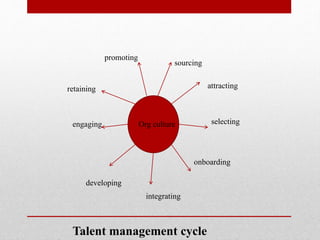
Org culture
sourcing
attracting
selecting
onboarding
integrating
developing
engaging
retaining
promoting
Talent management cycle
Stages of the Talent management Process
ENTRY
• Recruitment
• Selection
• Orientation
• Placement
RETENTION
Culture
Immediate manager
Involvement
Person- environment fit
DEVELOPMENT
• Competency Assessment
• Development Opportunities
• Mentoring
• Challenges
PERFORMANCE
• Role Clarity
• Performance Agreement
• Feedback
• Recognition and Reward
Entry
• Anticipation of future workforce needs
• Efficient recruitment programmes using various media/
sources
• Testing systems
• Employee referral
• Orientation and onboarding
Four Steps to the Talent
management process
Step 1- Develop assessment tools and scales
• Competency definition and measurement scale
• Performance appraisal definition and measurement
scale
• Talent potential forecast and measurement scale
• Apply measurement scale to each job
Step 2- Develop Training and Development Application
Tools
• Coaching Guide
• Assemble directory of best training programmes , top
books
Step 3- Evaluate each employee using assessment tools
Step 4- Prepare action reports
• Create bench strength summary
• Create Individual talent competency development forms
List of Competencies
• Action Orientation
• Communication
• Creativity/ Innovation
• Critical Judgment
• Customer Orientation
• Interpersonal Skill
• Leadership
• Teamwork
• Technical/ Functional Expertise
Talent management
Strategies
• Coaching for retention
• Outsourcing and outsourcers
• Succession planning
• Developing leadership through competencies
• Employment branding strategies
Challenges in Talent
management
• Plateaued Careers
• Glass ceilings
• Retirement/ Transition Planning
• Outplacement Programmes
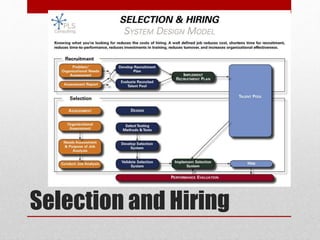
Selection and Hiring
What Appeals and
Engages
• Autonomy
• Entrepreneurial opportunities
• Creative opportunities
• Stimulating Tasks
• Fair predictable rewards
• Concrete compensations/benefits/retirement packages
• Stability
• Structure and routine
• Opportunities to gain competence
• Flexibility
• Freedom of choice
• Recognition
Identify---
• STRATEGICALLY IMPORTANT A POSITIONS
• SUPPORTING B POSITIONS
• SURPLUS C POSITIONS
FOCUS ON---
• IDENTIFYING A PLAYERS TO FILL A POSITIONS
• MAINTAINING B POSITIONS
• OUTSOURCING OR ELIMINATING C POSITIONS
MANAGING A POSITIONS
• ESTABLISH STRATEGIC SIGNIFICANCE OF THE
POSITIONS
• VARIABILITY OF THE PERFORMANCE OF PEOPLE
CURRENTLY IN THE JOB.
• ESTABLISH HOW MUCH VALUE A POSITION
CREATES FOR THE COMPANY
• DISPROPORTIONATE LEVEL OF INVESTMENT IN
THE POSITION
• MANAGE B AND C POSITIONS SIMULTANEOUSLY
Succession planning
• No reservations about succession
• Integration with company’s MDPs
• Importance of immersion
• Integrate succession planning with company’s talent
development
• Leadership development is a line and board
responsibility.
• Expose future leaders to the full range of company
operations
• Stakeholder buy- in for leadership programmes

Workshop on talent management

  • 1.
  • 2.
    What is talent? •In sport? • In Entertainment? • In Business? • In Politics?
  • 3.
    • Why dopeople work for organizations? What does it mean for employees to work “ here”
  • 4.
  • 5.
    Today’s Employees--- • Wanta voice • Want to balance life and work • Are opportunity seeking • Are averse to transactional work activities • Want to know what is going on • Want freedom of choice
  • 6.
    New realities intoday’s workforce • 25% global workforce looking for their next work • 45% talking to recruiters for their next job • 12% actively looking for a job • 13%casually looking a few times a week • 15 % talking to their networks • In India- 42% actively searching for new jobs.
  • 7.
    Satisfaction levels • 27%of employees are very satisfied • 45% are somewhat satisfied • 14% are neutral • 10% are somewhat dissatisfied • 4% are very dissatisfied • Is satisfaction a guarantee of loyalty??
  • 8.
    Most important factorsin seeking or considering a job • Greater opportunities for advancement • Better compensation and benefits • More challenging work • Better fit for skill sets • More learning opportunities
  • 9.
    Other important factors •Improved job title • Better office location • Equation with current team • Relationship with manager • Personal reasons
  • 10.
    Factors influencing choice ofcompany • Company has a reputation as a great place to work in • Reputation for great products and services • Reputation for great people • Reputation for being prestigious
  • 11.
    An engaged employee--- •Is passionate about what he does • Constantly learns and grows at work • Comfortable promoting himself and his ideas at work • Very career focused • Actively seeks information that helps him fit better at his job.
  • 12.
    Top professionals---- • Engagein professional networking • Research ways to update skills and improve career path • Research new career opportunities • Apply for new job with current employer • consider starting new business/ venture
  • 13.
    Implications for HRteam • Active engagement with prospective / current employees • Invest in strengthening talent brand • Take local attitudes into account • Don’t get complacent about current employees • Don’t sell a position on compensation and title alone • Don’t get put off by passive candidates
  • 14.
  • 15.
  • 16.
    Systems Thinking Mental Models Personalmastery Team learning Shared Vision The Five Disciplines of a Learning Organization Peter Senge’s “ The Fifth Discipline”
  • 17.
    SYSTEMS OVERVIEW • BUSINESSSTRATEGY • HR STRATEGY ALIGNED WITH BUSINESS STRATEGY • INTEGRATED BUSINESS AND HUMAN RESOURCES PLANNING • MANPOWER GAPS AND NEEDS • STRATEGY ADOPTED TO CURRENT GAPS AND NEEDS • FUTURE NEEDS • MANPOWER PLANNING TO MEET FUTURE NEEDS • SUCCESSION MANAGEMENT
  • 18.
    WHAT ARE THECHARACTERISTICS OF A TALENTED WORKFORCE? Is talent upwardly mobile? Why?
  • 19.
    Categories of employees •Super keeper • Keeper • Solid citizen • Misfit
  • 20.
    Talent management • Organizationscommitment to recruit, retain and develop the most talented and superior employees in the job market • The development and integration of HR processes that attract, develop, engage and retain the knowledge, skills and abilities of employees that will meet current and future business needs business needs.
  • 21.
    Building Blocks OfTalent management • Block #1- Competencies • Block #2- Performance management • Block #3- Evaluating Employee Potential • Block #4- Recruiting Superkeepers
  • 23.
  • 24.
    Competency- what isit? • A job competency is an underlying characteristic of a person, in that it may be a motive, a trait, a skill, an aspect of one’s self- image or social role, or a body of knowledge which he or she uses- Boyatzis 1982
  • 25.
    Competency Titles • Actionorientation • Leadership • Communications • Creativity/ innovation • Critical judgment • Customer orientation • Planning and organizing • decision making • Influencing • Managing relationships
  • 26.
    Competency attributes • Actionorientation- targets and achieves results, overcomes obstacles, accepts responsibility, establishes standards, creates a result oriented environment and follows through on actions. • Planning and organizing- achieves results through detailed planning and organization of people and resources to meet goals, targets and objectives within agreed time scales.
  • 27.
    Competency framework • Collectionof clusters across levels, which include competencies and behavioral indicators- may be detailed or generic
  • 28.
    Competency cluster • Collectionof closely related competencies, usually three to five per cluster. These competencies relate to • Thinking • Acting • interacting
  • 29.
    Competency cluster- working withpeople Managing relationships • L1- builds relationships internally • L2- Builds relationships externally • L3- maintains external networks
  • 30.
    CC- working withpeople Teamwork • L1- is a team member • L2- Supports team members • L3- provides direction to the team
  • 31.
  • 33.
    Stages of theTalent management Process ENTRY • Recruitment • Selection • Orientation • Placement RETENTION Culture Immediate manager Involvement Person- environment fit
  • 34.
    DEVELOPMENT • Competency Assessment •Development Opportunities • Mentoring • Challenges PERFORMANCE • Role Clarity • Performance Agreement • Feedback • Recognition and Reward
  • 35.
    Entry • Anticipation offuture workforce needs • Efficient recruitment programmes using various media/ sources • Testing systems • Employee referral • Orientation and onboarding
  • 36.
    Four Steps tothe Talent management process Step 1- Develop assessment tools and scales • Competency definition and measurement scale • Performance appraisal definition and measurement scale • Talent potential forecast and measurement scale • Apply measurement scale to each job Step 2- Develop Training and Development Application Tools • Coaching Guide • Assemble directory of best training programmes , top books
  • 37.
    Step 3- Evaluateeach employee using assessment tools Step 4- Prepare action reports • Create bench strength summary • Create Individual talent competency development forms
  • 38.
    List of Competencies •Action Orientation • Communication • Creativity/ Innovation • Critical Judgment • Customer Orientation • Interpersonal Skill • Leadership • Teamwork • Technical/ Functional Expertise
  • 39.
    Talent management Strategies • Coachingfor retention • Outsourcing and outsourcers • Succession planning • Developing leadership through competencies • Employment branding strategies
  • 40.
    Challenges in Talent management •Plateaued Careers • Glass ceilings • Retirement/ Transition Planning • Outplacement Programmes
  • 41.
  • 42.
    What Appeals and Engages •Autonomy • Entrepreneurial opportunities • Creative opportunities • Stimulating Tasks • Fair predictable rewards • Concrete compensations/benefits/retirement packages • Stability • Structure and routine • Opportunities to gain competence • Flexibility • Freedom of choice • Recognition
  • 43.
    Identify--- • STRATEGICALLY IMPORTANTA POSITIONS • SUPPORTING B POSITIONS • SURPLUS C POSITIONS
  • 44.
    FOCUS ON--- • IDENTIFYINGA PLAYERS TO FILL A POSITIONS • MAINTAINING B POSITIONS • OUTSOURCING OR ELIMINATING C POSITIONS
  • 45.
    MANAGING A POSITIONS •ESTABLISH STRATEGIC SIGNIFICANCE OF THE POSITIONS • VARIABILITY OF THE PERFORMANCE OF PEOPLE CURRENTLY IN THE JOB. • ESTABLISH HOW MUCH VALUE A POSITION CREATES FOR THE COMPANY • DISPROPORTIONATE LEVEL OF INVESTMENT IN THE POSITION • MANAGE B AND C POSITIONS SIMULTANEOUSLY
  • 46.
    Succession planning • Noreservations about succession • Integration with company’s MDPs • Importance of immersion • Integrate succession planning with company’s talent development • Leadership development is a line and board responsibility. • Expose future leaders to the full range of company operations • Stakeholder buy- in for leadership programmes