Developing a Talent Development Framework for  Alaska Air Group Presenter:  Gay Niven August 3, 2010
Hello! My name is Gay Niven A strong background in training and organizational development, including manufacturing, corporate and retail environments A believer in working  through people  to get results – I think people really are the differentiator for a successful business
Today’s Discussion A typical Talent Development Framework How it might look at Alaska Air Group An approach  A sample project plan with communication I’m going to walk you through my thoughts …
What Are the Business Issues? AAG strategic goals must be met to maintain safety, a generative company culture, customer satisfaction, and profit Key points Increasing business complexity requires an adaptive skill set in employees and leaders Highly-engaged employees drive customer satisfaction, so maintaining engagement is critical Significant industry constrictions exist, both internally and externally Retention of best performers is key Providing bench depth for senior/key positions to create continuity and maintain the AAG brain trust
Typical Components of a  Talent Development Framework Determination of a  philosophy Identification of the  people strategy Prioritization of  processes Use of  systems  to deliver and measure Add the overlay:  Culture High Potentials Metrics Identification of key positions  Succession Planning requirements
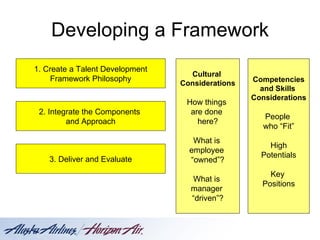
Developing a Framework 2. Integrate the Components  and Approach 1. Create a Talent Development Framework Philosophy 3. Deliver and Evaluate Cultural  Considerations How things  are done  here? What is  employee  “owned”? What is  manager  “driven”? Competencies and Skills  Considerations People  who “Fit” High Potentials Key  Positions
The Challenge “To have a competitive advantage, it’s not enough to assemble a group of great individuals; the individuals must function together in ways that deliver outstanding organizational performance.” Ed Lawler,  Center for Effective Organizations  University of Southern California
For Alaska Air Group, developing the framework requires a solid philosophy to guide decisions and a strategy to determine accountability, involvement and prioritization
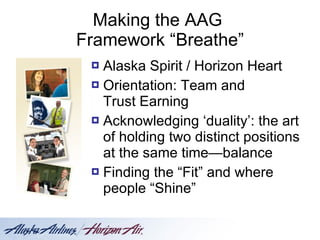
Making the AAG  Framework “Breathe” Alaska Spirit / Horizon Heart Orientation: Team and  Trust Earning Acknowledging ‘duality’: the art of holding two distinct positions at the same time—balance Finding the “Fit” and where people “Shine”
The Philosophy Developed in conjunction with executive and senior leaders Key questions How does AAG look at Talent Development? What is the short/long term focus? How “deep” does talent need to be planned? Who will sponsor/own this? Any benchmarking companies to examine? What would a successful framework accomplish? Span of time?
Integration of a Strategy Integrate the evolving strategy with both HR and business strategic plans Key questions Who’s involved, at what level, and how much? How will we measure results and/or ROI What are the key positions, critical jobs, success factors? Inventory positions, identify gaps in competencies Conduct a needs assessment:  data please! Who “owns” development?  Role identification in each process? Create clear distinction between performance and development
Delivery and Evaluation Strategically use tools: Training evaluations: satisfaction surveys, assessing behavioral changes Assessment tools/360 tools: use of perception-based feedback to improve managerial/leader effectiveness Workforce planning metrics Talent inventories to identify interests and abilities Strategic talent planning processes Recruiting systems: assessing sourcing to success metrics Performance management system
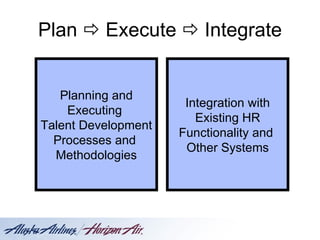
Plan    Execute    Integrate Planning and Executing  Talent Development  Processes and  Methodologies Integration with Existing HR Functionality and  Other Systems
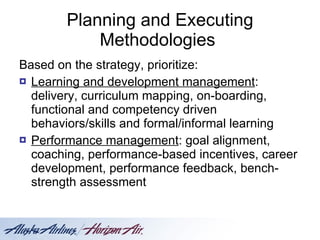
Planning and Executing Methodologies  Based on the strategy, prioritize: Learning and development management : delivery, curriculum mapping, on-boarding, functional and competency driven behaviors/skills and formal/informal learning Performance management : goal alignment, coaching, performance-based incentives, career development, performance feedback, bench-strength assessment
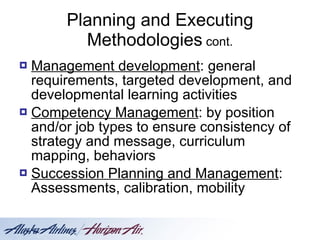
Planning and Executing Methodologies  cont. Management development : general requirements, targeted development, and developmental learning activities Competency Management : by position and/or job types to ensure consistency of strategy and message, curriculum mapping, behaviors Succession Planning and Management : Assessments, calibration, mobility
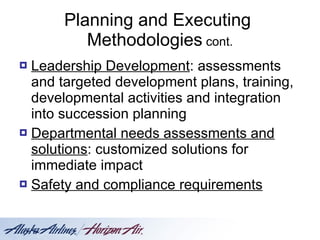
Planning and Executing  Methodologies  cont. Leadership Development : assessments and targeted development plans, training, developmental activities and integration into succession planning Departmental needs assessments and solutions : customized solutions for immediate impact Safety and compliance requirements
HR Functional Integration Coordination with other functions: Compensation Succession planning process Rewards and recognition programs Diversity and community involvement Talent acquisition/Recruiting Branding
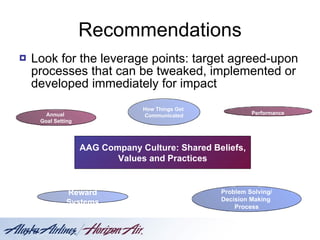
Recommendations Look for the leverage points: target agreed-upon processes that can be tweaked, implemented or developed immediately for impact Annual  Goal Setting How Things Get  Communicated Problem Solving/ Decision Making  Process Reward Systems AAG Company Culture: Shared Beliefs, Values and Practices Performance Measures
Recommendations  cont. Collect and assess available data: strategic plans, understanding current formal / informal systems, leader expectations, collect talent data, review employee survey data Conduct leader interviews: HR, business leaders Collate feedback results to HR leaders: validate/change Feedback results to business leaders: validate
Create Cascaded Teams Executive Steering Committee Meet quarterly or semi-annually Provide strategic direction and insight Project Team Meet every 4-6 weeks Validate plan, direction and involvement Provide support, insight and access Work team HR integration team: cross functional
Starting Points Strengthen the relationship between manager and employee Do people know what it takes to be successful? Are skills or competencies more important? Do they have the resources to do what is expected?
Starting Points  cont. Support employees driving their own development Are skills and competencies mapped to learning opportunities? Is there a career path obvious? Do managers know what to do? Can people “see” a destination?
Starting Points  cont. Is learning understood to be more than training in this organization? Most learning is experiential—are learning plans incorporating and giving credit to work as well as attendance What  is  being measured? What  can  be measured? What is valued?
Your Turn Questions? Comments

Talent Dev Framework

  • 1.
    Developing a TalentDevelopment Framework for Alaska Air Group Presenter: Gay Niven August 3, 2010
  • 2.
    Hello! My nameis Gay Niven A strong background in training and organizational development, including manufacturing, corporate and retail environments A believer in working through people to get results – I think people really are the differentiator for a successful business
  • 3.
    Today’s Discussion Atypical Talent Development Framework How it might look at Alaska Air Group An approach A sample project plan with communication I’m going to walk you through my thoughts …
  • 4.
    What Are theBusiness Issues? AAG strategic goals must be met to maintain safety, a generative company culture, customer satisfaction, and profit Key points Increasing business complexity requires an adaptive skill set in employees and leaders Highly-engaged employees drive customer satisfaction, so maintaining engagement is critical Significant industry constrictions exist, both internally and externally Retention of best performers is key Providing bench depth for senior/key positions to create continuity and maintain the AAG brain trust
  • 5.
    Typical Components ofa Talent Development Framework Determination of a philosophy Identification of the people strategy Prioritization of processes Use of systems to deliver and measure Add the overlay: Culture High Potentials Metrics Identification of key positions Succession Planning requirements
  • 6.
    Developing a Framework2. Integrate the Components and Approach 1. Create a Talent Development Framework Philosophy 3. Deliver and Evaluate Cultural Considerations How things are done here? What is employee “owned”? What is manager “driven”? Competencies and Skills Considerations People who “Fit” High Potentials Key Positions
  • 7.
    The Challenge “Tohave a competitive advantage, it’s not enough to assemble a group of great individuals; the individuals must function together in ways that deliver outstanding organizational performance.” Ed Lawler, Center for Effective Organizations University of Southern California
  • 8.
    For Alaska AirGroup, developing the framework requires a solid philosophy to guide decisions and a strategy to determine accountability, involvement and prioritization
  • 9.
    Making the AAG Framework “Breathe” Alaska Spirit / Horizon Heart Orientation: Team and Trust Earning Acknowledging ‘duality’: the art of holding two distinct positions at the same time—balance Finding the “Fit” and where people “Shine”
  • 10.
    The Philosophy Developedin conjunction with executive and senior leaders Key questions How does AAG look at Talent Development? What is the short/long term focus? How “deep” does talent need to be planned? Who will sponsor/own this? Any benchmarking companies to examine? What would a successful framework accomplish? Span of time?
  • 11.
    Integration of aStrategy Integrate the evolving strategy with both HR and business strategic plans Key questions Who’s involved, at what level, and how much? How will we measure results and/or ROI What are the key positions, critical jobs, success factors? Inventory positions, identify gaps in competencies Conduct a needs assessment: data please! Who “owns” development? Role identification in each process? Create clear distinction between performance and development
  • 12.
    Delivery and EvaluationStrategically use tools: Training evaluations: satisfaction surveys, assessing behavioral changes Assessment tools/360 tools: use of perception-based feedback to improve managerial/leader effectiveness Workforce planning metrics Talent inventories to identify interests and abilities Strategic talent planning processes Recruiting systems: assessing sourcing to success metrics Performance management system
  • 13.
    Plan  Execute  Integrate Planning and Executing Talent Development Processes and Methodologies Integration with Existing HR Functionality and Other Systems
  • 14.
    Planning and ExecutingMethodologies Based on the strategy, prioritize: Learning and development management : delivery, curriculum mapping, on-boarding, functional and competency driven behaviors/skills and formal/informal learning Performance management : goal alignment, coaching, performance-based incentives, career development, performance feedback, bench-strength assessment
  • 15.
    Planning and ExecutingMethodologies cont. Management development : general requirements, targeted development, and developmental learning activities Competency Management : by position and/or job types to ensure consistency of strategy and message, curriculum mapping, behaviors Succession Planning and Management : Assessments, calibration, mobility
  • 16.
    Planning and Executing Methodologies cont. Leadership Development : assessments and targeted development plans, training, developmental activities and integration into succession planning Departmental needs assessments and solutions : customized solutions for immediate impact Safety and compliance requirements
  • 17.
    HR Functional IntegrationCoordination with other functions: Compensation Succession planning process Rewards and recognition programs Diversity and community involvement Talent acquisition/Recruiting Branding
  • 18.
    Recommendations Look forthe leverage points: target agreed-upon processes that can be tweaked, implemented or developed immediately for impact Annual Goal Setting How Things Get Communicated Problem Solving/ Decision Making Process Reward Systems AAG Company Culture: Shared Beliefs, Values and Practices Performance Measures
  • 19.
    Recommendations cont.Collect and assess available data: strategic plans, understanding current formal / informal systems, leader expectations, collect talent data, review employee survey data Conduct leader interviews: HR, business leaders Collate feedback results to HR leaders: validate/change Feedback results to business leaders: validate
  • 20.
    Create Cascaded TeamsExecutive Steering Committee Meet quarterly or semi-annually Provide strategic direction and insight Project Team Meet every 4-6 weeks Validate plan, direction and involvement Provide support, insight and access Work team HR integration team: cross functional
  • 21.
    Starting Points Strengthenthe relationship between manager and employee Do people know what it takes to be successful? Are skills or competencies more important? Do they have the resources to do what is expected?
  • 22.
    Starting Points cont. Support employees driving their own development Are skills and competencies mapped to learning opportunities? Is there a career path obvious? Do managers know what to do? Can people “see” a destination?
  • 23.
    Starting Points cont. Is learning understood to be more than training in this organization? Most learning is experiential—are learning plans incorporating and giving credit to work as well as attendance What is being measured? What can be measured? What is valued?
  • 24.